Search the KHIT Blog

Showing posts sorted by relevance for query ASQ Health Care. Sort by date Show all posts

Saturday, June 16, 2012

ObamaScare Section 5405

"and other purposes."


"Facilitating Improvement in Primary Care: The Promise of Practice Coaching"


My friend Dr. Joe Fortuna, outgoing ASQ Health Care Division Chair, sent me a copy of the above-titled Issue Brief the other day. While I knew that "ACOs" and a raft of other "improvement/innovation" initiatives were authorized by the soon-to-be-SCOTUS-ajudged  PPACA (derisively, "ObamaCare"), this Section had escaped me.
A BRIEF HISTORY OF PRACTICE COACHING
Practice coaching in health care is rooted in the agricultural extension agent model of the early 20th century. In 1903, the U.S. Department of Agriculture started a program by which agricultural experts would visit farmers, develop ongoing collaborative relationships, suggest improvements, and facilitate the sharing of best practices. The program was highly successful as farmers, seeing the increased yields and profitability of early adopters, improved their agricultural methods. In 1914, Congress created the Agricultural Extension Service (AES)—now the Cooperative Extension Service—and, by 1920, 7,000 extension agents were working in almost every county of the nation.
Many primary care services in the United States are delivered by relatively small, independent private practices and community health centers lacking the robust quality improvement infrastructures found in hospitals and big medical groups. Just as small farmers were most in need of the kind of support provided by the AES, it is these smaller physician practices that are most in need of help. Donald Berwick, M.D., then president and CEO of the Institute for Healthcare Improvement, recognized this reality when he wrote in 2003 that “American health care could benefit greatly from the establishment by the federal government of a Health Care Extension Service modeled on the AES.” In 2009, physicians Kevin Grumbach, M.D., and James Mold, M.D., detailed how a health care cooperative extension service for primary care might look, with practice coaches serving as extension agents to spread the best practices of early adopters to primary care practices across the nation.
A year later, the Affordable Care Act of 2010 authorized creation of the Primary Care Extension Program along the lines proposed by Grumbach and Mold, and in 2011 the Agency for Healthcare Research and Quality—the agency charged with implementing the program—issued a call for proposals to award three states grants for primary care extension programs. Although Congress has not appropriated funds to implement the nationwide program, the many state and regional models of practice coaching being implemented—for example, by the Vermont Blueprint for Health, Colorado HealthTeamWorks, LA Net in Southern California, and federally funded regional extension centers promoting meaningful use of electronic health records [emphasis mine]—affirm the belief in many quarters that most practices cannot undertake needed transformation without such a mechanism in place.
ESSENTIAL FEATURES OF PRACTICE COACHING
Practice coaching can be viewed as analogous to self-management health coaching for patients. Coaching patients with chronic conditions means imparting patients with the knowledge, skills, and confidence to self-manage. Coaching does not do things for patients; it helps patients do things for themselves. The practice coach helps physicians and their staff gain knowledge and skills in the science of improvement so that they can continue to improve long after the coach is gone. Empowering practices to become their own agents of change is one of the features that distinguishes coaching from consulting...
Interesting. Two years ago RECs started out with all this noble rhetoric about helping "physicians and their staff gain knowledge and skills in the science of improvement...Empowering practices to become their own agents of change..."  -- and I am personally no exception, being a quarter century True Believer in QI; e.g., see my standard introductory workflow improvement deck (PDF) I use to try to sell the effort to small practice staffs. I am always frank to acknowledge that "if you burn up all of the MU incentive money in added labor cost resulting from more onerous workflows, what's the point?"

But, the boots-on-the-ground  REC technical assistance staffing reality largely dictated Milestone progress body counts.

So, today, we end up with stuff like this:

A Funny thing Happened on the way to Meaningful Use
Rob Lambert, MD
This July will mark the 16th anniversary of the installation of our electronic medical record.

Yup.  I am that weird.

Over the first 10-14 years of my run as doctor uber-nerd, I believed that widespread adoption of EHR would be one of main things to drive efficiency in health care. I told anyone I could corner about our drive to improve the quality of our care, while keeping our cash-flow out of the red. I preached the fact that it is possible for a small, privately owned practice to successfully adopt EHR while increasing revenue. I heard people say it was only possible within a large hospital system, but saw many of those installations decrease office efficiency and quality of care. I heard people say primary care doctors couldn’t afford EHR, while we had not only done well with our installation, but did so with one of the more expensive products at the time. To me, it was just a matter of time before everyone finally saw that I was right.

The passage of the EHR incentive program (aka “meaningful use” criteria) was a huge validation for me: EHR was so good that the government would pay doctors to adopt it. I figured that once docs finally could implement an EHR without threatening their financial solvency, they would all become believers like me.

But something funny happened on the way to meaningful use: I changed my mind. No, I didn’t stop thinking that EHR was a very powerful tool that could transform care. I didn’t pine for the days of paper charts (whatever they are). I certainly didn’t mind it when I got the check from the government for doing something I had already done without any incentive. What changed was my belief that government incentives could make things better. They haven’t. In fact, they’ve made things much worse...

...My dream of universal acceptance of EHR has turned sour. I am beginning to hate the words: “meaningful use.” I am starting to fantasize about a life without it, and maybe even a life without anybody else’s definition of what the care I give should look like. I want to be a doctor.  I want to take care of my patients. I want them to be the most important thing, not the other people enticing me with their big checks. Can I stay in our system while still giving care that is meaningful?
Ouch. And, this doc is no Luddite crank. Read the entire post.

Also of late, apropos of the issue.

Unraveling the IT Productivity Paradox — Lessons for Health Care
Spencer S. Jones, Ph.D., Paul S. Heaton, Ph.D., Robert S. Rudin, Ph.D., and Eric C. Schneider, M.D.
N Engl J Med 2012; 366:2243-2245June 14, 2012

There is ongoing debate about the wisdom of the $27 billion federal investment driving the adoption of health information technology (IT) under the Health Information Technology for Economic and Clinical Health (HITECH) Act of 2009. Proponents expect IT to catalyze the transformation of health care delivery in the United States from a fragmented cottage industry plagued by poor quality and high costs to a highly organized, integrated system that delivers high-quality care efficiently. Skeptics suggest that the productivity benefits of health IT have been overstated, arguing that it may create safety problems and could even increase costs...

New health IT systems risk failure if usability isn't carefully addressed. User-centered design calls for end users to be involved in every stage of product development. The principles of user-centered design have improved usability for many IT products. The merits of such design processes are illustrated by the evolution of “smartphones,” from their early monochromatic displays and clumsy thumb keyboards to today's high-definition touch screens that use the electrical properties of the human body to enhance responsiveness...

...The resolution of the original IT productivity paradox suggests that current conclusions about the value of health IT investments may be premature. Research suggests three lessons for physicians and health care leaders: invest in creating new measures of productivity that can reveal the quality and cost gains that arise from health IT, avoid impatience or overly optimistic expectations about return on investment and focus on the delivery reengineering needed to create a productivity payoff, and pay greater attention to measuring and improving IT usability. In the meantime, avoiding broad claims about overall value that are based on limited evidence may permit a clearer focus on the best ways of optimizing IT's use in health care.
Another good article.
__

So, where does all of this leave us?

Absent replenished funding from some source, RECs are effectively done next summer. As I've noted before, we are not funded for Stage 2 (which now doesn't ensue until 2014), and were I a 2011 Meaningful Use Attestor (Medicare EP), I'd have collected 87% of the total reimbursement potential ($38k/$44k) just for Stage One. OK, I'm trying to understand my ROI prospects for Stage Two here.

There are some looming barriers here, leaving aside the carping HIT critics (and I in no way mean to imply that Dr. Lambert is among them; he's one of the good guys). The brave, fashionable REC talk of "sustainability" these days has to leave one dubious.

I have made no secret of my frustration with this recent headline.


My comment?
I’d be interested in any initiatives aimed at “Positioning REC for Continued Success.” I have a concern that a brain drain may soon ensue.
Silencio. Zip, Zilch, Nada. Two years ago ASQ's Dr. Fortuna offered the good offices of the ASQ Health Care Division, pro bono, to ONC to help with in-the-trenches improvement efforts of the sort envisioned in the "practice coaching" and Primary Care Extension Centers concepts alluded to above. Those polite discussions went nowhere.

The need remains. The need goes beyond ONC being politically seen as a "success" in Secretary Sebelius's eyes.
__

Beneath the Jurassic DC Rain Forest Canopy that is HHS roam a number of territorial beasts of varying defensive perimeter ferocity: CMS, AHRQ, ONC among them. PPACA Section 5405 bestows upon AHRQ the authority to establish and administer "Primary Care Extension Centers." Yeah, that'd go over well in other Beltway shops.

Beyond turf contention considerations, and assuming PPACA survives the looming SCOTUS challenge decision (wholly or in pieces), I would think it to be an extreme long shot for 5405 initiatives to get publicly funded, given both the 2012 election year and the larger federal budget deficit problems that will await the next President and Congress.


But, again: the need remains.
Dr. Toussaint's new book sheds some useful light on addressing the need (it just came out on Kindle, so I can now more conveniently cite passages from it).


Change is bearing down fast on healthcare in the United States—not small change but a full overhaul of the system that will be as disruptive as it is inevitable because we can no longer afford to pay huge bills for substandard care.

As a doctor, a Chief Medical Officer and then CEO of major regional health system, I know that our biggest challenge is the immense waste in our care delivery system that causes poor quality and inflated costs. The magnitude of this opportunity is mind-boggling. The Institute of Healthcare Improvement reports that 30–50% of care delivery is wasteful, meaning that it is of no use to the patient. Translation: $750 billion per year could be saved if we get rid of the waste.

Around the country, various groups have been attacking the issues piecemeal. Several health systems have made great strides toward increasing healthcare quality and reducing medical harm, but are working in isolation and often end up struggling against a system that actually rewards waste and error. Meanwhile, the major proposals for healthcare reform focus on financial structures and money flow, on changing who will be insured, by what rules and by which intermediaries. These proposals do little more than shift around risk and create new layers of guidelines, rules, and laws while the root of the problem—quality—remains untouched. The largest piece of healthcare reform legislation passed in more than a half-century, the 2010 Affordable Care Act, bears an estimated cost of about $1 trillion over the next 10 years, but does not go far enough. We can improve upon it if employers, providers, patients, and governments work together to ensure better quality, affordable healthcare.

We need a healthcare system that focuses on healing, that encourages innovation without dictating how a patient receives care. This will require a systemic overhaul... (Kindle Locations 55-67).
__

First, we need to see. In order to build a true picture of any healthcare system, we must identify the data that accurately illustrate reality regarding quality and cost, and then publish that data in a way that people understand. When we achieve this type of transparency, everyone will have the same picture.

Next we must redesign the payment system, which is the tail wagging the healthcare dog in this country. Right now we pay for procedures, so Americans get more procedures and pay more for them than citizens of any other industrialized nation. What we really want to pay for is health and appropriate interventions to achieve ongoing health—a goal that can only be accomplished if we have adequate transparency in the system and can see what we are paying for and how much.

Finally, the true purpose of a meaningful redesign is to reorganize healthcare around the needs of the patient instead of the convenience of insurance companies or doctors. Better care for the patient is the real goal and, with every change, we must ask how it serves patient health. Without a healthier population receiving better care, any redesign is wasted effort (Kindle Locations 84-93).
Tall order. Noble and true sentiments. Below, toward the conclusion of the book:
ThedaCare’s decade of experiments with continuous improvement proved there was a minimum 30% waste in our healthcare processes. Often, the wasted time, energy, and materials in a process was closer to 50%. These experiments have been repeated in dozens of healthcare organizations in the United States, Canada, and elsewhere with the same results. 

The United States spends $2.5 trillion in healthcare every year. The 30-percent-waste in healthcare estimate is widely accepted. That means healthcare waste equals $750 billion every year. So, there is a lot of money in the margin. 

Organizations that aggressively remove waste and redesign care-delivery systems will be the ones able to pay physicians, nurses, and therapists better wages. (Likewise, healthcare professionals who take the most waste out of care processes will be highly prized.) In the end, the improvement-focused systems will be able to attract the brightest talent. 

Existing finance mechanisms and vertical silos, however, are deeply entrenched in our healthcare systems. Moving to new compensation techniques that support healthcare value will require some trial and error... (Kindle Locations 2017-2026). 

To find the most workable model, we need to return to the scientific method—observation, hypothesis, testing, and modification of hypothesis or action. Before one payment type will emerge as the clear winner, we need regional health systems to conduct experiments with global and bundled payment for health episodes, and shared savings models. Experiments need to begin now, with reports published in peer-reviewed journals, giving everyone in the medical community an opportunity to see the evidence and join the debate (Kindle Locations 2045-2048).
Continuing with the process improvement theme he proffered in "On The Mend," Dr. Toussaint again exhorts the utility of the lean model:
In a lean environment, physicians and staff use the scientific method to guide their work in the form of PDSA—plan, do, study, act. Instead of searching for a person to blame, they use PDSA to study the cause of error, devise a plan to correct the system—which is usually at the root of error—and then fix the process. This means that errors must be laid bare for everyone to see, as opposed to hidden. This is another type of transparency demanded in a lean environment. When everyone knows that errors exposed are actually opportunities to improve the system through PDSA instead of avenues to shame, people are less likely to hide their errors and compound problems (Kindle Locations 2058-2062).
Color me a believer. From one of my slide decks:


Notwithstanding the truth of all that, a respect for small practice barriers also required this slide in my deck.
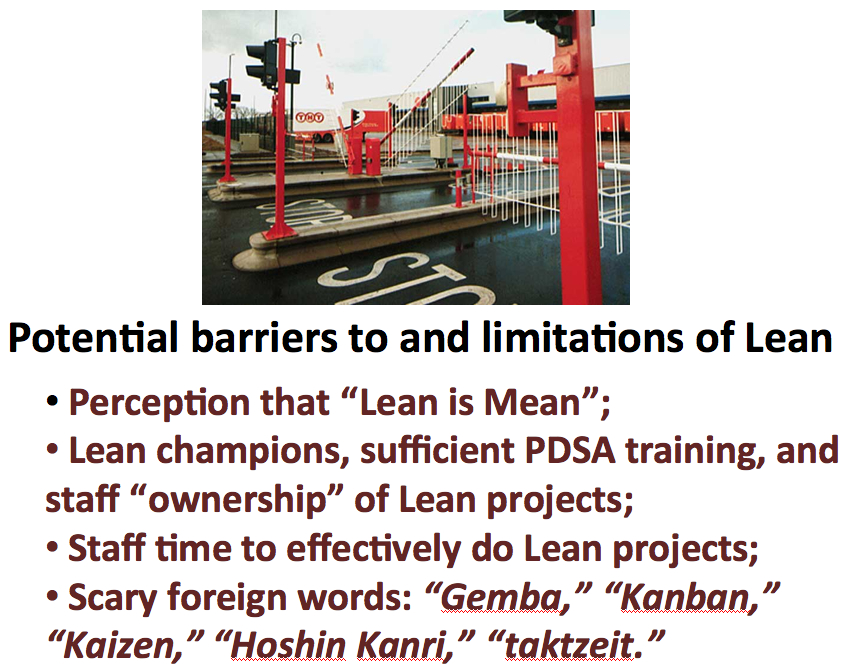

"Staff ownership of Lean projects" -- in other words, the result of effective "Practice Coaching," 'eh?

Irrespective of what happens to ObamaScare this month (and Section 5405's "Primary Care Extension Program" proposal) or us RECs, the need will not go away, particularly within the small shop primary care setting -- places where time and margins are stretched so thin as to even make our offers of "free" federally underwritten assistance a tough sell. These are not clinics that are going to pay $125 - $200 per hour (or more) for consulting/"coaching" help.
___

UPDATE, NICE POST I JUST FOUND


WALTHAM, Mass.—It is a widely accepted myth that medicine requires complex, highly specialized information-technology (IT) systems. This myth continues to justify soaring IT costs, burdensome physician workloads, and stagnation in innovation — while doctors become increasingly bound to documentation and communication products that are functionally decades behind those they use in their “civilian” life.

Even as consumer IT — word-processing programs, search engines, social networks, e-mail systems, mobile phones and apps, music players, gaming platforms — has become deeply integrated into the fabric of modern life, physicians find themselves locked into pre–Internet-era electronic health records (EHRs) that aspire to provide complete and specialized environments for diverse tasks. The federal push for health IT, spearheaded by the Office of the National Coordinator for Health Information Technology (ONC), establishes an information backbone for accountable care, patient safety, and health care reform. But we now need to take the next step: fitting EHRs into a dynamic, state-of-the-art, rapidly evolving information infrastructure — rather than jamming all health care processes and workflows into constrained EHR operating environments.

We believe that EHR vendors propagate the myth that health IT is qualitatively different from industrial and consumer products in order to protect their prices and market share and block new entrants. In reality, diverse functionality needn't reside within single EHR systems, and there's a clear path toward better, safer, cheaper, and nimbler tools for managing health care's complex tasks.

Early health IT offerings were cutting-edge, but contemporary EHRs distinctly lag behind systems used in other fields. In 1966, members of Octo Barnett's laboratory at Massachusetts General Hospital invented a highly efficient programming language for the earliest EHRs; the Massachusetts General Hospital Utility Multi-Programming System (MUMPS) partitioned precious computer memory so parsimoniously that with only 16 kilobytes, the earliest personal computers could run an EHR supporting multiple users. But nearly a half-century later, most EHR vendors not only have failed to innovate but don't even embrace existing modular architectures with interfaces that allow extension of product capabilities, innovative uses of data, and interoperation with other software...
...Loss of technological leadership reflects apathy and even opposition by EHR vendors to promoting liquidity of the data they collect. This attitude has thwarted medicine's decades-long quest for an electronic information infrastructure capable of providing a dynamic and longitudinal view of the health care of individuals and populations. EHR companies have followed a business model whereby they control all data, rather than liberating the data for use in innovative applications in clinical care.

Conducting a Google-style search of an EHR database usually requires involvement of a clinician's information services department and often the specialized knowledge and cooperation of the vendor's technical teams. In reaction, scores of academic medical centers have exported data into a common open-source system where population-level analytics are managed outside the vendor, and results shared across sites...

Commercial EHRs evolved from practice-management (i.e., billing) systems, and in response to the patient-safety movement, vendors tacked on documentation modules and order entry for physicians. Since each EHR product has been built as an isolated silo, the market for any good innovation is fragmented. Additional problems arise when complex software that was never engineered adequately must be reimagined, reinvented, and reimplemented repeatedly...
...Health IT vendors should adapt modern technologies wherever possible. Clinicians choosing products in order to participate in the Medicare and Medicaid EHR Incentive Programs should not be held hostage to EHRs that reduce their efficiency and strangle innovation. New companies will offer bundled, best-of-breed, interoperable, substitutable technologies — several of which are being developed with ONC funding — that can be optimized for use in health care improvement. Properly nurtured, these products will rapidly reach the market, effectively addressing the goals of “meaningful use,” signaling the post-EHR era, and returning to the innovative spirit of EHR pioneers.
One would hope. But, then again, transparency and vendor margin remain inversely correlated. And, it remains to be seen just how much more "ONC funding" will continue to flow (outside the Beltway, anyway). 
___

A COUPLE OF OBSERVATIONS ABOUT ASQ


I've been an enthusiastic and loyal member since the late '80's, and have benefited much from belonging to the Society (as has my wife). When I returned to HealthInsight in 2010 for the REC effort, I made contact with a number of ASQ division leaders. Joe Fortuna responded enthusiastically, as I have noted before. He went so far as to invite me to participate in a Division Leadership conference in Milwaukee on ASQ-HCD's dime.

Other than Dr. Fortuna, my inquiries yielded only one other response -- from a Software Quality Division official, warning me that I might be using the ASQ logo without authorization.

Seriously, dude? Seriously?

I checked. I don't need "permission."

My whole point in seeking out Software Quality Division leaders was, well, you know, HIT. From the "About" page:
Vision:
As stewards of the software quality profession, we are the global nexus for knowledge and recognized champion for excellence in software.

Mission:
To provide members the benefit of collective learning, enabling them to be more effective practitioners of software quality and greater contributors to their employers, customers, and the profession.
The Champion for Excellence in Software. Except, it would seem, where HIT software is concerned. Search their site for "EHR," EMR," or "HIE."


That is pretty discouraging. 

I recall during the early-mid '90's, while serving as the Las Vegas ASQ Section Chair, that we had a "software life cycle quality" meeting presentation put on by a member whose job entailed fighter aircraft avionics software development at Nellis AFB. It was pretty impressive. I would like to think that HIT, within its own "space," is equally mission-critical and deserving of ASQ attention. Ya think?

"Logo use permission"? Seriously?

 Another cute little ASQ head-scratcher. I signed up to join a number of relevant LinkedIn groups a couple of months ago. The status of this one, below (yesterday):


Whatever. So, how're those Lean Enterprise Division quarterly meeting minutes notes coming along?
___

Carry on...


Maybe we'll get a SCOTUS ruling this week. Maybe not. If not this week, then inexorably next week. I thought it might be last  week. I was wrong.

MONDAY UPDATE

No SCOTUS ruling today. In other NEW$...


Interesting. We'd applied for one of these CMMI grants. I had to write a section of the proposal, something about "patient self-management coaching" for three major chronic conditions (I had what we called the "clinic coaching" piece -- essentially "practice coaching"). I was dubious. We have some potential conflict of interest, quite frankly.

They awarded 107, out of what I heard was about 5,000 applications. It was a long shot out of the gate, nominally a ~2% probability of getting awarded, all else being equal (which it is most certainly not).

So they're expecting about a 111% 3-year ROI on these (~$.9 billion in grants). Right. Bend.That.Cost.Curve.

Push the money out the door ASAP. "Obligate" those funds against recission.
___

MORE HH$ NEW$


Still following this one (relative drops in the HH$ bucket, to be sure).
...The outcome of the [$793,456] evaluation will be a report including recommendations for enhancing and improving the Workflow toolkit. The report will provide results about the perceived usefulness of the Workflow toolkit. Results will be produced separately for practices and RECs as well as for both user groups as a whole. The report will also include specific suggestions on how to revise Workflow toolkit to make it more useful to its intended audiences.
AHRQ originally paid $494,028 for the "HIT Workflow Redesign Toolkit" (a rather pedestrian and dated compilation, IMO). Which, they now propose to consume an additional two years and $793k to "evaluate" (and, the evaluation of which looks troubling like it may perhaps involve some of the same entities contracted to produce it in the first place; still running that down).

I'll work for 10% of that, and you'll get a thorough and cogent report by the end of this year.

Seriously, people? This is John Stossel material.
___

HIPAA HITECH WATCH

I know the ObamaScare SCOTUS ruling has everyone on edge, but the Omnibus HIPAA HITECH Final Rule is under EO 12866 review at OMB. Their 90 day review period expires this Friday (June 22nd), but Dr. Mostashari recently said that the Final Rule will be released "by late summer." OMB can extend the review period one time for 30 days, but "[U]nder the Executive Order, the review period may be extended indefinitely by the head of the rulemaking agency."

Be nice if they issued it this Friday. It's under wraps until released, so we have no idea to what extent the Interim Rule Public Comment Period recommendations were incorporated.

Tick, tick, tick...
___

JUNE 20th UPDATE


He's right. I read and wrote up his new book a little while back. It dovetails nicely in many respects with Dr. Toussaint's new book "Potent Medicine."

Thursday, August 11, 2011

2011 ONC Regional Conference in Hollywood

Just got back home (Thursday evening). Lots to blog about. I learned a lot, from a lot of very smart, dedicated people. Below, Farzad Mostashari, MD, ScM, ONC head. Great guy. Inspiring speaker.

Well, what I'd thought might be The 800 lb. Gorilla in the Ballroom was dispensed with by about the 3rd question from the floor during Farzard's post-speech Q&A: that concerning the looming deficit "triggers" mandating deep cuts in federal discretionary spending should the "Junta" -- ahem, Bipartisan Congressional Super Committee -- be unable to agree on what to reduce or eliminate by Thanksgiving week 2011.

"I'm not losing a lot of sleep over it."

OK. "Broad Bipartisan Support" yadayada, and all that. What else could he say, though, that wouldn't precipitate a rush for the fire door exits and a spike in new members at TheLadders.com et al?

I guess we'll know soon. The entire 4-yr REC program cost is a spit in the budgetary ocean. We're invisible; we're, like, what? -- a week in Afghanistan? But, the Meaningful Use provider reimbursement money is a whole 'nuther deal. Pull those funds and it's Game, Set, And Match for the RECs.


But, then, there's stuff like this recently:
In July, House Majority Leader Eric Cantor, R-Va., released his own list of health care spending cuts totaling approximately $350 billion in federal savings over 10 years. Rep. Cantor has provided limited details about his proposals, but the broad concepts include:
  • Increasing penalties for health care providers failing to adopt electronic health records under Medicare “meaningful use” requirements would save $1 billion..
Cantor, no less. Maybe we will be spared. Maybe. But, consider the fevered, anxious gnashing of teeth already underway with the looming prospects of DoD cuts: "Defense cuts loom large for 'super committee'."
Not surprisingly, Defense Secretary Leon Panetta has described the automatic cuts as the "doomsday mechanism." He's warned that the prospect of nearly $1 trillion in reductions over a decade would seriously undermine the military's ability to protect the United States.
___
August 16th headline update

Need I say more?


Gonna be a perversely interesting 3 months. I hope we will get to continue our work, as indeed "The Time is NOW."


Above, recent Vermont Governor Jim Douglas, who addressed "The Emerging HIT Landscape on our Evolving Roles" during the opening keynote session. He was great.

Below, they set up a photo booth, and asked us all to have our pictures taken for the ONC "Putting the 'I' in Health IT" public awareness campaign.

On the subject of "public awareness," involvement, and resources, check out these sites:


Click the images for the links.
___

I attended a number of the breakout sessions: Public Awareness Campaign, Privacy, Security, Behavioral Health, and Workflow Redesign (I was on the panel on that one). The public awareness session was great, because none of this stuff will work effectively long-term absent public awareness and buy-in. They presented a fine campaign plan.

The back-to-back Privacy and Security sessions were held in a conference room so cold you have hung a side of beef in there. Tons of detail, most of which I'd already been studying at length (see prior posts). I still don't have a good answer to my question "does 'express consent' uniformly dictate a 'wet signature'?" (My feeling is "no, it does not.")

"Behavioral Health" was really just about the SAMSHA/HIPAA myriad strict disclosure constraints pertaining to drug and alcohol treatment programs, not at all about other aspects of mental/behavioral health more broadly. Useful information in any event.

The Workflow session was OK. I was a bit disappointed in my contribution to it, quite frankly. And, it was the first session right after the big buffet lunch. You could detect a lot of Food Coma setting in.

Live and learn.

All in all, a very worthy conference.

Note of appreciation: one of my REC counterparts from another state whom I'd met last year at the 2010 Regional in Salt Lake City came up and greeted me and said "Keep blogging. We all read your blog all the time. You say the things we all think about but won't say out loud."

That's pretty humbling and gratifying. I really have had no idea. I don't track my traffic stats on this blog (like I did on my now-suspended Santa Fe blog). It's not why I do this. I had one fellow HIT blogger criticize me recently over the length of my posts, i.e., that were I to chop stuff up into short bites posted more frequently, I'd get better hits.

Yeah. Understood. Well, there's enough of that already. And, again, it's not why I write this blog.

UPDATE ERRATUM


Dr. Fortuna (ASQ Health Care Division Chairman) copied me on a PDF of this new IOM report
, Engineering a Learning Healthcare System: A Look at the Future - Workshop Summary:
The fundamental notion of the learning healthcare system—continuous improvement in effectiveness, efficiency, safety, and quality—is rooted in principles that medicine shares with engineering. In particular, the fields of systems engineering, industrial engineering, and operations research have long experience in the systematic design, analysis, and improvement of complex systems, notably in such large sectors as the airline and automobile industries. Working cooperatively with the National Academy of Engineering (NAE), the Institute of Medicine (IOM) organized Engineering a Learning Healthcare System: A Look at the Future to bring together leaders from the fields of health care and engineering to identify particularly promising areas for application of engineering principles to the design of more effective and efficient health care—a learning healthcare system. This report presents the summary of the meeting’s discussions.

Currently, the organization, management, and delivery of health care in the United States falls short of delivering quality health care reliably, consistently, and affordably. As health care continues to increase in scope and complexity, so will the challenges to efficiency. In part, the capacity to address these challenges will depend on the ability to develop information about the relative effectiveness of interventions in a fashion that is more timely and practical than is typically the case for individually designed prospective studies, such as randomized clinical trials. It will also depend on the ability to design delivery systems in which the dynamics at the component interfaces are much more efficient. In both cases, the adaptation of engineering principles to facilitate continuous learning will be key.

Workshop Premises
  • Health care is substantially underperforming on most dimensions: effectiveness, appropriateness, safety, cost, efficiency, and value.
  • Increasing complexity in health care is likely to accentuate current problems unless reform efforts go beyond financing to foster significant changes in the culture, practice, and delivery of health care.
  • Extensive administrative and clinical data collected in healthcare settings are largely unused for new insights on the effectiveness of healthcare interventions and systems of care.
  • If the effectiveness of health care is to keep pace with the opportunity of diagnostic and treatment innovation, system design and information technology must be structured to ensure application of the best evidence, continuous learning, and research insights generated as a natural by-product of the care process.
  • Engineering principles are at the core of a learning healthcare system—one structured to keep the patient constantly in focus, while continuously improving quality, safety, knowledge, and value in health care.
  • Impressive transformations have occurred through systems and process engineering in service and manufacturing sectors—e.g., banking, airline safety, automobile manufacturing.
  • Despite the obvious differences that exist in the dynamics of mechanical vs. biological and social systems, the current challenges in health care necessitate an entirely fresh view of the organization, structure, and function of the delivery and monitoring processes in health care.
  • Taking on the challenges in health care offers the engineering sciences an opportunity to test, learn, and refine approaches to understanding and improving innovation in complex adaptive systems.

A 341 page "summary"? LOL. I'm going through it.
"[P]romising areas for application of engineering principles to the design of more effective and efficient health care"?

Yeah, that'll be universally loved. Notwithstanding the truth of it.
___

More to come...

Wednesday, April 9, 2014

I'm seriously overbooked

Well, I just finished this book. Several others came in and jumped the rope line (e.g., "Mindless," "Flash Boys," "The Seven Sins of Wall Street," "Capital in the 21st Century") 

You ought to get it and read it (and pay it forward). Again, my larger concern has long been that we focus too much on technological and process improvements at our policy peril. Toxic organizational dynamics and socioeconomic considerations (the latter addressed at cogent length in The American Health Care Paradox) are equally important, IMO.

Concluding excerpts:
CHAPTER 7: CONTINUING THE DISCOURSE

How could the United States devote so much money to health care and yet rank so poorly relative to other industrialized countries in key indicators of the nation’s health? Per capita, the United States spends nearly double what some of its peers spend, but Americans lag behind in terms of life expectancy, infant mortality, low birth weight, injuries and homicides, adolescent pregnancy and sexually transmitted diseases, HIV/ AIDS, drug-related deaths, obesity, diabetes, heart disease, chronic lung disease, and disability rates ... We have suggested that previous calculations have omitted an aspect of spending that is critically important for national health outcomes. This is spending on social services, an area in which the United States spends far less relative to its GDP than its peer countries. The new math unraveled the paradox. If we add together what countries spend on health care and what they spend on social services, the United States’ place in the ranking of industrialized countries shifts considerably. This sum of spending is what might be called the national investment in health. In looking at the sum, no longer does the United States appear to be a massively big spender. Americans’ spending on social services is far less per capita than that of counterpart countries...

This finding is consistent with what experts in public health have argued for decades: health is determined by far more than good genes and medicine...

A comparative analysis of Scandinavian and American values, however, reveals the depths of the United States’ challenges in casting a health care model to improve its population’s health. Although Scandinavians and Americans shared similar views about personal freedom, competition, political action, and investment in technology, conceptions of health differ markedly... Americans lack the trust in each other and in government enjoyed in Scandinavia. This distrust may explain the American resistance to shared accountability for health needed to address the social, environmental, and behavioral determinants of ill health...

IN THE YEARS WE HAVE spent conceiving of and writing this book, we have had ample time to consider the criticisms its ideas may face. We have wrestled with our own, similar doubts from time to time. We have wondered if the scope of the work is too large, the goals too lofty, or the implications too dire. At the same time, we have wondered whether we paid adequate attention to certain flash-point issues, such as mental health and chronic illness, which represent obvious intersections of health and social services. Reconciling and, at times, adapting our views in light of these concerns has been a meaningful exercise that strengthened the logic of our thinking. No doubt, the challenges that lay ahead are considerable, but confronting the deep roots of the spend more, get less paradox is a productive step toward effective reform. At this stage, we thought it wise to include discussion of some of the most pressing and enduring issues, which could not be fully addressed here, to prompt among readers a more authentic analysis of and continued discourse about core challenges ... we worry that some readers will become impatient with the lack of a quick fix, and hence withdraw from the national dialogue surrounding national health investment strategy. Last, we are concerned that readers will recognize the advantages of a more holistic approach to health but find the economic reordering that might ensue unpalatable, despite the promise of sustained benefits...

Although the scientific literature provides robust evidence regarding the influence of social, environmental, and behavioral factors on people’s health, 5 comprehensive evaluations that quantify the precise costs and health impacts of broad-based, nonmedical health interventions are less available. Solid housing, a nutritious diet, stable home life, a reasonable amount of sleep, and a steady job have all been linked to improved health so many times6 that the studies are becoming uninteresting for new researchers to pursue ... Unemployed and underemployed segments of the population have been shown to die younger and be in worse health throughout their lives than are those more gainfully employed, and this finding is persistent across countries and times.

More relevant for our purposes, studies are beginning to show that increased education can lower health care spending. For instance, in a study of older adults with asthma or hypertension, those with more versus less education were significantly less likely to be high spenders in health care. A recent Robert Wood Johnson Foundation report highlighted research that demonstrated that lack of college education accounted for up to 35 percent of the variation in premature death rates in the United States, and each added year of postsecondary school education was associated with a 16 percent decline in years of life lost before the age of seventy-five...

The desire for certainty is in part an artifact of the scientific approach to health care. The scientific method calls for researchers to establish controlled experiments that provide unbiased and generalizable conclusions. These standards are considered appropriate for biomedical research, but can be unduly constraining in a study of complex human behavior that is replete with any number of dynamic and unpredictable processes. Reducing such complexity to a controlled intervention to which people are assigned randomly, or to a reliable set of quantifiable values, is often an impossible challenge...

...while the scientific approach has fueled unprecedented medical and technical progress in many arenas, it has been of less value in conferring data that identifies a prescription for optimally addressing the multifaceted causes of ill health. Scientific methods are touted for their ability to identify the effect of a specific treatment controlling for all the other social, environmental, genetic, and lifestyle factors that might influence the health outcome. In examining broad health interventions, however, recognizing the impact of these larger factors is critical. What might be dismissed as a factor to control in a biomedical experiment, such as the presence of a family support system, is often a fundamental facet of the intervention from a complex systems perspective...

To address the challenge of multiple moving parts at once, researchers often turn to statistical regression analysis, which seeks to distill effects of jointly occurring factors into their component parts. Yet, these methods are less powerful in the face of feedback loops and nonlinear effects inherent in complex systems. As James Gleick, author of Chaos: Making a New Science, writes, “Linear equations are solvable . . . [They] have an important modular virtue: you can take them apart and put them together again. The pieces add up. [But] nonlinear systems generally cannot be solved and cannot be added together. Nonlinearity means that the act of playing the game has a way of changing the rules.”

All this is to say nothing of the ethical challenges researchers confront performing studies in which key social services are withheld from participants in need so as to study their impact on health...

Additionally, we worry that readers will misconstrue the implications of our analysis as little more than a call for more robust safety net services to complement the current health care sector. This would be a misinterpretation of our work. The data we have outlined and the reasoning we have presented are relevant for all Americans, regardless of income bracket. As already noted, the discrepancy in health between the United States and its peer countries is apparent even among wealthy, well-educated, and white subgroups of the American public...

Certainly, for people who are poor, social services, such as housing, nutrition, and safe neighborhoods, are essential. Often, these services must be financed by taxes or philanthropy and supported by governmental policy and action. Hence, our reference to social services may summon for some readers images of government handouts, the “dole,” and bloated bureaucracies...

We anticipate that some readers will become immobilized by the complexity of the issues and will settle for responding haphazardly to the matters at hand rather than seeking a strategic approach ... Some would say this is the American way. Speaking to this point, one health and wellness center service user (ID 59) declared:

The United States is the ultimate in ADHD [attention deficit/ hyperactivity disorder] investing. [LOL, what have I been saying? -BG]
The American preference for focusing on the immediate or impending source of pain without attending to underlying causes reflects a type of national investment myopia. This term refers to conditions in which people focus so intently on one aspect of a problem that they neglect other critical data in the landscape. Steven Most and Brian Scholl, professors of psychology at Harvard and Yale University, respectively, have referred to this phenomenon as “inattentional blindness.” ... Generally speaking, Americans are an impatient and skeptical lot, focused mostly on actions that will render immediate and impressive results...

Nevertheless, we purposefully have avoided offering straightforward solutions for which we recognize the public is thirsty. If our book disappoints in this way, it is because of our deep belief that simple prescriptions will not be effective. Rather, we believe that changing the dialogue around health to be holistic and inclusive of nonmedical contributions is paramount to resolving the spend more, get less phenomenon in American health care. Only in the wake of such a shift will scalable and sustainable solutions emerge.

Increased public dialogue about the consequences of overreliance on individualism and medical approaches, and underinvestment in social capital, may help the country to recognize that the difference of opinion among Americans, regarding whether health is better addressed through individual or collective action, represents a tension to manage, rather than a problem that can be solved. Going forward, Americans would be wise to accept responsibility for patiently managing this tension, rather than aggressively aiming to solve a fictitious problem.

In calling for a reconsideration of social services and social capital in the United States, we are grappling with a timeless tension between individualism and community orientation...

A final concern is that some readers will find the economic consequences of slowing health care expenditure too great a price to pay for better health nationally. The US health care industry has evolved to serve a purpose. Occupying 17.9 percent of the GDP in 2012 and employing one in eight working Americans, 24 the health care industry returns significant profit for any number of professional guilds, health care organizations, and publicly traded corporations. If embracing a holistic vision of health and developing shared accountability results in a shift of funds from health care to social services or a repurposing of health care funds to achieve population health outcomes, a substantial number of Americans may stand to lose...

We do not disagree with the statement that Americans spend more on health care and have worse health outcomes than our peer countries. But we do disagree with the common belief that the solution to this problem lies in reforming the health care sector in isolation...

No health care system in the world is perfect. All have advantages and disadvantages, and all manage the tensions inherent in rationing schemes built into the fabric of their designs. For the most part, the approach to promoting health that countries employ reflects the value base of their citizens. For decades, the United States has relied on reforming various methods of paying for health care or organizing its delivery, when in fact the problem has run deeper. Larger change, extending well beyond the scope of traditional health policy, will be required...

Recognizing its social, environmental, and behavioral dimensions and embracing the need for both personal and shared accountability to address these elements of health runs counter to the American affinity for individualism and threatens a large, profitable medical industry.

It remains an American choice to forego taking bold action and to continue instead on the current path; however, the monumental costs associated with preserving the status quo continue to grow, and relief from the national health burden is unlikely without a new approach. To devise this new approach on the basis of evidence rather than ideology would represent a courageous step in the history of American health policy. To that end, an ever-growing body of literature suggests that broadening Americans’ historically narrow focus on medicine in pursuit of improved national health may ultimately hold the key to unraveling the spend more, get less paradox.
This is an excellent piece of work. Of particular interest is their detailed assessment of the Scandanavian nations Denmark, Norway, and Sweden. We share much more in common with these countries in terms of political, cultural, and economic philosophies than in commonly believed (a reality sure to be summarily dismissed by our willfully ignorant wingnut partisans, to be sure). We would do well to adopt many of their health care system funding, governance, and organizational practices.

I am blessed to have a number of Swedish and Norwegian friends and acquaintances. I find them uniformly among the most amiable, calm, industrious, and creative people I know.

The endnotes documentation in Bradley and Taylor's book just seems to go on forever. I read all the way through them. e.g.,
42. The Gini coefficient in this context is a measure of income inequality. A Gini coefficient of zero expresses perfect equality, where all values are the same. A Gini coefficient of one (100 on the percentile scale) expresses maximal inequality among values; R. V. Burkhauser et al., “Estimating Trends in US Income Inequality Using the Current Population Survey: The Importance of Controlling for Censoring,” Journal of Economic Inequality 9 (2011): 393– 415; Census Bureau, Historical Income Tables: Income Inequality Table H-4 (Washington, DC: US Census Bureau, 2011); OECD, OECD Factbook 2011– 2012 (Paris, France: OECD Publishing, 2011).

57. In his New Year’s Address on January 1, 2013, by the prime minister of Norway, Jens Stoltenberg, agreed with the notion that the American Dream may be easier to achieve in Norway, saying, “The Americans have their American Dream. We have the Norwegian model. Our model may not sound as exciting, but it makes up for this by providing security. In a society where freedom goes hand in hand with security, more people are able to realize their dreams. What I am saying is this: It is easier to realize the American Dream in Norway than it is in America. We should be proud of this.” (Oslo, Norway: Office of the Prime Minister, 2013), accessed February 27, 2013, http:// www.regjeringen.no/ en/ dep/ smk/ Whats-new/ Speeches-and-articles/ statsministeren/ statsminister_jens_stoltenberg/ 2013/ prime-minister-jens-stoltenbergs-new-yea.html? id = 710868.

3. “Total quality management” (TQM) is a management approach to long-term success through achieving customer satisfaction. In a TQM effort, all members of an organization participate in improving processes, products, services, and the culture in which they work. http:// asq.org/ learn-about-quality/ total-quality-management/ overview/ overview.html. 

“Six Sigma” at many organizations simply means a measure of quality that strives for near perfection. Six Sigma is a disciplined, data-driven approach and methodology for eliminating defects in any process— from manufacturing to transactional and from product to service. http:// www.isixsigma.com/ new-to-six-sigma/ getting-started/ what-six-sigma/. 

“Toyota Lean” describes a philosophy that incorporates a collection of tools and techniques into the business processes to optimize time, human resources, assets, and productivity, while improving the quality level of products and services to their customers. http:// www.sae.org/ manufacturing/ lean/ column/ leanjun01. htm. Some of these, particularly TQM and Toyota Lean, originated in Japan. For more reading in this area, see W. E. Deming, Out of the Crisis (Cambridge, MA: MIT Press, 1986); K. Ishikawa, What Is Total Quality Control? The Japanese Way (Upper Saddle River, NJ: Prentice Hall, 1985); A. V. Feigenbaum, Total Quality Control (New York: McGraw-Hill, 1991); J. M. Juran, Juran on Leadership for Quality: An Executive Handbook (Detroit, MI: Free Press, 1989).

33. R. C. Fox, “The Medicalization and Demedicalization of American Society,” Daedalus 106, no. 1 (1977): 9– 22; I. Illich, A. Cochrane, and R. Williams, Medical Nemesis (Sydney, NSW: Australian Broadcasting Commission, Science Programmes Unit, 1975); H. Waitzkin and J. D. Stoeckle, “Information Control and the Micropolitics of Health Care: Summary of an Ongoing Research Project,” Social Science & Medicine (1967) 10, no. 6 (1976): 263– 76; H. Waitzkin and B. Waterman, “Social Theory and Medicine,” International Journal of Health Services 6, no. 1 (1976): 9– 23; P. Conrad, Identifying Hyperactive Children: The Medicalization of Deviant Behavior (Lexington, MA: Lexington Books, 1976), xvi, 122.
19. The IOM Report of 2009, For the Public’s Health: Investing in America’s Future, highlighted the woefully inadequate investment in public health and recommended doubling the investment and stabilizing Congress’s financial commitment to public health services. The United States devotes less than half of 1 percent of the $ 2.5 trillion spent on health care per year to public health efforts. The sentiment we describe is noted in Theodore Brown’s history of public health, which describes the national support for public health as occurring only in times of crisis and fear of epidemics, bioterrorism, and the like, rather than as a constant source of support for a healthy population. E. Fee and T. M. Brown, “The Unfulfilled Promise of Public Health: Déjà Vu All Over Again,” Health Affairs, 21, no. 6 (2002): 31– 43.
Kudos to these authors for doing all of this voluminous research and publishing this book. Whether it gets any policy traction amid our current Clown Car political Idiocracy environment remains to be seen. One certainly hopes so. Had I the money, I'd buy a copy for every member of Congress.
__
NOTE: MY "FAIR USE" EXCERPTS POLICY
As my regular readers know, I cite a ton of books, news, and web sources spanning the breadth of relevant technical and policy domains, sometimes at substantial length (albeit still relatively small excerpts, percentage-wise). I believe I remain well within the bounds of "Fair Use," as [1] I am not doing any of this for profit, [2] I always provide attribution and links -- which, [3] far from negatively impacting any copyright holders' commercial interests, might actually increase traffic to and interest in their offerings.


It is conventional in the press to cite short snips -- a sentence or two -- and then opine on them at length. I cite authors' works because I think they provide information of clear value having no need of my oh-so-wise clarification. I let them speak for themselves without my Bible-thumping interpositions. I am not a Preacher.
__

Below, some of my recent healthcare related reading list, spanning the gamut from technology and process QI through clinician cognitive burden issues and organizational factors to socioeconomic considerations (the principal topic of the Bradley-Taylor book cited above). I've discussed some of these on the blog from time to time, starting with my total tech fav.


I should be getting click-through money for all these cites, lol...
__
 
UPDATE

One more book on the way via Amazon Prime. Should be here today (Friday, 11th).


A quick diversion back to my other Jones, financial fraud. I have her book "It Takes a Pillage" on my Kindle. Excellent writer.
___

More to come...