Search the KHIT Blog

Showing posts sorted by date for query Agile. Sort by relevance Show all posts

Monday, July 20, 2026

AI slop and scientific publishing

A Science Magazine OpEd.
   
AI in scientific publishing: Slower, worse, and more expensive
H. HOLDEN THORP, Ed., Science Magazine

There’s a saying in the management world, popularized by NASA administrator Daniel Goldin in the 1990s, that the goal of technological improvements is to make products faster, better, and cheaper. Although this strategy had some success in the aerospace industry, the zealots of artificial intelligence (AI) have been making the same argument regarding how it will transform work, claiming that so little human effort will be required that humanity will enter an era of radical abundance, free from disease, drudgery, and danger, among other benefits, leaving society with more time for creative pursuits. But history tells a different story. When machines began to increase productivity during the second industrial revolution, American engineer Frederick Winslow Taylor’s The Principles of Scientific Management encouraged corporations to use surveillance to get employees to work harder and longer, an approach that exhausted and discouraged workers and led to the transfer of knowledge and any decision-making from workers to management, while enriching the profits for only those at the top. Yet, it remains foundational to the American economic enterprise. Indeed, scientific publishing is starting to experience some Taylorism with the insertion of AI. Rigorous human checking of AI-generated research papers is creating bottlenecks as publishers strive to maintain the integrity of the scientific record. The challenge is requiring even more human effort, making the whole endeavor slower and more expensive...
 
These factors are complicating scientific publishing. The rate of research submissions at Science and other journals is increasing because conducting research and producing papers are accelerating. But because more papers contain more AI-generated errors, greater human oversight is required to check the findings...
 
The creation of robust human-curated scientific literature has never been more crucial. The propagation of AI slop in the scientific record and generally on the internet is making science less trustworthy...The history of Taylorism indicates that society should fight to protect the welfare and agency of those being pushed to do too much by technology in the name of production.

If the scientific community fails to address the influence of AI, then authentic research and validated findings will slow down to an expensive trickle into established knowledge, and the opportunities for flawed or fabricated information to be seen as reality will grow—all while AI profiteers cash in.
TAYLORISM, UGH
INTRODUCTION 
President Roosevelt in his address to the Governors at the White House, prophetically remarked that “The conservation of our national resources is only preliminary to the larger question of national efficiency.” 
 
The whole country at once recognized the importance of conserving our material resources and a large movement has been started which will be effective in accomplishing this object. As yet, however, we have but vaguely appreciated the importance of “the larger question of increasing our national efficiency.” 
 
We can see our forests vanishing, our water-powers going to waste, our soil being carried by floods into the sea; and the end of our coal and our iron is in sight. But our larger wastes of human effort, which go on every day through such of our acts as are blundering, ill-directed, or inefficient, and which Mr. Roosevelt refers to as a lack of “national efficiency,” are less visible, less tangible, and are but vaguely appreciated. 
 
We can see and feel the waste of material things. Awkward, inefficient, or ill-directed movements of men, however, leave nothing visible or tangible behind them. Their appreciation calls for an act of memory, an effort of the imagination. And for this reason, even though our daily loss from this source is greater than from our waste of material things, the one has stirred us deeply, while the other has moved us but little. 
 
As yet there has been no public agitation for “greater national efficiency,” no meetings have been called to consider how this is to be brought about. And still there are signs that the need for greater efficiency is widely felt. 
 
The search for better, for more competent men, from the presidents of our great companies down to our household servants, was never more vigorous than it is now. And more than ever before is the demand for competent men in excess of the supply. 
 
What we are all looking for, however, is the readymade, competent man; the man whom someone else has trained. It is only when we fully realize that our duty, as well as our opportunity, lies in systematically cooperating to train and to make this competent man, instead of in hunting for a man whom someone else has trained, that we shall be on the road to national efficiency. 
 
In the past the prevailing idea has been well expressed in the saying that “Captains of industry are born, not made”; and the theory has been that if one could get the right man, methods could be safely left to him. In the future it will be appreciated that our leaders must be trained right as well as born right, and that no great man can (with the old system of personal management) hope to compete with a number of ordinary men who have been properly organized so as efficiently to cooperate. 
 
In the past the man has been first; in the future the system must be first. This in no sense, however, implies that great men are not needed. On the contrary, the first object of any good system must be that of developing first-class men; and under systematic management the best man rises to the top more certainly and more rapidly than ever before. 
 
This paper has been written: 
 
First. To point out, through a series of simple illustrations, the great loss which the whole country is suffering through inefficiency in almost all of our daily acts. 
 
Second. To try to convince the reader that the remedy for this inefficiency lies in systematic management, rather than in searching for some unusual or extraordinary man. 
 
Third. To prove that the best management is a true science, resting upon clearly defined laws, rules, and principles, as a foundation. And further to show that the fundamental principles of scientific management are applicable to all kinds of human activities, from our simplest individual acts to the work of our great corporations, which call for the most elaborate cooperation. And, briefly, through a series of illustrations, to convince the reader that whenever these principles are correctly applied, results must follow which are truly astounding. 
 
This paper was originally prepared for presentation to the American Society of Mechanical Engineers. The illustrations chosen are such as, it is believed, will especially appeal to engineers and to managers of industrial and manufacturing establishments, and also quite as much to all of the men who are working in these establishments. It is hoped, however, that it will be clear to other readers that the same principles can be applied with equal force to all social activities: to the management of our homes; the management of our farms; the management of the business of our tradesmen, large and small; of our churches, our philanthropic institutions our universities, and our governmental departments.
Frederick Winslow Taylor. The Principles of Scientific Management (pp. 5-7). (Function). Kindle Edition.  
I came to the "quality control & management" movement in 1986 when I took up 5 & 1/2 yrs of contract employment with a forensic-level environmental radiation laboratory in Oak Ridge.
 
I joined ASQ—back then "ASQC," the "American Society for Qualty Control." I served the Lab as a technical apps programmer and Statistical Process Control analyst (SPC).
 
Back then, "Taylorism" was a cautionary tale of the outdated (mostly white male) paternalistic past. The Main Dudes were Shewhart and Deming.
 
Shewhart was esteemed history. Deming was methodologically "Biblical" in the era. We were all in. I soaked it all in. In 1992 I passed the intimidating ASQ Exam for Certified Quality Engineer. The 4-hour open book test from Hell with a fail rate of 50%. I headed to the nearest bar after finishing.
 
My subsequent Cert was 'Total Quality Management / Continuous Quality Improvement" issued in the wake of 6 moths' training at IHC in Salt Lake City. 
 
Eventually, all things went "Lean."
 

I became a member of ASQ's "Lean Division." Touted "Lean" books here on the blog.
 
 
When I began posting this blog, I made ample note of my affinity for progressive QC/QA/QI methods. By 2016 I was covering various "Lean Heathcare" events. On the heels of that stuff came our mixed-metaphor "Agile" schtick. (My dubiety reeks a bit.)
I eventually became the ASQ Las Vegas Section 705 Chairman, and then went on to co-found and lead the Nevada Quality Alliance (NvQA), a state-level Baldrige-modeled nonprofit assessment and award program.
QI has by now turned out to be a mixed blessing. Specifically under the likes of Jeff Bezos et al, much of it has become faux-quantifed (e.g., "6-Sigma") gussied-up Taylorism. I am pleased to see AAAS voicing their/our concerns. Unsure at this point as to what will prove to be effective remediation.
"The creation of robust human-curated scientific literature has never been more crucial. The propagation of AI slop in the scientific record and generally on the internet is making science less trustworthy."
 
CODA
[NY Times] A Florida pastor sued OpenAI on Wednesday, claiming that its chatbot, ChatGPT, had offered him “extremely dangerous medical recommendations” that led to delayed care for a life-threatening pulmonary embolism last year.

The lawsuit claims that ChatGPT had assured Scott Winters that the early warning signs of his health crisis were “not something dangerous,” and had dissuaded him from seeking medical advice, instead telling him to trust that “God did not design your body to endlessly fail.”

The suit, filed in the Superior Court of California in San Francisco, accuses OpenAI and its chief executive, Sam Altman, of negligence and the “unauthorized practice of medicine,” pointing to moments when the chatbot offered Mr. Winters diagnoses and treatment plans and encouraged him to ignore pleas from friends and family to seek medical care… 
Practicing Medicine without a license or SME.

Wednesday, July 5, 2023

Define "Ethics"


Should you be asked to define "ethics," a lot of synonyms and contextually-related terms and phrases may pop to mind (assuming you even care to venture a response).
 
I've given the topic a ton of ongoing thought since getting my Master's in Ethics & Policy Studies (EPS) in 1998 at the age of 52. EPS was an interdisciplinary curriculum comprising Western Philosophies, Jurisprudence (incl. ConLaw), ECON, PolySci, and—in my case,—Public Health (specifically, Drug Abuse Policy).
 
Just finished a couple of delightful, intriguing books by Dr. Susan Liautaud.
 

I will certainly give these well-written-and-argued books 5-star reviews on Amazon, notwithstanding a few picks.

e.g., I'm a bit of a pedant with respect to the provision of material and adequately precise definitions in complex technical arguments, e.g.,
Dr. Liautaud finally gets around to a sort of a definition of "ethics" near the end of her first book:
You and I began this narrative journey by defining ethical decision-making on the edge. Every year, I send my students off with a forward-looking definition of ethics that spotlights the messiness, imperfection, truth, and recovery. It is this:
Above all, ethics are about creating the story we want for our lives and all the lives we are privileged to touch, by applying principled decision-making, no matter how close we are to the edge. Ethics require an unflinching commitment to truth and humanity. Ethics are recording the story that we will be proud for others to uncover as our view of a life well lived—however the facts may unravel, however we may succeed or fail, whatever luck we may or may not experience, while learning from, but leaving unedited, the inevitable human moments when we don’t live up to this definition.
The Power of Ethics: How to Make Good Choices in a Complicated World (p. 218). Simon & Schuster. Kindle Edition. 
apropos, from a 2018 post of mine:

I've alluded to this a couple of times:


I reached out to these folks, and gently pointed out that their "Ethical Framework" pdf download document had no definition of "ethics." The email reply I got blew me off -- "we all know what we mean, we're not gonna get bogged down in abstract academic jargon."

Right. In Silicon Valley-speak, just "Don't Be Evil" while you "Fail Fast and Break Stuff" in your Agile Scrums.

Dudes, I'm not talkin' obtuse ivory tower "Dialectical Hermeneutics,"or hypothetical "gotcha" moral dilemma "Trolley Problems," etc, just a common-sense primer of sufficient detail. e.g., from a book I got onto via Science Based Medicine: 


Ethical Frameworks and Principles 
Ethical considerations of any problem or issue can be divided into two major categories: (a) nonconsequentialist and (b) consequentialist approaches. 1 Nonconsequentialism considers that the action (or even just the motivation behind an action) is the crucial ethical factor. In other words, the action itself is more important than the actual outcome (consequence) of the action. By contrast, consequentialism holds that outcomes (as opposed to actions) should be the crucial determinants of ethical decisions…

Principlism 
The inherent subjectivity of ethics presents a problem: even when reflexive and uncritical responses (such as the ‘gut reactions’ of tabloid readers) are excluded, along with religious outlooks, medical ethicists still do not all agree on which ethical principles are best. 

It was in response to this reality that an approach to ethical analysis known as principlism was developed. Principlism attempts to factor in both nonconsequentialist and consequentialist approaches. The standard version is based on four core principles:

(1) Respect for autonomy (a nonconsequentialist principle—but one that utilitarianism also supports). 
(2) Nonmaleficence (‘first, do no harm’—a nonconsequentialist principle). 
(3) Beneficence (increase overall utility—a consequentialist principle; it is essentially utilitarianism). 
(4) Justice (fairly distribute benefits, risks and costs—a nonconsequentialist principle). 
Principlists apply this approach to an ethical case by examining how each of the four principles (in turn) applies to the issues raised by the case. It is quite common for medical ethics committees to use this method to reach decisions. Principlism can be very useful as a structured ‘checklist’ method to address ethical problems and therefore finds favour amongst laypeople or non-ethically trained professionals, who predominate on ethics committees…

Ernst, Edzard. More Harm than Good?: The Moral Maze of Complementary and Alternative Medicine (Kindle Locations 83-208). Springer International Publishing. Kindle Edition.
That entire chapter is excellent. One need not, however, even go to that much trouble. Any quick Google search will get you tons of relevant, succinct definitional information on the topic of Ethics.

Below, a good, accessible, inexpensive resource:


I still have all of my many grad school texts, but I keep this in my Kindle as a handy refresher.

It was emphasized to us in grad school early on that "Ethics" was not about some lookup cookbook of "right/wrong," but rather a frequently arduous process of rational moral deliberation comprising evidence (including accrued wisdoms), logic, and -- yes -- "values" fused in honest attempts to derive just decisions and policies.
 
Another relevant 2018 topical post—"Information Ethics."
 
And, is there such a thing as a "Science of Deliberation?" 

Way more to come.  For now, an hour with the author, in her own words.
 
 
UPDATE
 
I watched the entire hour of the above. Pretty good discussion of the issues and methods as Susan sets them forth in her books. This is probably not practical, but I'd have liked to have viewed a substantial bit less Zoom chat "talking heads" in favor of some deftly placed graphics overlays—even if mostly bullet list Powerpoint-type deck cards. I think it'd be helpful for those who've yet to read her books (which I unreservedly recommend your doing).

A RELATED SUSAN LIAUTAUD INITIATIVE


OK, I remain a tad clueless as to what is meant by "innovative ethics."
 
But, continue to drill down for contextual clues.
Our Ethos

HUMANITY

: We respect humanity. Effective ethics tethers us to our humanity as technology and science blur the boundaries between human and machine and global risks spiral to inhuman scale.
INNOVATION
: We are a laboratory and platform for ethics innovation. Effective ethics happens along with, or prior to, the science and technology. It is a partner in progress not an impediment to innovation or a clean-up act for its unwanted consequences.
CREATIVITY: 
We seek ethical wisdom everywhere from the arts to astronomy. Effective ethics is creative and solution-oriented: a forward-looking catalyst for positive change and “first evers” not a backward-looking limitation.
TRUTH
: We seek and support truth. Effective ethics rigorously and relentlessly insists on verifiable truth and questions bias, subjectivity, and context.
COMMITMENT
: We are “all in.” Effective ethics requires commitment not compromise--even in the most challenging situations.
REALITY: 
We do real world ethics. Effective ethics has concrete impact on real people in real situations. It is not an abstract or theoretical matter.
TRANSPARENCY: 
We share all our learning (whether revealing success or failure). Effective ethics requires transparency and exchange of ideas. It is a public good for shared benefit not a private possession.
CHALLENGE: 
We humbly tackle today’s most challenging ethics topics. Effective ethics requires collaboration and cross-pollination. We invite you to join us… and to challenge us.
"Innovation," "incubation..." Man, that is SO Silicon Valley. "We're Making the World a Better Place."
 
UPDATE: LOOKING BACK SOME 17 MONTHS
 
SOME TOPICAL ERRATA BEARING ON "CRITICAL THINKING"

apropos of "The Power of Ethics."

Some things that bedevil our thinking, particularly as it goes to persuasion and influence:

There is no first-person singular present-tense active voice usage of the word "wrong." No one ever says "I AM wrong."
 
[props to Kathryn Schulz]  Our aggregate default is that we're right about everything. To the extent that we continue to survive, that's an understandable assumption—as it pertains to minor, inconsequential issues, anyway, and it inexorably tilts us toward "confirmation bias."
 
Our education system mostly tells us there's one "right answer" to every question—lurking amid a boatload of "wrong ones."
 
And, those who quickly alight on the "right answer" get reinforced and nurtured as they move through the system.
 
Being wrong is not a synonym for being "stupid" or ignorant. 

Neither is "ignorant" a synonym for "stupid." But it's mostly epithetically spun that way

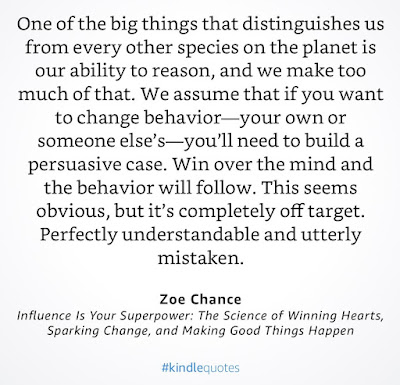
Humans "reason" to WIN the argument.

 Should truth happen along the way, so much the better. (See "Why Do Humans Reason?" by Sperber & Mercier) Evolutionary adaptive utility, "The Pen is Mightier Than The Sword."

He/She with the best story WINS!

Trial Lawyering 101. Prior to writing and movable type, stories were the whole ballgame. Hence, our evolved affinity.

Once you decide that X is right or wrong / good or bad, you cannot unring that bell.

A staple look-before-you-leap admonishment of mine back when I was teaching "Critical Thinking."

If, when it's all said and done, your logic is impeccable, and your facts and evidence are bulletproof, yet you remain unpersuasive, what have you really accomplished?''

Another classroom staple of mine. That one was "exceeding my brief" as it were, but my Sups never noticed or cared. Anyway, my overall teach-to-the-text priority focus as a piddly Adjunct necessarily had to be "OK, here's how this stuff works. Take it or leave it."
 
BACK TO ZOE
 

Once you finish her book you will have a firm grip on just why.
WHEN YOU THINK ABOUT the individual genetic and developmental differences that impact the sensory portions of our nervous systems, it’s remarkable that we can agree on a shared reality at all.  Linden, David. Unique(p. 253). Basic Books. Kindle Edition
A lot to think about and discuss here. "Truth?" Yeah.

SUSAN'S SECOND BOOK
The Six Forces Driving Ethics

Throughout this book, you will have seen references to six forces that I believe influence the ethics of every choice we make…

Banish the binary: Ethics are not a “yes or no” or “do it or don’t do it” choice. Some ethics failures are indeed straight-up unacceptable: racism, sexual misconduct, and disregarding science-based evidence about Covid-19. But most questions we face require navigating a gray zone…

Scattered power: Today, power is no longer concentrated only in the hands of a few; it’s more scattered than ever. Think of the power you have with your cell phone—to contribute to a political campaign or tutor a child across the country… or incite violence. The challenge today is to reconnect power to ethical responsibility… and to recognize that we each have a role…

Contagion: Ethics are contagious—for good or for ill. But we often focus so much on the unwanted behavior (fraud, social media data privacy, not wearing masks) that we ignore the factors that drove the spreading of the behavior—leaving them to fester and spur further trouble…

Pillars of ethics: Transparency and (un)informed consent are two long-standing pillars of ethical decision making. They depend on understanding what’s at stake in our decisions (short- and longer-term) but are crumbling in today’s complex, technological world…

Blurred boundaries: Blurred boundaries are everywhere today: human and machine, human and animal, and increasingly work and home. We are in uncharted, sometimes uncomfortable, territory as we think about the role of robots in society (receptionists, caring for the elderly, nannies, driverless cars), looking to animals for medical treatment (growing organs in pigs for human transplant), and beyond. We must keep humanity front and center and assure that humans take responsibility for the blur… and for reclarifying boundaries.

Compromised truth: Ethics hinge on truth. There is no such thing as post-truth or alternatively factual ethics. Today, truth is under threat in unprecedented ways from denial of science and other factual information to distrust of experts to algorithmic distortion of our news feeds and social media bubbles shielding us from diverse views. This compromised truth removes our choices from reality…


Liautaud, Susan. The Little Book of Big Ethical Questions (pp. 277-280). Simon & Schuster. Kindle Edition.
 
OK, LET'S BACK UP TO THE OUTSET OF SUSAN'S FIRST BOOK

Core considerations for contemplating pending ethically-sound decisions.
Question #1:
What are my guiding principles?

Who are you, as an individual or an organization? What do you stand for?

Our principles define our identity and tell the world what to expect from us, as well as how we expect others to behave. Principles apply to ethics choices in all aspects of our lives…
The Power of Ethics (p. 24).

Question #2:
Do I have the information I need to make this decision?

And what important information lies in the gap between the information you should know and the information you can know?

Entrepreneurs increasingly launch new products before we can fully assess the ways they might be used or misused, or before the creators fully comprehend the power and capability of the technologies behind them. We, as consumers, employees, and parents then use these new technologies before fully understanding their opportunities and risks. In between the two, regulators fail to keep pace. The complexity of technology has increased the complexity and unpredictability of information we must consider in order to make thoughtful ethical decisions before we launch, use, or regulate innovations.
(p. 27)

Question #3:
Who or what stakeholders matter to my decision?

Who or what could influence, or be affected by, your decision?

I define a stakeholder as any person, organization, object, or factor that could influence, or be affected by, a decision or situation. We often think stakeholders are only human beings, but stakeholders can also be inanimate objects if they have an impact on (or are impacted by) our choices. Even the digital assistant in your kitchen is a stakeholder if it gives you information (“It’s 35 degrees Fahrenheit outside”) that influences your decisions (I should put on a coat). Stakeholders can be a company, a policy, an algorithm, a chat bot, a test score, fake news, an edited gene, a government organization, and more. They can make positive or negative contributions to your decisions, and you can affect them positively or negatively.
(p. 30)

Question #4:
What are the potential consequences of my decision in the short, medium, and long term?

Have you considered the immediate and future impact of your decision at the time of the decision?

The framework requires us to a look at the short-, medium-, and long-term consequences of our decisions at the time they are being made. We should then do regular framework check-ins, so we can monitor consequences over time and keep up with evolving developments…
(p. 32)
Dr. Liautaud's four-facet overarching framework combined with the Six Forces criteria provide a rather comprehensive (yet broadly accessible) decision model for ethically sound small-d "democratic" decisionmaking. 
 
The stakes have never been higher.

 
After re-reading the foregoing assertion several times, I've warmed to it (at first blush I'd found it perhaps a tad hyperbolic in places). Humanity is up to its aggregate eyeballs in existential alligators. No one's coming to our rescue.
 
Recall my list:

We have much pressing moral work to do.
 
More to come...
__________
 

Friday, October 5, 2018

Population Health and an aging world


I first used the above photo in my recent post on "The Silver Tsunami." Then, in a subsequent post on "The Biden Cancer Initiative" I cited an article I ran across at STATnews.
More research on ‘dying healthy’ will also help us live healthier
By GEORGE J. ANNAS and SANDRO GALEA, OCTOBER 3, 2018


Helping people live longer has been a central goal of medicine for decades. The quest to extend life raises an interesting question: Should we keep investing in research aimed at adding even more years to the already impressive gains in the average life expectancy that occurred during the 20th century?

We can only go so far. There’s likely an unalterable biological limit to the human life span, somewhere around 115 years (though there are, of course, occasional outliers). Virtually all humans die before reaching that age, most of them before they turn 90.

This limit should give us pause…

Advances in medical treatment, including cancer treatments, are increasingly unlikely to provide further significant gains in human longevity. An analysis of 71 cancer drugs consecutively approved between 2001 and 2012, for example, suggests that their overall contribution to survival was just 2.1 months; the gains attributable to personalized cancer medicine have, so far, also been minimal.

Lacking evidence that the human life span can be radically increased by new medical technologies, we believe it’s time to shift our country’s investment priorities away from medical research that aims to extend life and instead focus on the same social, cultural, and political factors that successfully prolonged life in the last century.

That means more public investment in education, transportation, and housing. That kind of investment would directly contribute to the prevention of chronic diseases such as diabetes, heart disease, and many cancers, and would do more to improve the quality of life of the population than additional medical research aimed at treating individuals with specific diseases…

One way to preserve quality of life throughout the life span is to compress aging-related illness and disease into as short a time as possible.

Others before us have suggested that the U.S. is now at the point of diminishing returns in high-tech medicine. Unfortunately, calls to redirect resources away from research into extending life and toward quality of life have been ignored in the past, and the same will likely happen now. We believe that is a mistake…
I immediately tangentially thought of "A Good Death."

I looked into the authors of the foregoing STATnews piece, both faculty members of the Boston University School of Public Health.

Sandro Galea, MD is the author of this intriguing book:
Introduction
HEALTH MATTERS. A CONCERN with our health and well-being crosses national, partisan, and ideological divides. Our concern with health has led us to remarkable achievements that have made for a healthier world during the past century. Life expectancy worldwide is higher than it has ever been. In the past century alone, we have increased life expectancy by a mind-boggling 30 years after centuries during which life expectancy was more or less stagnant. We have dramatically reduced death from infectious disease, and large numbers of people worldwide have access to quality medical care when they need it. Yet, our health achievements leave much to be desired. Although life expectancy has increased overall, billions of people continue to die prematurely, and substantial healthy life years are lost worldwide due to disease or disability. Our collective health achievement is marred by tremendous gaps, with global life expectancy ranging from a high of 83 years in Japan to a low of 47 years in Malawi. The United States has worse health metrics than nearly all other high-income countries, even as the country spends far more on health than any other country worldwide. Population health in the United States is characterized by racial/ethnic and socioeconomic gaps, despite decades of study and effort to narrow these disparities. These successes, and failures, are all the remit of public health.

At heart, public health is concerned with the social, economic, cultural, and political conditions that shape the health of populations. The vast majority of health achievement during the past century is attributable to an improvement in these conditions: to better living conditions in cities, improved educational status for women and men, safer water and sanitation, availability of nutrient-rich food, stable housing and shelter, and reduction in violence and injury. Conversely, our shortcomings represent our failure to tackle the social divides—across countries and within countries—that become health divides. This is compounded by our mis-investment of resources in curative care and away from education, physical and social conditions of cities, social justice, and efforts at disease prevention that create the conditions for healthy populations…
1. The Aspirations and Strategies of Public Health 
DURING THE PAST century, public health has been responsible for an extraordinary number of achievements. Going forward, the field stands to make similar contributions to health in this century. Our rapidly changing world continually presents us with new challenges, including chronic diseases, increasing income disparities, the threat of bioterrorism, and climate change. In the face of these concerns, public health is well positioned to lead the way.

Yet, despite its record of achievement, organized public health appears to be on the defensive. High-profile initiatives such as the burgeoning precision medicine agenda and the continuing war on cancer have captured attention at the highest levels of politics, diverting resources into individualized efforts at disease prediction through genomic approaches, at the expense of population-based public health action geared toward the foundational drivers of health [2, 3]. Given that much public health scholarship arises from academic public health institutions that are heavily dependent on federal funding agencies, our national preference for cutting-edge technology and expensive treatment over less eye-catching prevention measures threatens to monopolize the direction of public health scholarship for decades to come. Public health is not alone in this financial uncertainty. We share funding and infrastructure deficiencies with transportation, education, and almost all other endeavors that are reliant on public funding and leadership. Investments in much of this infrastructure have been declining, or barely keeping pace with needs, for decades [4]‌. In this context, every extra dollar spent on medical care comes at a high opportunity cost, at the expense of public health [5].

The difficulties we face do not center on disagreements about the core goals of our field, which have always been, and remain, broad and aspirational. According to the American Public Health Association, “public health promotes and protects the health of people and the communities where they live, learn, work, and play” [6]‌. This statement captures public health’s goal of shaping the conditions that enable healthier populations, with a key emphasis on the prevention of disease…


Galea, Sandro (2017-06-20T23:58:59). Healthier: Fifty Thoughts on the Foundations of Population Health (Kindle Locations 184-258). Oxford University Press. Kindle Edition.
OK. More stuff to have to study up on. I have to confess I don't know much about the nuts and bolts of "public health" as an academic and/or professional domain. I spent my three tenures with the HealthInsight Medicare QIO first as a Nevada acute care hospitalization outcomes analyst (pdf), and then as an EHR implementation and workflow analyst (DOQ-IT, Meaningful Use REC) working the ambulatory primary care space (Family Med, Internal Med, Peds, OB/GYN). In that arena, mention "population health" to the harried docs on the enervating productivity treadmill would just get you eye-rolling, grumpy, dismissive responses -- "If we each provide the best care for our patients, 'population health' will take care of itself."

Not that simple, by a long shot. But, then, none of us in the trenches had time for debating abstract macro policy issues.
"Yet, despite its record of achievement, organized public health appears to be on the defensive."
In particular given the priorities of the Trump administration. And then there are the competing economic priorities and chronic misalignments revealed in Rosenthal's excellent book "An American Sickness." 
An Aside: where might "Data Science" fit in to this? And, broadly, the "Upstream"? In that regard, "Your ZIP code matters more than your genetic code."
And, let us not forget the "exposome."
Take a Deep Breath and Say Hi to Your Exposome
Researchers begin to explore the unique cloud of airborne microbes and chemicals that surrounds each of us


In the past few decades, researchers have opened up the extraordinary world of microbes living on and within the human body, linking their influence to everything from rheumatoid arthritis to healthy brain function. Yet we know comparatively little about the rich broth of microbes and chemicals in the air around us, even though we inhale them with every breath.

This struck Stanford University genomics researcher Michael Snyder as a major knowledge gap, as he pursued long-term research that involved using biological markers to understand and predict the development of disease in human test subjects. “The one thing that was missing was their exposure” to microbes and chemicals in the air, Snyder says. “Human health is clearly dependent not just on the genome or the microbiome, but on the environment. And sampling the environment was the big hole.”…
 Add one more discipline to the "Omics." 

ALSO OF INTEREST AT BU-SPH

Roaming around their website led me to this:
Health Law, Ethics & Human Rights Research

The Affordable Care Act
Constitutionality, implementation strategies, Medicaid expansion, role of private health insurance companies, coverage of public health screening, and patient-oriented research.
 

Clinical Bioethics
Analysis of clinical case consultations performed at Boston Medical Center dealing with end-of-life care, reproductive health, patient capacity to participate in decision-making, and resource allocation.

Genetics & Genomics   
Genetic screening and counseling strategies, including fetuses, newborns, children, and adults. Introduction of whole genome screening into the clinical setting. Role of government mandates and informed consent. Genetic privacy, genetic transfer experiments, and regulation of synthetic biology.

Health Promotion
Legal and ethical issues in health promotion programs among employers, health care payers, government, and communities as well as the constitutionality of state and federal laws designed to change health behaviors (e.g., cigarette labeling laws, container size limits for sugary drinks, etc.)

Health & Human Rights
Development of a theory linking health to respect for human rights, including the meaning of the international “right to health.”

Patient Rights & Patient Safety

Defining the legal rights of patients, including the “right to safety” and the role of evidence-based medicine in setting the standard of care.

Medicine & the Holocaust
Study of the role of medicine during the Holocaust, focusing on racial hygiene, eugenics, euthanasia, and genocide. Care of Holocaust survivors, research on perpetrators and bystanders.

Military Medical Ethics
Study of existing military doctrine, application of civilian medical ethics to the military; special emphasis on ethics standards at Guantanamo, including hunger strike protocols, and the concepts of “dual loyalty” and “dual use.”

Reproductive Rights
Constitutionality of new state laws that restrict abortion services.

Research on Human Subjects
Study of the changes needed in federal research regulations and methods to improve subject understanding of research and improve the consent process and its documentation.

Religion & Public Health
The role of religion in public health policy and the First Amendment limits on governmental interference with religion and religious practices.

Emergency Preparedness
An examination of how public health should work with national security agencies, including the relationship between epidemics and bioterrorist attacks.

Medical Privacy
Privacy of medical and genomic records, quality assurance studies, and electronic health records, as well as the access the government has to private health information.

Legal & Ethical Implications of Wellness Programs
An analysis of the reciprocal interactions between corporate wellness programs and the laws governing health insurance and employment.

Forensic Medicine
Forensic evaluations of refugees and asylum seekers, as well as victims of abuse and torture. Setting standards for same.
Wow. Makes me want to move to Boston and apply.

My interest in these areas has been abiding ever since grad school [pdf] in the 1990's ("Ethics and Policy Studies"). apropos, see my prior post on "Information Ethics."

Oh, and I've alluded to this a couple of times:


I reached out to these folks, and gently pointed out that their "Ethical Framework" pdf download document had no definition of "ethics." The email reply I got blew me off -- "we all know what we mean, we're not gonna get bogged down in abstract academic jargon."

Right. In Silicon Valley-speak, just "Don't Be Evil" while you "Fail Fast and Break Stuff" in your Agile Scrums.

Dudes, I'm not talkin' obtuse ivory tower "Dialectical Hermeneutics,"or hypothetical "gotcha" moral dilemma "Trolley Problems," etc, just a common-sense primer of sufficient detail. e.g., from a book I got onto via Science Based Medicine:

Ethical Frameworks and Principles
Ethical considerations of any problem or issue can be divided into two major categories: (a) nonconsequentialist and (b) consequentialist approaches. 1 Nonconsequentialism considers that the action (or even just the motivation behind an action) is the crucial ethical factor. In other words, the action itself is more important than the actual outcome (consequence) of the action. By contrast, consequentialism holds that outcomes (as opposed to actions) should be the crucial determinants of ethical decisions…

Principlism
The inherent subjectivity of ethics presents a problem: even when reflexive and uncritical responses (such as the ‘gut reactions’ of tabloid readers) are excluded, along with religious outlooks, medical ethicists still do not all agree on which ethical principles are best.

It was in response to this reality that an approach to ethical analysis known as principlism was developed. Principlism attempts to factor in both nonconsequentialist and consequentialist approaches. The standard version is based on four core principles:

(1) Respect for autonomy (a nonconsequentialist principle—but one that utilitarianism also supports).
(2) Nonmaleficence (‘first, do no harm’—a nonconsequentialist principle).
(3) Beneficence (increase overall utility—a consequentialist principle; it is essentially utilitarianism).
(4) Justice (fairly distribute benefits, risks and costs—a nonconsequentialist principle). 
Principlists apply this approach to an ethical case by examining how each of the four principles (in turn) applies to the issues raised by the case. It is quite common for medical ethics committees to use this method to reach decisions. Principlism can be very useful as a structured ‘checklist’ method to address ethical problems and therefore finds favour amongst laypeople or non-ethically trained professionals, who predominate on ethics committees…

Ernst, Edzard. More Harm than Good?: The Moral Maze of Complementary and Alternative Medicine (Kindle Locations 83-208). Springer International Publishing. Kindle Edition.
That entire chapter is excellent. One need not, however, even go to that much trouble. Any quick Google search will get you tons of relevant, succinct definitional information on the topic of Ethics.

Below, a good, accessible, inexpensive resource:


I still have all of my many grad school texts, but I keep this in my Kindle as a handy refresher.

It was emphasized to us in grad school early on that "Ethics" was not about some lookup cookbook of "right/wrong," but rather a frequently arduous process of rational moral deliberation comprising evidence (including accrued wisdoms), logic, and -- yes -- "values" fused in honest attempts to derive just decisions and policies.

UPDATE: ON HEALTH RESOURCE ALLOCATION

My latest issue of Science Magazine arrived today. This therein is relevant to the discussion in this post:
Cancer prevention: Molecular and epidemiologic consensus

Prevention of any disease can occur at two levels: (i) avoiding or reducing risk factors coupled with increases in protective factors (primary prevention, which is preferable when it can be practiced) and (ii) detection and intervention early in the course of disease evolution (secondary prevention). But despite substantial epidemiologic data showing that a large proportion of cancers and cancer deaths are preventable, decreases in cancer mortality rates in developed countries have lagged far behind decreases in mortality rates from heart disease (1), another major disease amenable to prevention (for example, 18 versus 68% decrease, respectively, between 1969 and 2013 in the United States) (2). We believe that one main factor explaining the relatively modest reduction in mortality is the limited support for cancer prevention research, which receives only 2 to 9% of global cancer research funding (3). As a United Nations (UN) High-Level Meeting begins this week to review efforts to combat noncommunicable diseases, a key question is how to prioritize resources to realize the potential of cancer prevention…
'eh?

CODA

Off-topic erratum: I drove today for the first time since my August 23rd SAVR aortic valve surgery. I start cardiac rehab PT next Tuesday. Doin' OK. Can definitely hear/feel that new valve thumpin'.
_____________

More to come...