Search the KHIT Blog

Monday, November 17, 2014

Physician, Heal Thy System

OK, I finished this book this weekend.


Many, many dots to connect. Notwithstanding my many churlish blog comment critics ("BobbyG is an EHR vendor shill," "how many patients have you treated? You're not a doctor, your views are irrelevant"), I have always been a physician champion, for deeply personal reasons going far beyond the academic and theoretical. This book provides ample support for that view.
I love being a physician. I love it for many reasons, but the main one is because of what I am able to do for people like Antonio. And the incredible thing about being a doctor is that every one of the almost one million physicians in the United States has a similar story— not a cleft lip necessarily but a story in which the physician changed someone’s life in a magnificent way. Countless specialists and primary care physicians alike have stories in which they literally saved a life— reached in and rescued the patient from the edge of the precipice. Or they saved many lives— of children, expectant mothers, and aging grandparents. The joy and satisfaction in those moments for physicians is unlike any other experience.

To reach the point where we can do these things requires years and years of hard work, including the rigor of a heavy science load in college followed by the unrelenting demands of medical school. Academic work combined with clinical training builds the skills that gradually transform the student into a clinician who advances to residency training and fellowship, ranging from three to eight years. Only then comes the great reward: the ability to care for people who need you.

This is the heart of the matter. Physicians love being doctors because we have the privilege of being able to calm fears and alleviate suffering— to change and save lives. This is what motivates doctors virtually every single day of their lives. When the structure and culture in which physicians work are well aligned, it is a most rewarding job.
But something has gone wrong in the physician world, and it is urgent that we fix it. Fundamental flaws in our system make it more difficult and less rewarding than ever to be a doctor... 
We ask the question “What is a physician?” because the doctor’s role has evolved over time, with a particularly rapid evolutionary acceleration in recent years, and many physicians feel confused or resentful about the direction that health care has taken. The deal is not what they signed up for. It is not only the ever-expanding volume and complexity of the clinical work that they face. Far too many physicians also find themselves working amid circumstances characterized by chaos and waste, being encouraged to practice defensive medicine, and being pressured by excessive regulation and hectoring insurance companies...
THE EVOLUTION OF THE PHYSICIAN’S ROLE
The physician’s evolution requires shifting from an Industrial Age model of care to an Information Age model of care. In the Industrial Age model, the doctor focused on illness. He (nearly always he), worried about each patient, one at a time, making his clinical decisions in conditions of virtually total autonomy. There were wonderful aspects to this care. It was often highly localized and intensely personal. There was a warmth to it that was derived from a sense of a physician’s responsibility to family, friends, and community.

But there was no information technology, there were few sophisticated diagnostic techniques, and there was a limited use of other team members able to provide highly valuable care. Doctors knew what they knew. There were fewer sources of information and knowledge about new medical techniques, and innovation spread at a glacial pace.

In the Information Age, physicians take responsibility not just for individual patients but also for managing populations of patients— those with diabetes, for example— to make sure patients are fully up to date on all of the treatments and measures that improve their overall condition. Information Age physicians skillfully use electronic medical records, clinical registries— data on large numbers of patients and the internet— to help determine the most effective treatments and provide a great deal of care outside the doctor’s office. In the Information Age, metrics are central to delivering the best care to patients, many of whom engage in deep research related to their conditions on a nearly endless variety of websites dedicated to diseases, cures, and treatments. Too often, the question in health care for physicians is how many patients you can see today. But in the Information Age, the better question is how many patients’ problems you can solve today— and this speaks to the role of physician as leader in the Information Age.

It is not just physicians who are operating within the Information Age. Increasingly, it is, as we have noted, patients as well. The Information Age model requires disruptive innovation to the health care system by holding doctors responsible for all six of the Institute of Medicine’s essential elements of quality care: that it is safe, timely, effective, efficient, equitable, and patient-focused.

But is this fair? Is it reasonable to ask doctors to become something more than they have been? Some physicians chafe at the Information Age model. Most physicians already feel overwhelmed—understandably so. They are asked to do too much in a system that too often thwarts their efforts as much as it enables them.

We have no illusions about how difficult change in health care can be, especially among doctors. Dr. Gene Lindsey, former CEO of Atrius Health in Boston, has worked diligently in recent years to shift the culture of his organization, and he has found this to be exceedingly difficult work. “There is so much anxiety in the physician community,” says Lindsey. “Adaptive change is enormous work. It means giving up things we thought were bedrock.” He cites the example of a physician who is a true expert in his clinical field and then must go through lean training— learning a variety of lean management tools and methods to improve quality , safety, and efficiency. “So you go from being completely competent in an area to being a novice in a new domain. There are a lot of heated conversations.” Many doctors argue that the essence of their job is clinical: that a good doctor focuses on the condition with which a patient presents and then uses her or his skill and training to cure the problem. And many physicians will always cling to that definition exclusively, insisting that matters such as access, cost, and such are better left to administrators and policy makers.

Cochran, Jack; Kenney, Charles C. (2014-05-06). The Doctor Crisis: How Physicians Can, and Must, Lead the Way to Better Health Care (pp. 30-33). Public Affairs. Kindle Edition.
Episodically, you come across a book that inspires tremendously and adds serious value. This is one of them. Like these. And these. And these. And this. (I could, -- and will -- go on.) The Doctor Crisis is optimistic and documentably informed, all while painfully candid (it contains a sobering lookback into the public CusterFluck that was the Kaiser-Permanente Colorado experience). Not Polyanna-ish in the least.
Most physicians already feel overwhelmed—understandably so. They are asked to do too much in a system that too often thwarts their efforts as much as it enables them.
That is simply true. Recall another of my recent posts wherein I cite this book (below).

The healthcare workforce today. Where do we stand, and what should we do to expand and improve it?
Dr. Jauhar's book was widely panned for being "whiny." While I would not agree with that (I found it to a great degree quite forthright), I would categorize it overall in line with the Dr. Cochran's comparison of "cynic vs dissenter."
...I did not offer solutions to the problems that the physicians raised. I did not commiserate with “yeah, everything sucks.” I just listened. And what I heard at clinic after clinic, from physician after physician, was that they were deeply unhappy and often angry.

At one clinic in particular , I found that the staff was not angry so much as they were infused with a sense of futility. It was as though they were at a dead end and there was nothing they could do.

During the Listening Tour, I learned a critical lesson: the difference between cynicism and dissent. Cynics are characterized by a sense of hopelessness and futility and do not present alternative solutions along with their criticism. A dissenter, however, wanted to work to make the organization more effective. Thus, I learned a valuable lesson: Dissent has value, while cynicism has none.

Dissent can be just as angry as cynicism but comes with engagement: I care enough to be angry about the situation here. Dissent comes with ideas for change and solutions for improvement. Dissent is forward thinking and solution oriented. Cynicism is futile, hopeless, and negative [ibid, pp. 56-57].
HEALER-LEADER-PARTNER

This, below, is the crux of the Cochran-Kenney case.
In a paper titled “Physician Leadership in Changing Times,” authors Jack Cochran, Gary Kaplan, and Rob Nesse, pose a critical question: Who shall lead, and why?
The notion of joint or system wide accountability is gaining prominence, but which stakeholder— physicians, hospitals, health plans, or others— will lead delivery system transformation? We believe it must be physicians (emphasis added). Among all providers, physicians have a disproportionate impact on the health care system, and therefore have a disproportionate opportunity and responsibility to lead change. Patients experience their own health and the health care system in many ways: physically, socially, psychologically, and financially. As the first and primary point of contact with the health care system for most patients, physicians must therefore act as caregivers , teachers, trusted information sources, and fiduciaries for their patients . They cannot and should not opt in and out of accountability toward their patients in any one of these roles.
This powerful statement serves as a redefinition of a physician’s role— perhaps a broader definition than ever before. The authors insist that “physicians are ideally positioned, and in fact compelled, to take responsibility for helping shape the health care system— not just their own practice— to better serve patients’ physical, social, psychological, and financial needs. That is a huge task, and it cannot be accomplished with passivity or indifference.” 
Some doctors will respond by saying that they already lead— they lead their office staff, their practice, their specialty, and so on. There are also many outstanding physician leaders at major medical centers, medical schools, professional societies, research institutes, and more— examples that demonstrate the potential of physician leadership. Yet throughout the profession an enormous amount of leadership potential remains untapped, and this cannot continue. Talented physician leaders must come off the sidelines and assert themselves more broadly, for never before has the health care industry so urgently needed vision and leadership... [ibid pp.33-34]
"The Doctor Crisis" is an excellent, thought-provoking read. It had me immediately reaching back to, among many others, Maccoby's "Transforming Health Care Leadership."

Improving health care organizations means changing cumbersome bureaucracies into dynamic systems that are patient-focused, cost-effective, and propelled by collaborative learning. This requires culture change, and the first change will be with leaders throughout the organization. No one can do it alone. Leaders need to work together and enlist willing partners and collaborators to achieve these goals.

Knowledge leaders are also needed to network with people outside the organization to bring new ideas and knowledge into the system. A destructive myth that is all too common in many health care organizations is: “We know best.” A not-invented-here syndrome rejects thinking from outside the organization and makes life miserable for able knowledge leaders. In one well -known health care organization, they either reject ideas that come from outside the system or, if they adopt an idea, they rebrand it with their own name. They have a habit of not referencing the original author. Learning organizations pride themselves on the ability to learn from many sources and also understand the need to recognize original contributions to their thinking, both from within and outside the organization.
Another commonly believed myth is that physicians will only follow physicians , and as one MD hospital director commented , “When MDs become administrators, they are no longer considered physicians.” However, physicians and other health care professionals will follow a leader with the knowledge and personality qualities essential to change bureaucracies into learning organizations. It is a myth that these leaders need to be caring ombudsmen. The leaders we need sometimes pull people outside of their comfort zones. It is also a myth that a good leader has all the answers . The leaders we need are able to make use of the knowledge and learning of all collaborators.
Maccoby, Michael; Norman, Clifford L.; Norman, C. Jane; Margolies, Richard (2013-07-29). Transforming Health Care Leadership: A Systems Guide to Improve Patient Care, Decrease Costs, and Improve Population Health (Kindle Locations 645-659). Wiley. Kindle Edition. 
Indeed. I've studied both of the Maccoby leadership books. An invaluable repository of the multifacted psychological and cognitive characteristics of "leadership."

One aspect of "The Doctor Crisis" had me jumping for joy -- the authors' recurrent citation of variations on the word "toxic" in the context of healthcare workforce culture.
Partner Physician as partner means being a great team member and recognizes that the surest route to sustained quality care is through effective teamwork. An essential component of teamwork is not only how team members band together to care for the patient but also how team members treat one another. Physicians who have collegial professional relationships often get the most out of their teams. Partnering is about stepping up and addressing challenges that impact the ability of the team to care for patients; it is about identifying and eliminating barriers to excellent care. It is also about understanding information technology systems and making sure all team members are using the system effectively.

Physicians need to be central to the development of strong teams and to work with nurses, pharmacists, medical assistants, and others to ensure that they too have careers that are relevant, interesting, and satisfying. Some physicians condescend to nonphysician leaders from both hospitals and health plans. Yet a true physician partner— working closely with these leaders— can accomplish a great deal. Arrogance and condescension are toxic elements in a team setting. ["The Doctor Crisis," pp. 40-41]

Play to Win had a powerful emotional impact on many at KP Colorado. One was Dr. Ellsworth (not his real name), a charming, popular physician. But over time, with the toxicity and dysfunction of the medical group , his outlook deteriorated along with that of many other physicians. It was not uncommon for Ellsworth to complain about one aspect of the medical group or another. [ibid, pg. 84]

Too often, the medical culture in the United States tolerates bad behavior by doctors. The culture permits some doctors to be rude, dismissive, and condescending to anyone without an MD after their name. This egocentricity is toxic. What if Dr. Smyth (not his real name) creates an intolerable atmosphere in the clinic? By creating an environment of fear and instability, patients are at risk. It’s 3 a.m., and a patient is having a problem. The nurse is unsure what to do. She believes that there might be an issue, but she knows that Dr. Smyth is on call and that he can be trouble. The nurse thinks it through: If I call Smyth at 3 a.m. it could be ugly, so maybe we’ll just see if we can get the patient through the night until the hospitalist is on at 7. [ibid, pg. 87]


...Dr. Woodley (not the physician’s real name), a new hire, was highly talented and technically proficient. But early on it became clear that Woodley was often condescending and dismissive to staff members. Nothing like this had emerged during the recruitment and orientation periods, yet Woodley was persistently difficult from day one.

Staff members complained, and we— the leadership team— listened. Staffers told us that they were intimidated by Woodley and were routinely belittled, made to feel incompetent. A couple of staff members were so deeply shaken by the mistreatment they received from Woodley that they went on medical leave.

Leaders sat down with Woodley. “This is what we stand for,” we said, “and these are our expectations. We told you this when we hired you, and we told you this at orientation. And this is how you’re going to get evaluated, and it’s not going to go well.”

Woodley replied that it was all about efficiency. “I’m just efficient, and if these people are slow, they’re going to have to get faster, because I’m efficient.”

Efficiency is great, we agreed, but collegiality and effective teamwork are critical as well. We set up a formal performance evaluation and gave Woodley a six-month improvement plan with crystal-clear standards and expectations. Incredibly, the behavior did not change. Woodley continued to abuse staff members, creating a toxic environment in the clinic. So, a high-quality, highly functional clinical doctor who just simply couldn’t— or wouldn’t— treat staff well was dismissed. [ibid, pp. 92-93]
I have repeatedly used the phrase "psychosocial toxicity" on this blog while discussing what I feel to be key elements of "high performance healthcare delivery teams." e.g.,
My recent posts have ruminated on what I see as the underappreciated necessity for focusing on the "psychosocial health" of the healthcare workforce as much as focusing on policy reform (e.g., P4P, ACOs, PCMH), and process QI tactics (e.g., Lean/PDSA, 6 Sigma, Agile), including the clinical QI Health IT-borne "predictive analytics" fruits of ""Evidence Based Medicine" (EBM) and "Comparative Effectiveness Research" (CER). Evidence of psychosocially dysfunctional healthcare organizational cultures is not difficult to find (a bit of a sad irony, actually). From the patient safety-inimical "Bully Culture" down to the "merely" enervating emotionally toxic, I place it squarely within Dr. Toussaint's "8th Waste" (misused talent).
I repeat yet again:
A psychosocially healthy workplace is a significant profitability and sustainability differentiator.
I stand by that view. See my July 19th, 2014 post Medical Error, Interop, and the Patient Safety-Health IT nexus.

Lots more to think about and report (there's so much good work out there in the literature). Need more coffee at the moment. Buy the Cochran-Kenney book. I get nothing for touting it, btw.
 __

THE "QUADRUPLE AIM"

Just as Dr. Toussaint added an "8th waste" (misused talent) to the traditional Lean methodology's "Seven Wastes," In The Doctor Crisis we encounter "The Quadruple Aim," which supplants the traditional "Triple Aim" of the progressive healthcare reform ideal.
Dr. Bodenheimer and his University of California San Francisco colleague Rachel Willard made a valuable contribution to “In Search of Joy in Practice,” conducting seven of the twenty-three primary care site visits covered in the report. After studying the seven practices, Bodenheimer and Willard authored a paper titled “The Building Blocks of High-Performing Primary Care: Lessons from the Field” for the California Health Care Foundation in which they observed that primary care in the United States “is undergoing a transformation— from physician-centered practices to patient-focused teams.” Bodenheimer believes so strongly in the importance of clinician morale that, he says, “the Triple Aim should be a quadruple aim, with clinician and staff satisfaction a necessity to achieve the other three aims.”...
The work by Drs. Sinsky, Bodenheimer, and their colleagues is instructive and inspiring, for they have broken out of the narrow definition of a physician as healer and embraced the concept of physician as healer-leader-partner. In doing so, they have taken on broad accountability for their patients’ health care, going beyond the clinic in search of improvements and joining together with others in a collaborative process that enhances the strength and power of their recommendations. They have identified improvements that seek to summon the idealist and enable the healer in all physicians to alleviate suffering and save lives..
We need a new deal with physicians. Just as the doctors in Colorado needed preservation and enhancement of careers to trigger a surge in the quality of patient care, so too do we need a comparable deal now for the nation. This work to preserve and enhance physician careers is so critical that, as Bodenheimer says, “the Triple Aim should be a quadruple aim, with clinician and staff satisfaction a necessity to achieve the other three aims.”
Physician compacts are deals that health care organizations make with their doctors. More and more organizations throughout the country are turning to compacts to make as explicit as possible what the organization can expect from doctors and what doctors can expect from the organization... [The Doctor Crisis, pp. 118-120, 178]
This book hits all of the by now familiar best practices process QI notes (including adroit use of Health IT for data-driven analytics across the board), but goes well beyond that into detail regarding explicit "compact"/"code of conduct" workforce culture policy--policy that is essentially "Just Culture" material. e.g.,
Colorado Permanente Medical Group [CPMG] physicians demonstrate commitment to our patients, practices, and one another by providing high-quality, responsible medical care in a professional manner. 

In meeting this commitment, CPMG physicians will: 
1. Interact with other physicians , practitioners, and staff in their department, CPMG Leadership , and contacts in the community in a collegial, supportive, and professional manner.
  • Give feedback to colleagues in a professional manner.
  • Give corrective feedback to staff in a respectful manner away from patients and other staff. Take concerns about a colleague which cannot be resolved directly to the department chief. 
  • Express dissenting views in a respectful manner. 
  • Accept responsibility and seek solutions to problems.
  • Give candid and timely feedback on peer/ staff evaluations. 
2. Provide excellent service to patients and internal customers:
  • Communicate patient care plans, consultations, and treatments back to referring providers. 
  • Maintain strict patient confidentiality.
  • Treat members as valued customers.
  • Maintain appropriate provider-patient boundaries.
  • Be punctual in all medical care settings (medical center, hospital, etc.).
  • Maintain high-quality provider-patient relationships by any member satisfaction measurement (Art of Medicine, Patient Satisfaction, etc.).
  • Attempt to resolve patient concerns.
  • Assume responsibility in general for decreasing his or her patient waiting time for appointments when the wait is unacceptably prolonged.
  • Respond appropriately to hospitals, page operators, and others.
  • Be flexible in accommodating changes in patient demand to best meet the needs of the patient and the medical group.
  • Balance multiple and at times unexpected or conflicting demands of patients.
  • Clearly explain the plan for care to the patient to better ensure patient compliance and satisfaction.
  • Demonstrate courtesy, respect, and a caring attitude to patients in order to enhance the provider-member relationship. 
  • Control emotional reactions toward patients and others.
3. Support the Principles of Medical Practice (Policy No. 5.03, Appendix A) and be careful stewards of our members’ resources. 
4. Participate as members of the health care team:
  • Meet work unit requirements and equitably share in the workload to ensure the department's needs are met.
  • Participate in Quality Assurance activities and follow accepted clinical guidelines.
  • Attend and participate in departmental meetings and team improvement activities.
  • Schedule time-off requests in a fair and collaborative manner subject to department needs.
  • Avoid maligning or undermining colleagues to patients or other physicians and staff, either verbally or in writing
  • The supervision of and collaboration with midlevel practitioners is strongly encouraged.
5. Contribute to the success of the Medical Group: 
  • Be an advocate of Kaiser Permanente and its principles.
  • Follow the policies and directives of the Board of Directors and administration.
  • Support and participate in the development and implementation of strategic change initiatives. 
[This Code of Conduct was not intended as an exhaustive statement about professional conduct and did not limit the discretion of Medical Group management in addressing concerns regarding conduct.] (ibid, pp. 194-196)
"Just Culture." See in particular Marx's "Whack-a-Mole: The Price We Pay For Expecting Perfection."

While some physicians make no bones about their irascible disdain for anything that impinges on their "autonomy" (particularly when it comes from non-clinician superiors), the authors note that
Throughout their careers, physicians have been continuously tested and measured. After all, every physician went through a challenging undergraduate course of study in the sciences just to be able to make it to medical school. As medical school students, they work to absorb immense amounts of clinical learning . Then comes the rigor of residency. Every step of the way for those ten or more years of education and training, these young men and women are measured on performance. They understand what it means , and in the vast majority of cases they welcome it. For most, it affirms their commitment to excel. [ibid, pg. 88]
Yes, assuming a Just Culture, I would add. The physician must internalize the necessity and desirability of becoming Healer-Leader-Partner within his/her own workplace culture if the goal of truly effective patient-centered care is to be realized.
Physician, Heal Thy System.
CODA

Dr. Toussaint on "Leadership."

Gemba is another useful word from the Japanese. Literally translated as “workplace,” gemba refers to the place where real value is created in an organization. Senior leadership of most companies spend shockingly little time there. If the CEO does appear in the intensive care unit or a busy emergency room, it’s usually a backslapping tour, meant to underline his authority and spread the idea that he both cares about and keeps a close eye on operations. At Toyota, on the other hand, going to the gemba meant assisting operations: looking for problems or improvement opportunities and finding out what workers need to stay on target. It means getting to know, first hand, the issues facing front-line workers and helping to work out solutions. It means learning, not teaching and telling.
Toussaint, John; Gerard, Roger (2010-06-06). On the Mend: Revolutionizing Healthcare to Save Lives and Transform the Industry (Kindle Locations 1315-1320). Lean Enterprise Institute, Inc.. Kindle Edition.
"It means learning, not teaching and telling."
Indeed. apropos, brings to mind another of my endless reads.


Below, from one of my irreverent REC slide decks:
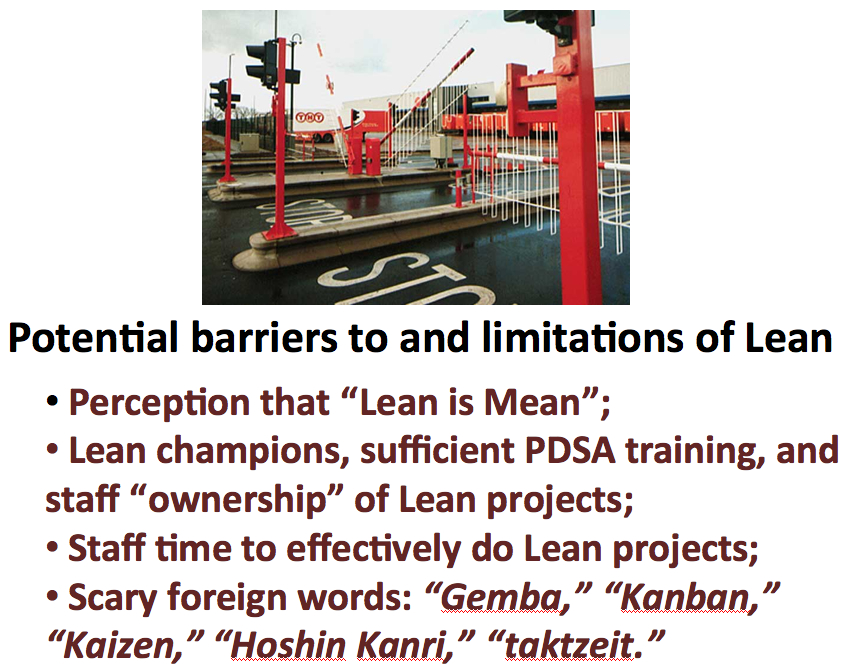

"Lean Champions." Uh, that would be "leadership."

ONE LAST THING...

___

More to come...

Thursday, November 13, 2014

The AMA on Usability - "the design and implementation of EHRs do not align with the cognitive and/or workflow requirements and preferences of physicians within and across specialties and settings."


Good paper.
The AMA recognizes that not all EHR usability issues are directly related to software design. Software design varies greatly among vendors and specific organizations that often customize EHR functions. For example, some EHR usability issues are a result of sub-optimal implementation, required by the practice itself or part of an organizational policy (e.g., risk management, institutional liability concerns or inadequate training of users). Other issues may be related to regulatory requirements (e.g., state and federal regulations such as an overly prescriptive MU). EHR usability issues may also be due to suboptimal practice workflow processes that have been incorporated into EHRs. Workflow analysis, collaborative end-to-end workflow design and associated training are very expensive and are often neglected in projects with limited budgets and strict timeframes to meet MU requirements (i.e., deadlines to receive subsidies and/or to avoid penalties)...
Eight EHR Usability Priorities
Enhance Physicians’ Ability to Provide High-Quality Patient Care. Effective communication and engagement between patients and physicians should be of central importance in EHR design. The EHR should fit seamlessly into the practice and not distract physicians from patients.
Support Team-Based Care. EHR design and configuration must: (1) facilitate clinical staff to perform work as necessary and to the extent their licensure and privileges permit and (2) allow physicians to dynamically allocate and delegate work to appropriate members of the care team as permitted by institutional policies
Promote Care Coordination. EHRs should have enhanced ability to automatically track referrals and consultations as well as ensure that the referring physician is able to follow the patient’s progress/ activity throughout the continuum of care.
Offer Product Modularity and Configurability. Modularity of technology will result in EHRs that offer flexibility to meet individual practice requirements. Application program interfaces (APIs) can be an important contributor to this modularity
Reduce Cognitive Workload. EHRs should support medical-decision making by providing concise, context sensitive and real-time data uncluttered by extraneous information. EHRs should manage information flow and adjust for context, environment and user preferences.
Promote Data Liquidity. EHRs should facilitate connected health care—interoperability across different venues such as hospitals, ambulatory care settings, laboratories, pharmacies and post-acute and long-term care settings. This means not only being able to export data but also to properly incorporate external data from other systems into the longitudinal patient record. Data sharing and open architecture must address EHR data “lock in.”
Facilitate Digital and Mobile Patient Engagement. Whether for health and wellness and/or the management of chronic illnesses, interoperability between a patient’s mobile technology and the EHR will be an asset.
Expedite User Input into Product Design and Post-Implementation Feedback. An essential step to user-centered design is incorporating end-user feedback into the design and improvement of a product. EHR technology should facilitate this feedback. 
As one would expect, Jerome Carter, MD is all over this on his excellent EHR Science blog.
AMA Conclusion: The Road Forward

According to the AMA Rand study, the single largest driver of professional satisfaction is the physician’s perceived ability to deliver high quality care to patients. The AMA believes that if the above priorities were implemented in the EHR design, it would (1) enable physicians to deliver such care, (2) improve physician experience with the technology, (3) increase physician productivity and (4) reduce administrative costs. Aside from these eight EHR usability priorities, the AMA believes that additional research is needed to determine how EHR use promotes or inhibits high quality care. It is essential to better understand the cognitive needs of physicians and how EHR products can meet them, identify evidence that outlines the benefit tools that support decision-making and explore how EHRs influence the patient encounter. All are opportunities for research that would benefit the advancement of EHR technology. Finding evidence of what works and what doesn’t work will be critical to improving EHRs.
That's all fine and necessary, and I guess this being the AMA, the physician-centric focus is inevitable. But, there are larger necessary policy (Fee For Service?) and organizational paradigm changes ("Talking Stick?") going far beyond technology that, if left largely unaddressed will likely significantly hinder or negate any UX/workflow advances.

Consider that a typical complete ONC certified ambulatory EHR system may house between 3,000 to 4,000 RDBMS variables under the GUI hood, and a typical "moderately complex patient" encounter (e.g., a 99213) may require finding/accessing, viewing, updating/editing, and evaluating/synthesizing many hundreds of them (or more; e.g., longitudinal "flow sheet" trend data and/or specialist findings) as part of the SOAPE process, all in a severely constrained period of time.

Do a workflow/click-thru time consumption thought experiment. See also my blog post update of August 8th, 2010.

Dr. Carter on the AMA paper:
...Building systems with features in line with the AMA framework requires knowledge about clinical work and models of how information is used by clinicians, neither of which  currently exists.  The same is pretty much true of clinical systems architectures.   Yes, EHR systems exist, but no one knows the ideal architecture or component design strategy to achieve robust, secure, interoperable, collaborative systems.  In other words, there is no blueprint, and there is no source to consult that explains how to create such blueprints.  To anyone who thinks that tweaking current systems is the way to go, I say: Remember what happened with MU Stage 2 certification.

Alteration of current products is not likely to result in systems that reflect the AMA’s framework.  The time, money, and effort required to convert current EHR systems into clinical care systems that support clinical work is likely greater than most companies would care to expend (see Is the Electronic Health Record Defunct?).  Therefore, I expect the next generation of systems will come from new companies and not current market leaders (see Disruption in the EHR Market: Will Anyone See It Coming? ).

Building usable, interoperable systems that intimately support clinical work will require creativity, research, patience and, I imagine, some amount of luck (or serendipity if you prefer). In other words, the road from here to there is not on a map.   There are a lot of challenges, so let’s acknowledge this and get going.  Those blueprints will not design themselves.
apropos of all of the foregoing, is the data acquisition/assimilation burden likely to grow?
IOM Panel Identifies 12 Social, Behavioral Measures for EHRs
Thursday, November 13, 2014


On Thursday, the Institute of Medicine released a report detailing 12 social and behavioral factors it feels should be included in electronic health records, FierceEMR reports...

Those measures are:
  • Alcohol use;
  • Depression;
  • Educational attainment;
  • Financial resource strain;
  • Intimate partner violence for women of reproductive age;
  • Median household income;
  • Physical activity;
  • Race/Ethnicity;
  • Residential address;
  • Stress;
  • Social isolation; and
  • Tobacco use.
In the report, the committee noted that adding these domains to EHRs could put more pressure on providers. However, the authors also noted that patients could report the data via their personal health records or a computer, which would not greatly disrupt providers' workflow.

In addition, IOM said the health benefits of including these domains outweigh the administrative burden (Gold, Politico Pro, 11/13)...
Certain to be controversial, for a variety of reasons. And, what about the burgeoning accretion of "omics" data?

For one thing, I would not be so sanguine about "minimal workflow disruption."

Hmmm... tangentially, how about this?
EHRs are increasingly common and contain detailed data about patients’ encounters with the health system — data that have tremendous value for health care improvement efforts. These same data also provide opportunities for marketing. Using EHR data, it’s possible to determine the clinical and demographic characteristics of patients within a given practice and the circumstances under which physicians choose particular treatments, even when information is anonymized at the patient level. Although most large EHR vendors do not sell data to third parties, some have made information sales part of their business model. For example, Practice Fusion offers its EHR software to physicians free of charge but generates revenue by selling access to anonymized clinical data derived from more than 80 million patient records.

EHRs can also be used for direct marketing to physicians at the point of care, through features such as banner ads, industry-sponsored clinical resources, and tools for requesting samples, article reprints, and other items — a role previously filled by sales representatives. Unlike traditional forms of advertising, digital technologies (e.g., MD On-Line) enable tailoring of advertisements to individual physicians on the basis of data from clinical encounters. Some marketing platforms (e.g., Physicians Interactive) integrate advertising at the point of prescribing with “eCoupons” that are generated in real time and transmitted directly to pharmacies when physicians select promoted medications.
From NEJM, by way of The Incidental Economist.

UPDATE

From Kaiser-Permanente Physician Leader:

A culture of doctors over-treating as a defense mechanism against medical liability should be replaced by a culture of patient-centered care.

The Dallas/Fort Worth Healthcare Daily ran a fascinating excerpt from the Steve Jacob’s book So Long, Marcus Welby, M.D.* The excerpt contained some very interesting assertions and statistics. For example: 
  • Consultant PwC, relying on that Congressional Budget Office (CBO) report, estimated that malpractice insurance and defensive medicine accounted for 10 percent of total health-care costs. A 2010 Health Affairs article more conservatively pegged those costs at 2.4 percent of healthcare spending. 
  • In a 2010 survey, U.S. orthopedic surgeons bluntly admitted that about 30 percent of tests and referrals were medically unnecessary and done to reduce physician vulnerability to lawsuits. 
  • A 2011 analysis by the American Medical Association found that the average amount to defend a lawsuit in 2010 was $47,158, compared with $28,981 in 2001. The average cost to pay a medical liability claim—whether it was a settlement, jury award or some other disposition—was $331,947, compared with $297,682 in 2001. 
  • Doctors spend significant time fighting lawsuits, regardless of outcome. The average litigated claim lingered for 25 months. Doctors spent 20 months defending cases that were ultimately dismissed, while claims going to trial took 39 months. Doctors who were victorious in court spent an average of 44 months in litigation. 
  • A study in The New England Journal of Medicine estimated that by age 65 about 75 percent of physicians in low-risk specialties have been the target of at least one lawsuit, compared with about 99 percent of those in high-risk specialties. 
  • According to Brian Atchinson, president of the Physician Insurers Association of America (PIAA), 70 percent of legal claims do not result in payments to patients, and physician defendants prevail 80 percent of time in claims resolved by verdict.
My comment:
Very interesting. will have to cite this on my blog. One area I feel gets insufficient attention is that of what I call “workplace psychosocial toxicity,” e.g., “bully culture” (or just the more prevalent FUD environments). I argue that all of the Health IT and process QI (my specialty) in the world may be negated by chronically toxic workplaces where one speaks truth to power at one’s peril. It’s a sad irony that many healthcare workplaces are anything BUT “Just Cultures.” I have examined this issue at great length, breadth, and depth. The chronically psych-toxic workplace issue is ultimately a patient safety issue.
__

JUST BOUGHT THIS BOOK

AUTHORS' NOTE 
We have superb doctors in the United States. These exceptionally well-trained men and women understand that they are crucial patient advocates. Physicians must accept the responsibility of guiding our nation to a better health care delivery system, but the pathway forward, amid jarring changes in our health care system, is not always clear.
The doctor crisis is the convergence of a complex amalgam of forces preventing primary care and specialty physicians from doing what they most want to do: put their patients first at every step in the care process every time. Barriers include overzealous regulation, bureaucracy, the liability burden, reduced reimbursements, and more. As a result, many physicians hold deeply negative views of the medical profession.
Solving the physician crisis is a prerequisite to creating a health care system that is patient-centered, safe, equitable, accessible, and affordable. And we believe that freeing doctors to concentrate on providing excellent care is, by definition, patient-centered.
Cochran, Jack; Kenney, Charles C. (2014-05-06). The Doctor Crisis: How Physicians Can, and Must, Lead the Way to Better Health Care. PublicAffairs. Kindle Edition.
We'll see. Looks like an interesting read.
__

ERRATUM

OK, this is funny. Props to Salon.com.


THIS IS FUNNY AS WELL

 in light of #GruberGhazi...

___

More to come...

Wednesday, November 12, 2014

With friends like these...

"This bill [The Affordable Care Act] was written in a tortured way to make sure CBO did not score the mandate as taxes. If [Congressional Budget Office] scored the mandate as taxes, the bill dies. Okay, so it’s written to do that. In terms of risk-rated subsidies, if you had a law which said that healthy people are going to pay in -– you made explicit that healthy people pay in and sick people get money — it would not have passed… Lack of transparency is a huge political advantage. And basically, call it the stupidity of the American voter, or whatever, but basically that was really, really critical for the thing to pass. And it’s the second-best argument. Look, I wish Mark was right that we could make it all transparent, but I’d rather have this law than not."
 
- Jonathan Gruber
Totally coincidental that this little stab in the back surfaced right in the wake of SCOTUS taking up King v Burwell? Arrogant weaselwonk is dancin' between the media raindrops today.

UPDATE
"[D]on’t assume that people who disagree with you are stupid, misinformed, greedy, or evil. They may just have different preferences about health insurance, taxes, income redistribution, or the role of government in health care. If preferences differ, telling people they can’t understand the complexities won’t help matters. Such condescension just makes aggrieved citizens angrier."

- David Hyman
Props to Nicholas Bagley, "Transparency and Grubergate 2.0"
___

More to come...

Monday, November 10, 2014

Meaningful Use and total GOP control of Congress. What's next?


What will happen to the Meaningful Use program now? Is it simply, in relative terms, too piss-ant to even bother with, given other much larger, more pressing, politically radioactive items such as immigration, Keystone XL, "Free Trade," the reinvogorated ObamaCare takedown challenge, ISIL, Iran, climate change (and the hated EPA)?


2014 MU Attestations and incentive payments through Q3 are pretty puny. 2014 may shake out with perhaps 15-20% of the action of 2013 and 2012 respectively, even assuming a Q4 uptick.


Click the image to enlarge.

Better than 90% of MU money has been distributed. ONC is out of leadership (all the brave talk notwithstanding), out of dough, and still slavishly devoted to their espoused "non-regulatory, market-based incentives approach" to Interoperababble.
Republican Congress could spur meaningful use slowdown
CIOs think needed changes to meaningful use may happen with a Republican Congress, but health IT advocates fear trouble with ONC in disarray.

The midterm election near sweep that gave Republicans control of both houses of Congress could help move a CIO-inspired meaningful use reform bill, as it elevates a leader of the Senate GOP "Reboot" group critical of meaningful use.

Meaningful use was already under the gun before the elections, and the election results will likely intensify that trend, according to health IT legislative specialists.

The Democratic administration's program was facing a growing backlash among CIOs and leaders in most sectors of health IT, who had coalesced in fall 2014 to demand that CMS and ONC back off from what many doctors and hospital executives saw as too demanding a pace...


Meanwhile, turnover and instability at ONC, as well as diminishing funding in the past two years of the Obama administration, have further weakened the agency, according to health IT advocates.

"The cost of the interregnum at ONC is that they have been unable to decide where to focus their energies and that's unfortunate," said David Harlow, a Boston lawyer and health IT blogger who served on ONC's Health IT Standards Committee...
Yeah.
Why Is Healthcare IT Under Fire?
The Office of the National Coordinator for Health IT has lost several key figures in recent months. An economic report suggests that meaningful use may have been a waste of money. Why is healthcare IT under such duress?

It's been a rough year for the Office of the National Coordinator for Health IT – and it's unclear when things will get better...
More...
Washington Debrief: How the Republican Election Victories Impact Health IT Reform
As 2014 MU Attestations Lag, Healthcare IT Leaders Worry about 2015

Key Takeaway: Centers for Medicare and Medicaid Services (CMS) data released during the November Health IT Policy Committee indicate that 2014 attestations are lagging, compared with 2013. Approximately 1,900 hospitals have attested to either Stage 1 or Stage 2 of Meaningful Use (MU) in 2014, compared with nearly 3,400 in 2013.

Why it Matters: Participation rates released last week validate industry concerns that changes to MU, meant to provide flexibility in 2014, will be greatly muted by providers’ inability to meet more difficult program requirements for a full year in 2015.

CMS figures indicate that approximately 2,560 hospitals were scheduled to meet Stage 2 Meaningful Use in 2014. However, new flexibility from a final rule released on September 4 gave hospitals the ability to repeat Stage 1 if they could not meet Stage 2 requirements, and they could attest to having troubles with 2014 Edition CEHRT implementation. Despite lowered expectations of Stage 2 hospital participation, CMS data released last week show that 840 hospitals have met the Stage 2 bar, over a 90-day reporting period, in 2014; this amounts to less than one-third of hospitals scheduled to meet Stage 2 in 2014, and health IT leaders worry this data paints an ominous picture of the program’s near-term future.

In 2015, nearly 4,000 hospitals are scheduled to meet Stage 2 Meaningful Use requirements for a 365-day reporting period. CHIME and other health IT leaders say this will put senseless stress on program participants and will impede program success, because many hospitals will be unable to achieve the next phase of MU...
Just search "Meaningful Use" at Google News. Plenty of speculative chatter.

Here's a doozy via Politico, one having nothing to do with the midterms:
EHR RECORD CERTIFICATION PROCESS DRAWS CONCERN: An alarmingly high percentage of electronic health records were certified by ONC without ever being tested on physicians or other clinical staff, which may partly explain why doctors and nurses find the software so clunky, hard to use and occasionally dangerous, according to a research team from MedStar’s National Center for Human Factors in Healthcare. They examined the products of 62 ONC-certified EHR vendors and found that 25 percent had not been tested on physicians; 10 percent were not tested on clinical staff of any kind. Sometimes as few as two people were involved in the end user testing of the products — and sometimes those two were employees of the EHR vendor. The unpublished study was discussed at a federal IT policy committee meeting Friday that centered on whether ONC’s EHR certification process should be made more rigorous.
Well, it goes to the fact that certification has solely to do with whether you can enter and retrieve the requisite MU data, no matter how clunky the process. We at Clinic Monkey have known that all along.

__

YA GOTTA LOVE THIS

So, HHS allowed the $673 million Regional Extension Center initiative expire after just four years (only 3 of which -- max -- were truly operational). Now, they're gonna spend $840 million on this:
Transforming Clinical Practices Initiative

The Transforming Clinical Practice Initiative is designed to help clinicians achieve large-scale health transformation. The initiative is designed to support 150,000 clinician practices over the next four years in sharing, adapting and further developing their comprehensive quality improvement strategies. The initiative is one part of a strategy advanced by the Affordable Care Act to strengthen the quality of patient care and spend health care dollars more wisely...
That's an average of $1,400/year per provider, $117/month.

Meanwhile, we'll take money away from the docs over "here."

NEW POST BY DR. CARTER
The AMA’s Usability Initiative Is a Good Start, so What Comes Next?
Jerome Carter's EHR Science blog is a must-read for anyone who cares about improving Health IT.
__

MU AUDITS: CLAWING BACK SOME OF THE MONEY


Click to enlarge.

MORE ON KING v BURWELL


As I pointed out in my prior post, it's really a simple matter in terms of the plain English of PPACA Section 1321.

From SCOTUSblog:
Symposium: The grant in King – Obamacare subsidies as textualism’s big test
Abbe R. Gluck is a Professor of Law at Yale Law School.


Obamacare’s opponents have depicted the challenges in King v. Burwell, Halbig v. Burwell, and the other subsidies cases as the choice between clear statutory text and vague notions of statutory purpose.   This is a smart strategy, because it creates the illusion of an easy choice for the Court’s textualists, and even for most of the other Justices...


Justice Scalia’s own statutory interpretation treatise argues (at pages 63 and 168) that “there can be no justification for needlessly rendering provisions in conflict if they can be interpreted harmoniously,” and that statutory provisions should not be interpreted to render them ineffective or superfluous.

Textualists also advocate structural, contextual interpretation. As Justice Scalia’s treatise puts it (at 168): “[N]o interpretive fault is more common than the failure to follow the whole-text canon, which calls on the judicial interpreter to consider the entire text, in view of its structure and of the physical and logical relation of its many parts.” The subtitles of the ACA immediately surrounding the provision in question are a set of interlinking pieces: they add new requirements on insurers to make insurance accessible; impose the infamous individual mandate on the public to populate the insurance pools; and create the federal and state exchanges and authorize the subsidies (which the exchanges deliver) to make insurance purchase accessible and affordable enough for the individuals now required to purchase it. In their 2012 joint dissent in NFIB v. Sebelius, Justices Scalia, Kennedy, Thomas, and Alito read these parts as making no logical sense without one another and also read the statute to include subsidies on federal exchanges:

“Congress provided a backup scheme; if a State declines to participate in the operation of an exchange, the Federal Government will step in and operate an exchange in that State.”
and then:
“That system of incentives collapses if the federal subsidies are invalidated. Without the federal subsidies, individuals would lose the main incentive to purchase insurance inside the exchanges, and some insurers may be unwilling to offer insurance inside of exchanges. With fewer buyers and even fewer sellers, the exchanges would not operate as Congress intended and may not operate at all.”...
Should SCOTUS strike down the federal HIX clause, it will truly be nothing more than egregiously partisan "legislating from the bench."
___

More to come...

Friday, November 7, 2014

Clinical workflow: "YAWL," y'all?

OK, "y'all" (I'm a "Damn Yankee"), trying to shake off my post-midterms malaise.

Recent Health IT articles document continuing CIO displeasure with EHR "usability," with some expressing the view that it will likely continue to worsen. The recent Dallas ER Ebola dustup has quickly become totemic regarding poor usability and siloed workflows.

Some of my graphic riffs on workflow.


Dr. Carter has a good new post up over at EHR Science:
EHR Systems and Patient Safety: The Interplay of Workflow and Information Needs
by JEROME CARTER on NOVEMBER 3, 2014


...User interactions with software systems are workflows.  I doubt anyone would disagree with this.  However, what seems to be lacking in the general perception of workflow is that any workflow consists of not only a series of tasks, but also the information created and consumed by those tasks as well as the people and software systems that execute them.    Simply put, information needs are workflow needs, and the two cannot be separated...

Using workflow patterns, one can precisely capture the task to be completed, who will do it, and what information will be required. It is time to move away from workflows as simply something one captures in a swim lane or flow chart and accept that they are mathematical entities that can be captured and rendered unambiguously using workflow patterns. Workflow patterns can be rendered visually using tools such as YAWL, therefore they can be used for interactions with clinicians as well as developers...
"YAWL"? (Yet Another Workflow Language)


Open source, a freebie, with a 307 page manual (pdf).
Nowadays, organisations are challenged to continuously improve their efficiency and to respond quickly to changes in their environment, such as new business opportunities, competition threats, and evolving customer expectations. It is not surprising then that organisations are paying more attention to capturing, analysing and improving their work practices in a systematic manner. The methods, techniques and tools to do this are collectively known as Business Process Management (BPM).

For IT departments, BPM provides an opportunity to align IT systems with business requirements, and to re- organise existing application infrastructure to better support the day-to-day operations of the organisation. BPM initiatives often translate into requirements for IT systems. Here is where workflow technology comes into play. Business process models produced by business experts are taken as a starting point by software architects to produce a blueprint for a software application that co-ordinates, monitors and controls some or all of the tasks that make up these business processes. Such software applications are called workflows...
Many years ago, workflow was a bit of a dark art, practised by deep-pocketed companies that were able to afford expensive workflow management systems and highly specialised consultants. Today, workflow technology is widely available and its benefits and pitfalls are more widely understood. A word of warning though: while workflow doesn’t have to belong to arcane masters of lore, it’s also not something to trivialise. If a workflow application is not aligned with the business it’s been deployed in, it can be worse than a manual, paper-based bureaucracy. It is therefore important that both business and IT stakeholders follow a sound BPM methodology before attempting to deploy a workflow application..
Key observation here:
"If a workflow application is not aligned with the business it’s been deployed in, it can be worse than a manual, paper-based bureaucracy."
More from the YAWL manual.
3.3 Building a Simple Workflow Example
Designing a workflow typically begins with a process modelling exercise. A process modelling expert sits down with a domain expert, and picks their brains on “how things are done”. The knowledge gained on the sequencing and nature of the work done is then transformed into an executable workflow...
Given the irreducible hypercomplexity of clinical workflow, I have to have some concerns as to whether this app can scale up and model medical processes in a manner accessible to anyone outside of IT geekdom. Recall, a typical complete, certified ambulatory EHR contains close to 4,000 variables within its RDBMS schema, and a typical 99213 visit will likely have to hit on (view and/or update) hundreds of them (via multiple staffers) within in the time constraints of a 30-40 minute office visit.

Below, a "healthcare" example (pg 274):


Yeah, that's really clear. I'm havin' a swell UX.

See my post back in March, Chuck Webster's "Pragmatic Interoperability," continued...

My Garageband visual analogy.


Make it 3-d? How about one more visual analogy?

Where the inner insulation coverings stand for "data/communications siloing"?

Workflow apps that continue to focus on logic paths (e.g., "conditionals" branches and loops) will continue to miss the critical time element. And, it doesn't help that the visual illustrations are typically contorted to fill the dimensional constraints of the 8.5 x 11 page (whether portrait or landscape).

To that end, one egregiously overlooked asset is sitting right there under the EHR hood in the now-requisite "audit log." to wit:
An EHR audit log is essentially an information workflow record that should be mined to analyze routine tasks times-to-completion and variability. Analysis can also reveal the "pain points," i.e., iterative, recurrent "flow" barriers. You then couple these data with data taken regarding concomitant physical tasks to flesh out a more useful picture for systematic improvement activities.

The very word 'workflow' has become a cliche. Rolls readily off the tongue with little thought given to what it entails. A more apt analogy might be a traffic copter shot of the jerky stop-&-go freeway traffic of rush hour. In most clinics, it's nearly ALWAYS rush hour...


A decade ago I was working in credit risk and portfolio management at a relatively small privately-held issuer of VISA/MC subprime credit cards (roughly a million active accounts). I had free run of most of the internal network. I got to looking at our in-house developed collections call center system (~1,000 collectors assiduously working the phones every day), and knew the source language and data tables architecture, so I started importing the data into SAS and mining them (it was basically a Collections "audit log," though I was the first to audit it, on my own initiative).

I was able to rather quickly show management that their staffing deployment and call volumes were egregiously misaligned. We were typically spending $1,000 to collect $50 (or less), hounding delinquent customers with sometimes up to 140 calls per month, at all hours of the day and night (the classic, hated subprime M.O.).


It was a lava flow of waste. I issued a snarky monthly report on these activities, dubbed "The Don Quixote Report."


On the basis of my rather simple call log analytics we were able to save the bank about $5 million a year in Collections Ops cost, dragging the VP of Collections kicking and screaming all the way (his annual bonus was tied in part to his budget, which was the largest in the company -- he did not become My Friend).


"Workflow" tactics deployed in healthcare remain stuck about 10-15 years behind the times, as they don't drill down into time consumed and error rates. Mining the EHR audit logs might be of great utility here -- though the datetime() stamps are gonna need to be more granular than just down to the second. SQL now supports time capture down to the microsecond, though tenths or hundreds might suffice.


Another barrier here in general might be "once you've seen one audit log data dictionary, you've seen one audit log data dictionary." Recall that we have at this point nearly 1,800 "complete Certified EHR systems" [March 2014]. How many differing audit log architectures we have is probably unknown outside of ONC CHPL -- if they even bother to look...
As I wrote back in March:
Lean / Six Sigma Process Improvement initiatives would likely focus principally (though not exclusively) on the "Physical Tasks" leg of clinical ops. Couple that with adroit analyses of HIT audit logs, and we might be able to better leverage significant improvement efforts. Time is, of course, the fundamental, inescapable constraint in any business. Saving time and reducing physical task and HIT inefficiencies and errors would leave more of it for improving the most important facet -- the cognitive.

So goes my theory, anyway.
__

IN OTHER NEWS

With the mid-term elections out of the way, SCOTUS has quickly reversed itself and agreed to hear Burwell v. King, the case challenging the legality of the federal health insurance exchange subsidies under the PPACA. The suit is over one sentence in the consolidated 974 page law (pdf; not "2,700," 974).


Section 1311, page 72. "...established by a State." These litigants argue that the feds cannot extend insurance subsidies to lower income households, that such subsidy is solely the province of state-run exchanges. SCOTUS has to determine Congressional "intent," via "Ouija Board Jurisprudence," instead of just, -- well-- asking those who voted in the majority. (Depose them. Call them as witnesses. Under Oath. Ask for documentation. The victors know what they intended, irrespective of any bill drafting oversights.)

I know, I know. You can't do that. "Separation of Powers." Much better to spend millions quibbling over the ostensibly inscrutable contextual meaning of one sentence.

Fine, 1311(d). Aren't y'all just thrilled with yourselves.

However, the rightfully governing clauses follow shortly on its heels, on pages 85-86, in Section 1321.
PART 3—STATE FLEXIBILITY RELATING TO EXCHANGES
SEC. 1321 42 U.S.C. 18041. STATE FLEXIBILITY IN OPERATION AND ENFORCEMENT OF EXCHANGES AND RELATED REQUIREMENTS.
(a) ESTABLISHMENT OF STANDARDS.—

(1) IN GENERAL.—The Secretary shall, as soon as practicable after the date of enactment of this Act, issue regulations setting standards for meeting the requirements under this title, and the amendments made by this title…

(c) FAILURE TO ESTABLISH EXCHANGE OR IMPLEMENT REQUIREMENTS.
(1) IN GENERAL.—If—
(A) a State is not an electing State under subsection (b); or
(B) the Secretary determines, on or before January 1, 2013, that an electing State—
(i) will not have any required Exchange operational by January 1, 2014; or
(ii) has not taken the actions the Secretary determines necessary to implement—
(I) the other requirements set forth in the standards under subsection (a); or
(II) the requirements set forth in subtitles A and C and the amendments made by such subtitles; the Secretary shall (directly or through agreement with a not- for-profit entity) establish and operate such Exchange within the State and the Secretary shall take such actions as are necessary to implement such other requirements.
(2) ENFORCEMENT AUTHORITY.—The provisions of section 2736(b) of the Public Health Services Act shall apply to the enforcement under paragraph (1) of requirements of subsection (a)(1) (without regard to any limitation on the application of those provisions to group health plans).

(d) NO INTERFERENCE WITH STATE REGULATORY AUTHORITY.—Nothing in this title shall be construed to preempt any State law that does not prevent the application of the provisions of this title...
1321(1)(c)(1)(ii)(I and II) 

What part of "the Secretary shall (directly or through agreement with a not- for-profit entity) establish and operate such Exchange within the State and the Secretary shall take such actions as are necessary to implement such other requirements" do people fail to comprehend?

This is nothing more than a cowardly, disingenuous tactical attempt to scuttle the PPACA by pricing millions of lower income earners out of the health insurance market in Red states that have refused to set up HIXs.

A week ago, SCOTUS announced they would not hear the case. Now, with the mid-terms out of the way, they're quickly green-lighting it. Hmmm... why would that be?

BTW, if you insist on the long-winded, scholarly version of divining Congressional intent with respect to the PPACA and this latest challenge, see  
BRIEF AMICI CURIAE FOR ECONOMIC SCHOLARS IN SUPPORT OF APPELLEES ON EN BANC REVIEW
Amici curiae are a group of 49 distinguished professors and internationally recognized scholars of economics who have taught and researched the economic forces operating in the health care and health insurance markets. The Economic Scholars include economists who have served in high-ranking positions in the Johnson, Ford, Carter, George H.W. Bush, Clinton, George W. Bush, and Obama administrations; two Nobel Laureates in Economics; two recipients of the John Bates Clark medal, which is awarded biennially to the American economist under 40 who has made the most significant contribution to economic thought and knowledge; one of only two social scientists awarded the Alan T. Waterman Award, usually reserved for physical and chemical scientists; six recipients of the Arrow award for best paper in health economics; and two recipients of the American Society of Health Economists Medal for the best American health economist aged 40 and under. A complete list of the Economic Scholars is provided in the Certificate as to Parties, Rulings, and Related Cases at the front of this brief.

Amici
believe that reform of the health care system is essential to constraining the growth of health care spending and to extending health insurance coverage, and that such reforms cannot succeed without premium subsidies for people with low or moderate incomes. 
Amici submit this brief to explain the economic reasons why premium subsidies are essential to achieving the reforms of the health care system that Congress seeks through the Affordable Care Act (“ACA”), and to urge that the ACA cannot conceivably achieve those reforms if it is interpreted in the manner proposed by the Appellants. Congress – correctly – structured the ACA as a series of interlocking reforms, of which premium subsidies are essential components. If those subsidies are unavailable to the many who will buy insurance on the federal Exchange, the other components of the ACA will not work, and the legislation will fail to achieve its goal of expanding coverage...
 "...and the legislation will fail to achieve its goal..."

Precisely what opponents of the PPACA want. By any means necessary.

More (pp 25-27)" 
According to Appellants’ construct, Congress knew that § 1401 of the ACA limited availability of premium subsidies to residents of states that established their own exchanges. As Appellants see it, Congress was willing to exclude from the promise of affordable health insurance any low-or moderate-income family or individual who happened to be unfortunate enough to live in a state that refused to set up its own Exchange. Congress, Appellants assert, intentionally conditioned federal assistance to make health insurance affordable for these families and individuals on each state’s willingness to undertake the thankless job of establishing and operating Exchanges. According to Appellants’ theory, states will eventually buckle under the pressure of their uninsured citizenry and create their own exchanges.

But the tale told by Appellants is entirely at odds with what Congress knew and intended when it enacted the ACA. First, as explained above, Congress fully understood the economic need for the ACA to rest on the three interlocking reforms, of which subsidies were one primary component. Nothing in the record suggests that Congress intended the economically disastrous approach of dramatically limiting subsidies only to participants in state exchanges. Second, the Congressional Budget Office never entertained the possibility that subsidies would not be available across all Exchanges. See supra. Members of Congress consulted regularly with the CBO, yet not one of them indicated that the CBO’s work was at odds with congressional intent. Third, initial versions of the ACA indicate that premium subsidies were understood to be available for enrollees buying insurance on the federal Exchange. Premium tax credits were included in the House bill even though that bill provided for a single Federal exchange rather than state exchanges. Affordable Health Care for America Act, H.R. 3962, 111th Cong. tit. III, § 301 (2009) (establishing single, federal exchange); id. tit. III, § 343 (providing for “affordability premium credit”). In the endgame debate in which the House debated Senate language, it is inconceivable that the House would have accepted a change sure to cripple the federally-run Exchange. Appellants point to nothing in the legislative record to support their economically implausible argument that the purpose of the subsidies changed from the initial House proposal to the final Act. Instead, as Judge Edwards put it, Appellants peddle a “narrative concocted to provide a colorable explanation for the otherwise risible notion that Congress would have wanted insurance markets to collapse in States that elected not to create their own Exchanges.” Halbig, 758 F.3d at 416 (Edwards, J., dissenting).


If anything, the record establishes that Congress created the state Exchanges not because it intended the federally-run Exchanges to be dysfunctional, but simply to provide States the option of creating their own exchanges. The federally-run Exchanges remained available to those States that lacked the resources, expertise, or desire to build their own.
The one plausible reason for SCOTUS even hearing this case?


P.S.

You will see media references to PPACA Section 1401 citing the contentious phrase "established by the state." Yeah, but take note of what it cites (page 110).


Again, 1311 is governed by Section 1321 in the event of state inaction or refusal (see above).

Moreover, at the risk of belaboring what ought be obvious with respect to "legislative construction," the very header at the top of page 110 says
"Subtitle E--Affordable Coverage Choices for All Americans."
Not "Affordable Coverage Choices for Only Those Americans Living in States That Follow PPACA Legislative Intent and Establish Health Insurance Exchanges."

Seriously, people? We really need legions of $500 per hour lawyers spewing forth lengthy "briefs" over something that simply jumps right off the page?


CODA


Indeed. This comes down to Chief Justice Roberts, given that four of SCOTUS have already vote to strike down the PPACA in toto. Should he provide the 5th vote to strike down federal HIX subsidies, given the dispositive countervailing evidence of legislative intent, it will scream partisan political corruption inside SCOTUS loud and clear.

BUT WAIT! THERE'S MORE!
Supreme Court already said DC Court was wrong on Obamacare subsidies

...Sophisticated textual analysis of complex laws like this one requires attention to the statutory text as a whole, in context, and not in isolation. That’s how the Virginia appeals court read the ACA today, and the Supreme Court itself offered the same admonition last month, through an opinion by Justice Antonin Scalia in the EPA case.

In fact, it was Justice Scalia himself, together with Justices Anthony Kennedy, Clarence Thomas, and Samuel Alito, who interpreted the health reform statute precisely this way in the 2012 health reform case—holistically, and assuming the statutory text makes subsidies available on state and federal exchanges alike.

In their joint dissent, they wrote:

“Congress provided a backup scheme; if a State declines to participate in the operation of an exchange, the Federal Government will step in and operate an exchange in that State.”

And then: “In the absence of federal subsidies to purchasers, insur­ance companies will have little incentive to sell insurance on the exchanges. … That system of incentives collapses if the federal subsidies are invalidated.”

The dissenters also assumed: “By 2019, 20 million of the 24 million people who will obtain insurance through an exchange are expected to receive an average federal subsidy of $6,460 per person”—numbers that only make sense if the federal exchanges are included.

So there you have it.

While one never can be certain about what the Supreme Court will do if it takes a case, the four Justices who held that the mandate was unconstitutional in 2012 then understood the Affordable Care Act to provide subsidies for insurance bought through the federal and state exchanges...
___

More to come...

Wednesday, November 5, 2014

Now what?


Below, from my email inbox this morning.


Republicans pretty much ran the table. NBC's Chuck Todd is calling it "a repudiation of President Obama" this morning.

Couple of my tweets.

This loss was a long time coming and belongs on the White House doorstep. President Obama’s leadership can be defined by one word: reaction. He never seemed to be leading Democrats anywhere, but instead was seen to be reacting to events. As we all learned with George W. Bush, "wrong and strong always beats weak and right," though the President hasn’t been right on very many things either, making matters worse.

- Taylor Marsh

Again, to what extent -- if any -- will this political power realignment affect Health IT?
___

More to come...