Search the KHIT Blog

Showing posts sorted by relevance for query #HIMSS16. Sort by date Show all posts

Saturday, February 27, 2016

#HIMSS16, up next


On my way shortly over to my old stomping grounds Las Vegas and the HIMSS 2016 Conference. Should be an interesting week. I'll be particularly interested in topics such as
  • Data exchange / "Interoperability";
  • Health IT Usability ("UX" and UCD");
    Security and Privacy;
  • Markets / Venture Capital in HIT;
  • Workflow;
  • "Omics" / "Precision Medicine";
  • Policy trends;
  • Clinician burnout;
  • "Leadership"
to cite just a few.

Speaking of "leadership," just read this in my New Yorker:

Shut Up and Sit Down
Why the leadership industry rules.

BY JOSHUA ROTHMAN


...For a long time, leadership experts remained nostalgic for old-type leaders. In the nineteenth century, books such as Thomas Carlyle’s “On Heroes, Hero-Worship, and the Heroic in History” attempted to isolate, through historical surveys, the character traits of “great men”; well into the twentieth century, many scholars elaborated on a “trait model” of leadership. They proposed that leaders possessed certain personality traits—courage, decisiveness, intelligence, attractiveness, and so on—that made them intrinsically followable, bureaucracy be damned. A great deal of time was spent thinking about how leadership qualities might be detected, so that leaders could be identified in advance of their elevation.

The trait model endures. Many leadership gurus talk about Jack Welch and Steve Jobs as people with the right stuff to lead. But plenty of people with the right stuff fail as leaders. In a 2002 book called “Searching for a Corporate Savior: The Irrational Quest for Charismatic C.E.O.s,” Rakesh Khurana, a professor at Harvard Business School, took stock of corporate America’s investment in the trait model of leadership. Khurana found that many companies passed over good internal candidates for C.E.O. in favor of “messiah” figures with exceptional charisma...


By the mid-twentieth century, alternatives to the trait model of leadership emerged. Experts have studied leadership psychologically, sociologically, and even “existentially-experientially.” Many have settled on a “process-based” approach. They’ve come to see leadership as something that unfolds in stages. A problem emerges, a leader is selected, a goal is developed, a team is assembled, the goal is reĆ«valuated, and so on. From this perspective, the working life of an organization begins to look like an unending sequence of leadership events. A leader’s job is to shepherd the team through the leadership process.

Process models favor the bureaucratic over the charismatic, and have a number of advantages over trait models. For one thing, they suggest that leadership is learnable: you just observe the process. For another, they’re capable of differentiating between the designated leader—often a broad-shouldered white guy with a power tie and a corner office—and the actual, “emergent” leaders around whom, at particular moments, events coalesce. (Research shows that workplaces often function because of unrecognized emergent leaders, many of them women.) Most fundamentally, process models acknowledge that “being a leader” isn’t an identity but, rather, a set of actions. It’s not someone you are. It’s something you do...
Nice that he cites Stanford's Dr. Jeffrey Pfeffer, whom I cited at some length in a prior post, "What exactly is "Leadership," anyway?"
Reading “Indispensable” and other works from the field of leadership studies, you can get the impression that leaders, like authors, have been deconstructed. Leaders used to be titanic and individual; now they’re faceless guiders of processes. Once, only the people in charge could lead; now anyone can lead “emergently.” The focus has shifted from the small number of people who have been designated as leaders to the background systems that produce and select leaders in the first place.

Leaders, moreover, used to command; now they suggest. Conceptually, at least, leadership and power have been decoupled. In 1927, Personnel Journal cited an expert who defined leadership as “the ability to impress the will of the leader on those led and induce obedience, respect, loyalty, and cooperation.” But after the Second World War the concept of leadership softened. Leaders, it was said, weren’t dictators or tyrants; instead of ordering us around, they influenced, motivated, and inspired us. A distinction began to emerge between leadership, which was said to be inspirational, and management, which was seen as more punitive. (As the business books have it, “Managers require, leaders inspire.”) The distinction persists today. On diagrams of the leadership process, “punishing disobedient subordinates” rarely appears.

This development has helped make the leadership industry possible, by making the idea of leadership more appealing. The notion that you don’t have to be officially powerful to lead has allowed more people to think of themselves as leaders. Leaders, it’s said, “elevate,” “empower,” and “inspire” those around them to do “extraordinary” things. But not everyone is happy with this cheerful vision. In “Leadership BS,” a book published last year, Jeffrey Pfeffer, a professor at Stanford’s Graduate School of Business, identifies five virtues that are almost universally praised by popular leadership writers—modesty, authenticity, truthfulness, trustworthiness, and selflessness—and argues that most real-world leaders ignore these virtues. (If anything, they tend to be narcissistic, back-stabbing, self-promoting shape-shifters.) To Pfeffer, the leadership industry is Orwellian. Its cumulative effect is to obscure the degree to which companies are poorly and selfishly run for the benefit of the powerful people in charge. That’s why bosses spend billions on leadership seminars: they make corporate life look like “The West Wing,” even though, in reality, it’s more like “House of Cards..."
apropos of our current mauldlin Presidential primary election campaign season,

People who fetishize leadership sometimes find themselves longing for crisis. They yearn for emergency, dreaming of a doomsday to be narrowly averted. Last month, Donald Trump’s campaign released its first official TV advertisement. The ad features a procession of alarming images—the San Bernardino shooters, a crowd at passport control, the flag of Syria’s Al Nusra Front—designed to communicate the idea of a country under siege. But the ad does more than stoke fear; it also excites, because it suggests that we’ve arrived at a moment welcoming to the emergence of a strong and electrifying leader. (Trump, a voice-over explains, will “quickly cut the head off ISIS—and take their oil.”) By making America’s moment of crisis seem as big (or “huge”) as possible, Trump makes himself seem more consequential, too.

Many of today’s challenges are too complex to yield to the exercise of leadership alone. Even so, we are inclined to see the problems of the present in terms of crises and leaders. “Crises of leadership are the order of the day at the beginning of the twenty-first century,” Elizabeth Samet writes, in the introduction to “Leadership: Essential Writings by Our Greatest Thinkers” (Norton). “If we live in a world of crisis,” she continues, “we also live in a world that romanticizes crisis—that finds in it fodder for an addiction to the twenty-four-hour news cycle, multiple information streams, and constant stimulation.” Samet believes that our growing addiction to the narrative of crisis has gone hand in hand with an increasing veneration of leadership—a veneration that leaves us vulnerable to “the false prophets, the smooth operators, the gangsters, and the demagogues” who say they can save us. She quotes John Adams, who suggested, in a letter to a friend, that there was something both undemocratic and unwise in the lionization of leadership. The country won’t improve, Adams wrote, until the people begin to “consider themselves as the fountain of power.” He went on, “They must be taught to reverence themselves, instead of adoring their servants, their generals, admirals, bishops, and statesmen.” It can be dangerous to decide that you need to be led...
Good article, read all of it.
...sociologist Max Weber distinguished between the “charismatic” leadership of traditional societies and the “bureaucratic” leadership on offer in the industrialized world. In the past, Weber wrote, the world revolved around “old-type” rulers, who could be “moved by personal sympathy and favor, by grace and gratitude.” Modern rulers, by contrast, are supposed to be emotionally detached; they work within a network of laws and systems designed to eliminate nonrational considerations like love and hatred. Weber was getting at a core problem for modern leaders. How can the performance of bureaucratic tasks (such as the design of a health-care overhaul) be infused with charismatic warmth?
'eh?

Also, reflecting on Tomasello, where does the adaptive utility of prosocial, empathic behavior fit in to the "leadership" concept?

Hope to see you at #HIMSS16.


Are we "Transforming Health through IT"? Or do things largely remain "Free Beer Tomorrow?"

I guess "Incremental, Albeit Lucrative Improvements in Our Vexingly Fragmented Shard-Ridden Health Care System" wouldn't cut it as a tagline.
___________

More to come...

Friday, March 4, 2016

#HIMSS16 Final Day


First, I cannot believe I sat there last night at my sister-in-law's place and watched that entire junior high locker room towel-snapping competition. This is what happens to me when there's too much wine. This also happens: "Your Daily Donald™"

Just saw this over at STATnews:
Republican health care experts dismiss ‘buffoon’ Trump’s ideas
By DAVID NATHER @DavidNather

WASHINGTON — The rise of Donald Trump has been disappointing for establishment Republicans — and downright excruciating for conservatives involved in health care policy.

Even after the release of his health care plan Wednesday, Trump strikes many of them as barely familiar with the most basic conservative health care ideas in their life’s work. In interviews, some of the most influential Republican experts on the issue told STAT they’re dismayed by what they consider the GOP front-runner’s lack of understanding of health care, his inconsistent statements about what he really believes, and his embrace of populist ideas for lowering drug prices that are straight out of the Democratic playbook.

It’s not in most policy experts’ nature to lash out or lob colorful insults at a presidential candidate, the way politicians and operatives do. But thanks to Trump, these are not ordinary times...
We didn't hear anything of substance regarding federal health policy at last night's GOP political C.diff mutual insult-fest. All we got between pre-adolescent barbs was lame repetitive stuff like Ted Cruz's reflexive "I will repeal every word of ObamaCare on Day One."

Right. Harvard-trained lawyer no less. Must have been out sick the day they went over Article I.


See also "The Debate That Made America Dumber." And, HuffPo has this:


Now Mitt is on The Donald's case, too. My quick Photoshop fun with The Father of ObamnyCare last go-round.


Is this a great country, or what?

I'm basically hanging around today to see Peyton's closing Keynote (I'm a UTK grad, as is my daughter). Gonna rifle through my notes from the past few days and post more thoughts. Most of my attention went to UX/UCD topics and "interoperability" (and a bit of "analytics"). The HIMSS status update on the ICD-10 conversion was pretty interesting too. They referred to it as "largely a Y2K event." While coding productivity is down somewhat (to be expected, at least transiently), claims denials have not been all that noticeable. Onward to ICD-11...

After the closing Keynote, given that my wife is over in Japan and Okinawa for work for 10 days, I'm gonna drive down the 15 to L.A. and stay in a B&B two blocks from the Hollywood apartment where my late elder daughter (and I) lived during her illness, spend some time ambling around for feelings that may dissipate my writer's block in finishing the details of the last six month's of Sissy's life -- all part of the book I'm working on.

ERRATUM

My running joke with Health 2.0's Matthew Holt:


Kudos to HIMSS. At the Health 2.0 Conferences we get the neurotically healthy skim milk, soy milk, or rice milk. Ugh.
___

PEYTON CLOSING KEYNOTE

I'd wondered whether turnout might be relatively light. Wrong. It filled up.

Close to showtime, I got collared, first by a volunteer staffer, then by a HIMSS exec. "No photography allowed, sorry."

I pushed back with the HIMSS fellow, wondering whether I might cross a line and get tossed, HIMSS16 press pass notwithstanding. "Dude, that ship has sailed. There are 3,000 people in this room with smartphones. They'll all be taking pictures. And, I've been covering these for four years now without any problem." Showed him my HIMSS media badge. "Sorry. No photography."

Whatever. I started packing my camera bag, and thought about blowing it off and leaving the pending Keynote to get a head start on my trip to Hollywood. I'd heard down in the press room that ESPN and other press were trying to crash the party (on speculation that Peyton might announce his NFL retirement), hence the reflexive viligance, I guess. 

He came back shortly. "I apologize. I got clarification. Just no video."

"Thanks, I appreciate it. I'm not shooting video." We exchanged cards.

He's the HIMSS national COO.

Some pics...

Michael Zaroukian, MD, incoming HIMSS Chair
Dana Alexander, RN, outgoing HIMSS Chair

'eh?

"Football is a game. Revolutionizing healthcare is a mighty endeavor. I can’t even come close to doing what you do."

He gave a great speech, self-deprecating, funny, polished, sincere, and inspiring. And totally relevant to the Health IT community. Glad I stayed (though I, like a lot of attendees, left prior to his closing post-speech discussion segment.)


See MedCity's recap here.

"NO VIDEO"


Jus' sayin'...

DONE


Back in California. I know every rock and bush on the 15. Off to Hollywood for the weekend.


The Stateline Solar Park just at the foot of Mountain Pass CA is really something to behold. I loves me some solar.

Still have HIMSS16 session notes to expand on. Stay tuned.

____________

More to come...

Wednesday, March 2, 2016

#HIMSS16 Day 2


No HIMSS wifi, all day. The place was smartphone hot spot hell.


Every time I clicked "Select another network" the list got longer.

We're the Technology People.

Posting this from my sister-in-law's house prior to heading out to the conference. Hope it's fixed today.

Off-topic erratum: This is what I did Monday night. Wearing my other hat.

ON "BIG DATA," FROM THE ATLANTIC

IF OUR BODIES COULD TALK
The Big-Data Quest to Treat Every Disease
Mar 02, 2016
Video by The Atlantic


When Sonia Vallabh and Eric Minikel discovered that Sonia had inherited the gene for a fatal neurodegenerative disease, they quit their jobs to dedicate themselves to finding a treatment. President Obama believes that the American people may be able to help. It cost $400 million to sequence a person’s genome in 2003. Now, the cost has plummeted to around $1,000. These maps of all of the genes in our bodies are now easily and quickly attainable, along with enormous amounts of other medical data. The singular question of modern medicine is what to do with this data, and how to use it effectively, efficiently, democratically, and responsibly to improve human health...
__

MY NEXT READ

Saw a post about this book yesterday on SBM.


From the publisher:
How does life work? How does nature produce the right numbers of zebras and lions on the African savanna, or fish in the ocean? How do our bodies produce the right numbers of cells in our organs and bloodstream? In The Serengeti Rules, award-winning biologist and author Sean Carroll tells the stories of the pioneering scientists who sought the answers to such simple yet profoundly important questions, and shows how their discoveries matter for our health and the health of the planet we depend upon.

One of the most important revelations about the natural world is that everything is regulated—there are rules that regulate the amount of every molecule in our bodies and rules that govern the numbers of every animal and plant in the wild. And the most surprising revelation about the rules that regulate life at such different scales is that they are remarkably similar—there is a common underlying logic of life. Carroll recounts how our deep knowledge of the rules and logic of the human body has spurred the advent of revolutionary life-saving medicines, and makes the compelling case that it is now time to use the Serengeti Rules to heal our ailing planet...
__

JUST IN, VIA FACEBOOK

 My comment:
Now that HHS is finally talking about "data standardization," use ONC's authority to require that all EHR vendors hand in their data dictionaries for data cross-mapping study -- like they SHOULD have done at the outset. [Link]
EHR SCIENCE UPDATE

Dr. Carter has a new post up two days in a row.
This Week on Clinical Workflow Center
by JEROME CARTER on MARCH 2, 2016


Moving from clinical workflow analysis and flowcharts to applications that use workflow technology to support clinical work is a big step.   Clinical process management (CPM), an approach to clinical processes that borrows from and builds on tools and methods from the field of business process management, is the subject of the most recent articles.  Enjoy!
See also his related ClinicalSwift.com. If I was going to return to coding (I last wrote an "app" in 1991 in a lab in Oak Ridge, lol), I'd probably use Apple's Swift language, among other tools.

I continue to find Dr. Carter's work extremely important. Wish he was here at HIMSS16.

HEALTHCARE MOONSHOT - THE END OF CANCER


__

SOME RANDOM PICS

It's like NASCAR. HIMSS has sold ad space everywhere, even on escalators.
EPIC sculpture.

I am now in the maw of EPIC as a patient in the Muir system. Below, more exhibition hall ramble.


Yes, HL7, our current darling with FHIR and the Argonaut initiative. See here and here.

So, NaviSite invited me to a private after-hours event at RAVO. I have no idea why, but I am grateful. And, I have to sheepishly confess, I also had no idea who Jillian Michaels is.


One effusive, totally smart woman. She reminded me of my late wild-child fitness buff sportsmodel daughter Sissy.

Below, by far the best session I've attended thus far. HX360, "Data Liberation" featuring my humbling friends HHS CTO @SusannahFox and the equally crazy smart health care hacker @fredtrotter.


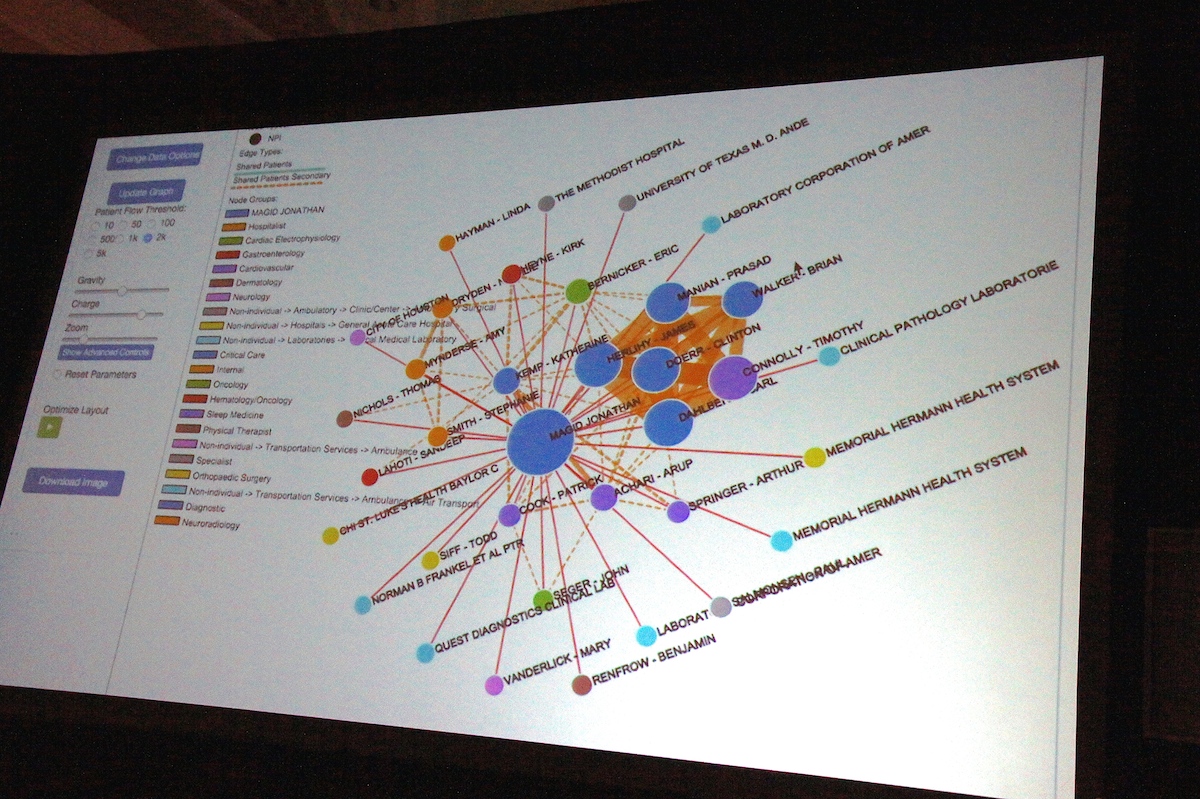
They tore it up. Fred demo'd some excellent interactive graphics derived from publicly released Medicare claims data.


The hope and expectation is that myriad private sector researchers will be able to effectively mine "liberated public data" in ways that HHS would never get around too.


HHS is lucky to have the smart, savvy, and humane Susannah Fox on board. If anyone can move the needle on Health IT innovation support inside HHS, it is Susannah. And, Fred! Dude is a walking diamond mine of raucous insight. I hope they video'd that session, and make it available.

Fred in 2012:


UPDATE

Susannah and Fred's session was captured on video.


CODA

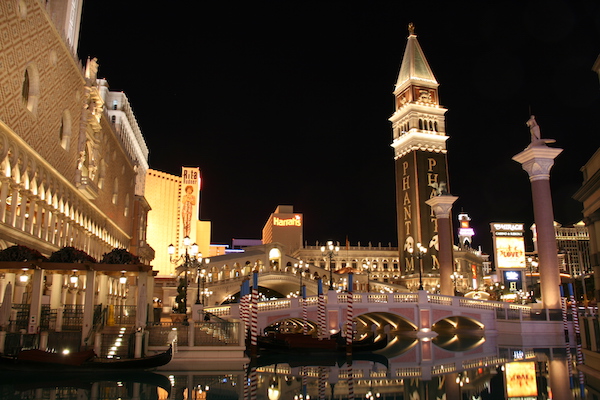
Leaving the Venetian garage at dusk.


This was funny


___________

More to come...