Search the KHIT Blog

Showing posts sorted by relevance for query The Age of Grievance. Sort by date Show all posts

Thursday, July 11, 2024

The Age of Grievance

“Measuring misfortune is no strategy for living.”
 
Click
2, A Good Word Spoiled

Not all grievances are created equal. I want to say that again. I want to be clear. And not all expressions of grievance raise identical concerns. Some don’t raise any at all. There are wildly disproportionate outbursts, mildly disproportionate outbursts, and ones scaled defensibly and even commendably to their trigger. There is January 6, 2021, and there is everything else. Attempts by leaders on the right to minimize what happened that day and lump it together with protests on the left are as ludicrous as they are dangerous.

What’s more, the fruits of the grievances on the left don’t match the fruits of the grievances on the right, and for all the talk about how illiberal both camps have become, it’s the right that currently poses the much greater threat to the country, both in terms of its disregard for democratic institutions—for democracy itself—and the behavior it provokes, sanctions, and sometimes even glorifies. The foiled plot to kidnap and possibly assassinate a prominent elected official, Michigan governor Gretchen Whitmer, was hatched by right-wing terrorists. It’s Marjorie Taylor Greene, an enormously popular right-wing lawmaker, who’s infamous for statements such as one in a speech at a gala for the New York Young Republican Club in December 2022, when she made light of January 6 by saying, “I will tell you something. If Steve Bannon and I had organized that, we would have won. Not to mention, it would’ve been armed.”

It’s Ron DeSantis, the Republican governor of Florida, who lashed out at the federal bureaucracy and indulged the darkest fantasies about the dimensions and depravity of the “deep state” by saying that if elected president, he’d “start slitting throats on Day One.” It’s Kari Lake, the failed Republican candidate for governor of Arizona in 2022, who seemed to be emulating Greene (what a thought) when she reacted to Trump’s federal indictment for treating classified documents like a personal stamp collection in June 2023 by saying: “If you want to get to President Trump, you are going to have to go through me, and you are going to have to go through 75 million Americans just like me. And I’m going to tell you, most of us are card-carrying members of the NRA.”

It’s Trump himself whose response to the far-ranging, grave legal predicament that he brought upon himself went beyond any sort of rebellion and resistance that a Democrat of comparable stature in modern times had called for. He waged an unfettered verbal assault on the American government and issued an unqualified vow to demolish certain American institutions. As the indictments rolled in, as the civil trials in which he was a defendant commenced, and as his fury pinballed from one courtroom and judge to another, his language grew ever darker, ever more dangerous. He labeled the Department of Justice, the FBI, and other byways of the federal bureaucracy in general and the Biden administration in particular “a sick nest of people that needs to be cleaned out immediately,” “fanatics,” “fascists,” and “sinister forces” who were engaged in “vicious persecution.” No, no, make that “demented persecution.” He called Letitia James, New York’s attorney general, a “monster” and, on the first day of his civil trial on the fraud charges that she’d brought against him, publicly stated that people “ought to go after this attorney general.” That chilling directive belonged to a lengthening sequence of violent musings, including his insinuation that General Mark Milley, the chairman of the Joint Chiefs of Staff during Trump’s presidency, should be executed for treason and his recommendation, during a speech to California Republicans, that shoplifters be shot as they left stores. His remarks increasingly amounted to sputtering thesauruses of thuggery with which he seemed to be pledging bloody payback. As Andrew Coyne, a columnist for the Globe and Mail of Toronto, wrote: “This is not the reaction of a normal person. It is not even the reaction of a mob boss. It is the reaction of a Batman villain.”

And that was before Trump used the occasion of a Veterans Day speech in New Hampshire in November 2023 to say that if he won the presidency anew in 2024, he would “root out” what he referred to as “radical left thugs that live like vermin within the confines of our country.” Challenged about the echoes of Nazism and fascism in that pledge, a Trump campaign spokesman defended it, exulting that the “sad, miserable existence” of its critics “will be crushed when President Trump returns to the White House.” The tenor of that vow matched the totalitarian fantasies of Trump, his advisers, and his allies, who envisioned and made plans for a federal workforce meticulously stocked with Trump loyalists and an army of federal prosecutors intensely focused on Trump’s enemies.

What’s more, there’s no left-wing analogue to Fox News, no media enterprise of commensurate reach that consciously pursued a commercial strategy of lying to its viewers, as Fox did about one of the most consequential matters of all: who won a presidential election in the most powerful country on earth. That’s what led to the settlement with Dominion, a maker of voting machines and the butt of hour upon hour of Fox programming that aired baseless claims—claims that Fox’s hosts and executives knew to be laughable: that those machines were rigged to switch votes from Trump to Biden.

But it’s also true that on both sides of the political divide, there’s a quickness to grievance, a tendency among many people to identify themselves and interpret events in terms of past, current, and looming hurts. There’s a psychological and emotional impulse—a way of approaching and assessing the world—that transcends partisan affiliation. It’s not so much bipartisan as it is pan-partisan or supra-partisan, and it’s getting worse. It exiles nuance. It rejects the kind of triage that a checks-and-balances government, which can deal with only so much so quickly, must do, even as it lengthens the odds of that government being able to do anything at all. It places personal over public interest. It turbocharges conflict.

That was one of the saddest revelations of the coronavirus pandemic, which posed a threat so universal and dire that it should have put the usual animosities on ice. At the start, I naively thought—or, more accurately, hoped—that it would. As we confronted a previously unthinkable shutdown of life as we knew it and fumbled our way through remote work, contactless grocery shopping, virtual family get-togethers, and the whole surreal rest of it, I wondered whether the suspension of normalcy would include an abnormal (but welcome!) discovery of the kind of solidarity that the country had experienced for a brief period after the terrorist attacks of September 11, 2001, when President George W. Bush suddenly had an approval rating north of 85 percent. (The intensely pitched debates about national security versus civil liberties and about the wisdom of invading Iraq came later.)

But much had changed in the nearly two decades between the shattering of the World Trade Center and the shuttering of all of New York City, and by 2020, national solidarity was a political yeti. Battle lines were quickly drawn. Rival camps promptly emerged: people who wanted to err on the side of epidemiological caution and those who felt that individual preference took precedence over any government edict, no matter how well intentioned, especially given how fledgling and fluid our understanding of the pandemic was; people who gave experts the benefit of the doubt and those who rebelled against what they saw as facile groupthink; people who instinctively admired Dr. Anthony Fauci and people who reflexively abhorred him; masking evangelists, some of whom muttered the wish that the virus would winnow the ranks of the reckless, and masking apostates, for whom all the shutting down and covering up was rank liberal opportunism…


Bruni, Frank. The Age of Grievance (pp. 13-17). Avid Reader Press / Simon & Schuster. Kindle Edition. 

So, I was randomly working away online yesterday when an Amazon book recommendation pinged into my inbox. Being long familiar with and a NY Times reader fan of Frank Bruni, I clicked.

About ten pages into the "look inside" preview. I'd seen enough. Notwithstanding that I already still have a good half-dozen fine books in play, this was/is too good to pass up. Download with 1 Click.

Do yourselves a serious favor. Read this book. In light of our most recent events, it could not be more timely. Beyond that, his writing style has me repeatedly, painfully laughing out loud. Dude, yer killin' me.
Peeps, didja all know that, if you are routinely successful at reining in your High Dudgeon Outrage Reflex, you are guilty of snooty Woke Liberal Grievance Able-ism.
ERRATUM
 
Anxiously awaitng.
 
And, I would be fine with this.
POST-PRESSER RECAP


More shortly...
 _________
  

Sunday, August 25, 2024

As we turn toward the U.S. Nov 5th elections final approach,

we would do well to get all up in our Brill.
  

This book just came to my attention yesterday, while reading a review of another title. It jumped my queue, and, I'm now a good way through it. It is so timely.


I've cited the work of the astute Steven Brill multiple times across multiple posts previously.
 
 
Relatedly, how about some Tom Nichols, "The Death of Expertise?"
 
 
See also my prior riffs on disinformation.

UPDATE: MORE FROM UP IN OUR BRILL
Here is a selection of the completely false stories that appeared online and gained traction on social media platforms around the world over just a four-week period beginning in mid-June 2023. These and many more added to the debris that was already online in a vaster, much worse, wasteland:
Deaths blamed on bird flu were actually caused by cell phone radiation; U.K. government report shows COVID-19 vaccines caused five hundred excess heart disease deaths weekly; the World Economic Forum called for a new Bible written by artificial intelligence; elderberries are more effective protection against flu than a vaccine; Disney-Pixar animation movies contain hidden references to adrenochrome, a chemical product from adrenaline that QAnon conspiracy theorists say is harvested from blood trafficked for its anti-aging chemicals; the Iwo Jima memorial will be updated to feature the Pride flag; a photo has surfaced of Aileen Cannon, the federal judge presiding over the Trump national security documents case who is thought to favor Trump, at a Trump campaign rally in Pennsylvania; Brendan Whitworth, the chief executive officer of Anheuser-Busch, is a CIA operative; the actor Jamie Foxx was left blind and paralyzed by a COVID vaccine; no Amish children have been diagnosed with chronic conditions like cancer, diabetes, or autism because Amish children do not get vaccinated; NATO was behind the Wagner Group rebellion in Russia; electric cars have been spontaneously combusting throughout Europe; Target is selling satanic clothing; the 2023 Canadian wildfires were caused by arsonists wanting to promote fear of climate change; a whistleblower with the Ukrainian energy company Burisma was found dead; Michelle Obama is transgender; Vladimir Putin ordered the destruction of COVID-19 vaccine stockpiles in Russia; John Kerry said U.S. farms could be confiscated by the government to fight global warming; photos from the humiliating invasion of Beijing in 1900 by eight countries, including the United States, are displayed in a U.S. military classroom; a video shows a U.S. soldier opening a gate and allowing immigrants to illegally cross the border; the World Health Organization confirmed that COVID-19 vaccines can induce multiple sclerosis; the Italian food company Barilla withdrew its pasta due to insect contamination; California law allows kids to receive gender-affirming procedures without parental consent; the Presidential Records Act allows outgoing presidents to retain classified documents; a video shows Maricopa County election officials breaking into voting machines; U.S. missiles in Ukraine are trafficked to Mexican cartels; Europe and the U.K. are offering citizenship to mercenaries who fight in Ukraine; Ontario doctors suggested the unvaccinated should be given psychiatric medication; Antarctic and Greenland ice sheets are not melting; a Washington state law allows the government to take children from the custody of parents who do not let their children get gender-affirming surgery; the Ukrainian intelligence chief is in a coma in Germany; Bill Gates is funding a new Chinese pathogen that will sicken Americans.
Again, this is new material that got traction on the internet over just a four-week period in 2023. — Whether it is a matter of be: by the legitimate businesses that are the essence of a free market economy, people around the world are contending with a sea of misinformation and disinformation aimed at triggering their insecurities, exploiting their grievances, and drowning out the trustworthy sources that they once relied on. This modern information environment has shattered trust, laying the groundwork for those hoping to thrive when enough people believe nothing or are willing to believe anything. [The Death of Truth, pp 98-100]
"Flood the zone with shit"—Steve Bannon
 
MONDAY PM UPDATE
 
I finished The Death of Truth. A riveting read. It could not be more timely. 

Over the last two decades we have seen the center eroded. The truths and trust shared by those in the center eroded, too. When government stopped working for people in that center, they drifted off to the fringes, lured by the fringe information they were barraged with online. Like so many of the rioters who stormed the Capitol or people who refused a safe vaccine, they became vulnerable to the false promises promoted by the demagogues, hucksters, and conspiracy theorists that the algorithms were steering them to. 


[In  chapter 15] we have listed the practical ways that governments can step in to make the internet a calmer, safer place. If that happens and if, at the same time, those who have been lured to the fringes begin to see their elected officials—given attention by calmer, more trust-building online content—working together and actually getting things done, the disaffected and the alienated will be less cynical and less likely to sign on to the demagogues’ alternatives. If some of what these center-oriented officials get done is in areas where there is dire need and broad consensus—such as initiatives aimed at fixing immigration or public education, creating a fairer tax system, or addressing elder-care and health-care costs—public cynicism and vulnerability to those bad actors and their toxic misinformation barrages will likely recede further. This could create a virtuous cycle in place of a downward spiral. Those who have been lured to the fringes will start to believe again in democracy, in government, and in other institutions and experts. They will be less likely to believe that the world is full of conspiracies that threaten them. 


They will start to believe in truth again. [The Death of Truth, pg. 236]

The final chapter (15) discusses Steve's broad range of promising tech and political reforms. The latter include  things such as "top two," "ranked choice" elections voting mechanisms, and direct plebiscite ballot referendum initiatives to counter and/or mitigate the pernicious effects of gerrymandering and deep-pockets dark money PACs. While I find that all intriguing, I cannot shake my abiding concerns going to interference by courts stuffed with reactionary FedSoc judges.


In any event, Steven Brill rocks. And, this book harks to a number of prior post relevant topics:
Just to cite a few (click any headline). Below, a conversation with the author.


TUESDAY UPDATE
 
Generally apropos of this overall riff? My daily stop at The Atlantic turned this up.

When the coronavirus pandemic started, the media scholar Lilie Chouliaraki, who teaches at the London School of Economics, knew she’d have to be more careful than many of her neighbors. A transplant recipient and lymphoma patient, she was at very high risk of serious illness. In her new book, Wronged: The Weaponization of Victimhood, she writes that rather than feeling victimized by this situation, she was grateful to have the option of sheltering in place. Still, as the pandemic wore on and opponents of masking and social distancing in Britain—as well as in the United States and many other nations—began to claim that they were victims of government overreach and oppression, Chouliaraki grew both confused and compelled by the role that victimhood language was playing in real decisions about the degree to which society should reopen.
 
COVID isn’t the only recent context in which victimhood has gotten rhetorically vexing. At the height of #MeToo, in 2017 and 2018, the U.S. seemed to engage in a linguistic battle over who got to call themselves victims: those who said they had suffered assault or harassment, or those who stood accused of committing those offenses. In Wronged, Chouliaraki links this debate to pandemic-era arguments about public health versus personal freedom in order to make the case that victimhood has transformed into a cultural trophy of sorts, a way for a person not just to gain sympathy but also to accumulate power against those who have wronged them. Of course, people call themselves victims for all sorts of very personal reasons—for example, to start coming to grips with a traumatic experience. But Chouliaraki is more interested in the ways victimhood can play out publicly—in particular, when powerful actors co-opt its rhetoric for their own aims.

Central to Chouliaraki’s exploration is the distinction she draws between victimhood and vulnerability. She argues that victimhood is not a condition but a claim—that you’re a victim not when something bad happens to you, but when you say, “I am wronged!” Anyone, of course, can make this declaration, no matter the scale (or even reality) of the wrong they’ve suffered. For this reason, per Chouliaraki, victimhood should be a less important barometer for public decision making than vulnerability, which is a condition. Some forms of it are physical or natural, and cannot be changed through human intervention. As a transplant patient, Chouliaraki is forever more vulnerable to illness than she used to be. Other sorts of vulnerability are more mutable. A borrower with poor credit is vulnerable to payday lenders, but regulatory change could make that untrue (or could make payday loans affordable). Such an intervention, crucially, would protect not just present borrowers but future ones. Focusing on vulnerability rather than victimhood, she suggests, is a better way to prevent harm…
Just what I need—another book dropped into the endlessly accruing pile.


We'll see how this coheres with Frank Bruni's The Age of Grievance. Ahhh... "victimhood."

Ever heard of the "Rescuer-Victim-Persecutor Triangle?" The "scripts people live?"


Steiner's book was the first one Cheryl and I read together in 1974 at our outset. It has aged rather well, IMO (It's been updated / re-issued w/ a new Forward, BTW).
Short take: To the extent you live a "scripted" life (your socially shaped "persona"), you are not "free" (in the moral agency sense). Don't know about you, but I've spent most of my 78+ years laboring to unlearn that shit.
Of late I can think of no more poignant "Victims" than those of our Poor Oppressed Majority of the Heritage Christian Nationalist Project 2025 drama.
 
LILIE CHOULIARAKI UPDATE

This woman personifies the word "scholar" at its best.
THE PLATFORMIZATION OF PAIN

Although our languages of pain are deeply grounded in the past, there is nonetheless something irreducibly new about the uses of victimhood today. The platformization of pain—that is, the performance of vulnerability on and through the commercial logic of social media platforms—has transformed the premises upon which victimhood is now claimed. It has done so in two ways: by reorganizing the communicative politics of pain and by expanding the realms of suffering in which victimhood can be claimed.

To begin with, platformization has enabled everyone with a mobile phone and a social media account to broadcast their pain to the 4.48 billion users across social media platforms. Such openness on internet platforms had earlier been greeted as a democratizing move, where marginalized groups found a way to voice their suffering and mobilize social forces for political change. Merlyna Lim, for example, had early on argued that to understand the massive Arab Spring protests of 2011 against the Hosni Mubarak regime, we need to explore the online habits of Egypt’s oppositional youth. Their engagement with Facebook and Twitter, she said, gave them “the means to shape repertoires of contention, frame the issues, propagate unifying symbols, and transform online activism into offline protests.”

In the course of the past decade, however, most scholars became ambivalent about this potential. Rather than a matter of benign technological connectivity, they contend, such expansion of voice has been driven by digital platforms’ corporate interests, which capitalize on user attention and engagement for profit. This means that even though social media platforms continue to make a difference, for instance in the case of the hashtag #MeToo, where they amplified women’s voices about their experiences of violence and abuse, they often do more harm than good. A sinister counterexample that makes the point is the emergence of misogynistic activisms that claim victimhood in order to legitimize violence against women. In this context, Alice Marwick and Robyn Caplan discuss the “manosphere,” a male-only community in websites such as incels.com that spreads its “misogynistic ontology by portraying feminism as a man-hating movement which victimizes men and boys” and that uses this portrayal as an excuse for attacking women. Such groups instrumentalize the communication of pain to turn women into wrong-doers who sexually manipulate their “vulnerable and innocent victims.” This online amplification of misogyny, critics argue, should be seen not only as a matter of patriarchal ideology but also as a matter of the algorithmic logic of platforms that in the pursuit of profit maximize the visibility of any claim to pain so as to monetize user attention: “The misogynist manosphere,” as Molly Dragiewicz and her colleagues’ research shows, “is significantly empowered by the ability to exploit the affordances and algorithmic characteristics of the contemporary digital media environment.”

The platformization of pain, to summarize, does not simply disseminate content but further reorganizes the communicative politics of pain in terms of how and by whom claims to pain are made, who gets the most visibility, and which online communities get legitimized and empowered or not. At the heart of this process lie the platforms’ technosocial architectures, specifically their capacity for anonymous and automated connectivity, which enables competing claims to pain to proliferate online, disconnected from their conditions of emergence—that is, both from the identity of the claimant (through anonymity) and from the context of the claim (through automation)—and so further dismantles the distinction between sufferer and perpetrator. At the same time, the platforms’ orientation toward virality—quantifying user engagement by response counts (retweets, likes) and size of communities (followers)—amplifies already popular claims to suffering without asking questions about who makes them or in which contexts of violence those claims are made. As José van Dijck puts it, “There is no quality assessment built into these [app] buttons[, so that] online quantification indiscriminately accumulates acclamation and applause and, by implication, depreciation and disapproval.”

Beyond restructuring the communication of victimhood, platformization has also expanded the realms of vulnerability within which claims to pain can be made. Digital violence, particularly in the form of online hate speech, has today extended these realms of suffering in that as hate speech goes online, it transfers already existing claims to trauma or injury onto social media platforms…
[Chouliaraki, Wronged, pp. 30-33]
Jus' sayin'. Read her Sheet.
 
Scholar. Eminently so. LSE is lucky to have her.
 
More to come..
_________
  

Friday, February 21, 2020

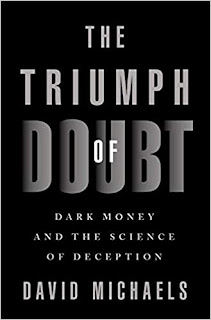
"Deliberation Science," meet "Deception Science"

"A government insider exposes the industry playbook for undermining evidence-based policy."

Reviewed in my latest Science Magazine. Had to get it.

https://www.amazon.com/Triumph-Doubt-Money-Science-Deception-ebook/dp/B082VD4GHK/ref=pd_ybh_a_11?_encoding=UTF8&psc=1&refRID=RAVDG70XVF23NBR4S99E
At the dawn of a new decade and in a pivotal election year, we face unprecedented challenges that threaten the environment, public health, and security. Meanwhile, dark money is being funneled through powerful lobbyists, plaguing the process of enacting informed, evidence-based policies. David Michaels's new book, The Triumph of Doubt, is a tour de force that examines how frequently, and easily, science has been manipulated to discredit expertise and accountability on issues ranging from obesity and concussions to opioids and climate change.

Michaels is the quintessential voice on the influence of special interests in policy-making and government inaction. An epidemiologist and professor of environmental and occupational health at George Washington University, he spent 7 years leading the U.S. Occupational Safety and Health Administration (OSHA) under President Obama and previously served as President Clinton's assistant secretary of energy for environment, safety, and health.

His book offers account after account of unethical bad actors working against the public good on issues ranging from asbestos to climate change. Powerful firms and individuals seeking personal gain repeat the tactics of a well-worn playbook of denial and misdirection proven effective by Big Tobacco more than 50 years ago. Michaels pulls no punches, naming the corporations and people responsible for fraud, deception, and even what he terms “climate terrorism.” He reveals the dirty ways that industries have succeeded at shaping their own narratives regarding safety and health by producing articles and diversions designed to deny and distort science while confusing the public…

Every chapter is deeply disturbing yet feels familiar because the tactics—and at times even the actors—are the same. The book will, and should, infuriate readers and serve as a call to action to demand more government oversight and regulation on health and safety issues that affect every citizen regardless of party affiliation.

Michaels begins the final chapter by acknowledging that capitalism has the capacity to produce extreme wealth and economic development at a cost to our health and the environment. The book closes with a sense of unease and urgency, offering practical steps to strengthen U.S. regulatory oversight, provide more funding transparency, and increase corporate accountability.

Only when we begin to recognize the abuse of power that is rampant in decisions that affect the health and safety of our families and communities will we understand our necessary role in demanding scientific integrity in policy-making…
You even get reviewed in Science Magazine, you tend to have presumptive cred; they don't waste space on weak stuff. I'm almost done reading it. Stay tuned. It's excellent.

"Deliberation Science?" Is that a thing?

See also "Define science."

David Michaels concludes:
Regulation Defends Capitalism
The catalog of horrors that has necessitated the growth of America’s public health regulatory system is long. It includes everything from the conditions in Chicago’s slaughterhouses (exposed by novelist Upton Sinclair in The Jungle) to cigarettes and asbestos to climate breakdown and the widespread PFAS contamination of drinking water. In each case, corporations making a product caused damage and externalized the costs. Litigation is typically valuable in redressing the public’s grievance, but it is not sufficient for changing the root issues, in part because litigation always occurs after the fact. By the time the lawsuit is filed, too many people have been sickened, or maimed, or killed—to say nothing of how the environment has been desecrated. 

Our regulatory system is the response to these market failures. The objectives of the new laws and the agencies empowered to enforce them is not only to stop the damage and prevent future harm; it is to maintain and strengthen the free market system. Although many advocates of free market economics refuse to acknowledge this dynamic, law and regulation are the underpinnings of our economic system. They define market structure and property rights while attempting to ensure that property rights don’t intrude on personal liberties. Without the regulatory apparatus of the state, our modern economy could not exist. The state fosters a safe space for market growth.

We all value freedom, in particular the freedom to live the lives we choose. But this is not possible unless we are secure from being harmed by others, and in our modern world we individuals cannot bargain with the factory owner or the manufacturer of contaminated food. We generally have little or no knowledge of the effects of a given exposure, or sometimes that such exposures are even occurring. It is our elected representatives and officials who must enact and enforce laws that protect us from individual and collective harm—from violence and from robbery, but also from dangers posed by tainted food, polluted air and water, unsafe drugs, and dangerous workplace exposures.

Science underpins all of these public health and environmental protections. The basic principle of the regulatory system holds that decisions must be made on the basis of the best evidence available at the time. Product defense science doesn’t just game our free-market system; it prevents our government from accomplishing one of the reasons for its very existence. It is often unrecognized because it is so ingrained in our understanding that a primary government function is to facilitate some individuals (including the owners of corporations) to benefit by producing or performing something that does not impinge on the freedom and well-being of other individuals. This is the basis of the criminal justice system, as well as our system of public health and environmental protections. We want stronger regulation not because we don’t care about freedom, but because we cannot be free without the state’s protection from harm. We need to know that our air is safe to breathe, that our food is safe to eat, and that we can return home from work at the end of our shifts no less healthy than when we walked out the door in the morning. That is both the imperative and, alas, the challenge.

Michaels, David. The Triumph of Doubt (pp. 270-272). Oxford University Press. Kindle Edition.
I will have a lot more to say shortly once I finish.

UPDATE

Finished.  Table of Contents:
  1. Introduction
  2. The Science of Deception
  3. The Forever Chemicals
  4. The NFL’s Head Doctors
  5. A Spirited Denial
  6. The Deal with Diesel
  7. On Opioids
  8. Deadly Dust
  9. Working the Refs
10. Volkswagen’s Other Bug
11. The Climate Denial Machine
12. Sickeningly Sweet
13. The Party Line
14. Science for Sale
15. Future in Doubt

Disclosures and Acknowledgments
Notes
Index
An important read. Although my wife and I have worked in highly regulated domains since the 1980s--FAA, EPA, DOE, NRC, OSHA, HHS, OCC, FDIC--and are fairly up to speed on regulatory processes and issues, I learned some great new stuff on the tactics and strategies of the "product defense" lobby industries.

Dr. Michaels is definitely cutting against the current de-regulatory neoliberal grain, which prioritizes the privatization of corporate profits concomitant with the socialization of risks and losses (dramatically accelerated under the Trump administration). I am reminded of a couple of recent reads.

to wit:
In a seminal study, Naomi Oreskes and Erik Conway have reconstructed the attempts of a handful of scientists, aligning themselves with corporate and political interests, to obscure scientific findings and limit their impact on democratic decision-making processes by spreading doubt in the public sphere.48 An essential ploy was to distract people’s attention from the core facts to marginal issues, for example, by discussing the role of volcanos rather than the effects of anthropogenic air pollution. This strategy (involving massive lobbying activities as well as corporate-funded research) was first successfully practiced in the 1950s with regard to the health risks of tobacco and was then reiterated and refined for other issues such as acid rain, the ozone hole, and climate change. It cynically exploits the open-ended nature of scientific discourse to create the impression that it is always too early to make such drastic decisions as prohibiting smoking in certain environments, stopping the use of CFCs, or limiting the emission of greenhouse gases. 

But why can this strategy work at all? It profits, first of all, from the highly differentiated division of labor in modern societies. Science is a complex societal subsystem, seemingly of little direct concern to most of the rest of society. One of its visible interfaces with society is an oversimplified image of knowledge shaped by past experiences, as well as by ideologies. In the United States, in particular, it has been influenced by the experience of the Cold War and neoliberal convictions: society-at-large relies on science when it comes to military challenges, to conquering new frontiers, and to securing commercial superiority. Science, essentially, is an asset in competitive situations, where it is expected to produce technical solutions. 

From the perspective of this image of knowledge, the warnings of critical scientists of the unintended side-effects of industrial, technological, or scientific developments appear to be a transgression of their natural sphere of activity; they mingle with politics and create problems, rather than delivering tangible solutions, optimally, in the form of technology. Against this background, it becomes easy for their opponents to cast doubt on their results, and even on their personal integrity, and to call for further, “more serious” research before any actions are taken that do not belong to the sphere of technology but to the sphere of societal regulations. Counteracting the strategic spread of misinformation therefore requires critical engagement with problematic images of science as well as with the economy of knowledge through which scientific knowledge (and misinformation) are shared within society, as has recently also been argued in a contribution to the journal Nature Climate Change:
As science continues to be purposefully undermined at large scales, researchers and practitioners cannot afford to underestimate the economic influence, institutional complexity, strategic sophistication, financial motivation and societal impact of the networks behind these campaigns. The spread of misinformation must be understood as one important strategy within a larger movement towards post-truth politics and the rise of “fake news.” Any coordinated response to this epistemic shift away from facts must both counter the content of misinformation as it is produced and disseminated, and (perhaps more importantly) must also confront the institutional and political architectures that make the spread of misinformation possible in the first place.
As it turns out, only a small fraction of the funds invested into research and development worldwide are dedicated to the augmentation of public knowledge. And even publicly funded research may suffer from constraints and path dependencies imposed by political or economic interests, or by the academic system itself—encouraging, for instance, a concentration of research on mainstream topics, with the danger that precisely the knowledge required to deal with the challenges of the Anthropocene may fail to be generated or publicly shared. What currently prevails is an “oligopolization of knowledge: when few know much, and many know little.” This oligopolization of knowledge is, of course, conditioned by the oligopolization of power—and vice versa. The risk is that the innovations necessary to meet the challenges of the Anthropocene are stymied, in particular when they present themselves in forms that may require locally adapted solutions rather than universal prescriptions. 

One example of the lack of research on key topics is the way in which the global challenges of disease are being addressed. Diseases are not only part of biological evolution; they are also part of cultural evolution, and they are becoming a challenge of epistemic evolution as well. They have emerged, for instance, from contact between humans and animals in domestication processes. One such example is smallpox, which was transferred from rodents to humans some millennia ago in the age of the Neolithic Revolution. Today global traffic, global nutrition chains, and global inequality of living conditions have set a new stage for the emergence and spread of bacterial and viral diseases. Diseases may constitute challenges that affect societies and economies on a global scale, even if they do so in extremely different ways in different parts of the world. While human health is probably better now than at any other time in history, this progress may have come at the price of degrading the environment and thus at the cost of future generations; and it may now be threatened by the consequences of our interventions in the Earth system. Knowledge produced in the traditional mode (as a by-product of cultural evolution through basic research and market-driven innovations) may turn out to be inadequate to cope with these challenges.

Renn, Jürgen. The Evolution of Knowledge (pp. 392-393). Princeton University Press. Kindle Edition.
Human affairs inexorably get "regulated" one way or another. Apologies to my "Libertarian" friends.

A note on law and "regulation." Trump fatuously never tires of touting his talking-point insistence that "for every new regulation issued, at least two existing ones must be eliminated."

The bulk of federal regulations are "statutory" in nature, authorized "as the Secretary shall determine" in passed and signed legislation. Think of laws as "policies" and regulations as "procedures." The policies (laws) set forth the "what" and the "why." The procedures (regulations) specify the "who/how/where/when" actions via which to administer the laws. Federal regulations cannot legally exceed the scopes of the parent laws. When they do, they are quickly challenged and struck down or modified.

Are there ineptly promulgated laws and regulations? Of course. The remedy is to make them more rational, focused, and effective, not simply do away with them. Again, human affairs get regulated one way or another.
If there were only one man in the world, he would have a lot of problems, but none of them would be legal ones. Add a second inhabitant, and we have the possibility of conflict. Both of us try to pick the same apple from the same branch. I track the deer I wounded only to find that you have killed it, butchered it, and are in the process of cooking and eating it. 

The obvious solution is violence. It is not a very good solution; if we employ it, our little world may shrink back down to one person, or perhaps none. A better solution, one that all known human societies have found, is a system of legal rules explicit or implicit, some reasonably peaceful way of determining, when desires conflict, who gets to do what and what happens if he doesn’t.

Friedman, David D.. Law's Order: What Economics Has to Do with Law and Why It Matters (p. 3). Princeton University Press - A. Kindle Edition.
UPDATE: THE LATEST ON BEING "DATA DRIVEN"

On deck. apropos of this post.
https://www.amazon.com/Power-Experiments-Decision-Making-Data-Driven-ebook/dp/B084P2SD7Y/ref=tmm_kin_swatch_0?_encoding=UTF8&qid=&sr=
Per The New Yorker.

The Amazon blurb:
How organizations—including Google, StubHub, Airbnb, and Facebook—learn from experiments in a data-driven world.

Have you logged into Facebook recently? Searched for something on Google? Chosen a movie on Netflix? If so, you've probably been an unwitting participant in a variety of experiments—also known as randomized controlled trials—designed to test the impact of different online experiences. Once an esoteric tool for academic research, the randomized controlled trial has gone mainstream. No tech company worth its salt (or its share price) would dare make major changes to its platform without first running experiments to understand how they would influence user behavior. In this book, Michael Luca and Max Bazerman explain the importance of experiments for decision making in a data-driven world.

Luca and Bazerman describe the central role experiments play in the tech sector, drawing lessons and best practices from the experiences of such companies as StubHub, Alibaba, and Uber. Successful experiments can save companies money—eBay, for example, discovered how to cut $50 million from its yearly advertising budget—or bring to light something previously ignored, as when Airbnb was forced to confront rampant discrimination by its hosts. Moving beyond tech, Luca and Bazerman consider experimenting for the social good—different ways that govenments are using experiments to influence or “nudge” behavior ranging from voter apathy to school absenteeism. Experiments, they argue, are part of any leader's toolkit. With this book, readers can become part of “the experimental revolution.”
_____________

More to come...

Thursday, July 18, 2024

The incoming Trump47 Secretary of Retribution

via The New Republic
Conservative political activist Ivan Raiklin claims to have assembled a “Deep State target list” that includes high-ranking Democrats and Republicans, U.S. Capitol Police officers, officials at the FBI and other intelligence agencies, witnesses in Trump’s impeachment trials, and journalists at The New York Times, CNN, The Washington Post, and other news outlets. Their supposed crime? Being Trump’s political enemies. And Raiklin views himself as justice incarnate.

During one podcast appearance earlier this year, Raiklin said his nickname was the “deep state marauder, a.k.a. the mauler.” Raiklin’s plan for what to do with his list isn’t nearly as gruesome, but it is still terrifying. He intends to enlist right-wing sheriffs to carry out mass arrests, and in May, he declared his intention to arrange “livestreamed swatting raids.”

Raiklin reportedly claims that if he went public with all of the so-called evidence he collected on Trump’s enemies in the deep state, it would be probable cause to arrest those high-ranking officials and journalists on his list.

Those arrests would be carried out by “constitutional sheriffs,” specifically a right-wing anti-government group called the Constitutional Sheriffs and Peace Officers Association. Those sheriffs would then deputize the 75,000 veterans Raiklin claims were dismissed from the military for refusing to comply with Covid-19 vaccine mandates, forming a rogue army intent on revenge…

Former Sheriff Richard Mack, who leads the Constitutional Sheriffs group, told Raw Story that he had severed ties with Raiklin in early June and did not approve of his rhetoric. “Quite frankly, he talks about that list of 350 people—I’m sure they can afford lawyers,” said Mack. “It reeks of lawsuits, and it doesn’t follow due process.”

Raiklin has also emailed sheriffs’ offices across the country hoping to enlist them to his cause. Not one has signed on, according to Raw Story.
Recall how Donald Trump has repeatedly promised his MAGA fans "retribution." This dude is a real piece of work.
 
GOP CONVENTION ERRATUM
 
 
I.Just.Can't.Do.Any.More...
 
I'd intended to stay up and her JD Vance's VP nomination speech. Decided it would be pointless. 


OTHER NEWS...

My latest issue of Science Magazine.
 
JULY 18TH GOP CONVENTION PRIME TIME CONCLUSION
 
In the wake of a sorry parade of MAGA D-list celebs—including Hulk Hogan, Dana White, Kid Rock, Tucker Carlson, Lee Greenwood—Donald Trump came out and babbled on for 93 minutes. Same litany. The less said about it the better.

One charming erratum: Son Eric Trump spoke to introduce his Dad, and claimed that his father "built the New York skyline."
 
Right. Sure.
 
Also, one musical performer was bumped from the final evening performance schedule after the Heiitage Foundation President learned of his religious beliefs.
 

Kid Rock was much more fitting.

BACK ON TASKS

I finished Frank Bruni's important book The Age of Grievance, and, in addition to several others still in play, I'm back onto the compelling book The AI Mirror.
 
If the image of AI as an imminent destroyer or supplanter of human dominance and supremacy were only a looking-glass fantasy—a flight of misplaced imagination, serving as a creative template adapted by generations of science fiction writers, then perhaps we could just enjoy it for its imagined possibilities. iRobot is a thrill! The Terminator is a lot of fun. The Matrix is a gas. Ex Machina is spellbinding. Westworld is mind-blowing (often literally—minds get blown open quite a lot)!

But in fact, the looking-glass illusion these entertaining fictions reflect is being leveraged today by billionaires, lobbyists, and powerful AI companies to directly influence and reshape public policy, scientific research priorities, venture capital investment, and philanthropic giving. It is being placed in service of movements to defer action on real and imminent existential threats—from climate change and ocean acidification to global pandemics and food insecurity—in favor of lavish funding for research on long-term AGI risk, which these powerful interests now claim outstrips all other dangers. The new tech-centered movement of longtermism, which grew out of an earlier movement called effective altruism, has put forth in many powerful academic, policy, and media circles the idea that AGI presents an incalculably greater threat than even climate change. Many longtermists now argue that the most prudent use of philanthropy and public resources for long-term human benefit is to invest more heavily in AGI risk and AI safety research. Yet it is not the safety of living humans today, or even the next generation, that drives longtermists.

Longtermist arguments often go as follows: because AGI in the far future could theoretically kill or immiserate even more living humans than are alive on the planet now, preventing future AGI from doing this is a more rational use of resources than funding clean energy tech, food security, or public health today. Related claims made by some longtermists include the idea that saving the future requires directing even more of today’s resources toward the wealthy in the Global North, rather than sending aid to the most impoverished countries in the Global South, since wealthy people in already disproportionately wealthy regions are better positioned to use their resources to fight these “existential” risks from AGI.

Longtermism is rooted in utilitarian ethics, a brand of moral theory that has long driven effective altruists to the contemporary work of philosopher Peter Singer. Utilitarianism, from its foundation in the nineteenth-century writings of philosophers Jeremy Bentham and John Stuart Mill to the AI-inflected writings of today’s longtermists, has always held that our first and highest moral duty is not to root out injustice, or cultivate virtue, or protect human rights and the planet, but rather to maximize the sum total of happiness that will be enjoyed in the future.

Peter Singer is widely admired for his vigorous defense of animal liberation on the grounds of their capacity to suffer, which subtracts from their happiness. He is less well known for his claims (still bitterly recalled by many disability activists) that it is ethical to kill so-called “defective infants” whose potential for future happiness he sees as severely compromised. What longtermists and effective altruists have in common with Singer is the utilitarian view that morality is a happiness optimization problem, a matter of running the numbers. Conveniently for AI enthusiasts, that makes morality just the sort of thing that computers and computer scientists are supposed to be good at!

For a virtue ethicist like me, there are profound dangers and moral errors in any view of morality that separates it from humane feeling, relational bonds, and social context, reducing it to a mere computation of net happiness units. As longtermist Eliezer Yudkowsky readily admits, this kind of fundamentalist utilitarianism licenses one to turn off moral feeling and just “shut up and multiply” happiness sums, even if the action dictated by the calculation feels deeply wrong or shocks the conscience. Some longtermists at Oxford’s Future of Humanity Institute (FHI) have used such license to entertain hypotheticals in which the welfare of billions of today’s suffering humans is dispassionately sacrificed for the potential to create far larger numbers of happy “digital people” in virtual worlds of the distant future. Others work out longtermist defenses of a related utilitarian view known as the Repugnant Conclusion: the proposal that given the option, it would be better to choose a world packed with people who all suffer so greatly that their lives are “barely worth living” than to choose a far more modest population of ten billion people who can all flourish.

These types of scenarios are often seen as compelling rebuttals to utilitarian logic. When taken instead as plausible moral obligations for humans, such scenarios are, as the philosopher and fierce critic of utilitarianism Bernard Williams famously said, the result of having “one thought too many.” Ideas like this did not dominate the early philanthropic thinking of effective altruists. From donating surplus personal wealth to the purchase of mosquito nets and other high-impact aid for the global poor, to investing in public health and climate resilience, much of what effective altruists initially tried to do is aligned with commonsense moral obligations to present and future generations. Even as the effective altruism movement merged with the more speculative AI fantasies of longtermism, many remained committed to fighting the existential threats already here: climate change, biohazards, and nuclear holocaust. As observed by a critic quoted in a 2022 profile on effective altruist and longtermist William MacAskill in The New Yorker, “If you read things that [effective altruists] are saying, they sound a lot crazier than what they’re actually doing.” If the more speculative AGI visions of longtermists were just intellectual side hustles for bored Oxford philosophers and Silicon Valley investors, we might think them harmless.

But today, longtermism is the language of moral thought spoken in a growing number of the wealthiest and most powerful political and industrial circles. Billionaires like Jaan Tallinn and Peter Thiel have been described as avid supporters, while Elon Musk, funder of the Future of Humanity Institute, has cited MacAskill as “a close match for my philosophy.” FHI Senior Research Fellow Toby Ord notes in his bio that he has advised “the World Health Organization, the World Bank, the World Economic Forum, the US National Intelligence Council, the UK Prime Minister’s Office, Cabinet Office, and Government Office for Science.” Ord was quoted to the UN General Assembly in a 2021 speech on climate by former British PM Boris Johnson. Nor do longtermists only seek influence in conservative political circles. FTX crypto founder and longtermist Sam Bankman-Fried was celebrated as a “megadonor” in US Democratic circles before being jailed on fraud charges, while longtermists in the UK formed a group called Labour for the Long Term to influence the Labour Party. Political influence is a core part of longtermist strategy. A 2022 position paper by Oxford’s Global Priorities Institute outlined their political case for institutional longtermism, the view that far-future considerations should dominate public policy and even our choice of political institutions, in contrast with longtermism as a personal philosophy for setting one’s own philanthropic priorities….

Vallor, Shannon. The AI Mirror: How to Reclaim Our Humanity in an Age of Machine Thinking (pp. 76-80). Oxford University Press. Kindle Edition.
"Longtermist arguments often go as follows: because AGI in the far future could theoretically kill or immiserate even more living humans than are alive on the planet now, preventing future AGI from doing this is a more rational use of resources than funding clean energy tech, food security, or public health today. Related claims made by some longtermists include the idea that saving the future requires directing even more of today’s resources toward the wealthy in the Global North, rather than sending aid to the most impoverished countries in the Global South, since wealthy people in already disproportionately wealthy regions are better positioned to use their resources to fight these “existential” risks from AGI."
My TwitterX reaction.
 
 
All apropos of my abiding core concerns.
 
 Stay tuned.
_________
  

Tuesday, July 7, 2026

Effective Dissent in our Age of Fear

    
I love Jacob Soboroff's new MS NOW show "Connect." It's where I was apprised of this timely new book last weekend. On Courage jumped my endless Kindle backlog rope line.


Serious piece of work thus far. I'm way into it already. Some related priors, quickly: "The ICE Storm," "Oopsie...Too Late." 
_____
 
STING

'eh?
 
UPDATE
 
I was just watching PBS News Hour and saw a segment featuring this author.
 
A Professor at UPenn.
 
Amazon blurb:
A compelling exploration of concrete strategies to reduce partisan animosity by building on what Democrats and Republicans have in common.

One of the defining features of twenty-first-century American politics is the rise of affective polarization: Americans increasingly not only disagree with those from the other party but distrust and dislike them as well. This has toxic downstream consequences for both politics and social relationships. Is there any solution?

Our Common Bonds shows that—although there is no silver bullet that will eradicate partisan animosity—there are concrete interventions that can reduce it. Matthew Levendusky argues that partisan animosity stems in part from partisans’ misperceptions of one another. Democrats and Republicans think they have nothing in common, but this is not true. Drawing on survey and experimental evidence, the book shows that it is possible to help partisans reframe the lens through which they evaluate the out-party by priming commonalities—specifically, shared identities outside of politics, cross-party friendships, and common issue positions and values identified through civil cross-party dialogue. Doing so lessons partisan animosity, and it can even reduce ideological polarization. The book discusses what these findings mean for real-world efforts to bridge the partisan divide. 
 I've just downloaded the Amazon preview for some initial impressions. to wit,
1. Is Overcoming Division a Fantasy? 

On a blustery January day, just moments after being sworn in as the forty-sixth president of the United States of America, Joe Biden delivered an address centered on “that most elusive of things in a democracy: unity.” This was perhaps a slightly odd choice, as the country seemed to be more divided than ever. Just two weeks before, supporters of former President Trump had stormed the US Capitol in an attempt to block the certification of Biden’s victory in the November 2020 election. January 6 marked only the second time in US history that the Capitol had been breached, but the first time that American citizens—rather than foreign troops—had been the ones doing the ransacking. Even before that insurrection, few would have characterized the United States as unified: the country was seemingly torn asunder by divides over how to address the COVID-19 pandemic and associated economic recession, as well as a centuries-overdue reckoning about the legacy of slavery and racism. Dissolution, not unity, seemed like a more appropriate topic for the moment. 

Biden acknowledged that there were deep and significant challenges to be overcome. But he argued that to confront these challenges, we have to “end this uncivil war that pits red against blue, rural versus urban, conservative versus liberal.” He acknowledged that this will be difficult, and that unity does not imply unanimity: “The right to dissent peaceably, within the guardrails of our Republic, is perhaps our nation’s greatest strength. Yet hear me clearly: Disagreement must not lead to disunion.” But he argued that if we could come together as one, we could “heal a broken land” and “write an American story of hope, not fear, of unity, not division, of light, not darkness” (Biden 2021). 

Those stirring words, poetic as they were, likely seemed hopelessly naïve to most Americans. Biden himself acknowledged as much, saying that he knew his words sounded like “a foolish fantasy” to many. The public agreed with his assessment: in a poll by the Pew Research Center early in his term, of all of the issues polled, the public was the least confident in Biden’s ability to unify the country, even when compared to major challenges like responding to the COVID-19 pandemic or reforming immigration policy (Pew Research Center 2021). This skepticism reflects the conventional wisdom about American politics: politicians in Washington, DC, are hopelessly divided and cannot come together on almost any issue, and ordinary voters are little better. Indeed, not only do voters disagree with one another, they also fundamentally dislike and distrust one another. This animosity seemingly eviscerates any calls for unity among members of the public…
the conventional wisdom about American politics: politicians in Washington, DC, are hopelessly divided and cannot come together on almost any issue, and ordinary voters are little better. Indeed, not only do voters disagree with one another, they also fundamentally dislike and distrust one another. This animosity seemingly eviscerates any calls for unity among members of the public…

Levendusky, Matthew (2023). Our Common Bonds: Using What Americans Share to Help Bridge the Partisan Divide (Loc 60). Kindle Edition.  
Seems relevant to the topic. Note a few priors, too: "High Conflict," "The Age of Grievance," "A Science of Deliberation?" "Civility," anyone? "Being Influential." Also, how about a shout-out to one of Matthew's UPENN colleagues, Kermit Roosevelt III.
 
I'm pretty far along into On Courage tonight. Lots to reflect upon.
 
ANOTHER UPDATE
 
CLICK
Stay tuned...