Search the KHIT Blog

Showing posts sorted by relevance for query Bezos. Sort by date Show all posts

Monday, April 20, 2026

Bohemian Grove? That is SO yesterday.

 
Very interesting Atlantic article, excerpted.
...In 2018, I was a guest at Jeff Bezos’s Campfire retreat in Santa Barbara, California. It’s an annual event in which the Amazon founder invites 80-plus guests—celebrities, artists, intellectuals, and anyone else he thinks is interesting—to spend three nights at a private resort. I had recently been approached by Amazon about moving my film-and-television business over from Disney, and although I had declined (or maybe because I had declined), Bezos’s team invited me to Campfire, perhaps keen to impress me with the power of his reach…

Each morning, we gathered in a lecture hall to hear presentations. If you’ve ever seen a TED Talk, you understand the format. The year I went, a sitting Supreme Court justice was interviewed, and a neurologist talked about technological advances in prosthetics. In the afternoons and evenings, we were encouraged to exchange ideas over drinks and four-course meals, with no set purpose—to network, in other words, with some of the most rarefied talent on Earth. The most common question I heard was “Why am I here?”

“Why am I here?” asked the 1980s hair-metal singer. “Why am I here?” asked the Pulitzer Prize–winning novelist, the famous anthropologist, the presidential historian. Only the movie stars and the billionaires didn’t ask: They had done this kind of thing before. It turns out there is a circuit of idea festivals. Many tech billionaires host one, and if you find yourself on the right list, you can spend much of the year traveling the world, eating Wagyu, and discussing how to make the world a better place with the most famous talk-show host in history...

At drinks on the second night, the head of a major talent agency asked me what I thought of the weekend. I said, “I’ve spent my whole career trying to figure out how the world works. I didn’t realize I could just come here and ask the people who ran it.” On some level I was kidding. The lead singer of an alt-country band didn’t run the world, nor did a noted author who would later be accused of impropriety. But finding myself at that resort by exclusive invitation, I now knew exactly what people meant when they talked about the elite.

Sitting in the lecture hall, pencils out, listening to a famous chef explain his humanitarian work, it was easy to feel like the solution to the world’s problems lay within our grasp. And yet, looking around at faces I had only ever seen in a magazine or on-screen, I had an unsettling revelation: This is the hubris of accomplishment. To be declared a genius at one thing is to begin to believe you are a genius at everything…

Here we were, 80 individuals with a combined net worth that was greater than a small city’s yet infinitesimal compared with the wealth and dominion of our host. How did he view this exercise—as a first step toward changing the world, or as a performative display of his reach and influence?

Bezos was everywhere that weekend—in a tight T-shirt, laughing too loudly, arms thrown around his teenage sons. He had recently become the world’s second centibillionaire, his net worth hovering somewhere around $112 billion, about half of what it is today. That number, previously unimaginable, had made him unique on a planet of 8 billion people, and you could feel it in the room. Even the richest and most famous among us were drawn to the energy of this impossible wealth...

Eight years later, Bezos and two of the world’s other richest men—Mark Zuckerberg and Elon Musk—have clearly left the world of consequences behind. They float in a sensory-deprivation tank the size of the planet, in which their actions are only ever judged by themselves.

The closer I’ve gotten to the world of wealth, the more I understand that being truly rich doesn’t mean amassing enough money to afford superyachts, private jets, or a million acres of land. It means that everything becomes effectively free. Any asset can be acquired but nothing can ever be lost, because for soon-to-be trillionaires, no level of loss could significantly change their global standing or personal power. For them, the word failure has ceased to mean anything…

This sense of invulnerability has deep psychological ramifications. If everything is free and nothing matters, then the world and other people exist only to be acted upon, if they are acknowledged at all. This is different from classic narcissism, in which a grandiose but fragile self-image can mask deep insecurity. What I’m talking about is a self-definition in which the individual grows to the size of the universe, and the universe vanishes. Asked recently if there is any check on his power, President Trump—himself a billionaire, and by far the richest president in American history—said, “Yeah, there is one thing. My own morality. My own mind. It’s the only thing that can stop me.” Not domestic or international law, not the will of the voters, not God or the centuries-old morality of civic and religious life…
Great piece. Read all of it.
 
My dear Las Vegas friend Jerry Lopez (below leading his killer band) once got to do a hang and performance at The Bohemian Grove in the SF Bay Area.
 
 
Similar kind of juiced-up heavy hitters thing at the Bohemian, but these current-day techbiz cats like Bezos, Musk, Zuckerberg, Altman et al are order(s) of magnitude wealthier and aggressive. This stuff struck me when I read the Atlantic article, given its publication concurrent with the airing of Kara Swisher's awesome new CNN docuseries.
 
SPEAKING OF CNN

    
I'm  not yet sure what to make of this. Really like Jake Ward.
 
More shortly... 

Wednesday, October 14, 2026

BEZOS vs MUSK


Excellent new long-read article in The Atlantic
 (~68 min)
CHOOSE YOUR OVERLORD
Musk vs. Bezos

By Josh Tyrangiel

…Together, in fierce competition, these two billionaires are in the early stages of a race to vertically integrate the galaxy—a process that involves rockets, moon landings, enormous satellite constellations, and space-based data centers running AI models fueled by computing power that no terrestrial supplier can match. Both say they hope to preserve human life from the specter of climate change and expand mankind’s understanding of the universe. Both would also like to dominate a market that, unlike every other market they’ve previously conquered, has no ceiling and few established rules.

Whether any of this is wise is a question the rest of us are not really being asked. For most of human history, the power to decide where a civilization went next belonged to governments, monarchs, or despots. It’s a measure of how much has changed that a retail executive from Seattle and a South African–born engineer are well positioned to exercise that power. Nobody voted for either of them. And they may be the only ones who can check the other’s power. Jake Sullivan, Joe Biden’s national security adviser, described this to me as “a very weird situation.” You’ve got two men with unfathomable power and an unshakable faith that they’re destined to shape the world. But neither of them is “actually Lex Luthor,” Sullivan said.

“ … Right?”

Perhaps not. But any answer requires a deeper understanding of the two men involved. Musk, typically, has overshared. Bezos has been more secretive…
Well worth your time. Josh Tyrangiel rocks.
 
Click for more
Also, another prior post:

Elon Musk wants humans to migrate to the moon & Mars. For galactic starters. And, he wants YOU—the predominantly uninvited—to foot the bill.

See also "Hubris Maximus"

And, don't forget this:
 

You can also always just hit my top-of-post search function and enter "Elon." Lots of prior entries. Similarly, "Bezos." And, I cited a book written about Jeff & Amazon, "The Everything Store."
 
More in a bit. 

Monday, September 2, 2019

Transformative information technology?

The other day I saw some quick TV news in passing about this German VC-funded start-up:


Basically, non-fiction reading summaries for those lacking time to get through all of the books on their reading lists. A first fleeting reaction came to mind--digital Cliffs Notes:


Some TechCrunch news from 2018"
We are living in the information age, but that doesn’t mean that we have all the time in the world to ingest everything that we want. A startup that is aiming to help with that has raised a round of funding to grow its business. Blinkist, a Berlin-based startup that presents condensed versions of non-fiction literature — each title can be read or listened to in about 15 minutes — has raised $18.8 million in funding led by Insight Venture Partners...
For at least the past six years, since I retired from the REC/QIO, I have averaged about two non-fiction books a week, in addition to my many periodicals and online reading. I read fairly quickly, but, still, I probably require 6-8 hours per book (I am not given to fluff stuff). Potentially cutting that time burden by roughly a factor of seven or so is, at first blush, an intriguing idea.

From an interview with one of the founders:
What can we look forward to in the years to come? What can we expect from you in the coming years?
New formats! We are currently playing around with the length of the titles because many customers are interested in more detailed formats. This summer, we are also introducing a new algorithm to the app which makes title suggestions even more intelligent and individualized. With currently more than 3,000 titles, this inconspicuous change will have a big influence on how our customers use Blinkist.

What is your vision: Where do you see your company in 5 years time and what is your ultimate goal?
Our long-term goal is to establish Blinkist as the leading global brand for lifelong learning. In five years, we will offer our customers even more content – thematically as well as in formats & scope – to meet various needs along the lifelong path of learning…
"Lifelong learning." Yeah, count me in there (though, since getting my Ethics & Policy Studies Master's in 1998 at the age of 52, I characterize myself more as a "lifelong unlearner"). I am so backed up with great reading at the moment, I can hardly see straight, and my queue is not getting any shorter.

Their "vetting" / summarization process is rather ("SME?") labor-intensive.
How does this summarizing of the books work? Freelancers? Journalists? Editors?
The books are summarized in several steps by freelance authors, then by editorial experts who check them for language and facts, finally, they are recorded and produced by professional speakers and our own audio team. Blinkist takes about 10 days from the abridged text to the audio version. An average of seven people are involved in the production of a title.
At this point my Dubiety Meter is in the yellow zone. What's the durable knowledge acquisition-retention tradeoff here? Who vets the vetters? Imagine trying to do a credibly scientific "subject vs control group" relative reading comprehension / knowledge transfer efficacy study of this tech.

You couldn't do it, as a practical matter. So, all you're likely to end up with is anecdotal marketing testimonials.

Which may be all that matters for the VC funders.
Another potential problem I see is circumscribed "scalability" in light of the relatively pricey labor-intensive summarization process. Room there for "NLP/Natural Language Processing" AI assistance? The Blinkist peeps might want to look into that, even if just for the outset tech "cache" while experimenting with its utility.

SEPT 3 UPDATE: BOOK REVIEW EXAMPLE

One of my many routine book review sources is Science Based Medicine. to wit:


I read the reviews and the comments and then typically look the book up on Amazon, etc (where I read the "look inside" sample and reader assessments, particularly the negative ones). If I find it interesting and relevant, I buy it and read it myself. There is no way I would farm it out for synopsis.
The main tactical time-saving shortcut I sometimes employ, mainly with books advancing an argument (rather than just some chronology), is based on the frequent "Tell 'em what you're gonna tell 'em, tell 'em, and then tell 'em what you just told them" layout of writing progression. If I trust my initial reviews and the authors have presumptive cred, I sometimes scan the table of contents, read the (preface, introduction and) opening chapter, then go to the concluding chapter (and epilogue)--figuring that everything in between comprises supporting evidence, which I can eventually get to. Depends on the book; some you have to read linearly, others can be consumed effectively by other means.
I also make extensive use of eBook "search" features to zone in on keywords and phrases of interest (quicker than hitting the indexes in hardcopy books, which I do as well).
OTHERS WEIGH IN


L.A. Times:
Op-Ed: Speed-reading with Blinkist isn’t reading at all
 

When I was young and cynical, a friend and I came up with a plan to make reading easy. We called it litzak — Muzak for literature — and the idea was to boil down great books to a sentence each. “Moby-Dick,” for instance, was reduced to: “A whale of a tale about the one that got away.”

We knew it was ridiculous. That was the intent. How could a single sentence capture the essence of a book? But as it turns out, the joke was on us. Blinkist, a website and an app, now summarizes nonfiction titles in the form of quick takes labeled “blinks.” The end result is more than one sentence, but not by much. Sarah Bakewell’s philosophical history “At the Existentialist Cafe” is broken into 11 screens of information; Michelle Obama’s memoir “Becoming” fills 13.

Litzak, in other words, although Blinkist, which has been around since 2012 and claims to “connect” 6 million readers, prefers a different spin. It calls its synopses “15-minute discoveries” to indicate how long it takes to read a Blinkist summary. “Almost none of us,” the editors assure us, “have the time to read everything we’d like to read.”…
Yeah, but,
"...a book is something we ought to live with, rather than speed through and categorize. It offers an experience as real as any other. The point of reading a book is not accumulating information, or at least not that alone. The most essential aspect is the communion between writer and reader.

The premise behind Blinkist, however, is the opposite: Reading can be, should be, measured by the efficient uptake of key ideas. Call it the Twitter of books, all those narratives in concise, digestible packages, conveniently consumable and once blinked at, toted up by the app in your “library” of instant reads."
 LOL.

From Quartz.com:
If you’re a voracious reader of new business titles, there’s a good chance you’ve heard of Blinkist, the app that sells condensed versions of top-selling books.

The Berlin-based startup wants to solve what it calls the “modern reading problem,” which is that no one has much time for reading anymore. The app’s writers consume books on behalf of subscribers and reduce them to texts that take 15 minutes to zip through. The company hopes you’ll call these executive summaries “Blinks.”

If that sounds gross to you, you’re not alone. On the surface (Blinkist’s native territory) the service sounds like yet another sign of our culture’s demise. Facing short attention spans and a constant need for novelty, we’re throwing in the proverbial towel, giving up on any act that stretches our ability to focus on a narrative or go deep. (“After taking Blinkist for a spin, I think it may appeal less to a time-poor, avid reader than a sweating businessman, crouched in a golf course toilet, trying to quickly brush up on his knowledge of politics or astrophysics to impress his boss,” Sian Cain writes in her review of the app for The Guardian.)

Some argue that Blinkist and its competitors, like Scribd’s new Snapshots, can have a place in one’s life if applied judiciously. They ought to be prohibited as stand-ins for literary work, goes the thinking, but may be acceptable shortcuts for mainlining non-fiction. Some books, meanwhile, really are meant to be information delivery systems, not experiences. In theory, that should make Blinkist perfect for books about careers and entrepreneurship, which are often fat with repetitive anecdotes, bullet-pointed material, and rehashed descriptions of social psychology or management studies…
Obviously, a lot of subscribers thus far find this service "useful." I rather doubt that I would. And, it rather looks like a VC "acquisition exit" to me. Bezos or Zuck (or Google) could buy this company with pocket change.

Speaking of Jeff Bezos, I recently tweeted this.
 
ERRATUM


It will be, as always, fabulous. I lament no longer covering these conferences.
______________

More to come...

Wednesday, December 14, 2016

His Serene Highness Trumplethinskin Summons Silicon Valley Technocracy Titans to Trump Tower

Props to Recode wag Kara Swisher for the "Trumplethinskin" moniker heads-up.


The Trump Tower High Tech Summit, December 14th, 2016. Summonees:
Founders Fund partner Peter Thiel
Oracle CEO Safra Catz

Amazon CEO Jeff Bezos

Apple CEO Tim Cook

Intel CEO Brian Krzanich

Google co-founder Larry Page

Former Google CEO and executive chairman of Alphabet Inc. Eric Schmidt

Cisco CEO Chuck Robbins

IBM CEO Ginni Rommety

Facebook’s chief operating officer Sheryl Sandberg

Tesla CEO Elon Musk

Microsoft CEO Satya Nadell
Palantir CEO Alex Karp
The combined Google search net worth estimate of the foregoing Summonees is roughly $72 billion. Wonder what the #BiglyFakeBillionaire thinks about that? Probably thoroughly enjoying Lording over them.
“I’m here to help you folks do well,” Mr. Trump told 13 tech executives, seated with about a dozen Trump team and family members around a large rectangular table.
Okee-Dokee, then. News to me that they've not been doing well of late.

Not attending, Uber CEO Travis Kalanick (net worth $6 billion). Notably not invited? Twitter CEO Jack Dorsey (net worth $2.2B). LOL. From the L.A. Times:
...Trump’s favorite social media platform, Twitter, was absent, for example. Politico attributed it to retribution for the company refusing during the campaign to abide Trump’s request to generate a #CrookedHillary emoji.

Twitter’s refusal to create a digital running stick figure holding a money bag is a grievance that his director of digital advertising aired on Medium a few weeks ago.

Trump representatives denied that was why Twitter was left out of the high-tech confab. They said Twitter didn’t make the cut because it wasn’t a big enough company. It has a market capitalization of about $13.8 billion, less than half that of Tesla, which was included in the meeting.

 Trump himself boasted at the top of the meeting about the deluge of requests to attend.

“I won't tell you the hundreds of calls we've had, asking to come to this meeting,” Trump said. He looked to Pay Pal co-founder Peter Thiel, an eccentric billionaire who was among the lone tech giants to back Trump’s campaign — and who now is seen by many tech executives as a potential lifeline in the new administration — as he sent out invitations.

“Peter would sort of say, ‘You know, that company's too small.’”

Those executives that did make the cut, Trump declared, led “monster companies.” They included Tim Cook of Apple, Jeff Bezos of Amazon, Elon Musk of Tesla, Sheryl Sandberg of Facebook, and Larry Page and Eric Schmidt of Google’s parent company, Alphabet.

“I'm here to help you folks do well,” Trump said, before taking credit for the bump in the stock market that followed his election. “And you're doing well right now and I'm very honored by the bounce. They're all talking about the bounce. So right now everybody in this room has to like me — at least a little bit.”

It was the get-along side of Trump on full display. The meeting was to be a symbol of an administration that would not hew to ideology but the best ideas.

Trump’s representatives spent the hours leading up to the meeting talking to the press about how good Trump is at listening, even to the people who despise him.

Plenty of folks back in Silicon Valley weren’t buying it. The executives who flew to New York found themselves confronted with letters, petitions and public scoldings from colleagues who reminded them that Trump has yet to disavow any parts of his agenda that most appalled Silicon Valley during the election.

“Now, more than ever, tech leaders must stand up for human dignity, and examine their role in public discourse,” EBay founder Pierre Omidyar wrote as he retweeted an article that pilloried tech leaders for going to Trump Tower...
Trump support among top digerati execs begins and ends with the name Peter Thiel. I doubt much of substance will come from this Technocracy Celebrity Apprentice photo-op. Beyond nil federal regulation in general, Silicon Valley wants the continuation of unfettered outsourcing of manufacturing (principally to China), ongoing "insourcing" of high tech (H-1B visa) immigrant talent, and the sheltering of profits overseas. Trump nominally opposes all of that (though he's voiced the usual platitudes about summarily and unilaterally striking down regulations), but it's hard to divine exactly what he truly believes or will try to act upon as Presidential priorities.

This was interesting, too:
The Royal Family.
 __

Speaking of tech (and the future of employment), just in my inbox from The New Yorker:

OUR AUTOMATED FUTURE
How long will it be before you lose your job to a robot?

by Elizabeth Kolbert

...How long will it be before you, too, lose your job to a computer? This question is taken up by a number of recent books, with titles that read like variations on a theme: “The Industries of the Future,” “The Future of the Professions,” “Inventing the Future.” Although the authors of these works are employed in disparate fields—law, finance, political theory—they arrive at more or less the same conclusion. How long? Not long.

“Could another person learn to do your job by studying a detailed record of everything you’ve done in the past?” Martin Ford, a software developer, asks early on in “Rise of the Robots: Technology and the Threat of a Jobless Future” (Basic Books). “Or could someone become proficient by repeating the tasks you’ve already completed, in the way that a student might take practice tests to prepare for an exam? If so, then there’s a good chance that an algorithm may someday be able to learn to do much, or all, of your job.”

Later, Ford notes, “A computer doesn’t need to replicate the entire spectrum of your intellectual capability in order to displace you from your job; it only needs to do the specific things you are paid to do.” He cites a 2013 study by researchers at Oxford, which concluded that nearly half of all occupations in the United States are “potentially automatable,” perhaps within “a decade or two.” (“Even the work of software engineers may soon largely be computerisable,” the study observed.)...


Imagine a matrix with two axes, manual versus cognitive and routine versus nonroutine. Jobs can then be arranged into four boxes: manual routine, manual nonroutine, and so on. (Two of Brynjolfsson and McAfee’s colleagues at M.I.T., Daron Acemoglu and David Autor, performed a formal version of this analysis in 2010.) Jobs on an assembly line fall into the manual-routine box, jobs in home health care into the manual-nonroutine box. Keeping track of inventory is in the cognitive-routine box; dreaming up an ad campaign is cognitive nonroutine.

The highest-paid jobs are clustered in the last box; managing a hedge fund, litigating a bankruptcy, and producing a TV show are all cognitive and nonroutine. Manual, nonroutine jobs, meanwhile, tend to be among the lowest paid—emptying bedpans, bussing tables, cleaning hotel rooms (and folding towels). Routine jobs on the factory floor or in payroll or accounting departments tend to fall in between. And it’s these middle-class jobs that robots have the easiest time laying their grippers on.

During the recent Presidential campaign, much was said—most of it critical—about trade deals like the North American Free Trade Agreement and the Trans-Pacific Partnership. The argument, made by both Bernie Sanders and Donald Trump, was that these deals have shafted middle-class workers by encouraging companies to move jobs to countries like China and Mexico, where wages are lower. Trump has vowed to renegotiate nafta and to withdraw from the T.P.P., and has threatened to slap tariffs on goods manufactured by American companies overseas. “Under a Trump Presidency, the American worker will finally have a President who will protect them and fight for them,” he has declared.

According to Brynjolfsson and McAfee, such talk misses the point: trying to save jobs by tearing up trade deals is like applying leeches to a head wound. Industries in China are being automated just as fast as, if not faster than, those in the U.S. Foxconn, the world’s largest contract-electronics company, which has become famous for its city-size factories and grim working conditions, plans to automate a third of its positions out of existence by 2020.The South China Morning Post recently reported that, thanks to a significant investment in robots, the company already has succeeded in reducing the workforce at its plant in Kunshan, near Shanghai, from a hundred and ten thousand people to fifty thousand. “More companies are likely to follow suit,” a Kunshan official told the newspaper.

“If you look at the types of tasks that have been offshored in the past twenty years, you see that they tend to be relatively routine,” Brynjolfsson and McAfee write. “These are precisely the tasks that are easiest to automate.” Off-shoring jobs, they argue, is often just a “way station” on the road to eliminating them entirely.

In “Rise of the Robots,” Ford takes this argument one step further. He notes that a “significant ‘reshoring’ trend” is now under way. Reshoring reduces transportation costs and cuts down on the time required to bring new designs to market. But it doesn’t do much for employment, because the operations that are moving back to the U.S. are largely automated. This is the major reason that there is a reshoring trend; salaries are no longer an issue once you get rid of the salaried. Ford cites the example of a factory in Gaffney, South Carolina, that produces 2.5 million pounds of cotton yarn a week with fewer than a hundred and fifty workers. A story about the Gaffney factory in the Times ran under the headline “u.s. textile plants return, with floors largely empty of people.”...


How much technology has contributed to the widening income gap in the U.S. is a matter of debate; some economists treat it as just one factor, others treat it as the determining factor. In either case, the trend line is ominous. Facebook is worth two hundred and seventy billion dollars and employs just thirteen thousand people. In 2014, Facebook acquired Whatsapp for twenty-two billion dollars. At that point, the messaging firm had a grand total of fifty-five employees. When a twenty-two-billion-dollar company can fit its entire workforce into a Greyhound bus, the concept of surplus labor would seem to have run its course. [emphasis mine - BG]

Ford worries that we are headed toward an era of “techno-feudalism.” He imagines a plutocracy shut away “in gated communities or in elite cities, perhaps guarded by autonomous military robots and drones.” Under the old feudalism, the peasants were exploited; under the new arrangement, they’ll merely be superfluous...
Yeah. I've had a good run at these AI/Robotics issues before. See, e.g., my recent post "What might Artificial Intelligence bring to humanity?" and the recursive links therein (pay particular attention to "Four Futures"). I've studied and cited many of the books mentioned in Elizabeth Kolbert's article, along with related others she did not reference.

Interesting how one thing leads to another. Reading more on Elizabeth Kolbert led me to her recent Pulitzer Prize-winning book, which I bought and have begun.


Doesn't nominally have anything to do with health care and health InfoTech, but it certainly goes to the fundamental "upstream" issue of human survival.
PROLOGUE
Beginnings, it’s said, are apt to be shadowy. So it is with this story, which starts with the emergence of a new species maybe two hundred thousand years ago. The species does not yet have a name— nothing does— but it has the capacity to name things. 


As with any young species, this one’s position is precarious. Its numbers are small, and its range restricted to a slice of eastern Africa. Slowly its population grows, but quite possibly then it contracts again— some would claim nearly fatally— to just a few thousand pairs. 

The members of the species are not particularly swift or strong or fertile. They are, however, singularly resourceful. Gradually they push into regions with different climates, different predators, and different prey. None of the usual constraints of habitat or geography seem to check them. They cross rivers, plateaus, mountain ranges. In coastal regions, they gather shellfish; farther inland, they hunt mammals. Everywhere they settle, they adapt and innovate. On reaching Europe, they encounter creatures very much like themselves, but stockier and probably brawnier, who have been living on the continent far longer. They interbreed with these creatures and then, by one means or another, kill them off. 

The end of this affair will turn out to be exemplary. As the species expands its range, it crosses paths with animals twice, ten, and even twenty times its size: huge cats, towering bears, turtles as big as elephants, sloths that stand fifteen feet tall. These species are more powerful and often fiercer. But they are slow to breed and are wiped out. 

Although a land animal, our species— ever inventive— crosses the sea. It reaches islands inhabited by evolution’s outliers: birds that lay foot-long eggs, pig-sized hippos, giant skinks. Accustomed to isolation, these creatures are ill-equipped to deal with the newcomers or their fellow travelers (mostly rats). Many of them, too, succumb. 

The process continues, in fits and starts, for thousands of years, until the species, no longer so new, has spread to practically every corner of the globe. At this point, several things happen more or less at once that allow Homo sapiens, as it has come to call itself, to reproduce at an unprecedented rate. In a single century the population doubles; then it doubles again, and then again. Vast forests are razed. Humans do this deliberately, in order to feed themselves. Less deliberately, they shift organisms from one continent to another, reassembling the biosphere.
Meanwhile, an even stranger and more radical transformation is under way. Having discovered subterranean reserves of energy, humans begin to change the composition of the atmosphere. This, in turn, alters the climate and the chemistry of the oceans. Some plants and animals adjust by moving. They climb mountains and migrate toward the poles. But a great many— at first hundreds, then thousands, and finally perhaps millions— find themselves marooned. Extinction rates soar, and the texture of life changes. No creature has ever altered life on the planet in this way before, and yet other, comparable events have occurred. Very, very occasionally in the distant past, the planet has undergone change so wrenching that the diversity of life has plummeted. Five of these ancient events were catastrophic enough that they’re put in their own category: the so-called Big Five. In what seems like a fantastic coincidence, but is probably no coincidence at all, the history of these events is recovered just as people come to realize that they are causing another one. When it is still too early to say whether it will reach the proportions of the Big Five, it becomes known as the Sixth Extinction...

Kolbert, Elizabeth (2014-02-11). The Sixth Extinction: An Unnatural History (pp. 1-3). Henry Holt and Co.. Kindle Edition.

On a brighter note, the Bald Eagle McNuggets one day soon to be available at the President Donald J. Trump® Yellowstone National Golf Resort and Spa are gonna be pretty yummie. And the Point Barrow Alaskan North Slope Pinot Noir will no doubt be delicious.

BTW: You might find my 2008 post "0.0143%" of interest.

UPDATE

Elizabeth Kolbert NPR interview.

____________

More to come...

Wednesday, February 4, 2026

Washington Post:

Rest in Peace.
 
 
One hopes that Bezos's summarily RIF'd jpurnalists and staffers will get to carry on their important work elsewhere forthwith. We certainly need them.
 
And, yeah, I know that WaPo has not yet closed its doors.
 
 
I went back decades as a reader and subscriber. I cancelled after Bezos began overtly interfering with editorial decisions to curry favor with Donald Trump.

Thursday, January 11, 2024

Persistent national and international exigent topics not (directly) involving Your Favorite President

 
Lots of stuff going on besides the daily clinically hyper-narcissistic antics of Donald Trump (aka #NielsenMandela).
 
Global warming is accelerating significantly.

Should China and India throw down militarily, it could escalate existentially.
They comprise ~35% of world population.

 
Actual and threatened armed state conflicts span the planet. "Refugee/Migration Crises?" "Academic adversities?" "Social/Gender/Racial Inequities?" "Civilian Firearms Violence?"... It's a depressingly durable, intertwined list.

UPDATE: "MALIGN TECHNOLOGIES?"
Scammy AI-Generated Book Rewrites Are Flooding Amazon
Authors keep finding what appear to be AI-generated imitations and summaries of their books on Amazon. There's little they can do to rein in the rip-offs.


When AI researcher Melanie Mitchell published Artificial Intelligence: A Guide for Thinking Humans in 2019, she set out to clarify AI’s impact. A few years later, ChatGPT set off a new AI boom—with a side effect that caught her off guard. An AI-generated imitation of her book appeared on Amazon, in an apparent scheme to profit off her work. It looks like another example of the ecommerce giant’s ongoing problem with a glut of low-quality AI-generated ebooks.

Mitchell learned that searching Amazon for her book surfaced not only her own tome but also another ebook with the same title, published last September. It was only 45 pages long and it parroted Mitchell’s ideas in halting, awkward language. The listed author, “Shumaila Majid,” had no bio, headshot, or internet presence, but clicking on that name brought up dozens of similar books summarizing recently published titles.

Mitchell guessed the knock-off ebook was AI-generated, and her hunch appears to be correct…

Ugh. A cynic might wonder whether Amazon itself dabbles (putting it mildly) in the knockoffs. Why might that be?

…“Do you track that and then do you create products that directly compete with those most popular brands that are out there?”

“We do not use any of that specific seller data in creating our own private brand products,” said Sutton.

Cicilline, skeptical, followed up a moment later. “You are selling your own products on a platform that you control, and they’re competing with products in the marketplace from retail—from other sellers, right?” he asked.

“That practice, I think, has been common in the retail industry for decades,” Sutton said. “Most retailers offer their own products in their store as well as third-party products and—”

“But—but, Mr. Sutton, the difference is Amazon is a trillion-dollar company that runs an online platform with real-time data, and millions of purchases, and billions in commerce, and can manipulate algorithms on its platform and to favor its own product,” Cicilline said. “That is not the same as the local retailer who might have a CVS brand and a national brand. I mean, it’s quite different. You said, we do not use seller data to compete with other sellers online. You do collect enormous data about what products are popular, what’s selling, where they’re selling. You’re saying you don’t use that in any way to promote Amazon products?”

“Let me answer it—thank you,” Sutton said.

“And I remind you, sir, you’re under oath,” Cicilline said.

“We—we use data to serve our customers,” Sutton said. “We don’t use individuals’ seller data to directly compete with them.”

Ten months later, reporting by The Wall Street Journal would directly contradict Sutton’s testimony: Amazon employees, the paper found, had repeatedly accessed documents and data about specific popular products before Amazon introduced almost identical products, from car-trunk organizers to office-chair seat cushions. It was just the sort of practice that advocates like Stacy Mitchell and Mike Tucker, the office-supply association director, had been warning small businesses about. Members of Congress, angry about the contradiction, would demand that Jeff Bezos himself testify before the subcommittee. When he did so, in July 2020, it would emerge from records obtained by the subcommittee that Amazon had in fact referred to third-party sellers on the site as “internal competitors,” rather than as the “partners” it publicly proclaimed them to be. And Bezos would acknowledge in testimony that the company steered shoppers to sellers who paid for Amazon’s shipping services, helping drive its large gains against other delivery companies but undercutting the company’s claim to being a neutral marketplace.

Three months later, in October 2020, the Democratic staff of the House subcommittee released a 449-page report on its investigation into the tech giants’ dominance, calling on Congress to take action to break up the companies. “To put it simply, companies that once were scrappy, underdog startups that challenged the status quo have become the kinds of monopolies we last saw in the era of oil barons and railroad tycoons,” the report stated. “These firms have too much power, and that power must be reined in and subject to appropriate oversight and enforcement. Our economy and democracy are at stake.”

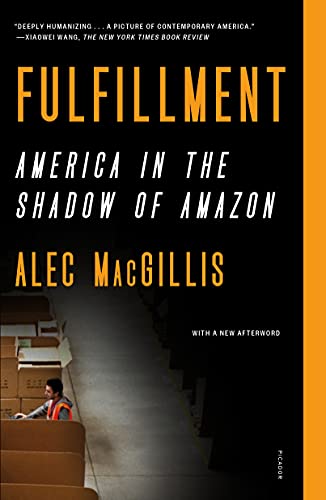
MacGillis, Alec. Fulfillment (pp. 322-323). Farrar, Straus and Giroux. Kindle Edition. 
Hmmm...

UPDATE
Click image.
Good article. Paywalled, I'm sure.

APPLIED AI UPDATE

  "New Yorker AI voiceover, Susan B. Glasser article"
 
Article link. This stuff is getting really good. I have a couple more I'll post ASAP, both from articles in The Atlantic. V/O artists are increasingly fixin' to lose their jobs.
 
  "Atlantic AI voiceover, Charley Warzel article"
 
 
One more from The Atlantic:
 
  "Atlantic AI voiceover, Quinta Jurecic article"
 
Once video AI gets to the relative aggregate quality of this kind of commercial AI audio, things will get extremely difficult.

The vendor for the foregoing examples:

ElevenLabs is a voice AI research & deployment company with a mission to make content universally accessible in any language & voice.


ElevenLabs creates the most realistic, versatile and contextually-aware AI audio, providing the ability to generate speech in hundreds of new and existing voices in over 20 languages. As a technology research company, ElevenLabs is at the forefront of developing new cutting-edge voice AI...

_________
 

Thursday, October 24, 2013

HealthCare.gov in the Congressional crosshairs


"Testy," "acrimonious" would materially understate the contentiousness of the House hearing, which I am following live online as I write. I would not want to be these CGI Federal and QSSI people right now.

I'm about 2/3 of the way through the Jeff Bezos/Amazon.com bio as of now. Highly recommended read. I bought the hardbound edition at CostCo, and will probably also spring for the Kindle edition ($10.99) as well. Worth it for the easy citation examples I will proffer. There are lessons that could be applied to this jaw-dropping HIX CusterFluck.


Below, one of my high school friends just posted this on Facebook.


Bill is a semi-retired multimillionaire who made his money the old-fashioned way. He built a wildly successful international periodicals distribution business, sold it for a huge cashout, and now dabbles as a "hard money lender." We played together in our Somerville NJ dance band in the early 1960's. Great guy. Smart guy. Still plays the sax (as I do on guitar, episodically).

He hates "ObamaCare" (and the federal government more generally). We joust online every now and then, and I usually fold after things get "elevated" by replying "so, how about those Red Sox?"

IN THE WINGS

The Big Prize in the unfolding "reality show" psychodrama. I'm sure she's rehearsing her lines.

__

TODAY'S TESTIMONY  SUMMARY THUS FAR (12:56 EDT)
"It's not our fault. That was not our responsibility. It's CMS's fault. We did everything we could. We'll get back to you on that..."
Stay tuned. Pass the popcorm...

POST-HEARING HEADLINE
Contractors point fingers over ObamaCare botch, blame gov't for poor testing

The finger-pointing was in full swing Thursday at a tense Capitol Hill hearing where the contractors behind the botched ObamaCare website defended their work and claimed the government failed to properly test the system before launch.

The contractors faced tough questioning from lawmakers on both sides of the aisle, who voiced frustration with the weeks-long problems surrounding the federal hub. Lawmakers cast doubt on attempts by contractors, who were paid millions, to claim they were not responsible for many of the site's problems. Top contractor CGI Federal revealed it was paid $290 million in taxpayer funds...
Yes. I've just watched about 4 hours of predictable finger-pointing and blame-deflecting.

UPDATE


OCT 25th UPDATE
The Midterm Grade for HealthCare.gov
By UWE E. REINHARDT for The NY Times


...President Obama taught constitutional law at the University of Chicago Law School. How would he have graded a student’s performance on, say, a term paper or test that the professor viewed as “unacceptable,” especially when there was “no excuse” for the paper’s deficiencies?

One would hope that the grade would have been F, even under modern grade inflation. I certainly would affix that grade to such inexcusably deficient work.

But who exactly should be assigned the F for the troubled rollout of HealthCare.gov?

At the Rose Garden ceremony, President Obama noted, “There’s no sugar coating it, the Web site has been too slow, people are getting stuck during the application process, and I think it’s fair to say that nobody is more frustrated by that than I am.”

That makes it sound as if the president was surprised and then angered by the poor performance of HealthCare.gov. Indeed, in a television interview Tuesday with Dr. Sanjay Gupta on CNN, the secretary of health and human services, Kathleen Sebelius, appears to suggest as much, even though HealthCare.gov is reported to have crashed days before the start on Oct. 1 when only 100 people tried to register simultaneously.

As someone who has lectured on corporate governance and served on corporate boards, I find Secretary Sebelius’s statement astounding. Is this how the project was managed? They knew the Web site was not working and yet decided to go ahead with it anyway, without the president’s personal O.K. for so strategic and risky a decision?

Once elected, a president becomes chief executive of a giant federal enterprise. Anyone familiar with corporate management would have thought that for as ambitious and technically a complex project as the initial rollout of HealthCare.gov – so important to many uninsured Americans and so politically important to the White House – the chief executive would have remained in very close touch with the management team overseeing the project and thus would have been briefed daily or at least weekly on the progress of the project and especially on any problems with it.

Woe to the members of the management team in a corporation if problems with a project are hidden from the chief executive when they become known, exposing the chief executive to embarrassing public relations surprises. Heads would roll. The board, however, would assign the blame for such problems not primarily to the management team and instead to the chief executive himself or herself. He hired and supervised the team.

From that perspective, the blame for the disastrous rollout of HealthCare.gov goes to its entire management team, to be sure, but primarily to the chief executive on top of that project. In my view, not only the proverbial buck stops on the chief executive’s desk, but, for the management of this particular project, the grade of F goes there as well...
Ugh. I wonder whether HHS Secretary Sebelius survives this mess, all her dismissive talk notwithstanding. I'd bet money that she doesn't. Maybe not straight away, but this is astonishingly inept. The President is not going to fire himself.
__

FRED TROTTER SCORES AN INTERVIEW WITH WaPo's EZRA KLEIN

One of my Health 2.0 Refactored Conference shots
Wonkbook: How HealthCare.gov looks to a health IT pioneer
By Ezra Klein and Evan Soltas, Updated: October 25, 2013

If you watched Thursday's monkey court -- sorry, heath care hearing, you didn't learn much save this: Democrats have a policy interest in fixing HealthCare.gov's problems but a political interest in downplaying their severity. Republicans have no interest in fixing the problems but a strong interest in publicizing them. The result is that the party that wants to talk about what's wrong with HealthCare.gov doesn't want to actually figure out how to fix it while the party that wants to fix it doesn't want to talk about it.

The assembled contractors weren't any more informative. They retreated behind a haze of acronyms and finger pointing and uncomfortable silences.

So for Wonkbook this morning, I spoke to someone who actually is more informative. Fred Trotter, the author of "Hacking Healthcare," is a pioneer in the health IT world. He's someone who actually does the kind of cutting-edge software development using the kind of cutting-edge techniques that people feel HealthCare.gov needed. A lightly edited transcript of our conversation follows.


Ezra Klein: Are you surprised by the rollout of HealthCare.gov?
Fred Trotter: I’ve been in health IT for years. I have this data set where I look at the health-care system as a whole and model it out. I have experience as a government contractor working on VISTA for the VA. So it doesn’t surprise me at all. What you need to run a massive consumer web site is the latest in horizontal scaling and that’s hardly approved software for the federal government. The federal government has very conservative mechanisms for purchasing off-the-shelf software and creating new software. That puts a lot of constraints on them.

EK: Explain what horizontal scaling is.

FT: When you get a certain amount of traffic going to any site on the internet a single computer can’t handle it. In order to handle tremendous amounts of traffic you have to have more than one computer sharing a task. At modern sites like Amazon and Ebay and Google, the main innovation they’ve pioneered is using lots of computers at the same time to answer one query to the web site.

But it’s a different problem for different tasks. If the federal government wanted to sell billions of books online that’s fairly understood. They could just look at Amazon. But they’re trying to do something entirely new. And that means that what they’re talking about is the invention of something new. The way Congress looks at software is that there are these sites that do these amazing things and we should do that, too. They don’t realize that a tremendous amount of invention has gone on at these scaled web sites to handle these processes.


EK: I’ve been reading the new biography of Jeff Bezos, as he is now my master and overlord, and an ongoing theme is that Amazon’s tech had to keep being reinvented as the site grew. And that process, it’s clear, was really hard, and getting it right was really important to why Amazon and not some other e-commerce site won. How much more difficult of a problem did the federal government give itself when they tried to unveil a single piece of tech that could handle huge traffic on day one?
FT: They screwed themselves twice. The first thing they did that was very foolish was to go at scale. Usually when the government understands the problem of that they do things in phases. They didn’t draft everyone for Vietnam all at once. That’s the model they should’ve used. They should’ve said people born in January can now get health insurance. Then it should’ve expanded to everyone born in the first quarter. And so on. But they presumed scale was easy. That was the first mistake. The second was assuming invention was easy. And scaling something that hasn’t been invented yet -- that’s technological suicide...
Interesting. I'm 100 pages shy of finishing the Bezos book. Will have some observations.
__

Just in...
Healthcare.gov will work smoothly by end of November, government pledges
Maggie Fox NBC News

The troubled federal health insurance website will be fixed by the end of November, giving uninsured Americans two weeks to get signed up in time to have health insurance by the earliest possible date, officials pledged Friday.

One of the main government contractors, QSSI, has been assigned to oversee the fix, says Jeff Zients, the newly appointed chief White House economic adviser who’s been tasked to fix the logjammed website.

“We are confident that by the end of the November, healthcare.gov will be smooth for the vast majority of users,” Zients told reporters on a conference call.

“Over the last week we worked with a team of experts to conduct an assessment of the overall state of the healthcare.gov site," Zients said. They lent "fresh eyes" to the problems plaguing the site. “The system is getting better,” he added. “There is a lot of work to do but healthcare.gov is fixable.”...
We shall see.

SATURDAY MORNING UPDATE

On the cusp of Halloween...

Why We Need a Healthcare.gov Witch Hunt
It is the only way we have a shot of settling a big debate: Can government do big things?
By John Dickerson, Slate

Washington think tanks your moment has arrived! Healthcare.gov is a mess and someone must chronicle exactly what went wrong. The press is trying, of course, but we also must cover the aftermath—the parade of predictable behavior that obscures more than it illuminates. Did you see the hearing in the House Energy and Commerce Committee yesterday? Despite the best efforts of Chairman Fred Upton, between the grandstanding, confused questions, and the witness fog machine, it's a wonder anyone got out alive. Meanwhile, Republicans are pointing fingers, placing blame, and otherwise showing disgust that a program that they have tried to kill is being run so badly. (Perhaps they're jealous that the administration is better at undermining Obamacare than they are.) Administration officials, on the other hand, are caught between covering their backsides, spouting plumes of happy talk, and hiring more people to collect the springs and sprockets from the launch pad where the whole thing went kaput. On Friday, officials in charge of the #techsurge said that healthcare.gov would be running smoothly by late November, two months after the launch.

Here's why a controlled witch hunt is needed: This episode is about much more than a website. That’s true with respect to health care, as Ezra Klein points out, and it’s also true because there are big national issues at stake that have nothing to do with the specific issues of sickness and health. Can government do big things? Sen. Lamar Alexander famously said during the health care debates, "We don't do comprehensive well"—meaning that any law that is big and complicated will fail. Is that right?

Alternatively, has partisanship and gridlock created a situation where small flaws in a law can't be fixed through tweaking legislation because such legislation can never pass? Is there something about complex technology that confuses the bureaucracy? Is the procurement system nuts? Does the political nature of all administration activity mean that no one is capable of reporting that the launch of a key element of the president's signature legislation is going to throw a rod? Some of the states seem to be doing just fine. Is that because they are smaller enterprises or because the people working on state health exchanges have more flexibility?...
...This [witch hunt] project should be one everyone loves. Only the most devout libertarian doesn't want the government to do anything. Those who want a smaller government should still want it to operate efficiently. Liberals, and people like the president, who believe in smart government, should be pushing hard for answers. If they're not interested in a thorough deconstruction of what went wrong for policy reasons, they should care for political ones. Healthcare.gov is now a very good excuse for anyone who wants to oppose an activist federal government. All a lawmaker has to say is that they don't want the same government that ran healthcare.gov in charge of X, where X is anything you want to see stopped in its tracks.

Right now, no one in this drama is trying to learn from the mistake. That's understandable, but it also guarantees that the mistake will be repeated.
Not sure I agree with the inflammatory, made-for-Ted-Cruz "witch hunt" characterization. But, it's like putting "sex" in the title as an attention grabber, I guess.
__

SUNDAY MORNING UPDATE

This is pretty funny.


___

More to come...