Well, It's been an interesting week. My weekend in Hollywood was good, if a bit surreal. I walked all around Sissy's 'hood (Selma at Fairfax) and drove down to the (now-renamed) hospital in Culver City where she died and just sat sadly in the lobby for a while, reflecting. Then drove down Venice Blvd and back up Overland to Santa Monica Blvd through Beverly Hills to my B&B.
A lot to think about. I'm ready to finish the book, detailing out the last six months of her life. A quick tease from one of my other blogs:
It is the soggy and crushingly sad el Nino L.A. winter of 1998. My now- brain-met stroke-addled daughter is painfully traversing the final months of her life. While admitted to acute care facilities (she has been an acute care patient in seven across the two years of her horrific cancer struggle), she gets the best clinical attention available, no strings attached, courtesy of Medi-Cal (the California Medicaid agency for the poor and otherwise medically indigent). But, outpatient care is another matter. Sissy has ongoing need of follow-up physical and occupational therapy, regarding which Medi-Cal will not authorize reimbursement.
Her therapy team from Brotman Medical Center -- at great individual and aggregate personal and professional risk to themselves -- arrange to have her routinely come in incognito off the books to an outpatient rehab clinic in Beverly Hills where they work on the side, to continue her therapy -- notwithstanding that we all know by that time that she will not likely survive much longer.
That is an utterly unembellished true story. There are numerous unsung heroes within our health care industry, people whose unrelenting focus is "patients first."
Multimillionaire mergers and acquisitions lawyer Rick Scott [now FL Governor] is not one of them...Lots to discuss.
__
Back to HIMSS16. As I noted at the outset, I would "be particularly interested in topics such as
- Data exchange / "Interoperability";
- Health IT Usability ("UX" and UCD");
Security and Privacy; - Markets / Venture Capital in HIT;
- Workflow;
- "Omics" / "Precision Medicine";
- Policy trends;
- Clinician burnout;
- "Leadership"
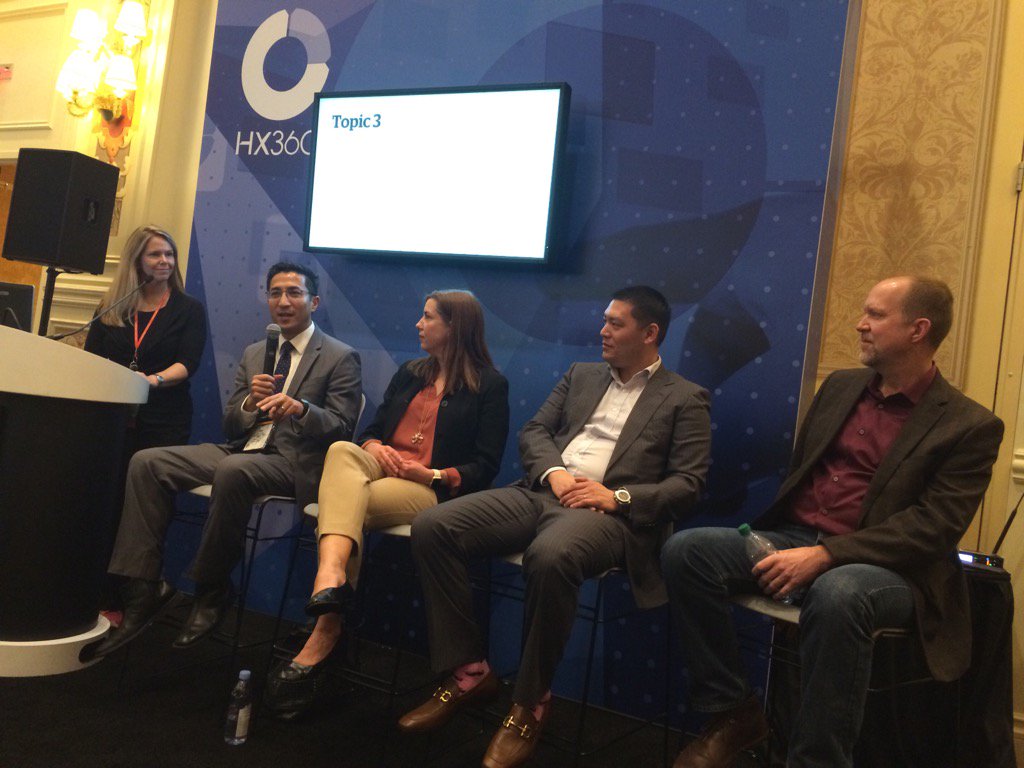
The "Usability / UX /UCD" sessions were the best for me (I will delve into some detail regarding the myriad difficulties proffered by the excellent "Vendor Perspective" panel). "Interoperability" remains a question in my mind. ("Interoperababble?")
The only other topic that stood out significantly to me was that of "Leadership," and it really didn't come until the final day. I'd been skeptical of the choice of Peyton Manning as the closing Keynoter, but he was in fact cogent and moving.
Prior to Peyton's close, Wharton's Dr. Jonah Berger gave a keynote presentation based on his new book "Contagious: Why Things Catch On."


It is very good. The connection to Health IT? you may have the coolest technology or other innovation going, but you still have to sell the ideas.
SIX PRINCIPLES OF CONTAGIOUSNESSDelightfully written, very accessible.
This book explains what makes content contagious. By “content,” I mean stories, news, and information. Products and ideas, messages and videos. Everything from fund-raising at the local public radio station to the safe-sex messages we’re trying to teach our kids. By “contagious,” I mean likely to spread. To diffuse from person to person via word of mouth and social influence. To be talked about, shared, or imitated by consumers, coworkers, and constituents.
In our research, my collaborators and I noticed some common themes, or attributes, across a range of contagious content. A recipe, if you will, for making products, ideas, and behaviors more likely to become popular...
Just as recipes often call for sugar to make something sweet, we kept finding the same ingredients in ads that went viral, news articles that were shared, or products that received lots of word of mouth.
After analyzing hundreds of contagious messages, products, and ideas, we noticed that the same six “ingredients,” or principles, were often at work. Six key STEPPS, as I call them, that cause things to be talked about, shared, and imitated.
Principle 1: Social Currency
How does it make people look to talk about a product or idea? Most people would rather look smart than dumb, rich than poor, and cool than geeky. Just like the clothes we wear and the cars we drive, what we talk about influences how others see us. It’s social currency. Knowing about cool things— like a blender that can tear through an iPhone— makes people seem sharp and in the know. So to get people talking we need to craft messages that help them achieve these desired impressions. We need to find our inner remarkability and make people feel like insiders. We need to leverage game mechanics to give people ways to achieve and provide visible symbols of status that they can show to others.
Principle 2: Triggers
How do we remind people to talk about our products and ideas? Triggers are stimuli that prompt people to think about related things. Peanut butter reminds us of jelly and the word “dog” reminds us of the word “cat.” If you live in Philadelphia, seeing a cheesesteak might remind you of the hundred-dollar one at Barclay Prime. People often talk about whatever comes to mind, so the more often people think about a product or idea, the more it will be talked about. We need to design products and ideas that are frequently triggered by the environment and create new triggers by linking our products and ideas to prevalent cues in that environment. Top of mind leads to tip of tongue.
Principle 3: Emotion
When we care, we share. So how can we craft messages and ideas that make people feel something? Naturally contagious content usually evokes some sort of emotion. Blending an iPhone is surprising. A potential tax hike is infuriating. Emotional things often get shared. So rather than harping on function, we need to focus on feelings. But as we’ll discuss, some emotions increase sharing, while others actually decrease it. So we need to pick the right emotions to evoke. We need to kindle the fire. Sometimes even negative emotions may be useful.
Principle 4: Public
Can people see when others are using our product or engaging in our desired behavior? The famous phrase “Monkey see, monkey do” captures more than just the human tendency to imitate. It also tells us that it’s hard to copy something you can’t see. Making things more observable makes them easier to imitate, which makes them more likely to become popular. So we need to make our products and ideas more public. We need to design products and initiatives that advertise themselves and create behavioral residue that sticks around even after people have bought the product or espoused the idea.
Principle 5: Practical Value How can we craft content that seems useful? People like to help others, so if we can show them how our products or ideas will save time, improve health, or save money, they’ll spread the word. But given how inundated people are with information, we need to make our message stand out. We need to understand what makes something seem like a particularly good deal. We need to highlight the incredible value of what we offer— monetarily and otherwise. And we need to package our knowledge and expertise so that people can easily pass it on.
Principle 6: Stories
What broader narrative can we wrap our idea in? People don’t just share information, they tell stories. But just like the epic tale of the Trojan Horse, stories are vessels that carry things such as morals and lessons. Information travels under the guise of what seems like idle chatter. So we need to build our own Trojan horses, embedding our products and ideas in stories that people want to tell. But we need to do more than just tell a great story. We need to make virality valuable. We need to make our message so integral to the narrative that people can’t tell the story without it.
Berger, Jonah (2013-03-05). Contagious: Why Things Catch On (pp. 21-24). Simon & Schuster. Kindle Edition.
"STEPPS," 'eh? Another handy 6-facet model. I am reminded of two "persuasion" books long in my stash.


Gardner's "Six Re's"
- Reason
- Research
- Resonance
- Representational Redistribution
- Rewards
- Real-world Events
- Liking
- Reciprocity
- Social Proof
- Consistency and Commitment
- Authority
- Scarcity
With respect to the "stories" tactic, I am reminded of Simon Blackburn's "Being Good."

Our consciousness of ourselves is largely or even essentially a consciousness of how we stand for other people. We need stories of our own value in the eyes of each other, the eyes of the world...
[W]e drape our own standards with the stories of divine origin as a way of asserting their authority. We do not just have a standard of conduct that forbids, say, murder, but we have mythological historical examples in which God expressed his displeasure pleasure at cases of murder.Yeah, abstract principles of good vs bad, right vs wrong, while necessary, are insufficient for motivating people. We need our concretizing "stories." Axiomatic to trial lawyering is that "he/she with the best story wins."
Simon Blackburn. Being Good: An Introduction to Ethics (Kindle Locations 44-46, 188-189). Kindle Edition.
I first heard that line proffered by a visiting attorney during my undergrad Senior Seminar in Psychology of Law at UTK in 1985.
I've long known about the theoretical and empirical underpinnings of generating what in the ad/marketing world is called "pull." When I started undergrad school at UTK in 1980 (at the age of 34) my major was "communications," specifically advertising. I'd already read a ton of literature on "B2B" advertising (corporate / industrial communications principles, which comprised my specific interest). the Ad Department at UTK, however, was totally focused on the consumer space, and I had zero interest in learning to effectively sell soap and cigarettes. I moved on to study statistics and experimental psych.
So, how does this stuff bear on "Leadership?" After all, you may have the coolest app around, but getting traction is another matter. Requires tactically and strategically effective "influence."
apropos, see my post What exactly is "Leadership," anyway?

One of my favorite HIMSS16 slides, from a UX session. "Talking Stick," baby.
__
OK, THIS IS INTERESTING
apropos of workflow?

Learn DifferentThis long read is worthy in its own right, but the caption under the graphic caught my eye straight away:
Silicon Valley disrupts education.
Seen from the outside, AltSchool Brooklyn, a private school that opened in Brooklyn Heights last fall, does not look like a traditional educational establishment. There is no playground attached, no crossing guard at the street corner, and no crowd of children blocking the sidewalk in the morning. The school is one floor up, in a commercial building overlooking Montague Street. On the building’s exterior is a logo: a light-blue square, with rounded corners, bearing the word “alt.” It looks like an iPhone app awaiting the tap of a colossal finger.
Inside, the space has been partitioned with dividers creating several classrooms. The décor evokes an IKEA showroom: low-slung couches, beanbags, clusters of tables, and wooden chairs in progressively smaller sizes, like those belonging to Goldilocks’s three bears. There is no principal’s office and no principal. Like the five other AltSchools that have opened in the past three years—the rest are in the Bay Area—the school is run by teachers, one of whom serves as the head of the school. There is no school secretary: many administrative matters are handled at AltSchool’s headquarters, in the SOMA district of San Francisco. There aren’t even many children. Every AltSchool is a “micro-school.” In Brooklyn Heights, there are thirty-five students, ranging from pre-kindergarten to third grade. Only a few dozen more children will be added as the school matures. AltSchool’s ambition, however, is huge. Five more schools are scheduled to open by the end of 2017, in San Francisco, Manhattan, and Chicago, and the goal is to expand into other parts of the country, offering a highly tailored education that uses technology to target each student’s “needs and passions.” Tuition is about thirty thousand dollars a year...
The curriculum is roughly aligned with the Common Core, the government standards that establish topics which students should master by the end of each grade. But AltSchool’s ethos is fundamentally opposed to the paradigm of standardization that has dominated public education in recent decades, and reflects a growing shift in emphasis among theorists toward “personalized learning.” This approach acknowledges and adapts to the differences among students: their abilities, their interests, their cultural backgrounds...
Today, the company employs more than a hundred and fifty people, split evenly among educators, technologists, and operations managers. This rapid growth has been funded by a hundred and ten million dollars in venture capital—and twenty million in venture debt—that has been raised over the past two years, among the largest investments ever made in education technology. AltSchool’s capital comes from some of Silicon Valley’s top investors, including the Founders Fund, Andreessen Horowitz, and John Doerr. Last year, the philanthropic Silicon Valley Community Foundation invested fifteen million dollars in AltSchool, through a fund financed by Mark Zuckerberg and his wife, Priscilla Chan. (Currently, tuition fees cover most of the expenses of running the schools, including teacher salaries; the investment money helps cover technologists’ salaries, real-estate costs, and other expenditures related to the company’s growth.) None of these backers want merely to own part of a chain of boutique micro-schools. Rather, they hope that AltSchool will help “reinvent” American education: first, by innovating in its micro-schools; next, by providing software to educators who want to start up their own schools; and, finally, by offering its software for use in public schools across the nation, a goal that the company hopes to achieve in three to five years...
"AltSchool embeds fish-eye lenses in the walls of its classrooms, capturing every word, action, and interaction, for potential analysis."'eh?
Recall something I posted last summer while covering the 2015 Lean Healthcare Transformation Summit:
__
"I tweeted this at one point:

Refers to this post of mine last year.
@BobbyGvegas says: August 20, 2014 at 12:39 pm
There are 3 fundamental aspects of workflow in the digital era: physical tasks, IT (EHR) tasks, and cognitive tasks. Every certified EHR has to have an audit trail to comply with HIPAA, given that every time ePHI is created, viewed, updated, transmitted, or deleted the transaction must be “date-time/who/what/about whom” captured in the audit trail log.
The ePHI audit log, to me, is a workflow record component. It can’t tell me WHY front desk Susie or Dr. Simmons took so long to get from one transaction element to the next — i.e., physical movements or cognitive efforts — but it can tell me a lot, adroitly analyzed.
I worked for number of years as a credit risk and portfolio management analyst in a credit card bank. We had an in-house collections department that took up an entire football field sized building, housing about 1,000 call center employees. I had free run of the internal network and data warehouse. One day I just happened upon the call center database and the source code modules (written by an IT employee in FoxPro, which I already knew at an expert level). I could open up the collections call log and watch calls get completed in real time. We were doing maybe a million outbound calls a month (a small Visa/MC bank).
(My fav in the Comments field was “CH used fowl language,” LOL)
It was, in essence, an ongoing workflow record of collections activity.
I pulled these data over into SAS and ground them up. I could track and analyze all activity sorted by any criteria I wished, all the way down to the individual collector level. I could see what you did all day, and what we got (or didn’t) for your trouble.So, with respect to the outdated AHRQ-esqe workflow "clipboard surveillance" talk at this HIMSS16 UX session, would "embedded fisheye lenses" in clinics just be too creepy? Marry up unobtrusive surveillance cameras with EHR audit logs...
I was [able to] rather quickly show upper management “Seriously? You dudes are spending $1,000 to collect $50, every day, every hour” etc. The misalignment was stunning. I started issuing a snarky monthly summary called “The Don Quixote Report” with a monthly “winner.” …Yeah, we called this hapless deadbeat 143 times this month trying to get 15 bucks out of him…
Well, it didn’t take long to squelch all that. We saved the bank 6 million dollars in Collections Department Ops costs that year via call center reforms. Didn’t exactly endear me to the VP of Collections, whose bonus was tied to his budget.
Gimme a SAS or Stata install and SQL access to the HIT audit logs, and I will tell you some pretty interesting (Wafts-of-Taylorism 2.0) workflow stories.
And, yeah, I know, there would be perhaps insurmountable patient privacy / HIPAA issues there with respect to the cameras, at least within the exam rooms.
Nonetheless, I repeat; absent cameras, gimme a SAS or Stata seat and access to EHR logs and I will paint you some fairly vivid and useful workflow pictures.
Speaking of clinical workflow, there's cool new content up at EHR Science.
__
THE PERSONAL HEALTH RECORD
I spent a couple of hours with Merle Bushkin, CEO of the company that hawks this product.
Merle and I had gone at it recently in the comments at THCB over dueling definitions of "interoperability" (I stand by mine).Your complete medical record in your pocket. Available anytime, anywhere. Updated for you.
- Patients own, control their records from all their providers.
- Can add records of dependent family members.
- Carry on key chain, in wallet; give to provider.
- Saves money; more than pays for itself.
- Doesn’t require electronic networks or Internet access.
- Accepts records in all formats, from all sources.
- Overcomes medical-record incompatibility and confusion.
- Provider can electronically sort, search, read patient’s records anytime, anywhere.
- Secure, easy to learn, use; convenient, affordable, available now.
- Empowers patient to participate in care, wellness decisions.
- Benefits everyone: patients, doctors, employers, insurers, government.
- Financially self-sustaining.

Nice man. Genuine, and well-intended. Former investment banker. I've been aware of his MedKaz initiative for several years now.
Watch the "Why MedKaz?" video here if the vimeo embed doesn't work.
'The only system that works." Odd that it's apparently not getting any traction.
__
ERRATUM: TWO NEW READS


The Serengeti Rules came to me via ScienceBasedMedicine.org. Ran across Cure at The Daily Beast.
The "Cure" book reminds me of an old read I've had in my stash since 1975.

I'm gonna have to use Dragon to read in some material. Not available in Kindle. This book remains a treasure.
____________
More to come...