We have promoted democracy in our movies and books. We speak of democracy in our speeches and lectures. We even sing about democracy, from sea to shining sea, in our national songs. We have entire government bureaus devoted to thinking about how we can help other countries become and remain democratic. We fund institutions that do the same.Click the image, read all of it.
And yet by far the most important weapon that the United States of America has ever wielded—in defense of democracy, in defense of political liberty, in defense of universal rights, in defense of the rule of law—was the power of example. In the end, it wasn’t our words, our songs, our diplomacy, or even our money or our military power that mattered. It was rather the things we had achieved: the two and a half centuries of peaceful transitions of power, the slow but massive expansion of the franchise, and the long, seemingly solid traditions of civilized debate…
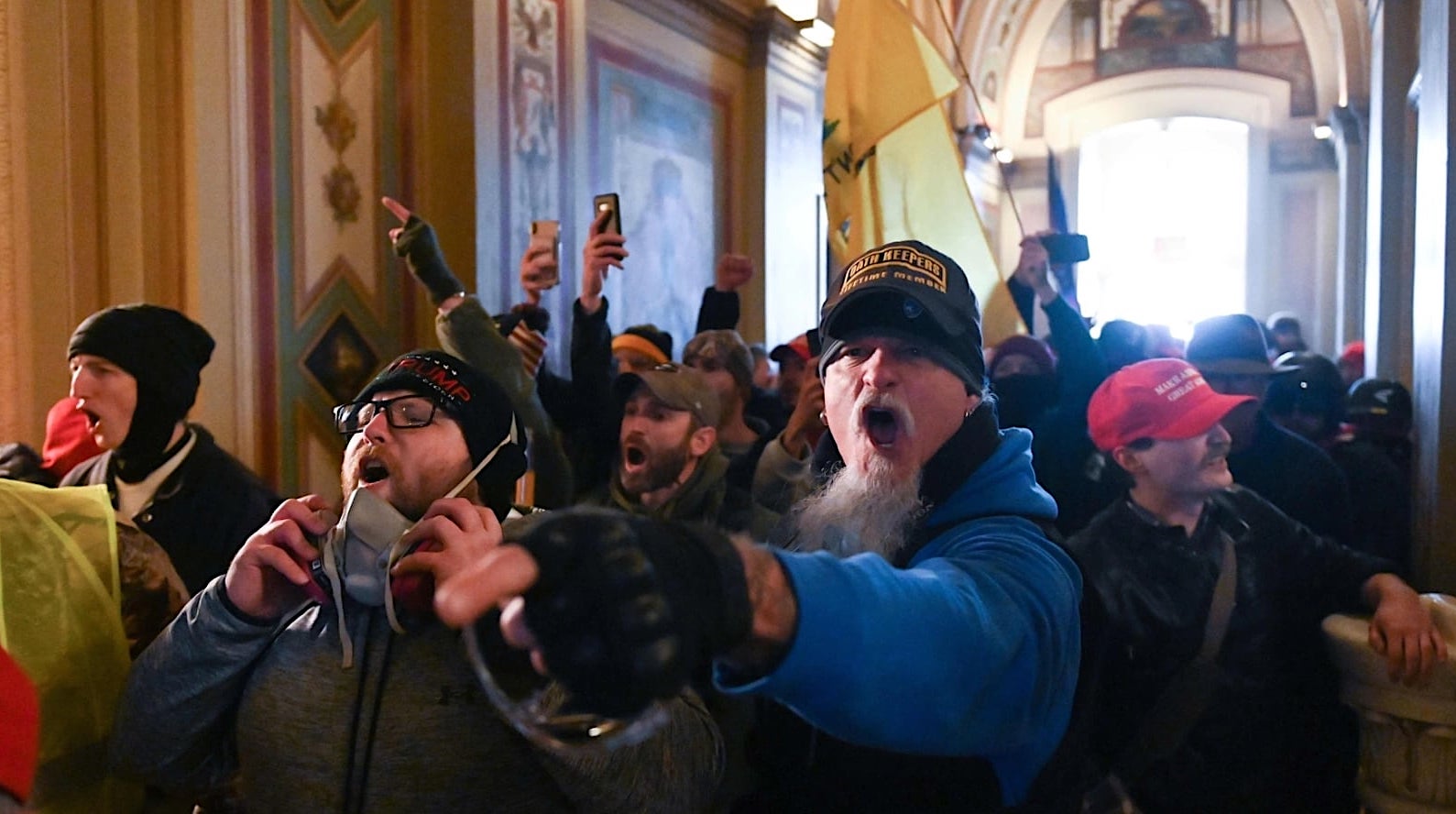
Over the past four years, that example has been badly damaged. We elected a president who refused to recognize the democratic process. We stood by while some members of Donald Trump’s party cynically colluded with him, helping him break laws and rules designed to restrain him. We indulged his cheerleading “media”—professional liars who pretended to believe the president’s stories, including his invented claims of massive voter fraud. Then came the denouement: an awkward, cack-handed invasion of the Capitol by the president’s supporters, some dressed in strange costumes, others sporting Nazi symbols or waving Confederate flags. They achieved the president’s goal: They brought the official certification of the Electoral College vote to a halt. House and Senate members and Vice President Mike Pence were escorted out of the legislative chambers. Their staff members were told to shelter in place. A woman was shot to death…
NOW REPORTING FROM BALTIMORE. A private, non-commercial blog begun in support of the federal Meaningful Use REC initiative, and Health IT and Heathcare improvement more broadly. Moving now toward important broader STEM and societal/ethics topics. Formerly known as "The REC Blog." NOTE: Comments are moderated, thanks to trolls and bots.
Search the KHIT Blog
Thursday, January 7, 2021
"A Republic, if you can keep it"
Monday, January 4, 2021
Our #Covid19 "Dark Winter" ensues
Monday, December 28, 2020
2020, ugh. What will 2021 bring?
There are three moments in the yearlong catastrophe of the covid-19 pandemic when events might have turned out differently. The first occurred on January 3, 2020, when Robert Redfield, the director of the Centers for Disease Control and Prevention, spoke with George Fu Gao, the head of the Chinese Center for Disease Control and Prevention, which was modelled on the American institution. Redfield had just received a report about an unexplained respiratory virus emerging in the city of Wuhan.
The field of public health had long been haunted by the prospect of a widespread respiratory-illness outbreak like the 1918 influenza pandemic, so Redfield was concerned… —Lawrence Wright
The influenza pandemic that began in 1918 killed as many as 100 million people over two years. It was one of the deadliest disasters in history, and the one all subsequent pandemics are now compared with.Click the title image.
At the time, The Atlantic did not cover it. In the immediate aftermath, “it really disappeared from the public consciousness,” says Scott Knowles, a disaster historian at Drexel University. “It was swamped by World War I and then the Great Depression. All of that got crushed into one era.” An immense crisis can be lost amid the rush of history, and Knowles wonders if the fracturing of democratic norms or the economic woes that COVID-19 set off might not subsume the current pandemic. “I think we’re in this liminal moment of collectively deciding what we’re going to remember and what we’re going to forget,” says Martha Lincoln, a medical anthropologist at San Francisco State University.
The coronavirus pandemic ignited at the end of 2019 and blazed across 2020. Many countries repeatedly contained it. The United States did not. At least 19 million Americans have been infected. At least 326,000 have died. The first two surges, in the spring and summer, plateaued but never significantly subsided. The third and worst is still ongoing…
The Trümperdämmerung is finally here, and it is every bit the raging dumpster fire that we, the unlucky audience for this drama, have come to expect. Is there anyone left who is surprised that the President is careening through the last days of his Administration with a reckless disdain that simply has no precedent in American public life? Still, the hardest thing to accept is that 2020 is not merely the year that Donald Trump’s luck ran out but that with it the country’s did, too. Sadly and yet inevitably, this terrible, wretchedly toxic year of pandemic death and economic distress, of partisan hatred and national protest, is the culmination of all that Trump has wrought and all that he is.
Now that 2020 is finally almost over, I find that I don’t want to remember it at all. (Though you should read Lawrence Wright’s definitive account of this Plague Year in this week’s New Yorker.) Perhaps this is simply because Trump has remained so defiantly and obnoxiously unrepentant, continuing his antics all the way to the end. He does not want to let go, to cede the spotlight, to renounce his outsized claim on our collective consciousness. It is my protest, our protest, to want so desperately to do so.
As it is, we are still in 2020, and I can barely summon the concerns and controversies of a year ago, when the most pressing political question in Washington was whether Trump’s former national-security adviser John Bolton would have to testify in the impeachment trial of the President. (Spoiler alert: he didn’t, though he would eventually call Trump unfit for office in a book whose contents he did not share with the United States Senate and the American public when it mattered most.) Now that the election and all the other mayhem associated with it have happened, it’s hard to recall that 2020 began with me wondering whether Biden still had a chance in the upcoming Democratic primaries, and pondering why the promising Presidential campaign of Kamala Harris had flamed out so quickly, before a single vote was cast. This was back when Trumpian outrages seemed less threatening to the literal health of the nation…
Thursday, December 24, 2020
Monday, December 21, 2020
Thursday, December 17, 2020
Here come the non-Rx OTC Covid-19 in-home assays
Aussie vendor. First home kit to get an FDA EUA permit. What about QA concerns? I am not yet privy to any data. Stay tuned to this Bat Channel.
“Our test is what’s called a fluorescent immunoassay. So we use a quantum dot nanoparticle, which we developed in conjunction with our friends at Thermo Fisher to create an ultra-bright fluorescent reporter to detect proteins of coronavirus. So ours is an antigen test which uses next-generation immunoassay technology to get improved performance on the existing immunoassay products that are in the market.” —Dr. Sean Parsons, Ellume CEO, during a BBC interview.
The Authorized Product
Your product is a non-prescription home use test intended for the qualitative detection of SARS-CoV-2 nucleocapsid antigens from mid-turbinate nasal swabs that are self-collected by an individual age 16 years or older, or are collected by an adult from an individual 2 years of age and older. This test is intended for use in individuals with or without symptoms or other epidemiological reasons to suspect a COVID-19 infection.
The SARS-CoV-2 nucleocapsid protein antigen is generally detectable in mid-turbinate nasal swab specimens during the acute phase of infection. Positive results indicate the presence of viral antigens, but the clinical correlation with past medical history and other diagnostic information is necessary to determine infection status. Positive results in an asymptomatic individual are presumptive and may need to be confirmed with a molecular assay. Positive results do not rule out a bacterial infection or co-infection with other viruses
Negative results are presumptive and confirmation with a molecular assay, if necessary, for patient management may be performed. Negative results do not rule out SARS-CoV-2 infection and should not be used as the sole basis for treatment or management decisions for the individual, including infection control decisions. Negative results should be considered in the context of an individual’s recent exposures, history and the presence of clinical signs and symptoms consistent with COVID-19.
Test results from your product will be automatically reported to relevant public health authorities, via your product’s software application (app), in accordance with local, state, and federal requirements, using appropriate LOINC and SNOMED codes, as defined by the “Laboratory In Vitro Diagnostics (LIVD) Test Code Mapping for SARS-CoV-2 Tests” provided by the Centers for Disease Control and Prevention (CDC).
Your product is a rapid, lateral flow immunoassay that involves the pre-mixing an d binding of fluorophore specific to SARS-CoV-2 with viral nucleocapsid protein present in a patient specimen. First, the Processing Fluid is added into the Dropper to release the fluorophore. After collecting a mid-turbinate nasal specimen, the Nasal Swab is locked into the Dropper to release the viral antigens from the specimen, which are then bound by the fluorophore. An aliquot of the sample containing the fluorophore-labelled antigen complexes is dispensed into the Analyzer Sample Port. The deposited liquid wicks into the test strip by capillary action. The sample flows across a membrane and traverses a series of discrete capture zones, consisting of immobilized complementary antibodies to SARS-CoV-2 viral nucleoprotein. Fluorescence signals at the two test zones are detected using a single-use optoelectronics reader system, housed within the Analyzer. The tests and controls are interpreted according to thresholds set within the microprocessor contained in the Analyzer. The computed result is communicated to the app and displayed on the user’s smartphone and if selected are also emailed to the user. The total time for the test is 20 min, 5 min for test set up and 15 min once the analyser is activated.
Your product requires the following internal control materials, or other authorized control materials (refer to Condition L), that are processed along with the specimens. All internal controls listed below must generate expected results in order for a test result to be considered valid…
III. Waiver of Certain Requirements[FDA is] waiving the following requirements for your product for the duration of this EUA:
Current good manufacturing practice requirements, including the quality system requirements under 21 CFR Part 820 with respect to the design, manufacture, packaging, labeling, storage, and distribution of your product, but excluding Subpart H (Acceptance Activities, 21 CFR 820.80 and 21 CFR 820.86), Subpart I (Nonconforming Product, 21 CFR 820.90), and Subpart O (Statistical Techniques, 21 CFR 820.250)
(IV)(N). You must have lot release procedures and the lot release procedures, including the study design and statistical power, must ensure that the tests released for distribution have the clinical and analytical performance claimed in the authorized labeling.
(P) You must evaluate the analytical limit of detection and assess traceability7 of your product with any FDA-recommended reference material(s). After submission to and concurrence with the data by FDA, you will update your labeling to reflect the additional testing. Such labeling updates will be made in consultation with, and require concurrence of, DMD/OHT7- OIR/OPEQ/CDRH...
Monday, December 14, 2020
Vax populi?
…The strength of a democratic society rests on its citizens’ ability to express their views and debate their merits. In the face of scientific uncertainty, economic pain, and conflicting values, it’s understandable that we disagree. But it’s also true that we know a lot about how the virus works, and that some views are beyond reasonable debate. Their persistence reflects a triumph of tribalism and the cowardice of those elected officials who have misused their influence, failing to protect the people they serve…
As a physician, I recognize that I’m also part of a tribe—one that celebrates science, authority, expertise. It’s easy for me to empathize with the suffering I see—hospitals full, patients dying, health-care workers overwhelmed—and harder to grasp the suffering I don’t: job loss, social disintegration, rising crime. By belittling or dismissing such concerns, instead of engaging and explaining, we divide the country further and compound the challenges of bringing the pandemic to heel. The Biden Presidency is an opportunity to reset how we talk about the virus, not just at the federal level but also in statehouses, hospitals, and public-health departments across the country. Biden has said, repeatedly, that he hopes to unify Americans. Almost certainly, this will require listening and responding to the concerns of the millions of people who see and experience the pandemic from a skeptical perspective…
…rarely, if ever, have so many lives depended so directly on the project of persuasion, empathy, and understanding. Faced with the prospect of the deadliest winter in modern U.S. history, we must not give up on that project. We cannot stop talking to one another.
The images of the first people to receive the covid-19 vaccine promise the end of this particular nightmare. But it’s likely that hundreds of thousands more will die in the United States before the pandemic is over. The return to life without social distancing and isolation, the end to our loneliness, could proceed with unnecessary slowness because the Trump Administration did not secure as many doses of the vaccine as it could have. We have come to expect this President to fail Americans, catastrophically, and we have become accustomed to understanding these failures through two traits of his Administration: cruelty and militant incompetence. But there is a third one, characteristic of many, if not all, autocracies: indifference…" —Masha Gessen
America Is Running Out of NursesMore from Dr. Khullar.
Travelling nurses have been moving from one hot spot to another. What happens when the hot spots keep multiplying?
Thursday, December 10, 2020
A 9/11 a day
How many Americans will die of covid-19 before the vaccine reaches scale?
Within days, the United States will probably begin administering vaccines aimed at preventing the spread of the novel coronavirus that emerged last year. It will ramp up slowly, with states determining who receives immunization in what order. The goal is that the country eventually have a large enough population of individuals immune to the virus that it can’t spread easily, a goal that will take months to achieve.
In the meantime, how many more Americans will die?
We are experiencing more deaths from covid-19, the disease caused by the virus, than at any prior point in the pandemic. Both because of a failure at the individual level to take necessary precautions against the virus’s spread and because of a tacit embrace of inaction at the federal and, in some cases, state level, the virus has spread largely out of control for the past three months…
Sunday, December 6, 2020
Parkinson's during a pandemic
What a year. Last December I was formally dx'd with Parkinson's Disease (PD). Looking back, it was evident back in 2017, at which time I'd misattributed my encroaching symptoms to my relentless stress over my late younger daughter's pancreatic cancer ordeal.
The tremor stuff now manifests itself as a twitchy left hand while using my mouse, LOL, causing me recurring inadvertent irrelevant ad click-thru's. I'm screwing up my Google-Facebook surveillance / tracking profile.
Thursday, December 3, 2020
Elections have consequences
One month since the November 2020 general election. More than 4 million new US Covid-19 cases since then, more than 100,000 Americans now hospitalized with the virus. More than 270,000 aggregate US deaths since the bug got here.
Oh, and the outgoing President wants the new vaccines soon to come on line to be named after him, according to his press secretary.
I'm not making that up. She said it during a White House presser.
ELECTIONS HAVE CONSEQUENCES
On Wednesday, more than three thousand Americans died because of the coronavirus, the nation’s deadliest day yet during the pandemic. The same day, the President of the United States chose to release, on social media, a forty-six-minute videotaped address from the White House. He called it possibly “the most important speech I’ve ever made.” The pandemic’s grim toll was never mentioned. What was? The “tremendous vote fraud and irregularities” in last month’s election, the results of which the President still refuses to accept. The “statistically impossible” victory of Joe Biden, and the idea that the Democrats had so “rigged” the election that “they already knew” the outcome in advance. It was all “corrupt,” “shocking,” “constitutionally absolutely incorrect,” and “so illegal.”… —Susan Glasser
DEC 5TH UPDATE
"Since the beginning of the pandemic, public-health experts have warned of one particular nightmare. It is possible, they said, for the number of coronavirus patients to exceed the capacity of hospitals in a state or city to take care of them. Faced with a surge of severely ill people, doctors and nurses will have to put beds in hallways, spend less time with patients, and become more strict about whom they admit into the hospital at all. The quality of care will fall; Americans who need hospital beds for any other reason—a heart attack, a broken leg—will struggle to find space. Many people will unnecessarily suffer and die..."
Moody and by accounts of his advisers sometimes depressed, the president barely shows up to work, ignoring the health and economic crises afflicting the nation and largely clearing his public schedule of meetings unrelated to his desperate bid to rewrite the election results. He has fixated on rewarding friends, purging the disloyal and punishing a growing list of perceived enemies that now includes Republican governors, his own attorney general and even Fox News.
The final days of the Trump presidency have taken on the stormy elements of a drama more common to history or literature than a modern White House. His rage and detached-from-reality refusal to concede defeat evoke images of a besieged overlord in some distant dictatorship defiantly clinging to power rather than going into exile or an erratic English monarch imposing his version of reality on his cowed court…
Tuesday, December 1, 2020
Our post-corona economy?
"This is as good an analysis as you could wish to read." --The Financial TimesWe shall see. Stay tuned.
From bestselling author and NYU Business School professor Scott Galloway comes a keenly insightful, urgent analysis of who stands to win and who's at risk to lose in a post-pandemic world
The COVID-19 outbreak has turned bedrooms into offices, pitted young against old, and widened the gaps between rich and poor, red and blue, the mask wearers and the mask haters. Some businesses--like home exercise company Peloton, video conference software maker Zoom, and Amazon--woke up to find themselves crushed under an avalanche of consumer demand. Others--like the restaurant, travel, hospitality, and live entertainment industries--scrambled to escape obliteration.
But as New York Times bestselling author Scott Galloway argues, the pandemic has not been a change agent so much as an accelerant of trends already well underway. In Post Corona, he outlines the contours of the crisis and the opportunities that lie ahead. Some businesses, like the powerful tech monopolies, will thrive as a result of the disruption. Other industries, like higher education, will struggle to maintain a value proposition that no longer makes sense when we can't stand shoulder to shoulder. And the pandemic has accelerated deeper trends in government and society, exposing a widening gap between our vision of America as a land of opportunity, and the troubling realities of our declining wellbeing.
Combining his signature humor and brash style with sharp business insights and the occasional dose of righteous anger, Galloway offers both warning and hope in equal measure. As he writes, "Our commonwealth didn't just happen, it was shaped. We chose this path--no trend is permanent and can't be made worse or corrected."
Yikes. What a writer.
_________
Sunday, November 29, 2020
Homelessness during the Covid-19 pandemic
...for the over half a million homeless people in the United States, the directive to “stay home, stay safe” (rural Vermont’s coronavirus message) must have seemed ludicrous, if not infuriating.55 Unsurprisingly, a study of 402 homeless adults sleeping in a shelter in Boston on April 2 and April 3, 2020, found that 36 percent of them tested positive for SARS-2, whereas in the city as a whole at the time, the percentage was likely less than 2 percent...
Christakis, Nicholas A.. Apollo's Arrow (p. 192). Little, Brown and Company. Kindle Edition.
Thursday, November 26, 2020
"Happy" Thanksgiving 2020
…There is something about a threat that reoccurs at the dim reaches of living memory, every fifty or one hundred years, that makes our species seem particularly small. When such a threat reappears, human suffering is combined with the sad realization that we should have seen it coming. Epidemics generally take advantage of the deepest and most highly evolved aspects of our humanity. We evolved to live in groups, to have friends, to touch and hug each other, and to bury and mourn one another. If we lived like hermits, we would not be victims of contagious disease. But the germs that kill us during times of plague often spread precisely because of who we are. And so for centuries, our response in a time of plague has been to rediscover the necessity of surrendering these aspects of our nature for a while.FALL 2020
We forget the lessons of past pandemics for different reasons. In some cases, they are simply too far back in our collective memory or too obscured by other events. Those plagues have become objects of inquiry to small groups of academic historians or scientists or they are subjects of oral traditions or myths. During Passover in early April 2020, several of my Jewish friends observed that biblical plagues had always been abstract for them, but now they felt more real; the point of the story at the seder was more manifest. In other cases, the reasons for forgetting are more prosaic, more epidemiological, more related to numbers: the particular pandemic disease was not fatal enough (2009 H1N1 influenza), or it did not afflict enough people because it was not infectious enough (MERS), or it burned out too fast (SARS-1), or it afflicted a confined subgroup of the human population (Ebola), or it was brought low by a vaccine (measles and polio), or by treatment (HIV), or by eradication (smallpox), allowing most people to simply push the disease out of their minds.
While the way we have come to live in the time of the COVID-19 pandemic might feel alien and unnatural, it is actually neither of those things. Plagues are a feature of the human experience. What happened in 2020 was not new to our species. It was just new to us.
Christakis, Nicholas A.. Apollo's Arrow (pp. 83-84). Little, Brown and Company. Kindle Edition.
Sunday, November 22, 2020
Honoring our nurses
I have been an ICU nurse for 17 years. I never thought I'd leave. Now I'm not sure I'll ever go back.
I've been on the front lines of Covid-19 since it broke out eight months ago. More than 250,000 people have now died in the United States. Case numbers are rising in all 50 states and Washington, D.C.And health care workers like me are burning out.
Meanwhile, President Donald Trump spends his weekends golfing, and Majority Leader Mitch McConnell sent the Senate home for Thanksgiving vacation a day early, even though the Centers for Disease Control and Prevention just advised against holiday travel.
I wish medical workers could take vacation days, too. I ran out of those months ago, when I contracted Covid-19 treating patients in the ICU. I'm exhausted. I'm angry. I'm sick of watching patients die. I'm tired of comforting families feeling guilty over the birthday party that cost their loved one's life.
I finally hit my breaking point and recently quit doing direct patient care in a hospital setting. Without sufficient personal protective equipment and staffed hospital beds, a national plan for testing and sufficient relief for those hardest hit by the virus, including hospitals, I didn't have the strength to continue...
Notwithstanding that I'm Irish, I have always dug the hell out of Latinx music. The Estefans are totally awesome.
In 2019, the Global Health Security (GHS) Index ranked the United States as the most prepared country in the world for a pandemic. Just over a year later, the United States has not only failed to control coronavirus disease 2019 (COVID-19), many consider the nation's response to the pandemic to be one of the worst in the world. Was the GHS Index biased? Or did the country's preparedness change drastically during this period?
Answering these questions requires understanding the pandemic as a complex system— one that reveals our greatest strengths and most debilitating weaknesses. In his provocative new book, Apollo's Arrow, Nicholas Christakis uses such an approach, drawing on his experience as both a hospice physician and a leading network scientist to integrate societal, technological, and biological data into a single cohesive narrative of the unfolding pandemic. Not surprisingly, the book is far-ranging, covering relevant aspects of epidemiology, human behavior, social networks, technology, immunology, and applied mathematics...
...There is no shortage of books that argue that pandemics are complex or ones that discuss the public health issues raised in Apollo's Arrow, and it is unlikely that there will be a shortage of future works that dissect domestic and international responses to the COVID-19 pandemic. What sets Christakis's work apart is that it was written in real time by an expert who astutely shows how pandemics are as much about our societies, values, and leaders as they are about pathogens.