Search the KHIT Blog

Showing posts sorted by relevance for query science of deliberation. Sort by date Show all posts

Tuesday, May 11, 2021

Is there a "science" of science communication?

 This
led me to this.
Introduction: Why Science Communication? Dan Kahan, Dietram A. Scheufele, and Kathleen Hall Jamieson #SciComm

Part One  
•  The Science of Communicating Science


1. The Need for a Science of Science Communication: Communicating Science’s Values and Norms Kathleen Hall Jamieson
2. Overview of the Science of Science Communication Heather Akin and Dietram A. Scheufele
3. On the Sources of Ordinary Science Knowledge and Extraordinary Science Ignorance Dan Kahan
4. How Changing Media Structures Are Affecting Science News Coverage Mike S. Schäfer
5. What the Public Thinks and Knows About Science—and Why It Matters William K. Hallman
6. Science Controversies: Can the Science of Science Communication Provide Management Guidance or Only Analysis? Bruce V. Lewenstein
7. A Recap: The Science of Communicating Science Joseph Hilgard and Nan Li

Part Two 
•  Identifying and Overcoming Challenges to Science Featured in Attacks on Science


8. Science as “Broken” Versus Science as “Self-Correcting”: How Retractions and Peer-Review Problems Are Exploited to Attack Science Joseph Hilgard and Kathleen Hall Jamieson
9. Publication Bias in Science: What Is It, Why Is It Problematic, and How Can It Be Addressed? Andrew W. Brown, Tapan S. Mehta, and David B. Allison
10. Statistical Biases in Science Communication: What We Know About Them and How They Can Be Addressed John P. A. Ioannidis
11. Is There a Hype Problem in Science? If So, How Is It Addressed? Peter Weingart
12. Is There a Retraction Problem? And, If So, What Can We Do About It? Adam Marcus and Ivan Oransky
13. A Recap: Identifying and Overcoming Challenges to Science Featured in Attacks on Science Joseph Hilgard

Part Three  
•  Science Comunication in Action: Failures and Successes


14. A Comparative Study of Communication About Food Safety Before, During, and After the “Mad Cow” Crisis Matteo Ferrari
15. Cross-National Comparative Communication and Deliberation About the Risks of Nanotechnologies Nick Pidgeon, Barbara Herr Harthorn, Terre Satterfield, and Christina Demski
16. Communications About Biotechnologies and GMOs Across Europe Heinz Bonfadelli
17. A Tale of Two Vaccines—and Their Science Communication Environments Dan Kahan and Asheley R. Landrum
18. A Recap: Science Communication in Action Heather Akin

Part Four  
•  The Roles of Elite Intermediaries in Communicating Science


19. Science Communication at Scientific Institutions Tiffany Lohwater and Martin Storksdieck
20. The Role of Scholarly Presses and Journals Barbara Kline Pope and Elizabeth Marincola
21. The Role of Governmental Organizations in Communicating About Regulating Science Jeffery Morris
22. Science Communication and Museums’ Changing Roles Victoria Cain and Karen A. Rader
23. The Role of Funding Organizations: Foundations Elizabeth Good Christopherson
24. Promoting Popular Understanding of Science and Health Through Social Networks Brian Southwell
25. Designing Public Deliberation at the Intersection of Science and Public Policy John Gastil
26. Translating Science into Policy and Legislation: Evidence-Informed Policymaking Jason Gallo
27. A Recap—The Role of Intermediaries in Communicating Science: A Synthesis Asheley R. Landrum

Part Five 
•  The Role, Power, and Peril of Media for the Communication of Science


28. The (Changing) Nature of Scientist–Media Interactions: A Cross-National Analysis Sara K. Yeo and Dominique Brossard
29. New Models of Knowledge-Based Journalism Matthew C. Nisbet and Declan Fahy
30. Citizens Making Sense of Science Issues: Supply and Demand Factors for Science News and Information in the Digital Age Michael A. Xenos
31.  The Changing Popular Images of Science David A. Kirby
32. What Do We Know About the Entertainment Industry’s Portrayal of Science? How Does It Affect Public Attitudes Toward Science? James Shanahan
33. How Narrative Functions in Entertainment to Communicate Science Martin Kaplan and Michael Dahlstrom
34. Assumptions About Science in Satirical News and Late-Night Comedy Lauren Feldman
35. A Recap: The Role, Power, and Peril of Media for the Communication of Science Nan Li and Robert B. Lull

Part Six  
•  Challenges in Communicating Science in a Polarized Environment


36. Countering False Beliefs: An Analysis of the Evidence and Recommendations of Best Practices for the Retraction and Correction of Scientific Misinformation Man-pui Sally Chan, Christopher Jones, and Dolores AlbarracĂ­n
37. Using Frames to Make Scientific Communication More Effective James N. Druckman and Arthur Lupia
38. Philosophical Impediments to Citizens’ Use of Science Jonathan Baron
39. Overcoming Confirmation and Blind Spot Biases When Communicating Science Kate Kenski
40. Understanding and Overcoming Selective Exposure and Judgment When Communicating About Science Natalie Jomini Stroud
41. Overcoming Innumeracy and the Use of Heuristics When Communicating Science Ellen Peters
42. Overcoming Biases in Processing of Time Series Data About Climate Bruce W. Hardy and Kathleen Hall Jamieson
43. Understanding and Overcoming Fear of the Unnatural in Discussion of GMOs Robert B. Lull and Dietram A. Scheufele
44. Protecting or Polluting the Science Communication Environment?: The Case of Childhood Vaccines Dan Kahan
45. Overcoming False Causal Attribution: Debunking the MMR–Autism Association Nan Li, Natalie Jomini Stroud and Kathleen Hall Jamieson
46. Overcoming the Challenges of Communicating Uncertainties Across National Contexts Michael Siegrist and Christina Hartmann
47. A Recap: Heuristics, Biases, Values, and Other Challenges to Communicating Science Heather Akin and Asheley R. Landrum

Conclusion—On the Horizon: The Changing Science Communication Environment Dietram A. Scheufele, Kathleen Hall Jamieson, and Dan Kahan

Index
Yikes. Three editors, 59 contributing authors, 508 pages. And, $149.62 Kindle edition (ugh).

Ironically, those communicating about science often rely on intuition rather than scientific inquiry not only to ascertain what effective messaging looks like but also to determine how to engage different audiences about emerging technologies and get science’s voice heard. For decades, one plausible explanation for this state of affairs was the relative absence of empirical work in science communication. This is no longer a problem. As the essays in this volume confirm, researchers in fields as diverse as political science, decision science, communication, and sociology have examined how science can best be communicated in different social settings and in the process have evaluated different approaches to cultivating societal engagement about emerging technologies. A central task of the work in this handbook is distilling what they know about the science of science communication and unpacking how they know it.

By the science of science communication, we mean an empirical approach to defining and understanding audiences, designing messages, mapping communication landscapes, and—most important—evaluating the effectiveness of communication efforts. The science of science communication, as a result, relies on evidence that is transparent and replicable, theory driven, and generalizable. In short, evidence is derived by the scientific method, drawing on theories and methods from disciplines including economics, sociology, psychology, education, and communications science. What makes science communication distinctive is the fact that science’s way of knowing places constraints on communication that are not present in the same way in other forms of communication—for instance, communication about politics…

The audience we envision for this book includes scholars and students interested in understanding the pitfalls and promise of a scientific approach to science communication as well as, but not primarily, those on the front lines tasked with communicating complex and sometimes controversial science to policymakers and the public on consequential topics ranging from nanotechnology and nuclear power to the need for vaccination.

The Science of Science Communication
In 2012, the National Academies of Sciences, Engineering, and Medicine took a leadership role in connecting a community of social scientists who were conducting empirical research on different aspects of science communication. Two Sackler Colloquia and two special issues of the Proceedings of the National Academy of Sciences devoted to the “Science of Science Communication” were the result (Fischhoff and Scheufele 2013, 2014). Their intent was both to heighten awareness among bench scientists about empirically based approaches to better communicating science and to promote the exchange of ideas among social scientists working on problems related to science communication in various (sub)disciplines.

Built on the foundations laid by those Sackler Colloquia, this volume is predicated on three major assumption. First, science is not monolithic. Second, the aspects of science or its applications that are being communicated or debated are a function of the nature of the science itself, the types of applications made possible by science or their societal implications, and the social dynamics surrounding emerging science. Finally, communication is an inevitable part of the process of characterizing scientific findings, engagement among scientists about them, and the process of sharing them with policymakers and diverse publics…

(2017-05-08T23:58:59). The Oxford Handbook of the Science of Science Communication (Oxford Library of Psychology). Oxford University Press. Kindle Edition.
FROM THE PRESIDENT OF THE AMERICAN ACADEMIES
Since its inception, the American Academy of Arts and Sciences’ Public Face of Science Initiative has sought to understand and strengthen the relationship between science and society. The COVID-19 pandemic has stressed the critical role science plays in ensuring the well-being—indeed, the very survival—of both individuals and society as a whole. As we face this crisis, we can take some encouragement from the findings of the Public Face of Science Initiative, which show that confidence in scientific leaders has remained relatively stable over the last thirty years. It is worth noting, however, that this confidence varies based on age, race, educational attainment, region, political ideology, and other characteristics.
 
The current crisis has underscored the importance of a society in which everyone has equal opportunity to learn from, engage with, and participate in science. However, revenue losses and budget cuts are having an enormous, and still-evolving, impact on the professional writers, educators, museum curators, outreach organizers, and researchers who are dedicated to building the connections between science and society. While the goals and suggested actions identified throughout this report are more important than ever, they are even further from being realized due to diminished resources and field-wide layoffs. For those with the power and capacity to support the institutions and organizations that provide access to science, now is the time to act. The priorities and goals in this report highlight important means for local science engagement efforts, science journalists, and the scientific community more generally to communicate and engage more effectively… 
I got on this recurrent riff in part in response to a Science Magazine article touting the so-called "Science of Deliberation." There's also, recall, the putative "Science of Success." And, hmmm... how about "Neuroaesthetics" science? more mundanely, "Data Science." A "Science of Compassion?"
 

Oh, and by the way. "I am not a scientist."

 
In a "democracy," citizens are properly among the core decision makers. Hence, science literacy, particularly in the policymaking context, is rather important, ja?

There's no shortage of exigent realities in need of adroit, rational evaluation and decision-making. For starters, beyond pandemic prevention and mitigation, climate change adversity will not disappear.
 
More from Oxford:
Identifying and Overcoming Challenges Featured in Attacks on Science
The overall credibility of science and scientists is higher than that of many communities (Scheufele 2013), with only military leaders eliciting greater public confidence than the scientific community in 2014 (General Social Survey 2012). Nevertheless, popular understanding of how scientists generate knowledge is freighted with misleading simplifications. The gap between how people think science works and how it actually does can itself generate confusion that undermines public confidence.

Climate science communication furnishes a case in point. The popular conception of the “scientific method” envisions scientists “proving” or “disproving” asserted “facts” through conclusive experiments. The contribution that climate science makes to policymaking, however, consists less of experimentally corroborating basic climate mechanisms, most of which are well-known, than it does of establishing how they interact with one another. To generate such understanding, climate scientists use dynamic models, which are iteratively refined and adjusted to take account of new data. Discrepancies between model forecasts and subsequently observed data are expected—indeed, they are the source of progressive improvements in understanding. By design, dynamic modeling enlarges knowledge through its failed predictions as much as through its successful ones (Silver 2012).

Not only did science communicators fail to make this element of climate science clear to the public, but over the past decade, many of them adopted communication “strategies” that elided it. To promote the urgency of action, they depicted the projections of the Intergovernmental Panel on Climate Change (IPCC) reports—particularly those of the Fourth Assessment—as extrapolations from settled and incontrovertible scientific findings. But because this framing was selected to accommodate the popular understanding that science warrants confidence based on experimentally “proven” facts, it made climate science more vulnerable to attack by those intent on undermining public confidence in it when, as was anticipated by scientists themselves, actual data diverged from the climate-science model forecasts…
[Oxford Handbook, Kindle loc 502]
'eh?
 
Interesting: One of the editors and contributing writers in this Oxford Handbook is Dan Kahan. I ran into his name in another book I'm reading.
Yale law professor Dan Kahan surveyed Americans about their political views and their beliefs about climate change. As you would expect, those two things were highly correlated. Liberal Democrats were much more likely than conservative Republicans to agree with the statement “There is solid evidence of recent global warming due mostly to human activity such as burning fossil fuels.”

So far, not surprising. The twist is that Kahan also measured his respondents’ “science intelligence” with a collection of different questions: Some were puzzles designed to test reasoning ability, such as “If it takes 5 machines 5 minutes to make 5 widgets, how long would it take 100 machines to make 100 widgets?” Other questions were tests of basic scientific knowledge, such as “Lasers work by focusing sound waves—true or false?” and “Which gas makes up most of the earth’s atmosphere: Hydrogen, nitrogen, carbon dioxide, or oxygen?”

If knowledge and intelligence protect you from motivated reasoning, then we would expect to find that the more people know about science, the more they agree with each other about scientific questions. Kahan found the opposite. At the lowest levels of scientific intelligence, there’s no polarization at all—roughly 33 percent of both liberals and conservatives believe in human-caused global warming. But as scientific intelligence increases, liberal and conservative opinions diverge. By the time you get to the highest percentile of scientific intelligence, liberal belief in human-caused global warming has risen to nearly 100 percent, while conservative belief in it has fallen to 20 percent.

The same funnel-shaped pattern shows up when you ask people for their opinions on other ideologically charged scientific issues: Should the government fund stem cell research? How did the universe begin? Did humans evolve from lower animal species? On all these questions, the people with the highest levels of scientific intelligence were also the most politically polarized in their opinions…


Galef, Julia. The Scout Mindset (pp. 45-46). Penguin Publishing Group. Kindle Edition.
UPDATE
 
Finished The Scout Mindset. Enjoyable read. Not a ton of new ground for me, but worthy nonetheless. Useful "Scout" metaphor.  
 
On deck, pre-ordered (5-18 release):

Amazon blurb:
From the Nobel Prize-winning author of Thinking, Fast and Slow and the coauthor of Nudge, a revolutionary exploration of why people make bad judgments and how to make better ones--"full of novel insights, rigorous evidence, engaging writing, and practical applications” (Adam Grant).

Imagine that two doctors in the same city give different diagnoses to identical patients—or that two judges in the same courthouse give markedly different sentences to people who have committed the same crime. Suppose that different interviewers at the same firm make different decisions about indistinguishable job applicants—or that when a company is handling customer complaints, the resolution depends on who happens to answer the phone. Now imagine that the same doctor, the same judge, the same interviewer, or the same customer service agent makes different decisions depending on whether it is morning or afternoon, or Monday rather than Wednesday. These are examples of noise: variability in judgments that should be identical.
 
In Noise, Daniel Kahneman, Olivier Sibony, and Cass Sunstein show the detrimental effects of noise in many fields, including medicine, law, economic forecasting, forensic science, bail, child protection, strategy, performance reviews, and personnel selection. Wherever there is judgment, there is noise. Yet, most of the time, individuals and organizations alike are unaware of it. They neglect noise. With a few simple remedies, people can reduce both noise and bias, and so make far better decisions.
 
Packed with original ideas, and offering the same kinds of research-based insights that made Thinking, Fast and Slow and Nudge groundbreaking New York Times bestsellers, Noise explains how and why humans are so susceptible to noise in judgment—and what we can do about it.
All part of a "deliberation science" piece. Whether the topics are judicial, legislative, scientific, or public/social policy deliberations, we need our best honest, objective reasoning efforts, particularly given this time of rampant mis- and disinformation (i.e., shoddy advocacy borne of ignorance and intent respectively).
 
More to come...
_________

Saturday, March 30, 2019

A "Science of Deliberation"?

As regular readers know, I am firmly on the side of science--specifically the "scientific method(s)," warts and all. But, what about "political discourse," which seems more than ever overpopulated with noisy, demagogic fact-averse partisans and ad hominem rhetorical bomb-tossers? After all, the phrase "political science" is unhappily viewed by many as a contradiction in terms.

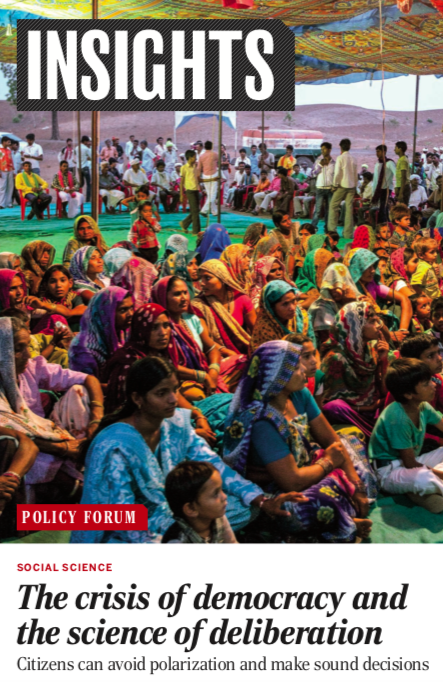
Interesting piece in Science Magazine (paywalled):

POLICY FORUM: SOCIAL SCIENCE
The crisis of democracy and the science of deliberation

That there are more opportunities than ever for citizens to express their views may be, counterintuitively, a problem facing democracy—the sheer quantitative overabundance overloads policymakers and citizens, making it difficult to detect the signal amid the noise. This overload has been accompanied by marked decline in civility and argumentative complexity. Uncivil behavior by elites and pathological mass communication reinforce each other. How do we break this vicious cycle? Asking elites to behave better is futile so long as there is a public ripe to be polarized and exploited by demagogues and media manipulators. Thus, any response has to involve ordinary citizens; but are they up to the task? Social science on “deliberative democracy” offers reasons for optimism about citizens' capacity to avoid polarization and manipulation and to make sound decisions. The real world of democratic politics is currently far from the deliberative ideal, but empirical evidence shows that the gap can be closed.

Declining civility in interactions among elected representatives decreases citizens' trust in democratic institutions. The more polarized (and uncivil) that political environments get, the less citizens listen to the content of messages and the more they follow partisan cues (1) or simply drop out of participating. Declining complexity in arguments means a growing mismatch between the simple solutions offered by political leaders and real complex problems. This decline combines with post-truth politics and the displacement of facts and evidence by the felt truth of “cultural cognition,” in which social identity conditions opinion, as seen clearly on climate change.

A long tradition of survey research in political science—going back to the 1950s—yields skeptical conclusions about citizen competence. Claims that people vote mainly guided by group identity, oblivious to reasons for or against candidates or policies (2), can fuel arguments against democracy and in favor of, for example, an “epistocracy” of government by wise elites (3). Not all survey research is so skeptical about citizen capacities; some treat cues from leaders and groups as useful cognitive shortcuts. But all survey research is “monological” in that it obtains evidence only about the capacity of the individual in isolation to reason about politics.

Psychological research shows that even if people are bad solitary reasoners, they can be good group problem-solvers (4). Individual reasoning can improve under the right social conditions (for example, ones that generate alternative viewpoints for the individual to consider), thus enabling the more positive assessment of individual reasoning found in cognitive and decision psychology (as opposed to social and political psychology) to come to the fore. Human life is indeed group life, but not in pathological form (5). Thus, research focused on individuals in isolation is not a strong match for the novel aspect of the contemporary crisis of democracy, which is a crisis of communication, not of individual reasoning, the virtues and flaws of which remain much as they have always been…

Deliberative Democracy
The science of deliberative democracy seeks evidence on the capacities of citizens as they engage democratic dialogue, not as they respond as isolated individuals to survey questions (or even as they respond in social psychological experiments that fail to capture key democratic features). In addition to focusing on individual knowledge, preference, and voting, deliberative democracy also incorporates inclusive participation that encompasses citizens and leaders, mutual justification, listening, respect, reflection, and openness to persuasion. The field of deliberative democracy could be viewed as going as far back as Aristotle (who grounded practical reason in collective political life). But what is new in the past two decades is the precision with which the tasks of deliberation—notably, the legitimation of public authority, mutual understanding, and the integration of diverse sorts of knowledge—have been specified and tested…

The citizenry is quite capable of sound deliberation. But deliberative democratization will not just happen. Much remains to be done in refining the findings of the field and translating them into political practice. That political reconstruction itself would ideally be deliberative and democratic, involving social science but also competent citizens and leaders in broad-ranging political renewal.

Highly recommended, fairly lengthy reading. Hits my sweet spot. My "Ethics & Policy Studies" Master's program was all deliberation all the time, to my great fortune.

UPDATE
 
Citation links from the Science Magazine article on "Science of Deliberation."

1

How elite partisan polarization affects public opinion formation

JN Druckman, E Peterson, R Slothuus - American Political Science …, 2013 - cambridge.org
Competition is a defining element of democracy. One of the most noteworthy events over the 
last quarter-century in US politics is the change in the nature of elite party competition: The 
parties have become increasingly polarized. Scholars and pundits actively debate how 
these elite patterns influence polarization among the public (eg, have citizens also become 
more ideologically polarized?). Yet, few have addressed what we see as perhaps more 
fundamental questions: Has elite polarization altered the way citizens arrive at their policy

2

[HTML] Democracy for realists

CH Achen, LM Bartels - Democracy for Realists, 2017 - degruyter.com
Democracy for Realists assails the romantic folk-theory at the heart of contemporary thinking 
about democratic politics and government, and offers a provocative alternative view 
grounded in the actual human nature of democratic citizens.Christopher Achen and Larry 
Bartels deploy a wealth of social-scientific evidence, including ingenious original analyses 
of topics ranging from abortion politics and budget deficits to the Great Depression and 
shark attacks, to show that the familiar ideal of thoughtful citizens steering the ship of state

3

[HTML] Against democracy

J Brennan - Against Democracy, 2017 - degruyter.com
• I wrote about nineteen invited op-eds and magazine articles pointing out the flaws in 
democracy. There wasn't the same kind of interest in 2014 or 2012 when I was writing about 
this.• Similarly, I went on public radio to discuss my thesis that some voters should not vote. 
Listeners called in to say,“I know! What do we do?” I had done the same program on same 
topic a year before; then, listeners called in to demand,“How dare you?”• I had multiple 
media inquiries per day from October through December.

4

Democratic reason

H Landemore - Democratic Reason, 2012 - degruyter.com
Individual decision making can often be wrong due to misinformation, impulses, or biases. 
Collective decision making, on the other hand, can be surprisingly accurate. In Democratic 
Reason, HĂ©lène Landemore demonstrates that the very factors behind the superiority of 
collective decision making add up to a strong case for democracy. She shows that the 
processes and procedures of democratic decision making form a cognitive system that 
ensures that decisions taken by the many are more likely to be right than decisions taken by

5

Human life is group life: deliberative democracy for realists

S Chambers - Critical Review, 2018 - Taylor & Francis
Skepticism about citizen competence is a core component of Christopher H. Achen and 
Larry M. Bartels's call, in Democracy for Realists, for rethinking our model of democracy. In 
this paper I suggest that the evidence for citizen incompetence is not as clear as we might 
think; important research shows that we are good group problem solvers even if we are poor 
solitary truth seekers. I argue that deliberative democracy theory has a better handle on this 
fundamental fact of human cognition and therefore has a more realistic view of the

6

[BOOK] The Oxford handbook of deliberative democracy

A Bächtiger, JS Dryzek, J Mansbridge, ME Warren - 2018 - books.google.com
Deliberative democracy has been one of the main games in contemporary political theory for 
two decades, growing enormously in size and importance in political science and many 
other disciplines. The Oxford Handbook of Deliberative Democracy takes stock of 
deliberative democracy as a research field, in philosophy, in various research programmes 
in the social sciences and law, and in political practice around the globe. It provides a 
concise history of deliberative ideals in political thought and discusses their philosophical …

7

[BOOK] Politics with the people: Building a directly representative democracy

MA Neblo, KM Esterling, DMJ Lazer - 2018 - books.google.com
Many citizens in the US and abroad fear that democratic institutions have become weak, and 
continue to weaken. Politics with the People develops the principles and practice of'directly 
representative democracy'-a new way of connecting citizens and elected officials to improve 
representative government. Sitting members of Congress agreed to meet with groups of their 
constituents via online, deliberative town hall meetings to discuss some of the most 
important and controversial issues of the day. The results from these experiments reveal a …

8

Deliberative abilities and influence in a transnational deliberative poll (EuroPolis)

M Gerber, A Bächtiger, S Shikano, S Reber… - British Journal of …, 2018 - cambridge.org
This article investigates the deliberative abilities of ordinary citizens in the context of 
'EuroPolis', a transnational deliberative poll. Drawing upon a philosophically grounded 
instrument, an updated version of the Discourse Quality Index (DQI), it explores how capable 
European citizens are of meeting deliberative ideals; whether socio-economic, cultural and 
psychological biases affect the ability to deliberate; and whether opinion change results from 
the exchange of arguments. On the positive side, EuroPolis shows that the ideal deliberator

9

The emancipatory effect of deliberation: Empirical lessons from mini-publics

S Niemeyer - Politics & Society, 2011 - journals.sagepub.com
This article investigates the prospects of deliberative democracy through the analysis of 
small-scale deliberative events, or mini-publics, using empirical methods to understand the 
process of preference transformation. Evidence from two case studies suggests that 
deliberation corrects preexisting distortions of public will caused by either active 
manipulation or passive overemphasis on symbolically potent issues. Deliberation corrected 
these distortions by reconnecting participants' expressed preferences to their underlying

10

Framing and deliberation: How citizens' conversations limit elite influence

JN Druckman, KR Nelson - American journal of political …, 2003 - Wiley Online Library
Public opinion research demonstrates that citizens' opinions depend on elite rhetoric and 
interpersonal conversations. Yet, we continue to have little idea about how these two forces 
interact with one another. In this article, we address this issue by experimentally examining 
how interpersonal conversations affect (prior) elite framing effects. We find that 
conversations that include only common perspectives have no effect on elite framing, but 
conversations that include conflicting perspectives eliminate elite framing effects. We also

11

[HTML] Does enclave deliberation polarize opinions?

K Grönlund, K Herne, M Setälä - Political Behavior, 2015 - Springer
When like-minded people discuss with each other, ie engage in 'enclave deliberation', their 
opinions tend to become more extreme. This is called group polarization. A population-
based experiment with a pre-test post-test design was conducted to analyze whether the 
norms and procedures of deliberation interfere with the mechanisms of group polarization. 
Based on a survey, people with either permissive or restrictive attitudes toward immigration 
were first identified and then invited to the experiment. The participants were randomly

12

[BOOK] Democratic Deliberation in Deeply Divided Societies:: From Conflict to Common Ground

E Ugarriza, D Caluwaerts - 2014 - books.google.com
Through case-analysis and cross-sectional assessment of eleven countries this collection 
explores the most deeply divided societies in the world in order to highlight what deliberative 
democracy looks like in a deeply divided society and to understand the conditions that 
deliberative democracies could realistically emerge in difficult circumstances

13

[BOOK] Democracy when the people are thinking: Revitalizing our politics through public deliberation

JS Fishkin - 2018 - books.google.com
Democracy requires a connection to the'will of the people'. What does that mean in a world 
of'fake news', relentless advocacy, dialogue mostly among the like-minded, and massive 
spending to manipulate public opinion? What kind of opinion can the public have under 
such conditions? What would democracy be like if the people were really thinking in depth 
about the policies they must live with? If they really'deliberated'with good information about 
their political choices? This book argues that'deliberative democracy'is not utopian. It is a

14

Public deliberation in an era of communicative plenty

SA Ercan, CM Hendriks, JS Dryzek - Policy & politics, 2019 - ingentaconnect.com
This article introduces and develops the concept of'communicative plenty'to capture the 
implications of the increasing volume of communication, both online and face-to-face, in 
contemporary democracies. Drawing on recent systems thinking in deliberative democracy, 
the article argues that communicative plenty can offer a viable context for large-scale public 
deliberation provided that: i) the spaces for voice and expression are accompanied by 
sufficient spaces of reflection and listening; and that ii) collective decisions involve

15

Fighting misinformation on social media using crowdsourced judgments of news source quality

G Pennycook, DG Rand - Proceedings of the National …, 2019 - National Acad Sciences
Reducing the spread of misinformation, especially on social media, is a major challenge. We 
investigate one potential approach: having social media platform algorithms preferentially 
display content from news sources that users rate as trustworthy. To do so, we ask whether 
crowdsourced trust ratings can effectively differentiate more versus less reliable sources. We 
ran two preregistered experiments (n= 1,010 from Mechanical Turk and n= 970 from Lucid) 
where individuals rated familiarity with, and trust in, 60 news sources from three

More on this ASAP. We're flying home today from closing on our new digs in Baltimore. Moving truck comes to CA next Friday. About to leave for BWI. Hotspotting off my iPhone at my new kitchen nook.

MONDAY UPDATE

Finished this book. Quick cite:

…[E]ven as networks of interactions between humans change, much about them is enduring and predictable. Understanding human networks, as well as how they are changing, can help us to answer many questions about our world, such as: How does a person’s position in a network determine their influence and power? What systematic errors do we make when forming opinions based on what we learn from our friends? How do financial contagions work and why are they different from the spread of a flu? How do splits in our social networks feed inequality, immobility, and polarization. How is globalization changing international conflict and wars?
   
Despite their prominent role in the answers to these questions, human networks are often overlooked when people analyze important political and economic behaviors and trends. This is not to say that we have not been studying networks, but instead that there is a chasm between our scientific knowledge of networks as drivers of human behavior and what the general public and policymakers know. This book is meant to help close that gap.

Each chapter shows how accounting for networks of human relationships changes our thinking about an issue. Thus, the theme of this book is how networks enhance our understanding of many of our social and economic behaviors.

There are a few key patterns of networks that matter, and so the story here involves more than just one idea hammered home. By the end of this book, you should be more keenly aware of the importance of several aspects of the networks in which you live. Our discussion will also involve two different perspectives: one is how networks form and why they exhibit certain key patterns, and the other is how those patterns determine our power, opinions, opportunities, behaviors, and accomplishments…
[pp 4-5]
Awesome read. Much triangulation to come, ASAP.

Dr. Jackson in closing:
The more things change
Technology will continue to advance and reshape our networks. Humans have been rewired many times: by the printing press, letter writing, trains, the telegraph, overseas travel, the telephone, the Internet, and the advent of social media. Perhaps it is our arrogance that leads us to assume that the current changes in our lives are truly revolutionary and unique.

Nonetheless, the changes are real— as we saw with networks of trade and military alliances. Still, humans are predictable. Human networks are easily recognizable and have exhibited regularities for some time. In our social transformations we see “more” of many things: denser networks, more homophily, more polarization, faster movement of information and contagion. And, as we have learned, even small changes in connectedness can have big consequences. Even changes in the extent, rather than the shape, of our networks can have profound implications— for contagion, immobility, and polarization.

There is much to be optimistic about. Economic productivity is at a historic high, large parts of the world are emerging from extreme poverty, and wars are down. People are living longer and enjoying themselves more. But there are challenges ahead. Divisions in our networks of interaction and communication remain, and some are even growing despite our advances in the ability to connect at a distance. The resulting frustration with increased immobility and inequality, when combined with growing polarization, can be volatile.

We need to better understand the benefits and risks from ever increasing financial entanglements and address those risks rather than ignoring them. We need to recognize that our network is highly connected when it comes to the transmission of diseases, including some that we have yet to encounter and that may spread more rapidlyand widely than in our worst nightmares. We need to recognize the numerous externalities in our lives, as well as how networks shape our social norms and behaviors, including corruption and crime.

We need to combat the damaging side- effects of homophily, as well as improve the incentives to collect and spread accurate and deep information, while learning to better filter the noise. Understanding the human network can ensure that our increased connectivity will improve our collective intelligence and productivity, instead of dividing society even more.
[pp 239-40]
Could not be more timely.

Topical downstream links: "Define 'science'."Also, what about "Democracy?" Also, is there a "Science of Science Communication"?

UPDATE: FROM THE "IMAGINE MY SURPRISE" DEPT.

_____________

More to come...