Search the KHIT Blog

Showing posts sorted by date for query NLU. Sort by relevance Show all posts

Thursday, December 8, 2022

"Malign Technologies" update: AI Natural Language Generation (NLG)

Who might have copyright ownership claims to AI-generated human-readable text?


I posted this today on Facebook. From an interesting article in The Atlantic:
“The world of generative AI is progressing furiously. Last week, OpenAI released an advanced chatbot named ChatGPT that has spawned a new wave of marveling and hand-wringing, plus an upgrade to GPT-3 that allows for complex rhyming poetry; Google previewed new applications last month that will allow people to describe concepts in text and see them rendered as images; and the creative-AI firm Jasper received a $1.5 billion valuation in October…”
OK, question for all of my musician/songwriter friends. If you use the free updated GPT-3 to “write” song lyrics by proxy (i.e., you type in a theme—“Ooooh, baby, you’re gone, and my heart is broken, whah, whah, whah…”—and out pops a Lizzy McAlpine-worthy heartthrob lament), well, who “owns” the lyrics copyright? OpenAI? (But, wait! I thought they are “open source?”)

No one will give a shit unless and until the AI-spawned song becomes a lucrative chart success— after which every music biz IP lawyer in LA and Nashville will be aggressively elbowing each other aside in the sprint to the courthouse to file claims.

Count on it.
BTW: I am a long-time songwriter, of durably nil repute (or $$$). As my wife adroitly put it, I was Quixotically "working in the not-for-profit sector." I may have to screw around with GPT-3, just for grins.
  BobbyG, 1981, "The Once & Future Fool"
While living in Knoxville beginning in the late 1970's I was a member of the East TN Chapter of the Nashville Songwriters' Association. But, once belatedly in college at UTK, where I learned the statistical/economic principle of "expected value" (probability x payoff), it became clear that the average estimated prospective "value" of your lovingly-crafted song was in "basis points" (hundreths of a cent) at best.

I changed careers in 1986, and went first into environmental radiation laboratory science. The old joke: "How do you become a millionaire in the music business? Start out with at least two million dollars."

UPDATE
 
I opened an account at OpenAI to explore this tech.
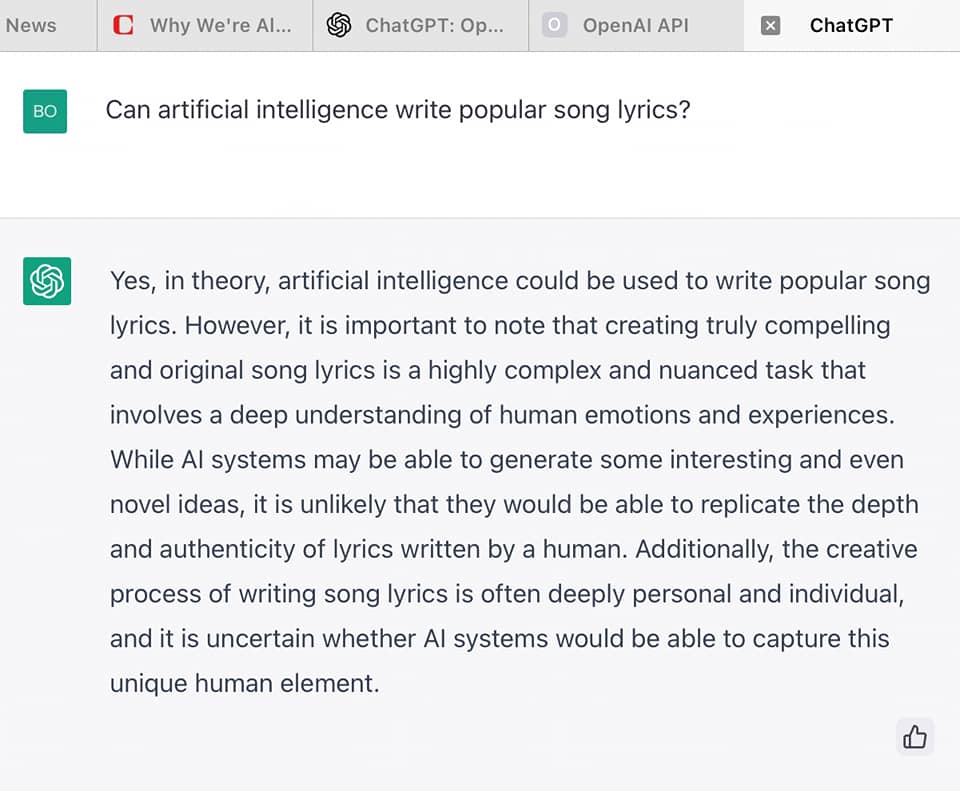
 
 
It's certainly fast. But my initial use thus far is just Q&A.
____

Now, the topical focus of The Atlantic piece is "authenticity" of student prose writing in the academic environment.
Essay generation is neither theoretical nor futuristic at this point. In May, a student in New Zealand confessed to using AI to write their papers, justifying it as a tool like Grammarly or spell-check: “I have the knowledge, I have the lived experience, I’m a good student, I go to all the tutorials and I go to all the lectures and I read everything we have to read but I kind of felt I was being penalised because I don’t write eloquently and I didn’t feel that was right,” they told a student paper in Christchurch. They don’t feel like they’re cheating, because the student guidelines at their university state only that you’re not allowed to get somebody else to do your work for you. GPT-3 isn’t “somebody else”—it’s a program.
Yeah. But apropos of my opening scenario, one can quickly come up with a number of broader questions. When big money is at stake (e.g., my recent prior FTX posts), all manner of problems surface—NLG "plagiarism (?)" aside.

My priority interest in AI has principally been about stuff like this:

Click
NLU: Natural Language Understanding.

I asked OpenAI ChatGPT the following:
ME:
Can artificial intelligence analyze a prose argument?

ChatGPT:
Yes, artificial intelligence (AI) can be trained to analyze prose arguments to some extent. However, the extent to which AI can effectively analyze prose arguments will depend on various factors, such as the quality and amount of training data the AI has been given, the specific AI model being used, and the complexity and nuances of the argument being analyzed.
I'll have to see if I can provide it an "argument," and instruct it to analyze and evaluate it. Skeptical. but, we'll see.

See some of my prior riffs on "AI" topics more generally here.

UPDATES

More from The Atlantic piece.
A chasm has existed between humanists and technologists for a long time. In the 1950s, C. P. Snow gave his famous lecture, later the essay “The Two Cultures,” describing the humanistic and scientific communities as tribes losing contact with each other. “Literary intellectuals at one pole—at the other scientists,” Snow wrote. “Between the two a gulf of mutual incomprehension—sometimes (particularly among the young) hostility and dislike, but most of all lack of understanding. They have a curious distorted image of each other.” Snow’s argument was a plea for a kind of intellectual cosmopolitanism: Literary people were missing the essential insights of the laws of thermodynamics, and scientific people were ignoring the glories of Shakespeare and Dickens.

The rupture that Snow identified has only deepened. In the modern tech world, the value of a humanistic education shows up in evidence of its absence. Sam Bankman-Fried, the disgraced founder of the crypto exchange FTX who recently lost his $16 billion fortune in a few days, is a famously proud illiterate. “I would never read a book,” he once told an interviewer. “I don’t want to say no book is ever worth reading, but I actually do believe something pretty close to that.”…
Ahhh... C.P. Snow. I've riffed on him before here.

Also, the best place to hide $16 billion from our liitle a-literate Genius pal Sam Bankman-Fried is apparently inside a book. 
 
"The Beast."
 
OK, THIS IS CUTE
 
Scott Singeisen, a “Professor of architecture” posts a Twitter thread in reaction to The Atlantic article:
Me:
Write a well argued response to Stephen Marche’s recent essay in @TheAtlantic that AI will make the college essay obsolete

ChatGPT:
Stephen Marche's essay in the Atlantic argues that AI will make the college essay obsolete. However, this claim is not well-supported and is ultimately not convincing.

First of all, it is important to note that the college essay serves a specific purpose in the admissions process. It allows admissions officers to get a sense of the applicant's personality, writing abilities, and potential fit for the institution. AI, on the other hand, is not capable of providing this type of insight. While AI may be able to analyze data and generate texts, it cannot replicate the human experience and provide the same level of depth and understanding that a college essay can.

Furthermore, the use of AI in the admissions process raises concerns about fairness and bias. AI systems are only as good as the data they are trained on, and if the training data is [sic] biased, the AI will also be biased. This could lead to admissions decisions that are unfair or that do not accurately reflect an applicant's abilities and potential.

Additionally, the use of AI in the admissions process could potentially widen the gap between students from different backgrounds. Students from disadvantaged backgrounds may not have access to the same resources and support as their more privileged peers, leading to a disadvantage in the admissions process.

In conclusion, while AI may have the potential to assist in the admissions process, it is not capable of replacing the college essay. The college essay serves a specific purpose in the admissions process and is an important tool for admissions officers to evaluate applicants. The use of AI also raises concerns about fairness and bias, and could potentially widen the gap between students from different backgrounds.
I'm gonna have to play with some of this stuff. 
 
I'm lucky. I never needed AI NLG "help" when it came to writing—prose or song lyrics. Likely has something to do with the 2-3 books a week (plus all of my periodicals) I've studied across my-now 55 years of "adult" life since turning 21. Ya think?

 Stephen Marche:

"[N]atural-language processing is going to force engineers and humanists together. They are going to need each other despite everything. Computer scientists will require basic, systematic education in general humanism: The philosophy of language, sociology, history, and ethics are not amusing questions of theoretical speculation anymore. They will be essential in determining the ethical and creative use of chatbots, to take only an obvious example…"

Yeah, And, don't forget the lawyers. Never overlook the lawyers, lest you come to rue the day.

MORE UPDATES
Click

Click
OK, WHAT ABOUT THIS CRAP?
 
 
Ugh... 

CODA
 
 
My latest login. The popularity of ChatGPT is melting their servers. 
 

Saturday, November 2, 2019

"Ethical Artificial Intelligence?"

When we have yet to even get to consistently ethical human intelligence?

https://www.amazon.com/Ethical-Algorithm-Science-Socially-Design-ebook/dp/B07XLTXBXV/ref=pd_ybh_a_3?_encoding=UTF8&psc=1&refRID=0MERJXWC8DFER78K0TQZhttps://www.amazon.com/Human-Compatible-Artificial-Intelligence-Problem-ebook/dp/B07N5J5FTS/ref=pd_ybh_a_11?_encoding=UTF8&psc=1&refRID=884HRK1K49EP20EHJ4AZ

Two (of four) of my current book reads. Stay tuned. Timely, important material.
 Note: Henceforth you are able to click on book cover images to go straight to their respective purchase info sites in a new browser window (usually Amazon). 
For openers, succinctly on "ethics."

Ethics

The field of ethics (or moral philosophy) involves systematizing, defending, and recommending concepts of right and wrong behavior. Philosophers today usually divide ethical theories into three general subject areas: metaethics, normative ethics, and applied ethics. Metaethics investigates where our ethical principles come from, and what they mean. Are they merely social inventions? Do they involve more than expressions of our individual emotions? Metaethical answers to these questions focus on the issues of universal truths, the will of God, the role of reason in ethical judgments, and the meaning of ethical terms themselves. Normative ethics takes on a more practical task, which is to arrive at moral standards that regulate right and wrong conduct. This may involve articulating the good habits that we should acquire, the duties that we should follow, or the consequences of our behavior on others. Finally, applied ethics involves examining specific controversial issues, such as abortion, infanticide, animal rights, environmental concerns, homosexuality, capital punishment, or nuclear war.
Notwithstanding my long (albeit late-blooming) white-collar career in a variety of tech disciplines, my field of grad study was squarely in the domain of "applied ethics." My MA is in "Ethics & Policy Studies," an interdisciplinary gumbo of applied ethics ("moral philosophy"), PolySci, Jurisprudence/ConLaw, and Econ, all applied to a policy topic of interest.

So, this kind of stuff is intrinsically of interest to me.

UPDATE

Amazon's AI certainly has my number. Touted just now in my inbox:

https://www.amazon.com/Human-Algorithm-Artificial-Intelligence-Redefining-ebook/dp/B07N8YYRVK/ref=pd_ybh_a_2?_encoding=UTF8&psc=1&refRID=Z2H35H7JEW8DHSH8KSZS
“[Coleman] argues that the algorithms of machine learning — if they are instilled with human ethics and values — could bring about a new era of enlightenment.” —San Francisco Chronicle
The Age of Intelligent Machines is upon us, and we are at a reflection point. The proliferation of fast-moving technologies, including forms of artificial intelligence akin to a new species, will cause us to confront profound questions about ourselves. The era of human intellectual superiority is ending, and we need to plan for this monumental shift.
A Human Algorithm: How Artificial Intelligence Is Redefining Who We Are examines the immense impact intelligent technology will have on humanity. These machines, while challenging our personal beliefs and our socioeconomic world order, also have the potential to transform our health and well-being, alleviate poverty and suffering, and reveal the mysteries of intelligence and consciousness. International human rights attorney Flynn Coleman deftly argues that it is critical that we instill values, ethics, and morals into our robots, algorithms, and other forms of AI. Equally important, we need to develop and implement laws, policies, and oversight mechanisms to protect us from tech’s insidious threats.
To realize AI’s transcendent potential, Coleman advocates for inviting a diverse group of voices to participate in designing our intelligent machines and using our moral imagination to ensure that human rights, empathy, and equity are core principles of emerging technologies. Ultimately, A Human Algorithmis a clarion call for building a more humane future and moving conscientiously into a new frontier of our own design.
A groundbreaking narrative on the urgency of ethically designed AI and a guidebook to reimagining life in the era of intelligent technology."
I'm gonna go broke buying books to study. I don't get paid for these rants. Gonna have to find a gig to continue to fund this Jones.

WHO IS FLYNN COLEMAN?


I have a question for Counselor Coleman:

"Assuming / Despite / If / Then / Therefore / Else..." Could AI do "argument analysis?"

e.g., "NLU"--Natural Language Understanding. I remain dubious. But, it's a moving target.

ANOTHER READ TO CONSIDER

https://www.amazon.com/Architects-Intelligence-truth-people-building-ebook/dp/B07H8L8T2J/ref=tmm_kin_swatch_0?_encoding=UTF8&qid=1572873579&sr=8-1-spons
...The demonstrated power of artificial intelligence has, in the last few years, led to massive media exposure and commentary. Countless news articles, books, documentary films and television programs breathlessly enumerate AI’s accomplishments and herald the dawn of a new era. The result has been a sometimes incomprehensible mixture of careful, evidence-based analysis, together with hype, speculation and what might be characterized as outright fear-mongering. We are told that fully autonomous self-driving cars will be sharing our roads in just a few years—and that millions of jobs for truck, taxi and Uber drivers are on the verge of vaporizing. Evidence of racial and gender bias has been detected in certain machine learning algorithms, and concerns about how AI-powered technologies such as facial recognition will impact privacy seem well-founded. Warnings that robots will soon be weaponized, or that truly intelligent (or superintelligent) machines might someday represent an existential threat to humanity, are regularly reported in the media. A number of very prominent public figures—none of whom are actual AI experts—have weighed in. Elon Musk has used especially extreme rhetoric, declaring that AI research is “summoning the demon” and that “AI is more dangerous than nuclear weapons.” Even less volatile individuals, including Henry Kissinger and the late Stephen Hawking, have issued dire warnings. 

The purpose of this book is to illuminate the field of artificial intelligence—as well as the opportunities and risks associated with it—by having a series of deep, wide-ranging conversations with some of the world’s most prominent AI research scientists and entrepreneurs. Many of these people have made seminal contributions that directly underlie the transformations we see all around us; others have founded companies that are pushing the frontiers of AI, robotics and machine learning...

Ford, Martin. Architects of Intelligence: The truth about AI from the people building it (p. 2). Packt Publishing. Kindle Edition.
_____________

More to come...

Saturday, May 25, 2019

AI-assisted NLU data analytics: Fat Tales, the 45th Moment of distributions, a.k.a. Trumptosis

From the WaPo Department of Blinding Glimpses of the Empirically Obvious.

From The Washington Post. Seriously?
Trump is twice as extreme as his predecessors in the past century. That’s dangerous.

It is the best of times. It is the worst of times.

In our current age of foolishness, things are “incredible,” “thriving,” “booming,” “prospering,” “tremendous,” “beautiful,” “very much happy” — the “greatest,” “best” and “most.”

It is also a “disaster,” a “mess,” “disintegrating,” “really bad,” “even worse” than the “worst,” “ridiculous,” “nasty” and “fake” — with “abuses,” a “lot of problems” and in a “spiral down.”

All of the above thoughts were proclaimed by President Trump within the span of a few minutes this week. So extreme is his rhetoric that even an attempt to portray himself as calm devolved into hysterical hyperbole…
Click the graphic below to enlarge.


The "Fourth Moment" of statistical distributions is known as "Kurtosis," a.k.a. the relative measure of "Fat Tails"

Get it? LOL.

Still working on updates for my prior post, but this was too good to pass up. We need "AI" to figure this stuff out? "Trumptosis," a new "best word."

And, no, it's not really funny.
_____________

More to come...

Thursday, May 31, 2018

Update on our favorite whipping boy, the EHR

From Trump's "failing NY Times" (I finally ponied up and subscribed, along with forking over at WaPo):

There are times when the diagnosis announces itself as the patient walks in, because the body is, among other things, a text. I’m thinking of the icy hand, coarse dry skin, hoarse voice, puffy face, sluggish demeanor and hourglass swelling in the neck — signs of a thyroid that’s running out of gas. This afternoon the person before me in my office isn’t a patient but a young physician; still, the clinical gaze doesn’t turn off, and I diagnose existential despair.

Let’s not call this intuition — an unfashionable term in our algorithmic world, although there is more to intuition than you think (or less than you think), because it is a subconscious application of a heuristic that can be surprisingly accurate. This physician, whose gender I withhold in the interest of anonymity and because the disease is gender-neutral, is burned out in what should be the honeymoon of a career. Over the years, I have come to recognize discrete passages in a medical life, not unlike in Shakespeare’s “Seven Ages of Man” — we have our med-school equivalent of “the whining schoolboy with his satchel and shining morning face” and the associate professor “jealous in honor, sudden and quick in quarrel.” But what I see in my colleague is disillusionment, and it has come too early, and I am seeing too much of it.

Does this physician recall sitting before me as an idealistic first-year medical student, keen to take the world in for repairs? It was during those preclinical years that the class learned to use the stethoscope, the ophthalmoscope and the tendon hammer, to percuss the body, sounding out its hollows, the territorial boundaries of lung and liver. After the preclinical come the two clinical years, though I think of those phases these days as precynical and cynical. When students arrive on the wards full time, white coats packed with the aforementioned instruments, measuring tape, tuning fork, flashlight and Snellen eye chart, they are shocked to find that the focus on the ward doesn’t revolve around the patients but around the computers lining the bunkers where students, residents and attending physicians spend the majority of their time, backs to one another. All dialogue among them and other hospital staff members — every order, every lab request and result — must pass through this electronic portal, even if the person whose inbox you are about to overload is seated next to you.

In America today, the patient in the hospital bed is just the icon, a place holder for the real patient who is not in the bed but in the computer. That virtual entity gets all our attention. Old-fashioned “bedside” rounds conducted by the attending physician too often take place nowhere near the bed but have become “card flip” rounds (a holdover from the days when we jotted down patient details on an index card) conducted in the bunker, seated, discussing the patient’s fever, the low sodium, the abnormal liver-function tests, the low ejection fraction, the one of three blood cultures with coagulase negative staph that is most likely a contaminant, the CT scan reporting an adrenal “incidentaloma” that now begets an endocrinology consult and measurements of serum cortisol.

The living, breathing source of the data and images we juggle, meanwhile, is in the bed and left wondering: Where is everyone? What are they doing? Hello! It’s my body, you know!…

My young colleague slumping in the chair in my office survived the student years, then three years of internship and residency and is now a full-time practitioner and teacher. The despair I hear comes from being the highest-paid clerical worker in the hospital: For every one hour we spend cumulatively with patients, studies have shown, we spend nearly two hours on our primitive Electronic Health Records, or “E.H.R.s,” and another hour or two during sacred personal time. But we are to blame. We let this happen to our trainees, to ourselves.

How we salivated at the idea of searchable records, of being able to graph fever trends, or white blood counts, or share records at a keystroke with another institution — “interoperability”! — and trash the fax machine. If every hospital were connected, we would have a monster database, Big Data that’s truly big and that would allow us to spot trends in disease so much earlier and determine best practice and predict complications. But we didn’t quite get that when, as part of the American Recovery and Reinvestment Act of 2009, $35 billion was eventually steered toward making medicine paperless.

My A.T.M. card is amazing: I can get cash and account details all over America and beyond. Yet I can’t reliably get a patient record from across town, let alone from a hospital in the same state, even if both places use the same brand of E.H.R., for reasons that are only partly explained by software that has been customized for each site. This is not like sending around a standard Word file. And so, too often the record comes by fax.

What the E.H.R. has done is help reduce medication errors; it is a wonderful gathering place for laboratory and imaging information; the notes are always legible. But the leading E.H.R.s were never built with any understanding of the rituals of care or the user experience of physicians or nurses. A clinician will make roughly 4,000 keyboard clicks during a busy 10-hour emergency-room shift. In the process, our daily progress notes have become bloated cut-and-paste monsters that are inaccurate and hard to wade through. A half-page, handwritten progress note of the paper era might in a few lines tell you what a physician really thought. (A neurosurgeon I once worked with in Tennessee would fill half the page with the words “DOING WELL” in turquoise ink, followed by his signature. If he deviated from that, I knew he was very worried and knew to call him.) But now, with a few keystrokes, you can populate your note with all the listed diagnoses, all the medications, all the labs, all the radiology reports, pages and pages of these, as well as enough “smart phrases” — “.EXT2” might spit out “Extremities-2+ pedal edema, normal pulses” — to allow you to swear you personally examined the patient from head to foot and personally took all the elements of the history, personally did a physical exam separate from the admitting physician that would put Sir William Osler to shame, all of which make it possible to bill at the highest level for that encounter (“upcoding”)...
"For every one hour we spend cumulatively with patients, studies have shown, we spend nearly two hours on our primitive Electronic Health Records..."

I'm still having trouble believing that. It is, however, an empirical matter, vague "studies have shown" anecdotes aside. (See, e.g., my 2014 riff on data-mining the EHR security logs for workflow analytics.)

Read the entire NY Times piece.

apropos, see a couple of my prior posts: "Are structured data the enemy of  health care quality?" and "Clinical cognition in the digital age."

And, of course, we musn't forget English major @Healthcare_Kate's swell "EHRs are a dying technology."

The NY Times article headline cites 'Machine Learning." But, I've noted possible "reproducibility problems."

Finally (for now). see my post "Fix the EHR?" Of course, but how about fixing the clinical process workflows?

ERRATA


Five weeks since my daughter died. Still seems like last night. Sigh...

Next up for me? The SAVR px. Just thrilled. Meeting with my Primary and my Cardiologist tomorrow, then the Cardiac Surgeon next Tuesday. I had a coronary angiogram done. Negative for blockages, so I'm looking at "just" a straight aortic valve job.

BTW, Danielle's former employer has launched the Danielle L. Gladd Scholarship Fund in her honor and memory. I just contributed.

UPDATE

Another cautionary tale regarding medical charts, this one having zilch to do with keystrokes and mouse clicks.
Your Medical Chart Might be Biased. Here’s What Doctors Should Do About It.
Racial disparities in health outcomes are complicated, but this is one place to start.
By DANIELLE OFRI


…A recent paper caught my eye because it captured one of the more subtle aspects of the brew: how we write about patients in the chart. Mary Catherine Beach and her colleagues at Johns Hopkins University were curious about whether our choice of language transmits bias from one medical professional to another. The researchers created a hypothetical case of an African American man with sickle cell disease, a condition that typically requires opiate medications for control of painful flares. They wrote two versions of the medical chart, one with neutral language and one with language—taken from real charts—that could be viewed as more stigmatizing. Medical students and residents were randomized to read one of the charts and then asked about their attitude toward the patient and how much pain medication they would prescribe.

Those trainees who read the chart with the more stigmatizing language exhibited more negative attitudes toward the patient and elected to give less aggressive pain treatment. This result is probably not surprising—we know that black patients tend to receive lower rates of pain treatment. But what is intriguing is how subtle the differences in language were between the two charts. In the first chart, the patient was described as a “28-year old man with sickle cell disease” and in the second chart as a “28-year old sickle cell patient.” Before the symptoms occurred the patient “spent yesterday afternoon with friends” versus “was hanging out with friends outside McDonalds.”

For the physical examination, the doctor observed in the first chart that the patient “is in obvious distress,” and in the second that the patient “appears to be in distress.” A nursing note in the first chart reported that the patient “is not tolerating the oxygen mask and still has 10/10 pain,” and in the second chart that the patient “refuses to wear his oxygen mask and is insisting that his pain is ‘still a 10.’ ”

The descriptions in the second chart weren’t necessarily inaccurate, but together they subtly paint the patient as a less reliable person, someone who perhaps is trying to game the system for drugs. According to Beach, this type of language not only discredits the patient’s report of pain, but highlights details that reinforce negative stereotypes. Medical charts are the primary means of communication among medical professionals, so this sort of language covertly signals to other members of the team that this is a ‘low class’ person who isn’t trustworthy or deserving.

As soon as Beach put it this way, I could see that our supposedly objective medical records contain racially laden dog whistles of the sort that we regularly decry in political speech. In the last two years we’ve gotten more adept at noticing and calling out references to inner cities, illegal aliens, international bankers, Sharia law, and locker-room talk, but we doctors like to think that we treat all our patients equally. We would never think of ourselves as racist or marginalizing. Yet, it’s there in our language…
Seriously doubt that digital "AI/NLU" (Natural Language Understanding) tech portends any help there.

I love Dr. Ofri's work, and have cited her many times.


Numerous relevant Danielle Ofri articles up on Slate, btw.

I'd like to know what Rachel Pearson ("@HumanitiesMD") thinks about the foregoing. I keep bugging her about wanting to read her Doctoral Dissertation, to no avail as yet. "You must be the only person in the country who wants to read it."
Summary of Dissertation:

Objectivity is an epistemological virtue that physicians aspire to embody in our practice. Historians and philosophers have pointed out that objectivity is culturally specific: it varies with time, place, and profession. In pre-clinical training, physicians learn to honor a scientific version of objectivity, in which the self is understood primarily as a potential source of error and “scientific selves” seeks to eradicate the pernicious influence of the self from scientific data. In practice, however, this research identifies that medical objectivity is distinct from scientific objectivity. This dissertation examines memoirs of medical training to understand how physician trainees learn, experience, and use objectivity...
All part of a piece, 'eh?
_____________

More to come...

Wednesday, May 23, 2018

"The International Center for Information Ethics?"

Gradually trying to start moving on after losing my daughter. The house is now quiet and empty except for Cheryl and I, after a crazy busy week.

Got a new (promptly reciprocated) Twitter Follow:


Given that my grad degree is in "Ethics and Policy Studies" (an interdisciplinary mashup of PolySci, Econ, applied Philosophy, and Jurisprudence, etc), I am innately attracted to this area. I joined. We shall see.
ABOUT US
The International Center for Information Ethics (ICIE) is an academic community dedicated to the advancement of the field of information ethics. It offers a platform for an intercultural exchange of ideas and information regarding worldwide teaching and research in the field. ICIE provides an opportunity for community and for collaboration between colleagues practicing and teaching in the field. It provides news regarding ongoing activities by various organizations involved in the shared goals of information ethics…


DIGITAL ETHICS
Digital Ethics concerns itself with human and digital interactions, including decisions made by humans while interacting with the digital, as well as those decisions made by the digital interacting with humans. Digital Ethics includes, in order of appearance into the field, Computer Ethics, Cyberethics, and AIethics. It places a focus on ethical issues pertaining to such things as software reliability and honesty, artificial intelligence, computer crime, digital transparency and e-commerce. The origins of Digital Ethics are found in the adoption of ethical concerns into Computer Science, as influenced by Norbert Wiener's 1948 Cybernetics.

MEDIA ETHICS
Media Ethics concerns itself with ethical practice in journalism and information dissemination, and includes issues as diverse as conflicts of interest, source transparency, fairness, fake news, and information accuracy. It aims to represent the best interests of the public through impartiality and balance, recognizing and addressing bias, and strives to respect individual privacy while demanding corporate and government transperency. Media Ethics makes explicit that journalism and media play a large part in shaping worldviews in society and as such demands a responsibility and personal commitment on the part of the journalist.

LIBRARY ETHICS
Alongside ethical considerations for Computer Science, the field of Information Ethics was first encapsulated under the ethical practices of Libraries and Information Science in the late 1980’s and early 1990’s. Library Ethics focuses on issues of privacy, censorship, access to information, intellectual freedom and social responsibility. It addresses copyright, fair use, and best practices for collection development. While Library Ethics originates, in the professional sense, in 19th-century librarianship, it finds its origins in a tradition of information ethics that stretches back to ancient Greece.

INTERCULTURAL INFORMATION ETHICS
Intercultural Information Ethics considers perspectives on information dissemination, ICTs and digital culture from the point of view of both globalization and localization. It provides an account of information culture as originating from all cultures, envisaged through comparative philosophies such as Buddhist and western-influenced information ethics traditions to African Ubuntu and Japanese Shinto ethics traditions in ICTs. In its applied sense, Intercultural Information Ethics strives to move beyond the presumed biases of western and greek-influenced ethical foundations for the field of Information Ethics to include globally diverse information ethics traditions. Philosophically, it endeavors to bridge a notable chasm in the field of information ethics, namely the foundational divide between information ecology and hermeneutics.

BIOINFORMATION ETHICS
Bioinformation Ethics explores issues of information pertaining to technologies in the field of biology and medicine. Traditional concerns in Bioethics such as abortion, organ donation, euthanasia, and cloning form the basis of Bioinfomation Ethics, but are supplemented by questions regarding the influence of digital and information & communication technologies. Bioinformation Ethics addresses rights to biological identity, the use of DNA and fingerprints, the dissemination of biomedical information and equal rights to insurance and bank loans based on genetics.

BUSINESS INFORMATION ETHICS
Business Information Ethics is the convergence of two separate fields of applied ethics, those being Information Ethics and Business Ethics. Business Information Ethics addresses informational considerations of the dissemination of goods and services, including information as a commodity, and provides ethical guidance in the analysis of the use of goods and services, including discourse on the impact they have on society. Business Information Ethics also addresses concerns for journal and information management, and includes the subfield of Organisational Information Ethics, as represented by the Centre for Business Information Ethics (CBIE).


“An important aspect of today's understanding of Ethics concerns issues of individual and social responsibility with regard to the impact of our choices in light of the influence of science and technology. While information and communication technologies open doors to new technological and scientific possibilities, they also act as a catalyst to an unprecedented encounter with otherness, ensuring through digital mediums the en masse collision of hitherto closed ethical systems and cultural worldviews."
-- Rafael Capurro
Yeah. It resonates.

apropos, see my prior post "Artificial intelligence and ethics." See also "The old internet of data, the new internet of things and "Big Data," and the evolving internet of YOU."

Stay tuned.
__

ERRATA

Also trying to get back on pace with my reading. I'm buried. Just a couple of new ones (I have about a dozen piled up):


I've had a good recurrent go at the massive fraud of Theranos (John Carreyrou's topic in his newly released book). Thus far a compelling "page turner." They've probably already sold movie rights.

More on Michael Pollan and Judea Pearl.

Three others I've recently started:

__

BTW, speaking of "AI" and "Ethics," see
How the Enlightenment Ends
Philosophically, intellectually—in every way—human society is unprepared for the rise of artificial intelligence.
Henry Kissinger, no less.
...If AI learns exponentially faster than humans, we must expect it to accelerate, also exponentially, the trial-and-error process by which human decisions are generally made: to make mistakes faster and of greater magnitude than humans do. It may be impossible to temper those mistakes, as researchers in AI often suggest, by including in a program caveats requiring “ethical” or “reasonable” outcomes. Entire academic disciplines have arisen out of humanity’s inability to agree upon how to define these terms. Should AI therefore become their arbiter?...
Yeah. One of my grad school profs observed one day that "it is often erroneously claimed that the Nazis 'had no ethics.' They most certainly did -- an aggressive ethos of murderous elimination."

UPDATE

A fashionable (overhyped?) area of AI of late is "NLP" (Natural Language Processing). Within that topical area is the subfield "NLU" (Natural Language Understanding). Notwithstanding its obvious extant (if circumscribed) utility -- e.g., "Siri" --, I have concerns. See my prior post "Assuming / Despite / If / Then / Therefore / Else..." Could AI do "argument analysis?"


It seems rather obvious to me that one foundational element of "Information Ethics" is that of the accuracy of information (in particular information comprising "arguments") -- i.e. rationality in pursuit of truths. If you don't have that, all you have is "noise."

I'd be rather skeptical of trying to sanguinely delegate such tasks to "NLU."
_____________

More to come...

Monday, September 11, 2017

Watson and cancer

"...there’s a rather basic but fundamental problem with Watson, and that’s getting patient data entered into it. Hospitals wishing to use Watson must find a way either to interface their electronic health records with Watson or hire people to manually enter patient data into the system. Indeed, IBM representatives admitted that teaching a machine to read medical records is “a lot harder than anyone thought.” (Actually, this rather reminds me of Donald Trump saying, “Who knew health care could be so complicated?” in response to the difficulty Republicans had coming up with a replacement for the Affordable Care Act.) The answer: Basically anyone who knows anything about it. Anyone who’s ever tried to wrestle health care information out of a medical record, electronic or paper, into a form in a database that can be used to do retrospective or prospective studies knows how hard it is..."
From Science Based Medicine. They've picked up on and run with the reporting first published by STATnews.
"Hospitals wishing to use Watson must find a way either to interface their electronic health records with Watson..."
Ahhh.. that pesky chronic 'interoperababble" data exchange problem.

SBM continues:
What can Watson actually do?
IBM represents Watson as being able to look for patterns and derive treatment recommendations that human doctors might otherwise not be able to come up with because of our human shortcomings in reading and assessing the voluminous medical literature, but what Watson can actually do is really rather modest. That’s not to say it’s not valuable and won’t get better with time, but the problem is that it doesn’t come anywhere near the hype...
Necessarily, Watson has to employ the more difficult "Natural Language Understanding" (NLU) component of Natural Language Processing (NLP). I have previously posted on my NLP/NLU concerns here.

Search Google news for "Watson oncology" or "Watson cancer."


I'm sure you've all seen the numerous Watson TV commercials by now.

Are we now skiing just past the "Peak of Inflated Expectations?"

Everything "OncoTech" is of acute interest to me these days amid my daughter's cancer illness. apropos, see my prior post "Siddhartha Mukherjee's latest on cancer."

UPDATE

THCB has a nice post on the topic.
7 Ways We’re Screwing Up AI in Healthcare
BY LEONARD D’AVOLIO


The healthcare AI space is frothy. Billions in venture capital are flowing, nearly every writer on the healthcare beat has at least an article or two on the topic, and there isn’t a medical conference that doesn’t at least have a panel if not a dedicated day to discuss. The promise and potential is very real.

And yet, we seem to be blowing it.

The latest example is an investigation in STAT News pointing out the stumbles of IBM Watson followed inevitably by the ‘is AI ready for prime time’ debate. If course, IBM isn’t the only one making things hard on itself. Their marketing budget and approach makes them a convenient target. Many of us – from vendors to journalists to consumers – are unintentionally adding degrees to an already uphill climb.

If our mistakes led to only to financial loss, no big deal. But the stakes are higher. Medical error is blamed for killing between 210,000 and 400,000 annually. These technologies are important because they help us learn from our data – something healthcare is notoriously bad at. Finally using our data to improve really is a matter of life and death…
Indeed. Good post. Read all of it.

Also of recent relevant note:
Athelas releases automated blood testing kit for home use
Silicon Valley-based startup Athelas today introduced a smartphone app that it says can do simple blood diagnosis at home and return results in just 60 seconds.

The kit itself looks a bit like an Amazon Echo device and is coupled with a smartphone app to reveal the results of the test. In a demonstration, co-founder Deepika Bodapati showed TechCrunch that from taking a sample of blood and sliding it into the device, within seconds users can see their white blood count, neutrophils, lymphocytes and platelets.

Bodapati and co-founder Tanay Tandon are well aware of the fate of a similar device that promised to deliver results but wasn’t exactly what it said it was. That was the blood testing startup, Theranos, that soared to a valuation of $9 billion and then crashed and burned after its effectiveness was called into question.

“Theranos proved there was clear interest in the space, it would have been a great company if it worked,” Tandon said in an interview with Bloomberg. “Now, investors say they need proof before we can raise money.”

Athelas has published papers on the accuracy of its data and has also been FDA-approved as a device to image diagnostics. Before it can be sold over the counter, it will have to receive further approval stating that it’s as accurate as a standard test in lab conditions…
"Theranos?" Remember them? I've had my considerable irascible sport with them here.

Athelas is specifically pitching the utility of their product for oncology blood assay monitoring.


Interesting. My daughter has to run over to Kaiser today for her routine blood draw in advance of her upcoming every-other-week chemo infusion. I'm not sure her oncologist (who is also a hematologist) would be comfortable leaning on DTC single-drop-of-blood assay alternatives.

I think the Athelas people will be at the upcoming Health 2.0 Conference, and we will be hooking up for discussion. I'll have to look back through the Conference agenda to see whether any Watson peeps will be there.

Also, in the wake of my recent cardiology workup, I have to wonder about apps like that now marketed DTC by AliveCor:
Meet Kardia Mobile.
Your personal EKG.

Take a medical-grade EKG in just 30 seconds. Results are delivered right to your smartphone. Now you can know anytime, anywhere if your heart rhythm is normal, or if atrial fibrillation is detected.

Is this widely useful or just another 'Worried Well" toy? I showed this pitch to my cardiologist. He was dubious -- with respect to my case, that is.

ERRATUM
On "big data" and "Big Silicon Valley firms." New book release on Sept 12th. Saw a number of articles with and by the author.
"…More than any previous coterie of corporations, the tech monopolies aspire to mold humanity into their desired image of it. They think they have the opportunity to complete the long merger between man and machine - to redirect the trajectory of human evolution. How do I know this? In annual addresses and town hall meetings, the Founding Fathers of these companies often make big, bold pronouncements about human nature - a view that they intend for the rest of us to adhere to. Page thinks the human body amounts to a basic piece of code: "Your program algorithms aren't that complicated," he says. And if humans function like computers, why not hasten the day we become fully cyborg? To take another grand theory, Facebook chief Mark Zuckerberg has exclaimed his desire to liberate humanity from phoniness, to end the dishonesty of secrets.

"The days of you having a different image for your work friends or co-workers and for the other people you know are probably coming to an end pretty quickly," he has said. "Having two identities for yourself is an example of a lack of integrity." Of course, that's both an expression of idealism and an elaborate justification for Facebook's business model…"

Looks interesting. I will be reading and reviewing it. I had a run at some of his issues in 2015. See "The old internet of data, the new internet of things and "Big Data," and the evolving internet of YOU."

UPDATE

Finished the Franklin Foer book. Riveting read. Read it "cover to cover" pretty much straight through in one day. Contextual review coming, stay tuned.

CODA

____________

More to come...

Wednesday, August 23, 2017

On deck, the 2017 Health 2.0 Conference, Oct 1-4

"This October 2,000 of the best and brightest will gather to discuss, witness, and share the leading cutting-edge innovations transforming today’s global health care system. Health 2.0’s flagship event connects thought leaders, providers, innovators, investors, and start-ups for four days packed full of curated discussions, demos, exhibits and networking…"

Conference block rate for the onsite Hyatt Regency hotel expires Sept 7th. Mercifully, the NFL 49ers play Arizona at Arizona on October 1st, so there won't be that huge traffic mess around Levi Stadium.

I booked my hotel rez starting on Saturday September 30th so I can hit the ground running Sunday morning. Joe Flower will keynote the Provider Symposium Sunday morning.

BTW, Sept 30th is the final day of federal FY 2017. President Trump is threatening a government shutdown to try to coerce congressional funding of his Mexico Wall (yeah, right). More seriously, the "Freedom Caucus" right wing Tea Party faction of the GOP wants another federal shutdown to try to get their way on the federal debt ceiling. My note on this now-hardy perennial a couple of years ago on another of my blogs:
Let's be very clear here: While "defunding" and transiently shutting down the government by failing to pass budget legislation is a political act within the bounds of tripartite government (notwithstanding its inanity), intentionally defaulting on the public debt is a separate and explicit Constitutional violation of legislative branch members' Oaths of office -- notwithstanding the GOP extremists' conflating attempt to glom it all together. to wit,

Section 4 of the 14th Amendment declares that "the validity of the public debt shall not be questioned." Section 5 subsequently states that the Congress has the sole responsibility over this question.

More broadly, as set forth in Article I, Sections 7 and 8, only Congress has the authority to appropriate funds and levy taxes. They can appropriate funds by raising taxes and/or borrowing from the private credit markets in the name of the nation. If they choose the latter, they are required to see to it that payment is always honored, even should that mean raising taxes or cutting other program expenditures. Neither the President not the Supreme Court has any Constitutional authority here. Should honoring the public debt require a presidential veto override, so be it. Muster the requisite votes. Should it require taking out "poison pill" provisions in order to pass debt service legislation, so be it. Those are among the legitimate mechanics of governance, in this case devolving to the Congress and no other entity.
..
During the 2013 Health 2.0 Conference we had a number of federal officials in attendance (e.g., ONC, CMS) to speak. Because of the 2013 federal shutdown they had to leave early and return to DC.

We'll see.

HIMSS

Interestingly, this will be the first Health 2.0 Conference under HIMSS ownership (should we call it "The 1st Annual HIMSS 2.0 Conference?")


I find it a bit curious that there is no prominent, static mention/link (as of today) regarding the 2017 Health 2.0 Conference on the HIMSS homepage. What's up with that? (Mention of the Conference does appear transiently amid a rotating group of small horizontal banner ads at the top of the page. Hit "Ctrl-R" repeatedly to see if you can get it to pull up.)

I went to the HIMSS Facebook page.


OK. Nyet. Nada. Zilch.

They do cite this on the HIMSS homepage at the right side "top of the fold":


Interesting timing overlap. I just searched through the agenda. Maybe I've missed something, but I see no mention of "Health IT Week." (Neither do repeated spelling-variant searches on the health2con.com site turn up any mention.) Wonder if they'll have an exhibit hall booth presence?

Now that HIMSS owns the Health 2.0 Conferences, I hope I don't get any photography grief, like I encountered at the HIMSS16 closing Keynote.

BTW, loves my New Yorker...


NLP on the agenda?

Searching the conference agenda also fails to turn up any mention of the acronym "NLP" or its referent phrase "Natural Language Processing," on which I've previously ruminated here and here.

I continue to study and follow the topic. Ran across this the other day (which I've excerpted below):
FDA, UCSF-Stanford CERSI, and San Francisco State University Collaborative WorkshopJune 15, 2017

Goals and Objectives:

The objective of this workshop was to identify current and emerging natural language processing (NLP) efforts being applied to unstructured text such as clinical notes or narratives in electronic health records (EHRs). The workshop provided insights into utility and challenges in designing and implementing NLP systems to capture relevant or missing information from clinical notes or text for conducting postmarketing safety surveillance and informing the design and execution of clinical trials for medical products, which include drugs, biologics, and devices. The workshop included panel discussion sessions to provide stakeholders with a forum to discuss natural language processing with experts in the field.

The workshop focused on whether NLP can be applied to unstructured text in clinical notes to:

  • Identify indication or reason for medical product use, adverse outcomes or events associated with use of these products, and confounders or personal behaviors that may modify risks associated with use of these products
  • Support protocol design, feasibility, recruitment efforts and execution of clinical trials
Use of Natural Language Processing to Extract Information from Clinical Text: Summary of the FDA Workshop
 

A public workshop organized by the U.S. Food and Drug Administration (FDA), the UCSF-Stanford Center of Excellence in Regulatory Science and Innovation (UCSF-Stanford CERSI), and San Francisco State University was held at the FDA White Oak Campus on June 15, 2017. The objective of the workshop was to identify current and emerging natural language processing (NLP) efforts being applied to unstructured text such as clinical notes or narratives in electronic health records (EHRs)…

While this workshop focused on NLP, it was noted by several speakers that it is only one part of the solution pipeline (sequence of software tools) – it is most often preceded by complex data acquisition and pre-processing, and followed up with some combination of machine learning or rule-based systems to produce desired decisions or interpretations. In many cases, NLP is in fact performed as a set of rules, or has been replaced with text mining and statistical methods with good success in specific areas especially when a large number of records are available. 


Classical NLP technology, designed for regular text, encounters significant challenges in processing information from clinical text in medical records such as EHRs. The challenges come from two key areas: a) NLP was not originally designed to process data in this format and with the “noise” inherent in EHRs, and b) most NLP algorithms require large gold standard databases for training ground truth data, which are hard to come by. It was also noted that for NLP to be successful in these areas, it will need to adequately handle negative statements (negations) and medical context. 


In spite of the above challenges, a literature review presented by one of the speakers showed that NLP and related methods were successful for some specific applications (e.g., radiology diagnosis, filling in certain EHRs, extraction of specific medical terms, etc.). Since each of these applications were developed separately, the issue of generalization remains.
To move forward, several possible approaches and directions were identified by one or more speakers/panelists:
  • Given that NLP is only part of the analysis pipeline that may include (deep) machine learning, it is important to optimize the whole pipeline, from data capture to final data/decision representation.
  • Leveraging new analytics methods that reduce dependence on large training databases (e.g., deep learning, CNN, text mining etc.) would be beneficial.
  • Developing general solutions using a single generalizable NLP/analytics method is difficult, so it may be worthwhile to work on solving specific problems first, then analyzing commonalities among successful solutions, leading to possible generalizations…
DATA
Electronic Health Records (EHRs) and other structured clinical documents were originally designed for very different purposes (patient care, billing, reporting). The clinical notes or text contained in these documents may contain additional information and context about the medical encounter but the clinical information it contains is non-standardized, has errors, typos, omissions and often miss key information necessary for envisioned FDA applications (e.g., confounders, prescriber and patient intent or behavior). This poses significant challenges for classical NLP tools designed to work on regular text. Further complicating the situation, the applications of NLP addressed at the workshop are many, and often require information and context not originally coded or missing in EHRs and related documents (e.g., confounders, temporal components, state of instrumentations)…
Leveraging a variety of complementary data sources (including other patient records, observations during the exam etc.) in addition to EHRs would help to provide missing information, redundancy, as well as context, all of which are important for making the correct decisions…

TOOLS AND RESOURCES
The following ideas were suggested by one or more speakers/panelists as possibilities to help develop tools…


  • Using and leveraging best practices of open source software.
  • Developing software environments in the form of interactive workbench where one can easily create and test analytic pipelines (aggregate of software tools used) by integrating available tools, as has been done for other areas.
  • Provide and disseminate open source NLP and machine learning tools with adequate distribution, licensing and documentation.
Availability of accessible, easy to share gold standard databases remains critical. The positive experience of other areas on machine learning where such databases have helped to make significant advances needs to be leveraged. This remains, however, a technical/cost issue as well as a policy and legal issue due to data privacy considerations…
Recall from my earlier posts, there are two materially differing subtopics: [1] NLG, Natural Language Generation (expressing "structured" numerical data and informatics codes in narrative form -- relatively old news), and [2] NLU, Natural Language Understanding, the far more difficult area (and the focus of my abiding dubiety).

Hope I find some good NLP stuff at the Conference (amid my myriad other topics of KHIT interest).

UPDATE: NLP NEWS ITEM
Apple's Siri latest target in string of natural language patent lawsuits
One-man company Word to Info on Friday expanded a string of patent lawsuits over natural language processing technology — active cases involve Amazon, Google, Microsoft and Nuance — to include Apple, taking specific aim at the tech titan's Siri virtual assistant.
Interesting. A "patent troll?" At first blush, looks like one to me. Bears watching.

ON THE VENTURE CAPITAL COMMUNITY

A staple of Health 2.0 events involves panels of Silicon Valley VCs. Below, an interesting read (particularly in the wake of the persistent troubles at Uber, and the misfortunes of bro'grammer #GoogleManifesto Man):

In December 2010, Sheryl Sandberg gave a talk about women’s leadership in which she mentioned “sitting at the table.” Women, she said, have to pull up a chair and sit at the conference-room table rather than clinging to the edges of the room, “because no one gets to the corner office by sitting on the side.”

Less than a year later, I would take those words to heart. I had been working for six years at the Silicon Valley firm Kleiner Perkins Caufield & Byers as a junior partner and chief of staff for managing partner John Doerr. Kleiner was then one of the three most powerful venture-­capital firms in the world. One day, I was part of a small group flying from San Francisco to New York on the private jet of another managing partner, Ted Schlein. I was the first to arrive at Hayward Airport. The main cabin of the plane was set up with four chairs in pairs facing each other. Usually the most powerful seat faces forward, looking at the TV screen, with the second most powerful next to it. Then came the seats facing backward. I was sure the white men booked on the flight (Ted, senior partner Matt Murphy, a tech CEO, and a tech investor) would be taking those four seats and I would end up on the couch in back. But Sheryl’s words echoed in my mind, and I moved to one of the power seats — the fourth, backward-facing seat, but at the table nonetheless. The rest of the folks filed in one by one. Ted sat across from me, the CEO next to him, and the tech investor next to me on my right. Matt ended up with what would have been my original seat on the couch.

Once we were airborne, the CEO, who’d brought along a few bottles of wine, started bragging about meeting Jenna Jameson, talking about her career as the world’s greatest porn star and how he had taken a photo with her at the Playboy Mansion. He asked if I knew who she was and then proceeded to describe her pay-per-view series (Jenna’s American Sex Star), on which women competed for porn-movie contracts by performing sex acts before a live audience.

“Nope,” I said. “Not a show I’m familiar with.”

Then the CEO switched topics. To sex workers. He asked Ted what kind of “girls” he liked. Ted said that he preferred white girls — Eastern European, to be specific.

Eventually we all moved to the couch for a working session to help the tech CEO; he was trying to recruit a woman to his all-male board. I suggested Marissa Mayer, but the CEO looked at me and dismissively said, “Nah, too controversial.” Then he grinned at Ted and added, “Though I would let her join the board because she’s hot.”

Somehow, I got the distinct vibe that the group couldn’t wait to ditch me. And once we landed at Teterboro, the guys made plans to go to a club, while I headed into Manhattan alone. Taking your seat at the table doesn’t work so well, I thought, when no one wants you there. (When Sandberg’s book Lean In came out, that same Jenna Jameson–obsessed CEO became a vocal spokesperson for it.)

Seven months later, I would sue Kleiner Perkins for sexual harassment and discrimination in a widely publicized case in which I was often cast as the villain — incompetent, greedy, aggressive, and cold. My husband and I were both dragged through the mud, our privacy destroyed. For a long time I didn’t challenge those stories, because I wasn’t ready to talk about my experience in detail. Now I am…
Yikes. Read all of it. (a fairly long read). I ran into it here. Just an excerpt from her forthcoming book Reset.


Interesting, accomplished, scary-smart woman. Same age as my younger daughter.
____________

More to come...