Search the KHIT Blog

Showing posts with label Artificial Intelligence. Show all posts

Thursday, May 7, 2026

The "Accelerationists" vs the "Doomers."

AI For Good?
 
Pending book release. Pre-pub excerpt from The Atlantic.
The Secret to Understanding AI
“Imagine the tech without the tech companies.”
By Josh Tyrangiel

In the before times—before machines could hallucinate, before compute was a noun—it was not uncommon to go several weeks without someone telling me the world was about to end. Similarly, a whole season might pass without anyone assuring me that it was also, simultaneously, about to become perfect.

That particular luxury died on November 30, 2022, when OpenAI released ChatGPT to the public. What followed was less a news cycle than a weather event—a tropical depression that would not budge. Within weeks, millions of people had their first experience with generative AI. Within months, every major technology company had announced its own version of a large language model, or a partnership, or a pivot. Venture capital arrived drooling. Most people in tech think about money, but AI-profit projections are different—like CFO fan fiction, written in Excel. In 2023, the McKinsey Global Institute estimated that $4.4 trillion in annual corporate profits could be up for grabs from generative AI alone. Morgan Stanley estimated $40 trillion more in operational efficiencies. The words artificial intelligence went from obscurity to a constant hum, present in every earnings call, every school-board meeting, and far too many arguments at dinner tables.

Yet for all of the noise, a simple question stayed unanswered: What exactly was this new technology going to do for people? Not for corporations or the billionaires who aspired to become trillionaires, but for people with mortgages and sick parents and children struggling to learn things…
May 12th release date.
AMAZON BLURB
In contrast to the wave of noisy polemics around AI, AI For Good explores how, in practice, it can actually improve our lives and tells the stories of everyday citizens at the forefront of this new “AI entrepreneurship.”

AI is often framed as a force of radical transformation, either catapulting us into a utopian future or dragging us toward existential ruin. But this book tells a different story. It’s not about high-profile tech CEOs who want to use AI to “break shit,” but about a bunch of smart pragmatists using AI to make the world better.

Josh Tyrangiel’s journey into AI began with a late-night YouTube video featuring General Gustave Perna, the retired four-star general who orchestrated the distribution of Covid vaccines during Operation Warp Speed. Perna’s success—and the end of the pandemic—depended on AI’s practical ability to synthesize and standardize vast amounts of logistical data. AI wasn’t the hero of the story—it was the tool that helped real people get things done.

This book follows those people, who make up a kind of AI counterculture. It explores AI’s quiet revolution in government services, medicine, education, and human connection—places where it’s being used to amplify human judgment rather than replace it. It tells the stories of teachers, doctors, and bureaucrats who often stumbled into AI as a means to solve specific, tangible problems, often with no prior software expertise.

While the loudest voices in AI debate doomsday scenarios and trillion-dollar market opportunities, this book focuses on those working in the messy, incremental, but deeply impactful space of AI practice. However, there is one big caveat—success is not guaranteed. Change is hard. Institutions move slowly. But even in failure there are lessons for everyone who’s interested in using AI—carefully, thoughtfully—to build a better world today.
I have too many books in play at the moment (about 8), but I'll be adding this to the list when it's released.
 
SOME OTHER READS JUST ADDED TO THE STASH

 
Dispatches from Grief is intensely personal for this "Girl Dad."


The greatest pitfall in the search for extraterrestrial life—according to science fiction, anyway—is foolhardy researchers somehow bringing aliens to Earth to wreak havoc.

But after decades of exploring our seemingly sterile solar system, real-world scientists today are much more concerned with the opposite problem: The possibility that Earth’s life will escape our planet to contaminate other worlds, sabotaging the quest to find any genuine “second genesis” of biology around the sun. Imagine that a multibillion-dollar robotic mission found wriggling microbes on Mars and that follow-up studies then revealing those “aliens” had DNA and other biomolecular machinery that showed they were emigrants from Earth.

Astrobiologically speaking, we would have met the enemy—and it would be us. Taking a cue from sci-fi, you might call such life-forms “Klingons,” for their presumptive hitchhike to the Red Planet as stowaways in spacecraft sent from Earth.

“Planetary protection” is the term scientists use for efforts to prevent otherworldly invasions of all sorts; to date, most of it has focused on Mars, but the practice applies to all potentially habitable environments within reach of our spacecraft. In the 1970s, for example, NASA did its best to keep its twin Viking landers Klingon-free before launching them to Mars. And if the NASA-led international Mars Sample Return effort ever manages to bring its precious payload back to Earth, the agency will be tasked with quarantining those specimens as if they contain extreme biohazards rather than lifeless bits of rock and soil…
Imagine my surprise. apropos of some prior riffs on astrophysics and exobiology.
 
OFF-TOPIC, CHEERS... 
More shortly... 

Thursday, April 2, 2026

Where are things now in the AI market?

 Can we even know?
 
 
Hmmm...
 
 
AI Bubble-burst drawing nigh?
 
Trump's Iran debacle certainly is not helping matters. 
 
TWO NEW READS UNDERWAY
 
 
SEBASTIAN MALLABY
This book is about intelligence. On the one hand, it’s a portrait of a remarkable human, a chess prodigy, a Nobel laureate, a polymathic thinker. On the other hand, it tells the story of his quest to build remarkable machines: systems that are intuitive, creative, and even original. At some point in the not-so-distant future, artificial intelligence will beat human intelligence at almost every mental task, and to say this marks a watershed would be a parody of understatement. Artificial intelligence heralds a transformation more profound than anything since Homo sapiens acquired the capacity for abstract thought, some seventy thousand years ago. 

I first met Demis Hassabis, the remarkable human, in the mid-2010s: an elfin figure with dark hair falling forward toward angular eyebrows, his face framed by standard-issue spectacles. Already a star technologist and the possessor of a comfortable fortune, he seemed much younger than his thirty-eight years. Smooth-skinned, slight of build, he came across as a phenomenally articulate youth rather than a staid adult. He would appear onstage at conferences dressed in a boyish crewneck and loose slacks. “AI is the technology of making machines smart,” he began one typical performance in 2015, stating his premise in the plainest form possible. 

What he said next was what got your attention. Hassabis embarked on an explanation of his life’s purpose: the pursuit of machine superintelligence. Growing up in North London, he had decided that two fields of inquiry stood out: physics and neuroscience. Physics explains the external world, from the behavior of particles to the functioning of the universe. Neuroscience explains the internal world—the neurons and synapses and electrical pulses that constitute intelligence. Later, at some point in his twenties, Hassabis had concluded that neuroscience was the more important of the two: The internal trumped the external. Intelligence is fundamental; it is the root of all else. It is the mechanism through which humans perceive reality. 

Still speaking plainly, as though he were saying that he’d wash the dishes after lunch, Hassabis invoked the eighteenth-century philosopher Immanuel Kant. 

“The mind interprets the world,” Kant had declared. 

“It’s the mind that creates our reality around us,” Hassabis now said, by way of emphasis. 

The question was how to comprehend intelligence. Here Hassabis pivoted to a second intellectual giant, the Nobel laureate Richard Feynman. “What I cannot build, I do not understand,” Feynman famously remarked, and Hassabis clicked on a controller in his hand to display a slide of the great physicist. Following Feynman’s dictum, in order to grasp human intelligence, scientists would have to build an artificial analog: a machine that mimicked human thinking. AI’s practical or profit-making potential was a secondary concern. The youthful figure on the stage wanted “to understand our own minds better.”…


Mallaby, Sebastian. The Infinity Machine: Demis Hassabis, DeepMind, and the Quest for Superintelligence (pp. xiii-xiv). (Function). Kindle Edition.
MATT KAPLAN 
Just as Galileo endured because of the kindness of Ferdinando II de’ Medici, so too did Mary because of the kindness (and ferocity) of Jack, and Carl Woese because of the support of Ralph Wolfe. Just as Lister’s students helped him to survive, so too did David help Kati when times were tough. Just as Michaelis bravely tested Semmelweis’s ideas when he was being attacked, so too has Prasenjit Dey tested Betsy’s findings in his own lab and made remarkable discoveries. 

That might all sound very poetic and idealistic. To a certain extent, it is. There is no getting around the fact that the systems within science need to be altered in a manner that reduces competition and nurtures creativity. Reform must happen. With that said, we are creatures with a love of stories. Since the first tales were told around fires, we have loved our heroes and fondly dreamed of stepping into their shoes. Those instincts have not changed. This is something that we must take advantage of. 

Science journalists, myself included, have a long history of reporting the latest scientific discoveries. This is important, but it is no longer enough. If we want to change the way scientists behave, we need to talk more about heroes both in the pages of books like this one and within the science sections of newspapers like The Economist. We need to be shouting the stories of scientists who are doing the right thing from the rooftops. When they call out fraud, refuse to be manipulated by perverse incentives, and support those with unorthodox ideas in their communities, we need to celebrate their actions. We have done a good job with Kati, but there are so many more people out there whose heroics remain unknown. We need to find them. We need to prioritize telling their tales. We need to do this. Now.


Kaplan, Matt. I Told You So!: Scientists Who Were Ridiculed, Exiled, and Imprisoned for Being Right (pp. 232-233). (Function). Kindle Edition.
Sebastion came to me via an Atlantic article. Matt via a new book review in Science Magazine. The Infinity Machine goes to current digitech issue, as explored by Laurie Segal above with Sam Altman.I Told You So is predominantly a work of science history focused in particular on the overlapping socioeconomic / cultural-political ramifications of the science domain across millenia.
 
OFF-TOPIC ERRATUM
    
The Paddington Road Greycare Center is fully staffed and fully attended today. Meee-mo & Pop on duty. Baltimore city schools are closed today in observance of Passover, so Calvin has an off day. He’s assisting with little brother Arlo. 

apropos, 
 

"Pop, can I use your iPhone?"—Calvin
 
'eh?
 

Sunday, February 8, 2026

At the edges of AI

Sandra Matz, Laurie Segall, & Moran Cerf
 
I urge you all to watch/listen to this intently, inclusive of the transcript.
 
I've cited Laurie Segall before. Had not encountered Sandra Matz until now. Nor Moran Cerf. I would love to see Laurie Segall do a cross-interview with Jacob Ward.

____
 
Then follow that video up with this one.
 
 
More shortly...

Sunday, August 10, 2025

AI: the Possible vs the Probable

Tristan Harris cuts to The Chase

 
"Wisdom Traditions?" "Philosophy?" Define "philosophy.'"
 
So, I punted to Google's new native "AI" jus' fer grins. BTW, some prior riffs on AI.
 
 
I was pleased by that. "Knowledge" and "Wisdom" differ. The former is necessary but insufficient for the latter. Given that my 1998 grad degree is in "Ethics & Policy Studies," I know just a thing or two about the core elements of "applied philosopy."
 
Another material facet of all of this.
 
Click here.
When Jensen Huang, the chief executive of the chipmaker Nvidia, met with Donald Trump in the White House last week, he had reason to be cheerful. Most of Nvidia’s chips, which are widely used to train generative artificial-intelligence models, are manufactured in Asia. Earlier this year, it pledged to increase production in the United States, and on Wednesday Trump announced that chip companies that promise to build products in the United States would be exempt from some hefty new tariffs on semiconductors that his Administration is preparing to impose. The next day, Nvidia’s stock hit a new all-time high, and its market capitalization reached $4.4 trillion, making it the world’s most valuable company, ahead of Microsoft, which is also heavily involved in A.I.

Welcome to the A.I. boom, or should I say the A.I. bubble? It has been more than a quarter of a century since the bursting of the great dot-com bubble, during which hundreds of unprofitable internet startups issued stock on the Nasdaq, and the share prices of many tech companies rose into the stratosphere. In March and April of 2000, tech stocks plummeted; subsequently many, but by no means all, of the internet startups went out of business. There has been some discussion on Wall Street in the past few months about whether the current surge in tech is following a similar trajectory. In a research paper entitled “25 Years On; Lessons from the Bursting of the Technology Bubble,” which was published in March, a team of investment analysts from Goldman Sachs argued that it wasn’t: “While enthusiasm for technology stocks has risen sharply in recent years, this has not represented a bubble because the price appreciation has been justified by strong profit fundamentals.” The analysts pointed to the earnings power of the so-called Magnificent Seven companies: Alphabet, Amazon, Apple, Meta, Microsoft, Nvidia, and Tesla. Between the first quarter of 2022 and the first quarter of this year, Nvidia’s revenues quintupled, and its after-tax profits rose more than tenfold.

The Goldman paper also provided a salutary history lesson...

MORE ON AGI CONCERNS
 

There sre now dozens of these critical AGI videos on YouTube alone. 
 
Briefly back to Econ stuff (pertaining to just OpenAI):
 
OpenAI astounded the tech industry for the second time this week by launching its newest flagship model, GPT-5, just days after releasing two new freely available models under an open source license.

OpenAI CEO Sam Altman went so far as to call GPT-5 “the best model in the world.” That may be pride or hyperbole, as TechCrunch’s Maxwell Zeff reports that GPT-5 only slightly outperforms other leading AI models from Anthropic, Google DeepMind, and xAI on some key benchmarks, and slightly lags on others.

Still, it’s a model that performs well for a wide variety of uses, particularly coding. And, as Altman pointed out, one area where it is undoubtedly competing well is price. “Very happy with the pricing we are able to deliver!” he tweeted.

The top-level GPT-5 API costs $1.25 per 1 million tokens of input, and $10 per 1 million tokens for output (plus $0.125 per 1 million tokens for cached input). This pricing mirrors Google’s Gemini 2.5 Pro basic subscription, which is also popular for coding-related tasks. Google, however, charges more if inputs/outputs cross a heavy threshold of 200,000 prompts, meaning its most consumption-heavy customers end up paying more…
"Tokens?"
 

 Lordy. Wafts of the Crypto bamboozlement ensue.
 
UPDATE
Much of the euphoria and dread swirling around today’s artificial-intelligence technologies can be traced back to January, 2020, when a team of researchers at OpenAI published a thirty-page report titled “Scaling Laws for Neural Language Models.” The team was led by the A.I. researcher Jared Kaplan, and included Dario Amodei, who is now the C.E.O. of Anthropic. They investigated a fairly nerdy question: What happens to the performance of language models when you increase their size and the intensity of their training? ...
From The New Yorker by Cal Newport. Interesting piece. GPT 5 is getting a lot of pushback. 
 
MORE CONSIDERATIONS
 
Chapter 1 
The Artificial Intelligence of the Ethics of Artificial Intelligence  
An Introductory Overview for Law and Regulation  

Joanna J. Bryson 

For many decades, artificial intelligence (AI) has been a schizophrenic field pursuing two different goals: an improved understanding of computer science through the use of the psychological sciences; and an improved understanding of the psychological sciences through the use of computer science. Although apparently orthogonal, these goals have been seen as complementary since progress on one often informs or even advances the other. Indeed, we have found two factors that have proven to unify the two pursuits. First, the costs of computation and indeed what is actually computable are facts of nature that constrain both natural and artificial intelligence. Second, given the constraints of computability and the costs of computation, greater intelligence relies on the reuse of prior computation. Therefore, to the extent that both natural and artificial intelligence are able to reuse the findings of prior computation, both pursuits can be advanced at once.

Neither of the dual pursuits of AI entirely readied researchers for the now glaringly evident ethical importance of the field. Intelligence is a key component of nearly every human social endeavor, and our social endeavors constitute most activities for which we have explicit, conscious awareness. Social endeavors are also the purview of law and, more generally, of politics and diplomacy. In short, everything humans deliberately do has been altered by the digital revolution, as well as much of what we do unthinkingly. Often this alteration is in terms of how we can do what we do—for example, how we check the spelling of a document; book travel; recall when we last contacted a particular employee, client, or politician; plan our budgets; influence voters from other countries; decide what movie to watch; earn money from performing artistically; discover sexual or life partners; and so on. But what makes the impact ubiquitous is that everything we have done, or chosen not to do, is at least in theory knowable. This awareness fundamentally alters our society because it alters not only how we can act directly, but also how and how well we can know and regulate ourselves and each other. 

A great deal has been written about AI ethics recently. But unfortunately many of these discussions have not focused either on the science of what is computable or on the social science of how ready access to more information and more (but mechanical) computational power has altered human lives and behavior. Rather, a great deal of these studies focus on AI as a thought experiment or “intuition pump” through which we can better understand the human condition or the nature of ethical obligation. In this Handbook, the focus is on the law—the day-to-day means by which we regulate our societies and defend our liberties …


Dubber, Markus D.; Pasquale, Frank; Das, Sunit (2020). Oxford Handbook of Ethics of AI (OXFORD HANDBOOKS SERIES) (Function). Kindle Edition.  
Just delving into this. Pretty interesting, right off. 
 
TOBY ORD INTERVIEW
 

 I've cited Toby Ord before.
 
ETHICS OF AI, ANOTHER CITE
Every task we apply our conscious minds to—and a great deal of what we do implicitly—we do using our intelligence. Artificial intelligence therefore can affect everything we are aware of doing and a great deal we have always done without intent. As mentioned earlier, even fairly trivial and ubiquitous AI has recently demonstrated that human language contains our implicit biases, and further that those biases in many cases reflect our lived realities. In reusing and reframing our previous computation, AI allows us to see truths we had not previously known about ourselves, including how we transmit stereotypes, but it does not automatically or magically improve us without effort. Caliskan, Bryson, and Narayanan discuss the outcome of the famous study showing that, given otherwise-identical resumes, individuals with stereotypically African American names were half as likely to be invited to a job interview as individuals with European American names. Smart corporations are now using carefully programmed AI to avoid implicit biases at the early stages of human resources processes so they can select diverse CVs into a short list. This demonstrates that AI can—with explicit care and intention—be used to avoid perpetuating the mistakes of the past. 

The idea of having “autonomous” AI systems “value-aligned” is therefore likely to be misguided. While it is certainly necessary to acknowledge and understand the extent to which implicit values and expectations must be embedded in any artifact, designing for such embedding is not sufficient to create a system that is autonomously moral. Indeed, if a system cannot be made accountable, it may also not in itself be held as a moral agent. The issue should not be embedding our intended (or asserted) values in our machines, but rather ensuring that our machines allow firstly the expression of the mutable intentions of their human operators, and secondly transparency for the accountability of those intentions, in order to ensure or at least govern the operators’ morality. 

Only through correctly expressing our intentions should AI incidentally telegraph our values. Individual liberty, including freedom of opinion and thought, are absolutely critical not only to human well-being but also to a robust and creative society. Allowing values to be enforced by the enfolding curtains of interconnected technology invites gross excesses by powerful actors against those they consider vulnerable, a threat, or just unimportant. Even supposing a power that is demonstrably benign, allowing it the mechanisms for technological autocracy creates a niche that may facilitate a less-benign power—whether through a change of hands, corruption of the original power, or corruption of the systems communicating its will. Finally, who or what is a powerful actor is also altered by ICT, where clandestine networks can assemble—or be assembled—out of small numbers of anonymous individuals acting in a well-coordinated way, even across borders.

Theoretical biology tells us that where there is greater communication, there is a higher probability of cooperation. Cooperation has nearly entirely positive connotations, but it is in many senses almost neutral—nearly all human endeavors involve cooperation, and while these generally benefit many humans, some are destructive to many others. Further, the essence of cooperation is moving some portion of autonomy from the individual to a group. The extent of autonomy an entity has is the extent to which it determines its own actions. Individual and group autonomy must to some extent trade off, though there are means of organizing groups that offer more or less liberty for their constituent parts.
[Dubber, et al, Ch 1.]  
A lot to consider in this book.

Tuesday, March 11, 2025

Cognition in "Strange New Minds."

Are AI LLMs approaching true "sentience?"
   
Released today.
 
The Amazon blurb:
An insider look at the Large Language Models (LLMs) that are revolutionizing our relationship to technology, exploring their surprising history, what they can and should do for us today, and where they will go in the future—from an AI pioneer and neuroscientist

In this accessible, up-to-date, and authoritative examination of the world’s most radical technology, neuroscientist and AI researcher Christopher Summerfield explores what it really takes to build a brain from scratch. We have entered a world in which disarmingly human-like chatbots, such as ChatGPT, Claude and Bard, appear to be able to talk and reason like us - and are beginning to transform everything we do. But can AI ‘think’, 'know' and ‘understand’? What are its values? Whose biases is it perpetuating? Can it lie and if so, could we tell? Does their arrival threaten our very existence?

These Strange New Minds charts the evolution of intelligent talking machines and provides us with the tools to understand how they work and how we can use them. Ultimately, armed with an understanding of AI’s mysterious inner workings, we can begin to grapple with the existential question of our age: have we written ourselves out of history or is a technological utopia ahead?
 

SCIENCE MAGAZINE REVIEW
In These Strange New Minds, cognitive neuroscientist and artificial intelligence (AI) safety specialist Christopher Summerfield presents a wide-ranging overview of AI for nonspecialists, focusing on what the technology really is, what it might do, and whether it should be feared. We no longer live in “a world where humans alone generate knowledge,” writes Summerfield. Machines possessing this potential will soon occupy custodial positions in society, he maintains (1). His book takes on six broad questions: How did we get here? What is a language model? Do language models think? What should a language model say? What could a language model do? And, are we all doomed?

Summerfield is a philosophical empiricist who argues that “the meaning of language depends on its evidentiary basis.” He is also a functionalist who believes that “it is perfectly possible for the same computational principle to be implemented in radically different physical substrates” and a materialist who sees the mind’s activity as identical to “neural computation.” But does he believe that AI machines think like humans do, or just that they appear to?...

...In the book’s final section, Summerfield turns to whether the technology will doom or deliver humankind. Here, he begins by discussing computer scientist Rich Sutton’s assertion that humankind should already be planning for the inevitable and great “succession” as AI machines “take over.” Neither AI successionists nor its antagonists have much to offer compared with those “whose core members are rooted in the AI safety community, [who] believe that there is an urgent need for AI to be tightly regulated precisely because it is so potent a tool,” argues Summerfield.

Existential risk groups have alternatively called for AI to be widely and publicly paused or for large government and private investments to design AI monitoring and countermeasures. So far, little headway has been made in either direction, but Summerfield’s book offers nonspecialists a good introduction to the issues and some hope that sound efforts in AI safety may see the light of day.
Just getting started. 

I'd like to get Shannon Valor's take on this book.
 

DR. SUMMERFIELD
 
MORE:
Whether or not we are on a pathway to building AI systems that figure out the deepest mysteries of the universe, these more mundane forms of assistance are round the corner. It also seems likely that the main medium by which most people currently seek information – an internet search engine – will soon seem as quaint as the floppy disk or the fax machine. ChatGPT is already integrated into the search engine Bing, and it surely won’t be long before Google and others follow suit, augmenting page search with conversational skills. As these changes occur, they will directly touch the lives of everyone on the planet with internet access – more than five billion people and counting – and are sure to upend the global economy in ways that nobody can quite predict. And this is all going to happen soon – on a timeframe of months or years, not decades. It’s going to happen to you and me.

The new world I’ve described might sound like quite a blast. Imagine having access to AI systems that act as a sort of personal assistant – at your digital beck and call – much more cheaply than the human equivalent, a luxury that today only CEOs and film stars can afford. We would all like an AI to handle the boring bits of life – helping us schedule meetings, switch utility provider, submit our tax returns on time. But there are serious uncertainties ahead. By allowing AI systems to become the ultimate repositories for human knowledge, we devolve to them stewardship of what is true or false, and what is right or wrong. What role will humans still play in a world where AI systems generate and share most knowledge on our behalf?

Of course, ever since humans began to exchange ideas, they have found ways to weaponize dissemination – from the first acts of deception or slander among the pre-industrial hunter-gatherer crew to the online slough of misinformation, toxicity, and polemic that the internet has become today. If they are not properly trained, machines with language risk greatly amplifying these harms, and adding new ones to boot. The perils of a world in which AI has authority over human knowledge may exceed the promise of unbounded information access. How do we know when an LLM is telling the truth? How can we be sure that they will not perpetuate the subtle biases with which much of our language is inflected, to the detriment of those who are already least powerful in society? What if they are used as a tool for persuasion, to shepherd large groups of people towards discriminatory or dangerous views? And when people disagree, whose values should LLMs represent? What happens if large volumes of AI-generated content – news, commentary, fiction, and images – come to dominate the infosphere? How will we know who said what, or what actually happened? Are we on the brink of writing ourselves out of history?

Summerfield, Christopher. These Strange New Minds: How AI Learned to Talk and What It Means (pp. 7-8). (Function). Kindle Edition. 
 
 CHRISTOPHER SUMMERFIELD SPEAKS
 

BLASTS FROM MY BLOG PAST
 
 I searched back in the blog for a look at what I'd posted a devade or so ago on "Artificial Intelligence."
 
Fairly quaint.
 
Stay tuned...
_________
  

Wednesday, June 19, 2024

The new Apple of my AI

As I continue migrating to my new 15" M3 Mac Air.
   

Ok, then...

...The artificial-intelligence apocalypse is a new fear that keeps many up at night, a terror born of great advances that seem to suggest that, if we are not very careful, we may—with our own hands—bring forth a future where humanity has no place. This strange nightmare is a credible danger only because so many of our dreams are threatening to come true. It is the culmination of a long process that hearkens back to the origins of civilization itself, to the time when the world was filled with magic and dread, and the only way to guarantee our survival was to call down the power of the gods.

Apotheosis has always haunted the soul of humankind. Since ancient times we have suffered the longing to become gods and exceed the limits nature has placed on us. To achieve this, we built altars and performed rituals to ask for wisdom, blessings, and the means to reach beyond our capabilities. While we tend to believe that it is only now, in the modern world, that power and knowledge carry great risks, primitive knowledge was also dangerous, because in antiquity a part of our understanding of the world and ourselves did not come from us, but from the Other. From the gods, from spirits, from raging voices that spoke in silence.

At the heart of the mysteries of the Vedas, revealed by the people of India, lies the Altar of Fire: a sacrificial construct made from bricks laid down in precise mathematical proportions to form the shape of a huge bird of prey—an eagle, or a hawk, perhaps. According to Roberto Calasso, it was a gift from the primordial deity at the origin of everything: Prajapati, Lord of Creatures. When his children, the gods, complained that they could not escape from Death, he gave them precise instructions for how to build an altar that would permit them to ascend to heaven and attain immortality: “Take three hundred and sixty border stones and ten thousand, eight hundred bricks, as many as there are hours in a year,” he said. “Each brick shall have a name. Place them in five layers. Add more bricks to a total of eleven thousand, five hundred and fifty-six.” The gods built the altar and fled from Mrtyu, Death itself. However, Death prevented human beings from doing the same. We were not allowed to become immortal with our bodies; we could only aspire to everlasting works. The Vedic people continued to erect the Altar of Fire for thousands of years: with time, according to Calasso, they realized that every brick was a thought, that thoughts piled on top of each other created a wall—the mind, the power of attention—and that that mind, when properly developed, could fly like a bird with outstretched wings and conquer the skies.

Seen from afar by people who were not aware of what was being made, these men and women must surely have looked like bricklayers gone mad. And that same frantic folly seems to possess those who, in recent decades, have dedicated their hearts and minds to the building of a new mathematical construct, a soulless copy of certain aspects of our thinking that we have chosen to name “artificial intelligence,” a tool so formidable that, if we are to believe the most zealous among its devotees, will help us reach the heavens and become immortal.

Raw and abstract power, AI lacks body, consciousness, or desire, and so, some might say, it is incapable of generating that primordial heat that the Vedas call tapas—the ardor of the mind, the fervor from which all existence emerges—and that still burns, however faintly, within each and every one of us. Should we trust the most optimistic voices coming from Silicon Valley, AI could be the vehicle we use to create boundless wealth, cure all ills, heal the planet, and move toward immortality, while the pessimists warn that it may be our downfall. Has our time come to join the gods eternal? Or will our digital offspring usurp the Altar of Fire and use it for their own ends, as we ourselves stole that knowledge, originally intended for the gods? It’s far too early to tell. But we can be certain of one thing, since we have learned it, time and time again, from the punishing tales of our mythologies: it is never safe to call on the gods, or even come close to them…
A Harper's Magazine subscriber long-read.


Below, another of my books in progress:
 
Hmmm...


BACK TO THE HARPER'S ESSAY
In the mid-nineteenth century, the mathematician George Boole heard the voice of God. As he crossed a field near his home in England, he had a mystical experience and came to believe he would uncover the rules underlying human thought…

Before Boole, the disciplines of logic and mathematics had developed quite separately for more than a thousand years. His new logic functioned with only two values—true and false—and with it he could not only do math but analyze philosophical statements and propositions to divine their veracity or falsehood. Boole put his new type of logic to use on something that to him, a deeply religious man, was a spiritual necessity: to demonstrate that God was incapable of evil…

Boole was a man inhabited by the spirit of his time, a spirit that was very different from ours: he believed that the human mind was rational and functioned according to the same laws that shape the larger universe; by painstakingly uncovering those laws, not only could we understand the world and reveal the hidden mechanisms that produce and guide our own thoughts, we could actually peer into the mind of Divinity. After confronting the problem of evil, he continued to develop his ideas, trying to create a calculus to reduce all logical syllogisms, deductions, and inferences to the manipulation of mathematical symbols, and to cast a precise foundation for the theory of probability. This resulted in his greatest work: An Investigation of the Laws of Thought, a book that laid out the rules of his new symbolic logic and also outlined, in the opening chapter, his grand intention to capture, with mathematics, the language of that ghost that whispers within the tortuous pathways of our minds:
The design of the following treatise is to investigate the fundamental laws of those operations of the mind by which reasoning is performed; to give expression to them in the symbolical language of a Calculus, and upon this foundation to establish the science of Logic and construct its method.
Boole was convinced that our minds operate on a fundamental basis of logic, but he died without having reached his goal of creating a system to understand thought

His work was inconsequential during his lifetime and ignored for more than eighty years after his death, until one day a young graduate student at MIT chanced upon The Laws of Thought, immersed himself in Boole’s strange algebraic logic, and created a practical application that has, since then, affected every aspect of our lives.

His name was Claude Shannon, a mathematician and electrical engineer who was working on the most advanced thinking machine of his time (Vannevar Bush’s differential analyzer, an early computer as big as an entire room), when he realized that Boole’s two-value logic was the perfect system with which to design electronic circuits. Electrical switches use binary values (0 for off and 1 for on), and they can be controlled by the logical operations created by the English mathematician. Incredibly complex computations can be made just by exploiting a simple duality: true or false, on or off, 1 or 0. That duality is the cornerstone of the Information Age…

A couple of additional titles will soon come into play.
 
 
Inheritance has yet to be released. The blurb:
“An insightful and breathtaking exploration of humanity’s evolutionary baggage that explains some of our species’ greatest successes and failures.” —Yuval Noah Harari, author of Sapiens


The ancient inheritance that made us who we are—and is now driving us to ruin.


Each of us is endowed with an inheritance—a set of evolved biases and cultural tools that shape every facet of our behavior. For countless generations, this inheritance has taken us to ever greater heights: driving the rise of more sophisticated technologies, more organized religions, more expansive empires. But now, for the first time, it’s failing us. We find ourselves hurtling toward a future of unprecedented political polarization, deadlier war, and irreparable environmental destruction.


In Inheritance, renowned anthropologist Harvey Whitehouse offers a sweeping account of how our biases have shaped humanity’s past and imperil its future. He argues that three biases—conformism, religiosity, and tribalism—drive human behavior everywhere. Forged by natural selection and harnessed by thousands of years of cultural evolution, these biases catalyzed the greatest transformations in human history, from the birth of agriculture and the arrival of the first kings to the rise and fall of human sacrifice and the creation of multiethnic empires. Taking us deep into modern-day tribes, including terrorist cells and predatory ad agencies, Whitehouse shows how, as we lose the cultural scaffolding that allowed us to manage our biases, the world we’ve built is spiraling out of control.


By uncovering how human nature has shaped our collective history, Inheritance unveils a surprising new path to solving our most urgent modern problems. The result is a powerful reappraisal of the human journey, one that transforms our understanding of who we are, and who we could be.
Superconvergence, from the Science Magazine review:
…Replete with unprecedented opportunities and existential risks hitherto unimaginable in life’s history, the new world we are entering transcends geographical boundaries, and—as a result of humankind’s global interdependencies—it must, by necessity, exist in a no-man’s-land beyond the mandates of ideologies and nation-states. Its topography is defined not by geological events and evolution by natural selection so much as by the intersection of several exponential human-made technologies. Most notably, these include the generation of machine learning intelligence that can interrogate big data to define generative “rules” of biology and the post- Darwinian engineering of living systems through the systematic rewriting of their genetic code.

Acknowledging the intrinsic mutability of natural life and its ever-changing biochemistry and morphology, Metzl is unable to align himself with UNESCO’s 1997 Universal Declaration on the Human Genome and Human Rights. To argue that the current version of the human genome is sacred is to negate its prior iterations, including the multiple species of human that preceded us but disappeared along the way. The sequences of all Earth’s species are in a simultaneous state of being and becoming, Metzl argues. Life is intrinsically fluid.

Although we are still learning to write complex genomes rapidly, accurately, without sequence limitation, and at low cost, and our ability to author novel genomes remains stymied by our inability to unpick the generative laws of biology, it is just a matter of time before we transform biology into a predictable engineering material, at which point we will be able to recast life into desired forms. But while human-engineered living materials and biologically inspired devices offer potential solutions to the world’s most challenging problems, our rudimentary understanding of complex ecosystems and the darker sides of human nature cast long shadows, signaling the need for caution.

Metzl provides some wonderful examples of how artificial species and bioengineering, often perceived as adversaries of natural life, could help address several of the most important issues of the moment. These challenges include climate change, desertification, deforestation, pollution (including the 79,000-metric-ton patch of garbage the size of Alaska in the Pacific Ocean), the collapse of oceanic ecosystems, habitat loss, global population increase, and the diminution of species biodiversity. By rewriting the genomes of crops and increasing the efficiency of agriculture, we can reduce the need to convert additional wild habitats into farmland, he writes. Additionally, the use of bioengineering to make sustainable biofuels, biocomputing, bio foodstuffs, biodegradable plastics, and DNA information–storing materials will help reduce global warming.

Meanwhile, artificial intelligence (AI) can free up human time. By 2022, DeepMind’s AlphaFold program had predicted the structures of 214 million proteins—a feat that would have taken as long as 642 million years to achieve using conventional methods. As Metzl comments, this places “millions of years back into the pot of human innovation time.” The ability to hack human biology using AI will also have a tremendous impact on the human health span and life span, not least through AI-designed drugs, he predicts.

Metzl is right when he concludes that we have reached a “critical moment in human history” and that “reengineered biology will play a central role in the future of our species.” We will need to define a new North Star—a manifesto for life—to assist with its navigation. Metzl argues for the establishment of a new international body with depoliticized autonomy to focus on establishing common responses to shared global existential challenges. He suggests that this process could be kick-started by convening a summit aimed at establishing aligned governance guidelines for the revolutionary new technologies we are creating.
Stay with me here...
_________
   

Thursday, April 6, 2023

More on "the battle for your brain."

Nice GBH interview.

 
I commented on their Twitter link in reaction to their DBS tech discussion (Deep Brain Stimulus), which is now beginning to be deployed as a Parkinson's px/tx among other neurodegenerative afflctions.
Will have to “implant” that interview into my blog, as I continue to review your book. DBS? Yeah, I have Parkinson’s. It majorly sux. I’d be all totally down with a Wi-Fi/Bluetooth interface (an App Store “API”?) with my neurons in lieu of cutting through my skull.
ALSO: DAVID EAGLEMAN'S NEW "INNER COSMOS" PODCAST SERIES


Dr. Eagleman rocks. You can subscribe to his audio podcasts at any of the major podcast platforms. 

Also apropos of this stuff, see "The Electrome."
 
UPDATE
Click above
__________
 

Thursday, December 8, 2022

"Malign Technologies" update: AI Natural Language Generation (NLG)

Who might have copyright ownership claims to AI-generated human-readable text?


I posted this today on Facebook. From an interesting article in The Atlantic:
“The world of generative AI is progressing furiously. Last week, OpenAI released an advanced chatbot named ChatGPT that has spawned a new wave of marveling and hand-wringing, plus an upgrade to GPT-3 that allows for complex rhyming poetry; Google previewed new applications last month that will allow people to describe concepts in text and see them rendered as images; and the creative-AI firm Jasper received a $1.5 billion valuation in October…”
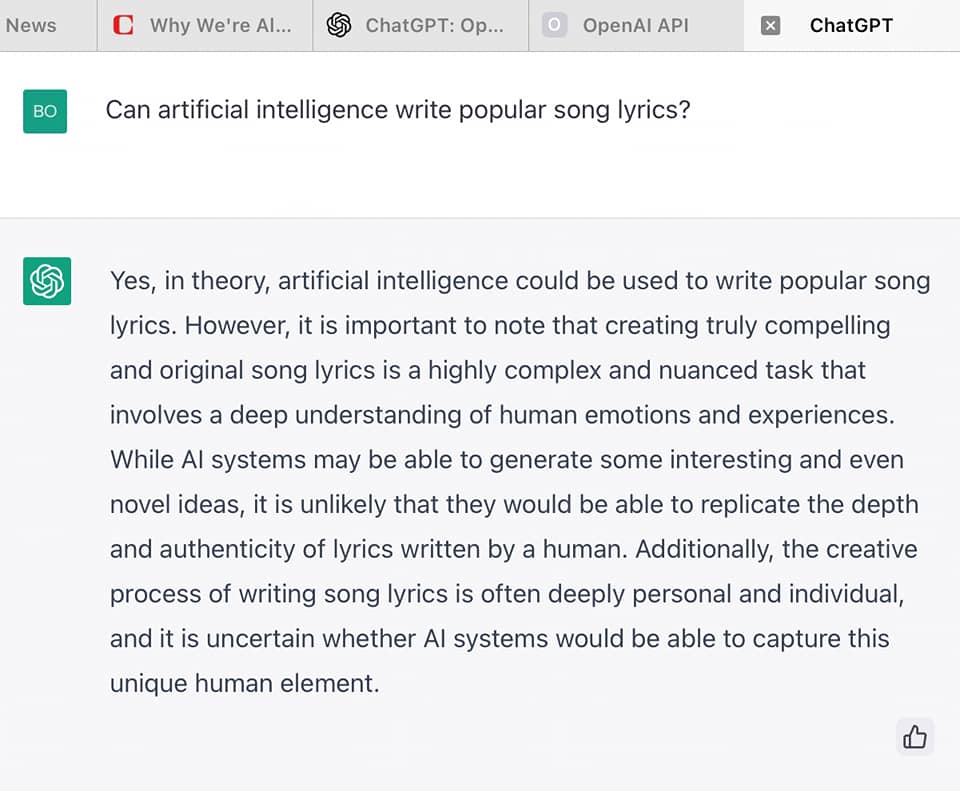
OK, question for all of my musician/songwriter friends. If you use the free updated GPT-3 to “write” song lyrics by proxy (i.e., you type in a theme—“Ooooh, baby, you’re gone, and my heart is broken, whah, whah, whah…”—and out pops a Lizzy McAlpine-worthy heartthrob lament), well, who “owns” the lyrics copyright? OpenAI? (But, wait! I thought they are “open source?”)

No one will give a shit unless and until the AI-spawned song becomes a lucrative chart success— after which every music biz IP lawyer in LA and Nashville will be aggressively elbowing each other aside in the sprint to the courthouse to file claims.

Count on it.
BTW: I am a long-time songwriter, of durably nil repute (or $$$). As my wife adroitly put it, I was Quixotically "working in the not-for-profit sector." I may have to screw around with GPT-3, just for grins.
  BobbyG, 1981, "The Once & Future Fool"
While living in Knoxville beginning in the late 1970's I was a member of the East TN Chapter of the Nashville Songwriters' Association. But, once belatedly in college at UTK, where I learned the statistical/economic principle of "expected value" (probability x payoff), it became clear that the average estimated prospective "value" of your lovingly-crafted song was in "basis points" (hundreths of a cent) at best.

I changed careers in 1986, and went first into environmental radiation laboratory science. The old joke: "How do you become a millionaire in the music business? Start out with at least two million dollars."

UPDATE
 
I opened an account at OpenAI to explore this tech.
 
 
It's certainly fast. But my initial use thus far is just Q&A.
____

Now, the topical focus of The Atlantic piece is "authenticity" of student prose writing in the academic environment.
Essay generation is neither theoretical nor futuristic at this point. In May, a student in New Zealand confessed to using AI to write their papers, justifying it as a tool like Grammarly or spell-check: “I have the knowledge, I have the lived experience, I’m a good student, I go to all the tutorials and I go to all the lectures and I read everything we have to read but I kind of felt I was being penalised because I don’t write eloquently and I didn’t feel that was right,” they told a student paper in Christchurch. They don’t feel like they’re cheating, because the student guidelines at their university state only that you’re not allowed to get somebody else to do your work for you. GPT-3 isn’t “somebody else”—it’s a program.
Yeah. But apropos of my opening scenario, one can quickly come up with a number of broader questions. When big money is at stake (e.g., my recent prior FTX posts), all manner of problems surface—NLG "plagiarism (?)" aside.

My priority interest in AI has principally been about stuff like this:

Click
NLU: Natural Language Understanding.

I asked OpenAI ChatGPT the following:
ME:
Can artificial intelligence analyze a prose argument?

ChatGPT:
Yes, artificial intelligence (AI) can be trained to analyze prose arguments to some extent. However, the extent to which AI can effectively analyze prose arguments will depend on various factors, such as the quality and amount of training data the AI has been given, the specific AI model being used, and the complexity and nuances of the argument being analyzed.
I'll have to see if I can provide it an "argument," and instruct it to analyze and evaluate it. Skeptical. but, we'll see.

See some of my prior riffs on "AI" topics more generally here.

UPDATES

More from The Atlantic piece.
A chasm has existed between humanists and technologists for a long time. In the 1950s, C. P. Snow gave his famous lecture, later the essay “The Two Cultures,” describing the humanistic and scientific communities as tribes losing contact with each other. “Literary intellectuals at one pole—at the other scientists,” Snow wrote. “Between the two a gulf of mutual incomprehension—sometimes (particularly among the young) hostility and dislike, but most of all lack of understanding. They have a curious distorted image of each other.” Snow’s argument was a plea for a kind of intellectual cosmopolitanism: Literary people were missing the essential insights of the laws of thermodynamics, and scientific people were ignoring the glories of Shakespeare and Dickens.

The rupture that Snow identified has only deepened. In the modern tech world, the value of a humanistic education shows up in evidence of its absence. Sam Bankman-Fried, the disgraced founder of the crypto exchange FTX who recently lost his $16 billion fortune in a few days, is a famously proud illiterate. “I would never read a book,” he once told an interviewer. “I don’t want to say no book is ever worth reading, but I actually do believe something pretty close to that.”…
Ahhh... C.P. Snow. I've riffed on him before here.

Also, the best place to hide $16 billion from our liitle a-literate Genius pal Sam Bankman-Fried is apparently inside a book. 
 
"The Beast."
 
OK, THIS IS CUTE
 
Scott Singeisen, a “Professor of architecture” posts a Twitter thread in reaction to The Atlantic article:
Me:
Write a well argued response to Stephen Marche’s recent essay in @TheAtlantic that AI will make the college essay obsolete

ChatGPT:
Stephen Marche's essay in the Atlantic argues that AI will make the college essay obsolete. However, this claim is not well-supported and is ultimately not convincing.

First of all, it is important to note that the college essay serves a specific purpose in the admissions process. It allows admissions officers to get a sense of the applicant's personality, writing abilities, and potential fit for the institution. AI, on the other hand, is not capable of providing this type of insight. While AI may be able to analyze data and generate texts, it cannot replicate the human experience and provide the same level of depth and understanding that a college essay can.

Furthermore, the use of AI in the admissions process raises concerns about fairness and bias. AI systems are only as good as the data they are trained on, and if the training data is [sic] biased, the AI will also be biased. This could lead to admissions decisions that are unfair or that do not accurately reflect an applicant's abilities and potential.

Additionally, the use of AI in the admissions process could potentially widen the gap between students from different backgrounds. Students from disadvantaged backgrounds may not have access to the same resources and support as their more privileged peers, leading to a disadvantage in the admissions process.

In conclusion, while AI may have the potential to assist in the admissions process, it is not capable of replacing the college essay. The college essay serves a specific purpose in the admissions process and is an important tool for admissions officers to evaluate applicants. The use of AI also raises concerns about fairness and bias, and could potentially widen the gap between students from different backgrounds.
I'm gonna have to play with some of this stuff. 
 
I'm lucky. I never needed AI NLG "help" when it came to writing—prose or song lyrics. Likely has something to do with the 2-3 books a week (plus all of my periodicals) I've studied across my-now 55 years of "adult" life since turning 21. Ya think?

 Stephen Marche:

"[N]atural-language processing is going to force engineers and humanists together. They are going to need each other despite everything. Computer scientists will require basic, systematic education in general humanism: The philosophy of language, sociology, history, and ethics are not amusing questions of theoretical speculation anymore. They will be essential in determining the ethical and creative use of chatbots, to take only an obvious example…"

Yeah, And, don't forget the lawyers. Never overlook the lawyers, lest you come to rue the day.

MORE UPDATES
Click

Click
OK, WHAT ABOUT THIS CRAP?
 
 
Ugh... 

CODA
 
 
My latest login. The popularity of ChatGPT is melting their servers.