Search the KHIT Blog

Showing posts with label Constitution. Show all posts

Sunday, June 28, 2026

"Connect," indeed


I have long dug Jacob Soboroff's work. Loving his new perch on MSNOW. He has this cool new schtick he does where he goes to various farmers' markets to just walk around and randomly buttonhole people asking for their opinions regarding where a variety of current socioeconomic-political issues might be headed. Goofing on Polymarkets and Kalshi, etc online betting apps, he calls it "Prediction Markets."
 
Love it.
 
I was watching his show this morning, and one guest he interviewed was UPenn Law Professor Kermit Roosevelt III.

Sheee-it. Having just finished the voluminous Hagerman-Swan book Regime Change, I'm tired, y'all (I've concomitantly had 3 other topically related new books in play as well delving into Your Favorite President).
 
Nonetheless, The Power of Kindle 1-Click Compels Me. I'm now up through MLK and Malcolm X on the Mall in 1964 (pre-green algae era).

QUICK UPDATE
 
I got hooked on Dr. Kermit's book and am now well into it.
 
Yeah, our personal and aggregate life "stories." One immediate reaction: I am reflexively reminded of Steiner's 1976 "Script Theory."

 
Steiner summation: To the extent you are the star/hero/victim in your own developmentally acquired melodrama, you are incapable of fully rational moral agency. "notandus, ergo sum," anyone?
 
Stories. Still largely how we communicate, given the path of human social history.
 
e.g., see
 
The world is full of theories of everything. The smartphone theory of everything argues that our personal devices are responsible for the rise of political polarization, anxiety, depression, and conspiracy theories—not to mention the decline of attention spans, intelligence, happiness, and general comity. The housing theory of everything pins inequality, climate change, obesity, and declining fertility on the West’s inability to build enough homes. If you treat theories of everything as literal theories of everything, you will be disappointed to find that they all have holes. I prefer to think of them as exercises in thinking through the ways that single phenomena can have large and unpredictable second-order effects.

My new favorite theory of everything is the orality theory of everything. This theory emerges from the work of mid-20th-century media theorists, especially Walter Ong and Marshall McLuhan. They argued that the invention of the alphabet and the rise of literacy were among the most important events in human history. These developments shifted communications from an age of orality—in which all information was spoken and all learning was social—to an age of literacy, in which writing could fix words in place, allowing people to write alone, read alone, and develop ever more complicated ideas that would have been impossible to memorize. The age of orality was an age of social storytelling and flexible cultural memory. The age of literacy made possible a set of abstract systems of thought—calculus, physics, advanced biology, quantum mechanics—that form the basis of all modern technology. But that’s not all, Ong and his ilk said. Literacy literally restructured our consciousness, and the demise of literate culture—the decline of reading and the rise of social media—is again transforming what it feels like to be a thinking person…
Yeah, man. I once had a prominent trial attorney visit our UTK senior seminar in Psychology of Law who simply noted "he with the best story wins."
 
He was pretty much right. apropos, see "Why do humans reason?" Spoiler alert: To win the argument. Should objective truth happen along the way, so much the better. Adaptive utility; win the argument and survive to fight another day.
 
Tell the better "story." It's rooted in our "Orality"-based evolution.
 
UPDATE
 
More Dr. Kermit:
 
 
I continue to plow through. A fine read. Adroitly argued, with ample credible supporting historical evidence. Certain to piss off Trumpworld (Stephen Miller in particular).
 
I reflect on my own middle class Whitey life history. See "Aghast." 

Stay tuned... 

Wednesday, October 22, 2025

Where is our nation headed?


I posted this image and text this morning to BlueSky, Meta, and TwittX:
THIS is likely where we’re headed, given that the Article I Branch is now in hospice care with a DNR.
That photo jibe is a knock-off from a WWII fascist quote aimed at the Pope. Hyperbolic today?
 
Consider, from Joyce Vance's new book, just released.
 
to wit,
...Judicial review positions the Court, arguably the weakest of the three branches of government, to determine when one of the other branches exceeds the scope of its constitutional authority and to countermand the unconstitutional act. 

Marbury v. Madison establishes the principle of judicial review, which allows courts to assess laws passed by Congress for constitutionality. The contours of judicial review are not laid out in the Constitution, but Chief Justice Marshall understood that if the new nation were to have a functional rule of law, the Supreme Court had to have both the authority to deem laws unconstitutional and to overrule them so they could not stay in effect in violation of the Constitution. 

But what about unconstitutional acts by a president? 
[emphasis mine] That part of the equation was explicitly confirmed by the Court in a case heard a century and a half later. By then, plenty of case law already pointed to this obvious conclusion, but the Court made plain: Even a president can’t bypass the courts and ignore judges’ decisions. In Youngstown Sheet & Tube Co. v. Sawyer, decided in 1952, the Supreme Court refused to let President Harry Truman take over US steel mills during the Korean War. Though Truman didn’t like the decision, he complied. That’s how the rule of law works. 

By December 1951, trouble was brewing in the nation’s steel mills. There was a dispute with organized labor over wages and working conditions. But the United States had been at war in Korea for more than a year, and China had also entered the fray. Then, negotiations with the United Steelworkers of America, a powerful union, failed. The union filed notice that it would strike at the end of the month when existing agreements with employers expired. Federal mediation with the union was tried and failed. Truman sent the case to the Federal Wage Stabilization Board in an effort to avoid a major disruption of material in such a delicate moment. That failed as well, and the union gave notice that a nationwide strike would commence on April 9, 1952. 

The Court explained what President Truman did next in its opinion: “The indispensability of steel as a component of substantially all weapons and other war materials led the President to believe that the proposed work stoppage would immediately jeopardize our national defense and that governmental seizure of the steel mills was necessary in order to assure the continued availability of steel. Reciting these considerations for his action, the President, a few hours before the strike was to begin, issued Executive Order 10340…. The order directed the Secretary of Commerce to take possession of most of the steel mills and keep them running.” The issue before the Court was whether a president had the power to take this action via executive order. 

The steel companies tried to fight off the executive order in court, arguing that the president lacked the power to make the seizures because neither the Constitution nor an act of Congress granted it to him. On April 30, 1952, the district court ruled in their favor and enjoined the government’s seizure. The court of appeals weighed in the same day, but it came to the opposite conclusion. It stayed the district court’s injunction, which meant the president could move forward. In a display of the speed with which the Supreme Court can act when motivated, it granted certiorari, agreeing to hear the case on May 3, and set it for oral argument on May 12. 

Plenty of case law from the intervening 149 years since Marbury pointed toward the conclusion the Supreme Court reached in Youngstown, but its decision settled the matter once and for all…


Vance, Joyce. Giving Up Is Unforgivable: A Manual for Keeping a Democracy (pp. 24-26). (Function). Kindle Edition. 
 Will Donald Trump simply scoff? He scoffs crudely at everything else these days
 
 Joyce's Substack (I subscribe).


BACK TO JOYCE
 
Cutting to the chase.
 
 
UPDATE
 
From Rick Wilson's Substack.
[Steve] Bannon is road-testing a narrative that treats the Constitution as negotiable, the law as elastic, and power as a permanent condition of the right people in the right offices. He’s not coy about it either. Asked how they’d get around the pesky “no third term” rule, he purred that there are “many different alternatives,” and that, at the “appropriate time,” he’d unveil the plan.

Translation: they’re workshopping pathways to normalize the unthinkable and daring the rest of us to stop them.

This is how authoritarians advance: by saying the quiet part out loud until it isn’t quiet anymore. They float the balloon, smirk while you sputter, then call your protest hysteria. The goal isn’t persuasion; it’s habituation. Bannon’s prediction isn’t a legal argument; it’s a loyalty oath: accept that Trump is destiny, that elections are a formality, and that rules are for the weak.
'eh?

Sunday, May 21, 2023

"A Professor with a Twitter account."

And now, a compelling new book release.

 
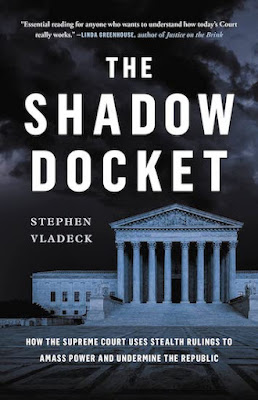
I've been eagerly awaiting this book release for weeks. It did not disappoint one whit. Clear jargon-free prose, great recounting of SCOTUS history (and the broader US judiciary) going back all the way to the Founding, as well as astute and acute analyses of emergent Article III "shadow docket" trends.
 
Totally a 5-Star read. 
“This book began as nothing more than a series of tweets. I’ve always been both professionally and personally interested in some of the more arcane areas of the Supreme Court’s practice, but it wasn’t until the fall of 2017—after the June 2017 travel ban ruling and a series of subsequent Supreme Court orders over that summer—that I started to see the germ of a more focused study of the Court’s evolving behavior through unsigned orders.” [pg 307]
A professor with a Twitter account.

...Judge Kacsmaryk, who has come to national attention in recent weeks as he considers in a separate case whether to issue a nationwide injunction banning the most common form of medication abortion in a lawsuit that could’ve been brought anywhere in the country, but was brought in Amarillo—entirely so that it would be heard by Kacsmaryk (whose anti-abortion views are well known). If all Judge Kacsmaryk did in his Tuesday ruling was deny the DOJ’s motion to change venue in the ESG case, it wouldn’t be much of a story. But in the course of rejecting the DOJ’s arguments, Kacsmaryk decided to come after me—even though I’m not involved in that case in any way.

First, he dismissed the (incontrovertible) evidence of Texas’ behavior as “an amicus brief filed by a professor with a Twitter account.” Leaving aside that the amicus brief to which he’s referring, once again, was filed in a different court in a different case, this clumsy attempt at a burn (lots of professors—and lawyers—have Twitter accounts) never comes close to addressing the substance of my trifling little tweets. If I had posted my data to a more academic site, would it somehow be more compelling?

But in a footnote, he took an even subtler and more personal shot, suggesting that “mercifully,” the late Texas Law Professor Charles Alan Wright “did not live long enough to endure the ‘tweet and repeat’ indignity of the Twittersphere.” Just to make the dig clear, I currently hold the Charles Alan Wright Chair in Federal Courts at the University of Texas School of Law. It’s hard to say what exactly Kacsmaryk intended to convey by name-checking the man whose chair I have the honor of holding; no doubt it was meant as another fire-emoji-level burn of me personally. But it’s a remarkably childish and churlish shot for a sitting federal judge to take at a non-party for the sin of amassing accurate data in support of a position he doesn’t like.

Indeed, there’s a lot to say about this passage. Were Professor Wright here, he might note how much of a stickler he was for both judicial decorum and for the importance of preserving the courts’ institutional reputation (he was also an early adopter of new technology; his Twitter account would’ve been lit). Since he’s not, I’ll note what it says about a judge that he’d go out of his way to try to denigrate someone with no direct involvement in a case before him for no other reason than scoring points (on Twitter, one presumes) and auditioning for a promotion in the next Republican administration. You wouldn’t think “I’m owning libs, so I’d make a great appellate judge” would be a persuasive argument, but here we are.

Then there’s the extent to which, again, it’s not actually responsive to any of the data I’ve gathered or the arguments I’ve made against the practice Kacsmaryk is endorsing. There’s the pettiness (to say nothing of the inaccuracy) of the “your chair’s namesake would disapprove” nonsense. But most of all, there’s the sense that this kind of behavior is beneath the dignity of a life-tenured federal judge with the power (at least for the moment) to issue rulings with nationwide implications…

As I noted in a prior post,
 
A woman's reproductive decisions are rightfully no one else's business. And, the improper ideological extrajudicial motives of this fundamentalist "Christian" judge, Matthew Kacsmaryk, could not be more clear.

Back to Steve Vladeck.
PREFACE
History books will teach that the Supreme Court eliminated the constitutional right to abortion on June 24, 2022. That’s when five justices officially overruled Roe v. Wade in a Mississippi case known as Dobbs v. Jackson Women’s Health Organization. Lost in the shadows will be another decision that the Court handed down almost ten months earlier, two minutes before midnight on September 1, 2021. That night, the same five justices who would later form the majority in Dobbs refused to block Texas’s ban on abortions after the sixth week of pregnancy—a point at which many do not yet know they’re even pregnant. Even though the Texas law, known as “SB8,” or the Texas Heartbeat Act, was clearly (and deliberately) inconsistent with Roe, five justices allowed it to go into effect. Justice Samuel Alito’s June 2022 opinion for the majority in Dobbs, which was publicly joined by Justices Clarence Thomas, Neil Gorsuch, Brett Kavanaugh, and Amy Coney Barrett, laid out, in 108 pages, a series of arguments about why the US Constitution should not be understood to protect a right to abortion, and why the Court’s prior decisions recognizing such a right should be overruled. The unsignedi September 2021 order in a dispute known as Whole Woman’s Health v. Jackson, in contrast, which no justice publicly endorsed, spanned just 401 words.

Unlike Dobbs, the cryptic order in Whole Woman’s Health did not expressly overrule the 1973 ruling in Roe that had first recognized abortion as a constitutional right. Instead, the single paragraph penned by the majority offered a technical reason for the Court’s refusal to block Texas’s abortion ban, noting that there were unresolved questions about whether the plaintiffs in that case had sued the right defendants. But for those on the ground in Texas, that was a distinction without a difference. By the morning of September 2, abortion providers across the nation’s second-largest state had largely shut their doors. From then on, most Texans needing abortions who had the means to travel out of state for the procedure did so. For those who couldn’t leave, Roe was a dead letter, effectively if not formally, from the Red River to the Rio Grande.

The Court’s refusal to stop Texas’s law from going into effect was a harbinger of things to come. After all, the same five justices—Thomas, Alito, Gorsuch, Kavanaugh, and Barrett—had used similar unsigned orders to block numerous state COVID restrictions over the previous year. Those decisions had established new—and more expansive—constitutional protections for religious worship compared to precedents. What’s more, many of the orders blocking COVID restrictions had come in cases where it was even less clear than in the Texas dispute that the justices could reach the merits of the constitutional question; indeed, the earlier rulings ran roughshod over some of the very procedural obstacles the majority cited in the Texas case. If the Court was nevertheless justified in intervening in those cases to protect a new understanding of constitutional rights, what did it say about the future of abortion that it wouldn’t intervene to protect an old one?

The paltriness of its legal reasoning notwithstanding, the unsigned order in the Texas case had a monumental impact in the real world. In that respect, it was no outlier. In recent years, the justices have issued a raft of similar orders, many containing even less analysis than the September 2021 ruling in the Texas case, that have produced massive substantive effects. From abortion to asylum; from elections to evictions to executions; from COVID vaccinations to the Clean Water Act; and from redistricting to religious liberty, the Court’s new conservative majority has used obscure procedural orders to shift American jurisprudence definitively to the right…
[pp 8-10
]
I was riveted by this book, glued to the couch for hour after hour.with my iPad. The text is now awash in Kindle highlighter, bookmarks, and notations. This is an important read.
 
A professor with a Twitter account.
  

Dude has cred. Kacsmaryk?
 
 
I am certainly no lawyer, much less a ConLaw one. But neither am I some clueless yet opinionated Barstool Barrister always at the shoot-at-the-lip ready to pop off on all things jurisprudential. I spent considerable time in grad school plumbing the opaque depths of various core facets of constitutional law relevant to my thesis topic. Across the ensuing 25 years, my study has routinely continued (hence the topic of this post). The more I learn, the less I sometimes feel I know in the aggregate.
 
Nonetheless, I ankle-bite episodically, and try to add more signal than noise.

MONDAY UPDATE: NPR
 
"The title sounds more like a thriller than a legal treatise. The Shadow Docket: How the Supreme Court uses stealth rulings to amass power and undermine the republic" — and the author, University of Texas law professor Stephen Vladeck, admits the term "shadow docket" is evocative.

Vladeck's book, written so it can be understood by the interested non-lawyer, focuses on a part of the court's work that until six or seven years was mainly viewed as pretty boring…


 "Are you CRYING?..."
MORE UPDATES
 
A great way to spend an hour. These people are certainly fast on their cognitive "feet."
 

OK, THIS STUFF IS HARDLY ACADEMIC
8 women join suit over Texas' abortion bans, claim their lives were put in danger

…Two plaintiffs, Kiersten Hogan and Elizabeth Weller, had their water break prematurely, but were both told to wait until they were sick enough to receive abortion care, according to a draft of the suit.

Hogan was allegedly told that if she tried to leave the hospital to seek care elsewhere she could be arrested for trying to kill her baby, according to a draft of the suit. She was kept in the hospital until she went into labor four days later in the hospital bathroom and delivered her son stillborn.

Weller had to wait until she developed an infection before a hospital approved her abortion despite her losing almost all her amniotic fluid, which a pregnancy is not viable without, according to a draft of the suit.

Kylie Beaton and Samantha Casiano said they were both forced to carry nonviable pregnancies to term…
That is obscene.
 
OFF-TOPIC ERRATUM
 
While many of us in the U.S. angrily vent ad nauseum over Our Constitutional Right To Not Be Inconvenienced, on Day 452 of Putin's 3-day Conquest of Ukraine...

A twenty-two-year-old Ukrainian sniper, code-named Student, stuffed candy wrappers into his ears before firing a rifle at the Russians’ tree line. He’d been discharged from the hospital two weeks earlier, after being shot in the thigh.
__________
 

Friday, June 24, 2022

"The Constitution does not confer a right to abortion;"

"Roe and Casey are overturned;"
 
Women have now effectively been written out of the 14th Amendment.
"The authority to regulate abortion is returned to the people and their elected [state] representatives."
Former Vice President Mike Pence wasted no time in coming out in support of federal legislation outlawing abortion nationwide.


Justice Alito asserts that, because the word "privacy" does not appear in the Constitution, it "confers" no such right. Well...
 
 
This goes to an old beef of mine going back decades.

I ran an ASCII text copy of the complete U.S. Constitution through a text analysis program.
Exported the results to an Excel sheet, where I tabulated the summary findings.

Pick an English language word at random. Raw base probability is about 99.5% that it won't be in the U.S. Constitution. So spare me that fatuous notion that because a given word doesn't appear in the Constitution, there can be no associated right. If the 4-word phrase "secure in her person" has any meaning at all, it comprises a lexically clear synonym for presumptive "privacy." (In that regard, the logical semantic meanings of phrases is what matters, not individual words. Need we seriously have to point that out? Apparently so.)
And, no, "presumptive" is not a synonym for "absolute." C’mon, people. Moreover, kindly spare me the old Borkian "privacy to to what, senator?" canard. The Constitution is not a checkbox tally sheet of fine-grained behavioral specifics.
A dark day, this one.

Curiously, no mention of Loving vs Virginia.
 
UPDATE: FINE TOPICAL ARTICLE
‘A revolutionary ruling – and not just for abortion’: A Supreme Court scholar explains the impact of Dobbs

The Supreme Court’s decision to reverse 50 years of constitutional protection for the right to get an abortion is more than 200 pages long. Morgan Marietta, a political scientist at the University of Massachusetts, Lowell, and editor of the annual SCOTUS series at Palgrave Macmillan, studies the ideas and ideology of the court. We asked him to illuminate the thinking that lies behind the momentous decision.

What does this ruling mean?


This is a revolutionary ruling. Not just for abortion, but for the ongoing debates over the nature of rights under the Constitution.

The ruling signals a massive change in how we read the Constitution, from a living reading to an original reading. The court has firmly rejected the theory of the living Constitution, which argues that the meaning of the document’s language changes as the beliefs and values of Americans change.

The living view, which prevailed at the Supreme Court during the second half of the 20th century, means that additional rights can emerge over time, including abortion, privacy and same-sex marriage. The living Constitution is updated through the judgment of the justices of the Supreme Court, who determine when public values have changed, and hence new rights have emerged.

Originalism, which is the approach taken by the justices who overruled Roe, rejects the living Constitution. In the originalist view, the Constitution is static until officially altered by amendment. It does not evolve on its own without public approval. The role of the justices is to determine the original public meaning of the text, but to leave other decisions to democratic representation through elections.

Regarding abortion, the conclusion of Dobbs is clear: “The Constitution does not prohibit the citizens of each State from regulating or prohibiting abortion. Roe and Casey arrogated that authority. We now overrule those decisions and return that authority to the people and their elected representatives.”

“Arrogated” is an unusual word; it means to take without justification, implying that it is done in an arrogant way. That is the core argument of Dobbs: Roe was the court being arrogant, taking power the justices didn’t have, which rightly belongs with “the people,” a Revolutionary-era term in a revolutionary ruling…
Worth yout time. Read all of it. There has been an absolute blizzard of excellent analytical commentary writing online since the Alito Opinion was published on Friday. I've been reading away since the decision was announced.

MORE DR. MORGAN
The explicit rights clearly described and enumerated in the Bill of Rights — freedom of religion, freedom of speech, freedom to bear arms and others — are rising in influence, specifically because they have been approved and ratified by the people.
I have to again (Quixotically?) call emphatic Bullshit on spurious assertions that the 4th Amendment, in contrast to the examples alluded to above, does not "enumerate" a presumptive, broad right to privacy. Other fundamental individual prerogatives set forth in the Bill of Rights are equally brief and lacking in detailed specifics. And, then there's the 9th Amendment.  to wit, citing my 1998 grad Thesis: 
While the word “privacy” admittedly appears nowhere in the text of the Bill of Rights, neither do the terms “obscenity,” “sodomy,” “pregnancy,” “sacred marital bedroom,” or “drug abuse.” Those who espouse a view of the Constitution as a document of broad moral principles find such lack of specificity compelling in their argument against simplistically limited textual “strict construction.” Indeed, the 9th Amendment—“The enumeration in the Constitution of certain rights shall not be construed to deny or disparage others retained by the people”—is universally cited by “broad construction” advocates to counter the observation that the specific term “privacy” is absent from the Constitutional language. To the “Constitution-of-Principle” advocate, the very brevity and generality of the Constitutional text is dispositive evidence that, far from being a document essentially no different than a commercial insurance contract, the “large-C” Constitution provides the general vision of justice and procedural guidelines for those who must administer ongoing the “small-c” constitution comprised of the very breadth of our social fabric.
SO, WHAT'S NEXT?
 
Democrats vow to enact a federal law guaranteeing abortion/reproductive autonomy rights nationally. Republican aggressively vow the opposite—federally outlawing abortion nationwide (so much for deference to the states). Given the current (and likely lengthy) makeup of the Supreme Court, Democrats have the more difficult task, i.e., legislation worded in a way that can survive an immediate SCOTUS challenge. Beyond that, hard-right activists will openly push for outlawing contraception, same-sex marriage (& perhaps interracial wedlock), and all things LGBTQIA. Gonna be a mess.

Like we don't already have enough to tend to.

DOBBS UPDATE
 
Dr. Michelle Goodwin in the NY Times:
No, Justice Alito, Reproductive Justice Is in the Constitution 
 
...Black women’s sexual subordination and forced pregnancies were foundational to slavery. If cotton was euphemistically king, Black women’s wealth-maximizing forced reproduction was queen.

Ending the forced sexual and reproductive servitude of Black girls and women was a critical part of the passage of the 13th and 14th Amendments. The overturning of Roe v. Wade reveals the Supreme Court’s neglectful reading of the amendments that abolished slavery and guaranteed all people equal protection under the law. It means the erasure of Black women from the Constitution.

Mandated, forced or compulsory pregnancy contravenes enumerated rights in the Constitution, namely the 13th Amendment’s prohibition against involuntary servitude and protection of bodily autonomy, as well as the 14th Amendment’s defense of privacy and freedom...

The 14th Amendment opens with the sentence, “All persons born or naturalized in the United States … are citizens of the United States and of the State wherein they reside” and as such would be protected by the laws of the United States. Such language applied to infants born to Black women, changing the provisions of law that had long denied Black children citizenship and the protection of laws. Lawmakers were understandably concerned about overturning states laws that had denied children the dignity of personhood.

Justice Samuel Alito’s claim, that there is no enumeration and original meaning in the Constitution related to involuntary sexual subordination and reproduction, misreads and misunderstands American slavery, the social conditions of that enterprise and legal history. It misinterprets how slavery was abolished, ignores the deliberation and debates within Congress, and craftily renders Black women and their bondage invisible.

It is no hyperbole to say that the Supreme Court’s decision in the Dobbs case is in league with some of the darkest rulings — Plessy v. Ferguson, which opened the floodgates to “separate but equal” laws that ushered in Jim Crow, and Buck v. Bell, which sanctioned states’ eugenics laws permitting forced sterilization of poor women
___
"Enumeration"—the act or process of making or stating a list of things one after another; the list itself.
 
4th Amendment—"The right of the people to be secure in their persons, houses, papers, and effects..."
 
"Secure"—free from danger; affording safety; free from risk of loss. 

SECURITY, PRIVACY, AND LIBERTY
The Dobbs ruling’s insistence that the Court should not impede states from making policies in which they weigh the interest in life for themselves, through their democratic processes, is tragicomic, even gruesome, coming the very day after the Court did just that in striking down a New York State gun-licensing law, based on the Court’s expansion of an individual right to bear arms under the Second Amendment.

In Planned Parenthood v. Casey, the plurality that reaffirmed Roe v. Wade wrote that “liberty finds no refuge in a jurisprudence of doubt”—meaning that, if the public is in doubt about whether constitutional rights are in danger of disappearing, that is not liberty. Dobbs leaves no doubt that the federal constitutional right to abortion is gone. And it ushers in an era of grave doubt about the status of liberty in the United States
.—Jeannie Suk Gersen, Harvard Law School
"An era of grave doubt about the status of liberty in the United States."

Particularly—for now—the Constitutional liberty of women.
 
__________
 

Friday, January 7, 2022

Are federal regulations "unconstitutional?"

SCOTUS could soon say "yes."
 

[Kim Wehle] Today, the Supreme Court will hear oral argument in a pair of cases challenging President Joe Biden’s vaccine mandates in two contexts: private workplaces with more than 100 employees and health-care facilities that participate in Medicare and Medicaid.

Ostensibly, these cases are before the Court to resolve whether a president can even temporarily require vaccine and testing protocols during a pandemic to protect public health. But the questions the Court may examine are much more sweeping, with enormous implications for the future of the executive branch and the massive swaths of American life it regulates.

Article I of the Constitution establishes that “all legislative Powers herein granted shall be vested in a Congress of the United States,” but it doesn’t define “legislative powers” except to suggest that they are something other than the nominal, undefined powers granted to the other two branches of the federal government—the president’s “executive Power” under Article II and the federal courts’ “judicial Power” under Article III. As a practical matter, legislative or “lawmaking” power might be defined as writing rules that operate prospectively to constrain conduct…
OK, let's stop right there for the moment. My wife and I have spent our entire decades-long white collar careers working in heavily-federally regulated business environments: EPA, DOE, DOD, OSHA, HHS / CMS, OCC, and FDIC. I have slogged through innumerable "proposed regulations"—i.e. the NPRM ("Notice of Proposed Rulemaking") Code of Federal Regulations (CFR) first-cut submissions (published in the Federal Register ongoing).
 
Statutory law and regulation bring to mind a rather precise and relevant business analogy. Bills that pass and become law provide us with the "what" and the "why." Think "Corporate Policies" documents (that we usually ignore—those ugly-assed 2" binders on the shelves). Within the laws we find stipulations pertaining to the "regulations," which comprise the "who," "how," "where", and "when" things get done to comply with the laws (or company policies). The "procedures." I've written my share.

Open any law on the books. Search for phrases like "as the Secretary shall implement by regulation."

You will find buku. It's a long-standing conventional staple of legislative promulgation. The who-how-where-when ops particulars largely get delegated to the myriad Article II federal agencies wherein reside the boots-on-the-ground relevant experts. Draft regulations undergo lengthy and detailed "pubic review and comment" periods prior to being finalized and added to the CFR.
This reality is by no means an unalloyed good. to wit, Obamacare contains more than 1,000 such phrases. I recall thinking at the time "be careful what you ask for."

I was right. Can you say "Tom Price?"
One last thought for now on federal CFRs. Their scopes are constrained to stay within the "intent" of the enabling legislation. Where they exceed their briefs, they are routinely challenged in court, and may well be nullified or otherwise appropriately circumscribed. That's how the system works. Yeah, it's tedious and boring. As the late Betty White would've said, "deal with it."
Moreover, federal agencies nominally answerable to the Executive Branch don't sit around thinking up random stuff to unilaterally regulate. C'mon.
So, to wrap for now. Is the Article III Branch about to declare that the Article I Branch cannot delegate via legislation the ops particulars (via statutory regulations) to the Article II Branch?

Probably not, in the aggregate. But, the Camel's Nose lurks at the edge of the tent nonetheless.

Consider these observations by WaPo's James Hohmann:
When Donald Trump took office five years ago, White House chief strategist Stephen K. Bannon vowed that the new president would wage an unending battle for the “deconstruction of the administrative state.”

The Supreme Court’s apparent readiness to block President Biden’s vaccine mandate for large companies, which will otherwise go into effect Monday, underscores the likelihood that Trump’s legacy, by remaking the judiciary, will include declawing the federal bureaucracy and hollowing out its regulatory authorities…

Solicitor General Elizabeth B. Prelogar, representing the Biden administration, told the justices that they are wrong to pretend Congress must renew authorities that have already been deferred to the executive branch, in this case to protect workers from “grave risk.” Covid “is the biggest threat to workers in OSHA’s history,” Prelogar said.

This gets to the nub of a deeper ideological dispute that reflects how the court is changing. It involves a lot more than OSHA or the polarized politics of vaccination. The unusual 3½ hours of arguments felt like the culmination of a multi-decade effort to tie the hands of a range of career civil servants inside alphabet-soup agencies such as the Environmental Protection Agency.

The right’s frustrations are understandable. The administrative state has swelled over the past century, repeatedly using broadly worded laws to issue far-reaching regulations that are often quite costly.

The left also has grounds to worry. Historically, and almost definitionally, a gridlocked Congress that cannot pass laws tends to be better for conservative reactionaries than progressive activists. Lawmakers also lack the mastery of esoteric issues, say soil runoff, that civil servants can master. When the courts force Congress to expressly decide, usually either nothing happens — or lobbyists sit in the driver’s seat…
We already have a problem with lobbyists and astroturfers hawking partisan "model legislation." I don't think we want them writing the regulations—the who-how-where-when procedures—that would have to be included in original bills passed into law should SCOTUS strike down the current Article I/II process.

Back to Kim Wehle:
The crucial legal question in the cases now before the Supreme Court is less about whether Biden properly exercised the authority granted to him in these acts than whether Congress acted constitutionally in passing along the authority to the executive branch to make such rules in the first place. If the Supreme Court’s conservative majority decides that that delegation was improper (a position that certain justices appear to have endorsed), a cascade of deregulation could begin, reversible only with a formal amendment to the Constitution or a new majority on the Court, both of which are all but impossible in the foreseeable future…

If Congress is hindered in its ability to employ agencies to fill in the details of its broad mandates, life in the United States could change dramatically. Agencies make rules and regulations affecting stock markets, consumer-product safety, the use and trafficking of firearms, environmental protection, workplace discrimination, agriculture, aviation, radio and television communications, financial institutions, federal elections, natural gas and electricity, the construction and maintenance of highways, imports and exports, human and veterinary drugs, and even the licensing and inspection of nuclear-power plants…
Jus' sayin'...
 
BTW, highly recommend her book.
MONDAY UPDATE

January 11th, Elizabeth Kolbert in The New Yorker.

Next month, the Supreme Court will hear oral arguments in a case involving an Obama-era power-plant rule that’s no longer in effect, and never really was. The Court has agreed to hear so many high-profile cases this term, on subjects ranging from abortion to gun rights to vaccine mandates, that this one—West Virginia v. Environmental Protection Agency—has received relatively little attention beyond legal circles. But its potential ramifications are profound. At a minimum, the Court’s ruling on the case is likely to make it difficult for the Biden Administration to curtail greenhouse-gas emissions. The ruling could also go much further and hobble the Administration’s efforts to protect the environment and public health.

West Virginia v. E.P.A. “could well become one of the most significant environmental law cases of all time,” Jonathan H. Adler, a law professor at Case Western Reserve University and a prominent conservative commentator, wrote on the legal blog the Volokh Conspiracy. Or, as Ian Millhiser put it, for Vox, “West Virginia is a monster of a case.”…

Under Donald Trump, the E.P.A. scrapped the Clean Power Plan and replaced it with what it called the Affordable Clean Energy rule, or ace. ace called on coal-fired power plants to install new equipment to increase their efficiency, an approach that some researchers concluded would have actually increased greenhouse-gas emissions by causing more coal, over all, to be burned. In issuing the regulation, the Trump Administration insisted that the E.P.A. didn’t have the authority to issue the Clean Power Plan in the first place. Democrat-led states took the Trump Administration to court, and, the day before Joe Biden’s Inauguration, the U.S. Court of Appeals for the D.C. Circuit struck down ace, saying that it was based “on a mistaken reading of the Clean Air Act.” The Clean Air Act, the court said, did give the E.P.A. broad latitude to decide what the “best system” would be…

At the center of the consolidated case is the question of whose interpretation of the E.P.A.’s authority under Section 111(d) of the Clean Air Act is correct: the Obama Administration’s or Trump’s—or, if you prefer, blue states’ attorneys general’s or red states’. But the case, which has attracted amicus briefs from a Death Star’s worth of right-wing think tanks, could become the start of something much bigger. Vickie Patton, the general counsel to the Environmental Defense Fund, one of the many respondents in the case, said that the petitioners are “asking the Court to do far-reaching damage to all sorts of ways we protect human life: by regulating food safety, car safety, deadly pollution, and so on.” She added, “There’s an enormous amount at stake for the American people.”…

The petitioners and their “friends” filed their briefs in the case last month. (Strikingly, several major utility companies, including Con Ed and National Grid, have joined with environmental groups, such as E.D.F., and blue states, such as New York and California, to oppose the petitioners.) Many of the briefs range far beyond the question of how to read Section 111(d) and seem aimed at what the former Trump adviser Steve Bannon famously called the “deconstruction of the administrative state.” (One of the briefs was co-authored by John Eastman, the lawyer who wrote the memo for the Trump legal team that urged Vice-President Mike Pence to overturn the results of the 2020 election.) Several invoke what’s become known as the “major questions” doctrine, which is popular among conservative jurists, including, notably, Justices Brett Kavanaugh and Neil Gorsuch….

According to the major-questions doctrine, an agency can issue a regulation that would have significant political or economic ramifications only if it has explicit instructions from Congress to do so. Major questions is a challenge to the prevailing approach, known as the Chevron doctrine, which is named after a case—Chevron U.S.A., Inc. v. Natural Resources Defense Council—that was decided by the Supreme Court in 1984. Chevron holds that, if a statute is silent or ambiguous on a point, the courts should defer to an executive agency’s interpretation, as long as the interpretation is reasonable.

The Chevron doctrine is critical to government regulation as we know it: often, federal rules are written in response to broad directives from Congress to, say, protect air quality or worker safety. The Biden Administration’s mandate that companies with a hundred or more employees require workers to be vaccinated against covid or tested weekly, for instance, relies on the Occupational Safety and Health Act of 1970. For obvious reasons, the act never mentioned covid. Last week, when the Supreme Court heard arguments in two cases challenging the Biden Administration’s authority to issue vaccine mandates, Justices Kavanaugh and Gorsuch raised the major-questions doctrine. Critics of major questions point out that, if the Court were to favor this doctrine and abandon or curtail Chevron—a move that, after last week’s arguments, seems increasingly likely—it would, in effect, be stripping power from the executive branch and handing it over to itself. “At a moment when conservatives are likely to control the Court for at least a generation, they don’t need to win congressional or presidential elections to ensure a perpetual veto over federal policy,” Hannah Mullen, a staff attorney at Georgetown Law’s Appellate Courts Immersion Clinic, wrote recently on the legal Web site Balls & Strikes.

Several of the parties to the West Virginia case go beyond the major-questions doctrine to argue in favor of what has become known as the “non-delegation” doctrine. According to this way of thinking, Congress is barred by the Constitution from delegating powers that could be construed as legislative to the executive branch. In the nineteen-thirties, the Court relied on non-delegation to strike down provisions of some of F.D.R.’s early initiatives. The idea has basically lain dormant since 1935, but in recent years several Justices—including Gorsuch and Clarence Thomas—have indicated a desire to revive it, though what exactly this would mean, ninety years after the New Deal, is unclear. As Justice Elena Kagan noted, in a 2019 decision, non-delegation has the potential to render most of contemporary government unconstitutional, “dependent as Congress is on the need to give discretion to executive officials to implement its programs.”…

Jus' sayin'
 
UPDATE: KIM WEHLE IS ON A ROLL
...[T]he Supreme Court is actually the worst of the four options when it comes to creating the country’s vaccine policy. Regular people can’t file comments with the Court on a proposed ruling and thereby put their views before the decision maker, as it can when an agency finalizes a regulation after a process known as “notice and comment” decision making. Nor can voters lobby Supreme Court justices for favorable policies as they can, at least in theory, with elected members of Congress. Unlike with legislation, moreover, there’s no way for the regulated community or those affected to know whether these “lawmakers” in robes would condone a revised vaccine regulation, other than for OSHA to enact a new one and litigate it all the way to the top for a stamp of approval. When judges—rather than Congress or administrative agencies—task themselves with filling in the blanks inevitably left in legislation, the people have little guidance in the interim…

Breyer saw it that way too. And he didn’t like it: “And then, there is this Court. Its Members are elected by, and accountable to, no one. And we lack the background, competence, and expertise to assess workplace health and safety issues. When we are wise, we know enough to defer on matters like this one. When we are wise, we know not to displace the judgments of experts, acting within the sphere Congress marked out and under Presidential control, to deal with emergency conditions. Today, we are not wise.”

Welcome to the new America, friends. Where the new boss of all bosses is not a king, or a president, or even Congress. It’s five or more elite legal minds with more unaccountable power than anyone—and with very strong opinions about what the law should be.
___
 
MORE GREAT NEW READS
 

"Truth Decay" is meticulous. Just now getting deep into "The Way Out."  
 
They go to my whole "Exigent Priorities" riff. Stay tuned...
__________