NOW REPORTING FROM BALTIMORE. A private, non-commercial blog begun in support of the federal Meaningful Use REC initiative, and Health IT and Heathcare improvement more broadly. Moving now toward important broader STEM and societal/ethics topics. Formerly known as "The REC Blog."
NOTE: Comments are moderated, thanks to trolls and bots.
I listened to this live. The Solicitor General did not have a good day. While the SCOTUS decision properly should be a 9-0 slam dunk, I'd speculate a 7-2, with Thomas and Alito dissenting.
UPDATE: Jus' sayin'...
BUT WAIT! THERE'S MORE!
Oaf of Office live TV Address to the Nation draws nigh. We're all thrilled...
Final decision day of the current Supreme Court term. Absent a (preposterous) declaration dismissing the Special Counsel’s DC indictment outright, will the current conservative majority provide Donald Trump with a Melt-Clock “remand” off-ramp ruling sending his case back down for further lower venue proceedings, imposing an additional procedural delay that would principally serve to push the DC J6 Insurrection case out past the November 5th presidential election?
We should know shortly after 10 a.m. eastern time. Trump claims that his every act occurring during his time in office was an “official act” consequently shielded by blanket constitutional immunity from all subsequent judicial matters civil or criminal. In MedMal lingo, this would be known as permanent comprehensive “tail coverage.”
JULY 1 UPDATE
6-3 to remand to the DC trial court for bench-level determination (subsequently yet again appealable all the way back up to SCOTUS) of exactly what constitutes "unofficial acts" pertinent to the Trump J6 case. Essentially the Melt Clock Offramp ruling favorable to Trump.
119 page opinion (pdf). I spent the day reading all of it.
UPDATE
TRUMP v UNITED STATES 2024: JUSTICE BARRETT CONCURRING IN PART …If the statute covers the alleged official conduct, the prosecution may proceed only if applying it in the circumstances poses no “‘dange[r] of intrusion on the authority and functions of the Executive Branch.’” Ante, at 14 (quoting Nixon v. Fitzgerald, 457 U. S. 731, 754 (1982)). On remand, the lower courts will have to apply that standard to various allegations involving the President’s official conduct. [2] Some of those allegations raise unsettled questions about the scope of Article II power, see ante, at 21–28, but others do not. For example, the indictment alleges that the President “asked the Arizona House Speaker to call the legislature into session to hold a hearing” about election fraud claims. App. 193. The President has no authority over state legislatures or their leadership, so it is hard to see how prosecuting him for crimes committed when dealing with the Arizona House Speaker would unconstitutionally intrude on executive power. ______
[2] This analysis is unnecessary for allegations involving the President’s private conduct because the Constitution offers no protection from prosecution of acts taken in a private capacity. Ante, at 15. Sorting private from official conduct sometimes will be difficult—but not always. Take the President’s alleged attempt to organize alternative slates of electors. See, e.g., App. 208. In my view, that conduct is private and therefore not entitled to protection. See post, at 27–28 (SOTOMAYOR, J., dissenting). The Constitution vests power to appoint Presidential electors in the States. Art. II, §1, cl. 2; see also Chiafalo v. Washington, 591 U. S. 578, 588–589 (2020). And while Congress has a limited role in that process, see Art. II, §1, cls. 3–4, the President has none. In short, a President has no legal authority—and thus no official capacity—to influence how the States appoint their electors. I see no plausible argument for barring prosecution of that alleged conduct.
Read & re-read that passage and footnote closely. Trump has NO constitutional immunity for trying to overturn the 2020 election. It simply does not matter which of his subordinates he enlisted in his efforts. They wera all "private acts."
UPDATE
"Perhaps you think Trump is exaggerating when he calls for a military tribunal to prosecute and execute the January 6th Committee members. Perhaps you think the idea of rounding up and punishing political opponents of Trump is some distant fantasy.
You could not be more wrong." - Rick Wilson
_____
OFF-TOPIC PERSONAL ERRATUM
July 1st is always a crappy day for me. On July 1, 1998, now 26 years distant, my elder daughter Sissy, succumbed to cancer in L.A. in the wake of 26 months of Hell. She'd just turned 30. It will always seem like last week.
Moreover, let's be perfectly clear about the intentions of the Alito camp allies.
The 900+ page Project 2025 "Action Plan Playbook" (pdf) negatively cites the word "abortion" 198 times (repeatedly conflating it with other hated "liberal" policies), and is utterly clear regarding its reactionary "Christian conservative" goal of establishing constitutionally-protected, vigilantly-enforced "Personhood at Conception."
JOHN OLIVER ON PROJECT 2025
134 days to the November 5th 2024 U.S. elections.
RELENTLESS WHITE CHRISTIAN NATIONALIST THEOCRATS
I have no problem with any of these reactionary people and groups advocating for their fatuous causes (look up the two doozy books depicted above). Where they cross over from advocacy to (more and more overt) coercion is where my red line resides.
Below, just ran across these two beauts on TwitterX:
JUNE 25 UPDATE
"Trump 2024 examines the presidency of Donald Trump through the eyes of 25 Evangelical Leaders. These leaders include:
Dennis Prager, Franklin Graham, Mike Huckabee, Tony Perkins, Irvin Baxter, Jerry Boykin, Damon Friedman, Brigitte Gabriel, Jack Graham, Harry Jackson, Jack Hibbs, Dr. Robert Jeffress, Alveda King, Mike Lindell, Bob McEwen, Eric Metaxas, Star Parker, Tony Perkins, Sammy Rodriguez, Dave Robbins, Don Stewart, Stephen Strange, Randall Terry, Paula White, Jeff Wickwire."
Quite the crew.
BRIAN KLAAS
Five Reasons Trump 2.0 Would Be Worse There's a widespread misconception that a second Trump term would be just like the first. That's a catastrophic misreading of American politics—and the unprecedented risks if he wins.
8-1, Clarence Thomas in irascible Ouija Board Jurisprudence dissent.
I'd just gotten this book. Timely, in light of today's SCOTUS ruling.
The Fifth Circuit is one of the thirteen federal appellate courts that sit below the Supreme Court and above the country’s district courts. Its jurisdiction covers Mississippi, Louisiana, and Texas, and it is often the last word on the law for the roughly thirty-seven million people who live in those states. Like the district court in Perez-Gallan, the circuit court in Rahimi had to rule on the constitutionality of a federal statute that bans gun possession for people who have protective orders against them. The Fifth Circuit had heard and rejected this exact challenge multiple times, concluding that the statute was reasonably adapted to the compelling government interest of reducing domestic gun violence. But the court was asked to reconsider its jurisprudence in light of Bruen. The court accepted the invitation to reevaluate its precedent and concluded that there was no sufficiently analogous law when the country was founded, so it struck the statute down. Even though there were historical statutes that prohibited gun possession for certain people, the court distinguished those laws away by highlighting that the Founding-era laws disarmed classes of people—specifically, Native Americans and enslaved Black people—in order to protect the discriminatory social order and prevent armed rebellion, while the statute in question disarmed people after individualized findings of credible threats to their partner or child. This rationale encapsulates the intellectual and moral bankruptcy of the originalist ideology. Rahimi concluded that intimate partner violence was not a constitutionally acceptable reason to place limits on gun possession and instead lifted up rank bigotry as the standard to which today’s gun laws must be held. Originalism observes that white supremacy dominated the country’s past and reasons that it must also dominate the country’s future. The Department of Justice petitioned the Supreme Court to review the Fifth Circuit’s decision, and the Court heard oral argument in United States v. Rahimi in November 2023. Soon it will have the opportunity to clarify how Bruen applies to statutes disarming people subject to orders of protection. Perhaps the Court will twist itself into an originalist pretzel to avoid further damaging its reputation by affirming the Fifth Circuit’s horrific reasoning. Perhaps not.
The ominous implications of the district court’s decision in Perez-Gallan and the Fifth Circuit’s decision in Rahimi should make even the most ardent gun lovers nervous. Taking the Supreme Court’s jurisprudence seriously empowers lower courts to strip us of innumerable freedoms if they have any reason to think that we would have been unfree in early America. Originalism is regressive by nature: an outsized focus on the alleged original meaning of the Constitution at the time of drafting means the rights of modern-day individuals—and the ability of legislatures to protect those rights—must be constrained by the outdated concerns of the Framers, like keeping British soldiers out of their living rooms. Former justice Stephen Breyer’s dissenting opinion in Bruen spotlighted how originalism binds lawmakers from meeting the present needs of their constituents. Even if the justices were trained historians (which, remember, they aren’t), Breyer argued that “laws addressing repeating crossbows, launcegays, dirks, dagges, skeines, stilladers, and other ancient weapons will be of little help to courts confronting modern problems.” This, to be sure, was the plan all along. The originalist ideology declares that random historical windows of conservatives’ choosing are society’s high-water marks, and we are constitutionally powerless to surpass them without formal amendment. The core function of originalism is providing aesthetically pleasing legal flourishes around the uglier idea that things shouldn’t get better than they’ve been. And if originalism is left unchecked, things will keep getting worse.
Dennie, Madiba K. The Originalism Trap (pp. 13-15). Random House Publishing Group. Kindle Edition.
I have yet to read the full opinion, including the several divergent concurrences, and Justice Thomas's reportedly cranky lone Dissent.
I've been episodically crackin' on "Originalist / Textualism" since my 1998 grad thesis (pdf):
Kinda jumped the line from the stuff I've been contemplating in my prior post. "Overbooked" as usual. Still working on my new M3 Mac Air migration, too.
Article V: The Congress, whenever two thirds of both Houses shall deem it necessary, shall propose Amendments to this Constitution, or, on the Application of the Legislatures of two thirds of the several States, shall call a Convention for proposing Amendments, which, in either Case, shall be valid to all Intents and Purposes, as Part of this Constitution, when ratified by the Legislatures of three fourths of the several States, or by Conventions in three fourths thereof, as the one or the other Mode of Ratification may be proposed by the Congress; Provided that no Amendment which may be made prior to the Year One thousand eight hundred and eight shall in any Manner affect the first and fourth Clauses in the Ninth Section of the first Article; and that no State, without its Consent, shall be deprived of its equal Suffrage in the Senate.
Whether any of us agree/disagree with SCOTUS decisions pursuant to any specific case, their primus inter pares authority with respect to statutory constitutional evaluation is beyond any rational dispute. I would think.
But, what of this case? Do we properly need a clarifying additional Amendment, rather than de facto "amendment by 'footnote'?" Pertaining to both Amendment 14, Section 3 (which now seems effectively nullified, politically), and to Article V itself?
This decision has been reflexively touted as a "unifying, dispositive 9-0 Slam-Dunk."
Hardly. Not so fast.
The justices did not want to throw Trump off the ballot, and so they didn’t.
It was always unlikely that the Supreme Court, with its right-wing majority, would uphold Colorado’s ruling throwing Donald Trump off the ballot merely because he tried to execute a coup after losing the 2020 election. As the unanimous per curiam ruling issued Monday overturning Colorado’s decision suggests, a Court made up of nine liberal justices may not have done so either.
That’s because sustaining the Fourteenth Amendment’s bar on insurrectionists holding office as written would put the justices in the difficult political position of looking like they were deciding an election. Such a thing could undermine popular support for the Court as an institution. It might prompt Congress to act to constrain the Court’s power. It could have led to a massive and potentially violent backlash from Trump supporters.
The unanimous part of the decision found that states do not have the authority to disqualify candidates for federal office, the least absurd and damaging rationale for avoiding disqualification, one that sidestepped rewriting history or contorting the English language on Trump’s behalf. The justices did not declare that January 6 was not an insurrection or that Trump did not engage in such, as elite pundits have twisted themselves into pretzels to argue in these past months; they did not decide that the president is not an officer “under” or “of” the United States, as acolytes of the conservative legal movement have urged.
Instead, the justices argued that allowing state enforcement would lead to anarchy that could “dramatically change the behavior of voters, parties, and States across the country, in different ways and at different times.” Referring to the potential problems that could be caused by individual state enforcement of the prohibition, the justices write that “nothing in the Constitution requires that we endure such chaos—arriving at any time or different times, up to and perhaps beyond the Inauguration.”
Not that this should have mattered to the Court’s originalists, whose commitment to that doctrine supposedly prevents them from deciding cases on the basis of their personal preferences rather than the law itself. But in this case, as the conservative legal scholars William Baude and Michael Stokes Paulsen wrote last year, originalists’ preferred interpretive prisms—the plain text of the amendment, how it was understood at the time, the intent of its framers—would have led to Trump being disqualified, a result that, apparently, none of the justices liked.
Every one of them decided, as transparently as possible in this case, that the text of the Constitution would have forced them to do something they did not want to do or did not think was a good idea, and so they would not do it. The justices did not want to throw Trump off the ballot, and so they didn’t. Not only that, but in order to head off the unlikely scenario of Congress trying to disqualify Trump after the election, they said that Congress must specifically disqualify individual insurrectionists, despite such a requirement having no basis in the text. Even if you agree with the majority that this was a wise decision politically, it cannot be justified as an “originalist” one; it was invented out of whole cloth—and in doing so, the justices basically nullified the section entirely. As the three Democratic-appointed justices note, “Although federal enforcement of Section 3 is in no way at issue, the majority announces novel rules for how that enforcement must operate.”
The thing to understand about this case is that, with the exception of the ruling’s partial unanimity, it is little different from many other recent big cases in which “originalism” supposedly carried the day, whether the topic was abortion rights, guns, voting rights, or something else. The conservative justices have a majority, and they may work their will. But the originalism they purport to adhere to is nothing more than a framework for reaching their preferred result in any particular circumstance. They felt that a plain reading of Section 3 of the Fourteenth Amendment would lead to chaotic or adverse outcomes, so they not only ignored it but also essentially amended the Constitution by fiat…
14.3 has always bothered me, in light of the lack of any detail going to what criteria we are to use to dispositively label someone an "insurrectionist" subsequently to be disqualified from federal office eligibility. Nonetheless, the rank expedient majority hypocrisy comprising this decision is no cause for jurisprudential Warm Fuzzies either.
Alito's Gadfly Serwer concludes:
This case reveals originalism as practiced by the justices for the fraud it actually is: a framework for justifying the results that the jurists handpicked by the conservative legal movement wish to reach. Americans should keep that in mind the next time the justices invoke originalism to impose their austere, selective vision of liberty on a public they insist must remain gratefully silent.
Sammy gonna have an aneurism. Might we soon see another irascible WATB OpEd?
DON’T BE FOOLED BY THE HEADLINES heraldingas “unanimous” today’s Supreme Court decision striking down the Colorado ballot ineligibility ruling. All nine justices did agree that no state, including Colorado, has the constitutional authority to put Section 3 of the Fourteenth Amendment to work. All nine justices thus effectively agreed that the horrors of January 6th are not bad enough to keep Donald Trump from running again this year. Had that been all the majority held, the decision might in fact have been unanimous. But the majority went further, making it virtually impossible that Section 3 will ever have a role in federal elections moving forward.
The Court did not have to do this. And four of the justices—all of the women on the Court—made clear that they would have preferred the Court not do it…
RANDOM NOTE
I suppose it ought be noted that the 14th amendment has a Section 5:
Sec 5: The Congress shall have power to enforce, by appropriate legislation, the provisions of this article.
Is that enough to justify the contentious concurrences? Note that it doesn’t say “shall have the sole power.”
WEDNESDAY, FEBRUARY 28, 2024 CERTIORARI GRANTED 23-939 TRUMP, DONALD J. V. UNITED STATES (23A745)
The application for a stay presented to The Chief Justice is referred by him to the Court. The Special Counsel’s request to treat the stay application as a petition for a writ of certiorari is granted, and that petition is granted limited to the following question: Whether and if so to what extent does a former President enjoy presidential immunity from criminal prosecution for conduct alleged to involve official acts during his tenure in office. Without expressing a view on the merits, this Court directs the Court of Appeals to continue withholding issuance of the mandate until the sending down of the judgment of this Court. The application for a stay is dismissed as moot.
The case will be set for oral argument during the week of April 22, 2024. Petitioner’s brief on the merits, and any amicus curiae briefs in support or in support of neither party, are to be filed on or before Tuesday, March 19, 2024. Respondent’s brief on the merits, and any amicus curiae briefs in support, are to be filed on or before Monday, April 8, 2024. The reply brief, if any, is to be filed on or before 5 p.m., Monday, April 15, 2024.
___
The "question presented"—
"Whether and if so to what extent does a former President enjoy presidential immunity from criminal prosecution for conduct alleged to involve official acts during his tenure in office?"
The question not at this point explicitly presented in the above, but clearly the one that matters—
"To what extent (if any) do the behaviors, incitements, and directives (express or implied) of now-former President Donald Trump relating to the 2020 Presidential election result dispute which culminated in the January 6th, 2021 attack on the U.S. Capitol constitute 'official acts'?"
Game on...
Fundamental to Donald Trump’s argument on this self-serving immunity claim is that whole “chief law enforcement officer of the United States” assertion. In order to fulfill his sacred Article II Outer Perimeter obligation that he “faithfully execute the laws,” it was Officially imperative that he continually reviewed the 2020 election to verify its legitimacy (which, of course, would never be found)..
Never mind his blatant personal conflict of vested interest in the outcome. His constitutionally proper response would have been to appoint a beat-to-Quarters DefCon5 DOJ special counsel and staff (via AG Barr) to independently review the 2020 election results. It continues to irritate the stew out of me that the various national media legal pundits don’t pound on this centrally salient point.
250 days to go until the 2024 U.S. national elections, folks.
ONE VOTE FOR BLANKET INDEMNITY AT THE OUTSET?
DIFFERENT VENUE, SAME FATUOUS IMMUNITY ASSERTION
“Trump’s argument is conclusory. No evidence was presented to support it, and Trump has not explained how hiring and making payments to a personal attorney to handle personal affairs carries out a constitutional duty. Reimbursing Cohen for advancing hush money to Stephanie Clifford cannot be considered the performance of a constitutional duty. Falsifying business records to hide such reimbursement, and to transform the reimbursement into a business expense for Trump and income to Cohen, likewise does not relate to a presidential duty. Trump is not immune from the People’s prosecution in New York Supreme Court. His argument of immunity is not a colorable defense.”—NY State Judge Alvin Hellerstein, Trump pornstar “Stormy Daniels” hush money criminal fraud case.
Might it help to paraphrase from Justice Roberts’ Feb 28th cert words?
NONE of the behaviors, incitements, and directives (express or implied) of Trump relating to the 2020 Presidential election result dispute which culminated in the January 6th, 2021 attack on the U.S. Capitol constitute any elements of “presidential duty.” In fact, they were plainly and wholly to the contrary, resulting in destructively violent mayhem, injuries, and deaths—leaving a black civic moral stain glaringly unworthy of the honorable self-governing republic we claim to be.
The new Supreme Court term commences Monday (Oct 2nd). Wonder how the pending federal shutdown will affect that?
Some other words of topical relevance not found in the Constitution: "close," "shut down, "shutdown," "budget," "deficit," "terminate, "dissolve," "lay off," "layoff,""furlough." And so on...
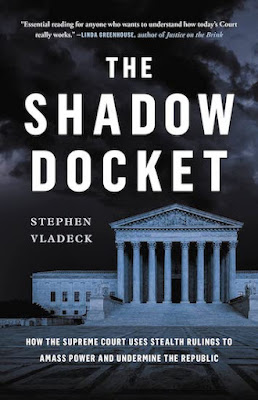
I've been eagerly awaiting this book release for weeks. It did not disappoint one whit. Clear jargon-free prose, great recounting of SCOTUS history (and the broader US judiciary) going back all the way to the Founding, as well as astute and acute analyses of emergent Article III "shadow docket" trends.
Totally a 5-Star read.
“This book began as nothing more than a series of tweets. I’ve always been both professionally and personally interested in some of the more arcane areas of the Supreme Court’s practice, but it wasn’t until the fall of 2017—after the June 2017 travel ban ruling and a series of subsequent Supreme Court orders over that summer—that I started to see the germ of a more focused study of the Court’s evolving behavior through unsigned orders.” [pg 307]
A professor with a Twitter account.
...Judge Kacsmaryk, who has come to national attention in recent weeks as he considers in a separate case whether to issue a nationwide injunction banning the most common form of medication abortion in a lawsuit that could’ve been brought anywhere in the country, but was brought in Amarillo—entirely so that it would be heard by Kacsmaryk (whose anti-abortion views are well known). If all Judge Kacsmaryk did in his Tuesday ruling was deny the DOJ’s motion to change venue in the ESG case, it wouldn’t be much of a story. But in the course of rejecting the DOJ’s arguments, Kacsmaryk decided to come after me—even though I’m not involved in that case in any way.
First, he dismissed the (incontrovertible) evidence of Texas’ behavior as “an amicus brief filed by a professor with a Twitter account.” Leaving aside that the amicus brief to which he’s referring, once again, was filed in a different court in a different case, this clumsy attempt at a burn (lots of professors—and lawyers—have Twitter accounts) never comes close to addressing the substance of my trifling little tweets. If I had posted my data to a more academic site, would it somehow be more compelling?
But in a footnote, he took an even subtler and more personal shot, suggesting that “mercifully,” the late Texas Law Professor Charles Alan Wright “did not live long enough to endure the ‘tweet and repeat’ indignity of the Twittersphere.” Just to make the dig clear, I currently hold the Charles Alan Wright Chair in Federal Courts at the University of Texas School of Law. It’s hard to say what exactly Kacsmaryk intended to convey by name-checking the man whose chair I have the honor of holding; no doubt it was meant as another fire-emoji-level burn of me personally. But it’s a remarkably childish and churlish shot for a sitting federal judge to take at a non-party for the sin of amassing accurate data in support of a position he doesn’t like.
Indeed, there’s a lot to say about this passage. Were Professor Wright here, he might note how much of a stickler he was for both judicial decorum and for the importance of preserving the courts’ institutional reputation (he was also an early adopter of new technology; his Twitter account would’ve been lit). Since he’s not, I’ll note what it says about a judge that he’d go out of his way to try to denigrate someone with no direct involvement in a case before him for no other reason than scoring points (on Twitter, one presumes) and auditioning for a promotion in the next Republican administration. You wouldn’t think “I’m owning libs, so I’d make a great appellate judge” would be a persuasive argument, but here we are.
Then there’s the extent to which, again, it’s not actually responsive to any of the data I’ve gathered or the arguments I’ve made against the practice Kacsmaryk is endorsing. There’s the pettiness (to say nothing of the inaccuracy) of the “your chair’s namesake would disapprove” nonsense. But most of all, there’s the sense that this kind of behavior is beneath the dignity of a life-tenured federal judge with the power (at least for the moment) to issue rulings with nationwide implications…
A woman's reproductive decisions are rightfully no one else's business. And, the improper ideological extrajudicial motives ofthisfundamentalist "Christian" judge, Matthew Kacsmaryk, could not be more clear.
Back to Steve Vladeck.
PREFACE History books will teach that the Supreme Court eliminated the constitutional right to abortion on June 24, 2022. That’s when five justices officially overruled Roe v. Wade in a Mississippi case known as Dobbs v. Jackson Women’s Health Organization. Lost in the shadows will be another decision that the Court handed down almost ten months earlier, two minutes before midnight on September 1, 2021. That night, the same five justices who would later form the majority in Dobbs refused to block Texas’s ban on abortions after the sixth week of pregnancy—a point at which many do not yet know they’re even pregnant. Even though the Texas law, known as “SB8,” or the Texas Heartbeat Act, was clearly (and deliberately) inconsistent with Roe, five justices allowed it to go into effect. Justice Samuel Alito’s June 2022 opinion for the majority in Dobbs, which was publicly joined by Justices Clarence Thomas, Neil Gorsuch, Brett Kavanaugh, and Amy Coney Barrett, laid out, in 108 pages, a series of arguments about why the US Constitution should not be understood to protect a right to abortion, and why the Court’s prior decisions recognizing such a right should be overruled. The unsignedi September 2021 order in a dispute known as Whole Woman’s Health v. Jackson, in contrast, which no justice publicly endorsed, spanned just 401 words.
Unlike Dobbs, the cryptic order in Whole Woman’s Health did not expressly overrule the 1973 ruling in Roe that had first recognized abortion as a constitutional right. Instead, the single paragraph penned by the majority offered a technical reason for the Court’s refusal to block Texas’s abortion ban, noting that there were unresolved questions about whether the plaintiffs in that case had sued the right defendants. But for those on the ground in Texas, that was a distinction without a difference. By the morning of September 2, abortion providers across the nation’s second-largest state had largely shut their doors. From then on, most Texans needing abortions who had the means to travel out of state for the procedure did so. For those who couldn’t leave, Roe was a dead letter, effectively if not formally, from the Red River to the Rio Grande.
The Court’s refusal to stop Texas’s law from going into effect was a harbinger of things to come. After all, the same five justices—Thomas, Alito, Gorsuch, Kavanaugh, and Barrett—had used similar unsigned orders to block numerous state COVID restrictions over the previous year. Those decisions had established new—and more expansive—constitutional protections for religious worship compared to precedents. What’s more, many of the orders blocking COVID restrictions had come in cases where it was even less clear than in the Texas dispute that the justices could reach the merits of the constitutional question; indeed, the earlier rulings ran roughshod over some of the very procedural obstacles the majority cited in the Texas case. If the Court was nevertheless justified in intervening in those cases to protect a new understanding of constitutional rights, what did it say about the future of abortion that it wouldn’t intervene to protect an old one?
The paltriness of its legal reasoning notwithstanding, the unsigned order in the Texas case had a monumental impact in the real world. In that respect, it was no outlier. In recent years, the justices have issued a raft of similar orders, many containing even less analysis than the September 2021 ruling in the Texas case, that have produced massive substantive effects. From abortion to asylum; from elections to evictions to executions; from COVID vaccinations to the Clean Water Act; and from redistricting to religious liberty, the Court’s new conservative majority has used obscure procedural orders to shift American jurisprudence definitively to the right… [pp 8-10]
I was riveted by this book, glued to the couch for hour after hour.with my iPad. The text is now awash in Kindle highlighter, bookmarks, and notations. This is an important read.
A professor with a Twitter account.
Dude has cred. Kacsmaryk?
I am certainly no lawyer, much less a ConLaw one. But neither am I some clueless yet opinionated Barstool Barrister always at the shoot-at-the-lip ready to pop off on all things jurisprudential. I spent considerable time in grad school plumbing the opaque depths of various core facets of constitutional law relevant to my thesis topic. Across the ensuing 25 years, my study has routinely continued (hence the topic of this post). The more I learn, the less I sometimes feel I know in the aggregate.
"The title sounds more like a thriller than a legal treatise. The Shadow Docket: How the Supreme Court uses stealth rulings to amass power and undermine the republic" — and the author, University of Texas law professor Stephen Vladeck, admits the term "shadow docket" is evocative.
Vladeck's book, written so it can be understood by the interested non-lawyer, focuses on a part of the court's work that until six or seven years was mainly viewed as pretty boring…
"Are you CRYING?..."
MORE UPDATES
A great way to spend an hour. These people are certainly fast on their cognitive "feet."
…Two plaintiffs, Kiersten Hogan and Elizabeth Weller, had their water break prematurely, but were both told to wait until they were sick enough to receive abortion care, according to a draft of the suit.
Hogan was allegedly told that if she tried to leave the hospital to seek care elsewhere she could be arrested for trying to kill her baby, according to a draft of the suit. She was kept in the hospital until she went into labor four days later in the hospital bathroom and delivered her son stillborn.
Weller had to wait until she developed an infection before a hospital approved her abortion despite her losing almost all her amniotic fluid, which a pregnancy is not viable without, according to a draft of the suit.
Kylie Beaton and Samantha Casiano said they were both forced to carry nonviable pregnancies to term…
That is obscene.
OFF-TOPIC ERRATUM
While many of us in the U.S. angrily vent ad nauseum over Our Constitutional Right To Not Be Inconvenienced, on Day 452 of Putin's 3-day Conquest of Ukraine...
A twenty-two-year-old Ukrainian sniper, code-named Student, stuffed candy wrappers into his ears before firing a rifle at the Russians’ tree line. He’d been discharged from the hospital two weeks earlier, after being shot in the thigh.
§ 230. Protection for private blocking and screening of offensive material
(a) Findings The Congress finds the following:
(1) The rapidly developing array of Internet and other interactive computer services available to individual Americans represent an extraordinary advance in the availability of educational and informational resources to our citizens.
(2) These services offer users a great degree of control over the information that they receive, as well as the potential for even greater control in the future as technology develops.
(3) The Internet and other interactive computer services offer a forum for a true diversity of political discourse, unique opportunities for cultural development, and myriad avenues for intellectual activity.
(4) The Internet and other interactive computer services have flourished, to the benefit of all Americans, with a minimum of government regulation.
(5) Increasingly Americans are relying on interactive media for a variety of political, educational, cultural, and entertainment services.
(b) Policy It is the policy of the United States—
(1) to promote the continued development of the Internet and other interactive computer services and other interactive media;
(2) to preserve the vibrant and competitive free market that presently exists for the Internet and other interactive computer services, unfettered by Federal or State regulation;
(3) to encourage the development of technologies which maximize user control over what information is received by individuals, families, and schools who use the Internet and other interactive computer services;
(4) to remove disincentives for the development and utilization of blocking and filtering technologies that empower parents to restrict their children’s access to objectionable or inappropriate online material; and
(5) to ensure vigorous enforcement of Federal criminal laws to deter and punish trafficking in obscenity, stalking, and harassment by means of computer.
(c) Protection for ‘‘Good Samaritan’’ blocking and screening of offensive material
(1) Treatment of publisher or speaker
No provider or user of an interactive computer service shall be treated as the publisher or speaker of any information provided by another information content provider.
(2) Civil liability
No provider or user of an interactive computer service shall be held liable on account of—
(A) any action voluntarily taken in good faith to restrict access to or availability of material that the provider or user considers to be obscene, lewd, lascivious, filthy, excessively violent, harassing, or otherwise objectionable, whether or not such material is constitutionally protected; or
(B) any action taken to enable or make available to information content providers or others the technical means to restrict access to material described in paragraph (1).1
(d) Obligations of interactive computer service
A provider of interactive computer service shall, at the time of entering an agreement with a customer for the provision of interactive computer service and in a manner deemed appropriate by the provider, notify such customer that parental control protections (such as computer hardware, software, or filtering services) are commercially available that may assist the customer in limiting access to material that is harmful to minors. Such notice shall identify, or provide the customer with access to information identifying, current providers of such protections.
(e) Effect on other laws
(1) No effect on criminal law
Nothing in this section shall be construed to impair the enforcement of section 223 or 231 of this title, chapter 71 (relating to obscenity) or 110 (relating to sexual exploitation of children) of title 18, or any other Federal criminal statute.
(2) No effect on intellectual property law
Nothing in this section shall be construed to limit or expand any law pertaining to intellectual property.
(3) State law
Nothing in this section shall be construed to prevent any State from enforcing any State law that is consistent with this section. No cause of action may be brought and no liability may be imposed under any State or local law that is inconsistent with this section.
(4) No effect on communications privacy law
Nothing in this section shall be construed to limit the application of the Electronic Communications Privacy Act of 1986 or any of the amendments made by such Act, or any similar State law.
(f) Definitions
As used in this section:
(1) Internet
The term ‘‘Internet’’ means the international computer network of both Federal and non-Federal interoperable packet switched data networks.
(2) Interactive computer service
The term ‘‘interactive computer service’’ means any information service, system, or access software provider that provides or enables computer access by multiple users to a computer server, including specifically a service or system that provides access to the Internet and such systems operated or services offered by libraries or educational institutions.
(3) Information content provider
The term ‘‘information content provider’’ means any person or entity that is responsible, in whole or in part, for the creation or development of information provided through the Internet or any other interactive computer service.
(4) Access software provider
The term ‘‘access software provider’’ means a provider of software (including client or server software), or enabling tools that do any one or more of the following:
(A) filter, screen, allow, or disallow content; (B) pick, choose, analyze, or digest content; or (C) transmit, receive, display, forward, cache, search, subset, organize, reorganize, or translate content.
__________
(June 19, 1934, ch. 652, title II, § 230, as added Pub. L. 104–104, title V, § 509, Feb. 8, 1996, 110 Stat. 137; amended Pub. L. 105–277, div. C, title XIV, § 1404(a), Oct. 21, 1998, 112 Stat. 2681–739.)
REFERENCES IN TEXT The Electronic Communications Privacy Act of 1986, referred to in subsec. (e)(4), is Pub. L. 99–508, Oct. 21, 1986, 100 Stat. 1848, as amended. For complete classification of this Act to the Code, see Short Title of 1986 Amendment note set out under section 2510 of Title 18, Crimes and Criminal Procedure, and Tables.
CODIFICATION Section 509 of Pub. L. 104–104, which directed amendment of title II of the Communications Act of 1934 (47 U.S.C. 201 et seq.) by adding section 230 at end, was executed by adding the section at end of part I of title II of the Act to reflect the probable intent of Congress and amendments by sections 101(a), (b), and 151(a) of Pub. L. 104–104 designating §§ 201 to 229 as part I and adding parts II (§ 251 et seq.) and III (§ 271 et seq.) to title II of the Act.
AMENDMENTS 1998—Subsec. (d). Pub. L. 105–277, § 1404(a)(3), added subsec. (d). Former subsec. (d) redesignated (e). Subsec. (d)(1). Pub. L. 105–277, § 1404(a)(1), inserted ‘‘or 231’’ after ‘‘section 223’’. Subsecs. (e), (f). Pub. L. 105–277, § 1404(a)(2), redesignatedsubsecs. (d) and (e) as (e) and (f), respectively.
EFFECTIVE DATE OF 1998 AMENDMENT Amendment by Pub. L. 105–277 effective 30 days after Oct. 21, 1998, see section 1406 of Pub. L. 105–277, set out as a note under section 223 of this title.
ORALS COMMENCE AT SCOTUS FEB 21ST ON TWO CASES
Facebook, Instagram, Twitter, Google/YouTube, Tumblr, Pinterest, GETTR, Telegram, & Truth Social, etc—none of them are currently considered "publishers" subject to content liability litigation and remedies. That may well change this year. There's a lot at stake.
Stay tuned...
2-22 UPDATE
[CNN] After back-to-back oral arguments this week, the Supreme Court appears reluctant to hand down the kind of sweeping ruling about liability for terrorist content on social media that some feared would upend the internet.
On Wednesday, the justices struggled with claims that Twitter contributed to a 2017 ISIS attack in Istanbul by hosting content unrelated to the specific incident. Arguments in that case, Twitter v. Taamneh, came a day after the court considered whether YouTube can be sued for recommending videos created by ISIS to its users.
What's at stake: The closely watched cases carry significant stakes for the wider internet. An expansion of apps and websites’ legal risk for hosting or promoting content could lead to major changes at sites including Facebook, Wikipedia and YouTube, to name a few.
For nearly three hours of oral argument, the justices asked attorneys for Twitter, the US government and the family of Nawras Alassaf – a Jordanian citizen killed in the 2017 attack – how to weigh several factors that might determine Twitter’s level of legal responsibility, if any. But while the justices quickly identified what the relevant factors were, they seemed divided on how to analyze them…
May portend a relatively narrow, non-"groundbreaking" set of rulings. Or no new rulings (kick it over to Congress). We won't know until June or July.