Search the KHIT Blog

Showing posts with label conspiracies. Show all posts

Wednesday, July 19, 2023

Is Denial an "ism?" Scientifically speaking?

 
I finished David Lipsky's thoroughly engaging book. Lordy, mercy...
 
 
Just submitted a review on Amazon.
How can a book be at once so recurrently hilarious and infuriating?

Read it and find out.

You're welcome in advance.

The author, beyond his formidable analytical acumen and indefatigable attention to the voluminous relevant historical detail on the topic, is a Sensei of Snark. Across the nearly 16 Kindle hours of this book, I have encountered and exceeded my Lifetime Permissible Dose of deft, ROTFL allusive analogies and metaphors. I kept interrupting my wife: "Baby, you gotta hear THIS..."

The Bang for the Buck here is fabulous. The subject could hardly be more important. Do yourselves a serious favor. Get David's book and place it at the front your must-read queue.
OK, so, is there a "science of Denial?"
 
Just started this one.
 
Recall an earlier post on "denial?"

Psychologists have been studying a very basic cognitive function that appears to be of increasing importance – how do we choose what to believe as true or false? We live in a world awash in information, and access to essentially the world’s store of knowledge is now a trivial matter for many people, especially in developed parts of the world. The most important cognitive skill in the 21st century may arguably be not factual knowledge but truth discrimination. I would argue this is a skill that needs to be explicitly taught in school, and is more important than teaching students facts.

Knowing facts is still important, because you cannot think in a vacuum. Our internal model of the world is build on bricks of fact, but before we take a brick and place it in our wall of knowledge, we have to decide if it is probably true or not. I have come to think about this in terms of three categories of skills – domain knowledge (with scientific claims this is scientific literacy), critical thinking, and media savvy…

One of my requisite daily web-surfing stops.
 
Also apropos of the topic—"The Big Myth," "Science denial: attributes and antidotes." And, how 'bout Amanda Ripley's "Conflict Entrepreneurs?"
 
The Wiki takes a crack at "Denialism."
 
 
Finally for now, is there a "science" of "Science Communication?"
 
ERRATUM

SPEAKING OF DENIAL

Ever since some of the earliest projections of climate change were made back in the 1970s, they have been remarkably accurate at predicting the rate at which global temperatures would rise. For decades, climate change has proceeded at roughly the expected pace, says David Armstrong McKay, a climate scientist at the University of Exeter, in England. Its impacts, however, are accelerating—sometimes far faster than expected.

For a while, the consequences weren’t easily seen. They certainly are today. The Southwest is sweltering under a heat dome. Vermont saw a deluge of rain, its second 100-year storm in roughly a decade. Early July brought the hottest day globally since records began—a milestone surpassed again the following day. “For a long time, we were within the range of normal. And now we’re really not,” Allegra LeGrande, a physical-research scientist at Columbia University, told me. “And it has happened fast enough that people have a memory of it happening.”

In fact, a growing number of climate scientists now believe we may be careening toward so-called tipping points, where incremental steps along the same trajectory could push Earth’s systems into abrupt or irreversible change—leading to transformations that cannot be stopped even if emissions were suddenly halted…
Click the title image. Read all of it.

UPDATE

My new Harper's
At the height of the COVID-19 pandemic, it was not unusual to enter common spaces across the United States—grocery stores, malls, office buildings—and experience a kind of perceptual whiplash. People wearing N-95 masks and latex gloves stood beside others wearing no mask at all—or else letting their mandatory face coverings slouch flaccidly beneath their chins. As protests broke out both for and against various public health measures intended to combat the spread of the virus, this polarization went beyond policy decisions concerning mandates and lockdowns to questions of medical fact and expert authority. It was as if the authorities had set off the fire alarm in a nation-size movie theater: one half of the audience vacated their seats in muted panic while the rest defiantly continued to eat their popcorn.

The pandemic laid bare the extent to which Americans occupy a split reality. From within the credentialed classes, the demos appears increasingly and disturbingly resistant to rational argument and evidence, with rowdy populist movements undermining at every turn the response to an unprecedented public health emergency. But from within these populist camps, it seems that many Americans have been blindly following—or worse, knowingly supporting—an undemocratic regime intent on imposing its values under cover of scientific neutrality. In this view, the pandemic was just the latest excuse for this regime to advance its technocratic agenda; often, resisting that agenda meant rejecting technical expertise entirely.

The result is that American democracy and scientific authority are suffering parallel crises of credibility, each standing accused by the other. This twofold crisis has many causes, among them political polarization and the spread of misinformation on social media, as well as long-standing antirationalist religious traditions and anti-intellectual strains in American business and culture. None of these factors should be minimized when attempting to understand America’s widespread antiscientific sentiment. But they need to be supplemented by another, far less widely acknowledged, fount of skepticism—one that requires contending with what the populist view gets right: scientific expertise has encroached on domains in which its methods are unsuited to addressing, let alone resolving, the issue at hand...

Unable to reach any kind of democratic consensus, Americans largely faked their way through the early stages of the pandemic. Some fraudulently claimed conspiratorial knowledge in order to challenge scientific expertise. Others disguised their preference for the preservation of bare life or for economic growth as the consequence of inarguable scientific findings, and denounced all dissenters as irrational and immoral.

Many have seen the pandemic as a forerunner to a much darker and more devastating global crisis. The next catastrophe—very possibly ecological in nature—may be far more destructive. Averting such a crisis will require listening with careful humility to scientists and scientific authority. Science’s role as adviser and counselor, keeping the demos in contact with reality, is irreplaceable.

At the same time, American society long ago allowed major institutions to be governed by scientism. If the wonks and data evangelists do not have their power curbed, the country could descend into a battle over whose values trump whose. Such a turn would signal not only the end of democracy in America, but also the imposition of an alien notion of life on those who no longer recognize themselves in the government that presides over them.

Prioritizing democratic dialogue and shifting away from top-down policymaking will not be easy. In a society as large and as varied as ours, there will always be the temptation to outsource contentious decisions to supposedly neutral authorities. But if we want to stand a chance of weathering the next crisis better than we have this one, we’ll need to learn to trust ourselves.
Jason Blakely is an associate professor of political science at Pepperdine University and the author of We Built Reality: How Social Science Infiltrated Culture, Politics, and Power.
A long-read. Worth every second. Like I didn't already have enough to ponder. Bristling at the word "scientism," but, OK. I'd spent most of the day burrowed deep into Jared Del Rosso's Denial before reading the Harper's essay.

COULDN'T RESIST

Bought his book. I'm never gonna get caught up.

AMAZON BLURB: Over the last fifty years, pseudoscience has crept into nearly every facet of our lives. Popular sciences of everything from dating and economics, to voting and artificial intelligence, radically changed the world today. The abuse of popular scientific authority has catastrophic consequences, contributing to the 2008 financial crisis; the failure to predict the rise of Donald Trump; increased tensions between poor communities and the police; and the sidelining of nonscientific forms of knowledge and wisdom. In We Built Reality, Jason Blakely explains how recent social science theories have not simply described political realities but also helped create them. But he also offers readers a way out of the culture of scientism: hermeneutics, or the art of interpretation. Hermeneutics urges sensitivity to the historical and cultural contexts of human behavior. It gives ordinary people a way to appreciate the insights of the humanities in guiding decisions. As Blakely contends, we need insights from the humanities to see how social science theories never simply neutrally describe reality, they also help build it.
Well, we'll see.

ADMIN ERRATUM

BobbyG is spending the @BobbyGvegas week in Twitter Jail for cracking back on @RepMTG for her endless repetitious fact-free allegations against the President. I tweeted "Provide us with some REAL EVIDENCE, or stifle it."

Elon's snark-bereft AI moderation algorithm determined it to be the egregious ToS violation of "advocating self-harm."

So, I wasn't yet quite ready to launch this (below), but it's serving as an interim work-around. Twitter handle @ArgumentScience.


OFF TOPIC


Horrific. Katrina. Riveting piece, overall. Mediocre acting in many places, but visually arresting and true to The Book.
 
My wife was at the time Director of QA for the Shaw Group of Baton Rouge LA. She spent the entire fall of 2005 post-hurricane down there with her peeps working 16-20 hours a day pumping NOLA "dry," doing blue tarps roofings, and putting people into FEMA trailer homes. She got home (Vegas) right before Christmas. We then did Mardis Gras in Bation Ruoge the following Feb.
 
More to come...
__________

Monday, May 15, 2023

"They KNEW."

Who are "they," and what did they allegedly"know?"

I watched an MSNBC segment online the other day featuring GOP "Never Trumper" gadfly Rick Wilson and this author. I was previously not hip to her.
 
Seriously My Bad.
 
Looked up her latest book, read the Amazon preview, downloaded it straight away, and read it forthwith. It jumped my queue.

ABSTRACT FROM THE YOUTUBE VIDEO BELOW.
In They Knew, New York Times bestselling author Sarah Kendzior explores the United States’ “culture of conspiracy,” putting forth a timely and unflinching argument: uncritical faith in broken institutions is as dangerous as false narratives peddled by propagandists. Conspiracy theories are on the rise because officials refuse to enforce accountability for real conspiracies. They Knew discusses conspiracy culture in a rapidly declining United States struggling with corruption, climate change, and other crises. As the actions of the powerful remain shrouded in mystery—like the Jeffrey Epstein operation—it is unsurprising that people turn to conspiracy theories to fill the informational void. They Knew exposes the tactics these powerful actors use to placate an inquisitive public. In Kendzior’s signature whip smart prose and eviscerating arguments, They Knew unearths decades of buried American history, providing an essential and critical look at how to rebuild our democracy by confronting the political lies and crimes that have shaped us.
"Whip smart prose" indeed. Sheee-it...

Cutting to the chase:
…All I am is a writer, but my work has become a transgression. A modern writer on politics is supposed to wait to tell the public what they know until it no longer matters. You are supposed to save information on national security for a book deal and participate in a pantomime of feigned shock and delayed realization. Your job is to help the powerful run out the clock, to serve as a stenographer while elite crimes go unpunished, until so much time passes that they are no longer categorized as crimes at all…

The truth is always worth it, no matter the price you pay. Normalcy bias is meant to pacify you out of a state of inquiry. When you continue your inquiry anyway, you may be demonized—called a liar, a conspiracy theorist, an outsider with a bad agenda. This is because you have become a threat to power, a break in the algorithm, a deviation in the plan. Conspiracy theories and actual conspiracies both revolve around questions of preexisting power dynamics and whether they can change. The ability to shift these dynamics is still in your hands—not unilaterally, but in concert with others sharing the same goal, and by acting with integrity and conviction. When everything else collapses, all you have are your principles.

Your only obligation is to the truth, and it is an unbreakable obligation. Everything else stems from it. You are entitled to truth from government as a basic covenant of citizenship. There is no justice without accountability, and there is no accountability without the truth. Insisting that the corruption we witness be acknowledged is never an empty gesture. The very act of this public demand, this uncompromising insistence on exposure of the criminal elite, can set in motion unpredictable events. Americans can learn from the past that we keep repeating. And possibly, in the end, we can break the future.


Kendzior, Sarah. They Knew (pp. 180, 200-201). Flatiron Books. Kindle Edition.
Lordy Mercy. Now I gotta make time to read her prior books.


For me, these will be mostly for the "whip smart" excellent writing (can't get enough of that), I'm pretty topically up to speed there, in general. Though, I'm certain I will learn a lot, particularly w/ respect to "Flyover Country."


I Tweeted,
OK, I just finished reading this book by . At this point, I have WAY more to ponder than comment on. I can say one thing, however: and Deborah Cahn should contact Sarah forthwith and offer her the gig as the screenwriter for Season 2 of “The Diplomat.”
She could have a recurring cameo role as well (skulky, acid-tongued independent investigative journalist, throwing down F-bombs and other snark with Keri Russell's Ambassador Kate?). I can just see it. Hell, I'd kill to be in that writers' room. Aaron Sorkin, sit down, bro'.

Seriously. All goes to how we deal with "exigencies" (or, fail to).

But, hey, w/ respect to “conspiracies,” in the words of Will Sommer, we could always just Trust the Plan.

BTW: Check out her podcast, Gaslit Nation.

More Sarah for now,
The dystopia extends beyond state surveillance and into corrupt private technology firms like Facebook that boast authoritarian sympathizers like Peter Thiel on their boards, data mining firms like Cambridge Analytica, built to manipulate the public into backing autocrats, and the general panopticon hellscape of smartphone living, in which everything can be monitored and nothing is revealed. This dystopia will worsen with the emergence of “deep fakes” and Mark Zuckerberg’s dehumanizing “metaverse” and the skyrocketing wealth of tech billionaires who are attempting to purchase and monopolize the public sphere. Their ideas, frequently presented as libertarian, are in fact the exact opposite. They are a replication of the worst instincts of government: a surveillance system with even less citizen recourse.

“Facebook in particular is the most appalling spying machine that has ever been invented,” Wikileaks founder Julian Assange said in 2011. “Here we have the world’s most comprehensive database about people, their relationships, their names, their addresses, their locations, and the communications with each other, their relatives, all sitting within the United States, all accessible to US intelligence.” Assange’s assessment is prescient, accurate, and ironic, as Assange delivered it in an interview on RT, the state news network of the Kremlin. Since 2011, the Russian government’s state surveillance operation has become even more brutal and has benefited greatly from Western social media ventures. Silicon Valley and the state intersect at disturbing inflection points, ones that often involve espionage…
[They Knew, pg. 188]
MAY 16TH UPDATE

Speaking of books: Been eagerly awaiting the release of this title. Cited it before. Got it.

 
This will merit its own post.

ERRATUM
“United States Representative Nancy Mace (R-South Carolina) on Tuesday suggested that virtually any person whose last name is Biden committed some kind of corrupt criminal act amid growing skepticism of the validity of House Republican investigations into President Joe Biden and his son Hunter.”
I keep tryin’ to like her (hey, we live in a Marjorie Taylor Greene world). A Fool’s Errand?
 
INBOX: WHACK UPSIDE THE HEAD!
 
 
I gotta wait til Oct. 3rd?
When Michael Lewis first met him, Sam Bankman-Fried was the world’s youngest billionaire and crypto’s Gatsby. CEOs, celebrities, and leaders of small countries all vied for his time and cash after he catapulted, practically overnight, onto the Forbes billionaire list. Who was this rumpled guy in cargo shorts and limp white socks, whose eyes twitched across Zoom meetings as he played video games on the side?

In Going Infinite Lewis sets out to answer this question, taking readers into the mind of Bankman-Fried, whose rise and fall offers an education in high-frequency trading, cryptocurrencies, philanthropy, bankruptcy, and the justice system. Both psychological portrait and financial roller-coaster ride, Going Infinite is Michael Lewis at the top of his game, tracing the mind-bending trajectory of a character who never liked the rules and was allowed to live by his own—until it all came undone.
Arrggghhh... that fatuous punk SBF. And little brother Gabe. Ahhh… Mistakes were made.
_________
 

Friday, February 24, 2023

Trust The Plan

 Yeah, right.

This new book just jumped the line. I consumed it forthwith. Wrote him an Amazon review. Five stars, Dawg.
Trust THIS Review

I was settling in to study the new 824 pg book "The Big Myth" by science historians Naomi Oreskes and Erik Conway for my blog when Will Sommer's new book "Trust The Plan" came to my attention. I read the Amazon "Look Inside" sample. Intrigued, I downloaded it and read it carefully overnight. I tweeted the author that "Chapter 7 alone was worth the price." Mr. Sommer delivers a fine, enjoyable writing style, and—notwithstanding that he's a journalist, not a social psych practitioner—provides astute analytical evaluations of the phenomena comprising the fevered, impenetrable  conspiratorial illogic which hobbles a disturbing percentage of humanity (abetted by the new comms wrinkle of digital social media). As a (now-retired) long-time statistical analyst and former forensic radiation lab programmer who did a lengthy adjunct stint teaching collegiate Critical Thinking and Argument Analysis, I have an abiding concern over the bozo cognitive muddles and antics characteristic of "QAnon" and the broader cohort of the "SERIOUSLY?" demographic. I joke that "Occam's gonna need a bigger chainsaw."

The joke is increasingly not funny. I've certainly had my exasperated mocking sport with these myriad, poignant Legends In Their Own Minds across the years, but some of them increasingly threaten or engage in armed violence, not only against the hated "State" but also anyone who individually pushes back on their noise.

"Trust The Plan" is well worth your time. Trust Me. It was for me. I don't have a "Plan," just a candid reading recommendation.
When I wrote and submitted the review (still pending as I post this), the only prior text review posted was a pissy 1-star Trump troll screed.
"Ridiculous" (Chris Long)
First of all, there IS no such entity as “QAnon.” This is literally a mainstream media construct. So, the author is off to a very poor start just from the title alone.
Secondly, the book description says it all: “Trust the Plan shows us in granular detail who we’ll be up against for years to come.” So what we have here is yet another anti-Trump diatribe.
No thanks.
TRUMP 2024!
Untraceable dude obviously did not read the book.
 
SATURDAY UPDATE
 
Amazon posted my review, along with this beaut.
 

"No further questions. The Prosecution rests, Your Honor."
 
The SERIOUSLY? demographic.

NPR UPDATE
 

ERRATA
Ohhhh, Canada...

Yeah, I know, we're admonished to "be civil" to these careening Dramatists. They're "hurting," and simply acting out in response to feeling "neglected" by us mainstream society "normies" and the overlord globalist "elites."
 
I guess. 
 
Oh, props to Will for noting the history of the "Where We Go One We Go All" thing. It's from the awesome 1996 Jeff Bridges sailing movie "The White Squall." Totally loved that flick.


 I have a singer-songwriter-keyboardist friend from Oregon, a devout evangelical Christian by the name of Doug Brons. He's fabulous. I've called him "the Michael MacDonald of Christian rock." In the last year or so, though, he's started posting weird QAnon-ish stuff on Facebook, making dark allusions to "the Coming Storm" and the "WWG1WGA" thing. Check out his recent song "We Are The Patriots."
 

OK, then...
_____
 
Oh, yo, hey Mr. "Chris Long" Trump 2024, a little quickie BobbyG Photoshop erratum for you:

 
Eloquent, as always. Original tweet here (unless they pull it).
I posted it on Facebook. One of my FB friends assumed it was a spoof. "Dude, I transcribed it verbatim from the audio clip put up on Twitter by his spokeswoman, then pilfered that "coin" image via Google and quickly glommed the whole thing together in a jpeg, using Photoshop."
IN THE MAIL TODAY

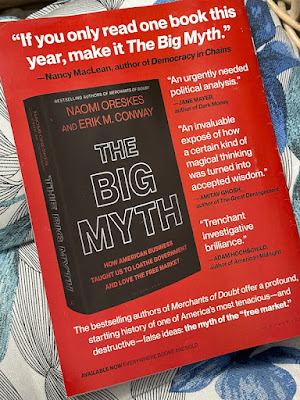
My new Harper's arrived. Back cover, full bleed ad:


I got the Kindle edition Tuesday when it was released, and am burrowed well into to it. First cited it here.
This is the story of how American business manufactured a myth that has, for decades and to our detriment, held us in its grip. It is the true history of a false idea: the idea of “the magic of the marketplace.” Some people call it market absolutism or market essentialism. In the 1990s, George Soros popularized the name we find most apt: market fundamentalism.1 It’s a quasi-religious belief that the best way to address our needs—whether economic or otherwise—is to let markets do their thing, and not rely on government. Market fundamentalists treat “The Market” as a proper noun: something unique and unto itself, that has agency and even wisdom, that functions best when left unfettered and unregulated, undisturbed and unperturbed. Government, according to the myth, cannot improve the functioning of markets; it can only interfere. Governments therefore need to stay out of the way, lest they “distort” the market and prevent it from doing its “magic.” In the late twentieth century, market fundamentalism was cloaked in the seemingly ancient raiments of received wisdom. In fact, it was more or less invented in the twentieth century.

Classical liberal economists—including Adam Smith—recognized that government served essential functions, including building infrastructure for everyone’s benefit and regulating banks, which, left to their own devices, could destroy an economy. They also recognized that taxation was required to enable governments to perform those functions. But in the early twentieth century, a group of self-styled “neo-liberals” shifted economic and political thinking radically. They argued that any government action in the marketplace, even well intentioned, compromised the freedom of individuals to do as they pleased—and therefore put us on the road to totalitarianism. Political and economic freedom were “indivisible,” they insisted: any compromise to the latter was a threat to the former—any compromise at all, even to address obvious ills like child labor or workplace injury. Why did we ever come to accept a worldview so impervious to facts? A worldview Smith himself, often thought of as the father of free-market capitalism, would have rejected? This book tells that story...

Oreskes, Naomi; Conway, Erik M.. The Big Myth (pp. 10-11). Bloomsbury Publishing. Kindle Edition
CONCLUSION

Judge Richard A. Posner is one of America’s most distinguished conservative jurists and for many years a leader of the law and economics movement. This movement, which originated at the University of Chicago, holds that the law is best viewed as a tool to promote economic efficiency and that economic analysis can and should can guide legal practice.1 Posner spent most of his career displaying a jaundiced view of government regulation and he influenced many a young jurist to do the same; one analysis finds him to be the most cited law writer of the second half of the twentieth century. His jurisprudential philosophy—which substantially equated justice with economic efficiency—provoked one critic to snarl that “Maximum Wealth, badly distributed, does not lead to maximum happiness.”

In 2009, Posner undertook an analysis of the 2008 financial crisis, which caused him to rethink his views. A “rational decision-maker starts with a prior probability,” Posner wrote in A Failure of Capitalism: The Crisis of ’08 and the Descent into Depression, “but adjusts that probability as new evidence comes to his attention.” The near collapse of the world’s banking system offered a raft of evidence about the reality of market failure and the need for government regulation, particularly in financial markets. “Behavior that generates large external costs,” he tartly observed, “provides an apt occasion for government regulation.” What he had learned from the crisis was that “we need a more active and intelligent government to keep our model of a capitalist economy from running off the rails. The movement to deregulate the financial industry went too far by exaggerating the resilience—the self-healing powers—of laissez-faire capitalism.” The responsibility for building the guard rails that capitalism has proven itself to require has to rest with government, because there isn’t any other institution to do it.

The 2008 collapse should have hit “economic libertarians in their solar plexus,” Posner observed, because the crisis was the result of underregulation, a consequence of the “innate limitations of the free market.” But if the economic libertarians were hit by the 2008 crisis, they refused to flinch. In conservative circles and the offices of K-street lobbyists, trade associations, and think tanks, and on the pages of the Wall Street Journal, as well as in much academic economics, free-market ideology remained largely in place… [pp. 567-568].
I recall my nano-bit part in the 2008 financial crash run-up.
 
UPDATE: I'm now about halfway through "The Big Myth," which the Kindle app tells me is almost a 19 hour read. It is kickin' my butt. Stay tuned...
__________