Search the KHIT Blog

Showing posts sorted by date for query The Age of Grievance. Sort by relevance Show all posts

Tuesday, July 7, 2026

Effective Dissent in our Age of Fear

    
I love Jacob Soboroff's new MS NOW show "Connect." It's where I was apprised of this timely new book last weekend. On Courage jumped my endless Kindle backlog rope line.


Serious piece of work thus far. I'm way into it already. Some related priors, quickly: "The ICE Storm," "Oopsie...Too Late." 
_____
 
STING

'eh?
 
UPDATE
 
I was just watching PBS News Hour and saw a segment featuring this author.
 
A Professor at UPenn.
 
Amazon blurb:
A compelling exploration of concrete strategies to reduce partisan animosity by building on what Democrats and Republicans have in common.

One of the defining features of twenty-first-century American politics is the rise of affective polarization: Americans increasingly not only disagree with those from the other party but distrust and dislike them as well. This has toxic downstream consequences for both politics and social relationships. Is there any solution?

Our Common Bonds shows that—although there is no silver bullet that will eradicate partisan animosity—there are concrete interventions that can reduce it. Matthew Levendusky argues that partisan animosity stems in part from partisans’ misperceptions of one another. Democrats and Republicans think they have nothing in common, but this is not true. Drawing on survey and experimental evidence, the book shows that it is possible to help partisans reframe the lens through which they evaluate the out-party by priming commonalities—specifically, shared identities outside of politics, cross-party friendships, and common issue positions and values identified through civil cross-party dialogue. Doing so lessons partisan animosity, and it can even reduce ideological polarization. The book discusses what these findings mean for real-world efforts to bridge the partisan divide. 
 I've just downloaded the Amazon preview for some initial impressions. to wit,
1. Is Overcoming Division a Fantasy? 

On a blustery January day, just moments after being sworn in as the forty-sixth president of the United States of America, Joe Biden delivered an address centered on “that most elusive of things in a democracy: unity.” This was perhaps a slightly odd choice, as the country seemed to be more divided than ever. Just two weeks before, supporters of former President Trump had stormed the US Capitol in an attempt to block the certification of Biden’s victory in the November 2020 election. January 6 marked only the second time in US history that the Capitol had been breached, but the first time that American citizens—rather than foreign troops—had been the ones doing the ransacking. Even before that insurrection, few would have characterized the United States as unified: the country was seemingly torn asunder by divides over how to address the COVID-19 pandemic and associated economic recession, as well as a centuries-overdue reckoning about the legacy of slavery and racism. Dissolution, not unity, seemed like a more appropriate topic for the moment. 

Biden acknowledged that there were deep and significant challenges to be overcome. But he argued that to confront these challenges, we have to “end this uncivil war that pits red against blue, rural versus urban, conservative versus liberal.” He acknowledged that this will be difficult, and that unity does not imply unanimity: “The right to dissent peaceably, within the guardrails of our Republic, is perhaps our nation’s greatest strength. Yet hear me clearly: Disagreement must not lead to disunion.” But he argued that if we could come together as one, we could “heal a broken land” and “write an American story of hope, not fear, of unity, not division, of light, not darkness” (Biden 2021). 

Those stirring words, poetic as they were, likely seemed hopelessly naïve to most Americans. Biden himself acknowledged as much, saying that he knew his words sounded like “a foolish fantasy” to many. The public agreed with his assessment: in a poll by the Pew Research Center early in his term, of all of the issues polled, the public was the least confident in Biden’s ability to unify the country, even when compared to major challenges like responding to the COVID-19 pandemic or reforming immigration policy (Pew Research Center 2021). This skepticism reflects the conventional wisdom about American politics: politicians in Washington, DC, are hopelessly divided and cannot come together on almost any issue, and ordinary voters are little better. Indeed, not only do voters disagree with one another, they also fundamentally dislike and distrust one another. This animosity seemingly eviscerates any calls for unity among members of the public…
the conventional wisdom about American politics: politicians in Washington, DC, are hopelessly divided and cannot come together on almost any issue, and ordinary voters are little better. Indeed, not only do voters disagree with one another, they also fundamentally dislike and distrust one another. This animosity seemingly eviscerates any calls for unity among members of the public…

Levendusky, Matthew (2023). Our Common Bonds: Using What Americans Share to Help Bridge the Partisan Divide (Loc 60). Kindle Edition.  
Seems relevant to the topic. Note a few priors, too: "High Conflict," "The Age of Grievance," "A Science of Deliberation?" "Civility," anyone? "Being Influential." Also, how about a shout-out to one of Matthew's UPENN colleagues, Kermit Roosevelt III.
 
I'm pretty far along into On Courage tonight. Lots to reflect upon.
 
ANOTHER UPDATE
 
CLICK
Stay tuned...

Saturday, March 28, 2026

"The end of social media as we know it?"

Jacob Ward in discussion with Nita Farahany.
 
 
In the wake of the New Mexico and California civil liability verdicts.
 
 
"The end of social media?" I guess we'll see. 'Not anytime soon' would be my speculation. Good discussion. I've cited both Nita and Jacob before.

 
My Grandson Calvin at 13 months, LOL.
He is now six. "Hey, Pop, can I use your iPhone?"
  
Baby brother Arlo, last week, 5 months.
Couple Jake and Nita's discussion above with that of Laurie Segall and Becky Kennedy in the prior post. Lotta good stuff to ponder. 

apropos...

ON DECK, COMES OUT MARCH 31ST:
 
Even by the standard of a tech industry stacked with so-called geniuses, Demis Hassabis is a special case. Born poor in North London to immigrant parents, a chess prodigy by age five and wizard coder in his teens, he turned down a seven figure offer before turning 18 to feed his insatiable scientific curiosity at Cambridge. Later, he added a neuroscience PhD to his computer science skills to pursue the dream of artificial general intelligence, the ultimate goal being to unravel the mysteries of biology and theoretical physics and to usher in super-abundance. Alongside a small group of fellow travelers, that is the path he is still on, leading the AI research at Google, winning a Nobel Prize along the way, and imagining machines that will compound, or possibly supplant, the human understanding of the universe.

Hassabis has given Sebastian Mallaby a great deal of his time, sitting for over thirty hours of conversation. But Mallaby has also drawn from Hassabis's detractors, such as his estranged cofounder Mustafa Suleyman; from his rivals, such as OpenAI's leading scientist Ilya Sutskever; and from academic pioneers who now fear for human survival, such as Nobel laureate Geoffrey Hinton. The result is a revelatory account of a singular figure and his company and a profound reckoning with this protean field as it leaps from the periphery to the center of our consciousness.

No one questions Hassabis’s brilliance. There are those who, like Elon Musk, have at times regarded him as an "evil genius." He is in a game where the stakes are matched only by the exorbitant costs — for talent, and for compute. Celebrated scientists pursue the technology because they cannot resist the sweetness of discovery. Others pursue it for money or power. The inventors believe they control their technology, but often, the technology controls them.

Despite Hassabis’s pivotal role inside Google’s engine room, this is not a Silicon Valley story. Hassabis deals with the Valley and takes its money, but remains outside and furiously critical of it, lambasting its leaders in conversation with Mallaby. The end of this race cannot be known, but as this great book shows us, Hassabis's quest to will a new form of cognition into the world is a defining story for our era.
_______ 
 
CODA: GRATUITOUS MUCKING AROUND ON MY BLOG
 
Amid Donald Trump's recent nearly 2-hour long televised White House Cabinet Meeting, at 38:14 he launched into his trademark random mumbling grievance ramble. It lasted a little over 19 minutes. I had it up on my iPad via a YouTube feed. At one point I gripped the screen tightly with one hand while holding it at an angle. It went into 2x speed mode (without going into "Chipmunks"). It was funny, so I launched my voice memo app and re-rolled the video. After I got a decent audio take, I dropped the ensuing .mp4 file over to my Macbook, pulled it up in Garageband (I also have Logic Pro, but this was easier), clipped off the front and end loose matter, and exported it to an audio .mp3. I mounted it here, below. The dude is unreal.

Donald Trump, March 26, 2026 mid-cabinet meeting rant, 2x speed

Sunday, February 15, 2026

For the first time, speech has been decoupled from consequence.

An LLM’s words shape our beliefs, decisions, and actions, yet no speaker stands behind them.
 

I ran across this compelling essay in The Atlantic today while watching the Winter Olympics. I had to shut the TV off and attend closely. Highly. highly recommended. Goes straight to a number of my long-standing sociopolitical concerns (inextricably enmeshed with digitech). 
 
Dr. Roy cut right to the chase from word one.
For the first time, speech has been decoupled from consequence. We now live alongside AI systems that converse knowledgeably and persuasively—deploying claims about the world, explanations, advice, encouragement, apologies, and promises—while bearing no vulnerability for what they say. Millions of people already rely on chatbots powered by large language models, and have integrated these synthetic interlocutors into their personal and professional lives. An LLM’s words shape our beliefs, decisions, and actions, yet no speaker stands behind them.

This dynamic is already familiar in everyday use. A chatbot gets something wrong. When corrected, it apologizes and changes its answer. When corrected again, it apologizes again—sometimes reversing its position entirely. What unsettles users is not just that the system lacks beliefs but that it keeps apologizing as if it had any. The words sound responsible, yet they are empty.

This interaction exposes the conditions that make it possible to hold one another to our words. When language that sounds intentional, personal, and binding can be produced at scale by a speaker who bears no consequence, the expectations listeners are entitled to hold of a speaker begin to erode. Promises lose force. Apologies become performative. Advice carries authority without liability. Over time, we are trained—quietly but pervasively—to accept words without ownership and meaning without accountability. When fluent speech without responsibility becomes normal, it does not merely change how language is produced; it changes what it means to be human.

This is not just a technical novelty but a shift in the moral structure of language. People have always used words to deceive, manipulate, and harm. What is new is the routine production of speech that carries the form of intention and commitment without any corresponding agent who can be held to account...

"Any corresponding agent who can be held to account?"

Increasingly quaint civic notion, that, given our chronic slide in recent years toward a bifurcated culture comprised of one large, dispersed cohort bound by laws and norms but not protected by them, chafing against a smaller but more powerful socioeconomic/political demographic protected by authority while increasingly rarely bound by it.
Language has always been more than the transmission of information. When humans speak, our words commit us in an implicit social contract. They expose us to judgment, retaliation, shame, and responsibility. To mean what we say is to risk something.
Trumpian "conservatives" in particular never forego an opportunity to passively-aggressively warn their political critics that "free speech is not free."
You might get Primaried. Perhaps doxxed. You might lose your job, your scholarship, your visa...
That has always been a liability going to speaking one's mind, yeah, we get it. But, Dr. Roy's lament focuses on a significant new elevated level.
The AI researcher Andrej Karpathy has likened LLMs to human ghosts. They are software that can be copied, forked, merged, and deleted. They are not individuated. The ordinary forces that tether speech to consequence—social sanction, legal penalty, reputational loss—presuppose a continuous agent whose future can be made worse by what they say. With LLMs, there is no such locus. No body that can be confined or restrained; no social or institutional standing to revoke; no reputation to damage. They cannot, in any meaningful sense, bear loss for their words. When the speaker is an LLM, the human stakes that ordinarily anchor speech have nowhere to attach. 
There is no Communications Act Section 230 Subsection LLM to rail against. Advocacy aimed at repealing Section 230 per se has yet to get significant traction, beyond a bit of rather ad hoc sound & fury.
 
But...
Speech without enforceable consequence undermines the social contract. Trust, cooperation, and democratic deliberation all rely on the assumption that speakers are bound by what they say.

The response cannot be to abandon these tools. They are powerful and genuinely valuable when used with care. Nor can the response be to pursue ever greater machine capability alone. We need structures that reanchor responsibility: constraints that limit the use of AI in various contexts such as schools and workplaces, and preserve authorship, traceability, and clear liability. Efficiency must be constrained where it corrodes dignity.

As the idea of AI “avatars” enters the public imagination, it is often cast as a democratic advance: systems that know us well enough to speak in our voice, deliberate on our behalf, and spare us the burdens of constant participation. It is easy to imagine this hardening into what might be called an “avatar state”—a polity in which artificial representatives debate, negotiate, and decide for us, efficiently and at scale. But what such a vision forgets is that democracy is not merely the aggregation of preferences. It is a practice of speaking in the open. To speak politically is to risk being wrong, to be answerable, to live with the consequences of what one has said. An avatar state—fluent, tireless, and perfectly malleable—would simulate deliberation but without consequence. It would look, from a distance, like self-government. Up close, it would be something else entirely: responsibility rendered optional, and with it, the dignity of having to stand behind one's words made obsolete.

Wiener understood that the whirlwind would come not from malevolent machines but from human abdication. Capability displaces responsibility. Efficiency erodes dignity. If we fail to recognize that shift in time, responsibility will return to us only after the damage is done—seated, as Wiener warned, on the whirlwind.
"AI AVATARS?" "THE AVATAR STATE?" 
 
Cue up "Agentic AI." LLMs may be peaking, relatively.
 
"Artificial Generative Intelligence" (LLM based) is apparently rapidly becoming passe. to wit: "Open Claw," anybody? "Agentic AI" sounds hipper than "AI Assistants."
 
Will Musk jump quickly to trademark "AgentiX.ai™" (or sue whomever else might get there first?) 
UPDATE: Someone's already on it
Again, a great (relatively lengthy, appropriately detailed) Deb Roy essay. The implications go well beyond simply "democracy."
________
 
DR. DEB ROY
 
Gotta cop. I was not hip to this scholar. My Bad. Impressive.
Deb Roy is a professor of Media Arts and Sciences at MIT, where he directs the MIT Center for Constructive Communication, based at the MIT Media Lab. He is also the cofounder and chair of Cortico, a non-profit dedicated to building stronger civic networks. 

 
Couple of Priors for now:
"Artificial Intelligence" broadly (back 10-12 years). link rot & all. "Persuasion." "Deliberatiom Science."
 
ERRATUM: ELITE ACADEMIA UPDATE
1. American University
2. Boston College
3. Boston University
4. Brown university
5. Carnegie Mellon University
6. Case Western Reserve University
7. Columbia University
8. College of William and Mary
9. Cornell University
10. Duke University
11. Emory University
12. Florida Institute of Technology
13. Fordham University
14. Georgetown University
15. George Washington University
16. Harvard University
17. Hawaii Pacific University
18. Johns Hopkins University
19. London School of Economics
20. Massachusetts Institute of Technology
21. Northeastern University
22. Northwestern University
23. New York University
24. Pepperdine University
25. Princeton University
26. Stanford University
27. Tufts University
28. University of Miami
29. University of Pennsylvania
30. University of Southern California
31. Vanderbilt University
32. Wake Forest University
33. Washington University in St. Louis
34. Yale University
The foregoing is a list of post-secondary institutions found by Trump's "Secretary of War" Pete Hegseth to be unacceptably "Woke/Humanistic" and hence off-limits for tuition-reimbursements of military members (mostly grad school level officers), effectively banning their enrollment and attendance. This was leaked the other day. 
 
UPDATE: I just saw a clip on MSNOW featuring Secretary Hegseth saying "we produce Warriors, not Wokesters. Harvard, good riddance."
 
UPDATE: DEB ROY
 
 
…What is arguably the defining trait of the second Trump administration, a bearing and a bullying that cast a noxious haze over all public discourse, which was already plenty polluted. This crew — Bondi, Stephen Miller, JD Vance, President Trump himself — don’t want to win opponents’ favor. They don’t even want to win the argument. Why sweat the delicate art of persuasion when you can use the brute force of condemnation? Comity and conciliation are a slog. They’re for suckers. Contempt is victors’ ready, heady prerogative.

It’s also what the MAGA movement was supposed to be rebelling against. Many people who flocked to Trump in all his spite and willful destructiveness were protesting the condescension and derision of the Democratic elite, who, they felt, held them in contempt. They were responding to Barack Obama’s lament about embittered Americans who “cling to guns or religion.” They were reacting to Hillary Clinton’s gibe about the “basket of deplorables.”

At least that’s one origin theory, one narrative thread.

But Trump, his aides and many of his supporters haven’t purged contempt from our politics. They’ve mainstreamed it. Purified it. Industrialized it. It’s their push-a-button pushback against everyone who challenges them and any circumstances that threaten to undermine them, an all-purpose way to pivot from the substance of a situation to an evasive and obfuscating ill will. Envelop everything in indiscriminate animosity and nothing real survives.

That’s what Kristi Noem, the homeland security secretary, and Miller, the impresario of ugliness, did when federal agents killed protesters in Minneapolis. Smear first, ask questions later (or, better yet, never)...
 
More to come...

Friday, October 10, 2025

“Love your enemies?” Seriously?

Some worthy re-reading, spurred by our accelerating, metastasizing discord. 
    
Republicans and Democrats today suffer from a level of motive attribution asymmetry that is comparable to that of Palestinians and Israelis. In both cases, the two sides think that they are driven by benevolence, while the other side is evil and motivated by hate. Therefore neither side is willing to negotiate or compromise. As a result, the authors found, “political conflict between American Democrats and Republicans and ethnoreligious conflict between Israelis and Palestinians seem intractable, despite the availability of reasonable compromise solutions in both cases.” 

Think about what this means: We are headed to the point where achieving bipartisan compromise, on issues from immigration to guns to confirming a Supreme Court justice, is as difficult as achieving Middle East peace. We may not be engaging in daily violence against each other, but we can’t make progress as a society when both sides believe that they are motivated by love while the other side is motivated by hate.

Brooks, Arthur C.. Love Your Enemies: How Decent People Can Save America from the Culture of Contempt (loc 305). Kindle Edition.
That reads like it was written this morning. He published that book in 2019. I bought and read it straight away. It warrants review in light of all this "Disagree Better" stuff of late in the wake of the Charlie Kirk murder.
 
"LOVE YOUR ENEMIES?"
 
Well, I have little trouble getting to "abide your adversaries," but the "enemies" thing is rather more complex (in part given my reluctance to accord inordinate cognitive energy thinking about "enemies").
 
And, that rumination takes us over to our increasing susceptibility to clutching the pearl hair-trigger to being "offended" by anything that irks us.
"You gain the strength of the temptation you resist." —Thomas Szasz 
We might also recall this:
“Anybody can become angry; that is easy. But to be angry with the right person and to the right degree and at the right time and for the right purpose, and in the right way—that is not within everybody’s power and is not easy.” —Aristotle, Nicomachean Ethics 
 
Back to Dr. Brooks.
 
Unless you inhabit a hermit cave with no internet access, you’ll know that we live in the Age of Offense. With high levels of polarization and innumerable ways to broadcast one’s every thought to strangers far and wide, it is easier than ever to lob insults and to denigrate ideological foes. Not surprisingly, according to a 2024 Pew Research Center study, 47 percent of Americans believe that people saying things that are “very offensive” to others is a major problem in the country today, whereas only 11 percent say it is not a problem. (The remainder says it is a minor problem.)

You might conclude that the solution is for people to stop offending others—good luck with that!—but consider another statistic in the same poll: A larger percentage of Americans (62 percent) says another big problem is “people being too easily offended by things others say.” These are not at all mutually exclusive findings; they suggest that we are simultaneously too offensive and too thin-skinned.

The second issue, however, is the one on which I wish to focus, because, for most people, being too easily offended is worse for one’s own quality of life than being obnoxiously rude. So instead of spending your efforts trying to stamp out what you find offensive, you should work on being less offended in the first place…
'eh?


"LOVE YOUR ENEMIES?"
 
 
Right. He will not be loving his "enemies from within."
 
More shortly...

Tuesday, May 20, 2025

OpenAI & Sam Altman on the front burner

In the prickly Empire of AI: Dreams and Nightmares in Sam Altman’s OpenAI (Penguin Press), Karen Hao tracks the fallout from the GPT breakthroughs across OpenAI’s rivals—Google, Meta, Anthropic, Baidu—and argues that each company, in its own way, mirrored Altman’s choices. The OpenAI model of scale at all costs became the industry’s default. Hao’s book is at once admirably detailed and one long pointed finger. “It was specifically OpenAI, with its billionaire origins, unique ideological bent, and Altman’s singular drive, network, and fundraising talent, that created a ripe combination for its particular vision to emerge and take over,” she writes. “Everything OpenAI did was the opposite of inevitable; the explosive global costs of its massive deep learning models, and the perilous race it sparked across the industry to scale such models to planetary limits, could only have ever arisen from the one place it actually did.” We have been, in other words, seduced—lulled by the spooky, high-minded rhetoric of existential risk. The story of A.I.’s evolution over the past decade, in Hao’s telling, is not really about the date of machine takeover or the degree of human control over the technology—the terms of the A.G.I. debate. Instead, it’s a corporate story about how we ended up with the version of A.I. we’ve got.

The “original sin” of this arm of technology, Hao writes, lay in a decision by a Dartmouth mathematician named John McCarthy, in 1955, to coin the phrase “artificial intelligence” in the first place. “The term lends itself to casual anthropomorphizing and breathless exaggerations about the technology’s capabilities,” she observes. As evidence, she points to Frank Rosenblatt, a Cornell professor who, in the late fifties, devised a system that could distinguish between cards with a small square on the right versus the left. Rosenblatt promoted it as brain-like—on its way to sentience and self-replication—and these claims were picked up and broadcast by the New York Times. But a broader cultural hesitancy about the technology’s implications meant that, once OpenAI made its breakthrough, Altman—its C.E.O.—came to be seen not only as a fiduciary steward but also as an ethical one. The background question that began to bubble up around the Valley, Keach Hagey writes in “The Optimist: Sam Altman, OpenAI, and the Race to Invent the Future” (Norton), “first whispered, then murmured, then popping up in elaborate online essays from the company’s defectors: Can we trust this person to lead us to AGI?”
 
"Prickly?"
 
Karen Hao's book is now out.


I've begun my study. apropos, see some prior posta:
ERRATUM
 
A decades-long friend of mine is now a Microsoft software engineer working on the Azure AI platform. A quick msg yesterday:
 
 
MAY 21ST UPDATE 
Click
…OpenAI is angling to replace every major tech firm: ChatGPT is an internet search tool as powerful as Google, can help you shop online and remove the need to type into Amazon, can be your work software instead of the Microsoft Office suite. OpenAI is even reportedly building a social-media platform. For now, OpenAI relies on the smartphones and web browsers people use to access ChatGPT—products that are all made by business rivals. Altman is trying to cut out the middleman and condense digital life into a single, unified piece of hardware and software. The promise is this: Your whole life could be lived through such a device, turning OpenAI’s products into a repository of uses and personal data that could be impossible to leave—just as, if everyone in your family has an iPhone, Macbook, and iCloud storage plan, switching to Android is deeply unpleasant and challenging….

Almost 20 years ago, when Apple introduced the iPhone, Steve Jobs said in a now-famous speech that “every once in a while, a revolutionary product comes along that changes everything.” Seeming to be in pursuit of similar magic, today’s video announcing OpenAI’s foray into hardware began with Altman saying, “I think we have the opportunity here to kind of completely reimagine what it means to use a computer.” But Jobs had an actual product to share and sell. Altman, for now, is marketing his imagination.
A QUICK DIVERSION
 
Saw this on PBS Newshour.
 
 
OK, topically relevant, define "civility." Hmmm... "The Age of Grievance," anyone?
 
KAREN HAO UPDATE
 
Deeply into AI Empire. Switching back & forth between earlier and later chapters. A couple of cites:
 
 
Wonderful reading.
 
Relatedly, read "The Oppenheimer of our age," cited in Karen's book.
 
UPDATE
 
I finished Karen's book. Instructive Bulwark interview with the author here.
 
                      
Lots more to consider. For one thing, this has got me re-reading my Shannon Vallor.
 
 
Another woman who will kick your butt. 

UPDATE
Click
Last spring, Daniel Kokotajlo, an A.I.-safety researcher working at OpenAI, quit his job in protest. He’d become convinced that the company wasn’t prepared for the future of its own technology, and wanted to sound the alarm. After a mutual friend connected us, we spoke on the phone. I found Kokotajlo affable, informed, and anxious. Advances in “alignment,” he told me—the suite of techniques used to insure that A.I. acts in accordance with human commands and values—were lagging behind gains in intelligence. Researchers, he said, were hurtling toward the creation of powerful systems they couldn’t control.

Kokotajlo, who had transitioned from a graduate program in philosophy to a career in A.I., explained how he’d educated himself so that he could understand the field. While at OpenAI, part of his job had been to track progress in A.I. so that he could construct timelines predicting when various thresholds of intelligence might be crossed. At one point, after the technology advanced unexpectedly, he’d had to shift his timelines up by decades. In 2021, he’d written a scenario about A.I. titled “What 2026 Looks Like.” Much of what he’d predicted had come to pass before the titular year. He’d concluded that a point of no return, when A.I. might become better than people at almost all important tasks, and be trusted with great power and authority, could arrive in 2027 or sooner. He sounded scared…

Thursday, March 6, 2025

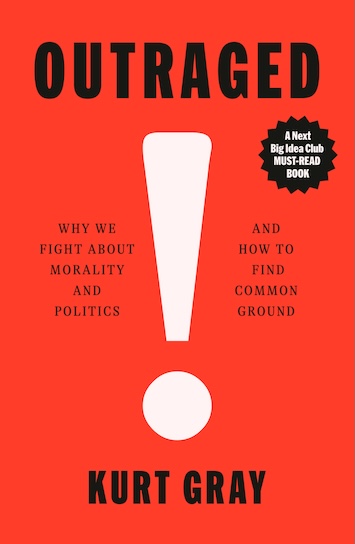
If you're not "Outraged,"

you've not been paying attention.
 

Science Magazine rreview rcommendation. On deck. Dr. Gray is all over it
 
Brings to mind Frank Bruni's book The Age of Grievance I cited last July, along with some other topically relevant works. 

UPDATE
 
I finished Kurt's book. It could scarcely be more timely, given current chaotic events. From the Science Magazine review:
Navigating conflict is difficult in the best of circumstances. It becomes even harder when our disagreements are deeply rooted in opposing moral convictions about the directions in which our collective lives are moving. When these tensions are embedded in contexts involving existential threats such as a changing climate that brings devastating storms or low wages and high prices for everything from grocery staples to health care and housing, fighting naturally erupts over the best way to fix a broken system. Political polarization seems inevitable.

In his compelling book, Outraged: Why We Fight About Morality and Politics and How to Find Common Ground, moral psychologist Kurt Gray uses stories and science to help readers understand why people are so angry at each other about almost everything. The reason, in his view? They feel threatened. They are afraid of what the future holds for them and for those they love. They feel as though the things that might ease their daily struggles are being ignored or even mocked by “the other side.”…
Dr. Gray is one busy research scholar. Impressive.
 
Click
Click

About the Center for the Science of Moral Understanding
Political intolerance is high. People dread turning on the news and discussing politics at the dinner table. This intolerance not only poisons our everyday interactions, but also imperils the health of democracies. How do we increase tolerance and civility? Some scientific work has examined how to bridge divides across people, but it is often scattered into disconnected disciplines, and current funding climates make it difficult to create momentum. The Center for the Science of Moral Understanding seeks to unite this work and catalyze a new science of moral understanding. The CSMU will then translate these new discoveries into societal change, creating a set of empirically based ways of increasing tolerance.

The Center harnesses a key insight—that much political disagreement is moral disagreement. To increase tolerance and civility, we need to understand the nature of moral judgment and the interpersonal processes that transform divergent moral judgments into conflict. The Center therefore connects moral and social psychology with related disciplines of neuroscience, political science, sociology, history, philosophy, economics, and legal studies.

Of particular timely relevance:
 

'eh?

Five stars.
 
UPDATE: QUICK TANGENTIALLY RELEVANT DIVERGENCE
The qualification of the noun "liberties" by the adjective "personal" is unfounded. Any qualification is unfounded. This particular one suggests that we can become free people without society, which is absolutely not true. We all begin life as helpless infants. Whether we can become free or not depends on circumstances beyond our control. No amount of declaiming "personal liberty" will create the conditions in which a baby grows up with the capacities and structures needed to be a free person. That effort to create a person must be social, beginning with the parents, and extending to friends, teachers, child-care workers, and others. A child needs a special kind of time at a special time of life, and that time will only exist if we recognize that the entire situation is about freedom and that freedom requires cooperation. If we want liberty, in other words, we cannot limit ourselves to the personal. The example of the newborn is important, because it is what we all share, but also because it suggests a truth that continues throughout life. In one way or other, we are always vulnerable, and our ability to be free will always depend on cooperation.

The use of the plural "liberties" (rather than "liberty" or "freedom" in the singular) is not an extension but an unwelcome qualification, in fact a limitation. The use of the plural suggests that there is a finite list of specific liberties, rather than freedom for all people as such. This indicates that liberty is constrained for people. Interestingly, no such constraint is placed upon the inhuman abstraction that also figures in Jeff Bezos's editorial line, "the free market." What has unqualified freedom, according to Bezos? Not people. The market. And this, as we shall see, is not only incoherent but authoritarian.
From Timothy Snyder's Substack.
___
 
SOME OTHER RELATED POSTS
Also. how about "Mental Immunity?"
 
What?
 
 
___
 
KURT GRAY SUMS UP
Moral Understanding
Moral understanding is hard won, and can be easily lost, especially because of the allure of the three myths debunked in this book. Myth 1 is that humans are more predators than prey. This misconception about human nature poisons our perceptions of our political opponents, who we wrongly assume want to watch the world burn. Fortunately, the truth is that people are more prey than predators; we are less motivated to destroy and more motivated to protect ourselves and society.

Myth 2 touches on the idea that people with different politics have deeply different minds. One theory suggests that liberals care only about direct physical and emotional harm and the harm of unfairness, while conservatives care about these concerns plus “harmless” morality like loyalty to group members, respecting authorities, and protecting purity. But the notion of “harmless wrongs” is a myth, grounded in the misconception that harm is an objective fact. It is not.

When it comes to our moral psychology, harm is a matter of perception. Everyone’s moral judgments are grounded in intuitive perceptions of victimization, and moral differences arise from different assumptions about who or what is especially vulnerable to victimization. Despite our different moral stances, this shared focus on harm provides common ground with our opponents, which can help us bridge divides.

To best harness this common ground and connect across political disagreement, we need to let go of a third myth: that facts are the best way to achieve moral understanding in contentious conversations. Ever since the Enlightenment, facts have (understandably) held a privileged position in our society, but our minds are better suited to connect over stories, especially those that center on suffering. Sharing stories of harm is more effective at bridging divides than launching statistics at our opponents. When we combine this advice with practitioner-tested steps for having better dialogues—connect, invite, and validate—conversations with political opponents go much better than expected.

This book has been about the psychology of our moral disagreements, because I believe that understanding the mind is crucial to understanding our human condition—and we are all humans, no matter our moral positions. When we appreciate how our minds work, it is easier to sit with the central tension of moral conflict: that other people can disagree with you and still be good people. Like my family in Nebraska, people can vote for different candidates and still be caring, compassionate, and moral people.

Despite having different moral convictions, people on the other side still care about their loved ones and still feel threatened by the modern world. In fact, it is because people care about their loved ones and feel threatened that they hold fast to their moral convictions. People with different politics might disagree with you about how best to protect society from harm, but we all genuinely care about preventing victimization.

Whether in politics or everyday life, most of us are trying our best to uphold morality. It can be hard to remember this, especially when someone insults you on social media, comparing your side to the Nazis—or when someone corners your car in a dark loading dock, like when I was a teenager on the way to the movies that night. But everyone—even the man who slapped me around—wakes up in the morning striving to do right. Each of us shares a human nature built upon detecting threat and a morality focused on preventing harm, and each of us wants our experiences of suffering to be heard.

It is true that many of us today are outraged. But most of us want to be less outraged, and understanding the truth about our moral minds will help.

Gray, Kurt. Outraged: Why We Fight About Morality and Politics and How to Find Common Ground (pp. 366-368). (Function). Kindle Edition.
You really should buy this book and study it closely. 

More to say shortly...
_________