I hope and trust everyone had a happy and safe New Year celebration.
Game on, really now. January 3rd, 2011, the day providers can begin registering their forthcoming eligibility for the Meaningful Use reimbursement money (via a new portal within the CMS PECOS system). I say "forthcoming" because everyone** will still have to traverse an initial continuous 90-day Meaningful Use compliance attestation period prior to filing for the year-one incentive money.
[** On the Medicare eligibility side, that is. Providers participating under Medicaid need only attest to having "Adopted, Implemented, or Upgraded" to an ONC Certified EHR during year one. In fact, the first checks have already been issued for Medicaid providers under that provision, in Kentucky and Oklahoma. Reimbursement timelines under Medicaid will vary by state. Nevada, for example, will reportedly not be ready to accept attestions and issue payments until late Q3 2011. We had been quietly worried here that Nevada, owing to its huge state budget deficit, might choose to opt out entirely (state participation is 'voluntary'), so this news was at least a bit welcome, notwithstanding the delay.]As usual, I have much to ponder and discuss. e.g.,
- The December 2010 PCAST Report on HIT (PDF)
- The December 23rd CMS Data Systems Modernization report (PDF)
- The November 2010 NIST EHR Usability report (PDF), and its antecedent
- AHRQ May 2010 Electronic Health Record Usability report (PDF), and its antecedent
- HIMSS 2009 EMR Usability Report (PDF)

Also, "HIE" (Health Information Exchange). I got to write the Executive Summary proffer for our Nevada proposal, which has been accepted by an initial core group of convening entities, with my company designated to be the stakeholder-inclusive not-for-profit administrator. As I concluded,
RETURN ON INVESTMENT CONSIDERATIONSHIE activity has ramped up to a fever pitch across the nation, given that it is central to the visions laid out in PCAST (itself inclusive of the outer stage HHS/ONC/CMS goals of HITECH in general).
Health care is fundamentally an information science, and, more importantly, the clinical information at its core is information about science – the science of treatment, healing, and wellness. Consequently, it is expensive to accurately acquire (given the considerable breadth of data to be usefully captured) and expensive to effectively interpret and act upon – in light of the extensive expertise required for quality health care. The labor time of everyone involved in the delivery of care is an invaluable resource, a precious, finite resource whose effectiveness can only be enhanced by improving the way we deliver its information lifeblood to the point of care.
More broadly, while the apparent nominal HIE capital and early operational outlays might seem to pose daunting barriers, such must be viewed in the context of the underappreciated but very real (and largely unimprovable) costs of the status quo. All of the health care stakeholders in Nevada stand to materially benefit from the adroit deployment of HIE, and, while any speculative ROI “hard dollar benefits” calculation is beyond the scope of this executive summary, suffice it to say that that the convening stakeholder parties will bring both the acumen and the goodwill necessary to make a Nevada HIE both an exemplar financial success and a significant contributor to quality health care.
Stay tuned, lots to discuss...
JAN 6th UPDATE
 From the National Quality Forum, two more (PDF) documents to ponder concerning HIT "usability"
- Driving Quality—A Health IT Assessment Framework for Measurement;
- Driving Quality and Performance Measurement—A Foundation for Clinical Decision Support;
“Currently, standards exist only for EHR certification, not for assessing effective health IT use. The meaningful use EHR incentive program and certification requirements for interoperability (sending information from one system to another) provide the incentive, but a standard mechanism to determine appropriate utilization of EHRs does not yet exist. Standards are needed to assess EHR use; without them consistency and comparability are not guaranteed. The framework described in this report will significantly inform standardization efforts with respect to structural components of EHRs and other clinical information systems. Such standardization will allow for clearly defined measures with reliable, consistent, and achievable results while reducing the effort required to assess clinical system effectiveness by system vendors, implementers, or users of such systems. Performance measures of health IT systems using these standard user interactions and transactions will enable clinical effectiveness research, help determine unintended consequences of health IT, and evaluate the real-world usability of products and applications.”
- Efficiency;
- Effectiveness, and;
- User experience
I would love to see a comparative certified EHR assessment matrix comprised of elements such as workflow navigation clicks, task time-to-completion, error rates, user experience ratings, etc, for each MU criterion (inclusive of those that are essentially "once-only," e.g., "turn on your Meds-Meds, Meds-Allergies Alerts functionality and thereafter leave it alone," or "conduct one test of HIE").
On the subject of HIT usability, I have struck up an interesting internet conversation with Dr. Scot Silverstein of Drexel University.
 A focused, erudite, credible critic of the persistent shortcomings of HIT.
Healthcare information technology (HIT) holds great promise towards improving healthcare quality, safety and costs. As we enter the second decade of the 21st century, however, this potential has been largely unrealized. Significant factors impeding HIT achievement have been false assumptions concerning the challenges presented by this still-experimental technology, and underestimations of the expertise essential to achieve the potential benefits of HIT. This often results in clinician-unfriendly HIT design, and HIT leaders and stakeholders operating outside (often far outside) the boundaries of their professional competencies. Until these issues are acknowledged and corrected, HIT efforts will unnecessarily over-utilize precious healthcare resources, will be unlikely to achieve claimed benefits for many years to come, and may actually cause harm...Interesting to me is Scot's opening sentence: "Healthcare information technology (HIT) holds great promise towards improving healthcare quality, safety and costs."
Precisely the essence of the opening riff of the first of the the above-cited NQF reports: "HEALTH INFORMATION TECHNOLOGY (HEALTH IT) offers great promise to improve healthcare quality, safety, and affordability, and the health of the population."
Much to ponder.
___
NEWS ERRATA:
The upcoming HIT Pro Exam (click either image below for link)

 That'll be interesting. HHS competition (however limited) for those expensive proprietary professional organization cert exams. They had better do a good job with this from a BOK sampling perspective. Back during DOQ-IT, we all had to take a CMS online "DOQ-IT Certification Exam." It did not go well. There were numerous QIO people with substantive cred such as years of HIT experience and advanced degrees in clinical informatics who "failed" it during the first rollout. The ensuing firestorm was something to behold. And, a complete waste of time and tax dollars.
___
UPDATE: A NAYSAYER

So as far as I see it, meaningful use is a brakeless train heading for a solid mountain. Some, to be sure, will jump before impact, abandoning the program rather than continuing to throw good money after that spent on a project which will not qualify for reimbursement. Far worse, others will continue to shovel coal into the rickety engine of their organization, pushing the train beyond capacity and hurting patients in an attempt to qualify for monies, ironically, set aside to help them. Any which way you slice it, this is ugly and going to get uglier.
- Anthony Guerra, InformationWeek, January 19, 2011He's not the only one, by any means. Sometimes I tire of all the contention, so much of it of the "perfectionism fallacy" flavor. Not that I am an unreflective, uncritical cheerleader for this effort, by any means, as anyone taking the time to read my posts carefully and fairly should surely concede.
___
INTERESTING:
CAPITALIZING ON THE REC "BRAND"?

"...For almost two years now HITECH Answers has been an independent source for educating eligible professionals on details of the HITECH Act. In that time, we’ve amassed a fairly significant library of pre-recorded webinars for viewing, along with a body of exclusive white papers and research. The time for analyzing the HITECH Act has ended. Our next logical step is to expand our resources to help shepherd EHR adoption and implementations. So we asked ourselves this question – how can we best utilize both our existing knowledge base and that of the independent experts who so graciously contribute their time and effort to HITECH Answers?This is obviously a for-profit initiative via which to sell Meaningful Use related stuff to providers. Leveraging the public, non-copyrightable Regional Extension Centers "brand." Not that I have any problem with HITECH Answers -- I've long had them in my right hand side "Links of Interest" column.
..
We concluded the answer to that question to a great extent is very similar to the purpose served by the 62 Regional Extension Centers – support as much as we can the process of adoption of a certified EHR system that meets meaningful use criteria..."
___
TANGENTIAL ERRATA:
A PRETTY COOL DATA VISUALIZATION WEBSITE
Click the image to enlarge.
 This comes from the very interesting "informationisbeautiful.net" website. I came across it during my daily surfing over to the "Science-Based Medicine" blog, one of my favs. They didn't cut him any slack, either, nothwithstanding the stellar interactive presentation:
As a pharmacist, I constantly need to contextualize data directly for patients, translating trial results into more understandable figures like numbers needed to treat and numbers needed to harm. I’m always searching for better ways of communicating the understanding of risks and benefit. Information is Beautiful is one of my favourite blogs, as the authors highlight innovative and effective ways of graphically presenting data. So I was initially excited about their attempt to summarize the data for supplements...Much to consider, as always.
Clicking each bubble will link you to the supporting clinical data. But there’s a crucial element missing in their presentation: harms. You cannot evaluate the value of a treatment based on efficacy alone. For example, selenium is ranked very highly for colorectal cancer prevention based on this study. Not only is there evidence to the contrary, selenium consumption is associated with a significant increase in the risk of type 2 diabetes. The risks actually seem more compelling and relevant than the potential benefits. Or look at red yeast rice, another supplement rated highly. While RYR does seem effective, is less effective and more dangerous than drugs derived from it. I like the IiB visual approach, but it fails in communicating meaningful data on risk and benefit, both of which are essential for decision-making.
___
MU "RECORD PATIENT DEMOGRAPHICS"
I recently did gap analysis visits with a SOAPware client and an Alteer client. As we discussed the Meaningful Use compliance requirements for "record patient demographics" (§170.304(c) "Enable a user to electronically record, modify, and retrieve patient demographic data including preferred language, insurance type, gender, race, ethnicity, and date of birth"), it became clear that confusion continues as to "race" and "ethnicity." The SOAPware install in particular had drop-down response options that numbered in the dozens to hundreds (mostly with respect to "ethnicity" -- seemingly everything this side of the fork in the family tree). I'm sure some database programmer was thoroughly thrilled at the swell inclusion of this granular "functionality."
I dropped the requisite MU options into an Excel sheet pick list to illustrate. It's pretty simple.


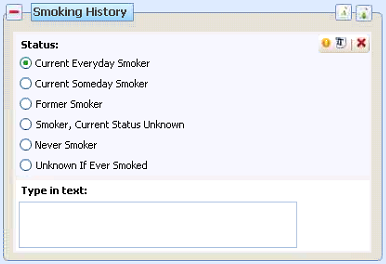
These (or their radio button/check box equivalents) are all you want to see for MU compliance. Nothing more. Not that you can't collect every additional bit of fine-grained (and non-reimbursable) data you wish. Note below: the same thing applies to §170.302(g) "Smoking status."
 Some EHRs enable you to capture more specific data such as "how many packs per day?", "for how long?", "other tobacco products?" (e.g., cigars, pipes, oral), but the above are what are specifically required for MU.
UPDATE
Saw a webinar demo today of a certified EHR product known as DigiDMS. Below, I did a screen capture of their Smoking Status template. There you go.
LATE JANUARY NEWS
As reported in Government Health IT, RECs get a bit of "breathing room." Sort of...
The Office of the National Coordinator for Health IT will expand the time period, from two to four years, in which it will foot most of the costs for the regional extension centers to boost the chances of their success in the difficult economic environment...A bit of ONC angst regarding potential REC staff CV updating / "brain drain" impetus owing to "sustainability" concerns, perhaps?
...Under the original four-year grants, the extension centers would be responsible for only 10 percent of costs during the first two years and ONC would pay 90 percent. In the final two years, that ratio would switch...
...However, the Health & Human Services Department found that the cost sharing as originally laid out would be “detrimental to the program” because of the tight economic conditions, according to an announcement in the Jan. 25 Federal Register. Instead, ONC will pay for 90 percent of the costs for the four years of the extension center grants...
Left unreported, though, is that, while they are "doubling" the 90/10 subsidy period (contingently so), they are not doubling the funding. The REC funding remains, for now, as initially allocated. Moreover, I don't know about all of the other RECs, but our SLA (provider contract for Meaningful Use assistance) obligates us only through Stage 1, Year 1 attestation. Stages 2 and 3 criteria are already in tentative draft and slated to be issued in a new IFR later this year. What will providers be expecting of us? Should we hit anywhere close to our recruitment targets, RECs are likely to be buried just trying to successfully assist their client providers with reaching Stage 1 compliance and reimbursement.
Then what?
___
ACRONYMANIA:
HIT ALPHABET SOUP

In the Year of Our Lord 1 A.P. ("after paper"), verily, it came to pass that there emerged the earliest MS-DOS based PMS (Practice Management Systems) with their monochrome character-based screens (followed soon by up to 16 bit neat-o color, replete with the arduously coded extended ASCII character set single and double rectangular boxes, borders, and miscellaneous symbols).

First generation clinical PM database apps more or less tolerably handling patient demographics, scheduling, and billing, and programmers soon busily begat the rudimentary "mid-office apps," the "EMRs" (Electronic Medical Record) via which to capture clinical encounter data, apps which were also necessarily subjected to arduous "interface" coding to marry up to the front and back office PM functions, in order to avoid redundant data entry tasks and provide more seamless encounter management.
While a good bit of interface programming still carries on (particularly in complex inpatient settings wherein multiple non-interoperable, department-specific IT platforms reside), today's mainstream outpatient "EHR" (Electronic Health Record) is typically a fully integrated GUI application capable of capturing and reporting back out the gamut of data comprising the interactions of patients, clinical support staffs, providers, and payors. Most broadly construed, "EHR" is often intended to include the "PHR" (Personal Health Record), comprised of either a login-secured online "patient portal" attached to a provider's system, or free-standing commercial online sites where patients may choose to independently repose their medical/health information.
What to do with all of these (now-digital) data "silos"?
Well, HIE, of course. We'll use the HL7-driven CDA to generate CCRs and CCDs (XML documents, to add yet another acronym), all to be pushed out through HIEs (eventually ubiquitously interconnected via the NHIN), all in support of [1] authorized (HIPAA-secured, we are soothingly assured) "anytime / anywhere point-of-care" access to patient health information (including within and across the nascent PCMHs and ACOs), and [2] data mining via which to conduct CER to advance the causes of EBM (and SBM?). Maybe we'll eventually be able to leverage in the results of HIA (not to mention epigenetics research) to complete the picture of improving health care (from the clinical perspective anyway -- which, we are exhorted, will inexorably "bend the cost curve" down from its current economically eviscerating FFS-driven trajectory to a long-overdue P4P paradigm).
All with the indispensable technical assistance of the RECs, IIRC, LOL...
___
PCAST on CER
 [Click the title graphic above for the full PDF report]
Today, most information about the effectiveness of therapies such as drugs derives from smallscale observations of a handful of patients (often a few hundred, sometimes fewer) in clinical studies. The most convincing clinical studies incorporate design elements, such as randomization of subjects to alternative treatments, to reduce the impact of unmeasured confounders on the treatment effect. These studies are appropriately considered to produce the highest quality evidence regarding a particular agent’s efficacy, but they also suffer from wellrecognized problems.Under "The Potential for Real-Time, Real-World, and Comprehensive Data," the report continues: "Numerous questions that clinical research is poor at addressing today could be answered using large datasets gathered through ongoing medical care, particularly if the data were available in near real time..."
Efficacy, not effectiveness: Clinical research studies usually focus on highly selected and often non representative patients. They are designed to detect differences in the main outcome of interest, which means they are often too small to pick up less common but potentially important outcomes (such as serious adverse events) and are too brief to capture fully the longterm consequences of different treatment strategies.
For efficiency’s sake, the studies often exclude patients with complex medical histories or many illnesses. This is problematic in that the treatments are needed by patients with complex illnesses where multiple different conditions make the range of choices greater than the usually simple comparison of a single trial.
Out of date before they are even finished: Today’s clinical research studies are not carried out in real time. Instead, they take years to design, fund, launch, and complete. Sometimes, by the time they are completed the question under investigation is obsolete. For instance, it is quite common for multiple clinical trials in cancer to be occurring simultaneously. New drugs can then be approved that have never been compared with each other, so the physician and patient do not have any way of knowing which is best. They only know that each is better than some other drug that is no longer used.
Burdensome and costly: Today’s clinical research enterprise is, at best, a sidecar loosely tethered to the clinical care enterprise. What is done in clinical research has its own expense structure and funding stream. The oversight of research is separate and apart from the oversight for clinical care. Its partici pants—both patients and investigators—are involved in sometimes redundant or repetitive activities. For instance, data often are collected twice for patients in clinical research studies: once for the patient’s chart, and again for the research database.
Narrow focus: Most research focuses on a narrow set of questions regarding therapeutic choices. Yet many important questions in healthcare stretch far beyond the choice between drug A or drug B. For example, healthcare research needs to evaluate operational aspects of the delivery system and evaluate arrays of therapeutic choices side by side. Ideas for new directions for research can and should come from observations about health trends independent of specific hypotheses. [pg 63]
- Syndromic surveillance and public health monitoring
- Adverse event monitoring
- Assessments of dissemination and utilization
Comparative effectiveness research: Perhaps the greatest potential of the data that can be captured using health IT lies in the potential to fuel comparative studies of diagnostic and therapeutic approaches. Comparing treatment and management approaches in a way that can easily be accessed by both physicians and patients could improve patient outcomes and reduce healthcare spending. Funding for comparative effectiveness research is already growing. Electronic health information, in the eas ily accessible form enabled by metadata tagged data element collection, aggregation, and security standards, would enable this kind of research to advance much more rapidly than with the traditional, institutional EHR model...Yes. But I would add that among the methodological issues to be taken into account by the data miners is that of the potential problem of "the large 'N'." Given a large enough sample (or simply "hitting against the universe," as my Starbucks corporate analyst pal Joey puts it), it can be quite easy to demonstrate findings indicating textbook "statistical significance" yet lacking any any substantive (clinically actionable) practical significance. Statisticians equivalently note this as the potential "Standard Error of the Mean Problem." Related to this might also be naivete with respect to the difference between "relative" and "absolute" differential findings.
...Methodological issues will need to be considered as data from EHRs become available for research studies of increasing sophistication. Practicing physicians are busy, not necessarily trained in research, and not always ideal collectors of patient data for research. Patients, exercising their right to opt in or out of studies, will cause data to be collected from incomplete, or incompletely defined, populations. Effects like these complicate the design and validation of research results. But the availability of data in quantities orders of magnitude larger than today will allow subtle and sophisticated experimental designs, more than compensating, we think, for the data’s complexities... [pp 65-66]
Another caveat goes to "multicollinearity" among essentially redundant predictor variables in a model, which can spuriously inflate correlation/regression statistics (a result of "overfitting"), particularly given a large sample (or data "universe").
Still, huge near-real time streams of clinical data -- properly vetted and analyzed -- cannot but yield important findings for improvements in care. I'm with the PCAST authors on this point. Our "On The Mend" authors Toussaint and Gerard would surely concur:
Data drives the scientist___
Deep within every doctor, a scientist lurks. Trained in data collection and usage, taught to rely on the scientific method, doctors are most comfortable with arguments that include numbers. Unfortunately, the fear of malpractice and damaged reputations has made medical professionals profoundly reluctant to publicly release scores on critical quality markers. That fear must be conquered...
A Lean health care initiative always begins with data collection and dissemination. What date is [sic] collected, and how it is presented, will change over time as an organization's needs and focus changes, but getting and broadcasting the facts is always necessary because data can cause people to change behavior. Doctors are competitive by nature. It is a necessary attribute to getting through medical school and then earning desirable residencies and fellowships. Making data public-–if the date is [sic] honest and relevant-–taps into every doctor's competitive nature. [pp. 105-106]
GAWANDE STRIKES AGAIN
 I could not recommend this article more highly. Wow. Talk about adroitly using data (and advocating persuasively from the bleakest of the trenches -- Camden, NJ -- for the PCMH/ACO concept)!
...[Dr. Jeffrey Brenner] persuaded Camden’s three main hospitals to let him have access to their medical billing records. He transferred the reams of data files onto a desktop computer, spent weeks figuring out how to pull the chaos of information into a searchable database, and then started tabulating the emergency-room visits of victims of serious assault. He created maps showing where the crime victims lived...Cutting to the chase (it's a lengthy piece; read all of it):
...Besides looking at assault patterns, he began studying patterns in the way patients flowed into and out of Camden’s hospitals. “I’d just sit there and play with the data for hours,” he says, and the more he played the more he found. For instance, he ran the data on the locations where ambulances picked up patients with fall injuries, and discovered that a single building in central Camden sent more people to the hospital with serious falls—fifty-seven elderly in two years—than any other in the city, resulting in almost three million dollars in health-care bills. “It was just this amazing window into the health-care delivery system,” he says...
...Brenner wasn’t all that interested in costs; he was more interested in helping people who received bad health care. But in his experience the people with the highest medical costs—the people cycling in and out of the hospital—were usually the people receiving the worst care. “Emergency-room visits and hospital admissions should be considered failures of the health-care system until proven otherwise,” he told me—failures of prevention and of timely, effective care.
If he could find the people whose use of medical care was highest, he figured, he could do something to help them. If he helped them, he would also be lowering their health-care costs. And, if the stats approach to crime was right, targeting those with the highest health-care costs would help lower the entire city’s health-care costs. His calculations revealed that just one per cent of the hundred thousand people who made use of Camden’s medical facilities accounted for thirty per cent of its costs. That’s only a thousand people—about half the size of a typical family physician’s panel of patients...
...Every country in the world is battling the rising cost of health care. No community anywhere has demonstrably lowered its health-care costs (not just slowed their rate of increase) by improving medical services. They’ve lowered costs only by cutting or rationing them. To many people, the problem of health-care costs is best encapsulated in a basic third-grade lesson: you can’t have it all. You want higher wages, lower taxes, less debt? Then cut health-care services.PCMHs, ACOs. Data-driven, "high touch," intensive preventive care (in particular directed at the higher-risk yet chronically underserved strata). Seems like we need not await the expansive empirical deliverance envisioned by the PCAST report. We can in fact act now.
People like Jeff Brenner are saying that we can have it all—teachers and health care. To be sure, uncertainties remain. Their small, localized successes have not yet been replicated in large populations. Up to a fourth of their patients face problems of a kind they have avoided tackling so far: catastrophic conditions. These are the patients who are in the top one per cent of costs because they were in a car crash that resulted in a hundred thousand dollars in surgery and intensive-care expenses, or had a cancer requiring seven thousand dollars a week for chemo and radiation. There’s nothing much to be done for those patients, you’d think. Yet they are also victims of poor and disjointed service. Improving the value of the services—rewarding better results per dollar spent—could lead to dramatic innovations in catastrophic care, too.
The new health-reform law—Obamacare—is betting big on the Brenners of the world. It says that we can afford to subsidize insurance for millions, remove the ability of private and public insurers to cut high-cost patients from their rolls, and improve the quality of care. The law authorizes new forms of Medicare and Medicaid payment to encourage the development of “medical homes” and “accountable care organizations”—doctors’ offices and medical systems that get financial benefits for being more accessible to patients, better organized, and accountable for reducing the over-all costs of care. Backers believe that, given this support, innovators like Brenner will transform health care everywhere.
Critics say that it’s a pipe dream—more money down the health-care sinkhole. They could turn out to be right, Brenner told me; a well-organized opposition could scuttle efforts like his. “In the next few years, we’re going to have absolutely irrefutable evidence that there are ways to reduce health-care costs, and they are ‘high touch’ and they are at the level of care,” he said. “We are going to know that, hands down, this is possible.” From that point onward, he said, “it’s a political problem.” The struggle will be to survive the obstruction of lobbies, and the partisan tendency to view success as victory for the other side...
But, formidable countervailing forces continue to campaign against the implementation of reform:

Friday, January 28, 2011While this House measure will never prevail in the Senate -- passage by the House notwithstanding (and would certainly be vetoed by the President were it to reach his desk), Senate "poison pill" amendments tied to otherwise "must-pass" appropriations legislation might well effectively achieve the same anti-reform goals. Certainly bears watching.
GOP Bill Could Rescind Funding Under Meaningful Use Program
A bill (HR 408) recently introduced in the House could have implications for the meaningful use incentive program and other provisions authorized under the HITECH Act, Health Data Management reports...
...Section 301 of the bill could affect other programs under the HITECH Act, which includes the authorization of:This section states that any unused funds from the act's $2 billion in discretionary spending allocated to the Office of the National Coordinator for Health IT would be rescinded if the funds are considered "un-obligated balances."
- Expanding HIPAA transaction sets;
- Health IT programs at colleges and universities;
- Regional extension centers; and
- Strengthened privacy and security rules.
The bill also would prohibit appropriating funds to implement any programs under the federal health care reform law...
Moreover, the ACO and PCMH concepts viewed as crucial to sustainably improved care, even should they not be rendered stillborn, will still need to surmount and resolve some core policy questions. As reported in the New England Journal of Medicine recently:
Physicians versus Hospitals as Leaders of Accountable Care Organizations___
NEJM | November 10, 2010 | Topics: Accountable Care Organizations, Reform Implementation
Robert Kocher, M.D., and Nikhil R. Sahni, B.S.
Enactment of the Affordable Care Act (ACA) was a historic event. Along with the Recovery Act, the ACA will usher in the most extensive changes in the U.S. health care system since the creation of Medicare and Medicaid. Under this law, the next few years will be a period of what economists call “creative destruction”: our fragmented, fee-for-service health care delivery system will be transformed into a higher-quality, higher-productivity system with strong incentives for efficient, coordinated care.1 Consequently, the actions of physicians and hospitals during this period will determine the structure of the delivery system for many years. The implications will be profound for hospitals’ dominant role in the health care system and for physicians’ income, autonomy, and work environments.
The ACA aims to simultaneously improve the quality of care and reduce costs. Doing so will require focused efforts to improve care for the 10% of patients who account for 64% of all U.S. health care costs.2 Much of this cost derives from high rates of unnecessary hospitalizations and potentially avoidable complications,3 and these, in turn, are partially driven by fee-for-service incentives that fail to adequately reward coordinated care that effectively prevents illness. The ACA includes numerous provisions designed to catalyze transformation of the delivery system, moving it away from fee for service and toward coordinated care...
YET ANOTHER BRILLIANT CONTRIBUTOR TO THE DIALOGUE

I implore everyone to read his fine "Frameworks for the Future" papers (PDFs). They're free. You just have to register a name and email address to get the download links.
If we don’t pull a rabbit out of a hat real soon now, we’re in serious trouble.Click his logo graphic or title link above. I read my first one today. Came away more inspired than I have been in quite some time. Joe is all over it.
The good news? There is a hat, and it has a rabbit in it. Lots of rabbits.
In my constant survey of the healthcare scene I am seeing a change, a new pattern that grows increasingly solid with passing months. It’s a pattern in which innovative organizations, systems, and physicians, are creating new business models and processes that are already providing better, faster, and cheaper healthcare. They are not just lowering healthcare inflation, a “bending of the cost curve,” but are causing a substantial drop in the cost of healthcare for themselves and the consumer, while increasing their margins.
These innovators, probably your competition, are not waiting. Their momentum is growing. Most important, you can make similar choices where you are...
The first four Frameworks for the Future are available now:
- Frameworks: A Strategic Survival Kit for Hospitals and Health Systems
- An Opportunity and Survival Kit for Physicians and Medical Groups
- A Strategic Healthcare Survival Kit for Employers
- A Strategic Survival Kit for Health Plans
I am optimistic. In almost every healthcare gathering I am the most optimistic person in the room. I am an optimist because I can see a path out of the wilderness in which we are wandering. It is emerging from experiments and pilots all across healthcare. Each of the pieces is tested and has been shown to work. None of it requires any kind of rationing, and little of it requires political action. It is all possible within the system we have.Great stuff. You owe it to yourselves to check it out in detail. I love this kind of boldness:
WasteMr. Flower is also keenly attuned to our exigent and looming circumstances:
A good rule of thumb in systems thinking says that the solutions inevitably lie in the problems themselves. In the face of all this extraordinary chaos and uncertainty, one factor shows special promise. It is a problem so large that its solution could solve all other problems. That is the problem of waste. Healthcare in the United States is done with such astonishing inefficiency, maldistribution, and waste that it turns out to be an extremely useful question to ask whether we could actually do it better, for everyone, for less money than we now spend— and to ask whether any mechanisms exist (or could be imagined) that would get us there.
We could, in fact, do healthcare for less. How much less? Ten percent less? Twenty percent? Thirty percent? How about 50 percent?
We could do healthcare for half of what it costs today.
We could do healthcare, at markedly higher quality, for everyone in this country, without rationing or denying anybody the care that they need, without having the government dictate how doctors practice or whether hospitals could expand, at half the cost we do it now...
...The remarkable thing about this assertion is that most of the economists, statisticians, and policy experts who most deeply study healthcare in the United States would not find it remarkable at all. They would argue how we got here and how we could get out of it, but the idea that theoretically we could do healthcare for half as much would not be that controversial.
Why would I make such an assertion? Where is the evidence to back it up?
The most obvious evidence is the experience of other countries: All other advanced economies render healthcare to all their citizens for half (at most two thirds) of what we do, whether measured per capita or as a percentage of the national output, and they have better health outcomes. In other words, they get more for less than we do.
In the public conversation, on talk shows and at parties and in online forums, people immediately ask the obvious question: “What are we spending so much more on?” They all have their favorite answers: Malpractice, the profits and overhead of insurance companies and drug companies, greedy doctors, wasteful government bureaucrats, lazy and unhealthy patients, answers that spring from their particular political worldview or their experience. It’s like a Rorschach inkblot test.
But there is a real answer to the question, “What are we spending so much more on?” The real answer is: Everything. A number of careful, thoughtful analyses that compare U.S. healthcare spending to that of other wealthy countries come to the same conclusion: We pay more across the board. We pay more for each drug—and we buy more expensive kinds of drugs, and more of them. We pay our doctors and nurses more, and each of us on average uses them more. We also use our clinicians far less efficiently, with many doctors spending inordinate amount of time on non-productive tasks such as arguing with insurance companies and filling out forms to comply with HIPAA and other measurement regimes. We pay more for inpatient care, and for outpatient care. Administrative expenses for insurance are higher than other countries with private insurance because of our highly fractured system, but even our public program expenses are higher than theirs. We spend far more on public health and prevention (public health departments, community health centers, the FDA and the CDC), research, and medical facilities. Compared to the size of our economy, we spend substantially more on every category of healthcare except long-term care, home care, and durable medical equipment than every other OECD country...
Aging patients, aging workforce, rising chronic disease, steeply rising cost: All of these point to a vast and increasing need for some kind of new efficiency and effectiveness in the way we provide healthcare. And that crying need is sharpened by the increasing awareness that we could do healthcare for less—much less...Such thoughts invariably again drive me back to things like the patient-centered "Lean Model" of care delivery processes such as those proffered by people like Toussaint and Gerard in their fine book 'On The Mend," which I've reviewed in a earlier post. Couple a full-court press focused on driving out care delivery waste with the ever-more-refined knowledge accruing from HIE-enabled comparative effectiveness research, along with a rational restructuring of our current maddening payment perplex (admittedly the most difficult part), well, perhaps there is indeed a case for optimism.
Read all of Joe's stuff to see what you think.
___