NOW REPORTING FROM BALTIMORE. A private, non-commercial blog begun in support of the federal Meaningful Use REC initiative, and Health IT and Heathcare improvement more broadly. Moving now toward important broader STEM and societal/ethics topics. Formerly known as "The REC Blog."
NOTE: Comments are moderated, thanks to trolls and bots.
Search the KHIT Blog
Showing posts with label Alameda Research. Show all posts
Showing posts with label Alameda Research. Show all posts
SBF on the SDNY witness stand testifying in his own defense in his FTX fraud trial.
"The biggest mistake was we did not have a dedicated risk management team, we didn't have a chief risk officer. We had a number of people who were involved to some extent in managing risk, but no one dedicated to it, and there were significant oversights."
Right. Understatement of the century thus far.
I know a thing or two about financial risk management—back in the days of actual money. From my 2008 post Tranche Warfare:
"THE BEST THINGS IN LIFE ARE'FEE'"
That was the oft-repeated sarcastic and cynical joke in executive circles at the privately held subprime VISA/MC issuer where I worked in risk management. My own initial supervisor, the hastily installed VP of Risk who'd been brought over from Collections, would candidly say in private that according our customers credit was like giving whiskey to alcoholics.
But,hey, it's legal. And, if we don't do it, someone else will.
"Churn & Burn"
I was hired initially in March of 2000 as a temp tech writer brought in to compose documentation for a pendingOCCexamination, and subsequently offered a permanent position as a "risk analyst" once they learned of my applied stats background and SAS programming fluency. When I arrived the operation was classic subprime "churn & burn," bordering on the "predatory" (some would say they'd crossed far over that border). Huge upfront and ongoing transaction fees charged to the financially desperate made it nearly impossible to lose money, heavy charge-off losses notwithstanding. Burn 'em up and churn new accounts.
At the outset of my tenure, the "Risk Department" was one effectively in name only, consisting of two holdovers of the prior risk manager'spro formaregime, one a quite saavy statistician, the other an econometrician -- both of whom had their eyes on the door.
There wasn't much "risk" to manage beyond those posed by nagging class-action litigation and pending consent decrees that were a familiar feature of the subprime domain (and cynically viewed simply as a manageable cost of doing business).
The new VP of Risk, though, set about to build an effective, "best practices" risk department, one eventually staffed by a platoon of astute MBAs and statisticians recruited from far and wide, one whose subprime credit risk modeling and portfolio management and operations analytics became the envy of the sector. The bank's portfolio and profits grew steadily and impressively, and charge-off losses declined impressively. We sailed through our regulatory examinations. The OCC eventually characterized us as "Best-in-Class"[pdf]. While most other subprime players crashed and burned during this period (including the largest issuers such as Providian and NextCard), our little bank had moved away from the reckless and predatory and into "near-prime" marketing territory...
We made successive record profits every year of the five I was there (my annual bonuses were very nice). We had financial risk by the throat. Market risk; interest rate risk; regulatory risk; reputation risk; operations risk; portfolio risk—all involving actual money rather than digital casino zero-sum table games tokens.
"The biggest mistake was we did not have a dedicated risk management team..."
Yeah, bro. In your own too-little-too-late post-crash words, "I fucked up."
BTW: Tangentially off-topic, but still, related to finance. I guess (online sports gaming).
HALLOWEEN DAY UPDATE
I've been following a number of these YouTube crypto podcasts lately. This young woman, Carly Reilly, is interesting. I have no idea as yet as to what her Sheet is.
What an old coot I am. Below, Michael Lewis at the SBF trial.
UPDATE: OF FAR MORE IMPORTANCE
The IDF bombed a northern Gaza refugee neighborhood on October 31st, killing and wounding an as-yet unknown number of Palestinian civilians. Israel claims the target was a senior Hamas commander and his subordinates. The entire apartment neighborhood was reduced to large rubble-strewn craters by a reported six large aircraft-dropped bombs.
Click image.
"...No third party is going to step into Gaza to fight the insurgency planned for Israeli troops, rebuild the infrastructure and society shattered by war, and solve the long-standing problem of governance that Hamas’s armed presence has ensured will endure. Israel is on its own, and so it must find an alternative both to leaving Gaza quickly, thereby allowing Hamas to reemerge, at least as a political entity, and to staying and battling the inevitable insurgency.
Whatever Israel decides to do now that its ground attack in Gaza is under way, it needs to understand that no deus ex machina will swoop in and save it from the accumulated consequences of its actions since 1967. When the smoke clears, yet again, Israel and the Palestinians—and not anyone else—will be left to cope with their self-inflicted disasters."
"Effective Altruism," as widely espoused these days in neoliberal / libertarian ECON circles, is a self-serving perversion of the utilitarian moral philosophy that first gained global traction via the works of Australian activist academic Peter Singer.
The original elevator speech went something like this: "in a world where needs will inexorably exceed available resources, we have a moral imperative to direct our charitable resources to the "highest & best" / "most effective" use.
Bang for the buck, essentially.
The roughly 10 Grand I've plowed into my veterinary frequent-flier Ranger, my 2018 California 90 lb Chocolate Lab mix stray rescue, is ostensibly "morally" wanting in such regard, given the massive intractable human miseries around the globe.
Whatever. Ranger stays. As do our monthly contributions to the MD Food Bank and a number of other worthy causes. I have no need of self-appointed moral critics evaluating the extent and "effectiveness" of my relative beneficence.
In light of my Master's in applied ethics ("Ethics & Policy Studies"), I found it intriguing, and thought I ought give EA a close, charitable read. Alluring in gauzy, vague principle, nonetheless it raised more questions than answers.
“EFFECTIVE ALTRUISM" CIRCA 2022
Nowadays it's fashionable in rapacious digerati circles to wield "effective altruism" as impenetrable Virtue Signaling armor—akin in a way to "Prosperity Gospel."
"Think about how much good you could do if you were a young, adroit, fearless crypto billionaire."
Which brings us back around tot this shitstorm.
More to come. This kid's parents are both Stanford Law professors (Joseph & Barbara). The 28 yr old Caroline Ellison he chose to be CEO of his wholly-owned Alameda Research (uh, hel-LO?) is the daughter of two vaunted MIT Economics professors (Glenn & Sara).
Prestige institutions, the Best-and-Brightest offspring. Depressing.
…The unwind of FTX is certain to dominate business press, pundit, and politician attention due to how its uber connected and very recently idolized top brass have been revealed as drug-addled business incompetents who neverless seem to have done a very good job at disappearing a lot of the moolah, presumable for their personal use. The level of media noise and coming prosecutions (both the Southern District of New York and Bahama are reportedly ginning up filing) and the failure of supposedly sophisticated player to find anything amiss will presumably chill interest in crypto, particularly if other firms fall over due to FTX contagion…
In the beginning, there was Satoshi Nakamoto, the pseudonymous programmer who created Bitcoin and promised an entire new way of thinking about money—and, by extension, power and politics. But, after it became clear that Nakamoto wasn’t going to appear on some mount and pass his tablets down to the masses, the cryptocurrency world began to yearn for a proper evangelist. The people who have tried to fill that role have mostly been self-appointed, such as Roger Ver, the loud and impassioned former C.E.O. of Bitcoin.com, and the man behind Bitcoin Cash; Vitalik Buterin, the enigmatic and perpetually bemused creator of Ethereum; and the Winklevoss twins, the Facebook-involved duo immortalized in the film “The Social Network,” who started the Gemini exchange and pushed for years for a Bitcoin exchange-traded fund, which they argued would spread the gospel to every brokerage account in America. The reason that the crypto community felt like it needed someone in this role was relatively simple: Internet money requires a leap of faith in a new society. What that particular new world might look like has always been a bit vague, with a few nods to the Austrian School of Economics, or seamless economies that are run entirely on smart contracts. But the pitch to you, the consumer, has always remained the same: In the crypto future, whatever it is, you will be incredibly rich…
Sam Bankman-Fried, the disgraced founder of the cryptocurrency exchange FTX—which went bankrupt this month in one of the most spectacular financial implosions since the Bernie Madoff scandal—was the latest and the most effective crypto messiah, precisely because he did not really seem to take crypto all that seriously. His creation myth has it that, after a very credentialled early life in which he, the son of two Stanford law professors, excelled in his private school, went to M.I.T., and then went off to go work on Wall Street, Bankman-Fried became enamored with effective altruism (E.A.), a somewhat scattered philanthropic philosophy that tries to optimize the good that can be done through charity, but whose members also spend an unusual amount of time worrying about the threats of sentient artificial intelligence. Bankman-Fried decided that he would try to make as much money as he could, in order to give it away in an E.A.-optimized way. He claims that he didn’t know what a blockchain was when he got started in crypto, which, he also said, was a field made up of projects that were mostly “bullshit.” But it also was a means to an end. The world would be better if he, the smartest guy in the room, had more money to distribute, and crypto was the fastest way to get rich. All it took, it turns out, was a series of massively leveraged bets, some hilariously creative bookkeeping, and an abiding belief that the trust in his credentials and in his philanthropic vision would keep people from even peeking under the hood…
For anyone checking out “the team,” the entire mix of Bankman-Fried’s appeal can be found here: the litany of prestigious universities, the association with serious thinkers, and the belief in a philosophy that doesn’t set off any ideological alarms. Among the people who wanted to turn Bankman-Fried into an A.T.M., the details added up to the story of a new type of smart guy who believed all the same things they did about crypto, and who was going to change the world.
If that narrative sounds familiar, it’s because it’s become the standard bildungsroman in journalism covering business, tech, and, in some ways, sports. It’s how many journalists talked about Mark Zuckerberg and Paul DePodesta, the Harvard graduate who convinced Billy Beane, the general manager of the Oakland A’s to build his team around analytics and “Moneyball.” In these stories, some young person who went to Harvard is always outsmarting the dumb establishment, the members of which all went to Harvard, too. The addendum is that the world will somehow be a better place if they win…
AT THE ATLANTIC
My Crypto Confession Sam Bankman-Fried was a member of two cults: one I have criticized, and one I belong to. By Derek Thompson
Sam Bankman-Fried, the disgraced founder of the trading platform FTX, was a member of two cults. Or, more precisely, he was a figurehead of two movements that outsiders considered cultish. One of these movements I have criticized relentlessly. The other I belong to.
The first is the cult of crypto. I’ve made little secret of the fact that, although I think crypto is anthropologically fascinating, its substance, so far, is almost completely lacking. The blockchain and its related innovations are sometimes described as extraordinary technology in search of an ordinary use case. They are also a glossary in search of a spine—pages worth of lingo (gm, ngmi, maxis, DeFi) that are, as of now, unglued from any stable vision of the future besides the bet that certain asset values will go up. To reinvent the casino and tell yourself that, next up, you’ll reinvent the world, requires either the mind of a time-traveling genius or the faith of a simple zealot…
ARE YOU SHITTING ME?
Sam and Caroline, Titans of DigiFi.
I have every confidence that there is much more skeevy stuff to come.
AGAIN: Old School here doesn’t know much about crypto etc per se but my profitable 2000-2005 tenure in subprime risk management left me with a material thought or two. Technologies may change, but the lure of the grift does not.
“Cryptocurrency is a giant scam, although a complicated scam . . . ” So begins Stephen Diehl’s diatribe against the crypto industry. When he published it in June, Bitcoin and other crypto assets were trembling. Since then, the collapse of FTX, the second-largest crypto exchange, has created a potentially existential crisis. Billions of dollars of customer assets seem to have been incinerated, along with FTX founder Sam Bankman-Fried’s status as an altruistic visionary. Is crypto all just a mirage?
Like Bankman-Fried, Diehl is a thirtysomething American with a nerdy manner and unbrushed hair. But while Bankman-Fried urged US lawmakers to carve favourable new regulations for crypto, Diehl pulled the other end of the rope. He lobbied for crypto to be regulated like other assets. In June he co-ordinated a letter of 1,500 technologists to senior members of the US Congress, urging them to look past “the hype and bluster of the crypto industry” and understand its “inherent flaws”.
Diehl has the grasp of programming and economics to question crypto from first principles. He has tried to sell blockchain technology — the distributed databases on which crypto is built — and believes that he could have ridden the crypto wave: “Anybody who looks like a nerd like me can probably go to the Valley and raise $50mn from some very credulous [venture capitalists] to pump a token and make a life-changing amount of money.” Instead he stood on the sidelines, blogging about crypto’s failings. That won him a following — but also harassment, including death threats. “The past three years have been hell,” he says, naturally shy. “It’s not easy being a crypto sceptic.”
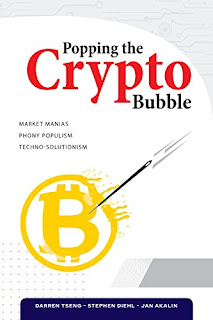
Diehl’s book, Popping the Crypto Bubble, traces Bitcoin’s emergence during the global financial crisis to the post-2016 crypto gold rush, which he refers to as the “Grifter Era”. He argues that crypto is slow (it relies on broadcasting transactions across decentralised networks) and unreliable (individuals are responsible for securing their assets; when they lose passwords or die, there is much less recourse than with, say, a bank). It cannot be both a great investment, which goes up and up, and a viable currency, which offers stable value. He argues that crypto assets’ price is based largely on there being an even greater fool who believes the hype.
“After 14 years, it is still a solution in search of a problem. It’s not building a new financial system. It’s not building a new internet. It’s not an asset uncorrelated with the market. It’s not a hedge against inflation. It is a vehicle for pure, naked speculation detached from anything in the economy. It’s a casino that’s wrapped in all of these lies. When you tear back those lies, what’s left looks like a net negative for the world.” You may not be interested in crypto, but you should be. “It reveals a lot of our dark tendencies,” Diehl says. “And it’s a mirror for a lot of the political struggle in society.” ...
UPDATE:
bought the book. An interesting read thus far. Squares with my broad
historical knowledge of pre-crypto economic bubbles and frauds, along
with my thus far relatively shallow (albeit accruing) education on this
new finance technology. UPDATE2: I'm about 80% through the book. Hugely informative and enjoyable read, highly recommended. This crypto crap has gotta be stopped. It's dangerous. UPDATE3: Finished it. Excellent.
That’s a rough approximation of the total value destruction across the cryptocurrency space from the peak seen in early November 2021 through Tuesday morning, when Bitcoin sat at a two-year low, and endorsement payments to Tom Brady from FTX were being scrutinized by Texas regulators.
Who could’ve known, just 12 months ago, that things would turn out this way for crypto? After all, the private money business sounded even more compelling this go-around than it has in the past.
I’m being sarcastic, of course. The private money business never works, and this time most assuredly wasn’t “different.”
In the wake of the FTX fiasco, much of the breathless crypto coverage emanating from the financial media (mainstream, alternative and otherwise), seems to intentionally avoid addressing the elephant in the room. If that’s the case, it’s understandable. Because to address it would be to concede that nearly everyone — from large media conglomerates to the most respected venture capitalists on the planet to storied hedge funds — was duped into believing that all it took to make the private money business viable was a single innovation.
That’s plainly absurd. For one thing, some experts offer trenchant arguments against the idea that blockchain constitutes a “technology” at all, if technology is supposed to be synonymous with true innovation. Even if it is an innovation, many skeptics argue it’s not an especially useful one. In the interest of brevity, I won’t walk through those arguments, but you can certainly do so yourself if you have Google and half an hour to spare.
Beyond that, though, the notion of private money at scale, and, more to the point, the notion of private money at scale as an investable proposition, is stupid. Not “misguided,” not “misplaced” and not any other more generous adjective either. Just plain old stupid…
"ALTRUISM," MY ASS
FTX Group corporate funds were used to purchase real-estate properties in the Bahamas, where the company had its headquarters, for employees and advisers. Reuters has reported that FTX, Bankman-Fried’s parents, and company executives bought a hundred and twenty one million dollars’ worth of real estate, mainly “luxury beachfront homes.” (FTX, Bankman-Fried, and the company executives did not respond to Reuters’ requests for comment. A spokesman for Bankman-Fried’s parents said that they had been trying to return the property to FTX before the bankruptcy proceedings. Separately, James Bromley, the FTX attorney, said on Tuesday that the company spent three hundred million dollars in the Bahamas buying homes and vacation properties for its senior staff.)
This is how Mr. Effective Altruist lived in the Bahamas. Notably absent were any rescued starving orphans from the Sudan or Syrian refugee camps.
In fairness, Mr. Bankman-Fried cannot begin to be His Most Awesomely Effective Philanthrophic Self until he achieves Trillionaire status (a notion he has mused about). Ya gotta do stuff At Scale these days. Hang in there, kiddies.
CODA
LOL. The irascible Randian contrarian take on "altruism."
Lordy, Mercy. She's also quoted as exhorting "Individualists of the world—UNITE!"
Whatever. So much fatuous incoherence, so little time... I think I need a drink.