Showing posts with label crypto. Show all posts
Showing posts with label crypto. Show all posts
Tuesday, March 10, 2026

Wednesday, December 10, 2025
Easy Money + Gilded Rage = Stealing the Future


Eyeball deep in David Z. Morris at the moment, in the wake of Messrs McKenzie & Silverman. Badasses, all of them. Individually and topically in concert.
Got onto David here: Artifice in the Age of Artificial Intelligence
Sam Bankman Fried ("SBF")? Yeah. Lordy. Been there, done that.
DAVID BEGINS:
I spent almost every weekday in October of 2023 in a courtroom in Lower Manhattan, listening to experts, lawyers, and first-hand witnesses recount the collapse of the FTX cryptocurrency exchange and prove Sam Bankman-Fried’s responsibility for it to a jury.But while this book recounts Bankman-Fried’s crimes in detail, it is ultimately focused on his ideas. Bankman-Fried, for a time known affectionately as “SBF,” was deeply tied to concepts and movements with names like Effective Altruism, determinism, utilitarianism, extinction risk, Rationalism, and longtermism.These buzzwords have been developed into increasingly formal systems by professional philosophers and ethicists at elite universities, and further amplified through a network of institutions well-funded by technology billionaires. But they stand for much deeper, much older structures of thought: a historical teleology that I here call “techno-utopianism.”The superficial optimism of Effective Altruism was fundamental to the public fascination with Bankman-Fried that helped fuel his lightning-fast ascent. But its deeper biases — to which he was perhaps uniquely vulnerable — also helped Bankman-Fried rationalize his crimes, and its superficial logics created the blind spots that led to his downfall.This book is not a work of journalism, but of forensic philosophy. It asks how techno-utopian ideas, so loudly declaring their intent to do good, instead led to one of the largest financial frauds in American history — and whether their broader sway in twenty-first-century politics and society may lead to similar results, on a much larger scale.
Morris, David. Stealing The Future: Sam Bankman-Fried, Elite Fraud, and the Cult of Techno-Utopia (pp. 8-9). (Function). Kindle Edition.

UPDATE
Sam Bankman-Fried's mother has recently submitted a 64-page appeal brief on her son's behalf:
I am a law professor at Stanford, where I have taught for close to forty years. Before that, I was a practicing lawyer in New York and clerked on the Second Circuit Court of Appeals. I am also Sam Bankman-Fried’s mother. Because of my professional life, I have witnessed the events of the past three years through two very different sets of eyes. Someday I may write about what it has been like to live through this experience as a parent. Today I write as a lawyer, about the government’s legal case against Sam and the other FTX defendants. I would have much preferred to leave this task to others. But the spectacle that has surrounded the FTX case since day one has not been conducive to serious, independent thought or attention to facts. It has also imposed a very high cost on anyone who publicly expressed doubts about whether justice has been done in this case. I hope this will change in time, and others will come forward to supplement or amend what I have written here. Most of what I say below is documented in the trial transcript and public records posted on the official court docket. I have provided cites for those who would like to follow up on their own…
Many observers see a fairly obvious Trump pardon effort ploy here. The further along I get in David's book, the more I tend to agree.
____
More broadly with respect to FinSec / crypto fraud, we must not forget our Sorkin. Andrew interviewed SBF remotely via Zoom for his "Dealbook" program in the wake of the FTX crash. David's analytic recounting of that conversation is riveting.
Also, we also ought revisit some Adam Becker.

Monday, November 24, 2025
Watched Jake Tapper interview Ben McKenzie on CNN
"Everyone is lying to you for money"

Yeah. Imagine our surprise.
I was not really hip to Ben McKenzie. My Bad. Rectifying that pronto. Almost done reading the book he co-authored with Jacob Silverman. His documentary has just been released. Gotta see it.

I've had my recurrent sport with FIRE Sector malfeasance generally and, more recently, the cryptocurrency scam. This delightful, painfully funny book validates my irascible takes on this bullshit.
 |
| @BobbyGvegas |
______
OMINOUS PORTENTS? THE 2025 CRYPTO "GENIUS ACT"

Deconstructing this POS a bit today. Fairly brief at 48 pages. 70 references to the "Secretary." 75 to "Treasury." 47 to "Comptroller." "Digital Assets," 24...
What could possibly go wrong?
More shortly. Gotta finish the book...
UPDATE
Finished the book. Excellent. Ben hipped us all to this today.


ON DECK
 |
| Click |
Stay tuned...
Friday, September 13, 2024
Truth Social down 80%? $399 Trump Sneakers not selling? $69.95 Trump Bibles not selling? $99 Trump NFTs? What'choo gonna do?
I know! Start a crypto business! Yeah, that'll work!


You can't make this stuff up. Stay tuned...

 |
| Sept 16th, 8:00 pm EDT |
UPDATE: SOME NEWS DETAIL
Former President Donald Trump plans to deliver remarks next Monday about cryptocurrency and the launch of the company World Liberty Financial, a crypto platform controlled by the Republican nominee's sons Donald Jr. and Eric.I'd seen repeated Trump posts across the past month or so on the topic. I thought "man, yoo can see this one comin' from a mile away.."
His speech will come 50 days before Election Day, an extraordinary use of dwindling campaign time to promote a personal business. The Republican former president has long mixed his political and business interests and marketed sneakers, photo books and Trump-branded Bibles during his 2024 campaign.
"We're embracing the future with crypto and leaving the slow and outdated big banks behind," Trump said in a video posted Thursday to X, the social media site that will also host his address on the subject at 8 p.m. EDT on Monday from his Mar-a-Lago home.
As part of his presidential campaign, Trump has pledged to turn the United States into the "crypto capital of the planet," raising red flags that he could use the federal government to help support a business tied to his family…


One time, he exhorted that crypto would henceforth be "made in the USA."
Yeah, I know.
I've had my blog Sport with the crypto canard multiple times.

Recall our boy Sam Bankman-Fried and his jive family? See here too. Recall also "Beauty and the beast?" Michael Lewis, anyone?
FROM TECH TIMES
The widely-hyped crypto platform of the Trump family is planned for a launch next week. World Liberty Financial is only one of the multiple crypto businesses that they position as the "future" of America, with ludicrous promises once he is in office.
It will be led by his sons, Donald Trump Jr. and Eric Trump, but much remains unknown about the new crypto platform from his lineage…
This oughta be swell. Like his other tacky stuff.


UPDATE:
WORLD LIBERTY FINANCIAL TOP EXECS POSE FOR A PHOTO

UPDATE, FROM CRYPTO NEWSZ
Chase Herro’s involvement in the [Trump WLFi] project raises significant concerns due to his questionable business history. Herro has been linked to selling dubious products like marijuana, colon cleanses, and various get-rich-quick schemes. He also operated “mastermind” groups, which charged hefty membership fees in exchange for vague networking and business strategies.
Additionally, Herro has a background as a pick-up artist under the alias “Zack Bauer.” He co-founded Date Hotter Girls, a platform that offered seminars teaching men how to “become the ultimate alpha male.” This venture, like most of his others, looks opportunistic and exploitative. In the cryptocurrency space, Herro has been involved in failed ventures like Pacer Capital, a trading firm that no longer exists, and Subify, a content platform marketed as an alternative to mainstream services like Patreon. These past activities have raised concerns about his role in the Trump family’s latest crypto endeavor.
Although, the vision of World Liberty Financial is appealing and addresses real needs in the decentralized finance space. However, the timing of this project appears suspicious, especially considering the involvement of the Trump family and Chase Herro, both of whom have reputations for questionable business ethics. Their history adds an air of skepticism to what could otherwise be a promising project…
OFF-TOPIC ERRATUM

My friends in Las Vegas have a live streaming show this week. Best band in the nation. Thia will be off the chain.

OTHER TRUMP ERRATA


_________
Thursday, November 2, 2023
Sam Bankman-Fried, guilty on all 7 felony counts
That (surprisingly?) took just a mere few hours (~5). Next? Remanded to remain in MCC pending sentencing (in March 2024)? Hey, I know! We'll let your jive ass out on bail to go do some on-the-ground Effective Altruism interim humanitarian work in Gaza. The Bayesian Priors are maxed-out up front (in myriad 30-ft deep bomb craters), the Expected Value dwarfs any of the speculative virtue-signaling bullshit you, your brother, your Dad, and Mother spewed ad nauseum).
CODA
Enough of this guy. Save one final worthy citation.

Over the course of the trial, the jurors were largely spared an extended discussion of the doctrines of effective altruism, although Ellison did mention at one point that Bankman-Fried’s pure utilitarianism left him unbothered by the ethical strictures—don’t lie, don’t steal—with which ordinary people are saddled. For what it’s worth, most effective altruists express a belief in utilitarianism “with side constraints”—that is, their aspirations to do the greatest good for the greatest number tend to be leavened with the normie morality of at least the major Commandments, if not all ten. Effective altruism was, however, present in style if not in substance. Even the most winning E.A.s—a group that includes Nishad Singh, someone I personally liked very much when I interviewed him eighteen months ago—are the most pedantic people alive. They believe they speak the mathematically precise language of the knowable universe. When Singh took the stand and banged on about things like auto-deleveraging events and liquidity backstop providers, the judge, his patience with E.A. specificity wearing thin, cut him off: “You stick to answering the questions that are asked, O.K.?”
Monday, October 30, 2023
"Mistakes Were Made"
SBF on the SDNY witness stand testifying in his own defense in his FTX fraud trial.

"The biggest mistake was we did not have a dedicated risk management team, we didn't have a chief risk officer. We had a number of people who were involved to some extent in managing risk, but no one dedicated to it, and there were significant oversights."Right. Understatement of the century thus far.
I know a thing or two about financial risk management—back in the days of actual money. From my 2008 post Tranche Warfare:
"THE BEST THINGS IN LIFE ARE 'FEE'"
That was the oft-repeated sarcastic and cynical joke in executive circles at the privately held subprime VISA/MC issuer where I worked in risk management. My own initial supervisor, the hastily installed VP of Risk who'd been brought over from Collections, would candidly say in private that according our customers credit was like giving whiskey to alcoholics.
But, hey, it's legal. And, if we don't do it, someone else will.
"Churn & Burn"
I was hired initially in March of 2000 as a temp tech writer brought in to compose documentation for a pending OCC examination, and subsequently offered a permanent position as a "risk analyst" once they learned of my applied stats background and SAS programming fluency. When I arrived the operation was classic subprime "churn & burn," bordering on the "predatory" (some would say they'd crossed far over that border). Huge upfront and ongoing transaction fees charged to the financially desperate made it nearly impossible to lose money, heavy charge-off losses notwithstanding. Burn 'em up and churn new accounts.
At the outset of my tenure, the "Risk Department" was one effectively in name only, consisting of two holdovers of the prior risk manager's pro forma regime, one a quite saavy statistician, the other an econometrician -- both of whom had their eyes on the door.
There wasn't much "risk" to manage beyond those posed by nagging class-action litigation and pending consent decrees that were a familiar feature of the subprime domain (and cynically viewed simply as a manageable cost of doing business).
The new VP of Risk, though, set about to build an effective, "best practices" risk department, one eventually staffed by a platoon of astute MBAs and statisticians recruited from far and wide, one whose subprime credit risk modeling and portfolio management and operations analytics became the envy of the sector. The bank's portfolio and profits grew steadily and impressively, and charge-off losses declined impressively. We sailed through our regulatory examinations. The OCC eventually characterized us as "Best-in-Class" [pdf]. While most other subprime players crashed and burned during this period (including the largest issuers such as Providian and NextCard), our little bank had moved away from the reckless and predatory and into "near-prime" marketing territory...
We made successive record profits every year of the five I was there (my annual bonuses were very nice). We had financial risk by the throat. Market risk; interest rate risk; regulatory risk; reputation risk; operations risk; portfolio risk—all involving actual money rather than digital casino zero-sum table games tokens.
"The biggest mistake was we did not have a dedicated risk management team..."Yeah, bro. In your own too-little-too-late post-crash words, "I fucked up."
See my prior posts on this sorry SBF-FTX Custerfluck.
BTW: Tangentially off-topic, but still, related to finance. I guess (online sports gaming).
HALLOWEEN DAY UPDATE
I've been following a number of these YouTube crypto podcasts lately. This young woman, Carly Reilly, is interesting. I have no idea as yet as to what her Sheet is.
What an old coot I am. Below, Michael Lewis at the SBF trial.
UPDATE: OF FAR MORE IMPORTANCE

The IDF bombed a northern Gaza refugee neighborhood on October 31st, killing and wounding an as-yet unknown number of Palestinian civilians. Israel claims the target was a senior Hamas commander and his subordinates. The entire apartment neighborhood was reduced to large rubble-strewn craters by a reported six large aircraft-dropped bombs.
 |
| Click image. |
"...No third party is going to step into Gaza to fight the insurgency planned for Israeli troops, rebuild the infrastructure and society shattered by war, and solve the long-standing problem of governance that Hamas’s armed presence has ensured will endure. Israel is on its own, and so it must find an alternative both to leaving Gaza quickly, thereby allowing Hamas to reemerge, at least as a political entity, and to staying and battling the inevitable insurgency.OH, AND, BY THE WAY
Whatever Israel decides to do now that its ground attack in Gaza is under way, it needs to understand that no deus ex machina will swoop in and save it from the accumulated consequences of its actions since 1967. When the smoke clears, yet again, Israel and the Palestinians—and not anyone else—will be left to cope with their self-inflicted disasters."

More to come...
__________Tuesday, October 24, 2023
Creative Commons Cross-Post: Sam Bankman-Fried update

A year ago, Sam Bankman-Fried (often called “SBF”) was on top of the world. He had been on the covers of Forbes, which dubbed him “the richest twentysomething in the world”, and Fortune – the equivalent, for a business leader, of a rock star on Rolling Stone, or an athlete on Sports Illustrated.
He was featured in the prestigious “lunch with the FT” in the Financial Times. He was seen as the responsible face of cryptocurrency. There was even speculation he could become the first trillionaire.
But in late 2022, his FTX crypto trading operation – and the closely related Alameda Research, an investment fund he had founded before FTX – both collapsed.
Bankman-Fried is currently charged with crimes relating to the disappearance of billions of dollars of FTX users’ money. These people did not think they were investing in FTX, or even lending to it. Their funds were just being kept there while they switched between, for example, dollars and bitcoins or between bitcoins and dogecoins. But instead it is claimed that their funds were transferred to Alameda and then lost.
Bankman-Fried is pleading not guilty and has published a statement reading: “I didn’t steal funds, and I certainly didn’t stash billions away.”
Review: Going Infinite: The Rise and Fall of a New Tycoon – Michael Lewis (Allen Lane)
Bankman-Fried, who was living in the Bahamas at the time of his arrest, now resides in a US prison. He is facing charges that could result in a sentence of more than a century behind bars and has been taunted as “Scam Bankrupt-Fraud”.
His remarkable story has been told by Michael Lewis, the author of Liar’s Poker, a Wall Street story drawing on his own experience as a bond salesman for Salomon Brothers; and the internationally successful book-then-film The Big Short, an account of the financial market shenanigans that led to the global financial crisis of 2007-09.
Lewis, who had extraordinary access to Bankman-Fried while writing, holds the unusual combination of degrees in art history from Princeton and economics from the London School of Economics. As a former bond salesman, he knows his way around financial markets and has seen his share of excess and oversized egos. As a journalist, he is skilled at clear writing about complex finance. He was ideally placed to write this book.
However, he has been widely criticised as too close to his subject. When Bankman-Fried was arrested, Lewis had been shadowing him for nearly a year. And as events unfolded – and even while Bankman-Fried was under house arrest – Lewis was there, taking notes.
Lewis describes himself as having been “totally sold” after his first meeting with Bankman-Fried. And he has called his book “a letter to the jury”. But he rejects criticism of his objectivity as “crazy”.
Effective altruism and ‘infinite dollars’
Going Infinite derives its title from a question Lewis asked his subject: how much would he need to be paid to sell and walk away from FTX? Bankman-Fried initially replied: $150 billion. He then added he needed “infinite dollars” because he planned to address existential risks facing humanity.

This rather grandiose response was based on a concept called “effective altruism”, inspired by a 1971 essay by Australian philosopher Peter Singer.
Lewis’s example is that instead of becoming a doctor in Africa and helping some people, you can make a fortune and then pay for 40 doctors and help 40 times as many people.
Bankman-Fried claimed his motivation for FTX was to fund effective altruism. Some of his senior executives claimed to share this motivation.
Bankman-Fried felt Donald Trump was an impediment to actions that would make the world a better place. He donated to anti-Trump Republicans and to Democrats. One revelation in the book is that Bankman-Fried contemplated paying Trump not to run again for president. The figure mentioned was US$5 billion, but it is not clear whether this number came from Trump himself.
The odd life of Sam Bankman-Fried
Bankman-Fried’s parents are both Stanford professors. But there is no obvious factor in his childhood that explains his eccentricities, or why he seemed to have few friends.
Lewis writes that Bankman-Fried had to teach himself facial expressions, and that Bankman-Fried thought he had “an aching hole in my brain where happiness should be”. He skates over Bankman-Fried’s years as a high school nerd, where the place he most felt a kind of belonging was math camp, and as a MIT physics student. And he concludes that the future crypto king was perfectly positioned, emotionally and intellectually, to make a religion of himself.
One of the most interesting parts of the book is the account of Bankman-Fried’s early career at Jane Street Capital, a Wall Street high-frequency trading firm, where interns were encouraged to gamble with each other and with the full-time employees as a way of developing their professional skills. There, Bankman-Fried’s intuition about probability shone.
The “SBF” who emerges from the book has some similarities with the portrait of Elon Musk in the eponymous just-published biography by Walter Isaacson. Both men are convinced they are the smartest guy in any room they are in. And both have the hubris to think the future of humanity depends on them.
Bankman-Fried reportedly said there was a 5% chance he could become US president. The US constitution meant this was one takeover to which the South Africa-born Musk could not aspire.
Isaacson relates a half-hour telephone discussion between Bankman-Fried and Musk about the latter’s takeover bid for Twitter. After consulting colleagues for 15 minutes, with Lewis present, Bankman-Fried was considering contributing “maybe a billion” as part of a consortium being assembled by Musk. But the discussion did not go well. Both apparently thought the other was crazy.
FTX was ‘essentially a casino’
So-called “cryptocurrencies”, like Bitcoin, are rarely used for their original stated purpose of making payments. They are really just speculative tokens with no fundamental value.
FTX promoted itself as the equivalent of a stock exchange for these cryptocurrencies.
Lewis writes:
The new crypto exchanges had no regulators. They acted as both exchange and custodian: they didn’t just enable you to buy bitcoin but also housed the bitcoin you’d bought.
FTX was no usual business operation. It was barely a business at all. FTX had no chief financial officer, nor even a list of its staff. It had a sort of board of directors, just for appearances. Bankman-Fried was one director, but in a conversation with Lewis, he could not recall the other two. As Lewis puts it, he “just thought grown-ups were pointless”.
Most of the senior staff at FTX and Alameda were friends of Bankman-Fried (although many have since turned on him, whether from a belated sense of shame or to try to wrangle shorter prison sentences). They lived and worked in a luxury compound in the Bahamas, a sunny place for shady people (as Somerset Maugham once described Monaco).
Apart from the luxury accommodation, there were other extravagances, such as food and chartered planes. Clothes were not one of them. Until his recent court appearances, Bankman-Fried was rarely seen in anything but a t-shirt and shorts - no matter the occasion.
One of his senior employees, Zane Tackett, told Lewis:
His oddness mixed with just how smart he was allowed you to wave away a lot of the concerns. The question of why just goes away.
FTX was essentially a casino. But Bankman-Fried both owned the casino and was gambling in it – apparently with other people’s chips. Alameda Research seemed to be making large bets with money transferred from the accounts of FTX customers.
While Alameda operated in the shadows, huge amounts were spent promoting FTX.
FTX spent tens of millions making an expensive advertisment featuring Larry David comparing crypto to the wheel, democracy and the moon landing. (It has already been screened at the trial.) At least, unlike Katy Perry, Larry can claim that in the advert he was sceptical!
After FTX collapsed, John Ray, the bankruptcy expert tasked with sorting out the mess, remarked: “Never in my career have I seen such a complete failure of corporate controls and such a complete absence of trustworthy financial information.” And he had handled Enron!
Accused of having stolen billions
Somewhere between US$5 billion and US$10 billion of customers’ money from FTX seems to have disappeared. Lewis writes that it may have been lost in losing bets by Alameda. Lewis estimates that Bankman-Fried made over 300 separate investments - one every three days. There were certainly some poor investments, such as 101 Bored Ape NFTs, bought for US$24 million. These have lost about 90% of their value.
Bankman-Fried has been accused of having stolen “billions from thousands of people”. His lawyers responded that he is being painted as a “cartoon villian”. A lot will depend on whether the jury regards him as a calculating liar or an idiot savant “math nerd”, hopelessly out of his depth as a manager.
Another interesting aspect yet to emerge is how the top Wall Street and Silicon Valley investors explain their naivety in trusting Bankman-Fried. How do you explain what the Financial Times called the “legend of Sam”?
Michael Lewis has written ‘a letter to the jury’
Lewis seems inclined towards the view Bankman-Fried may not have been deliberately fraudulent. He has spoken of a “mob mentality” and a “very quick rush to judgement”.
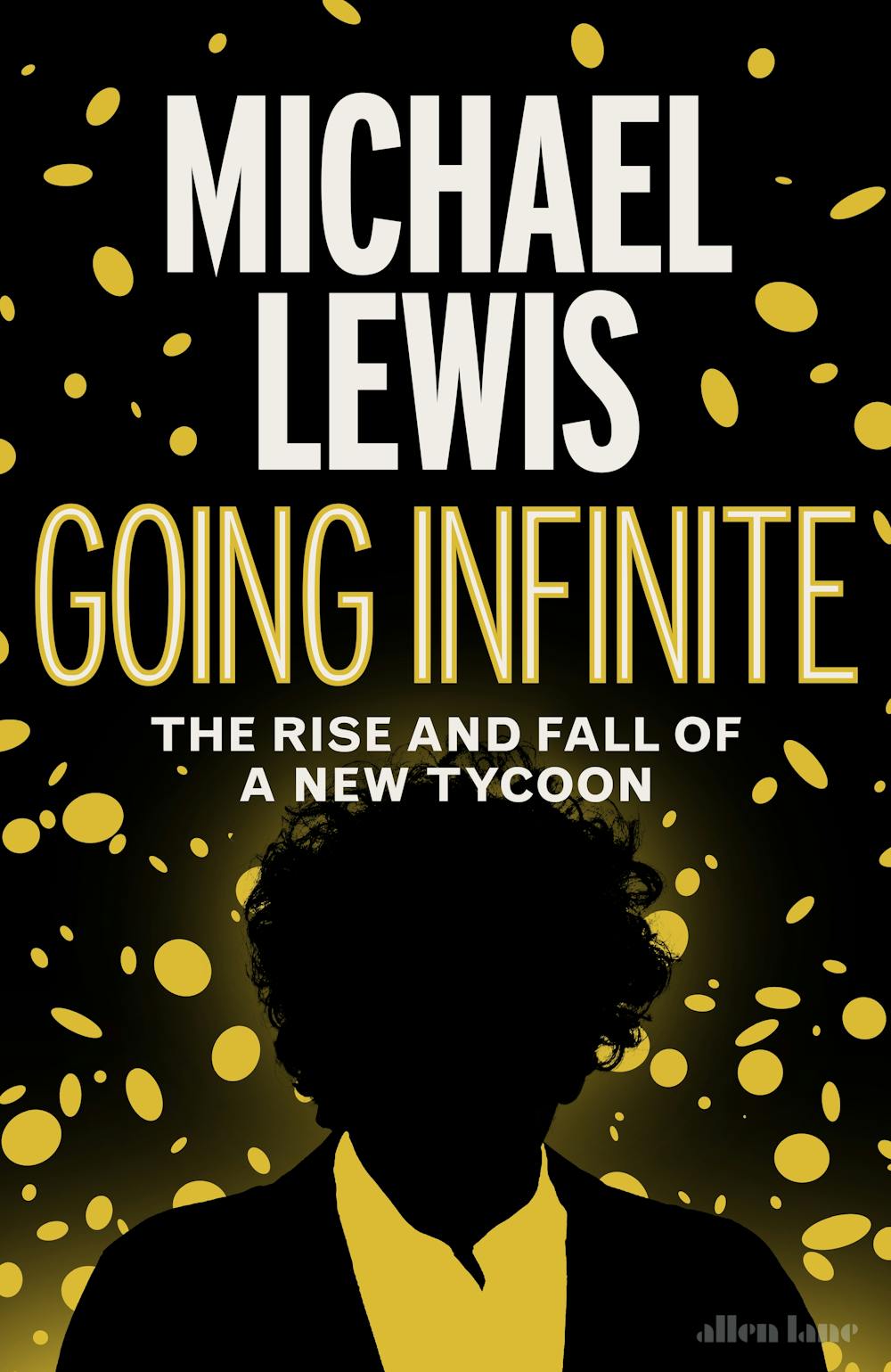
Biographers seem to sometimes experience a literary equivalent of the now much-debated “Stockholm syndrome”. If they are embedded with their subject, they may come to share their world view.
Another recent book that profiles Bankman-Fried, Number Go Up by Zeke Faux, paints a similar picture in many ways – but is more sceptical about his motivations.
Faux makes the telling point that many of the punters lured in by the advertisements for FTX lost money they could not afford to lose. This is hardly the act of an altruist. Faux described Lewis as asking his subject questions “so fawning, they seemed inappropriate for a journalist” at an FTX-sponsored conference.
Like Lewis’s other books on financial shenanigans, Going Infinite does a good job of explaining complex financial concepts. And it is an entertaining read about an unusual and intriguing personality. But it does seem like it was rushed out to coincide with the trial. There is no index, for example. It will need a second edition once the current court case is resolved.
John Hawkins, Senior Lecturer, Canberra School of Politics, Economics and Society, University of Canberra
___________
This article is republished from The Conversation under a Creative Commons license. Read the original article.
__________
SOME PRIOR POSTS OF MINE ON THIS SORRY TOPIC
SOME READINGS


And, there's more...
__________Friday, October 6, 2023
CoffeeZilla is NOT happy with Michael Lewis
Beware of Geeks bearing Tokens
Ouch. Well, he didn't like the book. I did (following an extremely careful, slow read). I totally loves me some CoffeeZilla, but I think he's cherry-picking Michael, 'cuz it's now canonical that we gotta be presumptively hatin' on SBF. I have a bit of the same pick with Gideon Lewis-Kraus in The New Yorker.
And, no one can accuse me of being a Sam Bankman-Fried apologist suck-up. See my prior, heavily-linked post.

 |
| New York Times |
"Mr. Lewis normally avoids writing books about figures who are already world-famous. In this case, the character he thought was likable and relatively fringe — Mr. Lewis had barely heard of Mr. Bankman-Fried before their hike — has become a world-renowned pariah, a stand-in for an entire industry’s technical and moral failings."Good article.
"In the book, Mr. Lewis is careful not to weigh in on whether Mr. Bankman-Fried committed the crimes he’s charged with. “I leave it to the reader,” he said. “The radical thing here is to withhold judgment.”

My summary $0.02 on crypto (irrespective of Sam):


Reading this book now. Excellent. Stay tuned…
UPDATE: JEN TAUB INTERVIEWS MICHAEL LEWIS
[NOTE: Jen (author of the fabulous Big Dirty Money) will interview Zeke Faux shortly.]
ONE EXCERPT FROM MICHAEL'S BOOK (NEAR THE END) WILL SUFFICE
“I asked Sam: ‘When you were doing this, have you ever thought how much this event will be hurting people, and does that count as part of your initial expected value calculation?’”MY AMAZON BOOK REVIEW
… [and] a different question. It preoccupied me from the moment of the collapse: Where had the money gone? It was not obvious what had happened to it. And it would be hard to understand why the effective altruists had done whatever they’d done with their customers’ money without knowing how much of it they had lost and how they had lost it. In the days after the collapse, I created what might have been the world’s crudest financial statement. It treated FTX and Alameda Research as a single entity: Sam’s World. One column listed all the money that had entered Sam’s World since its inception, in April 2019; a second column listed all the money that had exited Sam’s World. Both ignored the year and a half of Alameda’s existence before the creation of FTX, as the numbers involved were relatively small. All the numbers were obviously very rough estimates. Some came from Sam, but all were confirmed by former insiders who had no reason to lie to me. At any rate, when I was done, my extremely naive money-in, money-out statement looked like this:MONEY IN:Obviously, this wasn’t the way Ernst & Young would have drawn it up—though these lists I made for myself didn’t look much different than Sam and Caroline’s various attempts to summarize their affairs. In the previous three and a half years, nearly $9 billion more had entered Sam’s World than had exited it. When FTX stopped returning funds to customers, on Tuesday, November 8, it still had $3 billion on hand. That dropped the missing sum to $6 billion. (The roughly $450 million stolen in the hack three days later is irrelevant to this calculation.)
Net customer deposits: $15 billion
Investments from venture capitalists: $2.3 billion
Alameda trading profits: $2.5 billion
FTX exchange revenues: $2 billion
Net outstanding loans from crypto lenders (mainly Genesis and BlockFi): $1.5 billion
Original sale of FTT: $35 million
Total: $23,335,000,000
MONEY OUT:
Returned to customers during the November run: $5 billion
Amount paid out to CZ: $1.4 billion (Just the hard cash part of the payment. I’m ignoring the $500 million worth of FTT Sam also paid him, as Sam minted those for free. I’m also ignoring the $80 million worth of BNB tokens that CZ had used to pay for his original stake, worth $400 million at the time Sam returned them as part of his buyout of CZ’s interest.)
Sam’s private investments: $4.4 billion (The whole portfolio was $4.7 billion, but at least one investment, valued at $300 million, Sam had paid for with shares in FTX. He likely did the same with others, and so this number is likely bigger than it actually was.)
Loans to Sam: $1 billion (Used for political and EA donations. After his lawyers explained to him that taking out loans was smarter than paying himself a stock dividend, as he’d need to pay tax on the dividends.)
Loans to Nishad for same: $543 million
Endorsement deals: $500 million (This is likely generous too, as in some cases—Tom Brady was one of them—FTX paid its endorsers with FTX stock and not dollars.)
Buying and burning their exchange token, FTT: $600 million
Corporate expenses (salaries, lunch, Bahamas real estate): $1 billion
Total: $14,443,000,000
There were some likely explanations for the missing money. The more you thought about them, however, the less persuasive they became. For example, Alameda traders might have gambled away $6 billion. But if they had, why did they all believe themselves to be so profitable, right to the end? I’d spoken to a bunch of them. Several were former Jane Streeters. They weren’t stupid. They’d all been chirpy and upbeat and even a bit boastful about how much more money Alameda made per trader than Jane Street. Alameda may have lost a lot of money trading, but how those losses occurred was not easy to see. The most hand-wavy story just then being bandied about was that the collapse in crypto prices somehow sucked all the money out of Sam’s World. And it was true that Sam’s massive holdings of Solana and FTT—and other tokens of even more dubious value—had crashed. They’d gone from being theoretically worth $100 billion at the end of 2021 to being worth practically zero in November 2022. But Sam had paid next to nothing for these tokens; they had always been more like found money than an investment he’d forked over actual dollars to acquire. He’d minted FTT himself, for free. For his entire haul of Solana tokens, he’d paid no more than $100 million. His fleece cloud fortune had evaporated, but that didn’t explain where all those hard dollars had gone.
Lewis, Michael. Going Infinite: The Rise and Fall of a New Tycoon (pp. 223-226). W. W. Norton & Company. Kindle Edition.
5.0 out of 5 stars
There's a REASON I've bought and read all of Michael Lewis' books
Reviewed in the United States on October 5, 2023
Verified Purchase
I just finished. A great job. Thank you Michael. I've been following this debacle closely for a long time (I used to work in financial risk management). Everything in this book squares closely. And, there was much I could not have known but for Michael's penetrating interactions with Sam and his cohort. The entire "Effective Altruism" is preposterous on its face, as is the absurd "cryptocurrency" fallacy (it's simply "gambling"). I will leave it to the legal system to determine Sam Bankman-Fried's criminal culpability. At a minimum I regard him and his crew as having indulged in egregious, ruinous global recklessness. I also note that the FTX bankruptcy CEO brought in to deal with the mess, John Ray, does not come off looking very well here—and I seriously doubt Michael Lewis would go anywhere near defamation. Ray's cynical bias is rather disturbing. It will not help matters going forward.
I agree with another reviewer about the obvious 1-star negative "review" trolling. I would broadly favor all reviews be limited to "verified purchasers" and legit "advance comp copy" reviews. This is hardly the first time I've seen partisan disinfo "reviews" on Amazon where topics are controversial.
_____
OK it's Saturday morning, Oct 7th. Woke up to news that Hamas has launched a full-scale surprise land-sea-air attack on Israel. Netanyahu's government was caught napping. The FTX debacle can wait.


Below, the taller kid standing in front of the tank. Israeli Defense Force (IDF) Tank Commander, then-19 yr old Dov Gropper, son of my NJ high school garage band sax player Mike Gropper. (Dr.) Mike is now a noted Israeli clinical psychologist. This photo was taken several dozen miles miles inside Lebanon during the 2006 IDF incursion fighting Hezbollah. I despair that there will ever be a durable peaceful solution over there.

UPDATE

Sunday morning headline: Sadly, this is where our U.S. "conservatives" are at amid this catastrophe.


Subscribe to:
Posts (Atom)