Showing posts with label bitcoin. Show all posts
Showing posts with label bitcoin. Show all posts
Tuesday, March 10, 2026

Friday, September 13, 2024
Truth Social down 80%? $399 Trump Sneakers not selling? $69.95 Trump Bibles not selling? $99 Trump NFTs? What'choo gonna do?
I know! Start a crypto business! Yeah, that'll work!


You can't make this stuff up. Stay tuned...

 |
| Sept 16th, 8:00 pm EDT |
UPDATE: SOME NEWS DETAIL
Former President Donald Trump plans to deliver remarks next Monday about cryptocurrency and the launch of the company World Liberty Financial, a crypto platform controlled by the Republican nominee's sons Donald Jr. and Eric.I'd seen repeated Trump posts across the past month or so on the topic. I thought "man, yoo can see this one comin' from a mile away.."
His speech will come 50 days before Election Day, an extraordinary use of dwindling campaign time to promote a personal business. The Republican former president has long mixed his political and business interests and marketed sneakers, photo books and Trump-branded Bibles during his 2024 campaign.
"We're embracing the future with crypto and leaving the slow and outdated big banks behind," Trump said in a video posted Thursday to X, the social media site that will also host his address on the subject at 8 p.m. EDT on Monday from his Mar-a-Lago home.
As part of his presidential campaign, Trump has pledged to turn the United States into the "crypto capital of the planet," raising red flags that he could use the federal government to help support a business tied to his family…


One time, he exhorted that crypto would henceforth be "made in the USA."
Yeah, I know.
I've had my blog Sport with the crypto canard multiple times.

Recall our boy Sam Bankman-Fried and his jive family? See here too. Recall also "Beauty and the beast?" Michael Lewis, anyone?
FROM TECH TIMES
The widely-hyped crypto platform of the Trump family is planned for a launch next week. World Liberty Financial is only one of the multiple crypto businesses that they position as the "future" of America, with ludicrous promises once he is in office.
It will be led by his sons, Donald Trump Jr. and Eric Trump, but much remains unknown about the new crypto platform from his lineage…
This oughta be swell. Like his other tacky stuff.


UPDATE:
WORLD LIBERTY FINANCIAL TOP EXECS POSE FOR A PHOTO

UPDATE, FROM CRYPTO NEWSZ
Chase Herro’s involvement in the [Trump WLFi] project raises significant concerns due to his questionable business history. Herro has been linked to selling dubious products like marijuana, colon cleanses, and various get-rich-quick schemes. He also operated “mastermind” groups, which charged hefty membership fees in exchange for vague networking and business strategies.
Additionally, Herro has a background as a pick-up artist under the alias “Zack Bauer.” He co-founded Date Hotter Girls, a platform that offered seminars teaching men how to “become the ultimate alpha male.” This venture, like most of his others, looks opportunistic and exploitative. In the cryptocurrency space, Herro has been involved in failed ventures like Pacer Capital, a trading firm that no longer exists, and Subify, a content platform marketed as an alternative to mainstream services like Patreon. These past activities have raised concerns about his role in the Trump family’s latest crypto endeavor.
Although, the vision of World Liberty Financial is appealing and addresses real needs in the decentralized finance space. However, the timing of this project appears suspicious, especially considering the involvement of the Trump family and Chase Herro, both of whom have reputations for questionable business ethics. Their history adds an air of skepticism to what could otherwise be a promising project…
OFF-TOPIC ERRATUM

My friends in Las Vegas have a live streaming show this week. Best band in the nation. Thia will be off the chain.

OTHER TRUMP ERRATA


_________
Friday, January 20, 2023
The State of The Stupid.
A bit of Photoshop irascibility.

The rampant, reason-resistant incoherence is starting to get to me as I slink through Dry January and ponder the latest "federal debt default" canard.
The debt ceiling / federal shutdown / default threat dance is of course a recurrent, transiently annoying political brinksmanship shuffle. This time, however, the congressional GOP is overpopulated with nihilist firebrands who might just Go There. The upshot remains largely unknowable at this point—though it's unlikely to be good. From NPR’s Ron Elving:
How could this year's fight over the debt ceiling be different?
For now, the White House and the leaders of both parties in Congress continue to vow they will avoid default. But Republican leaders are saying they won't raise the limit until the White House and Democrats agree to negotiate deep cuts in the federal budget and substantial changes to the spending process. How deep? How substantial? Those would be among the questions to be answered.
But this is not a drill, and it is not just another repetition of a periodic exercise. For a variety of reasons, 2023 could be the year the dealmakers fail and we face the consequences long feared. There are pivotal figures within the Congress who seem to be working toward just this outcome as a policy goal…
Ugh.
Nascent "Crypto Ice Age" in the wake of FTX et al, my ASS! You just watch—these DigiFi hucksters will be exuberantly pitching scams aromatic of my foregoing deliberately absurd Photoshop spoof in no time.
Bet on it.

BTW, where's Gabe?
UPDATE
"Debt Crisis" Solution?
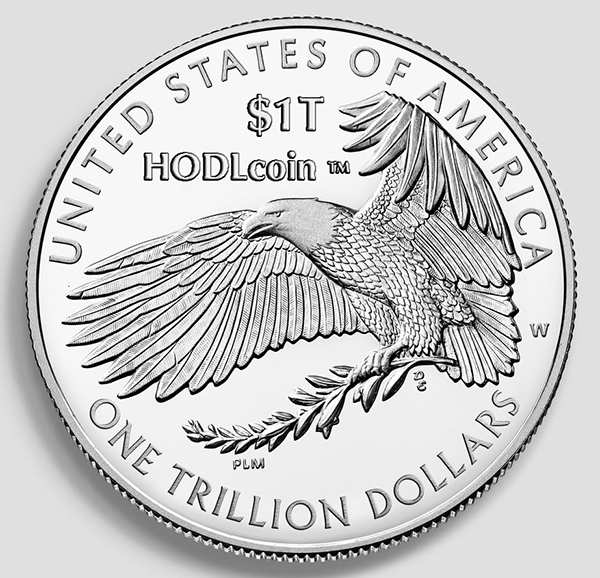
Why the legal scholar Rohan Grey thinks the U.S. Mint can defuse the debt-ceiling standoffBy Annie Lowrey
Later this year, for no good reason at all, the United States might enter a chaotic period of financial default. Once again, the country has hit its statutory debt limit, because Congress continues to spend more than the government receives in tax revenue. The Treasury has no more legal authority to issue new debt and is currently using a series of “extraordinary measures” to keep the government’s bills paid. Those extraordinary measures will last for only six months or so. At that point, either Congress will raise the debt ceiling or the full faith and credit of the country will be at risk.
Rohan Grey is a law professor at Willamette University, in Oregon, and a leading promoter of an arcane idea that could save the country from all that drama: The Biden administration could exercise its unilateral legal authority over U.S. currency to mint a trillion-dollar platinum coin and use it to pay the government’s bills…
The power to create money in the Constitution is literally the power to coin money…
Good article. Read all of it, including the linked citations. I smells me some tangential Modern Monetary Theory (MMT) riffs here...
@HODLcoin™ baby! LOL.
__________
Monday, November 28, 2022
"Effective Altruism" update: Sam Bankman-Fried's family affair.
Younger brother Gabe's $3.3 million DC "charity" digs.
sbf


Gabe Bankman-Fried—younger brother of the disgraced FTX founder, Sam Bankman-Fried—purchased a $3.289 million Capitol Hill townhouse in April. The deal was made through Gabe's nonprofit, Guarding Against Pandemics. The organization, aimed at preventing another pandemic, was partly funded by SBF. The move to the US capital was meant to send the message that the FTX founder "and his network were in DC to stay," according to a report from Puck.Yeah. Of course.
Just one week before FTX's collapse, Guarding Against Pandemics hosted back-to-back cocktail parties for high-ranking Democrats and Republicans, the New York Post reported.
The four-story townhouse comes with four bedrooms, four-and-a-half bathrooms, two private terraces, and an elevator, according to a listing for the property from real estate company Bright MLS…


OK, nothing on their website regarding Board of Directors or staff. A Guidestar.org search turns up nothing at all (you look there for things such as the annual IRS Form 990 non-profit information returns that set forth revenue, expenses, salaries of Principals, compensation of outside entities, etc). I rather doubt we'll readily find any legit incorporating documentation here. Across my life, I've founded and administered three for-profit corporations (two Sub-S and a C-Corp), as well as a 501(c)(3) non-profit charity, and 501(c)(6) "professional organization" non-profit (all on my own without lawyers). I know what to look for and where it should be found.
This is a "PAC" (Political Action Committee), not a 501(c)(3) public service "charity." Imagine our surprise.
Yep. A bit of additional skulking turns up this:

"Housed" in a "WeWork"-ish "virtual office."

See their "Federal Champions" page.
It'd be nice if actual professional investigative reporters (and regulatory authorities) would peek into this. Ya think?
UPDATE: Search of the Arizona Secretary of State's business & charities database comes up empty. Unsurprisingly. Be interesting to know the jurisdiction of registration.
MORE


No corporate SoS listing in California either. A search of the IRS site fails to find their 501(c)(4) EIN and related information.
So, Gabe's PAC got a $12,157,585 "donation" from his brother's "Alameda Research." Nothing fishy there...
Sent an email. Quixotic, yeah, I know.
COOL NEW STUFF
 |
| Click |

Crypto Lender BlockFi Files for Bankruptcy as FTX Fallout SpreadsHeads be rollin'...
BlockFi was entangled with FTX, and its stability was thrust into uncertainty after FTX collapsed.
ERRATA
- There are reportedly 180 "fiat" currencies around this world (~1 per nation).
- As of a couple of weeks ago, there were 22,000 cryptocurrencies.
Draw your own conclusions.
UPDATES

Everyone's now running for cover.
FURTHER RECOMMENDED READING FROM MY STASH

MORE
__________ #cryptNOcurrency
Tuesday, November 22, 2022
"Effective Altruism?" The FTX / Alameda multi-billion dollar cyrpto fraud story worsens.
"Effective Altruism," as widely espoused these days in neoliberal / libertarian ECON circles, is a self-serving perversion of the utilitarian moral philosophy that first gained global traction via the works of Australian activist academic Peter Singer.
The original elevator speech went something like this: "in a world where needs will inexorably exceed available resources, we have a moral imperative to direct our charitable resources to the "highest & best" / "most effective" use.
Bang for the buck, essentially.
The roughly 10 Grand I've plowed into my veterinary frequent-flier Ranger, my 2018 California 90 lb Chocolate Lab mix stray rescue, is ostensibly "morally" wanting in such regard, given the massive intractable human miseries around the globe.
Whatever. Ranger stays. As do our monthly contributions to the MD Food Bank and a number of other worthy causes. I have no need of self-appointed moral critics evaluating the extent and "effectiveness" of my relative beneficence.

In light of my Master's in applied ethics ("Ethics & Policy Studies"), I found it intriguing, and thought I ought give EA a close, charitable read. Alluring in gauzy, vague principle, nonetheless it raised more questions than answers.
“EFFECTIVE ALTRUISM" CIRCA 2022
Nowadays it's fashionable in rapacious digerati circles to wield "effective altruism" as impenetrable Virtue Signaling armor—akin in a way to "Prosperity Gospel."
"Think about how much good you could do if you were a young, adroit, fearless crypto billionaire."
Which brings us back around tot this shitstorm.
More to come. This kid's parents are both Stanford Law professors (Joseph & Barbara). The 28 yr old Caroline Ellison he chose to be CEO of his wholly-owned Alameda Research (uh, hel-LO?) is the daughter of two vaunted MIT Economics professors (Glenn & Sara).
Prestige institutions, the Best-and-Brightest offspring. Depressing.
For now, read this.
 |
| click |
A response at Naked Capitalism. Well worth your time.
MORE NEWS
Key Institutional Crypto Player, Genesis, on Verge of Failure; Possibility of “Apocalyptic” Bitcoin Liquidation
Posted on November 23, 2022 by Yves Smith
…The unwind of FTX is certain to dominate business press, pundit, and politician attention due to how its uber connected and very recently idolized top brass have been revealed as drug-addled business incompetents who neverless seem to have done a very good job at disappearing a lot of the moolah, presumable for their personal use. The level of media noise and coming prosecutions (both the Southern District of New York and Bahama are reportedly ginning up filing) and the failure of supposedly sophisticated player to find anything amiss will presumably chill interest in crypto, particularly if other firms fall over due to FTX contagion…
FROM THE NEW YORKER
Sam Bankman-Fried and the Long Road to Taking Crypto MainstreamAT THE ATLANTIC
The disgraced founder of FTX played on the vanities of the establishment, reassuring V.C. firms and the media that smart-guy insiders like him could save the world.
In the beginning, there was Satoshi Nakamoto, the pseudonymous programmer who created Bitcoin and promised an entire new way of thinking about money—and, by extension, power and politics. But, after it became clear that Nakamoto wasn’t going to appear on some mount and pass his tablets down to the masses, the cryptocurrency world began to yearn for a proper evangelist. The people who have tried to fill that role have mostly been self-appointed, such as Roger Ver, the loud and impassioned former C.E.O. of Bitcoin.com, and the man behind Bitcoin Cash; Vitalik Buterin, the enigmatic and perpetually bemused creator of Ethereum; and the Winklevoss twins, the Facebook-involved duo immortalized in the film “The Social Network,” who started the Gemini exchange and pushed for years for a Bitcoin exchange-traded fund, which they argued would spread the gospel to every brokerage account in America. The reason that the crypto community felt like it needed someone in this role was relatively simple: Internet money requires a leap of faith in a new society. What that particular new world might look like has always been a bit vague, with a few nods to the Austrian School of Economics, or seamless economies that are run entirely on smart contracts. But the pitch to you, the consumer, has always remained the same: In the crypto future, whatever it is, you will be incredibly rich…
Sam Bankman-Fried, the disgraced founder of the cryptocurrency exchange FTX—which went bankrupt this month in one of the most spectacular financial implosions since the Bernie Madoff scandal—was the latest and the most effective crypto messiah, precisely because he did not really seem to take crypto all that seriously. His creation myth has it that, after a very credentialled early life in which he, the son of two Stanford law professors, excelled in his private school, went to M.I.T., and then went off to go work on Wall Street, Bankman-Fried became enamored with effective altruism (E.A.), a somewhat scattered philanthropic philosophy that tries to optimize the good that can be done through charity, but whose members also spend an unusual amount of time worrying about the threats of sentient artificial intelligence. Bankman-Fried decided that he would try to make as much money as he could, in order to give it away in an E.A.-optimized way. He claims that he didn’t know what a blockchain was when he got started in crypto, which, he also said, was a field made up of projects that were mostly “bullshit.” But it also was a means to an end. The world would be better if he, the smartest guy in the room, had more money to distribute, and crypto was the fastest way to get rich. All it took, it turns out, was a series of massively leveraged bets, some hilariously creative bookkeeping, and an abiding belief that the trust in his credentials and in his philanthropic vision would keep people from even peeking under the hood…
For anyone checking out “the team,” the entire mix of Bankman-Fried’s appeal can be found here: the litany of prestigious universities, the association with serious thinkers, and the belief in a philosophy that doesn’t set off any ideological alarms. Among the people who wanted to turn Bankman-Fried into an A.T.M., the details added up to the story of a new type of smart guy who believed all the same things they did about crypto, and who was going to change the world.
If that narrative sounds familiar, it’s because it’s become the standard bildungsroman in journalism covering business, tech, and, in some ways, sports. It’s how many journalists talked about Mark Zuckerberg and Paul DePodesta, the Harvard graduate who convinced Billy Beane, the general manager of the Oakland A’s to build his team around analytics and “Moneyball.” In these stories, some young person who went to Harvard is always outsmarting the dumb establishment, the members of which all went to Harvard, too. The addendum is that the world will somehow be a better place if they win…
My Crypto ConfessionARE YOU SHITTING ME?
Sam Bankman-Fried was a member of two cults: one I have criticized, and one I belong to.
By Derek Thompson
Sam Bankman-Fried, the disgraced founder of the trading platform FTX, was a member of two cults. Or, more precisely, he was a figurehead of two movements that outsiders considered cultish. One of these movements I have criticized relentlessly. The other I belong to.
The first is the cult of crypto. I’ve made little secret of the fact that, although I think crypto is anthropologically fascinating, its substance, so far, is almost completely lacking. The blockchain and its related innovations are sometimes described as extraordinary technology in search of an ordinary use case. They are also a glossary in search of a spine—pages worth of lingo (gm, ngmi, maxis, DeFi) that are, as of now, unglued from any stable vision of the future besides the bet that certain asset values will go up. To reinvent the casino and tell yourself that, next up, you’ll reinvent the world, requires either the mind of a time-traveling genius or the faith of a simple zealot…

Sam and Caroline, Titans of DigiFi.
I have every confidence that there is much more skeevy stuff to come.
AGAIN: Old School here doesn’t know much about crypto etc per se but my profitable 2000-2005 tenure in subprime risk management left me with a material thought or two. Technologies may change, but the lure of the grift does not.
UPDATE: AS REPORTED BY DIGBY
“Cryptocurrency is a giant scam, although a complicated scam . . . ” So begins Stephen Diehl’s diatribe against the crypto industry. When he published it in June, Bitcoin and other crypto assets were trembling. Since then, the collapse of FTX, the second-largest crypto exchange, has created a potentially existential crisis. Billions of dollars of customer assets seem to have been incinerated, along with FTX founder Sam Bankman-Fried’s status as an altruistic visionary. Is crypto all just a mirage?
Like Bankman-Fried, Diehl is a thirtysomething American with a nerdy manner and unbrushed hair. But while Bankman-Fried urged US lawmakers to carve favourable new regulations for crypto, Diehl pulled the other end of the rope. He lobbied for crypto to be regulated like other assets. In June he co-ordinated a letter of 1,500 technologists to senior members of the US Congress, urging them to look past “the hype and bluster of the crypto industry” and understand its “inherent flaws”.
Diehl has the grasp of programming and economics to question crypto from first principles. He has tried to sell blockchain technology — the distributed databases on which crypto is built — and believes that he could have ridden the crypto wave: “Anybody who looks like a nerd like me can probably go to the Valley and raise $50mn from some very credulous [venture capitalists] to pump a token and make a life-changing amount of money.” Instead he stood on the sidelines, blogging about crypto’s failings. That won him a following — but also harassment, including death threats. “The past three years have been hell,” he says, naturally shy. “It’s not easy being a crypto sceptic.”
Diehl’s book, Popping the Crypto Bubble, traces Bitcoin’s emergence during the global financial crisis to the post-2016 crypto gold rush, which he refers to as the “Grifter Era”. He argues that crypto is slow (it relies on broadcasting transactions across decentralised networks) and unreliable (individuals are responsible for securing their assets; when they lose passwords or die, there is much less recourse than with, say, a bank). It cannot be both a great investment, which goes up and up, and a viable currency, which offers stable value. He argues that crypto assets’ price is based largely on there being an even greater fool who believes the hype.
“After 14 years, it is still a solution in search of a problem. It’s not building a new financial system. It’s not building a new internet. It’s not an asset uncorrelated with the market. It’s not a hedge against inflation. It is a vehicle for pure, naked speculation detached from anything in the economy. It’s a casino that’s wrapped in all of these lies. When you tear back those lies, what’s left looks like a net negative for the world.” You may not be interested in crypto, but you should be. “It reveals a lot of our dark tendencies,” Diehl says. “And it’s a mirror for a lot of the political struggle in society.” ...
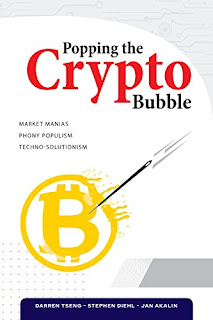
UPDATE: bought the book. An interesting read thus far. Squares with my broad historical knowledge of pre-crypto economic bubbles and frauds, along with my thus far relatively shallow (albeit accruing) education on this new finance technology.
UPDATE2: I'm about 80% through the book. Hugely informative and enjoyable read, highly recommended. This crypto crap has gotta be stopped. It's dangerous. UPDATE3: Finished it. Excellent.

Are we havin' fun yet?
Crypto: Everyone Was Just That Stupid
$2.1 trillion.
That’s a rough approximation of the total value destruction across the cryptocurrency space from the peak seen in early November 2021 through Tuesday morning, when Bitcoin sat at a two-year low, and endorsement payments to Tom Brady from FTX were being scrutinized by Texas regulators.
Who could’ve known, just 12 months ago, that things would turn out this way for crypto? After all, the private money business sounded even more compelling this go-around than it has in the past.
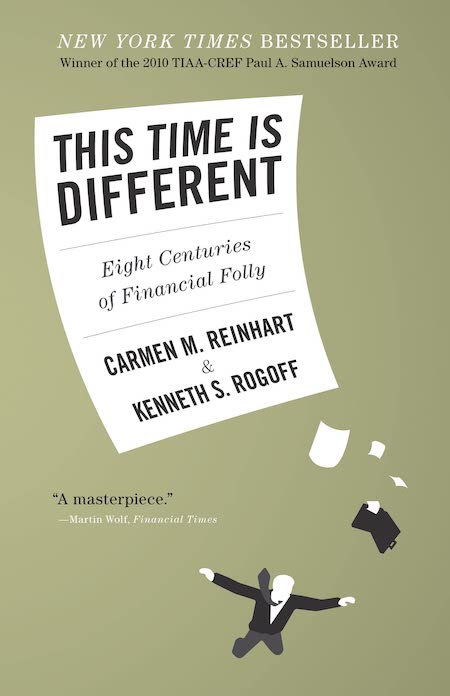
I’m being sarcastic, of course. The private money business never works, and this time most assuredly wasn’t “different.”
In the wake of the FTX fiasco, much of the breathless crypto coverage emanating from the financial media (mainstream, alternative and otherwise), seems to intentionally avoid addressing the elephant in the room. If that’s the case, it’s understandable. Because to address it would be to concede that nearly everyone — from large media conglomerates to the most respected venture capitalists on the planet to storied hedge funds — was duped into believing that all it took to make the private money business viable was a single innovation.
That’s plainly absurd. For one thing, some experts offer trenchant arguments against the idea that blockchain constitutes a “technology” at all, if technology is supposed to be synonymous with true innovation. Even if it is an innovation, many skeptics argue it’s not an especially useful one. In the interest of brevity, I won’t walk through those arguments, but you can certainly do so yourself if you have Google and half an hour to spare.
Beyond that, though, the notion of private money at scale, and, more to the point, the notion of private money at scale as an investable proposition, is stupid. Not “misguided,” not “misplaced” and not any other more generous adjective either. Just plain old stupid…
"ALTRUISM," MY ASS
FTX Group corporate funds were used to purchase real-estate properties in the Bahamas, where the company had its headquarters, for employees and advisers. Reuters has reported that FTX, Bankman-Fried’s parents, and company executives bought a hundred and twenty one million dollars’ worth of real estate, mainly “luxury beachfront homes.” (FTX, Bankman-Fried, and the company executives did not respond to Reuters’ requests for comment. A spokesman for Bankman-Fried’s parents said that they had been trying to return the property to FTX before the bankruptcy proceedings. Separately, James Bromley, the FTX attorney, said on Tuesday that the company spent three hundred million dollars in the Bahamas buying homes and vacation properties for its senior staff.)

This is how Mr. Effective Altruist lived in the Bahamas. Notably absent were any rescued starving orphans from the Sudan or Syrian refugee camps.
In fairness, Mr. Bankman-Fried cannot begin to be His Most Awesomely Effective Philanthrophic Self until he achieves Trillionaire status (a notion he has mused about). Ya gotta do stuff At Scale these days. Hang in there, kiddies.CODA
LOL. The irascible Randian contrarian take on "altruism."

Lordy, Mercy. She's also quoted as exhorting "Individualists of the world—UNITE!"
Whatever. So much fatuous incoherence, so little time... I think I need a drink.
__________ #cryptNOcurrency
Subscribe to:
Posts (Atom)