NOW REPORTING FROM BALTIMORE. A private, non-commercial blog begun in support of the federal Meaningful Use REC initiative, and Health IT and Heathcare improvement more broadly. Moving now toward important broader STEM and societal/ethics topics. Formerly known as "The REC Blog."
NOTE: Comments are moderated, thanks to trolls and bots.
The other is loudmouth bully & draft dodger Donald Trump.
Of the many bizarre and uncomfortable moments during today’s Oval Office meeting between Donald Trump, J. D. Vance, and Volodymyr Zelensky—during which Trump finally shattered the American alliance with Ukraine—one was particularly revealing: What, a reporter asked, would happen if the cease-fire Trump is trying to negotiate were to be violated by Russia? “What if anything? What if a bomb drops on your head right now?” Trump spat back, as if Russia violating a neighbor’s sovereignty were the wildest and most unlikely possibility, rather than a frequently recurring event… - Jonathan Chait
I could scarcely be more appalled today.
It Was an Ambush Today marked one of the grimmest days in the history of American diplomacy. By Tom Nichols
Leave aside, if only for a moment, the utter boorishness with which President Donald Trump and Vice President J. D. Vance treated Ukrainian President Volodymyr Zelensky at the White House today. Also leave aside the spectacle of American leaders publicly pummeling a friend as if he were an enemy. All of the ghastliness inflicted on Zelensky today should not obscure the geopolitical reality of what just happened: The president of the United States ambushed a loyal ally, presumably so that he can soon make a deal with the dictator of Russia to sell out a European nation fighting for its very existence.
Trump’s advisers have already declared the meeting a win for “putting America first,” and his apologists will likely spin and rationalize this shameful moment as just a heated conversation—the kind of thing that in Washington-speak used to be called a “frank and candid exchange.” But this meeting reeked of a planned attack, with Trump unloading Russian talking points on Zelensky (such as blaming Ukraine for risking global war), all of it designed to humiliate the Ukrainian leader on national television and give Trump the pretext to do what he has indicated repeatedly he wants to do: side with Russian President Vladimir Putin and bring the war to an end on Russia’s terms. Trump is now reportedly considering the immediate end of all military aid to Ukraine because of Zelensky’s supposed intransigence during the meeting…
It was gonna be a cakewalk, with Zelenskyy quickly arrested, exiled, or dead, Putin's tank columns rolling boldly through KyIv in no time, euphoric Ukrainians lining the streets to throw flowers at their liberators.
As noted foreign policy analyst Mike Tyson observes:
That was the assurance skeptical members of the Russian military said they were given by superiors as it appeared increasingly clear that President Vladimir V. Putin truly did mean to wage an unprovoked war on neighboring Ukraine.
And it seemed to make sense.
Ukraine was a vastly outgunned nation led by the unlikeliest of presidents, a former comedian elected just a few years before. Russia was a major military power, if not the global force it was in the days of the Soviet Union.
And so when the first planes raced across the border followed by ground troops, it was widely assumed that it would be mere days before the Russian tricolor was hoisted over Kyiv, the capital.
That was a year ago. Now, no one is talking about a walk in the park. They speak of slogs and slaughter. Of a Kremlin “special military operation” that metastasized into the biggest ground war in Europe since World War II. Of Russian casualties of around 200,000 killed or wounded, by some Western estimates."...
Sometimes the best way to understand what’s possible is to ask impossible questions.
One year ago, Russia launched a war that many never expected it to wage and assumed it would quickly win against a cowed Ukraine and its allies. How and when will the conflict end? For a war that has defied expectations, those questions might seem impossible to answer. Yet I recently posed them to several top historians, political scientists, geopolitical forecasters, and former officials—because only in imagining potential futures can we understand the rough bounds of the possible, and our own agency in influencing the outcome we want.
The main takeaways from the responses I received? Prepare for the possibility of a long, shape-shifting conflict, perhaps lasting years, even a decade or more. Watch how the rest of the world regards the Kremlin’s imperial ambitions. Expect any negotiated settlement to be fragile and reliant on third-party intervention. And don’t anticipate a dramatic finish, such as a Russian nuclear detonation in Ukraine or the overthrow of Vladimir Putin in Russia. Notably, in a reversal of perceptions a year ago, some experts could envision a decisive Ukrainian victory against Russia, but none forecast a decisive Russian win against Ukraine…
"The war in Ukraine is the final shovel of dirt on the grave of any optimism about the world order that was born with the fall of Soviet Communism. Now we are faced with the long grind of defeating Moscow’s armies and eventually rebuilding a better world." —Tom Nichols
Like so many people, I assumed and feared that Ukraine would be overrun by Putin's military in a matter of days, with President Zelenskyy quickly exiled, captured, or killed. Boy, were we all wrong. "Cometh the hour, cometh the man" indeed.
Month four of war now commences. The multiplicative adverse effects increasingly reverberate around the world.
"From a purely geopolitical point of view, this war matters enormously. Should Vladimir Putin pull victory from his initial catastrophes, we can expect a riven Europe, which would disable the uneasy alliance that won the Cold War and gave the world more than half a century of prosperity after World War II. A Russian victory would encourage China to eye the possibility of conquering Taiwan and imposing its hegemony in East Asia. And it would lead countries around the world to arm themselves with nuclear weapons, because they would know that, in the final analysis, they are alone. And lonely, fearful countries with nuclear weapons may very well use them."—Eliot A. Cohen
Russia’s invasion of Ukraine may have marked the start of “a third world war,” and Russian President Vladimir Putin must be defeated “as soon as possible” if the world wants to preserve civilization.
That was the stark message that Hungarian-born billionaire and philanthropist George Soros delivered on Tuesday to attendees at the 2022 World Economic Forum in Davos, Switzerland.
“Even when the fighting stops, as it eventually must, the situation will never revert” to where it was before, warned the 91-year-old Soros.
“Other issues that concern all of humanity – fighting pandemics and climate change, avoiding nuclear war, maintaining global institutions – have had to take a back seat to that struggle. That’s why I say civilization may not survive.”
Meanwhile, in my country, our maudlin, n-dimensionally fractious domestic political shitshow lurches on incoherently—likewise with no clear resolution(s) in sight.
Arizona GOP "Stop-The-Steal" gubernatorial candidate Kari Lake shows off the portrait she says will hang over her desk once she's elected.
Is it too early to start drinking yet?
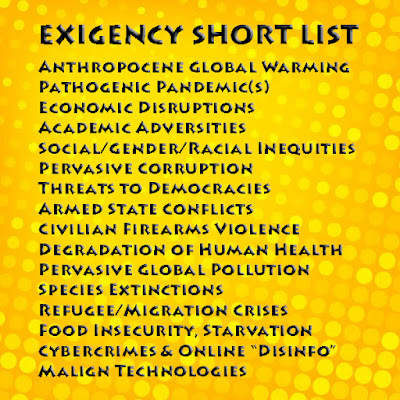
EXIGENT PRIORITIES?
Not making much progress sorting through this stuff of late. The Parkinson's ain't helpin' matters.
…Mitch McConnell, the Senate Minority Leader—who once said, following a school shooting in his home state of Kentucky, “I don’t think at the federal level there’s much that we can do other than appropriate funds” for school safety officers and counselling—tweeted that he was “horrified and heartbroken” by the tragedy at Robb Elementary School. Ted Cruz, the junior senator for Texas—who once ran a campaign ad that boasted, “After Sandy Hook, Ted Cruz stopped Obama’s push for new gun-control laws”—tweeted that he and his wife were “fervently lifting up in prayer the children and families in the horrific shooting.” Governor Greg Abbott—who last year signed seven pieces of gun-rights legislation into law, including one that permitted Texans to carry handguns without a license and another exempting the state from future federal gun restrictions—said that he and his wife “mourn this horrific loss and we urge all Texans to come together to show our unwavering support to all who are suffering.”
Politicians like these are routinely criticized for their hypocrisy and empty gestures—their “thoughts and prayers.” But, if only for the sake of rhetorical hygiene, we should go a step further. Republicans, as we know, get what they want. It is their best feature. They have vacuumed up the state legislatures, gerrymandered much of the country, stacked the Supreme Court and the federal judgeships, turned back the clock on L.G.B.T.Q. rights, paralyzed entire school districts with engineered panics over critical race theory and “grooming,” ended (or so it seems) reproductive rights as a constitutionally guaranteed freedom, and blocked all attempts at gun-control legislation. If the leaders of this political movement, which in Texas managed to ban most abortions and criminalize health care for trans kids in the space of a school year, took real offense to murdered children, they would never simply accept their deaths as the unfortunate cost of honoring the Founding Fathers’ right to take up muskets against hypothetical government tyranny. They would act. If America were not afraid to know itself, we could more readily accept that gun-rights advocates are enthralled with violent sorrow. This is the America they envisaged. It is what they worked so hard for. Their thoughts and prayers have been answered.—Jessica Winter