We can't claim to not have been warned.

THE SEIZURE of a school with hundreds of children came as a shock to Russia but hardly a surprise. Over ten years and two wars, the conflict to control the rugged mountainous territory of Chechnya barely thirty miles to the east of Beslan had evolved from a nationalist struggle for independence into a blood feud in which both sides terrorized civilians with wanton cruelty. Any sense of moral boundaries had long since evaporated. Vladimir Putin renewed the war in the days after his appointment as prime minister in 1999, promising it would be over in two weeks. Yet five years later, it wore on, bitter and unrelenting, deadly and indiscriminate. Putin’s bombers flattened the Chechen capital of Grozny, dropping more ordnance than any European city had endured since World War II, indifferent to the civilians huddling in their basements, and leaving behind a hollowed-out shell of a city where not a single building was still standing fully intact. Soldiers regularly conducted zachistki (or “cleansing operations”), sweeping up virtually any Chechen man between his teens and retirement age, many of whom wound up tortured and killed or simply went missing forever.
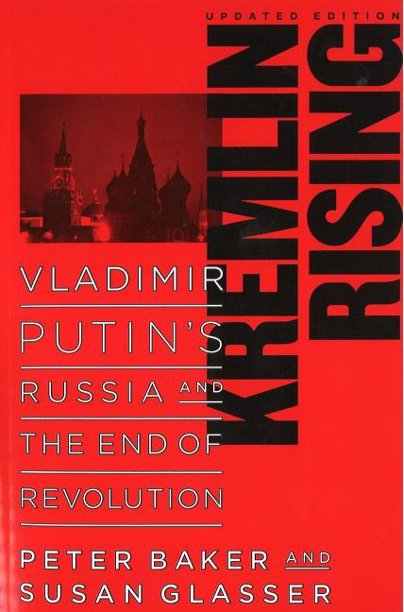
Baker, Peter; Glasser, Susan (2005-06-06T23:58:59.000). Kremlin Rising: Vladimir Putin's Russia and the End of Revolution. Scribner. Kindle Edition.
We had arrived in Russia as correspondents for the Washington Post on the eve of Putin’s election as president in 2000 and would stay on through nearly four years of change in a country the world thought it had gotten to know under Yeltsin. We found the place in the throes of a nationalist reawakening, cheered on by a proud, young leader, and yet such a weakened shadow of its former superpower self that it faced an epidemic of young conscripts running away from an army that couldn’t properly feed them. It was a time of economic boom as oil revenues floated Russia out of the bank runs and ruble collapses of Yeltsin’s presidency. And yet it was also a place ruled by ambivalence and anxiety, when fears of the future crowded out memories of the brutalities in the not-so-distant Communist past. This was a newly assertive Russia, rejecting international loans instead of defaulting on them, glorifying its lost empire rather than exulting in the downfall of dictatorship, a Russia where the clichés of the 1990s, of begging babushkas, gangster capitalism, and oligarchic excess, were no longer operative. The grinding, brutal war in the breakaway region of Chechnya—and the spill-over wave of gruesome terror attacks against subway riders and airline passengers, schoolchildren, and theatergoers—became a grim constant linking the two eras.
.…Putin’s Russia, no longer Communist yet not quite capitalist, no longer a tyranny yet not quite free. The heady idealism of the day that Yeltsin had clambered atop a tank in 1991 and brought down the Soviet Union was long since dead and often unmourned. “Democracy” was not now—if it had ever been—a goal supported by much of the population, and the very word had been discredited, an epithet that had come to be associated with upheaval rather than opportunity. Polls consistently found that no more than a third of the population considered themselves democrats a decade into the experiment, while an equally large number believed authoritarianism was the only path for their country.2 Yeltsin had, in other words, succeeded in killing off Communism but not in creating its successor.
Instead, the Russia we found on the eve of the Putin era remained a country in between, where strong-state rhetoric played well even as the state collapsed, where corruption and the government were so intertwined as to be at times indistinguishable, and where the president from the KGB set as his main priority the establishment of what he euphemistically called the “dictatorship of the law.” Like everyone else, we were left to wonder where these slogans would in reality lead, certain only that the Putin presidency would be very different from what had preceded it… [Baker & Glasser, ibid.]
As I post today, the nihilistically brutal Putin assault on Ukraine is six weeks old, with no clear indication of how it might end (nukes? chem/bio WMD?), or what the ensuing global political and socioeconomic ramifications will be. Of late I've been scrambling to mitigate my own relative historical post-Soviet cluelessness. apropos of this topic, among other sources, I recommend the works of Anne Applebaum, Fiona Hill, Tom Nichols, Masha Gessen, Timothy Snyder, Peter Baker & Susan Glasser, Joshua Yaffa, and Karen Dawisha, just to cite a few. In addition, the various new works going more broadly to the increasingly extensive enervating consequences of corrupt global kleptocracies (both overtly state-directed and transnationally oligarchic) have inextricable, significant revelance. See, e.g., Brooke Harrington, Katharina Pistor, Casey Michel, Tom Burgis, and Sarah Chayes.
So much for my emerging "
exigent priorities" riff.
"Armed State Conflict" has certainly jumped to the fore of late.
To be sure, a lot of these issues remain more or less inter-correlated and will not simply fade away. The only thing changing might be the relative prioritizations and intensities of the inter-correlations. If Vladimir Putin is successful in goading the rest of the world into nuclear conflict, much of these other topics may no longer matter materially–either permanently or for a long time.
It all certainly messes with my sleep.
UPDATE
APRIL 8TH
BROADER HISTORICAL BACKGROUND
My sister bought me this for Christmas. Finally started it. Brilliant. A towering scholarly work of history. A tough read. I'm about an hour and a half in. The "Bloodlands" of the 1933-1945 era were comprised mostly of Ukraine, Belarus, and Poland. 14 million non-combatants were killed there by both Hitler's Nazis and Stalin's Soviets. Today's Russian barbarity is no mystery.
In the middle of Europe in the middle of the twentieth century, the Nazi and Soviet regimes murdered some fourteen million people. The place where all of the victims died, the bloodlands, extends from central Poland to western Russia, through Ukraine, Belarus, and the Baltic States. During the consolidation of National Socialism and Stalinism (1933–1938), the joint German-Soviet occupation of Poland (1939–1941), and then the German-Soviet war (1941–1945), mass violence of a sort never before seen in history was visited upon this region. The victims were chiefly Jews, Belarusians, Ukrainians, Poles, Russians, and Balts, the peoples native to these lands. The fourteen million were murdered over the course of only twelve years, between 1933 and 1945, while both Hitler and Stalin were in power. Though their homelands became battlefields midway through this period, these people were all victims of murderous policy rather than casualties of war. The Second World War was the most lethal conflict in history, and about half of the soldiers who perished on all of its battlefields all the world over died here, in this same region, in the bloodlands. Yet not a single one of the fourteen million murdered was a soldier on active duty. Most were women, children, and the aged; none were bearing weapons; many had been stripped of their possessions, including their clothes.
Snyder, Timothy (2012-10-01T23:58:59.000). Bloodlands . Basic Books. Kindle Edition.
__________