Search the KHIT Blog

Showing posts with label NATO. Show all posts

Friday, January 23, 2026

A disturbing, enervating week

 
Now, we in the Baltimore / DC area await the weekend arrival of a huge snowstorm replete with single digit ambient temperatures. 
 
A boatload of stuff on deck. to wit:
 
 
Thursday evening Cheryl and I attended a Baltimore Speakers Series Ken Burns talk. A national treasure, he is. Just wow.
 
More shortly... 

Wednesday, January 21, 2026

Donald Trump Davos Switzerland Address

World Economic Forum 2026
 

Unreal. An utterly bizarre day.

The most broadly, deeply, and durably aggrieved person on the planet today.

UPDATE 


 I really like Jacob Ward's work.

Monday, January 19, 2026

Donald Trump warns NATO and the wider world

"Jonas" is the Prime Minister of Norway.
Trump sent him this on Sunday.
I probably need not even note that the Norwegian government neither adninisters nor awards the Nobel Peace Prize.
 
TELL US WHAT YA REALLY THINK, CONGRESSMAN

Sen. Ruben Gallego (D-AZ) was beside himself in an interview on CNN about President Donald Trump's latest threats to annex Greenland, calling the president a "madman" who is divorced from reality and needs to be treated as such.

"This is a man, again, that only cares about himself," Gallego told Anderson Cooper. "First, he doesn't like commitment to other countries that are based on alliances, based on trust, because this man has no trust in anybody else, and he would rather just break whatever he can to get what he wants. And if we pay in the process, we as Americans, he doesn't care, right? This is the danger. Now he's a problem. Let's be clear. The reason he's there is because we have cowardly republicans in the Senate, in the House that are not standing up to this man."

"Well, it seems like European leaders' strategy so far has been to basically try to de-escalate, reason with the president, find some kind of an off-ramp," said Cooper. "Do you think there is an off-ramp?"

"No," said Gallego. "And I've been very clear. He is a madman. He is insane. He's only thinking about himself."

"You really think he's insane?" Cooper pressed him.
 

"Yes!" shouted Gallego. "I'm sorry, where are we at this moment where we don't understand what's happening in this country? The man is threatening war against a NATO ally. We all think this is rational, right? Let's accept what's happening here. He is not rational right now. He is destroying our world reputation or potentially our economic opportunity or economic might and power around the world because he is being petty.

NY Times: "It seems safe to assume that when Harry Truman forged NATO at the dawn of the Cold War, he never imagined that over the course of nearly eight decades the only country that would wage economic war and threaten actual war against the allies for the purpose of territorial conquest would be the United States itself.

And yet that is the reality of this upside-down, might-makes-right world of President Trump’s creation as he slaps tariffs on America’s treaty partners and holds out the possibility of using military force to strong-arm Denmark and its European friends into giving up Greenland, a territory whose citizens do not want to become part of the United States.

Never in the past century has America gone forth to seize other countries’ land and subjugate its citizens against their will. Since the days of World War I, America was the country that resisted conquest, standing up to Hitler’s Germany, Tojo’s Japan, Stalin’s Soviet Union, Kim Il-sung’s North Korea and Saddam Hussein’s Iraq when they seized foreign terrain. Now Mr. Trump aspires to put America into the category of conquerors.

Coercing a loyal ally into giving up territory over its adamant objections would have been seen not long ago as preposterous, even mad — indeed, one of Mr. Trump’s own cabinet secretaries in his first term privately considered it delusional when he raised it back then. But it is a measure of how much Mr. Trump has changed the definition of normal that his appetite for seizing land that does not belong to him is debated as a serious proposition rather than dismissed out of hand as a brazen violation of U.S. treaty obligations and international law."

Friday, February 28, 2025

One of these leaders has spent more than 3 years surviving unrelenting military assaults by Putin's Russia.

The other is loudmouth bully & draft dodger Donald Trump.
 
Of the many bizarre and uncomfortable moments during today’s Oval Office meeting between Donald Trump, J. D. Vance, and Volodymyr Zelensky—during which Trump finally shattered the American alliance with Ukraine—one was particularly revealing: What, a reporter asked, would happen if the cease-fire Trump is trying to negotiate were to be violated by Russia? “What if anything? What if a bomb drops on your head right now?” Trump spat back, as if Russia violating a neighbor’s sovereignty were the wildest and most unlikely possibility, rather than a frequently recurring event… - Jonathan Chait
I could scarcely be more appalled today.
It Was an Ambush
Today marked one of the grimmest days in the history of American diplomacy.
By Tom Nichols

Leave aside, if only for a moment, the utter boorishness with which President Donald Trump and Vice President J. D. Vance treated Ukrainian President Volodymyr Zelensky at the White House today. Also leave aside the spectacle of American leaders publicly pummeling a friend as if he were an enemy. All of the ghastliness inflicted on Zelensky today should not obscure the geopolitical reality of what just happened: The president of the United States ambushed a loyal ally, presumably so that he can soon make a deal with the dictator of Russia to sell out a European nation fighting for its very existence.

Trump’s advisers have already declared the meeting a win for “putting America first,” and his apologists will likely spin and rationalize this shameful moment as just a heated conversation—the kind of thing that in Washington-speak used to be called a “frank and candid exchange.” But this meeting reeked of a planned attack, with Trump unloading Russian talking points on Zelensky (such as blaming Ukraine for risking global war), all of it designed to humiliate the Ukrainian leader on national television and give Trump the pretext to do what he has indicated repeatedly he wants to do: side with Russian President Vladimir Putin and bring the war to an end on Russia’s terms. Trump is now reportedly considering the immediate end of all military aid to Ukraine because of Zelensky’s supposed intransigence during the meeting…

Thursday, February 20, 2025

The New Whirled Order

 Yeah. Below, a back-to-reality break:
 
The 16th NATO Supreme Allied Commander, James Stavridis attended the US Naval Academy at Annapolis, and spent 37 years in the Navy, rising to the rank of 4-star Admiral. He oversaw NATO operations in Afghanistan, Libya, Syria, the Balkans, and counter piracy off the coast of Africa. He led the US Southern Command in Miami, charged with military operations through Latin America.

He served as senior military assistant to the Secretary of the Navy and the Secretary of Defense. He led the Navy’s premier operational think tank for innovation, Deep Blue, immediately after the 9/11 attacks. He also commanded a Destroyer Squadron and a Carrier Strike Group, both in combat. He was the longest serving Combatant Commander in recent US history.

Highly decorated, his awards include the Battenberg Cup for commanding the top ship in the Atlantic Fleet and the Navy League John Paul Jones Award for Inspirational leadership. Following his military career, he served as Dean of his alma mater The Fletcher School of Law and Diplomacy at Tufts University, where he earned his PhD. In 2016, he was vetted for Vice President by Secretary Hillary Clinton, and subsequently invited to discuss a cabinet position with President Donald Trump.

A best-selling author, Stavridis has published twelve books on leadership, character, risk, the oceans, maritime affairs, and Latin America, and hundreds of articles in leading journals. His most recent books are To Risk It All: Nine Conflicts and The Crucible of Decision, 2034: A Novel of the Next World War, a New York Times bestseller, and 2054: A Novel.

Stavridis is a Bloomberg Opinion columnist and Chief International Security Analyst for NBC News. He is Partner and Vice Chair, Global Affairs of The Carlyle Group and Chair of the Board of Trustees, Rockefeller Foundation.
 Admiral Stavridis spoke to us last night at the latest Baltimore Speakers Series event.. He was fabulous, a real patriot, accomplished military scholar, and brilliant, humorous, self-deprecating mind.

And then there's this ketamine-addled DOGE dipshit, appearing at CPAC.
 
 
He's cutting federal spending, get it?
 
 
ON A DEADLY SERIOUS NOTE
 
In this book, I aim to define freedom. The task begins with rescuing the word from overuse and abuse. I worry that, in my own country, the United States, we speak of freedom without considering what it is. Americans often have in mind the absence of something: occupation, oppression, or even government. An individual is free, we think, when the government is out of the way. Negative freedom is our common sense.

To be sure, it is tempting to think of liberty as us against the world, which the notion of negative freedom allows us to do. If the barriers are the only problem, then all must be right with us. That makes us feel good. We think that we would be free if not for a world outside that does us wrong. But is the removal of something in the world really enough to liberate us? Is it not as important, perhaps even more important, to add things?

If we want to be free, we will have to affirm, not just deny. Sometimes we will have to destroy, but more often we will need to create. Most often we will need to adapt both the world and ourselves, on the basis of what we know and value. We need structures, just the right ones, moral as well as political. Virtue is an inseparable part of freedom.

“Stone Walls do not a Prison make / Nor Iron bars a Cage”—said the poet. Sometimes they do, and sometimes they don’t. Oppression is not just obstruction but the human intention behind it. In Ukraine’s Donetsk, an abandoned factory became an art lab; under Russian occupation, the same building became a torture facility. A school basement, as in Yahidne, can be a concentration camp.

Early Nazi concentration camps, for that matter, were in bars, hotels, and castles. The first permanent one, Dachau, was in an abandoned factory. Auschwitz had been a Polish military base meant to defend people from a German attack. Kozelsk, a Soviet POW camp where Polish officers were held before their execution, had been a monastery—the one where Fyodor Dostoevsky, in The Brothers Karamazov, set the dialogue with the famous question: If God is dead, is everything permitted?

No larger force makes us free, nor does the absence of such a larger force. Nature gives us a chance to be free, nothing less, nothing more. We are told that we are “born free”: untrue. We are born squalling, attached to an umbilical cord, covered in a woman’s blood. Whether we become free depends upon the actions of others, upon the structures that enable those actions, upon the values that enliven those structures—and only then upon a flicker of spontaneity and the courage of our own choices.

The structures that hinder or enable are physical and moral. It matters how we speak and think about freedom. Liberty begins with de-occupying our minds from the wrong ideas. And there are right and wrong ideas. In a world of relativism and cowardice, freedom is the absolute among absolutes, the value of values. This is not because freedom is the one good thing to which all others must bow. It is because freedom is the condition in which all the good things can flow within us and among us.

Nor is it because freedom is a vacuum left by a dead God or an empty world. Freedom is not an absence but a presence, a life in which we choose multiple commitments and realize combinations of them in the world. Virtues are real, as real as the starry heavens; when we are free, we learn them, exhibit them, bring them to life. Over time, our choices among virtues define us as people of will and individuality.

When we assume that freedom is negative, the absence of this or that, we presume that removing a barrier is all that we have to do to be free. To this way of thinking, freedom is the default condition of the universe, brought to us by some larger force when we clear the way. This is naïve.

Americans are told that we were given freedom by our Founding Fathers, our national character, or our capitalist economy. None of this is true. Freedom cannot be given. It is not an inheritance. We call America a “free country,” but no country is free. Noting a difference between the rhetoric of the oppressors and the oppressed, the dissident Eritrean poet Y. F. Mebrahtu reports that “they talk about the country, we talk about the people.” Only people can be free. If we believe something else makes us free, we never learn what we must do. The moment you believe that freedom is given, it is gone.

We Americans tend to think that freedom is a matter of things being cleared away, and that capitalism does that work for us. It is a trap to believe in this or any other external source of freedom. If we associate freedom with outside forces, and someone tells us that the outside world delivers a threat, we sacrifice liberty for safety. This makes sense to us, because in our hearts we were already unfree. We believe that we can trade freedom for security. This is a fatal mistake.

Freedom and security work together. The preamble of the Constitution instructs that “the blessings of liberty” are to be pursued alongside “the general welfare” and “the common defense.” We must have liberty and safety. For people to be free, they must feel secure, especially as children. They must have a chance to know one another and the world. Then, as they become free people, they decide what risks to take, and for what reasons.

When Russia invaded Ukraine, President Volodymyr Zelens’kyi did not tell his people that they needed to trade liberty for safety. He told them that he was staying in the country. After my visit to Yahidne, I spoke to him in his office in Kyiv, behind the sandbags. He called de-occupation a chance to restore both security and freedom. He said that the “deprivation of freedom was insecurity,” and that “insecurity was the deprivation of freedom.”…

Snyder, Timothy. On Freedom (pp. xii-xv). (Function). Kindle Edition.
I read a ton of Timothy Snyder. Highly recommended.
_________
  

Thursday, February 23, 2023

One year on:

Russia's 3-day conquest of Ukraine.
 

It was gonna be a cakewalk, with Zelenskyy quickly arrested, exiled, or dead, Putin's tank columns rolling boldly through KyIv in no time, euphoric Ukrainians lining the streets to throw flowers at their liberators.
 
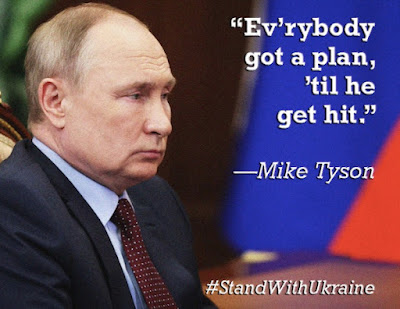
As noted foreign policy analyst Mike Tyson observes:
"Ev'rybody got a plan, 'til he get hit."
NY TIMES UPDATE
A walk in the park.

That was the assurance skeptical members of the Russian military said they were given by superiors as it appeared increasingly clear that President Vladimir V. Putin truly did mean to wage an unprovoked war on neighboring Ukraine.

And it seemed to make sense.

Ukraine was a vastly outgunned nation led by the unlikeliest of presidents, a former comedian elected just a few years before. Russia was a major military power, if not the global force it was in the days of the Soviet Union.

And so when the first planes raced across the border followed by ground troops, it was widely assumed that it would be mere days before the Russian tricolor was hoisted over Kyiv, the capital.

That was a year ago. Now, no one is talking about a walk in the park. They speak of slogs and slaughter. Of a Kremlin “special military operation” that metastasized into the biggest ground war in Europe since World War II. Of Russian casualties of around 200,000 killed or wounded, by some Western estimates."...

Been a very sad year.
How and When the War in Ukraine Will End
Forecasting a conclusion to an unpredictable conflict

By Uri Friedman

Sometimes the best way to understand what’s possible is to ask impossible questions.

One year ago, Russia launched a war that many never expected it to wage and assumed it would quickly win against a cowed Ukraine and its allies. How and when will the conflict end? For a war that has defied expectations, those questions might seem impossible to answer. Yet I recently posed them to several top historians, political scientists, geopolitical forecasters, and former officials—because only in imagining potential futures can we understand the rough bounds of the possible, and our own agency in influencing the outcome we want.

The main takeaways from the responses I received? Prepare for the possibility of a long, shape-shifting conflict, perhaps lasting years, even a decade or more. Watch how the rest of the world regards the Kremlin’s imperial ambitions. Expect any negotiated settlement to be fragile and reliant on third-party intervention. And don’t anticipate a dramatic finish, such as a Russian nuclear detonation in Ukraine or the overthrow of Vladimir Putin in Russia. Notably, in a reversal of perceptions a year ago, some experts could envision a decisive Ukrainian victory against Russia, but none forecast a decisive Russian win against Ukraine…
 
"The war in Ukraine is the final shovel of dirt on the grave of any optimism about the world order that was born with the fall of Soviet Communism. Now we are faced with the long grind of defeating Moscow’s armies and eventually rebuilding a better world."Tom Nichols
__________
 

Tuesday, May 24, 2022

3 months of war,

with no clear end in sight.
 
Like so many people, I assumed and feared that Ukraine would be overrun by Putin's military in a matter of days, with President Zelenskyy quickly exiled, captured, or killed. Boy, were we all wrong. "Cometh the hour, cometh the man" indeed.
 
Month four of war now commences. The multiplicative adverse effects increasingly reverberate around the world.
"From a purely geopolitical point of view, this war matters enormously. Should Vladimir Putin pull victory from his initial catastrophes, we can expect a riven Europe, which would disable the uneasy alliance that won the Cold War and gave the world more than half a century of prosperity after World War II. A Russian victory would encourage China to eye the possibility of conquering Taiwan and imposing its hegemony in East Asia. And it would lead countries around the world to arm themselves with nuclear weapons, because they would know that, in the final analysis, they are alone. And lonely, fearful countries with nuclear weapons may very well use them."Eliot A. Cohen
per CNN:
Russia’s invasion of Ukraine may have marked the start of “a third world war,” and Russian President Vladimir Putin must be defeated “as soon as possible” if the world wants to preserve civilization.

That was the stark message that Hungarian-born billionaire and philanthropist George Soros delivered on Tuesday to attendees at the 2022 World Economic Forum in Davos, Switzerland.

“Even when the fighting stops, as it eventually must, the situation will never revert” to where it was before, warned the 91-year-old Soros.

“Other issues that concern all of humanity – fighting pandemics and climate change, avoiding nuclear war, maintaining global institutions – have had to take a back seat to that struggle. That’s why I say civilization may not survive.”
Meanwhile, in my country, our maudlin, n-dimensionally fractious domestic political shitshow lurches on incoherently—likewise with no clear resolution(s) in sight.
 

Arizona GOP "Stop-The-Steal" gubernatorial candidate Kari Lake shows off the portrait she says will hang over her desk once she's elected.
 
Is it too early to start drinking yet? 
 
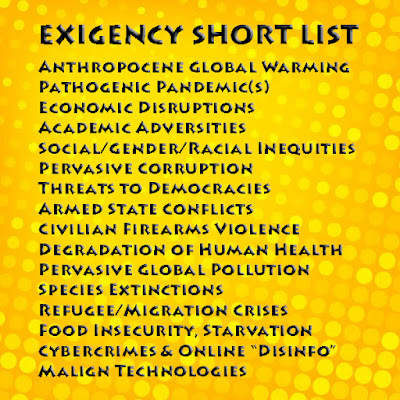
EXIGENT PRIORITIES?
 

Not making much progress sorting through this stuff of late. The Parkinson's ain't helpin' matters.
 
ERRATUM: FILE UNDER "MALIGN TECHNOLOGIES"
 
 
I have never understood this infatuation. to wit:


Highly recommend the videos of "CoffeeZilla."
 
BREAKING
Speechless.

UPDATE: The death toll has now risen to 21.
_____
 
LET US PREY
…Mitch McConnell, the Senate Minority Leader—who once said, following a school shooting in his home state of Kentucky, “I don’t think at the federal level there’s much that we can do other than appropriate funds” for school safety officers and counselling—tweeted that he was “horrified and heartbroken” by the tragedy at Robb Elementary School. Ted Cruz, the junior senator for Texas—who once ran a campaign ad that boasted, “After Sandy Hook, Ted Cruz stopped Obama’s push for new gun-control laws”—tweeted that he and his wife were “fervently lifting up in prayer the children and families in the horrific shooting.” Governor Greg Abbott—who last year signed seven pieces of gun-rights legislation into law, including one that permitted Texans to carry handguns without a license and another exempting the state from future federal gun restrictions—said that he and his wife “mourn this horrific loss and we urge all Texans to come together to show our unwavering support to all who are suffering.”

Politicians like these are routinely criticized for their hypocrisy and empty gestures—their “thoughts and prayers.” But, if only for the sake of rhetorical hygiene, we should go a step further. Republicans, as we know, get what they want. It is their best feature. They have vacuumed up the state legislatures, gerrymandered much of the country, stacked the Supreme Court and the federal judgeships, turned back the clock on L.G.B.T.Q. rights, paralyzed entire school districts with engineered panics over critical race theory and “grooming,” ended (or so it seems) reproductive rights as a constitutionally guaranteed freedom, and blocked all attempts at gun-control legislation. If the leaders of this political movement, which in Texas managed to ban most abortions and criminalize health care for trans kids in the space of a school year, took real offense to murdered children, they would never simply accept their deaths as the unfortunate cost of honoring the Founding Fathers’ right to take up muskets against hypothetical government tyranny. They would act. If America were not afraid to know itself, we could more readily accept that gun-rights advocates are enthralled with violent sorrow. This is the America they envisaged. It is what they worked so hard for. Their thoughts and prayers have been answered.
Jessica Winter
__________
 

Sunday, April 24, 2022

Two months of Hell in Ukraine

Photo by Nicole Tung, Kharkiv
What a terrible waste. No clear end in sight as yet.
 
UPDATE: A TAD OF GOOD NEWS

Le Pen supports Vladimir Putin, and would have wreaked havoc in NATO.
__________
 

Wednesday, March 30, 2022

Five weeks of savagery in Ukraine

 
I have to say, like many, I too thought the Russians would quickly capture Kyiv and remove President Zelenskyy (and perhaps kill him).
 
Notwithstanding the heroic, adroit Ukrainian pushback, the utter physical destruction across the country is depressing, and the misery visited upon the non-combatant civilian population is beyond heart-rending.

 
I am now 10 episodes into "Servant of the People" on Netflix. Highly recommended. Very informative, notwithstanding being a "sitcom."

 
UPDATE
 
This is rather jarring. PBS Frontline:
 
Through in-depth conversations with multiple heads of U.S. intelligence agencies, diplomats, Russian politicians, historians and journalists, this special report chronicles events that shaped the Russian leader, the grievances that drive him, and how a growing conflict with the West exploded into war in Europe. From acclaimed filmmaker Michael Kirk and his team, the documentary traces how Putin went from low-ranking KGB agent to longtime Russian president. It delves into his crackdown on dissent — and the media — inside Russia. It reveals how he has tested the West’s appetite for confrontation over and over again, including in Ukraine in 2014, as he’s tried to expand Russia’s global footprint. And it raises difficult questions about the path forward. Watch the documentary for an urgent examination of what led to this historic moment and how it could still unfold.
Also, a must-read essay by Anne Applebaum. "There IS no Liberal World Order."
Take democracy seriously. Teach it, debate it, improve it, defend it. Maybe there is no natural liberal world order, but there are liberal societies, open and free countries that offer a better chance for people to live useful lives than closed dictatorships do. They are hardly perfect; our own has deep flaws, profound divisions, terrible historical scars. But that’s all the more reason to defend and protect them. Few of them have existed across human history; many have existed for a time and then failed. They can be destroyed from the outside, but from the inside, too, by divisions and demagogues...

____________

THE SLAP I WANT TO SEE

 
MEANWHILE, BACK IN THE LAND OF THE FREE AND HOME OF THE BRAVE
 
You can't make this shit up.
__________
 

Tuesday, March 22, 2022

oderint dum metuant

 "Let them hate, so long as they fear."
 
Words fail to capture the savagery of Vladimir Putin.
 
How should the West respond? There is only one rule: We cannot be afraid. Russia wants us to be afraid—so afraid that we are crippled by fear, that we cannot make decisions, that we withdraw altogether, leaving the way open for a Russian conquest of Ukraine, and eventually of Poland or even further into Europe. Putin remembers very well an era when Soviet troops controlled the eastern half of Germany. But the threat to those countries will not decrease if Russia carries out massacres in Ukraine. It will grow.

Instead of fear, we should focus on a Ukrainian victory. Once we understand that this is the goal, then we can think about how to achieve it, whether through temporary boycotts of Russian gas, oil, and coal; military exercises elsewhere in the world that will distract Russian troops; humanitarian airlifts on the scale of 1948 Berlin; or more and better weapons.

The specific tactics will be determined by those who best understand diplomacy and military strategy. But the strategy has to be clear. A month ago, nobody believed this war would matter so much, and I’m sure many people wish it did not. But it does. That’s why every move we make must have a single goal: How does it help Ukraine win?
NOW ON NETFLIX, ZELENSKYY’S “SERVANT OF THE PEOPLE”


Painfully brilliant. Everyone should see it.
__________
 

Saturday, March 19, 2022

Ukraine invasion update

 
Succinct.
 

So much of what we imagine to be new is old; so many of the seemingly novel illnesses that afflict modern society are really just resurgent cancers, diagnosed and described long ago. Autocrats have risen before; they have used mass violence before; they have broken the laws of war before. In 1950, in the preface she wrote to the first edition of The Origins of Totalitarianism, Hannah Arendt, knowing that what had just passed could repeat itself, described the scant half decade that had elapsed since the end of the Second World War as an era of great unease: “Never has our future been more unpredictable, never have we depended so much on political forces that cannot be trusted to follow the rules of common sense and self-interest—forces that look like sheer insanity, if judged by the standards of other centuries.”

The toxic nationalism and open racism of Nazi Germany, only recently defeated; the Soviet Union’s ongoing, cynical attacks on liberal values and what it called “bourgeois democracy”; the division of the world into warring camps; the large influx of refugees; the rise of new forms of broadcast media capable of pumping out disinformation and propaganda on a mass scale; the emergence of an uninterested, apathetic majority, easily placated with simple bromides and outright lies; and above all the phenomenon of totalitarianism, which she described as an “entirely new form of government”—all of these things led Arendt to believe that a darker era was about to begin.

She was wrong, or partly so. Although much of the world would remain, for the rest of the 20th century, in thrall to violent and aggressive dictatorships, in 1950 North America and Western Europe were in fact just at the beginning of an era of growth and prosperity that would carry them to new heights of wealth and power. The French would remember this era as Les Trente Glorieuses; the Italians would speak of the boom economico, the Germans of the Wirtschaftswunder. In this same era, liberal democracy, a political system that had failed spectacularly in 1930s Europe, finally flourished. So did international integration. The Council of Europe, the North Atlantic Treaty Organization, the eventual European Union—all of these institutions not only supported the liberal democracies but knit them together more tightly than ever before. The result was certainly not a utopia—by the 1970s, growth had slowed; unemployment and inflation soared—but it nevertheless seemed, at least to those who lived inside the secure Western bubble, that the forces of what Arendt had called “sheer insanity” had been kept at bay.

Now we live in a different era, one in which growth at those 1950s levels is impossible to imagine. Inequality has grown exponentially, creating huge divides between a tiny billionaire class and everyone else. International integration is failing; declining birth rates, combined with a wave of immigration from the Middle East and North Africa, have created an angry rise of nostalgia and xenophobia. Worse, some of the elements that made the postwar Western world so prosperous—some of the elements that Arendt’s pessimistic analysis missed—are fading away. The American security guarantee that underlies the stability of Europe and North America is more uncertain than it has ever been. America’s own democracy, which served as a role model for so many others, is challenged as it has not been in decades, including by those who no longer accept the results of American elections. At the same time, the world’s autocracies have now accumulated enough wealth and influence to challenge the liberal democracies, ideologically as well as economically. The leaders of China, Russia, Iran, Belarus, and Cuba often work together, supporting one another, drawing on kleptocratic resources—money, property, business influence—at a level Hitler or Stalin could never have imagined. Russia has defied the entire postwar European order by invading Ukraine…
Read the entire article.

apropos of "kleptocratic resources,"


Acutely toxic to Democracy. Existentially exigent.

See also
 
UKRAINE INVASION UPDATE:
ANNIE LOWRY ON INFLATION
...One of the world’s biggest energy exporters is engaged in an unprovoked assault on one of Europe’s largest agricultural exporters. This means higher prices for commodities, which means higher prices for manufacturers, which means higher prices for retailers, which means higher prices for families in a brief matter of time. Much higher, perhaps: One barometer of the price of raw materials jumped 16 percent in the first week of March, the sharpest increase in half a century…

At the same time, the invasion has cut Europe off from its bread basket: Ukrainian wheat, corn, and sunflower oil are no longer leaving its Black Sea ports. As a result, wheat futures listed on the Chicago Board of Trade jumped the maximum allowed each of the first five days of March; they are now up about 40 percent from before the invasion. Even if Russia were to withdraw from Ukraine shortly, those price increases would probably persist. The war is disrupting the harvest cycle and damaging Ukraine’s shipping infrastructure, and the West is likely to maintain sanctions on Russia for years…
"For years?" Let's just hope we have "years."

UPDATE: STEVE COLL
It has become common to describe Russia’s invasion as a watershed in history comparable to 9/11 or to the fall of the Berlin Wall. “The war in Ukraine marks a turning point for our continent and our generation,” President Emmanuel Macron, of France, said earlier this month. Perhaps, but some of this speculation about Europe’s destiny and the future of Great Power competition may be premature. Certainly, the war has already produced a humanitarian disaster of shocking and destabilizing dimensions. Three million Ukrainians have fled their country. The 1.8 million of them who have gone to Poland constitute a population roughly the size of Warsaw’s. If the fighting drags on and Ukraine implodes, the country will export many more destitute people, and, as happened in the former Yugoslavia during the nineteen-nineties, it may also draw in opportunists, including mercenaries and extremists.

Meanwhile, Russia’s economy, according to the International Monetary Fund, could shrink by thirty-five per cent this year under the weight of Western sanctions. Putin’s oligarchs and enablers can endure the loss of super-yachts and private jets, but a sudden economic contraction on that scale would crush ordinary Russians and inevitably cost lives. (“Our economy will need deep structural changes,” Putin acknowledged last week, adding, “They won’t be easy.”) Russia’s isolation from large swaths of global banking and trade, and its loss of access to advanced U.S. technologies, could last a long time, too: democracies often find it easier to impose sanctions than to remove them, even when the original cause of a conflict subsides. (Ask Cuba.) “When the history of this era is written, Putin’s war on Ukraine will have left Russia weaker and the rest of the world stronger,” Biden said in his recent State of the Union address.

Still, some introspection may be in order. In his address, the President also declared that, “in the battle between democracy and autocracies, democracies are rising to the moment.” But Europe is troubled by illiberal populism, including in Poland. And Donald Trump—who, just two days before Russia rolled into Ukraine, called Putin’s preparatory moves “genius”—retains a firm hold on the Republican Party, and appears to be all in for a reëlection campaign in 2024. As long as Trump’s return to the White House is a possibility, Biden’s declarations will require some asterisks...
UPDATE FROM CNN
Ukrainian President Volodymyr Zelensky said Sunday he is ready to negotiate with Russian President Vladimir Putin, but warned that if any negotiation attempts fail, it could mean the fight between the two countries would lead to "a third World War."

“I’m ready for negotiations with him. I was ready for the last two years. And I think that without negotiations, we cannot end this war,” Zelensky told CNN’s Fareed Zakaria in an exclusive interview Sunday morning.

“If there’s just 1% chance for us to stop this war, I think that we need to take this chance. We need to do that. I can tell you about the result of this negotiations — in any case, we are losing people on a daily basis, innocent people on the ground," he said.

He continued, “Russian forces have come to exterminate us, to kill us. And we can demonstrate that the dignity of our people and our army that we are able to deal a powerful blow, we are able to strike back. But, unfortunately, our dignity is not going to preserve the lives. So, I think we have to use any format, any chance in order to have a possibility of negotiating, possibility of talking to Putin. But if these attempts fail, that would mean that this is a third World War.”
I think the probability of Putin agreeing to meet with President Zelenskyy is about zero. Vladimir is interested in one thing: Ukrainian capitulation. If it requires burning the entire nation down and killing everyone, so be it.

 
CODA
 
You might want to read up on Aleksandr Dugin. Putin's Jim Jones. Seriously bad news, this guy. The Putin Whisperer. And, then there's this swell guy.
__________
 

Tuesday, March 15, 2022

Ukraine: the 44 million trolleys problem

Kyiv, Ukraine, before Putin's invasion.
 
Yeah, it's perhaps a bit of a clickbait headline. The analogy is somewhat strained. Humor me.
 
Recall that annoying "moral reasoning thought experiment" from undergrad PHIL101?
 
A trolley is running loose down the tracks without its driver, headed toward a cluster of unaware citizens who might be killed. You have access to track switching controls that could divert it to a siding, where it would subsequently certainly kill one innocent person prior to coming to rest. What should you do?
 
OK, rearrange the particulars. Do we "sacrifice" 44 million Ukrainians (on the siding) in materially passive deference to our larger concern that Vladimir Putin might unleash nuclear obliteration on the wider world, as he has repeatedly threatened?
 
20 days of Russian savagery have ensued as of today. Ukraine is being reduced to rubble, its non-combatant citizens terrorized. Several million Ukrainians have now fled their country. The misery is mind-boggling.
 
What would you do?
 
 
UPDATE
 
__________