Search the KHIT Blog

Showing posts sorted by relevance for query NLU. Sort by date Show all posts

Tuesday, May 23, 2017

"Assuming / Despite / If / Then / Therefore / Else..." Could AI do "argument analysis?"


When I was a kid in grade school, back prior to indoor plumbing, it was just broadly referred to as "reading comprehension" -- "What was the author's main point?" Did she provide good evidence for her point of view? Do you agree or disagree with the author's conclusion? Why? Explain..."

The oral equivalent was taught in "debate teams" prep. #NLP

Now along comes the part of "AI" technology R&D (Artificial Intelligence) known by its top-level acronym "NLP" (Natural Language Processing). We see increasing discourse on developments in "Machine Learning," "Deep Learning," "Natural Language Generation" (NLG) and "Natural Language Understanding" (NLU).
There's been a good bit of chatter of late in the Health IT news about the asserted utility of NLP. See here as well.
I am interested in particular in the latter (NLU), most specifically as it pertains to rational "argumentative" discourse (mostly of the written type). e.g., "Critical Thinking" comes to mind (I was lucky to get to teach it for a number of years as an adjunct faculty member). I was subsequently accorded the opportunity to teach a graduate seminar in the higher-level "Argument Analysis."

From my grad seminar syllabus:
We focus on effective analysis and evaluation of arguments in ordinary language. The "analysis" part involves the process of getting at what is truly being argued by a proponent of a position on an issue. Only once we have done that can we begin to accurately assess the relative merits of a proposition—the "evaluation" phase. These skills are essential to grasp if we are to become honest and constructive contributors to debate and the resolution of issues.

Our 24/7 global communications civilization is awash in arguments ranging from the trivial to grand themes of moral import. Advocates of every stripe and theme pepper us relentlessly with persuasion messages ranging from the "short and sweet" to the dense and inscrutable. We have more to consider and evaluate than time permits, so we must prioritize. This we often do by making precipitous snap judgments—"Ready-Shoot-Aim"—which then frequently calcify into prejudice. The sophistication and nuance of language enables a savvy partisan to entice us into buying into an argument perhaps not well supported by the facts and logic...
I first encountered "Argument Analysis" in the fall of 1994 as an "Ethics & Policy Studies" graduate student myself. I chose for my first semester paper an analytic deconstruction of the PNHP 1994 JAMA paper "A Better-Quality Alternative: Single-Payer National Health System Reform."

The first two opening paragraphs:
MANY MISCONSTRUE US health system reform options by presuming that "trade-offs" are needed to counter-balance the competing goals of increasing access, containing costs, and preserving quality. Standing as an apparent paradox to this zero-sum equation are countries such as Canada that ensure access to all at a cost 40% per capita less, with satisfaction and outcomes as good as or better than those in the United States. While the efficiencies of a single-payer universal program are widely acknowledged to facilitate simultaneous cost control and universal access, lingering concerns about quality have blunted support for this approach.
Quality is of paramount importance to Americans. Opponents of reform appeal to fears of diminished quality, warning of waiting lists, rationing, and "government control." Missing from more narrow discussions of the accuracy of such charges is a broader exploration of the quality implications of a universal health care program. Conversely, advocates of national health insurance have failed to emphasize quality issues as key criteria for reform, often assuming that we have "the best medical services in the world." They portray reform primarily as extending the benefits of private insurance to those currently uninsured, with safeguards added to preserve quality.
For the "analysis" phase I undertook to examine and "flowchart" the subordinate arguments' logic of the 49 paragraphs of assertions comprising the PHNP article, numbering every argument statement as "paragraph(n), sentence(n.n), and sub-sentence truth-claim clause(n.n.a,b,c...) where warranted" as evident by close reading of the text. My full (pdf) copy of the paper is parked here.
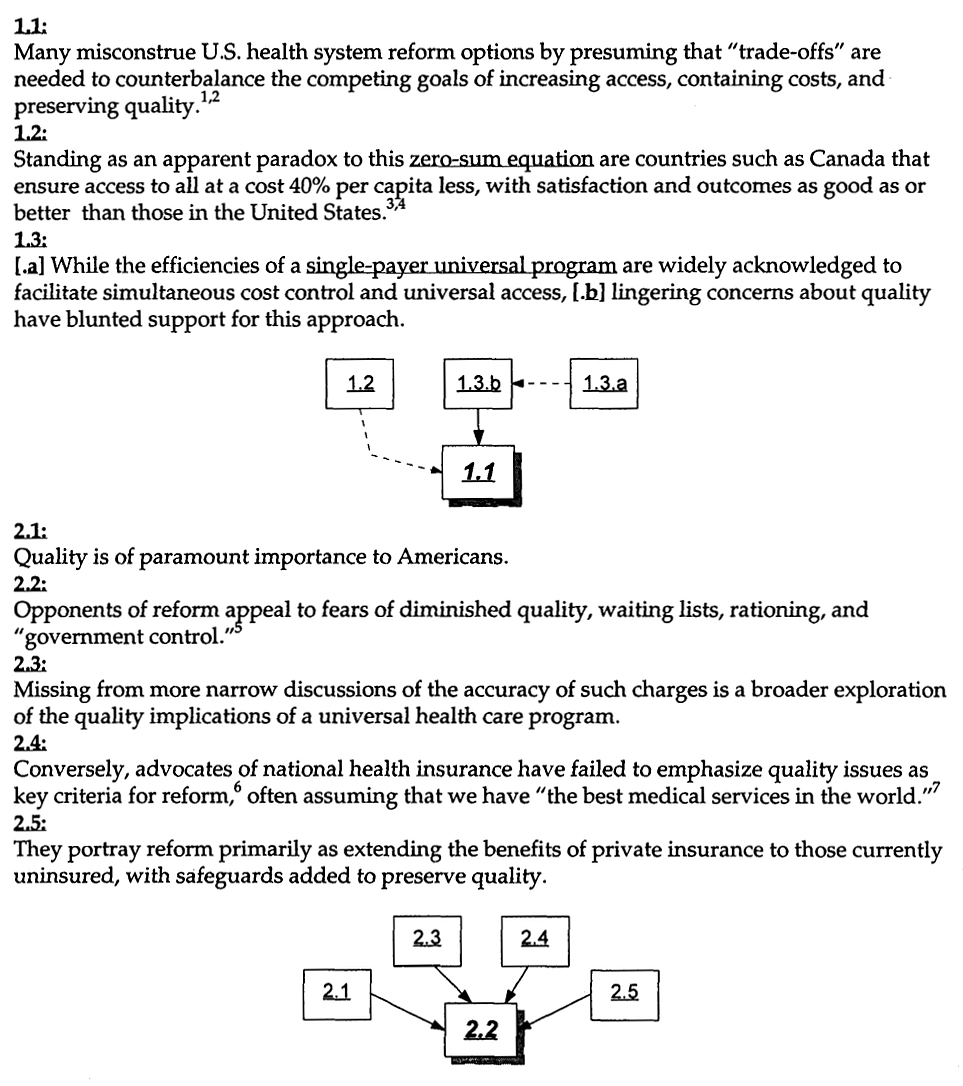
Click to enlarge.
Dotted lines denote a "despite" (a.k.a. "notwithstanding") statement, whereas solid lines depict "because-therefore" premise-to-conclusion movement in the direction of the arrowheads.

It was tedious. The bulk of the first 25 pages of the 56 page paper comprised this analytic "flowcharting" visualization helpful for what the late Steve Covey would characterize as a crucial "seek first to understand" effort. The remaining 31 pages subsequently focused on my (in large measure subjective) critical evaluation of the logic and evidence provided by the authors.
BTW: I'm certain I didn't get everything exactly right on the "analysis" side (or the eval side, for that matter). It was my first run at this type of thing. And, I had a second course to deal with at the time ("History of Ethics," 11 required texts) and was still working full-time at my Medicare QIO job.
Look at sentence 1.1, for example. You could nit-pick my decision, by splitting it up into "b" and "a" because-therefore clauses. Because "presuming trade-offs are needed," therefore "Many misconstrue..." Not that it'd have made a material difference in the analysis, but, still.
UPDATE: per the topic of my 1994 paper, Dr. Danielle Ofri in the news:
Americans Have Realized They Deserve Health Care
How long until they accept that the only way to guarantee it is through single-payer?
I have a good 100 hours or so in that one grad school paper. Imagine trying to do that to an entire book. Utterly impractical. So, we mostly suffer our "confirmation bias" and similar heuristic afflictions and jump to premature conclusions -- the bells we can't un-ring.

Hmmm...


Could we develop an AI NLU "app" for that? (I don't underestimate the difficulty, given the myriad fluid nuances of natural language. But, still...)
Thinking about NLP applicability to digital health infotech (EHRs), the differential dx SOAP method (Subjective, Objective, Assessment, and Plan) is basically an argument process, no? You assemble and evaluate salient clinical evidence (the "S" and the "O" data, whether numerical, encoded, or lexical narrative), which point in the aggregate to a dx conclusion and tx decision (the "A" and the "P"). I guess we'll see going forward whether applied NLP has any material net additional utility in the dx arena, or whether it will be just another HIT R&D sandbox fad.
Logic visualization software is not exactly news. In the late 80's I developed an instrumentation statistical process control program for the radiation lab where I worked in Oak Ridge -- the "IQCstats" system (pdf). Below is one page of the 100 or so comprising the logic flowcharts set included in my old 2" bound "User and Technical Guide" manual.

Click to enlarge

The flowcharts were generated by an "app" known as "CLEAR," which parsed my source code logic and rendered a complete set of flowcharts.

While "critical evaluation" of arguments proffered in ordinary language might not lend itself to automated digital assessment (human "judgments"), mapping the "Assuming / Despite / If / Then / Therefore / Else" logic might indeed be do-able in light of advances in "Computational Linguistics" (abetted by our exponentially increasing availability of ever-cheaper raw computing power).

Below, my graphical analogy for the fundamental unit of "argument" (a.k.a. "truth claim").

Click to enlarge


Any complex argument arises from assemblages of the foregoing "atomic" and "molecular" "particles" (once you've weeded through and discarded all of the "noise").
I should add that most of what I'm interested in here goes to "informal/propositional logic" in ordinary language. Formal syllogistic logic (e.g., formal deductive "proofs") comprise a far smaller subset of what we humans do in day-to-day reasoning.
English language discourse, recall, beyond the smaller "parts of speech," is comprised of four sentence types:
  1. Declarative;
  2. Interrogative;
  3. Imperative;
  4. Exclamatory.
We are principally interested in the subset of declaratives known as "truth claims" -- claims in need of evaluation prior to acceptance -- though we also have to be alert to the phony "interrogative" known as the "loaded question," i.e., an argument insinuation disingenuously posed as a "have-you-stopped-beating-your-wife" type of query. (Then there's also stuff like subtle inferences, ambiguities, and sarcasm, etc that might elude AI/NLU.)

NLP AND LINGUISTICS

It occurs to me that, notwithstanding my longstanding chops on the verbal/written side, I've never had any formal study in "linguistics," much less its application in NLP. Time to start reading up.

Introduction
Natural languages are the languages which have naturally evolved and used by human beings for communication purposes, For example Hindi, English, French, German are natural languages.  Natural language processing or NLP (also called computational linguistics) is the scientific study of languages from computational perspective. natural language processing (NLP) is a field of computer science and linguistics concerned with the interactions between computers and human (natural) languages. Natural language generation systems convert information from computer databases into readable human language. Natural language understanding systems convert samples of human language into more formal representations such as parse trees or first order logic that are easier for computer programs to manipulate. Many problems within NLP apply to both generating and understanding; for example, the computer must  be able to model morphology (the structure of words) in order to understand an English sentence, and a model of morphology is also needed for producing a grammatically correct English sentence, i.e., natural language generator.

NLP has significant overlap with the field of computational linguistics, and is often considered a subfield of artificial intelligence. The term natural language is used to distinguish human languages (such as Spanish, Swahili, or Swedish) from formal or computer languages (such as C++, Java, or LISP).  Although NLP may end comp us both  text and speech, work on speech processing is conventionally done in a separate field.

In NLP, the techniques are developed which aim the computer to understand the commands given in natural language and perform according to it. At present, to work with computer, the input is required to be given in formal languages. The formal languages are those languages which are specifically developed to communicate  with computer and are understood by machine, e.g., FORTRAN, Pascal, etc. Obviously, to communicate with computer, the study of these formal languages is required. Understanding these languages is  cumbersome and requires additional efforts to understand these. Hence, it limits their applications in computer. As compared to this, the communication in natural language will facilitate the functioning and communication with computer easily and in user-friendly way.

 Natural language processing is a significant area of artificial intelligence because a computer would be considered intelligent  if it can understand the commands given in natural language instead of C, FORTRAN, or Pascal. Hence, with the ability of computers to understand natural language it becomes much easier to communicate with computers. Also the natural language processing can be applied as a productivity tool in applications ranging from summarization of news to translate from one language to another. Though, the surface level processing of natural languages seems to be easy the deep level processing of natural languages, understanding of implicit messages and intentions of the speaker are extremely difficult avenues...
Ya have to wonder whether that was written by a computer. Minimally, a non-native English speaker/writer.

I've also just read up on "linguistics" broadly via a couple of short books, just to survey the domain.


The real meat comes here:


801 pages of dense, comprehensive detail.
Introduction
The field of computational linguistics (CL), together with its engineering domain of natural language processing (NLP), has exploded in recent years. It has developed rapidly from a relatively obscure adjunct of both AI and formal linguistics into a thriving scientific discipline. It has also become an important area of industrial development. The focus of research in CL and NLP has shifted over the past three decades from the study of small prototypes and theoretical models to robust learning and processing systems applied to large corpora. This handbook is intended to provide an introduction to the main areas of CL and NLP, and an overview of current work in these areas. It is designed as a reference and source text for graduate students and researchers from computer science, linguistics, psychology, philosophy, and mathematics who are interested in this area.
The volume is divided into four main parts. Part I contains chapters on the formal foundations of the discipline. Part II introduces the current methods that are employed in CL and NLP, and it divides into three subsections. The first section describes several influential approaches to Machine Learning (ML) and their application to NLP tasks. The second section presents work in the annotation of corpora. The last section addresses the problem of evaluating the performance of NLP systems. Part III of the handbook takes up the use of CL and NLP procedures within particular linguistic domains. Finally, Part IV discusses several leading engineering tasks to which these procedures are applied...

(2013-04-24). The Handbook of Computational Linguistics and Natural Language Processing (Blackwell Handbooks in Linguistics) (p. 1). Wiley. Kindle Edition.
Interesting. BTW, nice summation of Computational Linguistics on the Wiki.
Computational linguistics is an interdisciplinary field concerned with the statistical or rule-based modeling of natural language from a computational perspective.

Traditionally, computational linguistics was performed by computer scientists who had specialized in the application of computers to the processing of a natural language. Today, computational linguists often work as members of interdisciplinary teams, which can include regular linguists, experts in the target language, and computer scientists. In general, computational linguistics draws upon the involvement of linguists, computer scientists, experts in artificial intelligence, mathematicians, logicians, philosophers, cognitive scientists, cognitive psychologists, psycholinguists, anthropologists and neuroscientists, among others.

Computational linguistics has theoretical and applied components. Theoretical computational linguistics focuses on issues in theoretical linguistics and cognitive science, and applied computational linguistics focuses on the practical outcome of modeling human language use...
"applied computational linguistics focuses on the practical outcome of modeling human language..."

Like, well, NLU Argument Analytics?

UPDATE: I'm hitting a motherload of good stuff in Chapter 15 of "The Handbook..." on "computational semantics."

After getting up to speed on the technical concepts and salient details, perhaps the next step would involve learning Python.

"This book offers a highly accessible introduction to natural language processing, the field that supports a variety of language technologies, from predictive text and email filtering to automatic summarization and translation. With it, you'll learn how to write Python programs that work with large collections of unstructured text. You'll access richly annotated datasets using a comprehensive range of linguistic data structures, and you'll understand the main algorithms for analyzing the content and structure of written communication.

Packed with examples and exercises, Natural Language Processing with Python will help you:
  • Extract information from unstructured text, either to guess the topic or identify "named entities"
  • Analyze linguistic structure in text, including parsing and semantic analysis
  • Access popular linguistic databases, including WordNet and treebanks
  • Integrate techniques drawn from fields as diverse as linguistics and artificial intelligence
This book will help you gain practical skills in natural language processing using the Python programming language and the Natural Language Toolkit (NLTK) open source library. If you're interested in developing web applications, analyzing multilingual news sources, or documenting endangered languages -- or if you're simply curious to have a programmer's perspective on how human language works -- you'll find Natural Language Processing with Python both fascinating and immensely useful."
apropos of this topic generally, a couple of prior posts of mine come to mind. See "The Great A.I. Awakening? Health Care Implications?" and "Are structured data now the enemy of health care quality?"

Tangentially, my post of July 2015 "AI vs IA: At the cutting edge of IT R&D" as well.

So, could we use digital NLU technology to passably analyze natural language arguments, rather than just turning lab data and ICD-10 codes into SOAP narratives (and the converse)?

Me and my crazy ideas. Never gonna make it into any episodes of "Silicon Valley" (NSFW).

Perhaps our Bootcamp Insta-Engineer pals at ZIPcode Wilmington could have a run at Argumentation NLU?

Seriously, how about a new subset of CL tech R&D, "NLAA" -- "Natural Language Argument Analysis?"
__

UPDATE: RECENT NLG REPORTAGE

From Wired:
What News-Writing Bots Mean for the Future of Journalism
Joe Keohane, 02.16.17

WHEN REPUBLICAN STEVE King beat back Democratic challenger Kim Weaver in the race for Iowa’s 4th congressional district seat in November, The Washington Post snapped into action, covering both the win and the wider electoral trend. “Republicans retained control of the House and lost only a handful of seats from their commanding majority,” the article read, “a stunning reversal of fortune after many GOP leaders feared double-digit losses.” The dispatch came with the clarity and verve for which Post reporters are known, with one key difference: It was generated by Heliograf, a bot that made its debut on the Post’s website last year and marked the most sophisticated use of artificial intelligence in journalism to date.

When Jeff Bezos bought the Post back in 2013, AI-powered journalism was in its infancy. A handful of companies with automated content-generating systems, like Narrative Science and Automated Insights, were capable of producing the bare-bones, data-heavy news items familiar to sports fans and stock analysts. But strategists at the Post saw the potential for an AI system that could generate explanatory, insightful articles. What’s more, they wanted a system that could foster “a seamless interaction” between human and machine, says Jeremy Gilbert, who joined the Post as director of strategic initiatives in 2014. “What we were interested in doing is looking at whether we can evolve stories over time,” he says...
More and more examples abound on the NLG side of things. Just Google "written by AI."

UPDATE: SPEAKING OF NEWS

I cited this excellent book a while back.


Re: Chapter 8, "Computational Journalism"
In 2009, Fred Turner and I wrote: “What is computational journalism? Ultimately, interactions among journalists, software developers, computer scientists and other scholars over the next few years will have to answer that question. For now though, we define computational journalism as the combination of algorithms, data, and knowledge from the social sciences to supplement the accountability function of journalism.”

Hamilton, James T. (2016-10-10). Democracy’s Detectives (Kindle Locations 10750-10753). Harvard University Press. Kindle Edition.
NLP seems an obvious fit, 'eh?
__

UPDATE

Check this out:

Study the intersection of language and technology and place yourself at the forefront of a dynamic field by earning a Master of Science in Computational Linguistics from the University of Washington.

The powerful connections between text, human speech and computer technology are having a growing impact on society and our everyday lives. In this program, you can explore a discipline that has applications in a wide variety of fields – including business, law and medicine – and incorporates such diverse technologies as predictive text messaging, search engines, speech recognition, machine translation and dialogue systems...
Nice. That's something I would do in a heartbeat. Here's their web link.


Seattle is a special place for me to begin with. Both of my daughters were born there. (I'm writing this while sitting with my younger daughter as she goes through round 2 of her chemo tx.)

Seattle. Those were the days...
(With much gratitude for the Statute of Limitations.)
I still have numerous rock-solid friendships there. Sadly, recently lost one. He succumbed after a terrible 11 battle with Mantle Cell Lymphoma. He was a younger brother to me. Without qualification one of the best drummers on the planet. He could've played for Sting.

CODA

From The Atlantic:
Rethinking Ethics Training in Silicon Valley
“If technology can mold us, and technologists are the ones who shape that technology, we should demand some level of ethics training for technologists.”

- Irina Raicu
I work at an ethics center in Silicon Valley.

I know, I know, “ethics” is not the first word that comes to mind when most people think of Silicon Valley or the tech industry. It’s probably not even in the top 10. But given the outsized role that tech companies now play, it’s time to focus on the ethical responsibilities of the technologists who help shape our lives...
Yeah, I know, the jokes just write themselves. "Silicon Valley" and "ethics" in the same sentence?

I was not even aware of this place.


I will have to study up on them and report further.

apropos, see my 2015 post "The old internet of data, the new internet of things, and 'Big Data' and the evolving internet of YOU."

UPDATE

See my follow-on post "Continuing with NLP: a $4,200 'Study'."

OCT 2021 UPDATE

Wow. Just finished this riveting book. No, AI/NLU will not be doing ordinary language Argument Analysis and Evaluation anytime soon, if ever. Read it to understand precisely why. A masterwork.
____________

Monday, September 11, 2017

Watson and cancer

"...there’s a rather basic but fundamental problem with Watson, and that’s getting patient data entered into it. Hospitals wishing to use Watson must find a way either to interface their electronic health records with Watson or hire people to manually enter patient data into the system. Indeed, IBM representatives admitted that teaching a machine to read medical records is “a lot harder than anyone thought.” (Actually, this rather reminds me of Donald Trump saying, “Who knew health care could be so complicated?” in response to the difficulty Republicans had coming up with a replacement for the Affordable Care Act.) The answer: Basically anyone who knows anything about it. Anyone who’s ever tried to wrestle health care information out of a medical record, electronic or paper, into a form in a database that can be used to do retrospective or prospective studies knows how hard it is..."
From Science Based Medicine. They've picked up on and run with the reporting first published by STATnews.
"Hospitals wishing to use Watson must find a way either to interface their electronic health records with Watson..."
Ahhh.. that pesky chronic 'interoperababble" data exchange problem.

SBM continues:
What can Watson actually do?
IBM represents Watson as being able to look for patterns and derive treatment recommendations that human doctors might otherwise not be able to come up with because of our human shortcomings in reading and assessing the voluminous medical literature, but what Watson can actually do is really rather modest. That’s not to say it’s not valuable and won’t get better with time, but the problem is that it doesn’t come anywhere near the hype...
Necessarily, Watson has to employ the more difficult "Natural Language Understanding" (NLU) component of Natural Language Processing (NLP). I have previously posted on my NLP/NLU concerns here.

Search Google news for "Watson oncology" or "Watson cancer."


I'm sure you've all seen the numerous Watson TV commercials by now.

Are we now skiing just past the "Peak of Inflated Expectations?"

Everything "OncoTech" is of acute interest to me these days amid my daughter's cancer illness. apropos, see my prior post "Siddhartha Mukherjee's latest on cancer."

UPDATE

THCB has a nice post on the topic.
7 Ways We’re Screwing Up AI in Healthcare
BY LEONARD D’AVOLIO


The healthcare AI space is frothy. Billions in venture capital are flowing, nearly every writer on the healthcare beat has at least an article or two on the topic, and there isn’t a medical conference that doesn’t at least have a panel if not a dedicated day to discuss. The promise and potential is very real.

And yet, we seem to be blowing it.

The latest example is an investigation in STAT News pointing out the stumbles of IBM Watson followed inevitably by the ‘is AI ready for prime time’ debate. If course, IBM isn’t the only one making things hard on itself. Their marketing budget and approach makes them a convenient target. Many of us – from vendors to journalists to consumers – are unintentionally adding degrees to an already uphill climb.

If our mistakes led to only to financial loss, no big deal. But the stakes are higher. Medical error is blamed for killing between 210,000 and 400,000 annually. These technologies are important because they help us learn from our data – something healthcare is notoriously bad at. Finally using our data to improve really is a matter of life and death…
Indeed. Good post. Read all of it.

Also of recent relevant note:
Athelas releases automated blood testing kit for home use
Silicon Valley-based startup Athelas today introduced a smartphone app that it says can do simple blood diagnosis at home and return results in just 60 seconds.

The kit itself looks a bit like an Amazon Echo device and is coupled with a smartphone app to reveal the results of the test. In a demonstration, co-founder Deepika Bodapati showed TechCrunch that from taking a sample of blood and sliding it into the device, within seconds users can see their white blood count, neutrophils, lymphocytes and platelets.

Bodapati and co-founder Tanay Tandon are well aware of the fate of a similar device that promised to deliver results but wasn’t exactly what it said it was. That was the blood testing startup, Theranos, that soared to a valuation of $9 billion and then crashed and burned after its effectiveness was called into question.

“Theranos proved there was clear interest in the space, it would have been a great company if it worked,” Tandon said in an interview with Bloomberg. “Now, investors say they need proof before we can raise money.”

Athelas has published papers on the accuracy of its data and has also been FDA-approved as a device to image diagnostics. Before it can be sold over the counter, it will have to receive further approval stating that it’s as accurate as a standard test in lab conditions…
"Theranos?" Remember them? I've had my considerable irascible sport with them here.

Athelas is specifically pitching the utility of their product for oncology blood assay monitoring.


Interesting. My daughter has to run over to Kaiser today for her routine blood draw in advance of her upcoming every-other-week chemo infusion. I'm not sure her oncologist (who is also a hematologist) would be comfortable leaning on DTC single-drop-of-blood assay alternatives.

I think the Athelas people will be at the upcoming Health 2.0 Conference, and we will be hooking up for discussion. I'll have to look back through the Conference agenda to see whether any Watson peeps will be there.

Also, in the wake of my recent cardiology workup, I have to wonder about apps like that now marketed DTC by AliveCor:
Meet Kardia Mobile.
Your personal EKG.

Take a medical-grade EKG in just 30 seconds. Results are delivered right to your smartphone. Now you can know anytime, anywhere if your heart rhythm is normal, or if atrial fibrillation is detected.

Is this widely useful or just another 'Worried Well" toy? I showed this pitch to my cardiologist. He was dubious -- with respect to my case, that is.

ERRATUM
On "big data" and "Big Silicon Valley firms." New book release on Sept 12th. Saw a number of articles with and by the author.
"…More than any previous coterie of corporations, the tech monopolies aspire to mold humanity into their desired image of it. They think they have the opportunity to complete the long merger between man and machine - to redirect the trajectory of human evolution. How do I know this? In annual addresses and town hall meetings, the Founding Fathers of these companies often make big, bold pronouncements about human nature - a view that they intend for the rest of us to adhere to. Page thinks the human body amounts to a basic piece of code: "Your program algorithms aren't that complicated," he says. And if humans function like computers, why not hasten the day we become fully cyborg? To take another grand theory, Facebook chief Mark Zuckerberg has exclaimed his desire to liberate humanity from phoniness, to end the dishonesty of secrets.

"The days of you having a different image for your work friends or co-workers and for the other people you know are probably coming to an end pretty quickly," he has said. "Having two identities for yourself is an example of a lack of integrity." Of course, that's both an expression of idealism and an elaborate justification for Facebook's business model…"

Looks interesting. I will be reading and reviewing it. I had a run at some of his issues in 2015. See "The old internet of data, the new internet of things and "Big Data," and the evolving internet of YOU."

UPDATE

Finished the Franklin Foer book. Riveting read. Read it "cover to cover" pretty much straight through in one day. Contextual review coming, stay tuned.

CODA

____________

More to come...

Wednesday, May 23, 2018

"The International Center for Information Ethics?"

Gradually trying to start moving on after losing my daughter. The house is now quiet and empty except for Cheryl and I, after a crazy busy week.

Got a new (promptly reciprocated) Twitter Follow:


Given that my grad degree is in "Ethics and Policy Studies" (an interdisciplinary mashup of PolySci, Econ, applied Philosophy, and Jurisprudence, etc), I am innately attracted to this area. I joined. We shall see.
ABOUT US
The International Center for Information Ethics (ICIE) is an academic community dedicated to the advancement of the field of information ethics. It offers a platform for an intercultural exchange of ideas and information regarding worldwide teaching and research in the field. ICIE provides an opportunity for community and for collaboration between colleagues practicing and teaching in the field. It provides news regarding ongoing activities by various organizations involved in the shared goals of information ethics…


DIGITAL ETHICS
Digital Ethics concerns itself with human and digital interactions, including decisions made by humans while interacting with the digital, as well as those decisions made by the digital interacting with humans. Digital Ethics includes, in order of appearance into the field, Computer Ethics, Cyberethics, and AIethics. It places a focus on ethical issues pertaining to such things as software reliability and honesty, artificial intelligence, computer crime, digital transparency and e-commerce. The origins of Digital Ethics are found in the adoption of ethical concerns into Computer Science, as influenced by Norbert Wiener's 1948 Cybernetics.

MEDIA ETHICS
Media Ethics concerns itself with ethical practice in journalism and information dissemination, and includes issues as diverse as conflicts of interest, source transparency, fairness, fake news, and information accuracy. It aims to represent the best interests of the public through impartiality and balance, recognizing and addressing bias, and strives to respect individual privacy while demanding corporate and government transperency. Media Ethics makes explicit that journalism and media play a large part in shaping worldviews in society and as such demands a responsibility and personal commitment on the part of the journalist.

LIBRARY ETHICS
Alongside ethical considerations for Computer Science, the field of Information Ethics was first encapsulated under the ethical practices of Libraries and Information Science in the late 1980’s and early 1990’s. Library Ethics focuses on issues of privacy, censorship, access to information, intellectual freedom and social responsibility. It addresses copyright, fair use, and best practices for collection development. While Library Ethics originates, in the professional sense, in 19th-century librarianship, it finds its origins in a tradition of information ethics that stretches back to ancient Greece.

INTERCULTURAL INFORMATION ETHICS
Intercultural Information Ethics considers perspectives on information dissemination, ICTs and digital culture from the point of view of both globalization and localization. It provides an account of information culture as originating from all cultures, envisaged through comparative philosophies such as Buddhist and western-influenced information ethics traditions to African Ubuntu and Japanese Shinto ethics traditions in ICTs. In its applied sense, Intercultural Information Ethics strives to move beyond the presumed biases of western and greek-influenced ethical foundations for the field of Information Ethics to include globally diverse information ethics traditions. Philosophically, it endeavors to bridge a notable chasm in the field of information ethics, namely the foundational divide between information ecology and hermeneutics.

BIOINFORMATION ETHICS
Bioinformation Ethics explores issues of information pertaining to technologies in the field of biology and medicine. Traditional concerns in Bioethics such as abortion, organ donation, euthanasia, and cloning form the basis of Bioinfomation Ethics, but are supplemented by questions regarding the influence of digital and information & communication technologies. Bioinformation Ethics addresses rights to biological identity, the use of DNA and fingerprints, the dissemination of biomedical information and equal rights to insurance and bank loans based on genetics.

BUSINESS INFORMATION ETHICS
Business Information Ethics is the convergence of two separate fields of applied ethics, those being Information Ethics and Business Ethics. Business Information Ethics addresses informational considerations of the dissemination of goods and services, including information as a commodity, and provides ethical guidance in the analysis of the use of goods and services, including discourse on the impact they have on society. Business Information Ethics also addresses concerns for journal and information management, and includes the subfield of Organisational Information Ethics, as represented by the Centre for Business Information Ethics (CBIE).


“An important aspect of today's understanding of Ethics concerns issues of individual and social responsibility with regard to the impact of our choices in light of the influence of science and technology. While information and communication technologies open doors to new technological and scientific possibilities, they also act as a catalyst to an unprecedented encounter with otherness, ensuring through digital mediums the en masse collision of hitherto closed ethical systems and cultural worldviews."
-- Rafael Capurro
Yeah. It resonates.

apropos, see my prior post "Artificial intelligence and ethics." See also "The old internet of data, the new internet of things and "Big Data," and the evolving internet of YOU."

Stay tuned.
__

ERRATA

Also trying to get back on pace with my reading. I'm buried. Just a couple of new ones (I have about a dozen piled up):


I've had a good recurrent go at the massive fraud of Theranos (John Carreyrou's topic in his newly released book). Thus far a compelling "page turner." They've probably already sold movie rights.

More on Michael Pollan and Judea Pearl.

Three others I've recently started:

__

BTW, speaking of "AI" and "Ethics," see
How the Enlightenment Ends
Philosophically, intellectually—in every way—human society is unprepared for the rise of artificial intelligence.
Henry Kissinger, no less.
...If AI learns exponentially faster than humans, we must expect it to accelerate, also exponentially, the trial-and-error process by which human decisions are generally made: to make mistakes faster and of greater magnitude than humans do. It may be impossible to temper those mistakes, as researchers in AI often suggest, by including in a program caveats requiring “ethical” or “reasonable” outcomes. Entire academic disciplines have arisen out of humanity’s inability to agree upon how to define these terms. Should AI therefore become their arbiter?...
Yeah. One of my grad school profs observed one day that "it is often erroneously claimed that the Nazis 'had no ethics.' They most certainly did -- an aggressive ethos of murderous elimination."

UPDATE

A fashionable (overhyped?) area of AI of late is "NLP" (Natural Language Processing). Within that topical area is the subfield "NLU" (Natural Language Understanding). Notwithstanding its obvious extant (if circumscribed) utility -- e.g., "Siri" --, I have concerns. See my prior post "Assuming / Despite / If / Then / Therefore / Else..." Could AI do "argument analysis?"


It seems rather obvious to me that one foundational element of "Information Ethics" is that of the accuracy of information (in particular information comprising "arguments") -- i.e. rationality in pursuit of truths. If you don't have that, all you have is "noise."

I'd be rather skeptical of trying to sanguinely delegate such tasks to "NLU."
_____________

More to come...

Thursday, December 8, 2022

"Malign Technologies" update: AI Natural Language Generation (NLG)

Who might have copyright ownership claims to AI-generated human-readable text?


I posted this today on Facebook. From an interesting article in The Atlantic:
“The world of generative AI is progressing furiously. Last week, OpenAI released an advanced chatbot named ChatGPT that has spawned a new wave of marveling and hand-wringing, plus an upgrade to GPT-3 that allows for complex rhyming poetry; Google previewed new applications last month that will allow people to describe concepts in text and see them rendered as images; and the creative-AI firm Jasper received a $1.5 billion valuation in October…”
OK, question for all of my musician/songwriter friends. If you use the free updated GPT-3 to “write” song lyrics by proxy (i.e., you type in a theme—“Ooooh, baby, you’re gone, and my heart is broken, whah, whah, whah…”—and out pops a Lizzy McAlpine-worthy heartthrob lament), well, who “owns” the lyrics copyright? OpenAI? (But, wait! I thought they are “open source?”)

No one will give a shit unless and until the AI-spawned song becomes a lucrative chart success— after which every music biz IP lawyer in LA and Nashville will be aggressively elbowing each other aside in the sprint to the courthouse to file claims.

Count on it.
BTW: I am a long-time songwriter, of durably nil repute (or $$$). As my wife adroitly put it, I was Quixotically "working in the not-for-profit sector." I may have to screw around with GPT-3, just for grins.
  BobbyG, 1981, "The Once & Future Fool"
While living in Knoxville beginning in the late 1970's I was a member of the East TN Chapter of the Nashville Songwriters' Association. But, once belatedly in college at UTK, where I learned the statistical/economic principle of "expected value" (probability x payoff), it became clear that the average estimated prospective "value" of your lovingly-crafted song was in "basis points" (hundreths of a cent) at best.

I changed careers in 1986, and went first into environmental radiation laboratory science. The old joke: "How do you become a millionaire in the music business? Start out with at least two million dollars."

UPDATE
 
I opened an account at OpenAI to explore this tech.
 
 
It's certainly fast. But my initial use thus far is just Q&A.
____

Now, the topical focus of The Atlantic piece is "authenticity" of student prose writing in the academic environment.
Essay generation is neither theoretical nor futuristic at this point. In May, a student in New Zealand confessed to using AI to write their papers, justifying it as a tool like Grammarly or spell-check: “I have the knowledge, I have the lived experience, I’m a good student, I go to all the tutorials and I go to all the lectures and I read everything we have to read but I kind of felt I was being penalised because I don’t write eloquently and I didn’t feel that was right,” they told a student paper in Christchurch. They don’t feel like they’re cheating, because the student guidelines at their university state only that you’re not allowed to get somebody else to do your work for you. GPT-3 isn’t “somebody else”—it’s a program.
Yeah. But apropos of my opening scenario, one can quickly come up with a number of broader questions. When big money is at stake (e.g., my recent prior FTX posts), all manner of problems surface—NLG "plagiarism (?)" aside.

My priority interest in AI has principally been about stuff like this:

Click
NLU: Natural Language Understanding.

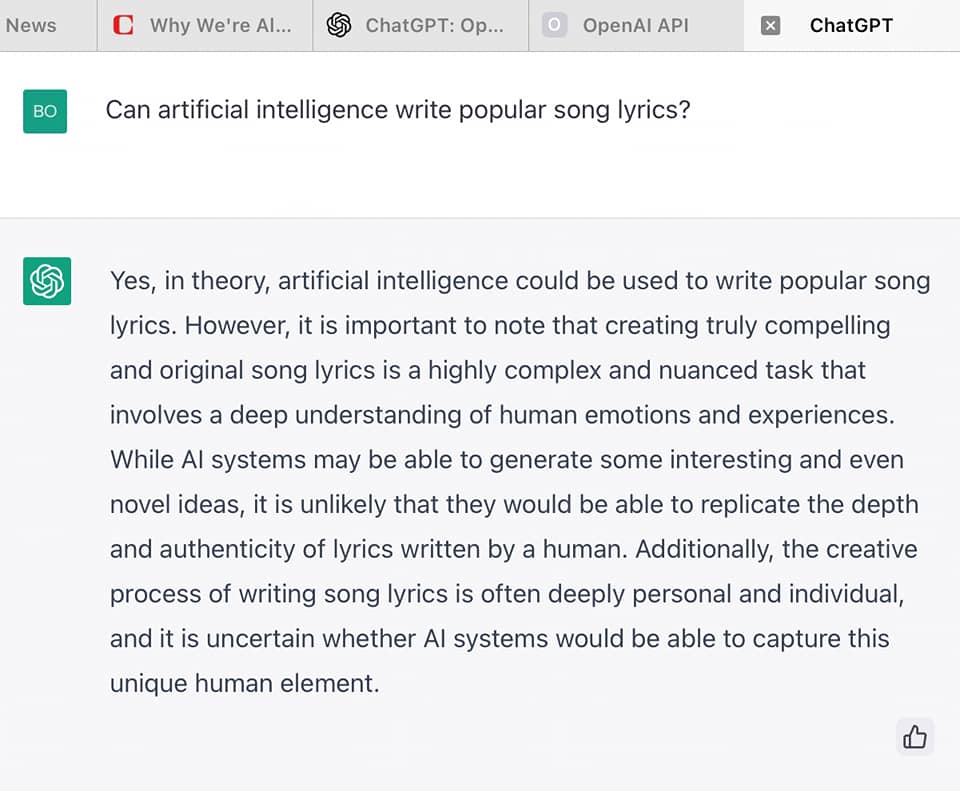
I asked OpenAI ChatGPT the following:
ME:
Can artificial intelligence analyze a prose argument?

ChatGPT:
Yes, artificial intelligence (AI) can be trained to analyze prose arguments to some extent. However, the extent to which AI can effectively analyze prose arguments will depend on various factors, such as the quality and amount of training data the AI has been given, the specific AI model being used, and the complexity and nuances of the argument being analyzed.
I'll have to see if I can provide it an "argument," and instruct it to analyze and evaluate it. Skeptical. but, we'll see.

See some of my prior riffs on "AI" topics more generally here.

UPDATES

More from The Atlantic piece.
A chasm has existed between humanists and technologists for a long time. In the 1950s, C. P. Snow gave his famous lecture, later the essay “The Two Cultures,” describing the humanistic and scientific communities as tribes losing contact with each other. “Literary intellectuals at one pole—at the other scientists,” Snow wrote. “Between the two a gulf of mutual incomprehension—sometimes (particularly among the young) hostility and dislike, but most of all lack of understanding. They have a curious distorted image of each other.” Snow’s argument was a plea for a kind of intellectual cosmopolitanism: Literary people were missing the essential insights of the laws of thermodynamics, and scientific people were ignoring the glories of Shakespeare and Dickens.

The rupture that Snow identified has only deepened. In the modern tech world, the value of a humanistic education shows up in evidence of its absence. Sam Bankman-Fried, the disgraced founder of the crypto exchange FTX who recently lost his $16 billion fortune in a few days, is a famously proud illiterate. “I would never read a book,” he once told an interviewer. “I don’t want to say no book is ever worth reading, but I actually do believe something pretty close to that.”…
Ahhh... C.P. Snow. I've riffed on him before here.

Also, the best place to hide $16 billion from our liitle a-literate Genius pal Sam Bankman-Fried is apparently inside a book. 
 
"The Beast."
 
OK, THIS IS CUTE
 
Scott Singeisen, a “Professor of architecture” posts a Twitter thread in reaction to The Atlantic article:
Me:
Write a well argued response to Stephen Marche’s recent essay in @TheAtlantic that AI will make the college essay obsolete

ChatGPT:
Stephen Marche's essay in the Atlantic argues that AI will make the college essay obsolete. However, this claim is not well-supported and is ultimately not convincing.

First of all, it is important to note that the college essay serves a specific purpose in the admissions process. It allows admissions officers to get a sense of the applicant's personality, writing abilities, and potential fit for the institution. AI, on the other hand, is not capable of providing this type of insight. While AI may be able to analyze data and generate texts, it cannot replicate the human experience and provide the same level of depth and understanding that a college essay can.

Furthermore, the use of AI in the admissions process raises concerns about fairness and bias. AI systems are only as good as the data they are trained on, and if the training data is [sic] biased, the AI will also be biased. This could lead to admissions decisions that are unfair or that do not accurately reflect an applicant's abilities and potential.

Additionally, the use of AI in the admissions process could potentially widen the gap between students from different backgrounds. Students from disadvantaged backgrounds may not have access to the same resources and support as their more privileged peers, leading to a disadvantage in the admissions process.

In conclusion, while AI may have the potential to assist in the admissions process, it is not capable of replacing the college essay. The college essay serves a specific purpose in the admissions process and is an important tool for admissions officers to evaluate applicants. The use of AI also raises concerns about fairness and bias, and could potentially widen the gap between students from different backgrounds.
I'm gonna have to play with some of this stuff. 
 
I'm lucky. I never needed AI NLG "help" when it came to writing—prose or song lyrics. Likely has something to do with the 2-3 books a week (plus all of my periodicals) I've studied across my-now 55 years of "adult" life since turning 21. Ya think?

 Stephen Marche:

"[N]atural-language processing is going to force engineers and humanists together. They are going to need each other despite everything. Computer scientists will require basic, systematic education in general humanism: The philosophy of language, sociology, history, and ethics are not amusing questions of theoretical speculation anymore. They will be essential in determining the ethical and creative use of chatbots, to take only an obvious example…"

Yeah, And, don't forget the lawyers. Never overlook the lawyers, lest you come to rue the day.

MORE UPDATES
Click

Click
OK, WHAT ABOUT THIS CRAP?
 
 
Ugh... 

CODA
 
 
My latest login. The popularity of ChatGPT is melting their servers. 
 

Wednesday, July 12, 2017

Webinar on Natural Language Processing in health care

On my calendar today. Saw this on Facebook and signed up.

Company link
DEMYSTIFYING TEXT ANALYTICS AND NLP IN HEALTHCARE

Over the past ten years, we have seen a wave of EMR implementations and quality reporting initiatives which have sought out those discrete, reportable data elements which can be used for clinical analytics. However, many more crucial pieces of information that we would like to use for analytics are trapped in radiology reports, clinician notes and other free text fields. A few examples illustrate the point. Ejection fraction data for heart failure patients is embedded in diagnostic test reports and physician notes. A cancer diagnosis resides in the problem list, but the stage and tumor size is often found only in the pathology report. Even in quality reporting used by payers, dozens of data elements are only found in notes. As a result, most health systems employ clinical chart abstractors and nurses to manually hunt through this free text content for critical pieces of information required for reporting on clinical performance.

Today, advancements in technology have made it possible to develop accurate, faster, more scalable alternatives to a manual chart extraction process, and in this webinar, we will review the core capabilities of the software that is used to search text along with the key natural language processing (NLP) techniques that allow teams to effectively analyze the free text found in clinical systems.
Interesting. I recently finished a full cardiology workup comprised of EKG's, a treadmill stress test, and a lengthy cardiac ultrasound px. The diagnostic meat of the ultrasound in particular was all contained in the lengthy text narrative "impression" write-up.

See my prior riffs on NLP here and here.


I've now completed a good bit of background study spanning some of these topics -- AI-related stuff involving Machine Learning, Deep Learning, Natural Language Generation (NLG), Natural Language Understanding (NLU, the far more difficult area), Linguistics generally, and Computational Linguistics specifically.


Based on my readings thus far, my answer to the question "might NLP/AI applications be used to accurately analytically parse the logic in textual arguments?" is "rather unlikely at this point, at least with respect to arguments of significant heft and complexity" (see, e.g., my 1994 "Single Payer proposal" deconstruction). Perhaps some braniac scholar in Computional Linguistics could take it on as a doctoral investigation, but I think the difficulties are too daunting for any relatively quick commercial turnaround of the concept -- given that market interest in such an application might be rather narrow. Moreover, I envision the type of random inaccuracies that dogged the earlier releases of Google Translate.

I could be wrong.
__

BTW: Some useful contextual background going to "textual analysis NLP in Health IT" is in my prior post "Are structured data the enemy of health care quality?"

POST WEBINAR UPDATE
Time well-spent (only an hour, including Q&A), though I did have a bit of an "old wine in new bottles" reaction (with a dash of "Gartner Hype Cycle"). Teasing out quantitative (or mixed "semi-quantitative") "data" from unstructured chart narratives/documents is not exactly a new idea, as I've noted before (e.g., it was a topic in the 2005-2008 DOQ-IT Meaningful Use precursor era) -- notwithstanding that the search engines/query tools (as we ought expect) are getting much better. The presenters noted that this emerging "text analytics/NLP" methodology still requires multidisciplinary SME (Subject Matter Expertise) -- e.g., clinicians, informaticists, and "data architects." We're not at the point of just hitting 'Enter' and let the AI do everything for us all the way to dx and/or prognosis derivation or aggregate reportage. This type of process remains more heuristic than algorithmic. Adroit (iterative and recursive) Boolean searching is at once science and art, not yet fully AI mechanistic. Among my takeaways was that they were describing a "computer-assisted, episodically SME human intermediated process." All well and good, but a bit of a stretch to fully call it "AI NLP."
One favorable reality, though, is that "text" is pretty much just text (e.g., mostly ASCII collating std). Consequently, some of the barriers that dog "interoperability" (the "interoperababble" of my "metadata heterogeneity" snark) are of lesser concern. The other favorable thing is the relative narrow range of formatting of clinical "narrative" discourse relative to that of general language communication.
Notably, among deployable clinical experts, they alluded to the utility of "nurse abstractors" for the "data validation" phase. I found that interesting. Back during my first Medicare QIO tenure (1993-1995, called "PROs" back then), we routinely sent teams of laptop-lugging nurse abstracters out to hospitals to collect clinical data for drill-down projects indicated by our UB-82 Claims Forms data analytics (pdf).
Nice downloadable 24-slide deck available to today's webinar registrants. Marked "© 2017 Private and Confidential" on every slide, so I'll refrain from showing anything here.
One slide I will show,


Click to enlarge. I'd love to go to that. Back during the DOQ-IT era, we'd go to the "TEPR" Conference in SLC every year ("Toward an Electronic Patient Record").
___

Also perhaps of topical relevance (albeit sometimes a bit tangential?), from a current read of mine, going to the salient elements of accurate medical diagnostics:

For all of the sophisticated diagnostic tools of modern medicine, the conversation between doctor and patient remains the primary diagnostic tool. Even in the fields that are visually based, such as dermatology, or procedurally based, such as surgery, the patient’s verbal description of the problem and the doctor’s questions about it are critical to an accurate diagnosis.

In some ways this seems almost anachronistic, given how advanced so much of our technology is now. Science-fiction movies predicted that medical diagnosis would be achieved by running a handheld machine over the patient’s body. And indeed much diagnosis is made with MRIs, PET scans, and advanced CT technology. Yet the simple verbal exchange between patient and doctor remains the cornerstone of medical diagnosis. The story the patient tells the doctor constitutes the primary data that guide diagnosis, clinical decision-making, and treatment.

However, the story the patient tells and the story the doctor hears are often not the same thing. The story Mr. Amadou was telling me and the story I was hearing were not identical. There were so many layers of emotion, frustration, logistics, and desperation, that it was almost as if we were in two different conversations entirely.

It is a common complaint of patients. They feel their doctors don’t really listen, don’t hear what they are trying to say. Many patients leave their medical encounters disappointed and frustrated. But beyond being merely dissatisfied, many patients leave misdiagnosed or improperly treated.

Doctors are equally frustrated with the difficulties of piecing together a patient’s story, especially for those with complex and inscrutable symptoms. As medicine grows more complicated, with illnesses more multifold and complex, the gap between what patients say and what doctors hear—and vice versa—grows more significant...
[

Ofri, Danielle. What Patients Say, What Doctors Hear (Kindle Locations 98-112). Beacon Press. Kindle Edition.]

We typically think of communication as the words exchanged when doctors and patients are seated across from one another at a desk during the “history” part of the visit. True, this is the bulk of communication and certainly the bulk of what communications researchers focus on, but over the years I’ve come to appreciate that a good deal of communication and connection arises during the physical exam. When I mention this observation, many people—both doctors and patients—are unconvinced. Who wants to chitchat after disrobing and having your body probed by a relative stranger in a room that feels like a meat locker? Who has time, anyway, for a real physical exam when there is so much to document in that electronic medical record and so little time?

So yes, there’s less and less physical examination these days. Visits are shorter and competing issues wrench away precious minutes. The ease and temptation of CTs and MRIs, the constant fear of lawsuits, and—let’s face it—the atrophy of our skills push doctors toward ordering more tests at the expense of a true physical exam. Often, the exam boils down to a halfhearted plop of the stethoscope on the fully clothed patient. I have been equally guilty of rushing through a pro forma physical exam when the pressure is on. And, in any case, the exam primarily serves as an adjunct to confirm or rule out a diagnosis that was ascertained in the history.

Doctors typically don’t like to talk about their truncation of the physical because it stirs an awkward mix of guilt and longing within us. We recall wistfully our rounds as students, when our bow-tied and starched-coated attendings unhurriedly probed every fingernail, meticulously percussed the cardiac contours, palpated the epitrochlear lymph nodes. We feel we are remiss with our current patients, that we are skimping on what has always been the sine qua non of the doctor-patient connection.

A decade ago people were predicting the permanent demise of the physical exam. Luckily there’s been a resurgence of interest in the physical because it can obviate the need for many expensive tests.

In the past few years I’ve observed that the physical exam has taken on an important role again, though as a slightly different medical tool. Now that the computer is front and center in almost every doctor-patient encounter, doctors spend the bulk of the visit staring at a screen. Not only are our eyes yanked away from the patient, but our attention is fragmented by the disjointed and niggling nature of the typical computer interface. It’s no wonder patients feel ignored by their doctors.

But then the doctor and patient move to the exam table and everything changes. This is often the first moment that we can talk directly, without the impediment of technology...
[ibid, Kindle Locations 446-466]

There were only small tangential studies about how much doctors recall of the information they read in medical journals (embarrassingly little) or how well they remember clinical information from a fictionalized case study (full-fledged doctors do better than medical students), but nothing with real patients.

There is one real-life experiment regarding physician memory that happens, unfortunately, a little too regularly. Electronic medical records have been revolutionary in many respects—a patient’s chart can no longer be adrift in the cardiology clinic and a crucial X-ray can’t be languishing in a surgeon’s back pocket. However, by dint of being computerized, such information is susceptible to the same glitches as every other bit of computerized material. In the middle of writing your Tolstoy-worthy note about a patient with sixteen illnesses, the computer freezes, or the program crashes, or you inadvertently hit “escape” or “delete” at an inopportune moment, and all of your carefully wrought observations evaporate into the ether.

At least once a day, it seems, a medical student or intern will turn up, ashen-faced, stammering with incomprehensibility about the note they just lost, about all their efforts that just went up in smoke. Even the old hands at the hospital, who’ve learned the electronic landmines in trial-by-fire experience, are not immune. Recently I’d been writing a particularly complicated note about a patient with multiple chronic illnesses who was on more than a dozen medications and had numerous lab values out of whack, when I was interrupted by a phone call about an abnormal X-ray for a different patient. I had to open that patient’s chart to untangle that issue. After sorting through that second patient’s medical history and what to do about the X-ray, I went to close the second chart so I wouldn’t commit the cardinal sin of mixing up two charts.

It took only a fraction of a second. Before I’d even released my finger from the mouse, I realized I’d closed the wrong tab. I kept my finger depressed on the mouse as long as I could, hoping that I could will that brief gesture into reverse, that I could telepathically conjure the information back onto the screen. When my irrational hopes could be sustained no longer and the boulder of despair had fully dropped anchor into my deepest bowels, I released my finger in agonizing slow motion.

I remained in vigorous denial for as long as I could, but finally my brain was forced to articulate what I already knew in my heart: I’d just lost everything. (And if you thought our vaunted electronic medical-record system would have something practical like auto save to prevent such a mess, dream on!)

I’d lost all the information I’d taken down while the patient was in the room. I’d lost all the analysis I’d been writing after she’d left the room. (She was a new patient, so I’d done an extensive background history.) I’d lost all of the details of her prior medical evaluations. I’d lost my entire train of thought about her because I’d been forced to delve into another patient’s medical history...
[ibid, Kindle Locations 2004-2027]


When I talk to the students and interns whom I’ve coached through similar electronic meltdowns, they have comparable experiences. The HPI and social history are the quickest to reformulate; other details can be sketchier. When I think about this from a literary perspective, the reason is obvious. The HPI is a story—there is a plot with twists and turns, challenges and conflicts. Stories are always easier to remember than lists of facts. And the social history is what writing teachers refer to as “fleshing out the character.” Without the social history, the patient is just a stock character. A thirty-two-year-old woman with abdominal pain is as much a stock character in medicine as the tragic hero or the Southern belle or the wise old man are stock characters in fiction. These are stick figures until the writer fleshes them out to become Orpheus, Blanche DuBois, or Albus Dumbledore. They are now three-dimensional and realistic human beings who lodge themselves in our memories. And while the social history in the medical interview doesn’t allow us the hundreds of pages that Tennessee Williams or J. K. Rowling can luxuriate in, it does permit us to get a fuller sense of our patients and some context of their lives. I may have forgotten what this patient’s diastolic blood pressure was, but I could never forget the pained expression on her face when she spoke of how her job made her miss reading bedtime stories to her daughter each night and how she wasn’t confident that the babysitter was reliably reading those stories to her daughter, who so needed the extra enrichment... [ibid, Kindle Locations 2054-2065]
Stay tuned.

UPDATE

The company's pitch video:


Nicely done. As is this one, below:

__

JULY 14TH UPDATE

They've published the webinar to YouTube. No warning notice of it being "private," so, here it is.

__

OF NOTE

My July issue of Science Magazine just arrived in the snailmail.


Numerous articles on AI applications across a breadth of scientific disciplines.
EDITORIAL
AI, people, and society
Eric Horvitz


n an essay about his science fiction, Isaac Asimov reflected that “it became very common…to picture robots as dangerous devices that invariably destroyed their creators.” He rejected this view and formulated the “laws of robotics,” aimed at ensuring the safety and benevolence of robotic systems. Asimov's stories about the relationship between people and robots were only a few years old when the phrase “artificial intelligence” (AI) was used for the first time in a 1955 proposal for a study on using computers to “…solve kinds of problems now reserved for humans.” Over the half-century since that study, AI has matured into subdisciplines that have yielded a constellation of methods that enable perception, learning, reasoning, and natural language understanding.

Growing exuberance about AI has come in the wake of surprising jumps in the accuracy of machine pattern recognition using methods referred to as “deep learning.” The advances have put new capabilities in the hands of consumers, including speech-to-speech translation and semi-autonomous driving. Yet, many hard challenges persist—and AI scientists remain mystified by numerous capabilities of human intellect.

Excitement about AI has been tempered by concerns about potential downsides. Some fear the rise of superintelligences and the loss of control of AI systems, echoing themes from age-old stories. Others have focused on nearer-term issues, highlighting potential adverse outcomes. For example, data-fueled classifiers used to guide high-stakes decisions in health care and criminal justice may be influenced by biases buried deep in data sets, leading to unfair and inaccurate inferences. Other imminent concerns include legal and ethical issues regarding decisions made by autonomous systems, difficulties with explaining inferences, threats to civil liberties through new forms of surveillance, precision manipulation aimed at persuasion, criminal uses of AI, destabilizing influences in military applications, and the potential to displace workers from jobs and to amplify inequities in wealth…
Yeah. I've had recurrent runs at some of these topics of concern. See, e.g., here , here, and here.

Nice, brief core AI glossary in the issue.
Defining the terms of artificial intelligence 
Just what do people mean by artificial intelligence (AI)? The term has never had clear boundaries. When it was introduced at a seminal 1956 workshop at Dartmouth College, it was taken broadly to mean making a machine behave in ways that would be called intelligent if seen in a human. An important recent advance in AI has been machine learning, which shows up in technologies from spellcheck to self-driving cars and is often carried out by computer systems called neural networks. Any discussion of AI is likely to include other terms as well.

ALGORITHM A set of step-by-step instructions. Computer algorithms can be simple (if it's 3 p.m., send a reminder) or complex (identify pedestrians).

BACKPROPAGATION The way many neural nets learn. They find the difference between their output and the desired output, then adjust the calculations in reverse order of execution.

BLACK BOX A description of some deep learning systems. They take an input and provide an output, but the calculations that occur in between are not easy for humans to interpret.

DEEP LEARNING How a neural network with multiple layers becomes sensitive to progressively more abstract patterns. In parsing a photo, layers might respond first to edges, then paws, then dogs.

EXPERT SYSTEM A form of AI that attempts to replicate a human's expertise in an area, such as medical diagnosis. It combines a knowledge base with a set of hand-coded rules for applying that knowledge. Machine-learning techniques are increasingly replacing hand coding.

GENERATIVE ADVERSARIAL NETWORKS A pair of jointly trained neural networks that generates realistic new data and improves through competition. One net creates new examples (fake Picassos, say) as the other tries to detect the fakes.

MACHINE LEARNING The use of algorithms that find patterns in data without explicit instruction. A system might learn how to associate features of inputs such as images with outputs such as labels.

NATURAL LANGUAGE PROCESSING A computer's attempt to “understand” spoken or written language. It must parse vocabulary, grammar, and intent, and allow for variation in language use. The process often involves machine learning.

NEURAL NETWORK A highly abstracted and simplified model of the human brain used in machine learning. A set of units receives pieces of an input (pixels in a photo, say), performs simple computations on them, and passes them on to the next layer of units. The final layer represents the answer.

NEUROMORPHIC CHIP A computer chip designed to act as a neural network. It can be analog, digital, or a combination. PERCEPTRON An early type of neural network, developed in the 1950s. It received great hype but was then shown to have limitations, suppressing interest in neural nets for years.

REINFORCEMENT LEARNING A type of machine learning in which the algorithm learns by acting toward an abstract goal, such as “earn a high video game score” or “manage a factory efficiently.” During training, each effort is evaluated based on its contribution toward the goal.

STRONG AI AI that is as smart and well-rounded as a human. Some say it's impossible. Current AI is weak, or narrow. It can play chess or drive but not both, and lacks common sense.

SUPERVISED LEARNING A type of machine learning in which the algorithm compares its outputs with the correct outputs during training. In unsupervised learning, the algorithm merely looks for patterns in a set of data.
TENSORFLOW A collection of software tools developed by Google for use in deep learning. It is open source, meaning anyone can use or improve it. Similar projects include Torch and Theano.

TRANSFER LEARNING A technique in machine learning in which an algorithm learns to perform one task, such as recognizing cars, and builds on that knowledge when learning a different but related task, such as recognizing cats.

TURING TEST A test of AI's ability to pass as human. In Alan Turing's original conception, an AI would be judged by its ability to converse through written text.
Notable to me is that the word "HEURISTIC" is not included. Human (brain "wetware") perception/cognition is way more inductive/heuristic than deductive/algorithmic.

apropos, another new read in my stash:

__
JULY 13TH OFF-TOPIC ERRATUM

One of my Facebook friends, a physician, is pumping this every day.

WHY MEDICARE FOR ALL?

The United States is the only country in the developed world that does not guarantee access to basic health care for residents. Countries that guarantee health care as a human right do so through a “single-payer” system, which replaces the thousands of for-profit health insurance companies with a public, universal plan.


Does that sound impossible to win in the United States? It already exists – for seniors! Medicare is a public, universal plan that provides basic health coverage to those age 65 and older. Medicare costs less than private health insurance, provides better financial security, and is preferred by patients (Davis, 2012). Single-payer health care is often referred to as “Expanded & Improved Medicare for All.”

Under the single-payer legislation in Congress (H.R. 676):

  • Everyone would receive comprehensive healthcare coverage under single-payer;
  • Care would be based on need, not on ability to pay;
  • Employers would no longer be responsible for health care costs and coverage decisions.
Single-payer would reduce costs by 24%, saving $829 billion in the first year by cutting administrative waste and allowing negotiation of prescription drugs (Friedman, 2013); and

Single-payer would create savings for 95% of the population. Only the top 5% would pay slightly more. (Friedman, 2013)
 Recall I did my first grad school paper on the Single Payer proposal in 1994 (pdf).

See also PNHP.org, "Physicians for a National Health Program."

Much of my prior post is of relevance here.

Also apropos, a great post now up at THCB:
The Most Important Questions About the GOP’s Health Plan Go Beyond Insurance and Deficits
By ROSS KOPPEL and JASMINE MARTINEZ


Ending healthcare for those who need it will not make them or their problems disappear. On the contrary, the GOP plan will shatter American families and the economy. Nothing magical happens if we stop caring for the elderly, the ones who need vaccinations, the small infections that can be treated for $2 worth of antibiotics, the uncontrolled diabetics, and those with contagious diseases who clean our schools’ offices and homes. They don’t just get healthy.

As George Orwell said in Down and Out in Paris and London, “the more one pays for food, the more sweat and spittle one is obliged to eat with it.” Cutting care only exacerbates illnesses, infection, disability, the effects of age and the costs to society. The burdens continue or increase but the cost is shifted to American families, businesses, and states.

Fifteen years ago, one of the authors showed that lost productivity from workers caring for Alzheimer’s patients cost US businesses over $60 billion a year. Employee-caregivers, usually at the peak of their responsibilities and corporate experience, quit, prematurely retired, were constantly distracted, or engaged in presentism (e.g., at work but focused on mom burning down the house). Business cost were incurred by the need to replace workers, extra training of replacement workers, and increased pressure on other workers to cover for caregivers. The more expensive the employee, the longer and more costly the search and the longer the time to get them up to speed. But that study examined just a miniscule number of patients and workers compared to the tens of millions of people affected by the proposed GOP bill. As noted, it’s not only those needing care, but our society and our families that must deal with the elderly, ill, disabled, under and uninsured, children not receiving even ordinary care, people not being screened for preventable illness, and countless others.

Extrapolating from Koppel’s tiny study to the US population and businesses reveals the GOP bill will cost the nation trillions of dollars in losses and extra costs. It will devastate state budgets, and explains why GOP governors are among those leading the resistance…
Read all of it.

CODA

'Access to broadband “is, or soon will become, a social determinant of health.”

What? From "How AI could exacerbate existing health disparities."
____________

More to come...