Search the KHIT Blog

Showing posts with label logic. Show all posts

Friday, November 14, 2025

So, I asked Gemini AI "What are the fundamentals of logical reasoning in ordinary language?"

This is what it spit back in 2-3 seconds. 
Logical reasoning in ordinary language is the process of using everyday language to analyze information and construct or evaluate arguments in a rational, systematic way. It involves identifying the structure of arguments, distinguishing good reasoning from bad, and recognizing potential flaws like logical fallacies. 

Core Concepts
* Arguments: The fundamental unit of logical reasoning, consisting of a set of premises(facts or assumptions) that provide reasons to accept a conclusion.
* Inference: The logical connection or bridge that links the premises to the conclusion. Reasoning is the activity of drawing these inferences.
* Validity: A characteristic of a deductive argument's structure where if the premises are true, the conclusion must be true. Validity depends on the form, not the actual truth of the premises.
* Soundness: A sound argument is one that is not only valid but also has factually truepremises.
* Strength/Cogency: These terms apply to inductive arguments. A strong argument makes the conclusion likely or probable, but not certain.
* Assumptions/Hidden Premises: Unstated beliefs or premises that are necessary for an argument to reach its conclusion. Identifying these is crucial for evaluation.
* Fallacies: Common errors or defects in reasoning that weaken an argument or make it deceptive, even if it seems persuasive on the surface (e.g., "begging the question", "hasty generalizations"). 

Types of Reasoning
Logical reasoning broadly includes several types, which differ in their goals and the certainty of their conclusions: 

Type of Reasoning    Description    Certainty of Conclusion    Example in Ordinary Language
Deductive    Moves from general principles to a specific conclusion.    Guaranteed (if premises are true and valid)    "All humans are mortal. Socrates is a human. Therefore, Socrates is mortal."
Inductive    Moves from specific observations to a broader generalization or hypothesis.    Probable/Likely, but not certain    "Every time I've observed adult stem cells, they've treated patients successfully. Therefore, adult stem cells may be an ideal source for clinical therapy."
Abductive    Starts with an incomplete set of observations and proceeds to the likeliest possible explanation (a "best guess").    Best possible explanation at the time    A doctor making a diagnosis based on a limited set of symptoms.
Practical Application
In everyday language, logical reasoning skills empower individuals to:
* Analyze texts and arguments effectively.
* Construct strong, coherent arguments in writing and discussion.
* Identify biases and flaws in others' reasoning.
* Make
informed decisions and solve problems more effectively in various contexts, from personal life to professional fields like law, science, and computer programming. 
To improve these skills, practice is essential, including breaking down arguments...
Not bad, for starters. Of course, I already knew the material. having first taught it nearly 30 years ago. So, I was just "AI-curious."
 
Interesting topical video below:
 

 See my prior post from a cou[le of days prior.
 
Just getting re-started,,,
 

Monday, November 10, 2025

"Thinking critically?"

 
I got to teach collegiate "critical thinking" for 5 fun years while living in Las Vegas (evening school adjunct faculty; my day gig was that of a credit risk analyst in a bank). I never really liked the curricular title. I'm likewise guarded about cavalierly using the word "idiot."
Too many of my students came in thinking "oh, cool, we're just gonna argue about stuff endlessly and get our gripes off our chests..." 

Also, "idiot" is not a dtrect synonym for "stupid," notwithstanding common invective usage. Greek "idios," aware of only one's self. Yeah, one could argue that such egocentric fixations are "stupid:" I suppose, but, dunno, brosdly.
Stay tuned... 
 
UPDATE
 
Will have to get back to this. Cleto Escobedo III just died.

Tuesday, September 9, 2025

"The SCIENCE of Storytelling?"

"He / she with the best story WINS!**
 
 
OK, I was just randomly surfing around on Pinterest today. Ran across this touted book. They have no ongoing shortage of "The Science of ______________" books. Reflexive dubiety ensued. Never heard of this writer.
 
Nonetheless, I checked (I have literary OCD). Thus far, glad I did.
 
** The foregoing blog post title tagline goes to my 1985 UTK undergrad Senior Seminar in Psychology of Law. A trial attorney guest speaker offered that "best stoory" observation. He was right.
Years later, during my tenure as an undergrad evening school faculty "Critical Thinking" instructor, I'd echo that point broadly. "What if your evidence is dis.ositive and your logic is bulletproof, yet you remain unpersuasive? What have you really accomplished?" In other words, we need to "sell" our assertions using good stories. “One death is a tragic story. 500,000 deaths from COVID-19 is a statistic.“
 
Who is this?
Prior stuff: On being persuasive/influential.  On "The Fluency Bias."  Hmmm... how about some "abductive inference" for dessert?

ON DECK
 
More "the science of _______________" stuff.
 

I subscribe to this academic institute. I get their updated email newsletters all the time. The Dr. Berman book was cited in the latest.
 
Stay tuned... 

Friday, May 3, 2024

"It doesn't matter what’s true." Schemas predominantly matter in political discourse.

What?
  
   
OK, gotta admit, I'm now a major-league Brian Klaas Fan Boy in the wake of reading his book.
 

Zuck was right. "Young people are just smarter."

Well, some of them.
 
So, Brian has a Substack (of course). I subscribed (and paid, notwithstanding my prevailing dubiety; it's a wimpy authoring platform, generally). 

I ran across this today.
Schemas and the Political Brain
Understanding how cognitive shortcuts work when processing new information is crucial to understanding modern politics—and it's a facet of cognition that Republicans manipulate extremely effectively.

Republicans have battered Democrats on messaging in recent years because they intuitively understand schemas in a way that Democrats often don’t.

What is a schema?

The word schema comes from the Greek schēmat or schēma, which means “form.” But the concept in its modern usage refers to patterns of thought that provide intellectual shortcuts for processing the information we encounter in our lives. Think of it a bit like your brain’s organizational system, which structures our knowledge, old and new. To organize vast quantities of data, we need to sort everything into categories and patterns, with simplified assumptions.

The whole world we experience is, in a sense, a giant set of data. When you go for a walk, the amount of data your brain encounters is overwhelming—the shade of color on every leaf, the patterns of cracks on the sidewalk, the faces of every person you encounter, what they’re wearing, and whether they smiled at you as you went past.

It would be impossible for your brain to process and retain all that information, particularly because most of it provides little value to you. You don’t need to recall in vivid detail whether a random woman you once walked past was wearing a hat or not. As a result, the brain does a bit of intellectual triage, where most of the information we process about the world is culled and discarded. It’s a highly efficient way of dealing with and navigating an immeasurably complex world. Our brains have evolved to process information this way because it helps us survive, able to retain what matters and forget what doesn’t...
Yeah, heuristics & stuff. Type I & Type II thinking, etc. 
 
Brian sums up...
How to use schemas

The lesson, then, is not that fact-based arguments are meaningless in politics, but rather that facts are most effective when they’re nestled within a ready-made intellectual framework for how to make sense of the world. Effective political movements use facts to reinforce schemas, but they understand that the schemas are what matter most. It’s a depressing truth, but getting the right taglines, slogans, and vivid ways of presenting political opponents is often far more important than being right.

So, if Democrats want to loosen Trump’s grip on the modern GOP, then the messaging needs to match the audience, while recognizing the schemas that Trump’s voters are using to process reality. Democrats can shout from the rooftops about how Trump is a racist authoritarian tax dodger who poses an existential threat to American democracy (facts that are certainly worth repeating!). But no matter how loudly those arguments are repeated, voters in the GOP base use schemas that simply don’t have a place for those facts. They’ll ignore them, dismiss them, contort themselves with brain gymnastics until they end up in a position where they remain comfortable within their existing cognitive framework.

What’s more likely to be effective to sway the MAGA base is to brand Trump as a loser, partly because that does fit with Republican schemas, and partly because it’s a direct attack on the schema that Trump has tried to cultivate for himself for his entire life — that he’s a winner who lives in a golden penthouse, a strategic genius who always ends up on top.

If you really want to destroy someone in politics, don’t attack them with a barrage of facts and decimal points, change the fundamental way that their own supporters perceive them. The path to political victory runs, to an astonishing degree, through psychology and neuroscience. That way true power lies.
OK. lots to remark upon. Goes to a lot of prior topics here. to wit,


Having to go back and re-study this beaut.

  
Kathryn rocks.
 
This delightful person (a Twitter/X fellow-traveler) started me down this latest rabbit hole.
  
Click
to wit,
Click
2 Core Rules:
The fallibilist rule: No one gets the final say. You may claim that a statement is established as knowledge only if it can be debunked, in principle, and only insofar as it withstands attempts to debunk it.

The empirical rule: No one has personal authority. You may claim that a statement has been established as knowledge only insofar as the method to check it gives the same result regardless of the identity of the checker, and regardless of the source of the statement.

10 Commitments:
Fallibilism
The ethos that any of us might be wrong thus we strive to keep our ideas open to criticism.

Objectivity
Understanding that truth is not based on feeling, identity, or a person's/group’s lived experience.

Exclusivity
A commitment to the idea of objective reality because what lies beyond that is chaos.

Disconfirmation
A commitment that all ideas and viewpoints are subject to challenge by the community.

Accountability
A commitment to offering our ideas for critique in good faith and acknowledge when we’re wrong.

Pluralism
Valuing viewpoint diversity and a commitment to encourage, and seek it out.

Civility
A commitment to discourage and avoid personal attacks and, instead, depersonalize rhetoric.

Professionalism
A commitment to valuing the credentials and reputations of this reality-based community.

Institutionalism
A commitment to valuing and relying upon established norms and codes of conduct.

No Bullshitting
A commitment to sincerely regard the truth instead of obscuring it.
Well, "scientific method," anyone?  Likin' the "civility" reference in particular. "Pluralism?" I'm in, notwithstanding its political contentiousness of late (e.g., DEI).

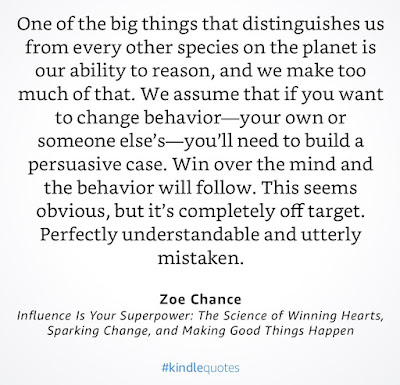
These topics also have me recalling the excellent work of Zoe Chance.

More shortly...
_________
  

Wednesday, May 3, 2023

"Deliberation Science?" A Creative Commons cross-post

Respectful persuasion is a relay race, not a solo sprint – 3 keys to putting it in practice

Sure, you can try to force people to agree with you–
but respectful persuasion is something else.
Andrii Yalanskyi/iStock via Getty Images Plus

Colin Marshall, University of Washington

The 2024 presidential election is still a year and a half away, but it can feel much closer: President Joe Biden has made his reelection bid official, presumed candidates are giving out-of-state speeches, pundits are already weighing in on nomination hopefuls, and social media is, as ever, a mess of people trying to persuade strangers to back their favorite. All for good reason: Even a little political persuasion in the next year could change the course of history.
 
I’m a philosopher who studies and teaches the ethics of persuasion. My students are eager to find ways to persuade their friends, family and neighbors about political issues such as climate change and abortion. Moreover, many of them want to persuade with integrity: They want to engage the people they’re talking with respectfully, instead of using the manipulative tricks they regularly see in politics and marketing. But what is respectful persuasion, and what distinguishes it from disrespectful manipulation?
 
There’s no simple formula for respectful persuasion. However, some philosophers see crucial hints in the work of 18th-century philosopher Immanuel Kant, whose theory of respect has guided many ethicists and policymakers for the past two centuries.
 
Drawing on Kant’s work, and that of other philosophers inspired by him, I think we can isolate three key components of respectful persuasion. This isn’t just an academic exercise. My students and I have found that these factors increase the chances of deep, meaningful conversation.

1. Giving reasons

Broadly speaking, reasons are considerations that rationally support some belief or action, including both empirical evidence and abstract arguments. For example, astronauts’ pictures of a round Earth rationally support the belief that the Earth is round. When we sincerely give someone reasons, we show respect for their rationality: their ability to recognize good reasons. 
 
By contrast, a hallmark of manipulation is bypassing rationality, such as repeatedly exposing people to false statements to make them appear true – something that psychologists call the “illusory truth effect.”
 
Manipulation can be effective, but psychologists have found that persuasion using reasons is more durable than nonrational persuasion such as repetition-based tricks. For example, someone who comes to believe in climate change based on the scientific evidence probably will not be as easily swayed later on by repeated exposure to climate skepticism. The rational support that good reasons provide for a belief can make that belief more stable.

2. Being open to learning

Giving reasons is not difficult by itself. The second component of respectful persuasion, however, is much more challenging: being open to receiving the other side’s reasons – a form of intellectual humility. This is especially hard for persuaders, since they have to give up some of the time they would have used to make their case.
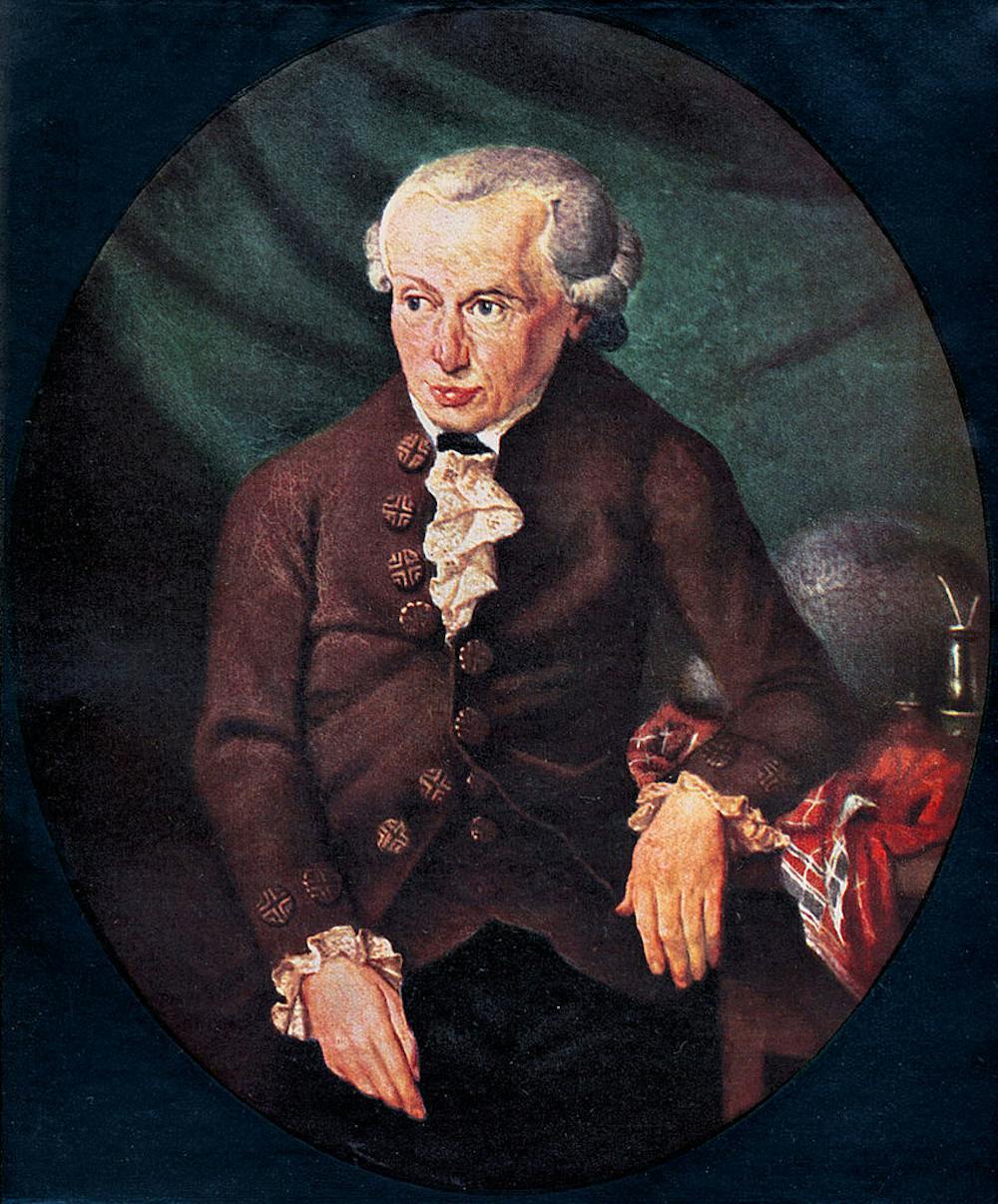
A centuries-old painting of a serious-looking seated man in a powdered wig and brown suit.
Kant’s ideas about respect are still helpful for thinking through sticky situations today.
Culture Club/Hulton Archive via Getty Images
Kant expressed this core idea nicely. Even someone encountering a person whose opinion seems obviously wrong, Kant wrote, has “a duty … to suppose that his judgment must yet contain some truth and to seek this out.” This isn’t merely a suggestion to listen to people one wants to persuade. Instead, respect demands actively seeking out truth in what the other person says. 
 
In fact, some studies suggest that intellectual humility makes people better able to evaluate the strength of arguments. This means that intellectually humble people may be more likely to recognize that a persuader’s arguments are actually better than their own, and have to reconsider their views – which can pose a real risk to someone’s self-esteem.
 
But being open to other people’s reasons also increases the chance of their being open to yours – a form of reciprocity in which you take turns learning from each other. Decades of psychological research have shown that, especially in two-person exchanges, people value reciprocity in communication and see it as a way of treating each other fairly. 
 
In other words, if you show openness to learning from someone else, rather than just lecturing, it may seem fair to them to be open to you too. 
 
That is why faking this kind of respect can be a powerful manipulative tool. A psychologically savvy canvasser, for instance, can manipulate swing voters by pretending to be open to learning about their own opinions. But this carries its own risk, since people who discover they have been manipulated may resent it.

3. Live and let live

Kant’s central principle of respect is that one should “not degrade any other as a mere means” to one’s ends. This requires people to rein in their own self-love out of consideration for others. In popular culture, this might be summed up in the idea of “live and let live”: Other things being equal, we shouldn’t interfere in other people’s lives. 
 
Overlooking this principle can make persuasion disrespectful in a variety of ways, even when the persuader has good intentions. The philosopher George Tsai argues that this happens in cases of unsolicited advice: Imagine, he writes, that while your date goes to the restroom, an eavesdropping stranger tells you that she thinks you could do better. Even if the stranger is right, it’s simply none of her business.
Two men in business attire chat while a woman in a sleeveless white top listens in, looking concerned.
Having an opinion doesn’t mean you need to share it.
DragonImages/iStock via Getty Images Plus
Another example of how interference can make persuasion disrespectful is that changing someone’s mind can harm their dignity and disrupt their connection to their community. For example, say that you persuade a relative who lives in a small ranching community to become vegan. That change might lead to their being ostracized by people they rely on.
 
Because persuasion can affect other people’s lives in many ways, this third component of respect is the most difficult to adhere to. Sometimes, people may be justified in interfering in other people’s lives, such as if lives are at stake or in particularly close relationships – but those are special circumstances.

One conversation at a time

In class, my students attempt to persuade one another four times, using a range of formats: five minutes vs. a whole week; in person vs. over Zoom. At the end, they score one another on effectiveness and respectfulness.
 
My students are smart, informed and passionate, and the class offers them a positive, carefully structured environment. Despite all that, they almost never succeed in persuading one another – at least not when it comes to politics.
 
Something interesting happens, though, when they let respect guide their conversations. Instead of launching into lectures, they start seeing each exchange as an opportunity to learn from each other – perhaps as an opportunity to leave their partner thinking about something in a new way, without fully persuading them.
 
If you approach our conversation as a chance to exchange ideas, without trying to change my mind, you may lay a cornerstone of trust. That, in turn, could make me more receptive to similar viewpoints in the future – even if I’m speaking with other people. Truly respectful political persuasion might best be seen as an extended team effort, not a one-time, one-person task.
___The Conversation
 
Colin Marshall, Associate Professor of Philosophy, University of Washington
 
This article is republished from The Conversation under a Creative Commons license. Read the original article.
__________
 
Is there in fact a "Science of Deliberation?" See also "The Truth About Denial." And, how about "Mental Immunity" from disinformation and fabulism? Hmmm... "Collective Illusions?" After all, we all want to be "influential," right?

Saturday, April 15, 2023

"Mental Immunity?"

Hmmm... cue the Cognitive Antivaxxers in 3, 2, 1?
Is the marketing metaphor broadly apt, or potentially problematic? (Let a thousand Marxist Woke Lib Re-Education Camps proliferate.) Are there identifiable material neural cognitive "pathogens" equivalent to bacteria, viruses, fungi, protozoa, worms, and prions? Will we find them in "the Electrome amid "the battle for your brain?"

More stuff to study.

Looking fairly promising early on.
 
 
Oh, so, it's merely an "analogy? OK.
 
Andy Norman gets big props for this:
 
 
That was imparted to me in grad school a quarter century ago. This is the first time since then I've encountered someone else succinctly making the same point. Major brownie points, Sir. Very cool. 
apropos: "What image does the word philosopher conjure? Maybe Socrates, bearded and barefoot, counseling Plato on the agora; Rousseau on one of his solitary walks around the outskirts of Paris; Sartre sucking pensively on his pipe at the Café de Flore. What it may not call to mind is a woman.."
'eh?
 
BTW: I would also commend backing up a bit to Adrian Bardon's deft "The Truth About Denial."

 
All of this stuff goes to my ongoing Jones regarding so-called "Deliberation Science."
 
A SMH headline this morning.
 
 
Okeee dokeee, then.
 
Moving along. Dr. Norman:

 
I taught undergrad "Critical Thinking" and then graduate "Argument Analysis" as an Adjunct for a number of years (evening school part-time faculty; day gig risk analyst in a bank at the time). I loved it (notwithstanding the crap compensation), but, I never really dug the conventional phrase "critical thinking." Whole 'nuther digression, that...
 
But, first, Dr. Norman:
The Twentieth Century’s Critical Thinking Crusade

A third initiative centers on the concept of critical thinking. A hundred years ago, the philosopher John Dewey introduced the phrase to name a quasi-scientific frame of mind. His insight was sound: responsible thinkers test ideas and try not to rely on the ones that don’t survive scrutiny. As we now like to put it: we can teach people how to “think critically,” and thereby reduce their susceptibility to bad ideas.

This approach, too, has fallen short of expectations. Despite being the focal point of higher education for one hundred years, our species remains distressingly prone to irrational thinking. There’s some evidence that higher education imparts a limited immunity to some forms of ideological contagion, but on all accounts, the effect is weaker than hoped. One study found that “many colleges fail to improve critical thinking skills.” Another found that, while a large majority of professors claim to impart critical thinking skills, relatively few can say what they mean by critical thinking or explain how their teaching imparts it. In 2016, 43 percent of American college graduates voted for the disastrously unqualified and unprincipled Donald Trump. This massive failure of America’s critical thinking factory should be a wake-up call for us all.

I no longer find the concept of critical thinking particularly useful. It’s mostly a vague, feel-good term that means “the way we educated people like to think.” It’s really a conceptual black box, one that hides important differences. It’s not a solution, but a placeholder for one. Yes, the term critical hints at the need to reduce our susceptibility to bad ideas, but the concept of critical thinking does little more than gesture clumsily at the traits that make that possible.

Immunity to bad ideas depends on far more than the critical thinking skills we like to talk about in higher education. Indeed, our focus on skills has led us to overlook the better part of the mind’s defenses. (It’s more important to shape the deep sensibilities that marshal these skills for one or another purpose, and mold the resulting habits of mind.) Meanwhile, we need to acknowledge this truth: the critical thinking paradigm has not served us particularly well.

Reason, science, and critical thinking: these concepts give shape to some of our best efforts to prevent outbreaks of bad ideas. Each effort is well intentioned and worthy of admiration. None, though, can claim true success. Now we can see why: each approach has limitations rooted in its defining concept. The conceptual toolbox we’ve inherited isn’t channeling our efforts in the right way. As a result, we’re not doing enough—or enough of the right things—to promote responsible cognition. In this sense, philosophy’s reason project—and its science and critical thinking–based variants—are failing us.


Norman, Andy. Mental Immunity (pp. 28-29). HarperCollins. Kindle Edition. 
Resonates with me. My initial faculty experience was also that too many of my students assumed that the "Critical" part meant that they'd get to endlessly criticize each other, and vent off their pet peeves via classroom verbal free-for-alls. Moreover, I'd look out over my classes and think "man, most of you people need to re-take high school English." And that was no mere irascible elitist conceit; the university publicly admitted during my tenure (1999-2004) that more than half of incoming freshman had to be remanded to remedial English.

FROM A PRIOR POST: BOBBYG'S RANDOM MUSINGS ON COGNITION
Some things that bedevil our thinking, particularly as it goes to persuasion and influence:

There is no first-person singular present-tense active voice usage of the word "wrong." No one ever says "I AM wrong."
 
[props to Kathryn Schulz]  Our aggregate default is that we're right about everything. To the extent that we continue to survive, that's an understandable assumption—as it pertains to minor, inconsequential issues, anyway, and it inexorably tilts us toward "confirmation bias."
 
Our education system mostly tells us there's one "right answer" to every question—lurking amid a boatload of "wrong ones."
 
And, those who quickly alight on the "right answer" get reinforced and nurtured as they move through the system.
 
Being wrong is not a synonym for being "stupid" or ignorant. 

Neither is "ignorant" a synonym for "stupid." But it's mostly epithetically spun that way

Humans "reason" to WIN the argument.

 Should truth happen along the way, so much the better. (See "Why Do Humans Reason?" by Sperber & Mercier) Evolutionary adaptive utility, "The Pen is Mightier Than The Sword."

He/She with the best story WINS!

Trial Lawyering 101. Prior to writing and movable type, stories were the whole ballgame. Hence, our evolved affinity.

Once you decide that X is right or wrong / good or bad, you cannot unring that bell.

A staple look-before-you-leap admonishment of mine back when I was teaching "Critical Thinking."

If, when it's all said and done, your logic is impeccable, and your facts and evidence are bulletproof, yet you remain unpersuasive, what have you really accomplished?''

Another classroom staple of mine. That one was "exceeding my brief" as it were, but my Sups never noticed or cared. Anyway, my overall teach-to-the-text priority focus as a piddly Adjunct necessarily had to be "OK, here's how this stuff works. Take it or leave it."
BACK TO ZOE
 

Once you finish her book you will have a firm grip on just why. I love it when I learn stuff.
WHEN YOU THINK ABOUT the individual genetic and developmental differences that impact the sensory portions of our nervous systems, it’s remarkable that we can agree on a shared reality at all.  Linden, David. Unique (p. 253). Basic Books. Kindle Edition
 Stay tuned. More to come...
__________


Saturday, September 24, 2022

"How to Think"

apropos of so-called "deliberation science"
 
OK, this author is all over it.
THE WORK OF METAPHOR

...keywords are always dangerous, always threatening to become parasitic on thinking, but they do some of their most wicked work when they take the form of unacknowledged metaphors. This is one of the great themes of that seminal book by George Lakoff and Mark Johnson, Metaphors We Live By. In an especially important passage, they discuss the consequences of one of the most deeply embedded metaphors in our common discourse, the one that identifies argument as a form of warfare. Their examples:
Your claims are indefensible.
He attacked every weak point in my argument.
His criticisms were right on target.
I demolished his argument.
I’ve never won an argument with him.
If you use that strategy, he’ll wipe you out.
He shot down all of my arguments.

The identification of argument with war is so complete that if you try to suggest some alternative way of thinking about what argument is—It’s an attempt to achieve mutual understanding; It’s a means of clarifying our views—you’re almost certainly going to be denounced as a wishy-washy, namby-pamby sissy-britches.

We fixate so immovably on this notion of argument as war in part because human beings, generally speaking, are insanely competitive about everything; but also because in many arguments there truly is something to be lost, and most often what’s under threat is social affiliation. Losing an argument can be a personal embarrassment, but it can also be an indication that you’ve sided with the wrong people, which means that you need to find a new ingroup or else learn to live with what the Marxists call “false consciousness.” (It was in hopes of avoiding this choice that Phelps-Roper cut off communication with David Abitbol, but, as we saw, she had already crossed a kind of social and intellectual Rubicon.)

So yes: argument can indeed be war, or at least a contest in which it is possible to lose. But there’s another side to this story: what is lost not in an argument but through passive complicity with that militaristic metaphor. Because there are many situations in which we lose something of our humanity by militarizing discussion and debate; and we lose something of our humanity by dehumanizing our interlocutors. When people cease to be people because they are, to us, merely representatives or mouthpieces of positions we want to eradicate, then we, in our zeal to win, have sacrificed empathy: we have declined the opportunity to understand other people’s desires, principles, fears. And that is a great price to pay for supposed “victory” in debate.

If we look more closely at the argument-as-war metaphor, we’ll see that it depends on a habit of mind that is lodged very deep in our consciousness: the habit of dichotomizing…

Jacobs, Alan. How to Think: A Survival Guide for a World at Odds (pp. 96-98). The Crown Publishing Group. Kindle Edition. 
"We shouldn’t expect moral heroism of ourselves. Such an expectation is fruitless and in the long run profoundly damaging. But we can expect to cultivate a more general disposition of skepticism about our own motives and generosity toward the motives of others. And—if the point isn’t already clear—this disposition is the royal road that carries us to the shining portal called Learning to Think." [pg 147]
 
This book is just packed with sobering wisdoms.
4. THE MONEY OF FOOLS
The dangers of too much trust in and reliance on words


The title of this chapter comes courtesy of Thomas Hobbes, the great seventeenth-century political philosopher. Early in his masterpiece, Leviathan, he writes, “Nor is it possible without letters for any man to become either excellently wise, or, unless his memory be hurt by disease or ill constitution of organs, excellently foolish. For words are wise men’s counters—they do but reckon by them; but they are the money of fools. Translating Hobbes’s point into contemporary English: Literacy (“letters”) is an extraordinary invention because of its power to amplify existing traits. By reading, a man already having some wisdom can gain far more; but it is equally true that reading can make a man already inclined toward foolishness far, far more foolish…

…It is easy to become captive to words, to treat them as though they truly and fully convey genuine knowledge—as though they are real cash money, legal tender, accepted everywhere at their face value, rather than mere counters.

Words are immensely seductive, in ways we don’t often recognize. Their power can perhaps most clearly be seen in young children, who become fascinated by new words and look for every possible opportunity to use them. Now, in fact, adults are no different in this respect: we just have learned to do a better job than our younger counterparts of obscuring our fascination, of pretending that a phrase brand new to us has been part of our word hoard forever. Oh, this old thing? But we turn the shiny new phrases over and over in our minds, as a miser fondles the coins in his pockets.

…Whenever we use a particular vocabulary—political, say, or aesthetic, or moral, or religious, or sociological—to describe a person, or a thing, or an event, we call attention to certain aspects of what we’re describing. But we also, as long as we look through the screen of that language, inadvertently hide from ourselves, become blind to, other aspects. Burke doesn’t believe we have a choice about whether or not to employ terministic screens: “We can’t say anything without the use of terms.” But for that very reason we need to work hard to understand how our terms work, especially how they “direct the attention”: What does this language ask me to see? What does it prevent me from seeing? And—perhaps most important of all: Who benefits from my attention being directed this way rather than that?
[How to Think pp. 89-91]
Sobering. I long-ago tested off-the-charts high on "verbal skills / reading comprehension." I can imagine Dr. Jacobs gently admonishing "yeah, just don't dislocate your shoulder patting yourself on the back." The nexus of verbal fluency and effective, beneficent thinking (and communication) is substantially more tenuous than I have long simply assumed. I stand admonished once again.
 
Dr. Jacobs concludes:
The Thinking Person’s Checklist

1. When faced with provocation to respond to what someone has said, give it five minutes. Take a walk, or weed the garden, or chop some vegetables. Get your body involved: your body knows the rhythms to live by, and if your mind falls into your body’s rhythm, you’ll have a better chance of thinking.

2. Value learning over debating. Don’t “talk for victory.”

3. As best you can, online and off, avoid the people who fan flames.

4. Remember that you don’t have to respond to what everyone else is responding to in order to signal your virtue and right-mindedness.

5. If you do have to respond to what everyone else is responding to in order to signal your virtue and right-mindedness, or else lose your status in your community, then you should realize that it’s not a community but rather an Inner Ring.

6. Gravitate as best you can, in every way you can, toward people who seem to value genuine community and can handle disagreement with equanimity.

7. Seek out the best and fairest-minded of people whose views you disagree with. Listen to them for a time without responding. Whatever they say, think it over.

8. Patiently, and as honestly as you can, assess your repugnances.

9. Sometimes the “ick factor” is telling; sometimes it’s a distraction from what matters.

10. Beware of metaphors and myths that do too much heavy cognitive lifting; notice what your “terministic screens” are directing your attention to—and what they’re directing your attention away from; look closely for hidden metaphors and beware the power of myth.

11. Try to describe others’ positions in the language that they use, without indulging in in-other-wordsing.

12. Be brave.
[How to Think p. 148]
Also,

ON DECK
 
Just got an Amazon suggestion. We shall see. Looks interesting.
 
UPDATE
 
Bought the book. Well into it. Very good.
__________