Search the KHIT Blog

Showing posts sorted by relevance for query Kolbert. Sort by date Show all posts

Wednesday, December 14, 2016

His Serene Highness Trumplethinskin Summons Silicon Valley Technocracy Titans to Trump Tower

Props to Recode wag Kara Swisher for the "Trumplethinskin" moniker heads-up.


The Trump Tower High Tech Summit, December 14th, 2016. Summonees:
Founders Fund partner Peter Thiel
Oracle CEO Safra Catz

Amazon CEO Jeff Bezos

Apple CEO Tim Cook

Intel CEO Brian Krzanich

Google co-founder Larry Page

Former Google CEO and executive chairman of Alphabet Inc. Eric Schmidt

Cisco CEO Chuck Robbins

IBM CEO Ginni Rommety

Facebook’s chief operating officer Sheryl Sandberg

Tesla CEO Elon Musk

Microsoft CEO Satya Nadell
Palantir CEO Alex Karp
The combined Google search net worth estimate of the foregoing Summonees is roughly $72 billion. Wonder what the #BiglyFakeBillionaire thinks about that? Probably thoroughly enjoying Lording over them.
“I’m here to help you folks do well,” Mr. Trump told 13 tech executives, seated with about a dozen Trump team and family members around a large rectangular table.
Okee-Dokee, then. News to me that they've not been doing well of late.

Not attending, Uber CEO Travis Kalanick (net worth $6 billion). Notably not invited? Twitter CEO Jack Dorsey (net worth $2.2B). LOL. From the L.A. Times:
...Trump’s favorite social media platform, Twitter, was absent, for example. Politico attributed it to retribution for the company refusing during the campaign to abide Trump’s request to generate a #CrookedHillary emoji.

Twitter’s refusal to create a digital running stick figure holding a money bag is a grievance that his director of digital advertising aired on Medium a few weeks ago.

Trump representatives denied that was why Twitter was left out of the high-tech confab. They said Twitter didn’t make the cut because it wasn’t a big enough company. It has a market capitalization of about $13.8 billion, less than half that of Tesla, which was included in the meeting.

 Trump himself boasted at the top of the meeting about the deluge of requests to attend.

“I won't tell you the hundreds of calls we've had, asking to come to this meeting,” Trump said. He looked to Pay Pal co-founder Peter Thiel, an eccentric billionaire who was among the lone tech giants to back Trump’s campaign — and who now is seen by many tech executives as a potential lifeline in the new administration — as he sent out invitations.

“Peter would sort of say, ‘You know, that company's too small.’”

Those executives that did make the cut, Trump declared, led “monster companies.” They included Tim Cook of Apple, Jeff Bezos of Amazon, Elon Musk of Tesla, Sheryl Sandberg of Facebook, and Larry Page and Eric Schmidt of Google’s parent company, Alphabet.

“I'm here to help you folks do well,” Trump said, before taking credit for the bump in the stock market that followed his election. “And you're doing well right now and I'm very honored by the bounce. They're all talking about the bounce. So right now everybody in this room has to like me — at least a little bit.”

It was the get-along side of Trump on full display. The meeting was to be a symbol of an administration that would not hew to ideology but the best ideas.

Trump’s representatives spent the hours leading up to the meeting talking to the press about how good Trump is at listening, even to the people who despise him.

Plenty of folks back in Silicon Valley weren’t buying it. The executives who flew to New York found themselves confronted with letters, petitions and public scoldings from colleagues who reminded them that Trump has yet to disavow any parts of his agenda that most appalled Silicon Valley during the election.

“Now, more than ever, tech leaders must stand up for human dignity, and examine their role in public discourse,” EBay founder Pierre Omidyar wrote as he retweeted an article that pilloried tech leaders for going to Trump Tower...
Trump support among top digerati execs begins and ends with the name Peter Thiel. I doubt much of substance will come from this Technocracy Celebrity Apprentice photo-op. Beyond nil federal regulation in general, Silicon Valley wants the continuation of unfettered outsourcing of manufacturing (principally to China), ongoing "insourcing" of high tech (H-1B visa) immigrant talent, and the sheltering of profits overseas. Trump nominally opposes all of that (though he's voiced the usual platitudes about summarily and unilaterally striking down regulations), but it's hard to divine exactly what he truly believes or will try to act upon as Presidential priorities.

This was interesting, too:
The Royal Family.
 __

Speaking of tech (and the future of employment), just in my inbox from The New Yorker:

OUR AUTOMATED FUTURE
How long will it be before you lose your job to a robot?

by Elizabeth Kolbert

...How long will it be before you, too, lose your job to a computer? This question is taken up by a number of recent books, with titles that read like variations on a theme: “The Industries of the Future,” “The Future of the Professions,” “Inventing the Future.” Although the authors of these works are employed in disparate fields—law, finance, political theory—they arrive at more or less the same conclusion. How long? Not long.

“Could another person learn to do your job by studying a detailed record of everything you’ve done in the past?” Martin Ford, a software developer, asks early on in “Rise of the Robots: Technology and the Threat of a Jobless Future” (Basic Books). “Or could someone become proficient by repeating the tasks you’ve already completed, in the way that a student might take practice tests to prepare for an exam? If so, then there’s a good chance that an algorithm may someday be able to learn to do much, or all, of your job.”

Later, Ford notes, “A computer doesn’t need to replicate the entire spectrum of your intellectual capability in order to displace you from your job; it only needs to do the specific things you are paid to do.” He cites a 2013 study by researchers at Oxford, which concluded that nearly half of all occupations in the United States are “potentially automatable,” perhaps within “a decade or two.” (“Even the work of software engineers may soon largely be computerisable,” the study observed.)...


Imagine a matrix with two axes, manual versus cognitive and routine versus nonroutine. Jobs can then be arranged into four boxes: manual routine, manual nonroutine, and so on. (Two of Brynjolfsson and McAfee’s colleagues at M.I.T., Daron Acemoglu and David Autor, performed a formal version of this analysis in 2010.) Jobs on an assembly line fall into the manual-routine box, jobs in home health care into the manual-nonroutine box. Keeping track of inventory is in the cognitive-routine box; dreaming up an ad campaign is cognitive nonroutine.

The highest-paid jobs are clustered in the last box; managing a hedge fund, litigating a bankruptcy, and producing a TV show are all cognitive and nonroutine. Manual, nonroutine jobs, meanwhile, tend to be among the lowest paid—emptying bedpans, bussing tables, cleaning hotel rooms (and folding towels). Routine jobs on the factory floor or in payroll or accounting departments tend to fall in between. And it’s these middle-class jobs that robots have the easiest time laying their grippers on.

During the recent Presidential campaign, much was said—most of it critical—about trade deals like the North American Free Trade Agreement and the Trans-Pacific Partnership. The argument, made by both Bernie Sanders and Donald Trump, was that these deals have shafted middle-class workers by encouraging companies to move jobs to countries like China and Mexico, where wages are lower. Trump has vowed to renegotiate nafta and to withdraw from the T.P.P., and has threatened to slap tariffs on goods manufactured by American companies overseas. “Under a Trump Presidency, the American worker will finally have a President who will protect them and fight for them,” he has declared.

According to Brynjolfsson and McAfee, such talk misses the point: trying to save jobs by tearing up trade deals is like applying leeches to a head wound. Industries in China are being automated just as fast as, if not faster than, those in the U.S. Foxconn, the world’s largest contract-electronics company, which has become famous for its city-size factories and grim working conditions, plans to automate a third of its positions out of existence by 2020.The South China Morning Post recently reported that, thanks to a significant investment in robots, the company already has succeeded in reducing the workforce at its plant in Kunshan, near Shanghai, from a hundred and ten thousand people to fifty thousand. “More companies are likely to follow suit,” a Kunshan official told the newspaper.

“If you look at the types of tasks that have been offshored in the past twenty years, you see that they tend to be relatively routine,” Brynjolfsson and McAfee write. “These are precisely the tasks that are easiest to automate.” Off-shoring jobs, they argue, is often just a “way station” on the road to eliminating them entirely.

In “Rise of the Robots,” Ford takes this argument one step further. He notes that a “significant ‘reshoring’ trend” is now under way. Reshoring reduces transportation costs and cuts down on the time required to bring new designs to market. But it doesn’t do much for employment, because the operations that are moving back to the U.S. are largely automated. This is the major reason that there is a reshoring trend; salaries are no longer an issue once you get rid of the salaried. Ford cites the example of a factory in Gaffney, South Carolina, that produces 2.5 million pounds of cotton yarn a week with fewer than a hundred and fifty workers. A story about the Gaffney factory in the Times ran under the headline “u.s. textile plants return, with floors largely empty of people.”...


How much technology has contributed to the widening income gap in the U.S. is a matter of debate; some economists treat it as just one factor, others treat it as the determining factor. In either case, the trend line is ominous. Facebook is worth two hundred and seventy billion dollars and employs just thirteen thousand people. In 2014, Facebook acquired Whatsapp for twenty-two billion dollars. At that point, the messaging firm had a grand total of fifty-five employees. When a twenty-two-billion-dollar company can fit its entire workforce into a Greyhound bus, the concept of surplus labor would seem to have run its course. [emphasis mine - BG]

Ford worries that we are headed toward an era of “techno-feudalism.” He imagines a plutocracy shut away “in gated communities or in elite cities, perhaps guarded by autonomous military robots and drones.” Under the old feudalism, the peasants were exploited; under the new arrangement, they’ll merely be superfluous...
Yeah. I've had a good run at these AI/Robotics issues before. See, e.g., my recent post "What might Artificial Intelligence bring to humanity?" and the recursive links therein (pay particular attention to "Four Futures"). I've studied and cited many of the books mentioned in Elizabeth Kolbert's article, along with related others she did not reference.

Interesting how one thing leads to another. Reading more on Elizabeth Kolbert led me to her recent Pulitzer Prize-winning book, which I bought and have begun.


Doesn't nominally have anything to do with health care and health InfoTech, but it certainly goes to the fundamental "upstream" issue of human survival.
PROLOGUE
Beginnings, it’s said, are apt to be shadowy. So it is with this story, which starts with the emergence of a new species maybe two hundred thousand years ago. The species does not yet have a name— nothing does— but it has the capacity to name things. 


As with any young species, this one’s position is precarious. Its numbers are small, and its range restricted to a slice of eastern Africa. Slowly its population grows, but quite possibly then it contracts again— some would claim nearly fatally— to just a few thousand pairs. 

The members of the species are not particularly swift or strong or fertile. They are, however, singularly resourceful. Gradually they push into regions with different climates, different predators, and different prey. None of the usual constraints of habitat or geography seem to check them. They cross rivers, plateaus, mountain ranges. In coastal regions, they gather shellfish; farther inland, they hunt mammals. Everywhere they settle, they adapt and innovate. On reaching Europe, they encounter creatures very much like themselves, but stockier and probably brawnier, who have been living on the continent far longer. They interbreed with these creatures and then, by one means or another, kill them off. 

The end of this affair will turn out to be exemplary. As the species expands its range, it crosses paths with animals twice, ten, and even twenty times its size: huge cats, towering bears, turtles as big as elephants, sloths that stand fifteen feet tall. These species are more powerful and often fiercer. But they are slow to breed and are wiped out. 

Although a land animal, our species— ever inventive— crosses the sea. It reaches islands inhabited by evolution’s outliers: birds that lay foot-long eggs, pig-sized hippos, giant skinks. Accustomed to isolation, these creatures are ill-equipped to deal with the newcomers or their fellow travelers (mostly rats). Many of them, too, succumb. 

The process continues, in fits and starts, for thousands of years, until the species, no longer so new, has spread to practically every corner of the globe. At this point, several things happen more or less at once that allow Homo sapiens, as it has come to call itself, to reproduce at an unprecedented rate. In a single century the population doubles; then it doubles again, and then again. Vast forests are razed. Humans do this deliberately, in order to feed themselves. Less deliberately, they shift organisms from one continent to another, reassembling the biosphere.
Meanwhile, an even stranger and more radical transformation is under way. Having discovered subterranean reserves of energy, humans begin to change the composition of the atmosphere. This, in turn, alters the climate and the chemistry of the oceans. Some plants and animals adjust by moving. They climb mountains and migrate toward the poles. But a great many— at first hundreds, then thousands, and finally perhaps millions— find themselves marooned. Extinction rates soar, and the texture of life changes. No creature has ever altered life on the planet in this way before, and yet other, comparable events have occurred. Very, very occasionally in the distant past, the planet has undergone change so wrenching that the diversity of life has plummeted. Five of these ancient events were catastrophic enough that they’re put in their own category: the so-called Big Five. In what seems like a fantastic coincidence, but is probably no coincidence at all, the history of these events is recovered just as people come to realize that they are causing another one. When it is still too early to say whether it will reach the proportions of the Big Five, it becomes known as the Sixth Extinction...

Kolbert, Elizabeth (2014-02-11). The Sixth Extinction: An Unnatural History (pp. 1-3). Henry Holt and Co.. Kindle Edition.

On a brighter note, the Bald Eagle McNuggets one day soon to be available at the President Donald J. Trump® Yellowstone National Golf Resort and Spa are gonna be pretty yummie. And the Point Barrow Alaskan North Slope Pinot Noir will no doubt be delicious.

BTW: You might find my 2008 post "0.0143%" of interest.

UPDATE

Elizabeth Kolbert NPR interview.

____________

More to come...
Saturday, April 6, 2024

Climate change mass migration implications: "On The Move"

Read about this in Science Magazine.  Goes to my "Covering Climate" riffs.
 
Photo from the Science Magazine review. Been there, seen that fiery, smoky sky.
2018 wildfire haze, in front of my house in Antioch, looking W. toward SF mid-day.
 
AMAZON BLURB FOR THE BOOK
A New York Times Book Review Editors' Choice

"
 
On the Move explains how we got here and where we're headed. It's crucial guide to the world we are creating." —Elizabeth Kolbert, author of Under a White Sky and The Sixth Extinction


A vivid, journalistic account of how climate change will make American life as we know it unfeasible.Humanity is on the precipice of a great climate migration, and Americans will not be spared. Tens of millions of people are likely to be driven from the places they call home. Poorer communities will be left behind, while growth will surge in the cities and regions most attractive to climate refugees. America will be changed utterly.


Abrahm Lustgarten’s On the Move is the definitive account of what this massive population shift might look like. As he shows, the United States will be rendered unrecognizable by four unstoppable forces: wildfires in the West; frequent flooding in coastal regions; extreme heat and humidity in the South; and droughts that will make farming all but impossible across much of the nation.


Reporting from the front lines of climate migration, Lustgarten explains how a pattern of shortsighted policies encouraged millions to settle in vulnerable parts of the country, and introduces us to homeowners in California, insurance customers in Florida, and ranchers in Colorado who are being forced to make the agonizing choice of when, not whether, to leave. Employing the most current climate data and predictive models, he shows how America’s population will be squeezed northward into a shrinking triangle of land stretching from Tennessee to Maine to the Great Lakes. The places many of us now call home are at risk, and On the Move reveals how we’ll deal with the consequences.
These are the opening book lines from the Prologue:

 
I totally get it. In 2017, my late younger daughter was diagnosed with Stage IV pancreatic cancer. There were days when her chemo sessions had to be canceled because the area wildfire smoke was so heavy in the air. Four months after she died, I had to have aortic valve replacement heart surgery. My postop PT rehab sessions had to be canceled several times for the same reason. In 2019 we left California and moved to Baltimore—only to then get slammed with COVID-19 shutdowns the following year, and then persisent fire smoke from massive Canadian wildfires.

Below, the author's cool web page (click the image).


FROM SCIENCE MAGAZINE:
American climate migration
Increasingly inhospitable conditions will change the nation’s demography, argues a journalist

Currently, less than 1% of Earth is too hot to support human life, but researchers estimate that by 2070 nearly 20% of the planet’s surface will be outside humanity’s comfort zone. The “bubble of unlivability” could include up to a third of the people on Earth, and existing inequalities will likely increase conflict. In the United States, vulnerable populations will be prone to disproportionate risk.

On the Move
, by journalist Abrahm Lustgarten, is a poignant and meticulously researched exploration of climate change and both its imminent and long-term effects on human migration in the US. Through analysis, personal narratives, and projected future scenarios, Lustgarten unveils the stark reality of a world on the brink of massive demographic shifts driven by an increasingly inhospitable climate.

Lustgarten begins with a personal account of the moment he recognized the climate crisis as a reality that no region will escape. His usual view of the San Francisco skyline was replaced by “a sepia-toned, smoke-filled universe,” he writes. “Just twelve miles away as the crow flies, behind the ridge of parched and brittle redwoods I could see from my window, the Point Reyes National Seashore was burning. Tall gray towers of smoke billowed upward, raining down soot.” He then details how climate-driven migrations are not a future possibility but rather a current event, with historical precedents and emerging patterns that signal a profound shift in how and where people can live.

Lustgarten predicts that Americans will see an influx of migrants from the south and will experience considerable internal migration as well. Increasingly frequent and severe wildfires, extreme weather patterns, and sea level rise will make some areas uninhabitable. “The poorest neighborhoods— many of them predominantly Black and Latinx—are in the lowest-lying areas, and they will suffer first,” he observes.

The book begins with an analysis of climate change pressures, providing a glimpse into what life might look like within several decades. Here, Lustgarten highlights the risks many Americans have unknowingly accepted by living in vulnerable areas and how economic policies have exacerbated these risks.

In subsequent chapters, Lustgarten projects the demographic shifts that are likely to occur within the United States. These include coastal residents moving inland because of rising sea levels and hurricanes, as well as migration from the drought-stricken Midwest to regions with stable water sources...

Amid the growing body of literature on climate change, Lustgarten’s book provides a crucial examination of the impacts—realized and projected—in our own backyards and how these changes are remaking society. Importantly, it is both a call to action and a blueprint for how to weather the coming storm, highlighting historical injustices and charting an equitable path forward. review
No "praise-criticism-praise" dings. 100% positive review assessment. I've just begun reading the book. 
 
It's reminding me that I am remiss, in not yet finishing Michael E. Mann's latest:

We live on a Goldilocks planet. It has water, an oxygen-rich atmosphere, and an ozone layer that protects life from damaging ultraviolet rays. It is neither too cold nor too hot, seemingly just right for life. Despite our ongoing search—which, with the recent advent of the James Webb telescope, now extends out nearly fourteen billion light years—we have thus far found no other planet in the universe with such benevolent conditions. It’s almost as if this planet, Earth, was custom made for us. And yet it wasn’t.

For the vast majority of its 4.54 billion years, Earth has proven it can manage just fine without human beings. The first hominids—proto-humans—emerged a little more than two million years ago. Only during the past 200,000 years have modern humans walked the Earth. And human civilizations have existed for only about 6000 or so years, 0.0001 percent of Earth’s history—a fleeting moment in geological time.

What is it that made this fragile yet benevolent moment of ours possible? Ironically, it’s the very same thing that now threatens us: climate change…


Mann, Michael E.. Our Fragile Moment (p. 8). PublicAffairs. Kindle Edition.
apropos of On The Move, Dr. Mann notes
The fact that the rate of warming today far exceeds that during the PETM presents its own unique challenges. We saw that mammals and other species migrated away from regions that became too warm, or literally—as in the curious case of the shrinking horses—adapted to the warmth. But the rate of warming today, as we’ve seen, is more than ten times greater, exceeding the rate at which plants and animals can be expected to migrate or adapt. And adding insult to injury, we’ve built all sorts of obstacles—in the form of cities, highways, and other infrastructure—that stand in the way of likely migration routes.

Now what about a worst-case scenario, where we actually regress, reversing the climate policies we’ve already enacted, proceeding instead to burn all of the reasonably accessible fossil fuel reserves? The state-of-the-art model projections used in the most recent assessments of the Intergovernmental Panel on Climate Change (IPCC) indicate a most-likely warming, in that case, of about 7°F by 2100, plateauing in 2300 to an approximate 14°F warming. That is a huge, devastating amount of warming, but it’s not a “runaway” greenhouse scenario, nor is it a PETM hothouse scenario. What if we instead take the most extreme end of the IPCC simulation range? In that worst-case scenario we’re looking instead at as much as 11°F by 2100, plateauing to about 23°F in 2300. That would put global average temperatures at around 83°F two centuries from now. That scenario is extremely unlikely as it assumes a reversal of climate policy progress already made and is based on the most extreme of the more than fifty climate models analyzed by the IPCC. Though it still falls several degrees short of the PETM, it’s uncomfortably close, and possibly hot enough that much of the planet would be uninhabitably hot for humans and other large mammals. So yeah, if we try really, really hard, we could make at least most of this planet unlivable for human beings…
[Our Fragile Moment, pp, 182-183]
Ugh.

HEAT, DROUGHTS, FLOODS,  FAMINE, WARS?
WHAT OF MASS MIGRATION POLITICS?

… [Stephen] Miller and another Breitbart editor, Julia Hahn, became close. With rosy cheeks and fair skin, Hahn had grown up in Beverly Hills, another wealthy hub of Los Angeles County. During a social gathering at Hahn’s apartment, Miller didn’t want to talk about anything except immigration. “That was all he was fixated on,” McHugh says, “even in a social gathering.”

He recommended that Breitbart do a story about the racist-dystopian book The Camp of the Saints. It was the book that helped inspire Tanton and May to create anti-immigration think tanks, the one filled with degrading descriptions of refugees, such as “kinky-haired, swarthy-skinned, long-despised phantoms,” and “teeming ants toiling for the white man’s comfort.”

Miller suggested that Breitbart “point out the parallels” between the novel and real life. Days later, Julia Hahn wrote a four-thousand-word ode to the book. She compared Pope Francis to Raspail’s fictional pope who preaches universal love, suggesting the book was prophetic. “Pope Francis is urging America to throw open her borders,” she wrote. (In fact, he had urged the United States to treat migrants “in a way which is always humane.”) Hahn compared Hollywood celebrities to the book’s “celebrity elites” who “throw bacchanalian bashes to celebrate and raise funds” for refugees. She likened Rubio to “one of the most dangerous characters . ... ‘full of the milk of human kindness,’ ” Albert Durfort, who fights for an immigration policy that will “seal their doom.” She wrote: “Importing millions of migrants from failed countries with different values and customs will not raise standards of living but will instead merely remake the West in the image of those failed countries.”

After that, Bannon repeatedly cited the book to describe the situation at the border. “It’s not a migration. It’s really an invasion. I call it the Camp of the Saints,” he said.

Guerrero, Jean. Hatemonger: Stephen Miller, Donald Trump, and the White Nationalist Agenda (pp. 149-150). HarperCollins. Kindle Edition. 

It behooves us to recall the explicit 2024 promises of The Verminator, should he return to The White House, along with his seething xenophobic White Nationalist in Chief Stephen Miller.

Stay tuned. More shortly...
_________
 

Friday, January 7, 2022

Are federal regulations "unconstitutional?"

SCOTUS could soon say "yes."
 

[Kim Wehle] Today, the Supreme Court will hear oral argument in a pair of cases challenging President Joe Biden’s vaccine mandates in two contexts: private workplaces with more than 100 employees and health-care facilities that participate in Medicare and Medicaid.

Ostensibly, these cases are before the Court to resolve whether a president can even temporarily require vaccine and testing protocols during a pandemic to protect public health. But the questions the Court may examine are much more sweeping, with enormous implications for the future of the executive branch and the massive swaths of American life it regulates.

Article I of the Constitution establishes that “all legislative Powers herein granted shall be vested in a Congress of the United States,” but it doesn’t define “legislative powers” except to suggest that they are something other than the nominal, undefined powers granted to the other two branches of the federal government—the president’s “executive Power” under Article II and the federal courts’ “judicial Power” under Article III. As a practical matter, legislative or “lawmaking” power might be defined as writing rules that operate prospectively to constrain conduct…
OK, let's stop right there for the moment. My wife and I have spent our entire decades-long white collar careers working in heavily-federally regulated business environments: EPA, DOE, DOD, OSHA, HHS / CMS, OCC, and FDIC. I have slogged through innumerable "proposed regulations"—i.e. the NPRM ("Notice of Proposed Rulemaking") Code of Federal Regulations (CFR) first-cut submissions (published in the Federal Register ongoing).
 
Statutory law and regulation bring to mind a rather precise and relevant business analogy. Bills that pass and become law provide us with the "what" and the "why." Think "Corporate Policies" documents (that we usually ignore—those ugly-assed 2" binders on the shelves). Within the laws we find stipulations pertaining to the "regulations," which comprise the "who," "how," "where", and "when" things get done to comply with the laws (or company policies). The "procedures." I've written my share.

Open any law on the books. Search for phrases like "as the Secretary shall implement by regulation."

You will find buku. It's a long-standing conventional staple of legislative promulgation. The who-how-where-when ops particulars largely get delegated to the myriad Article II federal agencies wherein reside the boots-on-the-ground relevant experts. Draft regulations undergo lengthy and detailed "pubic review and comment" periods prior to being finalized and added to the CFR.
This reality is by no means an unalloyed good. to wit, Obamacare contains more than 1,000 such phrases. I recall thinking at the time "be careful what you ask for."

I was right. Can you say "Tom Price?"
One last thought for now on federal CFRs. Their scopes are constrained to stay within the "intent" of the enabling legislation. Where they exceed their briefs, they are routinely challenged in court, and may well be nullified or otherwise appropriately circumscribed. That's how the system works. Yeah, it's tedious and boring. As the late Betty White would've said, "deal with it."
Moreover, federal agencies nominally answerable to the Executive Branch don't sit around thinking up random stuff to unilaterally regulate. C'mon.
So, to wrap for now. Is the Article III Branch about to declare that the Article I Branch cannot delegate via legislation the ops particulars (via statutory regulations) to the Article II Branch?

Probably not, in the aggregate. But, the Camel's Nose lurks at the edge of the tent nonetheless.

Consider these observations by WaPo's James Hohmann:
When Donald Trump took office five years ago, White House chief strategist Stephen K. Bannon vowed that the new president would wage an unending battle for the “deconstruction of the administrative state.”

The Supreme Court’s apparent readiness to block President Biden’s vaccine mandate for large companies, which will otherwise go into effect Monday, underscores the likelihood that Trump’s legacy, by remaking the judiciary, will include declawing the federal bureaucracy and hollowing out its regulatory authorities…

Solicitor General Elizabeth B. Prelogar, representing the Biden administration, told the justices that they are wrong to pretend Congress must renew authorities that have already been deferred to the executive branch, in this case to protect workers from “grave risk.” Covid “is the biggest threat to workers in OSHA’s history,” Prelogar said.

This gets to the nub of a deeper ideological dispute that reflects how the court is changing. It involves a lot more than OSHA or the polarized politics of vaccination. The unusual 3½ hours of arguments felt like the culmination of a multi-decade effort to tie the hands of a range of career civil servants inside alphabet-soup agencies such as the Environmental Protection Agency.

The right’s frustrations are understandable. The administrative state has swelled over the past century, repeatedly using broadly worded laws to issue far-reaching regulations that are often quite costly.

The left also has grounds to worry. Historically, and almost definitionally, a gridlocked Congress that cannot pass laws tends to be better for conservative reactionaries than progressive activists. Lawmakers also lack the mastery of esoteric issues, say soil runoff, that civil servants can master. When the courts force Congress to expressly decide, usually either nothing happens — or lobbyists sit in the driver’s seat…
We already have a problem with lobbyists and astroturfers hawking partisan "model legislation." I don't think we want them writing the regulations—the who-how-where-when procedures—that would have to be included in original bills passed into law should SCOTUS strike down the current Article I/II process.

Back to Kim Wehle:
The crucial legal question in the cases now before the Supreme Court is less about whether Biden properly exercised the authority granted to him in these acts than whether Congress acted constitutionally in passing along the authority to the executive branch to make such rules in the first place. If the Supreme Court’s conservative majority decides that that delegation was improper (a position that certain justices appear to have endorsed), a cascade of deregulation could begin, reversible only with a formal amendment to the Constitution or a new majority on the Court, both of which are all but impossible in the foreseeable future…

If Congress is hindered in its ability to employ agencies to fill in the details of its broad mandates, life in the United States could change dramatically. Agencies make rules and regulations affecting stock markets, consumer-product safety, the use and trafficking of firearms, environmental protection, workplace discrimination, agriculture, aviation, radio and television communications, financial institutions, federal elections, natural gas and electricity, the construction and maintenance of highways, imports and exports, human and veterinary drugs, and even the licensing and inspection of nuclear-power plants…
Jus' sayin'...
 
BTW, highly recommend her book.
MONDAY UPDATE

January 11th, Elizabeth Kolbert in The New Yorker.

Next month, the Supreme Court will hear oral arguments in a case involving an Obama-era power-plant rule that’s no longer in effect, and never really was. The Court has agreed to hear so many high-profile cases this term, on subjects ranging from abortion to gun rights to vaccine mandates, that this one—West Virginia v. Environmental Protection Agency—has received relatively little attention beyond legal circles. But its potential ramifications are profound. At a minimum, the Court’s ruling on the case is likely to make it difficult for the Biden Administration to curtail greenhouse-gas emissions. The ruling could also go much further and hobble the Administration’s efforts to protect the environment and public health.

West Virginia v. E.P.A. “could well become one of the most significant environmental law cases of all time,” Jonathan H. Adler, a law professor at Case Western Reserve University and a prominent conservative commentator, wrote on the legal blog the Volokh Conspiracy. Or, as Ian Millhiser put it, for Vox, “West Virginia is a monster of a case.”…

Under Donald Trump, the E.P.A. scrapped the Clean Power Plan and replaced it with what it called the Affordable Clean Energy rule, or ace. ace called on coal-fired power plants to install new equipment to increase their efficiency, an approach that some researchers concluded would have actually increased greenhouse-gas emissions by causing more coal, over all, to be burned. In issuing the regulation, the Trump Administration insisted that the E.P.A. didn’t have the authority to issue the Clean Power Plan in the first place. Democrat-led states took the Trump Administration to court, and, the day before Joe Biden’s Inauguration, the U.S. Court of Appeals for the D.C. Circuit struck down ace, saying that it was based “on a mistaken reading of the Clean Air Act.” The Clean Air Act, the court said, did give the E.P.A. broad latitude to decide what the “best system” would be…

At the center of the consolidated case is the question of whose interpretation of the E.P.A.’s authority under Section 111(d) of the Clean Air Act is correct: the Obama Administration’s or Trump’s—or, if you prefer, blue states’ attorneys general’s or red states’. But the case, which has attracted amicus briefs from a Death Star’s worth of right-wing think tanks, could become the start of something much bigger. Vickie Patton, the general counsel to the Environmental Defense Fund, one of the many respondents in the case, said that the petitioners are “asking the Court to do far-reaching damage to all sorts of ways we protect human life: by regulating food safety, car safety, deadly pollution, and so on.” She added, “There’s an enormous amount at stake for the American people.”…

The petitioners and their “friends” filed their briefs in the case last month. (Strikingly, several major utility companies, including Con Ed and National Grid, have joined with environmental groups, such as E.D.F., and blue states, such as New York and California, to oppose the petitioners.) Many of the briefs range far beyond the question of how to read Section 111(d) and seem aimed at what the former Trump adviser Steve Bannon famously called the “deconstruction of the administrative state.” (One of the briefs was co-authored by John Eastman, the lawyer who wrote the memo for the Trump legal team that urged Vice-President Mike Pence to overturn the results of the 2020 election.) Several invoke what’s become known as the “major questions” doctrine, which is popular among conservative jurists, including, notably, Justices Brett Kavanaugh and Neil Gorsuch….

According to the major-questions doctrine, an agency can issue a regulation that would have significant political or economic ramifications only if it has explicit instructions from Congress to do so. Major questions is a challenge to the prevailing approach, known as the Chevron doctrine, which is named after a case—Chevron U.S.A., Inc. v. Natural Resources Defense Council—that was decided by the Supreme Court in 1984. Chevron holds that, if a statute is silent or ambiguous on a point, the courts should defer to an executive agency’s interpretation, as long as the interpretation is reasonable.

The Chevron doctrine is critical to government regulation as we know it: often, federal rules are written in response to broad directives from Congress to, say, protect air quality or worker safety. The Biden Administration’s mandate that companies with a hundred or more employees require workers to be vaccinated against covid or tested weekly, for instance, relies on the Occupational Safety and Health Act of 1970. For obvious reasons, the act never mentioned covid. Last week, when the Supreme Court heard arguments in two cases challenging the Biden Administration’s authority to issue vaccine mandates, Justices Kavanaugh and Gorsuch raised the major-questions doctrine. Critics of major questions point out that, if the Court were to favor this doctrine and abandon or curtail Chevron—a move that, after last week’s arguments, seems increasingly likely—it would, in effect, be stripping power from the executive branch and handing it over to itself. “At a moment when conservatives are likely to control the Court for at least a generation, they don’t need to win congressional or presidential elections to ensure a perpetual veto over federal policy,” Hannah Mullen, a staff attorney at Georgetown Law’s Appellate Courts Immersion Clinic, wrote recently on the legal Web site Balls & Strikes.

Several of the parties to the West Virginia case go beyond the major-questions doctrine to argue in favor of what has become known as the “non-delegation” doctrine. According to this way of thinking, Congress is barred by the Constitution from delegating powers that could be construed as legislative to the executive branch. In the nineteen-thirties, the Court relied on non-delegation to strike down provisions of some of F.D.R.’s early initiatives. The idea has basically lain dormant since 1935, but in recent years several Justices—including Gorsuch and Clarence Thomas—have indicated a desire to revive it, though what exactly this would mean, ninety years after the New Deal, is unclear. As Justice Elena Kagan noted, in a 2019 decision, non-delegation has the potential to render most of contemporary government unconstitutional, “dependent as Congress is on the need to give discretion to executive officials to implement its programs.”…

Jus' sayin'
 
UPDATE: KIM WEHLE IS ON A ROLL
...[T]he Supreme Court is actually the worst of the four options when it comes to creating the country’s vaccine policy. Regular people can’t file comments with the Court on a proposed ruling and thereby put their views before the decision maker, as it can when an agency finalizes a regulation after a process known as “notice and comment” decision making. Nor can voters lobby Supreme Court justices for favorable policies as they can, at least in theory, with elected members of Congress. Unlike with legislation, moreover, there’s no way for the regulated community or those affected to know whether these “lawmakers” in robes would condone a revised vaccine regulation, other than for OSHA to enact a new one and litigate it all the way to the top for a stamp of approval. When judges—rather than Congress or administrative agencies—task themselves with filling in the blanks inevitably left in legislation, the people have little guidance in the interim…

Breyer saw it that way too. And he didn’t like it: “And then, there is this Court. Its Members are elected by, and accountable to, no one. And we lack the background, competence, and expertise to assess workplace health and safety issues. When we are wise, we know enough to defer on matters like this one. When we are wise, we know not to displace the judgments of experts, acting within the sphere Congress marked out and under Presidential control, to deal with emergency conditions. Today, we are not wise.”

Welcome to the new America, friends. Where the new boss of all bosses is not a king, or a president, or even Congress. It’s five or more elite legal minds with more unaccountable power than anyone—and with very strong opinions about what the law should be.
___
 
MORE GREAT NEW READS
 

"Truth Decay" is meticulous. Just now getting deep into "The Way Out."  
 
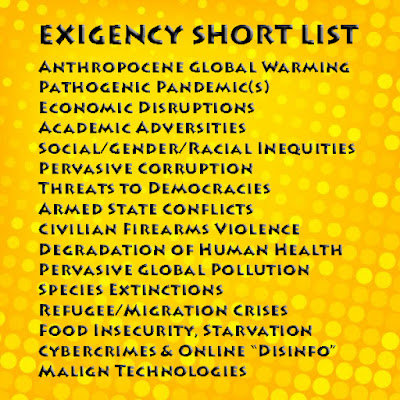
They go to my whole "Exigent Priorities" riff. Stay tuned...
__________
 

Tuesday, January 10, 2017

On the Eve of WinterTech

It's "J.P. Morgan Week" in San Francisco (hashtag #JPM17), amid which I will be covering the Health 2.0 WinterTech Conference (hashtag #WinterTech. Register here).


Where did that year go? My WinterTech 2016 experience.

Interesting article up over at THCB:
JP Morgan Week: Lessons For Investors From the Theranos Story
Jan 10, 2017


Theranos raised $900 million from investors and achieved a market capitalization of nearly $9 billion. Today, its investors may have lost most of their money and the company is pursuing a new strategy. It’s a familiar story to lenders and investors and likely to be hallway chatter today as the 35th Annual J. P. Morgan Healthcare Conference convenes in San Francisco.

Theranos targeted the lucrative blood testing market offering a new technology that allowed labs to do 30 blood tests almost instantly with a single drop of blood. The company began its operations in 2003 with a $5.8 million investment from Draper, Fisher, Jurvetson and other venture funds. By 2010, it had raised $83.4 million more in three follow-on rounds and then scored a reported $633 million investment in 2014 increasing its market value to $9 billion. In those 11 years, the company operated in relative secrecy: its 60-plus patent filings gave clues about its activities while its CEO, Stanford drop-out Elizabeth Holmes, shunned the spotlight...


Stories like Theranos are familiar to every investor and lender gathered in San Francisco this week. All of them have had disappointing results because an organization where they’ve parked capital as debt or equity has failed to meet expectations due to poor execution, or changing market conditions derailed their plan. And some have faced the enormity of challenges like those facing Theranos today in the companies/organizations they’ve funded...

Looming prominently at JPM this week is speculation about the Trump administration’s replacement for the Affordable Care Act...
Yeah. Theranos, ugh. I'll have more to say on them once I've finished reviewing the CMS lab QA assessment.
"Looming prominently at JPM this week is speculation about the Trump administration’s replacement for the Affordable Care Act."
In that regard, everyone might want to read medical economist J.D. Kleinke's recent "out-of-retirement" piece. As he noted on Facebook: "No, I haven't come out of retirement . . . but after all the dangerous and annoying nonsense we heard this week about the ACA, I really had to write this . . . or my head would explode."
Why There Is No Obamacare Replacement — In One Picture

There is no conservative replacement health reform plan for Obamacare — because Obamacare is a conservative health reform plan.

After six years of promising to repeal ‘n’ replace the President’s signature domestic achievement, Republican lawmakers have no coherent alternative to the Affordable Care Act for one good reason: because the Affordable Care Act was once the market-based alternative to a real, not imagined, “government takeover” of health care.

What has always made the ACA a political pariah to Republicans, typified by the bizarre claim by House Speaker Paul Ryan (R-WI) on Wednesday that “Obamacare” has “ruined” and “dismantled” our health care system, is the plan’s namesake — far more than its necessarily complex architecture or any of its actual details, unless you count the details they made up.

And so, if only for kicks, how about some actual historic facts and context about a health reform plan that was actually decades in the making, only three years into full implementation, and on the eve of blind destruction by demagogues who have no idea what they’re taking about.

The chart below illustrates where the ACA sits, ideologically, relative to all other health reform plan models.
This chart places the ACA along a continuum of all serious reform options developed, debated, and discarded or ignored since the 1980s. They are all here: from the single-payer, centrally controlled models popular with those who detest corporations and the corrupting influence of money in medicine — two actual, not imagined “government takeovers of health care” — to a fully free-market, laissez faire model favored by those who detest regulation and the heavy hand of government in medicine...
J.D. rocks. Read the entire post. I first cited him on this blog in 2011 in my post "Use Case."
HIT market failure ... If the state of U.S. medical technology is one of our great national treasures, then the state of U.S. HIT is one of our great national disgraces. We spend $1.6 trillion a year on health care—far more than we do on personal financial services—and yet we have a twenty-first-century financial information infrastructure and a nineteenth-century health information infrastructure. Given what is at stake, health care should be the most IT-enabled of all our industries, not one of the least. Nonetheless, the “technologies” used to collect, manage, and distribute most of our medical information remain the pen, paper, telephone, fax, and Post-It note.

Meanwhile, thousands of small organizations chew around the edges of the problem, spending hundreds of millions of dollars per year on proprietary clinical IT products that barely work and do not talk to each other. Health care organizations do not relish the problem, most vilify it, many are spending vast sums on proprietary products that do not coalesce into a systemwide solution, and the investment community has poured nearly a half-trillion dollars into failed HIT ventures that once claimed to be that solution. Nonetheless, no single health care organization or HIT venture has attained anything close to the critical mass necessary to effect such a fix.

This is the textbook definition of a market failure. All but the most zealous free-market ideologues recognize that some markets simply do not work. Indeed, reasoned free-market champions often deconstruct specific market failures to elucidate normal market functioning. The most obvious examples of such failures (such as public transit and the arts) are subsidized by society at large because such subsidies yield benefits to the public that outweigh their costs. Economists refer to these net benefits as “positive externalities,” defined as effects that cannot be captured through the economic equation of direct cost and benefit...
This year, the health space policy focus -- early on, anyway -- will be on the "Repeal and (not) Replace ObamaCare" battle on the Hill (and on K-Street), along with related fights over Medicare and Social Security. Not that MedTech and Health InfoTech will be exempt from the upshots, (e.g., we see calls for #TrumpleThinSkin to summarily rescind Meaningful Use Stage 3 -- as if that were within his Presidential purview), just that Health IT is relative chump change in the context of the huge pending ACA fight.

JUST UP AT THE INCIDENTAL ECONOMIST
Screwing Congress
January 10, 2017, Nicholas Bagley

There’s been a lot of talk about the executive actions that President Trump might take to reshape the Affordable Care Act. Here’s one I haven’t heard discussed: undoing the Hill fix.

Prior to the ACA, members of Congress and their staffers got health coverage through their jobs, just like most Americans. But Congress wanted to signal that it believed in the new exchanges that the ACA created. The ACA therefore sent members and their staffers onto the exchanges. Specifically, the ACA says that “the only health plans that the Federal Government may make available to Members of Congress and congressional staff … shall be health plans that are … offered through an Exchange.”

That left an open question. Could the federal government continue to pay for members’ and staffers’ health plans? Or would they have to pay for their plans out of their wages?

The statute wasn’t entirely clear, so the Office of Personnel Management weighed in. It concluded that the ACA allowed the federal government, as an employer, to purchase exchange plans for members and staffers. That was good news for people who work on the Hill: zeroing out their health coverage would have amounted to an enormous pay cut...


...Mr. Trump, the Hill fix was never illegal. But the ACA gives you the flexibility to undo it. You’ll be president in ten days. Your move.
Interesting.

UPDATE: CONGRESS "REINS" IN TRUMP?

Yeah, that should be fun. From The New Yorker,
SUSPENDING THE RULES: HOW CONGRESS PLANS TO UNDERMINE PUBLIC SAFETY
Elizabeth Kolbert

A handy rule of thumb in Washington is that the more pernicious the act, the more high-minded the title. Thus, last week, the House of Representatives approved the Regulations from the Executive in Need of Scrutiny Act of 2017, also known as the REINS Act. The bill would strip the executive branch of the power to issue significant new rules on topics ranging from air quality to food safety. In normal times, such a power grab by Congress would surely face a veto threat from the President, but, of course, these are not normal times.

Under the latest version of the REINS Act, a regulation with “an annual effect on the economy of $100,000,000 or more” could not take effect without congressional approval. In this way, either the House or the Senate could easily scuttle a major new regulation—one that requires food producers to sanitize their tools, for example—simply by doing nothing. “Given partisan gridlock in Congress, this could result in a de facto ban on new public interest safeguards,” Alison Cassady, the director of domestic energy policy at the Center for American Progress, noted in a recent post on the bill.

The ostensible justification for the REINS Act is a fear of executive overreach. However, it’s easy to discern the real—and darker—motive. No agency imposes a regulation with “an annual effect on the economy of $100,000,000 or more” lightly. Such regulations take years to draft and finalize. They’re subject to multiple levels of review, not to mention months of public comment. These regulations also tend to be the sort that have an impact on big corporations, in areas such as energy production, workers’ safety, and lending practices, and, not surprisingly, big corporations often don’t like them...
Interesting. This, though, differs materially from "the Secretary shall" kind of statutory regulations that are a staple of federal legislation. See, e.g., my December post "The Price is Right..."

One more thing to watch.

BOOKSHELF UPDATE

Almost finished with this book. A very long read, a comprehensive and important look into the critical issues we face at the intersection of science and policy.


Stay tuned. Maybe I'll finish it today. Also have just started this one:


The foregoing will be contextually connected with the three below (as well as a number of others).


I refer to the latter three as "The arc of existence from the Big Bang to the Anthropocene." I may take this rumination over to one of my other blog platforms, maybe Medium.
_____________

More to come...

Thursday, November 11, 2021

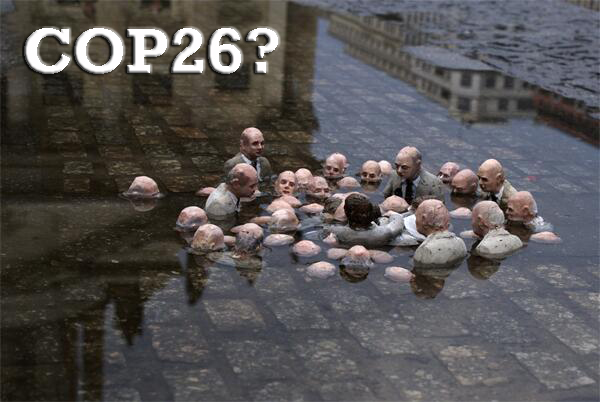
COP26: Progress, or platitudes?

While the world debates how best to reverse the trend of anthropogenic global warming (AGW), scientists continue to refine their data on historical global temperatures. A recent study published in Nature adds to this a high resolution picture of average surface temperatures over the last 24,000 years, since the last glacial maximum. The study reinforces the conclusion that the last century of warming is unprecedented over this time frame, and does not reflect any natural cycle but rather the effects of human forcing.

To construct their map of past temperatures, the researchers combined two methods. They used a dataset of chemical analysis of marine sediments, which are affected by local average temperatures. They combined this with a dataset based on computer-simulated climate models. The idea was to leverage the strengths of each approach to arrive at a map of historical surface temperatures that is more accurate than either method alone.

Of course, no one study is ever the final word, but this reconstruction is in line with other research using independent methods and data. The authors also draw two other main conclusions from their data. There has been a debate about whether or not the last 10,000 years had a small warming trend, and this graph supports that conclusion. Further, the authors conclude that the main driver of the large warming trend starting around 17,000 years ago is the retreat of the glacial ice sheets, but that the main driver of the rapid warming over the last 150 years is increasing green house gases. The rate of this recent warming is also out of proportion to any natural cycle detected in the last 24,000 years.

Those who refuse to accept the overwhelming scientific consensus on AGW will likely not be moved by this new study. It’s easy to find reasons to dismiss data if you are motivated to do so. For AGW, that motivation appears to be solution aversion – concerns about proposed steps to mitigate AGW and its consequences. For the fossil fuel industry, this motivation is obvious. They have massive assets in the ground they want to capitalize on, and will push back against any policy that deprives them of those assets. But they have successfully financed a disinformation campaign and turned it into a political ideology. Now denying AGW is a matter of tribal identity for some.

This denial takes many forms, but they tend to flow into each other. There are “stages” of denial: the Earth is not warming, the Earth is warming but its part of a natural cycle, human activity is causing the warming but it won’t be harmful (and may even be beneficial), human activity is causing warming and it will be bad but there’s nothing we can do about it or need to do about it. The one thing that all these positions have in common is the conclusion that we need not do anything about AGW – solution aversion. In practice deniers tends to flow up and down the list of positions depending on the situation, using a Motte and Bailey defense strategy. They will deny that warming is even happening when they think they can, but otherwise will retreat to more defensible positions when necessary, only to sally forth later to again deny even that warming is happening…

The Neurologica Blog


Click here.
 
OH, BOY...
 

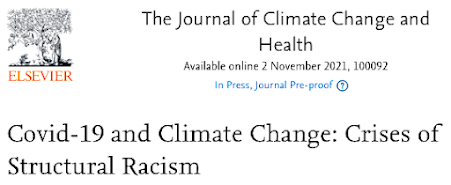
Click the title. Just watch wingnut heads explode. To them, you cannot even say "Structural Racism." Texas Governor Abbott will probably soon get legislation forbidding the use of the phrase.
For generations, policies of structural racism have systematically undervalued and removed opportunity from non-White communities. From the Black Hills of South Dakota to Boston's formerly redlined communities of Chelsea and Dorchester, such structural racism has limited medical access for communities of color, created cascades of comorbidities, and eroded social safety nets. Therefore, when SARS-CoV-2 landed on our shores, this systematic removal of resources saw Black, Indigenous, and persons of color experience twice the death rate from Covid-19 as White individuals. As healthcare professionals, it is critical that we understand how such a historical removal of opportunity has led to these health inequities. Such an understanding is foundational to achieving the truly equitable solutions that we so desperately need…

As we look towards the climate crisis, we must learn from and avoid the many shortcomings of the US Covid-19 response. Our attempts at buying our way out of social accountability with record breaking vaccine production and mandated masks played into these historic inequities. During the depths of the pandemic in 2020, those who have historically had resources and opportunity could much more easily achieve social distancing and safe pandemic practices. By repeating such a surface level approach for the climate crisis we will assuredly ruin our chances of providing adequate resiliency to frontline communities.

For the climate crisis, we must be skeptical of solutions that rely solely upon innovation and individualism…

To achieve equitable climate solutions, we must look inward to successfully move forward. We must look critically at our institutions of healthcare and government if we want to achieve long-lasting, equitable progress. As structural racism has historically disempowered millions in this country and made so many communities disproportionally vulnerable to climate change, then our healthcare solutions must be centered upon empowerment…

Doing right by marginalized communities across this country will mean prioritizing policy that undoes structurally racist policies, builds community resilience through infrastructure, and mitigates US emissions through revitalizing our energy infrastructure and cutting our emissions in half by 2030. To achieve such systemic change, our united action will be essential…

In my inbox this morning.

UPDATE: NEW BOOK ON DECK
 
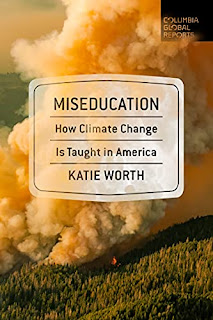
Why are so many American children learning so much misinformation about climate change?

Investigative reporter Katie Worth reviewed scores of textbooks, built a 50-state database, and traveled to a dozen communities to talk to children and teachers about what is being taught, and found a red-blue divide in climate education. More than one-third of young adults believe that climate change is not man-made, and science instructors are being contradicted by history teachers who tell children not to worry about it.

Who has tried to influence what children learn, and how successful have they been? Worth connects the dots on oil corporations, state legislatures, school boards, libertarian thinktanks, conservative lobbyists, and textbook publishers, all of whom have learned from the fight over evolution and tobacco, and are now sowing uncertainty, confusion, and distrust about climate science, with the result that four in five Americans today don’t think there is a scientific consensus on global warming. In the words of a top climate educator, “We are the only country in the world that has had a multi-decade, multi-billion dollar deny-delay-confuse campaign.” Miseducation is the alarming story of how climate denialism was implanted in millions of school children.


"Exceptional reporting undergirds the truly shocking facts in this book: the fossil fuel industry is doing all that it can to undermine education about climate change, which will be the most important fact in the lifetimes of kids in school today." —Bill McKibben
Release date Nov. 16th. More info here.
 
SPEAKING OF THE KIDS
 
Why I care about these topics. Not the only reason, by any means, but certainly a priority.
 
 
I care about the world we are handing off to our progeny. I rather doubt that my list of priority exigent topics will diminish anytime soon.


As I’ve noted before, a lot of this stuff is overlapping and mutually recursive (“feedback loops”). Some of it perhaps transient, some of it “existential“ if not dealt with effectively.

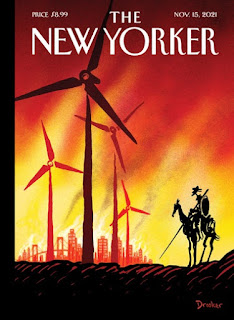
Oh, my current New Yorker just arrived.
 
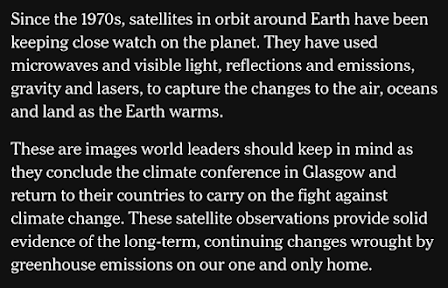
For those inclined to see them, there were plenty of bad omens last week as the latest round of international climate negotiations—cop26—got under way in Glasgow. A storm that lashed England with eighty-mile-per-hour winds disrupted train service from London to Scotland, leaving many delegates scrambling to find a way to get to the meeting. Just as the conclave began, Glasgow’s garbage workers went on strike, and rubbish piled up in the streets. Prime Minister Boris Johnson, in his opening speech, compared the world’s situation to that of James Bond, who often finds himself “strapped to a doomsday device, desperately trying to work out which colored wire to pull to turn it off, while a red digital clock ticks down remorselessly to a detonation that will end human life as we know it.” As one commentator pointed out, in his latest movie—spoiler alert!—Bond ends up dead.

Joe Biden’s performance in Glasgow, too, was inauspicious. In his formal remarks to cop26, the President declared that the United States was “back at the table” and “hopefully leading by the power of our example.” Later that day, Biden was undercut by Senator Joe Manchin, Democrat of West Virginia, who announced that he wasn’t quite sure he could support the $1.75-trillion spending package on which Biden’s claims rested. The timing was, as the A.P. noted, “unfortunate.” In separate, unscripted remarks in Glasgow, Biden circled back, acknowledging that the U.S. is not leading by example—or, really, leading at all. “I guess I shouldn’t apologize, but I do apologize for the fact the United States, in the last Administration, pulled out of the Paris accords,” he said, referring to the set of climate agreements negotiated at cop21, in 2015. He added, by way of understatement, that this has “put us sort of behind the eight ball.”

cop26 is a sequel to cop21, which was an attempt to recover from the mess of cop15, held in Copenhagen in 2009. To really appreciate America’s fecklessness, however, you have to go all the way back to the conference that preceded all these bad cops—the so-called Earth Summit, in 1992. At that meeting, in Rio de Janeiro, President George H. W. Bush signed the United Nations Framework Convention on Climate Change, which committed the world to preventing “dangerous anthropogenic interference with the climate system.” At the United States’ insistence, the convention included no timetable or specific targets for action…

—Elizabeth Kolbert
__________