Search the KHIT Blog

Showing posts with label Anthropocene. Show all posts

Saturday, April 6, 2024

Climate change mass migration implications: "On The Move"

Read about this in Science Magazine.  Goes to my "Covering Climate" riffs.
 
Photo from the Science Magazine review. Been there, seen that fiery, smoky sky.
2018 wildfire haze, in front of my house in Antioch, looking W. toward SF mid-day.
 
AMAZON BLURB FOR THE BOOK
A New York Times Book Review Editors' Choice

"
 
On the Move explains how we got here and where we're headed. It's crucial guide to the world we are creating." —Elizabeth Kolbert, author of Under a White Sky and The Sixth Extinction


A vivid, journalistic account of how climate change will make American life as we know it unfeasible.Humanity is on the precipice of a great climate migration, and Americans will not be spared. Tens of millions of people are likely to be driven from the places they call home. Poorer communities will be left behind, while growth will surge in the cities and regions most attractive to climate refugees. America will be changed utterly.


Abrahm Lustgarten’s On the Move is the definitive account of what this massive population shift might look like. As he shows, the United States will be rendered unrecognizable by four unstoppable forces: wildfires in the West; frequent flooding in coastal regions; extreme heat and humidity in the South; and droughts that will make farming all but impossible across much of the nation.


Reporting from the front lines of climate migration, Lustgarten explains how a pattern of shortsighted policies encouraged millions to settle in vulnerable parts of the country, and introduces us to homeowners in California, insurance customers in Florida, and ranchers in Colorado who are being forced to make the agonizing choice of when, not whether, to leave. Employing the most current climate data and predictive models, he shows how America’s population will be squeezed northward into a shrinking triangle of land stretching from Tennessee to Maine to the Great Lakes. The places many of us now call home are at risk, and On the Move reveals how we’ll deal with the consequences.
These are the opening book lines from the Prologue:

 
I totally get it. In 2017, my late younger daughter was diagnosed with Stage IV pancreatic cancer. There were days when her chemo sessions had to be canceled because the area wildfire smoke was so heavy in the air. Four months after she died, I had to have aortic valve replacement heart surgery. My postop PT rehab sessions had to be canceled several times for the same reason. In 2019 we left California and moved to Baltimore—only to then get slammed with COVID-19 shutdowns the following year, and then persisent fire smoke from massive Canadian wildfires.

Below, the author's cool web page (click the image).


FROM SCIENCE MAGAZINE:
American climate migration
Increasingly inhospitable conditions will change the nation’s demography, argues a journalist

Currently, less than 1% of Earth is too hot to support human life, but researchers estimate that by 2070 nearly 20% of the planet’s surface will be outside humanity’s comfort zone. The “bubble of unlivability” could include up to a third of the people on Earth, and existing inequalities will likely increase conflict. In the United States, vulnerable populations will be prone to disproportionate risk.

On the Move
, by journalist Abrahm Lustgarten, is a poignant and meticulously researched exploration of climate change and both its imminent and long-term effects on human migration in the US. Through analysis, personal narratives, and projected future scenarios, Lustgarten unveils the stark reality of a world on the brink of massive demographic shifts driven by an increasingly inhospitable climate.

Lustgarten begins with a personal account of the moment he recognized the climate crisis as a reality that no region will escape. His usual view of the San Francisco skyline was replaced by “a sepia-toned, smoke-filled universe,” he writes. “Just twelve miles away as the crow flies, behind the ridge of parched and brittle redwoods I could see from my window, the Point Reyes National Seashore was burning. Tall gray towers of smoke billowed upward, raining down soot.” He then details how climate-driven migrations are not a future possibility but rather a current event, with historical precedents and emerging patterns that signal a profound shift in how and where people can live.

Lustgarten predicts that Americans will see an influx of migrants from the south and will experience considerable internal migration as well. Increasingly frequent and severe wildfires, extreme weather patterns, and sea level rise will make some areas uninhabitable. “The poorest neighborhoods— many of them predominantly Black and Latinx—are in the lowest-lying areas, and they will suffer first,” he observes.

The book begins with an analysis of climate change pressures, providing a glimpse into what life might look like within several decades. Here, Lustgarten highlights the risks many Americans have unknowingly accepted by living in vulnerable areas and how economic policies have exacerbated these risks.

In subsequent chapters, Lustgarten projects the demographic shifts that are likely to occur within the United States. These include coastal residents moving inland because of rising sea levels and hurricanes, as well as migration from the drought-stricken Midwest to regions with stable water sources...

Amid the growing body of literature on climate change, Lustgarten’s book provides a crucial examination of the impacts—realized and projected—in our own backyards and how these changes are remaking society. Importantly, it is both a call to action and a blueprint for how to weather the coming storm, highlighting historical injustices and charting an equitable path forward. review
No "praise-criticism-praise" dings. 100% positive review assessment. I've just begun reading the book. 
 
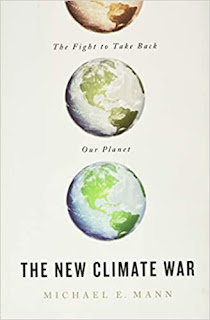
It's reminding me that I am remiss, in not yet finishing Michael E. Mann's latest:

We live on a Goldilocks planet. It has water, an oxygen-rich atmosphere, and an ozone layer that protects life from damaging ultraviolet rays. It is neither too cold nor too hot, seemingly just right for life. Despite our ongoing search—which, with the recent advent of the James Webb telescope, now extends out nearly fourteen billion light years—we have thus far found no other planet in the universe with such benevolent conditions. It’s almost as if this planet, Earth, was custom made for us. And yet it wasn’t.

For the vast majority of its 4.54 billion years, Earth has proven it can manage just fine without human beings. The first hominids—proto-humans—emerged a little more than two million years ago. Only during the past 200,000 years have modern humans walked the Earth. And human civilizations have existed for only about 6000 or so years, 0.0001 percent of Earth’s history—a fleeting moment in geological time.

What is it that made this fragile yet benevolent moment of ours possible? Ironically, it’s the very same thing that now threatens us: climate change…


Mann, Michael E.. Our Fragile Moment (p. 8). PublicAffairs. Kindle Edition.
apropos of On The Move, Dr. Mann notes
The fact that the rate of warming today far exceeds that during the PETM presents its own unique challenges. We saw that mammals and other species migrated away from regions that became too warm, or literally—as in the curious case of the shrinking horses—adapted to the warmth. But the rate of warming today, as we’ve seen, is more than ten times greater, exceeding the rate at which plants and animals can be expected to migrate or adapt. And adding insult to injury, we’ve built all sorts of obstacles—in the form of cities, highways, and other infrastructure—that stand in the way of likely migration routes.

Now what about a worst-case scenario, where we actually regress, reversing the climate policies we’ve already enacted, proceeding instead to burn all of the reasonably accessible fossil fuel reserves? The state-of-the-art model projections used in the most recent assessments of the Intergovernmental Panel on Climate Change (IPCC) indicate a most-likely warming, in that case, of about 7°F by 2100, plateauing in 2300 to an approximate 14°F warming. That is a huge, devastating amount of warming, but it’s not a “runaway” greenhouse scenario, nor is it a PETM hothouse scenario. What if we instead take the most extreme end of the IPCC simulation range? In that worst-case scenario we’re looking instead at as much as 11°F by 2100, plateauing to about 23°F in 2300. That would put global average temperatures at around 83°F two centuries from now. That scenario is extremely unlikely as it assumes a reversal of climate policy progress already made and is based on the most extreme of the more than fifty climate models analyzed by the IPCC. Though it still falls several degrees short of the PETM, it’s uncomfortably close, and possibly hot enough that much of the planet would be uninhabitably hot for humans and other large mammals. So yeah, if we try really, really hard, we could make at least most of this planet unlivable for human beings…
[Our Fragile Moment, pp, 182-183]
Ugh.

HEAT, DROUGHTS, FLOODS,  FAMINE, WARS?
WHAT OF MASS MIGRATION POLITICS?

… [Stephen] Miller and another Breitbart editor, Julia Hahn, became close. With rosy cheeks and fair skin, Hahn had grown up in Beverly Hills, another wealthy hub of Los Angeles County. During a social gathering at Hahn’s apartment, Miller didn’t want to talk about anything except immigration. “That was all he was fixated on,” McHugh says, “even in a social gathering.”

He recommended that Breitbart do a story about the racist-dystopian book The Camp of the Saints. It was the book that helped inspire Tanton and May to create anti-immigration think tanks, the one filled with degrading descriptions of refugees, such as “kinky-haired, swarthy-skinned, long-despised phantoms,” and “teeming ants toiling for the white man’s comfort.”

Miller suggested that Breitbart “point out the parallels” between the novel and real life. Days later, Julia Hahn wrote a four-thousand-word ode to the book. She compared Pope Francis to Raspail’s fictional pope who preaches universal love, suggesting the book was prophetic. “Pope Francis is urging America to throw open her borders,” she wrote. (In fact, he had urged the United States to treat migrants “in a way which is always humane.”) Hahn compared Hollywood celebrities to the book’s “celebrity elites” who “throw bacchanalian bashes to celebrate and raise funds” for refugees. She likened Rubio to “one of the most dangerous characters . ... ‘full of the milk of human kindness,’ ” Albert Durfort, who fights for an immigration policy that will “seal their doom.” She wrote: “Importing millions of migrants from failed countries with different values and customs will not raise standards of living but will instead merely remake the West in the image of those failed countries.”

After that, Bannon repeatedly cited the book to describe the situation at the border. “It’s not a migration. It’s really an invasion. I call it the Camp of the Saints,” he said.

Guerrero, Jean. Hatemonger: Stephen Miller, Donald Trump, and the White Nationalist Agenda (pp. 149-150). HarperCollins. Kindle Edition. 

It behooves us to recall the explicit 2024 promises of The Verminator, should he return to The White House, along with his seething xenophobic White Nationalist in Chief Stephen Miller.

Stay tuned. More shortly...
_________
 

Friday, February 9, 2024

Climate Science News: Dr. Michael E. Mann

Punitive Damages Awarded to Climate-Change Scientist Dr. Michael Mann in Decade-Long Defamation Case

We secured a decisive victory in our long-standing defamation claims against an adjunct scholar with the Competitive Enterprise Institute (CEI), Rand Simberg, and a TV/radio personality who wrote for the National Review, Mark Steyn. Following a four-week jury trial, we were awarded punitive damages of $1,000 against Simberg and $1,000,000 against Steyn by a jury in the District of Columbia Superior Court. 

Dr. Mann’s trial team was led by John Willian1s, a Washington, D.C. based defamation lawyer, and Pete Fontaine, a Philadelphia-based environmental lawyer with Cozen O'Conner. Williams and Fontaine were joined by Patrick Coyne of Finnegan, Henderson, Farabow, Garrett & Dunner, LLP and Amorie Hammel of Cozen O'Connor.

Today's verdict followed 12 years of litigation by Dr. Mann and the entire legal team.

Dr. Mann, a member of the National Academy of Sciences and currently a Presidential Distinguished Professor at the University of Pennsylvania, was a lead author with Dr. Raymond Bradley and Dr. Malcolm Hughes of groundbreaking research in 1998 and 1999 which demonstrated a sharp increase in global temperatures linked to increasing greenhouse gas emissions. Dr. Mann’s research reconstructed historical temperatures over the past 1,000 years using national temperature archives. That temperature reconstruction is represented on a graph shaped like a hockey stick lying on its side with the blade pointing upward. The graph, which came to be known as the "Hockey Stick" graph, was prominently featured by the Intergovernmental Panel on Climate Change (IPCC) in its 2001 report on climate change.

Dr. Mann filed his defamation suit in 2012 after Rand Simberg writing for CEI and Mark Steyn writing for National Review published articles comparing Dr. Mann to the convicted child molester arid fo1mer Penn State football coach, Jerry Sandusky. The articles asserted that Dr. Mann had falsified his Hockey Stick research and called Dr. Mann "the Jerry Sandusky of climate science" who "molested and tortured data" arid committed “scientific and academic misconduct.”

Under the Supreme Court's New York Times v. Sullivan standard, Dr. Mann was required to show by clear and convincing evidence that the defendants published their writings with “actual malice," a heavy burden under the First Amendment of the U.S. Constitution. The trial team showed that the defendants either knew or recklessly disregarded multiple investigations clearing Dr. Mann of misconduct in the wake of the 2009 ClimateGate controversy involving stolen emails from a research unit in the United Kingdom. Two of those investigations were key pieces of evidence in the case: one completed by Pennsylvania State University (where Dr. Mann was a professor for 17 years) and a second by the National Science Foundation, which funded the research.

According to Mr. Fontaine, "Today's verdict vindicates Mike Mann’s good name and reputation. It also is a big victory for truth and scientists everywhere who dedicate their lives answering vital scientific questions impacting human health arid the planet."

According to Dr. Mann, "I hope this verdict sends a message that falsely attacking climate scientists is not protected speech." 
 
MICHAEL'S NEWEST BOOK
 
In this sweeping work of science and history, the renowned climate scientist and author of The New Climate War shows us the conditions on Earth that allowed humans not only to exist but thrive, and how they are imperiled if we veer off course.
 
For the vast majority of its 4.54 billion years, Earth has proven it can manage just fine without human beings. Then came the first proto-humans, who emerged just a little more than 2 million years ago—a fleeting moment in geological time. What is it that made this benevolent moment of ours possible? Ironically, it’s the very same thing that now threatens us—climate change.

The drying of the tropics during the Pleistocene period created a niche for early hominids, who could hunt prey as forests gave way to savannahs in the African tropics. The sudden cooling episode known as the “Younger Dryas” 13,000 years ago, which occurred just as Earth was thawing out of the last Ice Age, spurred the development of agriculture in the fertile crescent. The “Little Ice Age” cooling of the 16th-19th centuries led to famines and pestilence for much of Europe, yet it was a boon for the Dutch, who were able to take advantage of stronger winds to shorten their ocean voyages.

The conditions that allowed humans to live on this earth are fragile, incredibly so. Climate variability has at times created new niches that humans or their ancestors could potentially exploit, and challenges that at times have spurred innovation. But there’s a relatively narrow envelope of climate variability within which human civilization remains viable. And our survival depends on conditions remaining within that range.
 
In this book, renowned climate scientist Michael Mann will arm readers with the knowledge necessary to appreciate the gravity of the unfolding climate crisis, while emboldening them—and others--to act before it truly does become too late.
 

I've cited Dr. Mann numerous times.

UPDATE
 
__________


Sunday, July 30, 2023

Increasingly lethal heat waves

 
Just finished this book (first cited it here). Jeff did a great job covering the global breadth of troubling issues, including the depressing voluminous statistics accompanying them. Well worth your time.
 
I will just post below this one infuriating excerpt pertaining to desperate illegal migrants attempting to cross into the ever-hotter southwest U.S.

“El Camino del Diablo," or the Devil’s Highway, is an ancient passage in the Sonoran Desert of Arizona that runs through Organ Pipe Cactus National Monument, a US Air Force bombing range, and the Tohono O’odham Nation reservation, and more or less directly over the grave of writer and desert hell-raiser Edward Abbey.  The Devil’s Highway is a haunted place. Stories of people struggling in the desert’s merciless heat, tongues swollen from lack of water, stumbling, hallucinating, stripping off their clothes, go back centuries. Here among the saguaro cactus and ironwood trees, suffering from heat is an ancient and tragic ritual. Here, heat is not so much an engine of migration as a migration barrier, a thermal wall that blocks or kills anything that attempts to cross it, just as warm water in a river is a migration barrier for spawning salmon in the Pacific Northwest.

One person who understands all this as well as anyone is John Orlowski, a member of No More Deaths, a humanitarian group that helps migrants in their dangerous journey across the US/ Mexican border. Orlowski is in his early sixties, with a shock of white hair and a deep desert tan. He has the strong, lanky build of a lifelong mountain climber (he has scaled Yosemite’s El Capitan three times), with a nose that tilts off to the right like it was broken in a fight back in the day. While other men his age settle into retirement in a condo in Florida or the Rockies, Orlowski moved to Ajo (pop. 3,600), an old copper mining town on the Mexican border about two hours from Tucson, to help migrants get safely across the desert.

I met Orlowski one morning for breakfast at the Agave Grill, a restaurant in Ajo decorated with watercolors of saguaro cactuses and rattlesnakes. “Ajo is a heavily militarized place,” Orlowski told me. Besides the fifteen sheriffs in this sparsely populated county, there is a new US Border Patrol station just outside of town, where five hundred Border Patrol agents work. Still, the desert around here is vast, and the migrants are many. Over coffee, Orlowski explained how the border police use helicopters to patrol the most remote parts of the borderlands. If they spot a group of migrants, they use a technique called dusting, in which they lower the helicopter down to thirty or forty feet above the migrants, kicking up a huge dust storm and scattering the migrants. “When they are alone, they are much more vulnerable,” Orlowski said. It is a brutal technique. Many of the people who die have gotten separated from their families and travel companions and end up wandering alone in the desert. In the last three decades, No More Deaths estimates that more than nine thousand people have died here on the Devil’s Highway, virtually all of them from dehydration and heat exhaustion.

Orlowski pointed out that there are lots of Border Patrol agents in places where it is easy to cross. And far, far fewer in places where it is hot and dangerous to cross. “Part of their strategy is to funnel migrants through the hottest, most dangerous regions of the border,” Orlowski explained.

“So, basically, the US Border Patrol has figured out a way to weaponize heat,” I said.

“Yes, that’s one way to think about it,” he replied.

After we finished breakfast, we got into his dusty pickup and headed out into the desert. In the back, he was carrying plastic jugs of water, cans of beans, and other food items that can survive for weeks in the desert. We drove through Organ Pipe Cactus National Monument, where saguaro cacti stand like worshippers with arms raised to the heavens. The rocky peaks of Growler Mountains, harsh and mean-looking, watched over us in the distance. We eventually turned down a dirt road and drove parallel with the border. In some places, the border itself is just a 4x4 fence that you could easily walk over or under. In other places, a tall, grotesquely ugly metal barrier (Trump’s wall) had gone up. Every once in a while, I’d see a white cross, which marked the spot where human remains had been found.

After about forty-five minutes of bouncing along the dirt road, we pulled off and parked. It felt like we were a thousand miles from anything soft, cool, or kind. We loaded jugs of water into backpacks and headed out for a spot on the top of a nearby mountain where Orlowski knew migrants cross. I had prepared for the hike pretty well, I thought, with a wide-brimmed hat, sunglasses, and pants and a long-sleeve shirt with UVF protection. Still, I felt the heat immediately and began to sweat. I saw more white crosses. As we plodded along, I worried about stepping on human remains that had been turned to near dust by the heat. A few days earlier, the body of Gurupreet Kaur, a six-year-old girl from India who was crossing the border with her mother and other family members, was discovered within a few hundred yards from where we were hiking. We found lots of evidence that people had been through here recently: a worn Nike running shoe, a shirt, a plastic bag, a phone charging cord, a few black plastic one-gallon water bottles (they are black so they don’t reflect light and the Border Patrol doesn’t see them from far away). As we headed up the mountain, I couldn’t help but notice the austere beauty of the desert: red flowers of the prickly pear cactus in bloom, and spiny ocotillos, their long, slender branches like octopus tentacles.

After about an hour of hiking, we reached the mountaintop. Orlowski and his fellow volunteers at No More Deaths had dropped water and beans here about a week earlier. Now the supplies were gone—a sure sign that migrants had come through. We pulled six gallon jugs of water out of our backpacks. “Agua Pura,” Orlowski scribbled on the jugs with a marker. He unloaded an eight-pack of SunVista pinto beans out of his backpack and left that too. In the distance, I saw towers of the US Border Patrol’s alert beacons. A helicopter skimmed by. We could see south to Mexico, and north toward Tucson and Phoenix. I was exhausted. I was hot. I sat on a rock beside Orlowski and tried to imagine wanting to come to America so badly that I would walk for five or six days across this ghostly boneyard of heat. And the hotter it gets, the more treacherous this passage will become. Migration itself becomes a deadly gamble.

Orlowski pointed toward the Growler Mountains in the distance. “Between here and there, I’m sure there are dozens of people crossing right now, you just can’t see them,” he said. “Just like the heat, they are invisible.””


The Heat Will Kill You First: Life and Death on a Scorched Planet by Jeff Goodell [pp. 92-98]

 
I'M GONNA KEEP UP MY ONGOING RANT
 

Yeah, and spare me the Perfectionism Fallacy.
 
UPDATE
It’s not just hot. Climate anomalies are emerging around the globe.
July was packed with weather anomalies, but some were so abnormal they sent a wave of consternation through the scientific community


A glimpse of a more tumultuous future seemed on full display throughout July, a month packed with weather anomalies that exceeded any definition of normal…

But some events were so abnormal that they sent a wave of consternation through the scientific community. Antarctic sea ice is at a historically low level for this time of year, according to federal data. Sea surface temperatures across the North Atlantic have been “off the charts,” Europe’s Copernicus Climate Change Service reported, noting that the figures set records for this time of year “by a very large margin.” Water temperatures off the coast of South Florida rose to unfathomable levels in recent days, leading scientists to fear for the fate of the only living coral barrier reef in the continental United States.

“On the one hand, we knew these things were going to happen. These have been the predictions for a long time,” said Claudia Tebaldi, a scientist at the Pacific Northwest National Laboratory.

And yet, she said, “this year, in particular, has seemed so extreme. … The size of the anomalies is surprising.”…
More to come...
__________
 

Wednesday, July 12, 2023

The Anthropocene Exigency.

It's not going to abate absent sustained globally cooperative human countermeasures.


TWO NEW READS
 

THE HEAT WILL KILL YOU FIRST

…You probably think of heat on a temperature scale, either Fahrenheit or Celsius. You think of it as a gradual, linear thing, a quality of the air around you that moves up and down in increments, or that can be controlled by a thermostat. Seventy degrees is a little hotter than 68 degrees, which is a little hotter than 65 degrees. The change of seasons also plays into this incremental perception of heat—winter gradually warms into spring, spring into summer. Yes, there are some days that are noticeably hotter or colder than others, but we crank up the air-conditioning or throw on a sweater. We trust it will pass and things will return to normal. Temperature is a merry-go-round that we are used to riding.

This sense of incrementalism also holds true with the climate crisis. The Earth is getting hotter due to the burning of fossil fuels. This is a simple truth, as clear as the moon in the night sky. So far, thanks to 250 years of hell-bent fuel consumption, which has filled the atmosphere with heat-trapping carbon dioxide (CO2), global temperatures have risen by 2.2 degrees since the preindustrial era and are on track to warm by 6 degrees or more by the end of the century. The more oil, gas, and coal we burn, the hotter it will get.

Right now we’re more than halfway to 3.6 degrees (2 degrees Celsius) of warming from preindustrial temperatures, which scientists have long warned is the threshold for dangerous climate change. The reports of the UN’s Intergovernmental Panel on Climate Change are full of harrowing details of what might happen to our world with 3.6 degrees of warming, from collapsing ice sheets to crop-killing drought. But to nonscientists—which is to say, most humans on the planet—3.6 degrees of warming does not sound dangerous at all. Who can tell the difference between a 77-degree day and an 81-degree day? Then there are folks who argue that extreme cold kills people and causes all kinds of weather-related problems too so maybe a hotter world isn’t such a bad thing after all.2 Even the phrase “global warming” sounds gentle and soothing, as if the most notable impact of burning fossil fuels will be better beach weather.

The difficulty of understanding the consequences of heat is amplified by conventional notions of what it means to be hot. In pop culture, hot is sexy. Hot is cool. Hot is new. Websites publish “hot lists” of the latest books, movies, TV shows, and actors. Facebook started in Mark Zuckerberg’s Harvard dorm as a hot-or-not website called FaceMash, which ranked the attractiveness of Harvard women. Heat is an expression of passion—you feel hot for the guy at the bar or engage him in a heated debate. A person who is quick to anger is hot-blooded. Near the house where I live in Austin is a gym called Heat Bootcamp. Here, sweat is purifying, a sign of inner strength (a throwback to medieval times, perhaps, when heat was linked to masculinity through what philosopher Thomas Aquinas called “the elemental heat of the semen”). In Miami, one of the hottest cities in the US, where heat is a lethal threat to outdoor workers and where the city regularly floods due to rising seas caused by the melting ice sheets of Greenland and Antarctica, the basketball team is named, without irony, the Miami Heat.


Goodell, Jeff (2023-07-10). The Heat Will Kill You First (loc 196-222). Little, Brown and Company. Kindle Edition.

THE PARROT AND THE IGLOO

IN 1956, Time magazine and the New York Times had addressed science and the possibilities. That spring, Roger Revelle gave Time his first climate change interview—in an issue that documented the unnerving Soviet policy of smiles and an America that no longer had enough animal-act enthusiasm to support two circuses. (Since then, the remaining outfit has also folded its tent. Trained bears and top hats we’ve decided belong to our entertainment past.)

“In fifty years or so,” Time reported, summarizing Revelle’s research into the carbon exhalations of our machines, “this process may have a violent effect on the earth’s climate.”

They had known even then about the tightness of terrestrial margins. You’d need only a one- or two-degree rise to start the ice melting, the climate changing. “When all the data have been studied,” Time explained, scientists “may be able to predict whether man’s factory chimneys and auto exhausts will cause salt water to flow in the streets of New York and London.”

Five months later—cement sky, pavement leaves—the New York Times had speculated about “striking changes in climate.” A human-caused warmth that could “convert the polar regions into tropical deserts and jungles, with tigers roaming about and gaudy parrots squawking in the trees.”

A spicy thing to visualize, as light and weather thinned toward Christmas: the former frozen regions being lorded over by a mouthy bird.

And now it was here. Time magazine’s half-century waiting period elapsed. And a great international apparatus had sprung up to capture and examine the data. The IPCC, of course. Two hundred science organizations on record; from the Academy of Athens to the Zimbabwean Academy of Science. Climate change was human-caused, and real.

With three great repositories of the world’s temperature. One in Manhattan—Jim Hansen’s NASA office, six stories up from the Seinfeld coffee shop. Another amidst the Washington gridlock and founding-father statuary at the National Oceanic and Atmospheric Agency. The third in Britain: the Jack Bauer-sounding Climatic Research Unit, at the University of East Anglia.

The Unit had amassed four million separate temperature readings, from four thousand sites on the planet, reaching back 150 years.

This was weather’s week-by-week episode guide—the sun-and-rain version of Ulysses. No characters, no Dublin, just sky. It had become the largest story in science.

It was 2009. To scientists, with their research accepted and agreed to, the climate fight now looked “winnable.” They weren’t following the politics. They had their eyes on their opponents, who they believed were done.

Relief can be misleading. Especially when it is anticipatory. That just-before moment then becomes the most hazardous. When you envision the glass of water so thoroughly you wonder if you’ve already drunk it. When you feel yourself breaking the tape so clearly you cease to run. When actually finishing the race begins to seem like a formality.

In his memoir of these years, climate scientist Michael Mann quotes an observation by General Douglas MacArthur: “It is fatal to enter any war without the will to win it.”

Mann’s pasting this in tells the whole story: by 2009, the climate scientists believed they’d entered the wind-up phase, their long conflict behind them. Also, that Mann believed they had lost their killer instinct. The desire—sometimes salutary—to hear an enemy skeleton crunch beneath the boot. “By early 2009,” Mann writes in The Hockey Stick and the Climate Wars, “a troubling complacency had emerged among the scientists.”


Lipsky, David. The Parrot and the Igloo: Climate and the Science of Denial (pp. 407-409). W. W. Norton & Company. Kindle Edition.
David Lipsky is killin' me. What a writer! And, the Snark... geez.
 
 
"Because the climate doesn’t care about politics, or experts, or warnings, and isn’t even aware there are people. We have our days and lists and hours, our schedules and emergencies; but the climate keeps its own time."  [David Lipsky, pp. 471-72]
________
 
NPR WHILE IN THE CAR TODAY FETCHING MY GRANDSON CALVIN


apropos, see my recent post "Baltimore Code Red."
 
 NY TIMES' DAVID WALLACE-WELLS:
 

Global warming is accelerating, with temperatures not just rising but rising faster than ever. Every day, it seems, we get better at normalizing extreme weather. But it is simultaneously proving harder to compartmentalize — even in places such as New York City that once looked to residents like concrete fortresses against nature.

A month ago, when orange skies blanketed New York, it was a sign to many that this particular climate horror could no longer be conceptually quarantined as a local phenomenon of the American West, where tens of millions had already acclimated to living in the path of fire and every year breathing in some amount of its toxic smoke. That was normal for them, we New Yorkers thought, even though San Francisco had turned a sunless dark amber for the first time only in 2020. It wasn’t normal for us, we told ourselves. Then, when the air quality index dropped from 405 back into the 100s again, in the weeks after, the joggers hit the pavement at their routine times, glad the sky was merely unhealthily smoggy...
Yeah...
 
 
RETROSPECTIVE. FROM AN APRIL 2021 POST OF MINE:
THE MORAL CASE FOR GLOBAL WARMING MITIGATION
 
I read this a number of months back. Good read. Sound argument.

This urgent and eye-opening book makes the case that protecting humanity's future is the central challenge of our time.

If all goes well, human history is just beginning. Our species could survive for billions of years - enough time to end disease, poverty, and injustice, and to flourish in ways unimaginable today. But this vast future is at risk. With the advent of nuclear weapons, humanity entered a new age, where we face existential catastrophes - those from which we could never come back. Since then, these dangers have only multiplied, from climate change to engineered pathogens and artificial intelligence. If we do not act fast to reach a place of safety, it will soon be too late.

Drawing on over a decade of research,The Precip
ice explores the cutting-edge science behind the risks we face. It puts them in the context of the greater story of humanity: showing how ending these risks is among the most pressing moral issues of our time. And it points the way forward, to the actions and strategies that can safeguard humanity.

An Oxford philosopher committed to putting ideas into action, Toby Ord has advised the US National Intelligence Council, the UK Prime Minister's Office, and the World Bank on the biggest questions facing humanity. In The Precipice, he offers a startling reassessment of human history, the future we are failing to protect, and the steps we must take to ensure that our generation is not the last. [
Amazon blurb]

Well worth your time.

…There’s a rally planned for mid-September in New York City, when the U.N. Secretary-General, António Guterres, has called a Climate Ambition Summit, to make a case that Biden, who may address the General Assembly, should meet Guterres’s demands to end fossil-fuel expansion, particularly because this country still leads the world in oil and gas production. But this moment feels as if it calls for something larger—comparable to the Earth Day demonstrations of a half century ago, which brought ten per cent of the American population into the streets. It’s eruptions on that scale that change the political reality. And those eruptions are usually rooted not just in fear and anger but also in love and resolve.

The massive Santa Barbara oil spill of 1969, which was caused by a rig six miles off the California coast, was one of the sparks for the first Earth Day, in April, 1970. People were raging over the sight of dead seabirds soaked in oil, but they were also fighting for things that they loved: the ocean, the beach, the chance to sit peacefully on the sand. The incredible warming of these current weeks should strike fear, but it should also remind us how valuable a breeze is, how remarkable a deep-blue winter day, or how precious the cool that comes when night falls. The crazily raging river a quarter mile from my door scares me, but it also makes me think how stunning it is in its usual form. This planet remains stirringly beautiful, and that beauty must be one of the things that moves us to act. And so must the beauty that people can produce: we can take the deadly power of the sun and, with a panel, convert it into the electrons that help cool our homes in a heat wave. If all of that sounds overblown, scientists say that this past week broke records for the hottest days in about a hundred and twenty-five thousand years, which takes us back to the bare edge of the human story. We’re at a hinge point in that story if ever there was one.
Yeah. Below, a long-time rant of mine.

 
And, yeah, I realize that solar voltage / amperage / wattage capture is but one component. Storage, conversion, practical & equitable distribution (incl. integration w/currrent electrical grids, etc).—None of those are free or effortless to scale up. But deniers can spare me the endless "yes, but" Perfectionism Fallacy line dance.
Moreover, the "consumption unsustainability" / "degrowth" argument is a separate issue (and a gnarly one in its own right). Conflation is not Our Friend.
PERSONAL ERRATUM
 
We went to Deep Creek Lake in far western Maryland on July 1st for a big family vacation. This is what we hit just west of Cumberland MD on I-68.

 
That was Cheryl and I, in a rental SUV, with our now-3 yr old great-grandson Kai in the car seat in the back. More excitement than I needed.
 
SUNDAY JULY 16TH UPDATE
 
 
DAVID LIPSKY INTERVIEW

__________
 

Monday, July 18, 2022

Anthropocene: Rapid job growth sector

Zero employment rate here going forward for the outdoorsy type.
"We have a choice. Collective action or collective suicide. This has to be the decade of decisive climate action. It is in our hands.” —United Nations Secretary-General António Guterres, July 2022
Below, recent out-of-control inflagration in Spain.


The competing/interlocking exigencies are piling up, are they not? Synergistically so, to an increasing degree—adverse negative feedback loops gathering momentum. Just consider most recently, "Armed State Conflict"—Russia's attack on Ukraine. Adverse side effects have rippled through many areas of concern worldwide, and are likely to only worsen as the conflict drags on.
 
 
Prior anthropocene-related posts here
__________
 

Sunday, July 10, 2022

A world of hurt


136 days of obscene Russian war (crimes) against Ukraine as of July 10th, with no end in sight. And, 121 days until the U.S. mid-term elections, portending the possible beginning-of-the-end of our Democracy (fully culminating in 2024 should the GOP retake the White House, assuming they gain control of Congress this November).
 
In that regard, the U.S. Supreme Court "conservative / textualist" supermajority has now struck down womens' federal reproductive rights via the Dobbs decision (nullifying Roe), made it easier to obtain handguns by overturning New York's permit regulations on "concealed carry," invalidated EPA Clean Air Act environmental regulatory authority, and further eroded the separation of Church and State via their Maine religious schools and Bremerton WA "kneeling Christian football coach" rulings. SCOTUS has also agreed to next hear cases intended to accord state legislatures unreviewable plenary authority to summarily appoint "Presidential Electors," irrespective of previously certified state popular vote tallies.
 
Inflation is now (unsurprisingly) rampant, globally. People in the underdeveloped world face massive looming starvation. War, droughts, adverse climate change comprise enervating force multipliers...
 
Had I not direct multigenerational offspring, perhaps I'd have fewer [bleeps] to give.
 
“We just have a few more tragedies to report before we can get to the fun stuff.”
 
RECOMMENDED READING
 
"Autistic isolation," LOL. Mic drop.

Don't take my word for it. Do Your Own Research. 
 
TOPICAL ERRATA
Confirmation bias is normal human behavior. What’s not normal is the emergence of a populist madness on the American right that counts on the intimidation of the sensible many by the delusional few. This development threatens to turn a great republic into little more than a collection of unthinking and dangerous reflexes, its citizens like a school of fish aimlessly darting back and forth as they are lured by bait or chased by predators…

…That means it’s up to us to assert those norms and values in everything we do in our daily life. It means that citizens of good will must hold their ground, calmly and without reacting to the many bad-faith provocations thrown at them. It means linking arms with people with whom we disagree about almost everything, so long as we agree on the Constitution and our rights as citizens…
Tom Nichols, @TheAtlantic
 ON JUSTICE CLARENCE THOMAS
...In his second year on the Court, Thomas said that he was “proudly and unapologetically irrelevant and anachronistic.” Almost thirty years later, he has become what conservatives of every era seek to be: anachronistic and relevant.

Under Thomas’s aegis, the Court now assumes a society of extraordinary violence and minimal liberty, with no hope of the state being able to provide security to its citizens. In his Bruen concurrence, Alito extends Thomas’s history of Reconstruction to all modern America: “Many people face a serious risk of lethal violence when they venture outside their homes.” Like the Black citizens of Reconstruction, he argues, few of us should expect the police to protect us. “The police cannot disarm every person who acquires a gun for use in criminal activity,” Alito writes, “nor can they provide bodyguard protection for [New York] State’s nearly 20 million residents.”

Once upon a time, Alito’s claims of systemic danger and state incapacity would have been dismissed as the rantings of a mountain survivalist. But, after decades of mass shootings, his assertion that the cops can’t protect you reads as a corollary to the left’s warning that the cops won’t protect you. What makes both beliefs plausible is the failed state that America has become, with no small amount of help from Thomas, the right-wing Court, and elected officials from both parties.

Today’s felt absence of physical security is the culmination of a decades-long war against social welfare. In the face of a state that won’t do anything about climate change, economic inequality, personal debt, voting rights, and women’s rights, it’s no wonder that an increasing portion of the population, across all races, genders, and beliefs, have determined that the best way to protect themselves, and their families, is by getting a gun. A society with no rights, no freedoms, except for those you claim yourself—this was always Thomas’s vision of the world. Now, for many Americans, it is the only one available. Corey Robin, the @NewYorker
MORE ON THE CURRENT SCOTUS SUPERMAJORITY
Watching Justice Samuel Alito go spelunking in his Dobbs opinion through centuries of so-called history and tradition in search of legal justifications to overturn the right to abortion decided almost 50 years ago in Roe v. Wade was like watching a boy play in a pile of dirt. Where do I dig next, he seemed to be muttering to himself as he shoveled manure from a slave-era law in Virginia onto an 18th-century pile of garbage he quoted from some doofus who believed women were inferior beings. Clarence Thomas was right there behind him in his decision that New York can't prevent people from carrying concealed weapons, plowing through statutes from jolly old England and the American frontier to show that Dodge City didn't really mean it when they told cowboys they had to check their six-guns with the sheriff if they came into town.

And then along came Chief Justice Roberts as clean-up man, swinging the club of something known as the "major questions doctrine" to deny the Environmental Protection Agency its statutory authority to — duh — protect the environment unless Congress spells out exactly how they should do it. According to Roberts, it is Congress, not the EPA, that has to write a rule telling corporations they can't empty industrial waste directly into creeks, rivers or the ocean because it's a "major question" if it costs corporations a lot of money, so let's make it as hard as possible for the government to take a chunk out of our golf buddies' bottom lines…

All of this in service to their favorite doctrine of all — rights granted by the Constitution must be "deeply rooted in the nation's history and tradition" or they aren't really rights at all. Legal scholars have been predicting that the court will use its new jewel of a doctrine to overturn Obergefell v. Hodges, not to mention other recent decisions recognizing rights under the privacy provision of the equal protection clause of the 14th Amendment … because we have no "history and tradition" of same-sex marriage or gay sex or rubbers or the pill, or anything else they simply don't like...
Lucian K. Truscott IV, @Salon
__________
 

Sunday, January 2, 2022

And, away we go...

Buckle up, folks.
"Shards," anyone?
 
US Covid19 daily incidence rate (new confrmed cases) is now nearly 400,000. Deaths have now surpassed 825,000 in the US.


See my ongoing post on Medium.
__________

 

Friday, December 31, 2021

What will 2022 bring?

Hope it will be good for you.


New Year's Eve is my wife's birthday. We're layin' low this year.

My best friend of now nearly 48 years. Scary smart, and the nicest person I ever met.

One of our nieces sent her this.

 
The Crazy Grands have had great fun with Calvin this week. He turns 2 on January 15th. We keep him 3 days a week at our "Paddington Road Greycare Center."

Helping Grandmother with the dishes.
 
Have a safe New Year's Eve celebration. And a good 2022. An important, consequential year faces us. 

ERRATUM

My latest read.
 
I've got about 6 books in process at the moment. This one jumped the queue yesterday. Long story. Stay tuned...
__________