Search the KHIT Blog

Showing posts with label Climate Change. Show all posts

Wednesday, April 22, 2026

EVERY Day is Earth Day


Yeah, how predictable. Drill, baby, drill. "Clean Coal." Outlaw wind turbines. "Green scams." Yadayadayada...
 
But facts are stubborn things. Facts that will outlive Donald Trump and his pillagers.
 
 
Search the word "renewables" on this blog for some prior observations. Alternatively, use "anthropocene."
 

CHRISTINA MITTERMEIER
 
"I have floated in the middle of the Pacific, far from any shore, looking down into water so blue it felt like the beginning of the universe. I have stood at the edge of the Arctic, listening to ice crack and fall into a warming sea. In these moments, I understood something that no dataset had ever been able to teach me: we are small, and the Earth is generous, and we have not yet earned that generosity.

Today the world pauses to celebrate this planet. I want to ask you to do something harder than celebrating. I want to ask you to grieve, just for a moment, for what we have already lost. The reefs we bleached. The forests we traded for cattle. The glaciers that are now water. Grief, when we allow ourselves to feel it, becomes fuel.

I grew up in Mexico, the daughter of a country where the land and the sea were never abstractions. They were food, livelihood, identity. The communities I have photographed across a hundred countries, Indigenous guardians, fishermen, divers, children who still swim in clean rivers, they have never needed Earth Day to remind them that the planet is alive. They know it, in their bones and their hands and their hunger.

The rest of us are still learning.

Here is what I have learned behind the lens: beauty is not passive. A photograph of a humpback whale does not ask you to admire her. It needs you to protect her. Every image I have ever made has been a letter: urgent, loving, written to whoever is willing to read it.

So today, I ask you to make a promise that survives until April 23rd. And April 24th. And every day after that. Protect a piece of it. Vote for it. Fund it. Teach your children its name.

The Earth does not need Earth Day. But it does need you.

Happy Earth Day. Now let's get to work."
She posted this on Facebook today. We heard her speak last week. Fabulous.
 
More shortly...

Wednesday, October 9, 2024

Hurricane Milton


Below, CNN's Anderson Cooper getting in on the Weather Entertainer schtick.


OCT 10TH UPDATE
 
Bad as it was, Milton could have been much worse. Far fewer fatalities than I'd feared.

CODA


Just think of the pollutants: Industrial, agricultural, vehicular, medical, household toxins, plus raw sewage. Ugh.
_________
  

Monday, September 30, 2024

"What else could go wrong?"

"Don't ask."
   
 
Lake Lure, NC in the wake of Hurricane Helene. That is just jaw-dropping.

Thousands of people still missing across the multistate area impacted by the hurricane.


Other exigent news? Israel vs Hezbollah major regional escalations, U.S. national dockworkers' union strike pending, Donald Trump calls Kamala Harris congenitally "mentally impaired." Disgraced, now-seditious former general Mike Flynn calls the sitting vice president “an enemy of America” with whom "we are at war."

UPDATE
 
More Ellie Pavlick on AI.


Excellent podcast interview (transcript here). Goes to my September 18th post.
_________
  

Saturday, April 6, 2024

Climate change mass migration implications: "On The Move"

Read about this in Science Magazine.  Goes to my "Covering Climate" riffs.
 
Photo from the Science Magazine review. Been there, seen that fiery, smoky sky.
2018 wildfire haze, in front of my house in Antioch, looking W. toward SF mid-day.
 
AMAZON BLURB FOR THE BOOK
A New York Times Book Review Editors' Choice

"
 
On the Move explains how we got here and where we're headed. It's crucial guide to the world we are creating." —Elizabeth Kolbert, author of Under a White Sky and The Sixth Extinction


A vivid, journalistic account of how climate change will make American life as we know it unfeasible.Humanity is on the precipice of a great climate migration, and Americans will not be spared. Tens of millions of people are likely to be driven from the places they call home. Poorer communities will be left behind, while growth will surge in the cities and regions most attractive to climate refugees. America will be changed utterly.


Abrahm Lustgarten’s On the Move is the definitive account of what this massive population shift might look like. As he shows, the United States will be rendered unrecognizable by four unstoppable forces: wildfires in the West; frequent flooding in coastal regions; extreme heat and humidity in the South; and droughts that will make farming all but impossible across much of the nation.


Reporting from the front lines of climate migration, Lustgarten explains how a pattern of shortsighted policies encouraged millions to settle in vulnerable parts of the country, and introduces us to homeowners in California, insurance customers in Florida, and ranchers in Colorado who are being forced to make the agonizing choice of when, not whether, to leave. Employing the most current climate data and predictive models, he shows how America’s population will be squeezed northward into a shrinking triangle of land stretching from Tennessee to Maine to the Great Lakes. The places many of us now call home are at risk, and On the Move reveals how we’ll deal with the consequences.
These are the opening book lines from the Prologue:

 
I totally get it. In 2017, my late younger daughter was diagnosed with Stage IV pancreatic cancer. There were days when her chemo sessions had to be canceled because the area wildfire smoke was so heavy in the air. Four months after she died, I had to have aortic valve replacement heart surgery. My postop PT rehab sessions had to be canceled several times for the same reason. In 2019 we left California and moved to Baltimore—only to then get slammed with COVID-19 shutdowns the following year, and then persisent fire smoke from massive Canadian wildfires.

Below, the author's cool web page (click the image).


FROM SCIENCE MAGAZINE:
American climate migration
Increasingly inhospitable conditions will change the nation’s demography, argues a journalist

Currently, less than 1% of Earth is too hot to support human life, but researchers estimate that by 2070 nearly 20% of the planet’s surface will be outside humanity’s comfort zone. The “bubble of unlivability” could include up to a third of the people on Earth, and existing inequalities will likely increase conflict. In the United States, vulnerable populations will be prone to disproportionate risk.

On the Move
, by journalist Abrahm Lustgarten, is a poignant and meticulously researched exploration of climate change and both its imminent and long-term effects on human migration in the US. Through analysis, personal narratives, and projected future scenarios, Lustgarten unveils the stark reality of a world on the brink of massive demographic shifts driven by an increasingly inhospitable climate.

Lustgarten begins with a personal account of the moment he recognized the climate crisis as a reality that no region will escape. His usual view of the San Francisco skyline was replaced by “a sepia-toned, smoke-filled universe,” he writes. “Just twelve miles away as the crow flies, behind the ridge of parched and brittle redwoods I could see from my window, the Point Reyes National Seashore was burning. Tall gray towers of smoke billowed upward, raining down soot.” He then details how climate-driven migrations are not a future possibility but rather a current event, with historical precedents and emerging patterns that signal a profound shift in how and where people can live.

Lustgarten predicts that Americans will see an influx of migrants from the south and will experience considerable internal migration as well. Increasingly frequent and severe wildfires, extreme weather patterns, and sea level rise will make some areas uninhabitable. “The poorest neighborhoods— many of them predominantly Black and Latinx—are in the lowest-lying areas, and they will suffer first,” he observes.

The book begins with an analysis of climate change pressures, providing a glimpse into what life might look like within several decades. Here, Lustgarten highlights the risks many Americans have unknowingly accepted by living in vulnerable areas and how economic policies have exacerbated these risks.

In subsequent chapters, Lustgarten projects the demographic shifts that are likely to occur within the United States. These include coastal residents moving inland because of rising sea levels and hurricanes, as well as migration from the drought-stricken Midwest to regions with stable water sources...

Amid the growing body of literature on climate change, Lustgarten’s book provides a crucial examination of the impacts—realized and projected—in our own backyards and how these changes are remaking society. Importantly, it is both a call to action and a blueprint for how to weather the coming storm, highlighting historical injustices and charting an equitable path forward. review
No "praise-criticism-praise" dings. 100% positive review assessment. I've just begun reading the book. 
 
It's reminding me that I am remiss, in not yet finishing Michael E. Mann's latest:

We live on a Goldilocks planet. It has water, an oxygen-rich atmosphere, and an ozone layer that protects life from damaging ultraviolet rays. It is neither too cold nor too hot, seemingly just right for life. Despite our ongoing search—which, with the recent advent of the James Webb telescope, now extends out nearly fourteen billion light years—we have thus far found no other planet in the universe with such benevolent conditions. It’s almost as if this planet, Earth, was custom made for us. And yet it wasn’t.

For the vast majority of its 4.54 billion years, Earth has proven it can manage just fine without human beings. The first hominids—proto-humans—emerged a little more than two million years ago. Only during the past 200,000 years have modern humans walked the Earth. And human civilizations have existed for only about 6000 or so years, 0.0001 percent of Earth’s history—a fleeting moment in geological time.

What is it that made this fragile yet benevolent moment of ours possible? Ironically, it’s the very same thing that now threatens us: climate change…


Mann, Michael E.. Our Fragile Moment (p. 8). PublicAffairs. Kindle Edition.
apropos of On The Move, Dr. Mann notes
The fact that the rate of warming today far exceeds that during the PETM presents its own unique challenges. We saw that mammals and other species migrated away from regions that became too warm, or literally—as in the curious case of the shrinking horses—adapted to the warmth. But the rate of warming today, as we’ve seen, is more than ten times greater, exceeding the rate at which plants and animals can be expected to migrate or adapt. And adding insult to injury, we’ve built all sorts of obstacles—in the form of cities, highways, and other infrastructure—that stand in the way of likely migration routes.

Now what about a worst-case scenario, where we actually regress, reversing the climate policies we’ve already enacted, proceeding instead to burn all of the reasonably accessible fossil fuel reserves? The state-of-the-art model projections used in the most recent assessments of the Intergovernmental Panel on Climate Change (IPCC) indicate a most-likely warming, in that case, of about 7°F by 2100, plateauing in 2300 to an approximate 14°F warming. That is a huge, devastating amount of warming, but it’s not a “runaway” greenhouse scenario, nor is it a PETM hothouse scenario. What if we instead take the most extreme end of the IPCC simulation range? In that worst-case scenario we’re looking instead at as much as 11°F by 2100, plateauing to about 23°F in 2300. That would put global average temperatures at around 83°F two centuries from now. That scenario is extremely unlikely as it assumes a reversal of climate policy progress already made and is based on the most extreme of the more than fifty climate models analyzed by the IPCC. Though it still falls several degrees short of the PETM, it’s uncomfortably close, and possibly hot enough that much of the planet would be uninhabitably hot for humans and other large mammals. So yeah, if we try really, really hard, we could make at least most of this planet unlivable for human beings…
[Our Fragile Moment, pp, 182-183]
Ugh.

HEAT, DROUGHTS, FLOODS,  FAMINE, WARS?
WHAT OF MASS MIGRATION POLITICS?

… [Stephen] Miller and another Breitbart editor, Julia Hahn, became close. With rosy cheeks and fair skin, Hahn had grown up in Beverly Hills, another wealthy hub of Los Angeles County. During a social gathering at Hahn’s apartment, Miller didn’t want to talk about anything except immigration. “That was all he was fixated on,” McHugh says, “even in a social gathering.”

He recommended that Breitbart do a story about the racist-dystopian book The Camp of the Saints. It was the book that helped inspire Tanton and May to create anti-immigration think tanks, the one filled with degrading descriptions of refugees, such as “kinky-haired, swarthy-skinned, long-despised phantoms,” and “teeming ants toiling for the white man’s comfort.”

Miller suggested that Breitbart “point out the parallels” between the novel and real life. Days later, Julia Hahn wrote a four-thousand-word ode to the book. She compared Pope Francis to Raspail’s fictional pope who preaches universal love, suggesting the book was prophetic. “Pope Francis is urging America to throw open her borders,” she wrote. (In fact, he had urged the United States to treat migrants “in a way which is always humane.”) Hahn compared Hollywood celebrities to the book’s “celebrity elites” who “throw bacchanalian bashes to celebrate and raise funds” for refugees. She likened Rubio to “one of the most dangerous characters . ... ‘full of the milk of human kindness,’ ” Albert Durfort, who fights for an immigration policy that will “seal their doom.” She wrote: “Importing millions of migrants from failed countries with different values and customs will not raise standards of living but will instead merely remake the West in the image of those failed countries.”

After that, Bannon repeatedly cited the book to describe the situation at the border. “It’s not a migration. It’s really an invasion. I call it the Camp of the Saints,” he said.

Guerrero, Jean. Hatemonger: Stephen Miller, Donald Trump, and the White Nationalist Agenda (pp. 149-150). HarperCollins. Kindle Edition. 

It behooves us to recall the explicit 2024 promises of The Verminator, should he return to The White House, along with his seething xenophobic White Nationalist in Chief Stephen Miller.

Stay tuned. More shortly...
_________
 

Friday, February 9, 2024

Climate Science News: Dr. Michael E. Mann

Punitive Damages Awarded to Climate-Change Scientist Dr. Michael Mann in Decade-Long Defamation Case

We secured a decisive victory in our long-standing defamation claims against an adjunct scholar with the Competitive Enterprise Institute (CEI), Rand Simberg, and a TV/radio personality who wrote for the National Review, Mark Steyn. Following a four-week jury trial, we were awarded punitive damages of $1,000 against Simberg and $1,000,000 against Steyn by a jury in the District of Columbia Superior Court. 

Dr. Mann’s trial team was led by John Willian1s, a Washington, D.C. based defamation lawyer, and Pete Fontaine, a Philadelphia-based environmental lawyer with Cozen O'Conner. Williams and Fontaine were joined by Patrick Coyne of Finnegan, Henderson, Farabow, Garrett & Dunner, LLP and Amorie Hammel of Cozen O'Connor.

Today's verdict followed 12 years of litigation by Dr. Mann and the entire legal team.

Dr. Mann, a member of the National Academy of Sciences and currently a Presidential Distinguished Professor at the University of Pennsylvania, was a lead author with Dr. Raymond Bradley and Dr. Malcolm Hughes of groundbreaking research in 1998 and 1999 which demonstrated a sharp increase in global temperatures linked to increasing greenhouse gas emissions. Dr. Mann’s research reconstructed historical temperatures over the past 1,000 years using national temperature archives. That temperature reconstruction is represented on a graph shaped like a hockey stick lying on its side with the blade pointing upward. The graph, which came to be known as the "Hockey Stick" graph, was prominently featured by the Intergovernmental Panel on Climate Change (IPCC) in its 2001 report on climate change.

Dr. Mann filed his defamation suit in 2012 after Rand Simberg writing for CEI and Mark Steyn writing for National Review published articles comparing Dr. Mann to the convicted child molester arid fo1mer Penn State football coach, Jerry Sandusky. The articles asserted that Dr. Mann had falsified his Hockey Stick research and called Dr. Mann "the Jerry Sandusky of climate science" who "molested and tortured data" arid committed “scientific and academic misconduct.”

Under the Supreme Court's New York Times v. Sullivan standard, Dr. Mann was required to show by clear and convincing evidence that the defendants published their writings with “actual malice," a heavy burden under the First Amendment of the U.S. Constitution. The trial team showed that the defendants either knew or recklessly disregarded multiple investigations clearing Dr. Mann of misconduct in the wake of the 2009 ClimateGate controversy involving stolen emails from a research unit in the United Kingdom. Two of those investigations were key pieces of evidence in the case: one completed by Pennsylvania State University (where Dr. Mann was a professor for 17 years) and a second by the National Science Foundation, which funded the research.

According to Mr. Fontaine, "Today's verdict vindicates Mike Mann’s good name and reputation. It also is a big victory for truth and scientists everywhere who dedicate their lives answering vital scientific questions impacting human health arid the planet."

According to Dr. Mann, "I hope this verdict sends a message that falsely attacking climate scientists is not protected speech." 
 
MICHAEL'S NEWEST BOOK
 
In this sweeping work of science and history, the renowned climate scientist and author of The New Climate War shows us the conditions on Earth that allowed humans not only to exist but thrive, and how they are imperiled if we veer off course.
 
For the vast majority of its 4.54 billion years, Earth has proven it can manage just fine without human beings. Then came the first proto-humans, who emerged just a little more than 2 million years ago—a fleeting moment in geological time. What is it that made this benevolent moment of ours possible? Ironically, it’s the very same thing that now threatens us—climate change.

The drying of the tropics during the Pleistocene period created a niche for early hominids, who could hunt prey as forests gave way to savannahs in the African tropics. The sudden cooling episode known as the “Younger Dryas” 13,000 years ago, which occurred just as Earth was thawing out of the last Ice Age, spurred the development of agriculture in the fertile crescent. The “Little Ice Age” cooling of the 16th-19th centuries led to famines and pestilence for much of Europe, yet it was a boon for the Dutch, who were able to take advantage of stronger winds to shorten their ocean voyages.

The conditions that allowed humans to live on this earth are fragile, incredibly so. Climate variability has at times created new niches that humans or their ancestors could potentially exploit, and challenges that at times have spurred innovation. But there’s a relatively narrow envelope of climate variability within which human civilization remains viable. And our survival depends on conditions remaining within that range.
 
In this book, renowned climate scientist Michael Mann will arm readers with the knowledge necessary to appreciate the gravity of the unfolding climate crisis, while emboldening them—and others--to act before it truly does become too late.
 

I've cited Dr. Mann numerous times.

UPDATE
 
__________


Wednesday, July 12, 2023

The Anthropocene Exigency.

It's not going to abate absent sustained globally cooperative human countermeasures.


TWO NEW READS
 

THE HEAT WILL KILL YOU FIRST

…You probably think of heat on a temperature scale, either Fahrenheit or Celsius. You think of it as a gradual, linear thing, a quality of the air around you that moves up and down in increments, or that can be controlled by a thermostat. Seventy degrees is a little hotter than 68 degrees, which is a little hotter than 65 degrees. The change of seasons also plays into this incremental perception of heat—winter gradually warms into spring, spring into summer. Yes, there are some days that are noticeably hotter or colder than others, but we crank up the air-conditioning or throw on a sweater. We trust it will pass and things will return to normal. Temperature is a merry-go-round that we are used to riding.

This sense of incrementalism also holds true with the climate crisis. The Earth is getting hotter due to the burning of fossil fuels. This is a simple truth, as clear as the moon in the night sky. So far, thanks to 250 years of hell-bent fuel consumption, which has filled the atmosphere with heat-trapping carbon dioxide (CO2), global temperatures have risen by 2.2 degrees since the preindustrial era and are on track to warm by 6 degrees or more by the end of the century. The more oil, gas, and coal we burn, the hotter it will get.

Right now we’re more than halfway to 3.6 degrees (2 degrees Celsius) of warming from preindustrial temperatures, which scientists have long warned is the threshold for dangerous climate change. The reports of the UN’s Intergovernmental Panel on Climate Change are full of harrowing details of what might happen to our world with 3.6 degrees of warming, from collapsing ice sheets to crop-killing drought. But to nonscientists—which is to say, most humans on the planet—3.6 degrees of warming does not sound dangerous at all. Who can tell the difference between a 77-degree day and an 81-degree day? Then there are folks who argue that extreme cold kills people and causes all kinds of weather-related problems too so maybe a hotter world isn’t such a bad thing after all.2 Even the phrase “global warming” sounds gentle and soothing, as if the most notable impact of burning fossil fuels will be better beach weather.

The difficulty of understanding the consequences of heat is amplified by conventional notions of what it means to be hot. In pop culture, hot is sexy. Hot is cool. Hot is new. Websites publish “hot lists” of the latest books, movies, TV shows, and actors. Facebook started in Mark Zuckerberg’s Harvard dorm as a hot-or-not website called FaceMash, which ranked the attractiveness of Harvard women. Heat is an expression of passion—you feel hot for the guy at the bar or engage him in a heated debate. A person who is quick to anger is hot-blooded. Near the house where I live in Austin is a gym called Heat Bootcamp. Here, sweat is purifying, a sign of inner strength (a throwback to medieval times, perhaps, when heat was linked to masculinity through what philosopher Thomas Aquinas called “the elemental heat of the semen”). In Miami, one of the hottest cities in the US, where heat is a lethal threat to outdoor workers and where the city regularly floods due to rising seas caused by the melting ice sheets of Greenland and Antarctica, the basketball team is named, without irony, the Miami Heat.


Goodell, Jeff (2023-07-10). The Heat Will Kill You First (loc 196-222). Little, Brown and Company. Kindle Edition.

THE PARROT AND THE IGLOO

IN 1956, Time magazine and the New York Times had addressed science and the possibilities. That spring, Roger Revelle gave Time his first climate change interview—in an issue that documented the unnerving Soviet policy of smiles and an America that no longer had enough animal-act enthusiasm to support two circuses. (Since then, the remaining outfit has also folded its tent. Trained bears and top hats we’ve decided belong to our entertainment past.)

“In fifty years or so,” Time reported, summarizing Revelle’s research into the carbon exhalations of our machines, “this process may have a violent effect on the earth’s climate.”

They had known even then about the tightness of terrestrial margins. You’d need only a one- or two-degree rise to start the ice melting, the climate changing. “When all the data have been studied,” Time explained, scientists “may be able to predict whether man’s factory chimneys and auto exhausts will cause salt water to flow in the streets of New York and London.”

Five months later—cement sky, pavement leaves—the New York Times had speculated about “striking changes in climate.” A human-caused warmth that could “convert the polar regions into tropical deserts and jungles, with tigers roaming about and gaudy parrots squawking in the trees.”

A spicy thing to visualize, as light and weather thinned toward Christmas: the former frozen regions being lorded over by a mouthy bird.

And now it was here. Time magazine’s half-century waiting period elapsed. And a great international apparatus had sprung up to capture and examine the data. The IPCC, of course. Two hundred science organizations on record; from the Academy of Athens to the Zimbabwean Academy of Science. Climate change was human-caused, and real.

With three great repositories of the world’s temperature. One in Manhattan—Jim Hansen’s NASA office, six stories up from the Seinfeld coffee shop. Another amidst the Washington gridlock and founding-father statuary at the National Oceanic and Atmospheric Agency. The third in Britain: the Jack Bauer-sounding Climatic Research Unit, at the University of East Anglia.

The Unit had amassed four million separate temperature readings, from four thousand sites on the planet, reaching back 150 years.

This was weather’s week-by-week episode guide—the sun-and-rain version of Ulysses. No characters, no Dublin, just sky. It had become the largest story in science.

It was 2009. To scientists, with their research accepted and agreed to, the climate fight now looked “winnable.” They weren’t following the politics. They had their eyes on their opponents, who they believed were done.

Relief can be misleading. Especially when it is anticipatory. That just-before moment then becomes the most hazardous. When you envision the glass of water so thoroughly you wonder if you’ve already drunk it. When you feel yourself breaking the tape so clearly you cease to run. When actually finishing the race begins to seem like a formality.

In his memoir of these years, climate scientist Michael Mann quotes an observation by General Douglas MacArthur: “It is fatal to enter any war without the will to win it.”

Mann’s pasting this in tells the whole story: by 2009, the climate scientists believed they’d entered the wind-up phase, their long conflict behind them. Also, that Mann believed they had lost their killer instinct. The desire—sometimes salutary—to hear an enemy skeleton crunch beneath the boot. “By early 2009,” Mann writes in The Hockey Stick and the Climate Wars, “a troubling complacency had emerged among the scientists.”


Lipsky, David. The Parrot and the Igloo: Climate and the Science of Denial (pp. 407-409). W. W. Norton & Company. Kindle Edition.
David Lipsky is killin' me. What a writer! And, the Snark... geez.
 
 
"Because the climate doesn’t care about politics, or experts, or warnings, and isn’t even aware there are people. We have our days and lists and hours, our schedules and emergencies; but the climate keeps its own time."  [David Lipsky, pp. 471-72]
________
 
NPR WHILE IN THE CAR TODAY FETCHING MY GRANDSON CALVIN


apropos, see my recent post "Baltimore Code Red."
 
 NY TIMES' DAVID WALLACE-WELLS:
 

Global warming is accelerating, with temperatures not just rising but rising faster than ever. Every day, it seems, we get better at normalizing extreme weather. But it is simultaneously proving harder to compartmentalize — even in places such as New York City that once looked to residents like concrete fortresses against nature.

A month ago, when orange skies blanketed New York, it was a sign to many that this particular climate horror could no longer be conceptually quarantined as a local phenomenon of the American West, where tens of millions had already acclimated to living in the path of fire and every year breathing in some amount of its toxic smoke. That was normal for them, we New Yorkers thought, even though San Francisco had turned a sunless dark amber for the first time only in 2020. It wasn’t normal for us, we told ourselves. Then, when the air quality index dropped from 405 back into the 100s again, in the weeks after, the joggers hit the pavement at their routine times, glad the sky was merely unhealthily smoggy...
Yeah...
 
 
RETROSPECTIVE. FROM AN APRIL 2021 POST OF MINE:
THE MORAL CASE FOR GLOBAL WARMING MITIGATION
 
I read this a number of months back. Good read. Sound argument.

This urgent and eye-opening book makes the case that protecting humanity's future is the central challenge of our time.

If all goes well, human history is just beginning. Our species could survive for billions of years - enough time to end disease, poverty, and injustice, and to flourish in ways unimaginable today. But this vast future is at risk. With the advent of nuclear weapons, humanity entered a new age, where we face existential catastrophes - those from which we could never come back. Since then, these dangers have only multiplied, from climate change to engineered pathogens and artificial intelligence. If we do not act fast to reach a place of safety, it will soon be too late.

Drawing on over a decade of research,The Precip
ice explores the cutting-edge science behind the risks we face. It puts them in the context of the greater story of humanity: showing how ending these risks is among the most pressing moral issues of our time. And it points the way forward, to the actions and strategies that can safeguard humanity.

An Oxford philosopher committed to putting ideas into action, Toby Ord has advised the US National Intelligence Council, the UK Prime Minister's Office, and the World Bank on the biggest questions facing humanity. In The Precipice, he offers a startling reassessment of human history, the future we are failing to protect, and the steps we must take to ensure that our generation is not the last. [
Amazon blurb]

Well worth your time.

…There’s a rally planned for mid-September in New York City, when the U.N. Secretary-General, António Guterres, has called a Climate Ambition Summit, to make a case that Biden, who may address the General Assembly, should meet Guterres’s demands to end fossil-fuel expansion, particularly because this country still leads the world in oil and gas production. But this moment feels as if it calls for something larger—comparable to the Earth Day demonstrations of a half century ago, which brought ten per cent of the American population into the streets. It’s eruptions on that scale that change the political reality. And those eruptions are usually rooted not just in fear and anger but also in love and resolve.

The massive Santa Barbara oil spill of 1969, which was caused by a rig six miles off the California coast, was one of the sparks for the first Earth Day, in April, 1970. People were raging over the sight of dead seabirds soaked in oil, but they were also fighting for things that they loved: the ocean, the beach, the chance to sit peacefully on the sand. The incredible warming of these current weeks should strike fear, but it should also remind us how valuable a breeze is, how remarkable a deep-blue winter day, or how precious the cool that comes when night falls. The crazily raging river a quarter mile from my door scares me, but it also makes me think how stunning it is in its usual form. This planet remains stirringly beautiful, and that beauty must be one of the things that moves us to act. And so must the beauty that people can produce: we can take the deadly power of the sun and, with a panel, convert it into the electrons that help cool our homes in a heat wave. If all of that sounds overblown, scientists say that this past week broke records for the hottest days in about a hundred and twenty-five thousand years, which takes us back to the bare edge of the human story. We’re at a hinge point in that story if ever there was one.
Yeah. Below, a long-time rant of mine.

 
And, yeah, I realize that solar voltage / amperage / wattage capture is but one component. Storage, conversion, practical & equitable distribution (incl. integration w/currrent electrical grids, etc).—None of those are free or effortless to scale up. But deniers can spare me the endless "yes, but" Perfectionism Fallacy line dance.
Moreover, the "consumption unsustainability" / "degrowth" argument is a separate issue (and a gnarly one in its own right). Conflation is not Our Friend.
PERSONAL ERRATUM
 
We went to Deep Creek Lake in far western Maryland on July 1st for a big family vacation. This is what we hit just west of Cumberland MD on I-68.

 
That was Cheryl and I, in a rental SUV, with our now-3 yr old great-grandson Kai in the car seat in the back. More excitement than I needed.
 
SUNDAY JULY 16TH UPDATE
 
 
DAVID LIPSKY INTERVIEW

__________
 

Monday, June 5, 2023

Quick drought update.

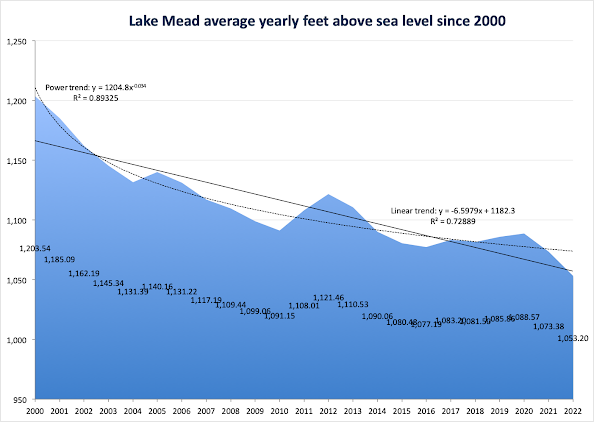
Lake Mead water level.
   

 Ahhh... the infamous "Bathtub Ring." Looking back from the top of Hoover Dam. I've been there and shot pics there many times during my 21 years living in Las Vegas. The vertical distance from the top of the bathtub ring to the water surface level is now more than 150 feet.
 
I continue to update an Excel sheet monthly, tracking the water level decline since January 2000.
 
Interestingly, in the wake of this past winter's repeated severe western watershed blizzards, the Lake Mead water level has risen a bit more than 8 feet across the past two months. Hardly makes a dent in the average annual decline.
 
Here in Baltimore, while we are not yet formally in drought conditions, our area rainfall is now more than 7 inches below average. And, our sky of late has been an ugly gray-yellow haze, owing to the Canadian wildfires currently ravaging the breadth of that nation from Nova Scotia and Quebec to Manitoba and Alberta Provinces.
 
No rain predicted here in BMore before next week.
 
Stay tuned...
__________
 

Thursday, September 1, 2022

Worsening droughts and water shortages

concomitant with record flooding
 

I continue to update my Excel sheet tracking and depicting monthly and yearly Lake Mead water levels. We lived in Las Vegas from 1992 through 2013. Loved it there. But, I would often joke that Vegas was "the next Anasazi ruin."
 

Ran across a cool interview article the other day.
As Colorado River Dries, the US Teeters on the Brink of Larger Water Crisis
The megadrought gripping the western states is only part of the problem. Alternative sources of water are also imperiled, and the nation’s food along with it.


This story first appeared at ProPublica. ProPublica is a Pulitzer Prize-winning investigative newsroom. Sign up for The Big Story newsletter to receive stories like this one in your inbox.

The western United States is, famously, in the grips of its worst megadrought in a millennium. The Colorado River, which supplies water to more than 40 million Americans and supports food production for the rest of the country, is in imminent peril. The levels in the nation’s largest freshwater reservoir, Lake Mead, behind the Hoover Dam and a fulcrum of the Colorado River basin, have dropped to around 25% of capacity. The Bureau of Reclamation, which governs lakes Mead and Powell and water distribution for the southern end of the river, has issued an ultimatum: The seven states that draw from the Colorado must find ways to cut their consumption — by as much as 40% — or the federal government will do it for them. Last week those states failed to agree on new conservation measures by deadline. Meanwhile, next door, California, which draws from the Colorado, faces its own additional crises, with snowpack and water levels in both its reservoirs and aquifers all experiencing a steady, historic and climate-driven decline. It’s a national emergency, but not a surprise, as scientists and leaders have been warning for a generation that warming plus overuse of water in a fast-growing West would lead those states to run out.

I recently sat down with Jay Famiglietti, the executive director of the Global Institute for Water Security at the University of Saskatchewan, to talk about what comes next and what the public still doesn’t understand about water scarcity in the United States. Before moving to Canada, Famiglietti was a lead researcher at NASA’s water science program at the Jet Propulsion Laboratory in Pasadena, California, and a member of the faculty at the University of California, Irvine. He pioneered the use of the Gravity Recovery and Climate Experiment satellites to peer into the earth’s mass and measure changes in its underground water supplies. The Colorado River crisis is urgent, Famiglietti said, but the hidden, underground water crisis is even worse. We talked about what U.S. leaders either won’t acknowledge or don’t understand and about how bad things are about to get.

Our conversation has been edited for length and clarity.

Let’s start with the Colorado River because it’s in the news. The federal government has put some extraordinary numbers out there, suggesting water users cut between 2 and 4 million acre-feet of water usage starting this year — roughly 40% of the entire river’s recent flow. How could that possibly happen?

It’s going to be really hard. We’re looking at drastically reduced food production and the migration of agriculture to other parts of the country and real limits on growth, especially in desert cities like Phoenix. My fear is that groundwater will, as usual, be left out of the discussion — groundwater is mostly unprotected, and it’s going to be a real shit show.

Remind us how that happens. States and farmers cut back on the Colorado River, and California and Arizona just start pumping all the water out of their aquifers?

Yeah. This started with the drought contingency plan [the 2018 legal agreement among the states on the Colorado River]. Arizona had to cut nearly 20% of its Colorado River water. To placate the farmers, the deal was that they would have free access to the groundwater. In fact, something like $20 million was allocated to help them dig more wells. So, it was just a direct transfer from surface water to groundwater. Right away, you could see that the groundwater depletion was accelerating. With this latest round, I’m afraid we’re just going to see more of that.

Some of that groundwater actually gets used to grow feed for cattle in the Middle East or China, right? There’s Saudi-owned agriculture firms planting alfalfa, which uses more water than just about anything, and it’s not for American food supply. Do I have that right?


There’s been other buyers from other countries coming in, buying up that land, land grabbing and grabbing the water rights. That’s happening in Arizona.

What about in California? Groundwater depletion has caused the earth to sink in on itself. Parts of the Central Valley are 28 feet lower today than they were a century ago.

California passed the Sustainable Groundwater Management Act in 2014, which mandated an extraordinarily long time horizon: two years to form the Groundwater Sustainability Agencies and then five years for each GSA to come up with its sustainability plan. So that’s now: 2022. And then 20 years to come into sustainability. My fear is that the slow implementation will allow for too much groundwater depletion to happen. It’s sort of the same old, same old.

But could it work?


I don’t think we’re talking about sustainability. I think we’re talking about managed depletion. Because it’s impossible to keep growing the food that we grow in California. It’s agriculture that uses most of the groundwater. The math just isn’t there to have sustainable groundwater management. If you think of sustainability as input equals output — don’t withdraw more than is being replenished on an annual basis — that’s impossible in most of California.

Will we run out of water? Are we talking about 10 years or 100 years?

Yes. We are on target to. Parts of the Central Valley have already run out of water. Before SGMA, there were places in the southern part of the valley where I would say within 40 to 50 years we would run out or the water is so saline or so deep that it’s just too expensive to extract. SGMA may slow that down — or it may not. I don’t think the outlook is really good. Our own research is showing that groundwater depletion there has accelerated in the last three years.

Then what happens? What does California or Arizona look like after that?

It looks pretty dry. Even among water users, there’s an element that doesn’t understand that this is going to be the end for a lot of farming. Farmers are trying to be really efficient but also magically want the supply of water to be sustained.

We focus on the big cities like Phoenix and Las Vegas, but it’s farms that use 80% of water. They grow crops that provide huge amounts of the winter fruits and vegetables and nuts for the entire country. Is there any way that farming in California and Arizona can continue even remotely close to how it is today?

I don’t think so. It has to drastically change. We’ll need wholesale conversion to efficient irrigation and different pricing structures so that water is better valued. We’ll need different crops that are bred to be more drought tolerant and more saline-water tolerant. And we’ll probably have a lot less production.

What does that mean for the country’s food supply?

This is the big question. I don’t want to be flippant, but people don’t understand the food-water nexus. Do we try to bring more water to the southern high plains, to Arizona, to California, because if the food system’s optimized, maybe that’s the cheapest thing to do? Or does agriculture move to where the water is? Does it migrate north and east? It’s not just food production. What about the workers? Transportation? If we were to move all of our agriculture to northern California, into Idaho, into North Dakota over the next decade, that’s a major upheaval for millions and millions of people who work in the ag industry...
Read all of it. Bracing.
 
See also my lengthy aggregative post on the Western US Drought, written after I'd moved back to California from Las Vegas. 

Now I live in Baltimore, but there's no escaping climate change. In that regard, see also my "Covering Climate Now" posts.
 
AND, THE HEAT
 

One news item had 127F in Death Valley this weekend.
___

Uhhh... lest I forget: Flooding, anyone?
 
As I write, 1/3rd of Pakistan is under water, with more than 1,000 dead  The entire population of Jackson MS is without safe municipal water—because of record flooding that destroyed the water management infrastructure.
 
AND, RIVERS GOING DRY
 
Europe’s mighty rivers are drying up in the climate-driven drought

Europe’s major rivers are shrinking under the most severe climate-driven drought in decades.

It’s distressing enough to see mighty waterways like the Loire, Po and Rhine reduced to a trickle in places.  But the ongoing drought is also revealing how much we depend on them for trade, energy and transport.

The Rhine’s evaporation is especially concerning. At the chokepoint of Kaub, near Frankfurt, it is expected to fall below 40cm on Friday. This would make it impassable for some larger ships carrying supplies of oil, coal and gas...
We're seeing similar problems in Asia.
 
SEA LEVEL RISE?
 
 
"Zombie Ice?"

Lots of bad stuff looming.

 
Again, these travails can be multidimensionally adverse-feedback-loop reinforcing.

UPCOMING BOOK RELEASES
 

Award-winning YALE PROFESSOR Woo-kyoung Ahn delivers “A MUST-READ—a smart and compellingly readable guide to cutting-edge research into how people think.” (Paul Bloom)

 
Psychologist Woo-kyoung Ahn devised a course at Yale called “Thinking” to help students examine the biases that cause so many problems in their daily lives. It quickly became one of the university’s most popular courses. In Ahn’s class, students examine “thinking problems”—like confirmation bias, causal attribution, and delayed gratification—and how they contribute to our most pressing societal issues and inequities. Now, for the first time, Ahn presents key insights from her years of teaching and research in a book for everyone.


Ahn draws on decades of research from other cognitive psychologists, as well as from her own groundbreaking studies. And she presents it all in a compellingly readable style that uses fun examples from K-pop dancing, anecdotes from her own life, and illuminating stories from history and the headlines.


Thinking 101 is a book that goes far beyond other books on thinking, showing how we can improve not just our own daily lives and tackle real-world problems through better awareness of our biases but also the lives of everyone around us. It is, quite simply, required reading for everyone who wants to think—and live—better.
____
The tech elite have a plan to survive the apocalypse: they want to leave us all behind.

Five mysterious billionaires summoned Douglas Rushkoff to a desert resort for a private talk. The topic? How to survive The Event: the societal catastrophe they know is coming. Rushkoff came to understand that these men were under the influence of The Mindset, a Silicon Valley–style certainty that they can break the laws of physics, economics, and morality to escape a disaster of their own making—as long as they have enough money and the right technology. In Survival of the Richest, Rushkoff traces the origins of The Mindset in science and technology through its current expression in missions to Mars, island bunkers, and the Metaverse. This mind-blowing work of social analysis shows us how to transcend the landscape The Mindset created—a world alive with algorithms and intelligences actively rewarding our most selfish tendencies—and rediscover community, mutual aid, and human interdependency. Instead of changing the people, he argues, we can change the program.
I saw and read reviews on these soon-to-be-released titles today in Science.

I've previously cited Douglas Rushkoff's prior book "Throwing Rocks at the Google Bus" some years back. Adroit writer.
__________