


Again, what is the point of all of my posting?


...We are not just helpless victims of fate but are the agents in charge of our own narrative, for better or worse, victorious or defeatist. This forceful shaping of our attitudes to events beyond our control has profound consequences for well-being and sickness…
How experience comes into the world has been an abiding mystery since the earliest days of recorded thought. Aristotle warned his readers more than two thousand years ago that “to attain any assured knowledge about the soul is one of the most difficult things in the world.” Mind is radically different from the stuff that makes up the brain and everything else. Quantum mechanics and general relativity, the periodic table of chemical elements, the endless strings of ATGC nucleotides that make up our genes—these appear to describe the physical, not the mental (I write “appear to” as quantum mechanics demonstrates that there are no observer-independent events, opening the door for consciousness to enter, at the ground level of reality). Yet we awaken every day to our subjective world of experiences.
The intellectual position that has garnered the most respect in contemporary Anglo-American philosophy departments is the ever more strident denigration or even outright denial of subjectivity. What is real is people talking obsessively about their experiences and acting on them; there is nothing above and beyond these speech acts and other intended or actual behaviors. The feeling part of consciousness, called phenomenal consciousness, is a big illusion. Philosophers in the know dispense with the “awful painfulness of my toothache” in the manner that Ebenezer Scrooge dealt with Christmas: “Bah! Humbug!” Furthermore, free will, our ability to deliberate about an upcoming fork in the road and to decide which path to take, is also thrown under this “illusion” bus. This rejection of the reality of lived experience constitutes a mind-boggling repudiation of what is immediately and indubitably given to us. It is also profoundly antihumanist, depriving us of those attributes that make us different from machines—indeed, equating us with machines.
It’s an absurd adjuration, akin to Cotard’s delusion, a rare psychiatric disorder in which able-bodied patients, often severely depressed, vehemently insist that some of their limbs are missing, that their bodies are rotting from the inside, or even that they are dead. When confronted with the fact that they are having a conversation, right now, with their doctor, they do admit that the situation is a bit baffling, but the fact is that they are dead, and that’s all there is to it. So it is with some contemporary thinkers who insist, against the evidence of their own senses, that experiences don’t exist. Truly astounding—gaslighting all of us into believing that our experiences are fake!
Fortunately, consciousness can’t be cancelled forever. The mental, having refused to yield, is returning with a vengeance. Indeed, the wheel is turning back to much more ancient understandings of experience, including idealism, the proposition that ultimately even matter and energy are mental manifestations, and panpsychism, the school of thought that all creatures, and perhaps even matter itself, are ensouled, that it feels-like-something to be anything, not just a human or even a bat. Modern science is supporting aspects of this remarkable turn of events…
What about nonhuman, artificial minds, rivaling or even exceeding ours? This topic is treated last. Sentient machines have been a recurring theme in science fiction. In 2022, this topic burst into public view with the startling claim by a Google software engineer that the company’s “large language model” was sentient and had to be considered a person with associated legal rights. The linguistic skills and knowledge of these models and their competitors, most famously ChatGPT and GPT-4 by OpenAI, trained on a vast trove of books and online documents far beyond what any human can read in a lifetime, are astonishing by the standards of even a few of years ago. They write summaries, emails, jokes, (bad) poetry, computer code, letters of recommendation, and dialogue indistinguishable from human-generated material, including plausible-sounding fabrications. They are evolving at an astounding pace and will transform society in fundamental ways.
These chatbots seemingly constitute living proof of the dominant narrative of liquid modernity: the mind is software that can be as readily embodied within silicon wafers as it is within flesh, echoing a pernicious Cartesian dualism. Smart money in Silicon Valley thinks so, most engineers and many philosophers think so, and popular movies and TV shows reinforce this belief.
Against the grain, integrated information theory radically disagrees with this functionalist view. It argues from first principles that digital computers can (in principle) do everything that humans can do, eventually even faster and better. But they can never be what humans are. Intelligence is computable, but consciousness is not. This is not because the brain possesses any supernatural properties. The critical difference between brains and digital computers is at the hardware level, where the rubber meets the road—that is, where action potentials are relayed to tens of thousands of recipient neurons versus packets of electrons shuttled back and forth among a handful of transistors. As we’ll see, the integrated information of digital computers is negligible. And that makes all the difference.
It means that these machines will never be sentient, no matter how intelligent they become. Furthermore, that they will never possess what we have: the ability to deliberate over an upcoming choice and freely decide.
The brain is the most complex piece of self-organized, active matter in the known universe. By no coincidence, it is also the organ of consciousness. Unlike scientific advances in genomics or astrophysics, progress in understanding the brain and the mind directly relates to who we are, our strengths and infirmities, how we can live a contented life, and whether we partake of some larger, ultimate reality. Humanity is not condemned to walk around forever in an epistemological fog—we can know, and we will know.
Koch, Christof. Then I Am Myself the World (pp. 14-21). Basic Books. Kindle Edition.

 |
—Bernardo Kastrup, Executive Director, Essentia Foundation |


 |
| Click |
An ordinary family man, geologist, and Mormon, Soren Johansson has always believed he’ll be reunited with his loved ones after death in an eternal hereafter. Then, he dies. Soren wakes to find himself cast by a God he has never heard of into a Hell whose dimensions he can barely grasp: a vast library he can only escape from by finding the book that contains the story of his life...A fun read.
"...We are not just helpless victims of fate but are the agents in charge of our own narrative, for better or worse, victorious or defeatist. This forceful shaping of our attitudes to events beyond our control has profound consequences for well-being and sickness…"

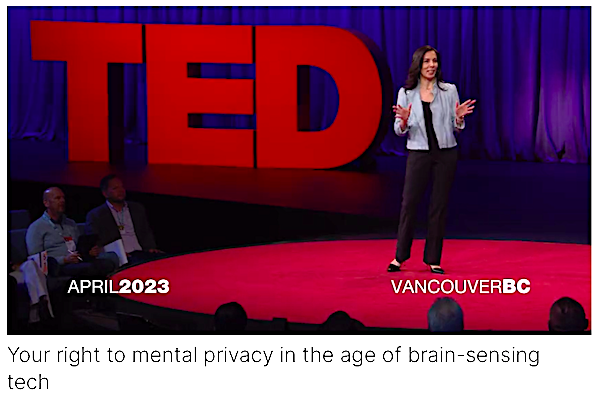
Neurotechnology, or devices that let you track your own brain activity, could help you deeply understand your health. But without privacy protections, your innermost thoughts, emotions and desires could be at risk of exploitation, says neurotech and AI ethicist Nita Farahany. She details some of the field's promising potential uses—like tracking and treating diseases from depression to epilepsy—and shares concerns about who collects our brain data and how they plan to use it, ultimately calling for the legal recognition of "cognitive liberty" as we connect our brains and minds to technology.


The Center for AI Safety (CAIS — pronounced 'case') is a San Francisco-based research and field-building nonprofit. We believe that artificial intelligence (AI) has the potential to profoundly benefit the world, provided that we can develop and use it safely. However, in contrast to the dramatic progress in AI, many basic problems in AI safety have yet to be solved. Our mission is to reduce societal-scale risks associated with AI by conducting safety research, building the field of AI safety researchers, and advocating for safety standards.Is “artificial intelligence” basically “neurotechnology?” One with silicon microcircuits, standing in for biophysical neurons? Are brains simply “computers?”
Your Brain: Perception DeceptionPBS Airdate: May 17, 2023
ANIL SETH, PH.D. (University of Sussex): The brain is one of the most complex objects that we know of, in the universe.
NARAYANAN “BOBBY” KASTHURI, M.D., PH.D. (University of Chicago, Argonne National Laboratory): There are 10 times more connections in your brain than there are stars in the Milky Way galaxy. So, we literally walk around with about 10,000 galaxies worth of neuronal connections in one of our brains.
HEATHER BERLIN, PH.D., M.P.H. (Icahn School of Medicine at Mount Sinai): That vast web of connections creates you, but how?
NANCY KANWISHER, PH.D. (Massachusetts Institute of Technology McGovern Institute for Brain Research): Figuring out how the brain implements the mind is a massive challenge.
ANIL SETH: It seems as though the world just pours itself into the mind, through the transparent windows of the eyes and the ears and all our other senses.
HEATHER BERLIN: But is what we see, hear and feel real?
STEPHEN MACKNIK, PH.D (SUNY Downstate Health Sciences University): You might think that the reality outside is actually what you’re perceiving. And the answer is no, it really isn’t…
Your Brain: Who's in Control?PBS Airdate: May 24, 2023
SUSANA MARTINEZ-CONDE, PH.D. (SUNY Downstate Health Sciences University): The brain is the biggest mystery in science today.
THALIA WHEATLEY, PH.D. (Dartmouth College): It’s responsible for all the facets of our personality, everything we think and everything we feel. It makes you you.
URI MAOZ, PH.D. (Chapman University): A very large fraction of what’s happening in my brain, I am not aware of at all.
HEATHER BERLIN, PH.D., M.D. (Icahn School of Medicine at Mount Sinai): But what exactly is going on in your unconscious brain? What part of your brain is really in charge?
CHARLES LIMB, M.D. (University of California, San Francisco): All day long, we’re doing unscripted things that we didn’t know we would be doing. Life is not scripted…

SEVERAL YEARS AGO, Tim Greenamyre, a neuroscientist and physician who directs the Pittsburgh Institute for Neurodegenerative Diseases at the University of Pittsburgh (Pitt), began to notice unsettling symptoms in his own body. He couldn’t smell things. He was constipated. He was shouting and kicking in his sleep. His left arm didn’t swing when he walked.
In July 2021, Greenamyre turned to a neurologist colleague to confirm the diagnosis he already suspected. He had Parkinson’s disease, an illness he has devoted himself to treating and trying to cure. Over the course of his long and productive career, the 67-year-old has not only won the admiration of his patients and clinical colleagues, but also developed a widely used animal model of Parkinson’s and contributed key insights into environmental triggers. That work exposed him to chemicals that induce the disease in rodents, a possible factor in his own illness.
“The irony is obvious,” says Greenamyre, a shy man with a dry sense of humor and a penchant for practical jokes who, to the unpracticed eye, shows few if any signs of the disease. (For now, he says, medication is helping.)
For colleagues, the news has been shocking and heartbreaking. “I was so deeply affected I could not respond right away,” says Laurie Sanders, a neuroscientist who studies Parkinson’s at Duke University School of Medicine and is a former Greenamyre postdoc. “All I really honestly wanted to do was just drive to Pittsburgh and give him a hug.”
Nearly all of Greenamyre’s 200 or so Parkinson’s patients, some of whom he has looked after for more than a decade, will learn of his diagnosis from this article, in which he is reluctantly making his condition public because it’s becoming the subject of rumors. He worries it will distract them. “I want their visits to be focused on them, not on me,” he says.
Compounding the irony, Greenamyre’s diagnosis comes at a time of fresh optimism among Parkinson’s researchers, who believe they might at last be closing in on treatments that could slow or stop the progression of the second most common neurodegenerative disease after Alzheimer’s. Parkinson’s disease afflicts roughly 1 million people in the United States, with nearly 90,000 new cases diagnosed each year. Globally, more than 8.5 million people have the disease, which is the fastest growing neurological disease in the world by one estimate.
The classic motor symptoms of Parkinson’s disease, described in 1817 by English surgeon James Parkinson, result from the degeneration of cells that produce the neurotransmitter dopamine in the substantia nigra, a midbrain area involved in movement control. This causes a variety of symptoms including, most commonly, tremors, muscle stiffness, and trouble with balance and coordination. As the disease advances, people may have difficulty speaking and initiating movement. Later, many develop dementia. Parkinson’s itself doesn’t kill, but its complications, particularly aspiration pneumonia due to difficulty swallowing, often do.
Dopamine, delivered in an oral drug combination of levodopa (L-Dopa) and carbidopa, has been the front-line therapy since it was approved in the U.S. in the 1970s, although it remains unavailable or unaffordable for many globally. The drug improves motor symptoms, but with time it begins to wear off more quickly, and sometimes-intolerable side effects— including involuntary, jerking movements called dyskinesia—frequently develop. Fifty years on, the failure of science to produce a therapy that stops the disease instead of targeting its symptoms has been painful and frustrating for patients and their families…


Like the million other Americans with Parkinson’s, Greenamyre’s patients are all waiting for something beyond dopamine. “It’s still a disease without a cure,” Hannan says. “I keep asking every time I come: ‘Is there something close?’”
JUST LEARNED A NEW ACRONYM
"MRgFUS"
A non-invasive ultrasound treatment for Parkinson's disease that was tested in a pivotal trial led by University of Maryland School of Medicine (UMSOM) researchers is now more broadly available at the University of Maryland Medical Center (UMMC). Recent FDA approval of a device used in the procedure effectively opens up access to focused ultrasound beyond clinical trial participation.
The device, called Exablate Neuro and manufactured by Insightec, was approved in late 2021 by the U.S. Food and Drug Administration to treat advanced Parkinson's disease on one side of the brain. UMMC is one of only several sites in the Mid-Atlantic region with the capabilities and expertise to perform focused ultrasound for Parkinson's disease and other movement disorders. The procedure requires a multi-disciplinary team, including a neurosurgeon, movement disorder neurologist, and neuroradiologist...


…It's a very natural evolution of technology, which is, people are very accustomed to sensors and their smart watches, and in their rings that track their heartbeats and footsteps and breaths and body temperatures.
8:47
And so the idea that brain sensors can now detect and decode our brain activity is a natural progression of where technology and the quantified self movement is. But it was only when I started to hear from technologists themselves about moving from.
9:05
You know what had been a category of technology that had really been niche products, with very limited applications
9:11
to embedding brain sensors into our everyday devices, like earbuds and headphones and watches and wearable tattoos, and how that not only will decode and give us access to our brain activity, but enable us to have a new way of interfacing with technology that I really understood
9:28
how urgent the conversation was that this was about to be a transformational technology. and, unlike AI, where everybody is talking about it. Nobody seems to be talking about this transformational technology that's happening. So
9:42
that made like it made it incredibly urgent for me to. Then, finally, with all these ideas percolating for a very long time to write this book, and to define this category of cognitive liberty and lawn in our lives…
Tech and democracy are not friends right now. We need to change that — fast.
As I’ve discussed previously in this series, social media has already knocked a pillar out from under our democratic institutions by making it exceptionally easy for people with extreme views to connect and coordinate. The designers of the Constitution thought geographic dispersal would put a brake on the potential power of dangerous factions. But people no longer need to go through political representatives to get their views into the public sphere.
Our democracy is reeling from this impact. We are only just beginning the work of renovating our representative institutions to find mechanisms (ranked choice voting, for instance) that can replace geographic dispersal as a brake on faction.
Now, here comes generative artificial intelligence, a tool that will help bad actors further accelerate the spread of misinformation...
The chilling effects of government surveillance have been extensively documented. Dr. Elizabeth Stoycheff, a professor of communications at Wayne State University, studies the ways that mass surveillance affects people’s behavior. In one study, Stoycheff created a baseline psychological profile of research participants based on their surveyed ideological beliefs, personality traits, and online activity. Then she subtly reminded a random subset of those participants that they were subjects of mass government surveillance. Afterward, all the participants were shown a made-up newspaper headline which stated that the United States had undertaken airstrikes against the Islamic State in Iraq and were asked their opinion about it, including how they thought other Americans would feel and whether they would be willing to voice their own opinions in public. The participants who had been primed to think about mass government surveillance were significantly more reluctant to share their nonconforming views, even when their personality profiles predicted otherwise. This underscores the significant impact of self-censorship in response to surveillance and reinforces decades of research on the “spiral of silence” that was first identified in 1974 by the German political scientist Elisabeth Noelle-Neumann—the phenomenon in which the perception that one’s opinion is unpopular makes one reluctant to express it.
What most dismayed Stoycheff was people’s cavalier dismissal of surveillance. “So many people I’ve talked with say they don’t care about online surveillance because they don’t break any laws and don’t have anything to hide. I find these rationales deeply troubling,” she mused. “It concerns me that surveillance seems to be enabling a culture of self-censorship because it further disenfranchises minority groups. It is difficult to protect and extend the rights of these vulnerable populations when their voices aren’t part of the discussion. Democracy thrives on a diversity of ideas and self-censorship starves it. Shifting this discussion so Americans understand that civil liberties are as fundamental to the country’s long-term well-being as thwarting very rare terrorist attacks is a necessary move.”
Freedom of thought is at the heart of those civil liberties; without it, the diversity of ideas necessary for human flourishing is silenced. Just as surveillance chills people from sharing their nonconforming views, thought surveillance will inevitably lead people to attempt thought modification—trying to silence their inner voices, risking a dangerous spiral that ends with the suppression of even their innermost views. Making it of paramount importance that we prohibit governments’ surveillance of thought.
Government surveillance of brain activity will inevitably push us toward greater conformity. With greater conformity comes a passive acceptance of authority and authoritarianism, either out of fear or in hopes of appearing cooperative, even when that conflicts with one’s own moral compass. Children are particularly susceptible to pressure to conform and so are even likelier to try to redirect divergent thinking for fear of being ostracized. Many of the worst atrocities are “crimes of obedience”: acts carried out in response to orders from authority that violate legal and social norms.
To know the difference between right and wrong, and to decide for ourselves what that is, we must have the freedom to think critically about the world around us. Freedom of thought guarantees us a private space to think and self-reflect, where we are free from fear of reprisal. This gives us the wherewithal to reject orders that we know are wrong.
This freedom is critical for all of us, not just great thinkers. John Stuart Mill made this point eloquently in On Liberty, arguing that “it is as much, and even more indispensable to enable average human beings to attain the mental stature which they are capable of.” When we have the freedom to think, we can decide for ourselves whether we want to be angry about a setback or an insult from another; we can investigate our feelings and align our instincts with our self-identity. But we can do so only in a mental space that is free from government surveillance.
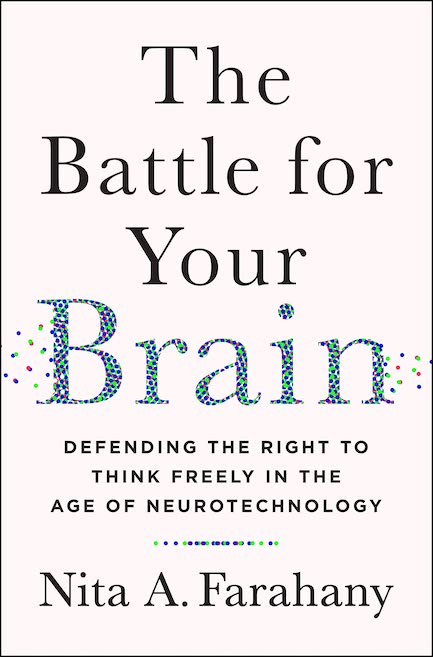
Farahany, Nita. The Battle for Your Brain (pp. 75-77). St. Martin's Publishing Group. Kindle Edition.


Will have to “implant” that interview into my blog, as I continue to review your book. DBS? Yeah, I have Parkinson’s. It majorly sux. I’d be all totally down with a Wi-Fi/Bluetooth interface (an App Store “API”?) with my neurons in lieu of cutting through my skull.


 |
| Click above |
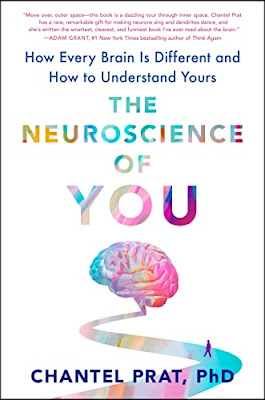

CHAPTER 8
CONNECT
How Two Brains Get on the Same Wavelength
In the book Talking to Strangers, Malcolm Gladwell takes his readers through a series of dramatic, real-world examples of misunderstandings between people that make two points very clearly: (1) Understanding other people can be really difficult; and (2) misunderstandings between people can have disastrous consequences. From Ponzi schemes to genocide, when we get it wrong—we really get it wrong. Is it any wonder that some of us are hesitant to explore relationships with others?
In this book, I’ve provided the background knowledge to help you understand the biological barrier that can drive misalignment between people. When two different brains, shaped by the confluence of their unique biology and life experiences, interact with each other in a shared environment, they do so through the barrier of the different subjective realities that they create.
Yet the very brains that make it difficult to see eye to eye with someone else are the same ones that inspire us to try. And though it’s certainly truer for some more than others, our social human brains crave connection. From early caregiving relationships through the different types of intimate adult partnerships we form, our brains contain a host of built-in mechanisms that drive us to connect. And this makes good sense, given how central relationships are to our survival. In fact, forming connections with others is one of the most important brain functions of all.
I think George R. R. Martin got to the heart of this when he wrote, “When the snow falls and the white winds blow, the lone wolf dies but the pack survives”—as a central part of the House Stark narrative in Game of Thrones. Because when times get tough, having close relationships is critical to our survival, even if most humans no longer rely directly on one another for things like warmth or hunting in packs. We have seen this play out over and over in health-related research, where the power of touch has been shown to help the brains and bodies of premature babies develop, and social support networks help buffer the health effects of chronic illnesses like AIDS. To put the importance of close relationships into a more concrete, health-related context, consider the results of a recent meta-analysis conducted by Julianne Holt-Lunstad and Timothy Smith. After analyzing data collected from more than 300,000 participants around the world, the authors concluded that lacking close interpersonal relationships was more than twice as strongly associated with early mortality as either excessive drinking or obesity.
And I’m sure that our understanding of the health risks associated with loneliness will increase exponentially as psychologists and healthcare professionals start to crunch the data collected from the massive “social isolation experiment” that the COVID-19 pandemic created. A quick search through the scientific literature using keywords “social isolation,” “pandemic,” and “health” returned more than 1,500 articles published in the last two years on this topic. Though I can’t quite get to the place of calling this a silver lining, each of these studies will contribute to our understanding of why interpersonal connection is a necessary component of healthy living, and which of the many ingredients of successful connections promote physical and mental health. But will they provide the recipe for forming healthy relationships?…
Prat, Chantel. The Neuroscience of You (pp. 287-289). Penguin Publishing Group. Kindle Edition
WHEN YOU THINK ABOUT the individual genetic and developmental differences that impact the sensory portions of our nervous systems, it’s remarkable that we can agree on a shared reality at all…We have a new winner in the "Best Place to Hide a $100 Bill From Donald Trump" awards.
…Each of us operates from a different perception of the world and a different perception of ourselves.
A portion of the individual variation in sensory systems is innate. But those innate effects are elaborated and magnified with time as we accumulate experiences, expectations, and memories, filtered through and in turn modifying those very same sensory systems. In this way, the interacting forces of heredity, experience, plasticity, and development resonate to make us unique.
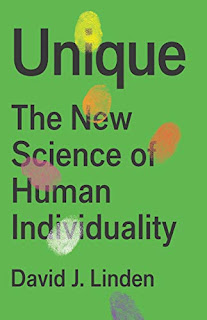
Linden, David. Unique (pp. 253-254). Basic Books. Kindle Edition.
How we become unique is one of the deepest questions that we can ask. The answers, where they exist, have profound implications, and not just for internet dating. They inform how we think about morality, public policy, faith, health care, education, and the law. For example: If a behavioral trait like aggression has a heritable component, then are people born with a biological predisposition toward it less legally culpable for their violent acts? Another question: If we know that poverty reduces the heritability of a valued human trait like height, should we, as a society, seek to reduce the inequities that impede people from fulfilling their genetic capacity? These are the types of questions where the science of human individuality can inform discussion.I sorely want David to defy the odds and survive. Read his book and you will agree.
Although investigating the origins of individuality is not just an endeavor for biologists—cultural anthropologists, artists, historians, linguists, literary theorists, philosophers, psychologists, and many others have a seat at this table—many of this topic’s most important aspects involve fundamental questions about the development, genetics, and plasticity of the nervous system. The good news is that recent scientific findings are illuminating this question in ways that are exciting and sometimes counterintuitive. The better news is that it doesn’t just boil down to the same tiresome nature-versus-nurture debate that has been impeding progress and boring people for years. Genes are built to be modified by experience. That experience is not just the obvious stuff, like how your parents raised you, but more complicated and fascinating things like the diseases you’ve had (or those that your mother had while she was carrying you in utero), the foods you’ve eaten, the bacteria that reside in your body, the weather during your early development, and the long reach of culture and technology.
So, let’s dig into the science. It can be controversial stuff. Questions about the origins of human individuality speak directly to who we are. They challenge our concepts of nation, gender, and race. They are inherently political and incite strong passions. For over 150 years, from the high colonial era to the present, these arguments have separated the political Right from the Left more clearly than any issue of policy.
Given this fraught backdrop, I’ll do my best to play it straight and synthesize the current scientific consensus (where it exists), explain the debates, and point out where the sidewalk of our understanding simply ends… [pp 6-7]
…If you’ve ever doubted the significance of brain plasticity, rest assured that its tendrils reach from the individual to the society.
Because of livewiring, we are each a vessel of space and time. We drop into a particular spot on the world and vacuum in the details of that spot. We become, in essence, a recording device for our moment in the world.
When you meet an older person and feel shocked by the opinions or worldview she holds, you can try to empathize with her as a recording device for her window of time and her set of experiences. Someday your brain will be that time-ossified snapshot that frustrates the next generation.
Here’s a nugget from my vessel: I remember a song produced in 1985 called “We Are the World.” Dozens of superstar musicians performed it to raise money for impoverished children in Africa. The theme was that each of us shares responsibility for the well-being of everyone. Looking back on the song now, I can’t help but see another interpretation through my lens as a neuroscientist. We generally go through life thinking there’s me and there’s the world. But as we’ve seen in this book, who you are emerges from everything you’ve interacted with: your environment, all of your experiences, your friends, your enemies, your culture, your belief system, your era—all of it. Although we value statements such as “he’s his own man” or “she’s an independent thinker,” there is in fact no way to separate yourself from the rich context in which you’re embedded. There is no you without the external. Your beliefs and dogmas and aspirations are shaped by it, inside and out, like a sculpture from a block of marble. Thanks to livewiring, each of us is the world.
Eagleman, David. Livewired (pp. 244-245). Knopf Doubleday Publishing Group. Kindle Edition.
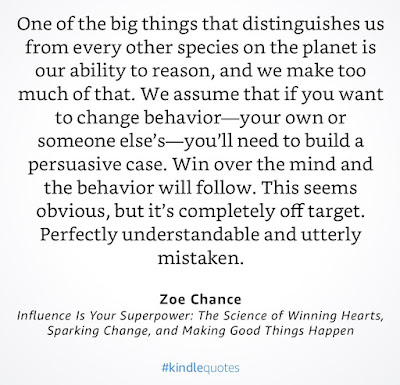
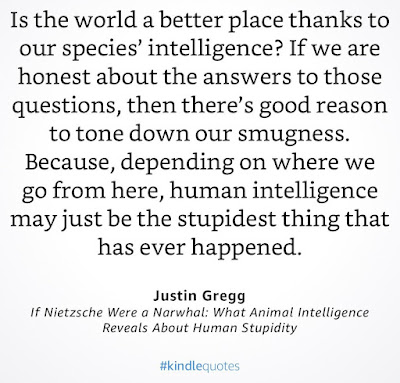
Should truth happen along the way, so much the better. (See "Why Do Humans Reason?" by Sperber & Mercier) Evolutionary adaptive utility, "The Pen is Mightier Than The Sword."
Another random observation. Even though I've taught collegiate "Critical Thinking," I've never much liked the phrase. Many students routinely came into my classes eager to be "critical" in the sense of being "contentious," "argumentative"—ready to throw down over their pet peeves and argue about stuff, "get shit off their chests." Sound familiar these days?
…every single life experience changes your brain. Some of the changes are inconsequential and others are incremental. But on rare occasions, for better or for worse, a single event can change the way we work, forever.Yeah, that squares nicely with the views of other neuroscience SMEs.
This is an important note to take, before diving deeper into the neuroscience of you. The fact that something about your brain causes you to think, feel, or behave in a certain way does not necessarily mean either that you were born that way or that it can’t change. The truth is that your brain is a moving target. And most research linking brains to behaviors, like my work on the two hemispheres and reading skill, only looks at a single point in time—a snapshot, so to speak. With this kind of experiment, it’s simply impossible to tell how much of a particular brain design is stable or has been shaped by your experiences. [The Neuroscience of You, p. 25]


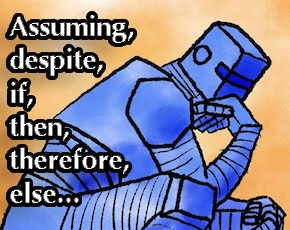
SOME TOPICAL ELEMENTS OF DELIBERATION SCIENCE?Not in any particular order here, nor mutually exclusive. And, what am I overlooking?
- Deductive logic (incl. Boolean logic?)
- Inductive inference
- Abductive inference
- Fuzzy logic
- Argument analysis and evaluation
- Philosophy of science
- Statistics
- Data science
- Game theory
- Rhetoric
- Linguistics (incl. semantics, pragmatics, semiotics, "Corpus Linguistics")
- Psychology (developmental, cognitive, social...)
- Sociology
- Cultural anthropology
- Political science
- History and systems of jurisprudence
- Moral philosophy and ethics
- Neuroscience
Behaviorlal Genetics?
…From the mundane activities, like estimating the angle your bike can turn at a given speed to the more profound decision points in life, like figuring out whether a particular choice will bring you more joy or more pain, your brain spends every waking moment engaged in elaborate problem-solving and decision-making algorithms. And of course, each brain goes about it a bit differently…Yeah. All of which bear on "deliberation." Ja?
…In fact, every lived experience physically changes your brain, resulting in a brain that is fine-tuned for operating in the environments that shaped it. And I think you might be surprised to learn what counts as an experience from your brain’s perspective. Ultimately, these experiences fundamentally shape the way we see the world we inhabit as well as how we understand people and situations that we don’t have a lot of experience with. [The Neuroscience of You [pp. 154-155]
"Deliberate" (adjective): intentional;"Deliberate" (verb): to consider carefully, factually, rationally;"Deliberation" (noun): the process of considering carefully, factually, rationally.

OK, after "jury deliberations," what might we think of? "Supreme Court deliberations?" "Congressional deliberations?" (Skeptics might argue the latter to be a contradiction in terms.)

Deliberation is a process of thoughtfully weighing options, usually prior to voting. Deliberation emphasizes the use of logic and reason as opposed to power-struggle, creativity, or dialogue. Group decisions are generally made after deliberation through a vote or consensus of those involved.Nicely stated.
In legal settings a jury famously uses deliberation because it is given specific options, like guilty or not guilty, along with information and arguments to evaluate. In "deliberative democracy", the aim is for both elected officials and the general public to use deliberation rather than power-struggle as the basis for their vote…
In political philosophy, there is a wide range of views regarding how deliberation becomes a possibility within particular governmental regimes. Most recently, the uptake of deliberation by political philosophy embraces it alternatively as a crucial component or the death-knell of democratic systems. Much of contemporary democratic theory juxtaposes an optimism about democracy against excessively hegemonic, fascist, or otherwise authoritarian regimes. Thus, the position of deliberation is highly contested and is defined variously by different camps within contemporary political philosophy. In its most general (and therefore, most ambiguous) sense, deliberation describes a process of interaction between various subjects/subjectivities dictated by a particular set of norms, rules, or fixed boundaries. Deliberative ideals often include "face-to-face discussion, the implementation of good public policy, decisionmaking competence, and critical mass."
The origins of philosophical interest in deliberation can be traced to Aristotle’s concept of phronesis, understood as "prudence" or "practical wisdom" and its exercise by individuals who deliberate in order to discern the positive or negative consequences of potential actions…
 |
| Click |

We view grit and quit as opposing forces. After all, you either persevere or you abandon course. You can’t do both at the same time, and in the battle between the two, quitting has clearly lost.What's the joke? "Rehab is for quitters."
While grit is a virtue, quitting is a vice.
The advice of legendarily successful people is often boiled down to the same message: Stick to things and you will succeed. As Thomas Edison said, “Our greatest weakness lies in giving up. The most certain way to succeed is always to try just one more time.” Soccer legend Abby Wambach echoed this sentiment over a century later when she said, “You must not only have competitiveness but ability, regardless of the circumstance you face, to never quit.”
Similar inspirational advice is attributed to other great sports champions and coaches, such as Babe Ruth, Vince Lombardi, Bear Bryant, Jack Nicklaus, Mike Ditka, Walter Payton, Joe Montana, and Billie Jean King. You can also find almost identical quotes from other legendary business successes through the ages, from Conrad Hilton to Ted Turner to Richard Branson.
All these famous people, and countless others, have united behind variations of the expression “Quitters never win, and winners never quit.”
It is rare to find any popular quote in favor of quitting except one attributed to W. C. Fields: “If at first you don’t succeed, try, try again. Then quit. There’s no use being a damn fool about it.”
Duke, Annie. Quit (p. xviii). Penguin Publishing Group. Kindle Edition.
CERTAINTY IS EVERYWHERE. FUNDAMENTALISM IS IN FULL bloom. Legions of authorities cloaked in total conviction tell us why we should invade country X, ban The Adventures of Huckleberry Finn in schools, or eat stewed tomatoes; how much brain damage is necessary to justify a plea of diminished capacity; the precise moment when a sperm and an egg must be treated as a human being; and why the stock market will eventually revert to historical returns. A public change of mind is national news.But why? Is this simply a matter of stubbornness, arrogance, and/or misguided thinking, or is the problem more deeply rooted in brain biology? Since my early days in neurology training, I have been puzzled by this most basic of cognitive problems: What does it mean to be convinced? At first glance, this question might sound foolish. You study the evidence, weigh the pros and cons, and make a decision. If the evidence is strong enough, you are convinced that there is no other reasonable answer. Your resulting sense of certainty feels like the only logical and justifiable conclusion to a conscious and deliberate line of reasoning.But modern biology is pointing in a different direction. Consider for a moment an acutely delusional schizophrenic patient telling you with absolute certainty that three-legged Martians are secretly tapping his phone and monitoring his thoughts. The patient is utterly convinced of the “realness” of the Martians; he “knows” that they exist even if we can’t see them. And he is surprised that we aren’t convinced. Given what we now know about the biology of schizophrenia, we recognize that the patient’s brain chemistry has gone amok, resulting in wildly implausible thoughts that can’t be “talked away” with logic and contrary evidence. We accept that his false sense of conviction has arisen out of a disturbed neurochemistry.It is through extreme examples of brain malfunction that neurologists painstakingly explore how the brain works under normal circumstances. For example, most readers will be familiar with the case of Phineas Gage, the Vermont laborer whose skull and frontal region of the brain were pierced with an iron bar during an 1848 railroad construction accident.1 Miraculously, he lived, but with a dramatically altered personality. By gathering together information from family, friends, and employers, his physicians were able to piece together one of the earliest accurate descriptions of how the frontal lobe affects behavior...Burton, Robert Alan (2008-02-04T22:58:59.000). On Being Certain. St. Martin's Publishing Group. Kindle Edition.


 |
| Click |
The Center for Practical Wisdom was started by a group of scientists and scholars at the University of Chicago with an interest in human decision making that is concerned with how our decisions affect others. From Aristotle, our working definition of practical wisdom is practical decision making that leads to human flourishing. While much of the world, since Binet, the father of the IQ test, has focused on the importance of intelligence for society, intelligence is about solving problems without consideration for the impact of the solutions on others. By contrast, we think about practical wisdom or wise reasoning as considering value commitments that are concerned with understanding the impact of decisions on others.OK, cool. I'm kinda late to the party here. Will have to get up to speed on this.


