Search the KHIT Blog

Showing posts with label First Amendment. Show all posts

Friday, September 19, 2025

"A Beautiful Day for Saying Nothing."

"That chill in the air isn’t Jimmy Kimmel’s show being suspended. It’s just autumn!"
   
 
It would be awful to live in interesting times, but, fortunately, we don’t.

What a beautiful fall day it is. A beautiful day for saying nothing! That chill you feel in the air isn’t Pam Bondi saying she’s going to go after free speech, then clumsily backtracking. It’s not Jimmy Kimmel’s show being suspended indefinitely after FCC Chair Brendan Carr threatened ABC. It’s just autumn: The perfect time to discuss approved subjects.

Let’s not get political. Let’s avoid hate speech. (That’s when Jonathan Karl asks the president questions. You might almost mistake it for journalism, but, remember, he has hate in his heart.) Let’s avoid antifa. (That’s when the president has a bad feeling about you. Or maybe you even did an act of terror, like protesting the president while he ate dinner, hurling words at his head, harming him.)

Let’s just stand here, silently. Isn’t it nice here? So quiet. Just stand here and savor the freedom. And, of course, the bravery. And, of course, the corporate mergers. You can tell the country is free because everywhere you look, there is less and less evidence that slavery ever happened.

Save your voice until it grows rusty from disuse. Think of all the free time you’ll get back once you no longer have to spend an hour every night watching comedians criticize the regime. You will be amazed at how many other things there are to talk about. The nice smell of the leaves, pumpkin-spice season come ’round again, the smell of the top of your baby’s head. Travis and Taylor are getting married—to each other, even!

It’s not a chilling effect. It would only be chilling if you had something horrid to say, and you don’t, do you? Certainly nothing critical of the regime, and absolutely no paraphrasing, not of anyone, not at this time! So it’s not chilling. You can say whatever you would like. You can say, “Kill ’em,” about mentally ill homeless people, and keep your job with a simple apology. Just make certain, first, that you are one of those whose speech is never considered a threat. You’ll know.

Silence will certainly save us. Authoritarianism is like measles: Ignore it and it will go away. I have this guidance straight from Secretary Kennedy.

I If we are quiet enough, they are sure to forget we are here. They’re not just looking for pretexts at this point, to do what they were always going to do. Don’t say the word pretext so loud. There has never been a pretext even once. We certainly don’t know what you mean. Just be quiet. Don’t say We have to speak up now, because there will always be an excuse when the troops descend on the city or the strike hits the boat or the vans roll up and start shoving people inside. I’m sorry I said excuse. I’m sorry I said pretext. I should have said reason. I should have said nothing.

Let’s all just sit here motionless for the next four years and hope things work out! Then the merger can go through; then the shareholders can breathe a sigh of relief. Surely someone else will say something before it’s too late. It’s a beautiful fall day. Look at the fall.


By Alexandra Petri
____
    
"As a subscriber, you can send unlimited gift articles to other readers to enjoy with or without subscriptions."
(I am a decades-lomg Atlantic subsciber. Encourage you to sign up.)
 
CODA

Thursday, March 27, 2025

I am compelled to be Franks with you

The “censorship industrial complex” operates like other thought-terminating cliches such as “the woke mind virus” or “cancel culture”: as a way for powerful people to invert reality as well as First Amendment doctrine. This victim-claiming tactic seeks not only to distract the American people from the efforts of the government to engage in actual censorship, but to disguise these censorship efforts as free speech.

But the American people can see what is happening. The current President of the United States is ordering lawful residents to be kidnapped and expelled from the country because of their speech. He is dictating what words people are allowed to use, what educational institutions are allowed to teach, what values businesses are allowed to promote. He is declaring any person he disagrees with to be a criminal. He is calling for critics and dissenters to be imprisoned and assaulted. He is threatening journalists, students, judges, lawyers, religious leaders, governors—anyone he deems insufficiently loyal and insufficiently obedient. Trump’s message could not be clearer: you either bbow down to him, or you will be punished. This is what censorship looks like.

You are members of the United States Senate, government officials tasked with the sacred duty of serving the American public—not a self-professed king and not his wealthy jester—and honoring their constitutional rights. This is a president who has declared himself above the law, including the First Amendment. Those who truly wish to fight censorship should start with him.
Dr Franks' conclusion of her opening statement during this weeks' testimony before the Senate Judiciary Committee.
 
Following up on a prior review post.
 
Fundamentalism is as alive and well in law as it is in religion. I have seen firsthand how often people use the Constitution the way religious fundamentalists use the Bible—selectively, self-servingly, and in bad faith.

Much as the evangelical community I was raised in focused on verses about homosexuality or women’s inferiority while ignoring the Golden Rule, constitutional fundamentalists focus on individual rights of speech and bearing arms while disregarding the equal protection guarantees of the Fourteenth Amendment. This is not just a tactic of conservatives, whose affinity for Christian fundamentalism is no secret, but also of self-identified liberals. I was not particularly surprised when National Rifle Association supporters and Breitbart readers denounced my work on gun violence as an attack on the Constitution; I was more taken aback when American Civil Liberties Union representatives and self-identified liberals made similar claims about my efforts to protect intimate privacy rights.

As I have fielded e-mails, phone messages, and social media posts threatening me with job loss, rape, and death, I have been struck by another parallel between religious and constitutional fundamentalism: the tendency to engage in a tactic I call victim-claiming. Often used in conjunction with victim-blaming, which attempts to deprive victims of sympathy, victim-claiming attempts to generate sympathy for perpetrators. Victim-claiming is a reversal technique that puts the powerful in the the space of the vulnerable, the abuser in the space of the abused. It is the theme that disturbed me as a young reader of the Bible, which often portrays powerful men as suffering at the hands of their supposed inferiors. The point of such passages seemed to be the justification of the use of violence by the powerful against the vulnerable.

The fundamentalist reading of the Constitution, especially of the First and Second Amendments, produces the same effect. The most powerful and privileged people in America—white men—cast themselves as an underclass engaged in a protracted struggle against the women and minorities seeking to censor and disarm them.

I was moved to write this book because I believe that good faith can conquer bad. I believe that good faith in the Constitution, in particular, is both possible and necessary. I wrote this book to make the case against fundamentalism and for the principle of reciprocity expressed in Christianity’s Golden Rule, Kant’s categorical imperative, and the Fourteenth Amendment’s equal protection clause. I wrote this book to advocate for the position that the only rights any of us should have are the rights that all of us should have. If only some of us are saved, all of us are lost…

Franks, Mary Anne. The Cult of the Constitution: Our Deadly Devotion to Guns and Free Speech (loc. 108-133). Kindle Edition. 
Her March 25th Senate Judiciary Committee Testimony was riveting
 

GOP senators picked on the wrong woman. David Newhoff nails it:
If [Louisiana GOP] Sen. Kennedy had an ounce of guts or a modicum integrity, he would argue either that Franks misstates the law or, perhaps, that she correctly states the law, but misstates the facts alleged about the “censorship industrial complex.” Instead, the senator and the cyber-mob he incited could not have more ably proven Franks’s critique of First Amendment history if they had read her book and tried intentionally to do so.

Like many examples in the book, this powerful office holder, while whining that he’s being “censored,” whips up a hate-storm of violent threats designed to silence a citizen whose only power is her voice. Also, the optics are hard to ignore. If Kennedy’s five minutes were a movie scene, the Southern White male throwing his weight around while acting offended that anyone would suggest that white male privilege exists, would be panned by critics as too on the nose. The only things missing were a fan and a Mint Julep…
Read all of it. David is spot-on.
 
Below, more Franks:
 
_____


Hmmm... ring any bells?
 
 
My irascible take:
 

I would pay good money to attend a live discussion featuring Mary Anne Franks, Danielle Citron, Katherine Stewart, and Matthew Taylor.
 
Much more shortly...

Tuesday, March 18, 2025

Overbooked yet again.

It's how I roll...
 

This book has jumped the queue as I've been pressing to finish Christopher's riveting new work on LLM AI technology, These Strange New Minds. Mary Anne Franks rocks. I'd hoped to finish her and Chris's books today...

Then I opened my inbox this morning when I got up.


I'd forgetten that Who Is Government was on pre-order (I am a long-time insatiable Michael Lewis FanBoy).
After Donald Trump won his first presidential election, I had one of the strangest experiences I’ve ever had as a writer. The federal government had set aside a big pot of money for the candidates of both parties to staff their presidential transition teams. Trump and Hillary Clinton had both built massive teams of people ready to enter the 15 big federal departments and hundreds of smaller federal agencies to learn whatever was happening inside. A thousand or so Obama officials were waiting for them, along with briefings that had taken them six months to prepare. But then, days after the election, Trump simply fired the 500 or so people on his transition team. “Chris, you and I are so smart that we can leave the victory party two hours early and do the transition ourselves,” he told a perplexed Chris Christie, who’d assembled the team.

Then he appointed Rick Perry as his secretary of energy. In his own presidential campaign, Perry had called for the Energy Department’s elimination—and was forced, at his Senate confirmation hearings, to acknowledge that he’d had no real idea of what went on inside the Energy Department, but now that he’d spent a few days looking into it, he really did not want to eliminate it. At that moment, it became clear that none of these people, newly in charge of the United States government, had the faintest idea what it did. (The Energy Department, among its other critical functions, manages our nuclear weapons.) And they weren’t alone! I didn’t really have any clue what went on inside the department, either. People capable of ruining panel discussions and dinner parties with their steady stream of opinions about American politics were totally flummoxed by the simplest questions about American government…

Our government—as opposed to our elected officials—has no talent for telling its own story. On top of every federal agency sit political operatives whose job is not to reveal and explain the good work happening beneath them but to prevent any of their employees from embarrassing the president. The PR wing of the federal government isn’t really allowed to play offense, just a grinding prevent defense. And the sort of people who become civil servants—the characters profiled in this book—tend not to want or seek attention.

And, finally, there is the stereotype of “the government worker.” We all have in our heads this intractable picture: The nine-to-fiver living off the taxpayer who adds no value and has no energy and somehow still subverts the public will.

You never know what effect any piece of writing will have. Writers write the words, but readers decide their meaning. My vague sense is that most readers of these stories have come away with feelings both of hope (these civic-minded people are still among us) and dread (we’re letting something precious slip away). My own ambition for The Post series and this book was that they would subvert the stereotype of the civil servant. The typecasting has always been lazy and stupid, but increasingly, it’s deadly. Even as writers grow rich proving it wrong.

Given our current Trump/MAGA/DOGE shitstorm, this stuff is all acutely timely.
 
 
OUR FABULIST-IN-CHIEF THIS MORNING, WHINING ONCE AGAIN ON HIS "TRUTH SOCIAL" ABOUT OUR JUDICIAL BRANCH.
"This Radical Left Lunatic of a Judge, a troublemaker and agitator who was sadly appointed by Barack Hussein Obama, was not elected President - He didn’t WIN the popular VOTE (by a lot!), he didn’t WIN ALL SEVEN SWING STATES, he didn’t WIN 2,750 to 525 Counties, HE DIDN’T WIN ANYTHING!" Trump wrote. "I WON FOR MANY REASONS, IN AN OVERWHELMING MANDATE, BUT FIGHTING ILLEGAL IMMIGRATION MAY HAVE BEEN THE NUMBER ONE REASON FOR THIS HISTORIC VICTORY. I’m just doing what the VOTERS wanted me to do. This judge, like many of the Crooked Judges’ I am forced to appear before, should be IMPEACHED!!! WE DON’T WANT VICIOUS, VIOLENT, AND DEMENTED CRIMINALS, MANY OF THEM DERANGED MURDERERS, IN OUR COUNTRY. MAKE AMERICA GREAT AGAIN!!!"

BUT WAIT! THERE'S MORE!
 
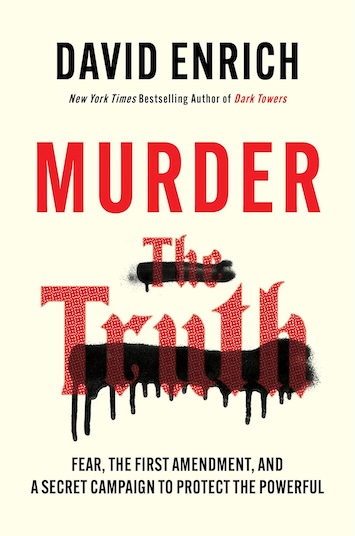
Saw this author interviewed on PBS Newshour last night.
 
This book is the story of a largely under-the-radar legal movement that is weaponizing the obscure field of libel law—a campaign whose growing momentum has closely tracked the country’s increasing flirtations with authoritarianism.

At first glance, libel law might seem an unlikely venue for a battle with high stakes for American democracy…
Yeah. At first blush, his book coheres nicely with Mary Anne Franks'.
 
ERRATUM
 
Been watching daily equities markets fluctuations lately (like a lot of folks). Found this a bit interesting.
 

Trump's "Truth Social" (DJT) and Musk's TESLA. I overlaid the dark grey negativeely sloping approximate "trendline" starting on Inauguration Day. Had I the raw data, I'm guessing I could compute a linear Pearson-R of perhaps ~ 0.9. These two DOGE BFFs fully deserve each other.
____
 
UPDATE


Her book is killer.
_____
 
UPDATE: THE DAY IN STUPID
 
 
Okeee Dokeee, then.
 
Stay tuned...
_________
  

Monday, February 20, 2023

Will this SCOTUS strike down or materially modify CDA Section 230?

SECTION 230, COMMUNICATIONS DECENCY ACT: 47.USC.230

§ 230. Protection for private blocking and screening of offensive material

(a) Findings
The Congress finds the following:
(1) The rapidly developing array of Internet and other interactive computer services available to individual Americans represent an extraordinary advance in the availability of educational and informational resources to our citizens.

(2) These services offer users a great degree of control over the information that they receive, as well as the potential for even greater control in the future as technology develops.

(3) The Internet and other interactive computer services offer a forum for a true diversity of political discourse, unique opportunities for cultural development, and myriad avenues for intellectual activity.

(4) The Internet and other interactive computer services have flourished, to the benefit of all Americans, with a minimum of government regulation.

(5) Increasingly Americans are relying on interactive media for a variety of political, educational, cultural, and entertainment services.
(b) Policy
It is the policy of the United States—
(1) to promote the continued development of the Internet and other interactive computer services and other interactive media;

(2) to preserve the vibrant and competitive free market that presently exists for the
Internet and other interactive computer services, unfettered by Federal or State regulation;

(3) to encourage the development of technologies which maximize user control over
what information is received by individuals, families, and schools who use the Internet and other interactive computer services;

(4) to remove disincentives for the development and utilization of blocking and filtering technologies that empower parents to restrict their children’s access to objectionable or inappropriate online material; and

(5) to ensure vigorous enforcement of Federal criminal laws to deter and punish trafficking in obscenity, stalking, and harassment by means of computer.
(c) Protection for ‘‘Good Samaritan’’ blocking and screening of offensive material

(1) Treatment of publisher or speaker

No provider or user of an interactive computer service shall be treated as the publisher
or speaker of any information provided by another information content provider.

(2) Civil liability
No provider or user of an interactive computer service shall be held liable on account
of—

(A) any action voluntarily taken in good faith to restrict access to or availability of material that the provider or user considers to be obscene, lewd, lascivious, filthy, excessively violent, harassing, or otherwise objectionable, whether or not such material is constitutionally protected; or

(B) any action taken to enable or make available to information content providers or others the technical means to restrict access to material described in paragraph (1).1
(d) Obligations of interactive computer service
A provider of interactive computer service shall, at the time of entering an agreement with a customer for the provision of interactive computer service and in a manner deemed appropriate by the provider, notify such customer that parental control protections (such as computer hardware, software, or filtering services) are commercially available that may assist the customer in limiting access to material that is harmful to minors. Such notice shall identify, or provide the customer with access to information identifying, current providers of such protections.
(e) Effect on other laws
(1) No effect on criminal law

Nothing in this section shall be construed to impair the enforcement of section 223 or 231 of this title, chapter 71 (relating to obscenity) or 110 (relating to sexual exploitation of children) of title 18, or any other Federal criminal statute.

(2) No effect on intellectual property law

Nothing in this section shall be construed to limit or expand any law pertaining to intellectual property.

(3) State law

Nothing in this section shall be construed to prevent any State from enforcing any State
law that is consistent with this section. No cause of action may be brought and no liability may be imposed under any State or local law that is inconsistent with this section.

(4) No effect on communications privacy law

Nothing in this section shall be construed to limit the application of the Electronic Communications Privacy Act of 1986 or any of the amendments made by such Act, or any similar State law.
(f) Definitions

As used in this section:
(1) Internet

The term ‘‘Internet’’ means the international computer network of both Federal and non-Federal interoperable packet switched data networks.

(2) Interactive computer service

The term ‘‘interactive computer service’’ means any information service, system, or access software provider that provides or enables computer access by multiple users to a computer server, including specifically a service or system that provides access to the Internet and such systems operated or services offered by libraries or educational institutions.

(3) Information content provider

The term ‘‘information content provider’’ means any person or entity that is responsible, in whole or in part, for the creation or development of information provided through the Internet or any other interactive computer service.

(4) Access software provider

The term ‘‘access software provider’’ means a provider of software (including client or
server software), or enabling tools that do any one or more of the following:

(A) filter, screen, allow, or disallow content;
(B) pick, choose, analyze, or digest content; or
(C) transmit, receive, display, forward, cache, search, subset, organize, reorganize, or translate content.
__________

(June 19, 1934, ch. 652, title II, § 230, as added Pub. L. 104–104, title V, § 509, Feb. 8, 1996, 110 Stat. 137; amended Pub. L. 105–277, div. C, title XIV, § 1404(a), Oct. 21, 1998, 112 Stat. 2681–739.)

REFERENCES IN TEXT
The Electronic Communications Privacy Act of 1986, referred to in subsec. (e)(4), is Pub. L. 99–508, Oct. 21, 1986, 100 Stat. 1848, as amended. For complete classification of this Act to the Code, see Short Title of 1986 Amendment note set out under section 2510 of Title 18, Crimes and Criminal Procedure, and Tables.

CODIFICATION
Section 509 of Pub. L. 104–104, which directed amendment of title II of the Communications Act of 1934 (47 U.S.C. 201 et seq.) by adding section 230 at end, was executed by adding the section at end of part I of title II of the Act to reflect the probable intent of Congress and amendments by sections 101(a), (b), and 151(a) of Pub. L. 104–104 designating §§ 201 to 229 as part I and adding parts II (§ 251 et seq.) and III (§ 271 et seq.) to title II of the Act.

AMENDMENTS
1998—Subsec. (d). Pub. L. 105–277, § 1404(a)(3), added subsec. (d). Former subsec. (d) redesignated (e). Subsec. (d)(1). Pub. L. 105–277, § 1404(a)(1), inserted ‘‘or 231’’ after ‘‘section 223’’. Subsecs. (e), (f). Pub. L. 105–277, § 1404(a)(2), redesignatedsubsecs. (d) and (e) as (e) and (f), respectively.

EFFECTIVE DATE OF 1998 AMENDMENT
Amendment by Pub. L. 105–277 effective 30 days after Oct. 21, 1998, see section 1406 of Pub. L. 105–277, set out as a note under section 223 of this title.
 
ORALS COMMENCE AT SCOTUS FEB 21ST ON TWO CASES
 
Facebook, Instagram, Twitter, Google/YouTube, Tumblr, Pinterest, GETTR, Telegram, & Truth Social, etc—none of them are currently considered "publishers" subject to content liability litigation and remedies. That may well change this year. There's a lot at stake.
 
Stay tuned...

2-22 UPDATE
[CNN]  After back-to-back oral arguments this week, the Supreme Court appears reluctant to hand down the kind of sweeping ruling about liability for terrorist content on social media that some feared would upend the internet.

On Wednesday, the justices struggled with claims that Twitter contributed to a 2017 ISIS attack in Istanbul by hosting content unrelated to the specific incident. Arguments in that case, Twitter v. Taamneh, came a day after the court considered whether YouTube can be sued for recommending videos created by ISIS to its users.

What's at stake: The closely watched cases carry significant stakes for the wider internet. An expansion of apps and websites’ legal risk for hosting or promoting content could lead to major changes at sites including Facebook, Wikipedia and YouTube, to name a few.

For nearly three hours of oral argument, the justices asked attorneys for Twitter, the US government and the family of Nawras Alassaf – a Jordanian citizen killed in the 2017 attack – how to weigh several factors that might determine Twitter’s level of legal responsibility, if any. But while the justices quickly identified what the relevant factors were, they seemed divided on how to analyze them…
May portend a relatively narrow, non-"groundbreaking" set of rulings. Or no new rulings (kick it over to Congress). We won't know until June or July.
__________
 

Monday, February 21, 2022

NSFW: Critical Race Theory, in 28:07


Boom.
 
apropos,
The commander in chief had had it with the press. He’d spent his time in the highest office of the land trying to do the best for his people, but all the press did was undermine him and endanger the nation. There he was, making the country great again, and what did they write about? His marriages, his divorces, his children, even his weight! It was time the purveyors of fake news paid the price for their slander, sedition, and outright treason. The most powerful man in the country decided it was time to push back…
Donald Trump? Nope. England's King Henry VIII.
 
Excellent read thus far. Goes to my "Deliberation Science" stash.
__________