Search the KHIT Blog

Showing posts with label Free Speech. Show all posts

Friday, September 19, 2025

"A Beautiful Day for Saying Nothing."

"That chill in the air isn’t Jimmy Kimmel’s show being suspended. It’s just autumn!"
   
 
It would be awful to live in interesting times, but, fortunately, we don’t.

What a beautiful fall day it is. A beautiful day for saying nothing! That chill you feel in the air isn’t Pam Bondi saying she’s going to go after free speech, then clumsily backtracking. It’s not Jimmy Kimmel’s show being suspended indefinitely after FCC Chair Brendan Carr threatened ABC. It’s just autumn: The perfect time to discuss approved subjects.

Let’s not get political. Let’s avoid hate speech. (That’s when Jonathan Karl asks the president questions. You might almost mistake it for journalism, but, remember, he has hate in his heart.) Let’s avoid antifa. (That’s when the president has a bad feeling about you. Or maybe you even did an act of terror, like protesting the president while he ate dinner, hurling words at his head, harming him.)

Let’s just stand here, silently. Isn’t it nice here? So quiet. Just stand here and savor the freedom. And, of course, the bravery. And, of course, the corporate mergers. You can tell the country is free because everywhere you look, there is less and less evidence that slavery ever happened.

Save your voice until it grows rusty from disuse. Think of all the free time you’ll get back once you no longer have to spend an hour every night watching comedians criticize the regime. You will be amazed at how many other things there are to talk about. The nice smell of the leaves, pumpkin-spice season come ’round again, the smell of the top of your baby’s head. Travis and Taylor are getting married—to each other, even!

It’s not a chilling effect. It would only be chilling if you had something horrid to say, and you don’t, do you? Certainly nothing critical of the regime, and absolutely no paraphrasing, not of anyone, not at this time! So it’s not chilling. You can say whatever you would like. You can say, “Kill ’em,” about mentally ill homeless people, and keep your job with a simple apology. Just make certain, first, that you are one of those whose speech is never considered a threat. You’ll know.

Silence will certainly save us. Authoritarianism is like measles: Ignore it and it will go away. I have this guidance straight from Secretary Kennedy.

I If we are quiet enough, they are sure to forget we are here. They’re not just looking for pretexts at this point, to do what they were always going to do. Don’t say the word pretext so loud. There has never been a pretext even once. We certainly don’t know what you mean. Just be quiet. Don’t say We have to speak up now, because there will always be an excuse when the troops descend on the city or the strike hits the boat or the vans roll up and start shoving people inside. I’m sorry I said excuse. I’m sorry I said pretext. I should have said reason. I should have said nothing.

Let’s all just sit here motionless for the next four years and hope things work out! Then the merger can go through; then the shareholders can breathe a sigh of relief. Surely someone else will say something before it’s too late. It’s a beautiful fall day. Look at the fall.


By Alexandra Petri
____
    
"As a subscriber, you can send unlimited gift articles to other readers to enjoy with or without subscriptions."
(I am a decades-lomg Atlantic subsciber. Encourage you to sign up.)
 
CODA

Monday, February 20, 2023

Will this SCOTUS strike down or materially modify CDA Section 230?

SECTION 230, COMMUNICATIONS DECENCY ACT: 47.USC.230

§ 230. Protection for private blocking and screening of offensive material

(a) Findings
The Congress finds the following:
(1) The rapidly developing array of Internet and other interactive computer services available to individual Americans represent an extraordinary advance in the availability of educational and informational resources to our citizens.

(2) These services offer users a great degree of control over the information that they receive, as well as the potential for even greater control in the future as technology develops.

(3) The Internet and other interactive computer services offer a forum for a true diversity of political discourse, unique opportunities for cultural development, and myriad avenues for intellectual activity.

(4) The Internet and other interactive computer services have flourished, to the benefit of all Americans, with a minimum of government regulation.

(5) Increasingly Americans are relying on interactive media for a variety of political, educational, cultural, and entertainment services.
(b) Policy
It is the policy of the United States—
(1) to promote the continued development of the Internet and other interactive computer services and other interactive media;

(2) to preserve the vibrant and competitive free market that presently exists for the
Internet and other interactive computer services, unfettered by Federal or State regulation;

(3) to encourage the development of technologies which maximize user control over
what information is received by individuals, families, and schools who use the Internet and other interactive computer services;

(4) to remove disincentives for the development and utilization of blocking and filtering technologies that empower parents to restrict their children’s access to objectionable or inappropriate online material; and

(5) to ensure vigorous enforcement of Federal criminal laws to deter and punish trafficking in obscenity, stalking, and harassment by means of computer.
(c) Protection for ‘‘Good Samaritan’’ blocking and screening of offensive material

(1) Treatment of publisher or speaker

No provider or user of an interactive computer service shall be treated as the publisher
or speaker of any information provided by another information content provider.

(2) Civil liability
No provider or user of an interactive computer service shall be held liable on account
of—

(A) any action voluntarily taken in good faith to restrict access to or availability of material that the provider or user considers to be obscene, lewd, lascivious, filthy, excessively violent, harassing, or otherwise objectionable, whether or not such material is constitutionally protected; or

(B) any action taken to enable or make available to information content providers or others the technical means to restrict access to material described in paragraph (1).1
(d) Obligations of interactive computer service
A provider of interactive computer service shall, at the time of entering an agreement with a customer for the provision of interactive computer service and in a manner deemed appropriate by the provider, notify such customer that parental control protections (such as computer hardware, software, or filtering services) are commercially available that may assist the customer in limiting access to material that is harmful to minors. Such notice shall identify, or provide the customer with access to information identifying, current providers of such protections.
(e) Effect on other laws
(1) No effect on criminal law

Nothing in this section shall be construed to impair the enforcement of section 223 or 231 of this title, chapter 71 (relating to obscenity) or 110 (relating to sexual exploitation of children) of title 18, or any other Federal criminal statute.

(2) No effect on intellectual property law

Nothing in this section shall be construed to limit or expand any law pertaining to intellectual property.

(3) State law

Nothing in this section shall be construed to prevent any State from enforcing any State
law that is consistent with this section. No cause of action may be brought and no liability may be imposed under any State or local law that is inconsistent with this section.

(4) No effect on communications privacy law

Nothing in this section shall be construed to limit the application of the Electronic Communications Privacy Act of 1986 or any of the amendments made by such Act, or any similar State law.
(f) Definitions

As used in this section:
(1) Internet

The term ‘‘Internet’’ means the international computer network of both Federal and non-Federal interoperable packet switched data networks.

(2) Interactive computer service

The term ‘‘interactive computer service’’ means any information service, system, or access software provider that provides or enables computer access by multiple users to a computer server, including specifically a service or system that provides access to the Internet and such systems operated or services offered by libraries or educational institutions.

(3) Information content provider

The term ‘‘information content provider’’ means any person or entity that is responsible, in whole or in part, for the creation or development of information provided through the Internet or any other interactive computer service.

(4) Access software provider

The term ‘‘access software provider’’ means a provider of software (including client or
server software), or enabling tools that do any one or more of the following:

(A) filter, screen, allow, or disallow content;
(B) pick, choose, analyze, or digest content; or
(C) transmit, receive, display, forward, cache, search, subset, organize, reorganize, or translate content.
__________

(June 19, 1934, ch. 652, title II, § 230, as added Pub. L. 104–104, title V, § 509, Feb. 8, 1996, 110 Stat. 137; amended Pub. L. 105–277, div. C, title XIV, § 1404(a), Oct. 21, 1998, 112 Stat. 2681–739.)

REFERENCES IN TEXT
The Electronic Communications Privacy Act of 1986, referred to in subsec. (e)(4), is Pub. L. 99–508, Oct. 21, 1986, 100 Stat. 1848, as amended. For complete classification of this Act to the Code, see Short Title of 1986 Amendment note set out under section 2510 of Title 18, Crimes and Criminal Procedure, and Tables.

CODIFICATION
Section 509 of Pub. L. 104–104, which directed amendment of title II of the Communications Act of 1934 (47 U.S.C. 201 et seq.) by adding section 230 at end, was executed by adding the section at end of part I of title II of the Act to reflect the probable intent of Congress and amendments by sections 101(a), (b), and 151(a) of Pub. L. 104–104 designating §§ 201 to 229 as part I and adding parts II (§ 251 et seq.) and III (§ 271 et seq.) to title II of the Act.

AMENDMENTS
1998—Subsec. (d). Pub. L. 105–277, § 1404(a)(3), added subsec. (d). Former subsec. (d) redesignated (e). Subsec. (d)(1). Pub. L. 105–277, § 1404(a)(1), inserted ‘‘or 231’’ after ‘‘section 223’’. Subsecs. (e), (f). Pub. L. 105–277, § 1404(a)(2), redesignatedsubsecs. (d) and (e) as (e) and (f), respectively.

EFFECTIVE DATE OF 1998 AMENDMENT
Amendment by Pub. L. 105–277 effective 30 days after Oct. 21, 1998, see section 1406 of Pub. L. 105–277, set out as a note under section 223 of this title.
 
ORALS COMMENCE AT SCOTUS FEB 21ST ON TWO CASES
 
Facebook, Instagram, Twitter, Google/YouTube, Tumblr, Pinterest, GETTR, Telegram, & Truth Social, etc—none of them are currently considered "publishers" subject to content liability litigation and remedies. That may well change this year. There's a lot at stake.
 
Stay tuned...

2-22 UPDATE
[CNN]  After back-to-back oral arguments this week, the Supreme Court appears reluctant to hand down the kind of sweeping ruling about liability for terrorist content on social media that some feared would upend the internet.

On Wednesday, the justices struggled with claims that Twitter contributed to a 2017 ISIS attack in Istanbul by hosting content unrelated to the specific incident. Arguments in that case, Twitter v. Taamneh, came a day after the court considered whether YouTube can be sued for recommending videos created by ISIS to its users.

What's at stake: The closely watched cases carry significant stakes for the wider internet. An expansion of apps and websites’ legal risk for hosting or promoting content could lead to major changes at sites including Facebook, Wikipedia and YouTube, to name a few.

For nearly three hours of oral argument, the justices asked attorneys for Twitter, the US government and the family of Nawras Alassaf – a Jordanian citizen killed in the 2017 attack – how to weigh several factors that might determine Twitter’s level of legal responsibility, if any. But while the justices quickly identified what the relevant factors were, they seemed divided on how to analyze them…
May portend a relatively narrow, non-"groundbreaking" set of rulings. Or no new rulings (kick it over to Congress). We won't know until June or July.
__________
 

Tuesday, April 26, 2022

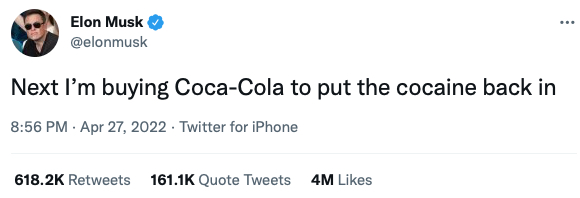
Elon Musk (apparently) buys "the de-facto public square"

 
Of course, my first response on Twitter was:


Yeah, but not seein' "the End of Western Civilization As We Know it" here.

I must have been out sick the day in grad school ConLaw when they covered "de-facto Public Square" (I cannot locate the words in the Constitution). 
 
Whatever, y'all. Have at it.

BTW: for a serious read on the history of "free speech,"

If Dirck Coornhert, Baruch Spinoza, John Lilburne, Olympe de Gouges, or Frederick Douglass were alive today they would surely declare the twenty-first century an unprecedented Golden Age for free speech. They would marvel at what can be freely discussed openly in real time between people across the globe with no looming Inquisition, Star Chamber, or Committee of Public Safety. No one in the Netherlands bats an eyelid if the doctrines of the Reformed Church are questioned or rejected. Every “free-born Englishman”—regardless of class or religious belief—has a right to criticize the government with no prior censorship or onerous laws against seditious words. In France, women have the same right to “mount the tribune” as men, and political heretics don’t have to fear the guillotine. And in the US, though racism is yet to be defeated, African Americans are no longer “dumb in their chains,” nor can they be silenced by repressive “black codes” or violent mobs acting with impunity.

Given the epic struggles, setbacks, false starts, and enormous sacrifices that led to this happy state of affairs, there is indeed much to celebrate about the current condition of free expression. But the Golden Age of free speech is in decline rather than ascendancy despite the unprecedented ubiquity of speech and information.

In the ninth century CE, Ibn al-Rāwandī could reject prophecy and central doctrines of Islam without serious punishment. But if he were alive today, his life and liberty would be severely threatened in a number of Muslim-majority countries, where blasphemy and apostasy are punishable by death. Even in secular democracies like France and the UK, al-Rāwandī’s radical ideas might well be met with the Jihadist’s Veto.

Gandhi would surely lament that India still uses colonial-era speech crimes to curtail the freedoms of speech and assembly that Gandhi considered the “two lungs that are absolutely necessary for a man to breathe the oxygen of liberty.”

Four decades ago, Western democracies relied on freedom of expression to empower dissidents behind the Iron Curtain, which contributed to the triumph of the Helsinki effect and the end of European communism. Today, the combination of free speech and technology ensuring the free flow of information across borders is increasingly seen as a trojan horse threatening democracy rather than a battering ram knocking down the walls of censorship in closed societies.

At times European democratic leaders have sounded more like a distorted echo of the Soviet apparatchiks who warned against the flood of Western “racism,” “fascism,” and “false propaganda” than the stewards of democracies built upon the central premise of free and open debate for all. Eleanor Roosevelt’s prescient warning that prohibiting incitement to hatred under international human rights law “would encourage governments to punish all criticism under the guise of protecting against religious or national hostility” has been forgotten.

In the US, the robust legal protection afforded by the First Amendment can barely disguise that the underlying assumptions of American “free speech exceptionalism” have lost much of their unifying appeal. As an abstract principle, American faith in free speech remains strong. But the unity collapses along unforgiving tribalist and identarian lines once each side’s sacred taboos are violated by the other side…


Mchangama, Jacob. Free Speech (pp. 383-385). Basic Books. Kindle Edition
Excellent book.
 
Maybe Musk will make Twitter less toxic, net. Maybe not. Will he make it profitable? I guess we'll see (, moreover, he didn't cut a personal check; this whole deal is leveraged out the wazoo with Other People's Money, collateralized with stock from his other ventures so I have to question the extent of his unilateral whimsical authority).
 
I mostly have just used Twitter to pimp my blog (it seems to have worked pretty well), and my days are waning in any event, so I could certainly live without social media broadly. And, were Musk to order Donald Trump et al reinstated to Twitter, that might be the day I delete.

NEWS UPDATE
A sharp fall in Tesla’s share price is raising doubts that CEO Elon Musk will be able to go ahead with his $44 billion purchase of Twitter. Tesla fell by 12.2 percent on Tuesday, slashing $126 billion off the market value of the electric automaker. That drop cut the value of Musk’s Tesla stake by $21 billion, which, as Reuters noted, was exactly the same amount he has committed in equity to the Twitter buyout. One analyst said the possibility of Musk selling shares, and becoming distracted by the bid, was causing “a bear festival on the [Tesla] name.” Others said continued falls in Tesla’s share price could jeopardize his funding arrangements. On a bad day for tech stocks, Twitter shares also fell back to trade around 8 percent below Musk’s offer price of $54.20 a share—reflecting fears that the world’s richest man might walk away from the deal. —Daily Beast
Interesting.

Where does all of this leave Trump's poignant "Truth Social?"
 
UPDATE
 

Right. Richest dude on earth, gaslighting away in juvie fashion. Seriously?
________
 

Monday, February 21, 2022

NSFW: Critical Race Theory, in 28:07


Boom.
 
apropos,
The commander in chief had had it with the press. He’d spent his time in the highest office of the land trying to do the best for his people, but all the press did was undermine him and endanger the nation. There he was, making the country great again, and what did they write about? His marriages, his divorces, his children, even his weight! It was time the purveyors of fake news paid the price for their slander, sedition, and outright treason. The most powerful man in the country decided it was time to push back…
Donald Trump? Nope. England's King Henry VIII.
 
Excellent read thus far. Goes to my "Deliberation Science" stash.
__________