Search the KHIT Blog

Showing posts with label Twitter. Show all posts

Monday, January 6, 2025

Blue Sky migration progress update

UPDATE
 
Wow...
Green Beret who exploded Cybertruck in Las Vegas used AI to plan blast

[CNN] The active-duty US Army Green Beret who authorities say exploded a Tesla Cybertruck outside the Trump International Hotel in Las Vegas last week used artificial intelligence to plan the blast, according to the Las Vegas Metropolitan Police Department.

Sheriff Kevin McMahill said at a Tuesday news conference the soldier, Matthew Livelsberger, started using Chat GPT to get information on how to conduct his plot.

Officials did not indicate what results ChatGPT gave the suspect in response to his searches about explosives and firearms.

CNN has reached out to OpenAI for comment…
apropos of my prior post? You gonna now need verified personal ID login (and a usage tracking logfile) to use ChatGPT, Pi, Grok, etc? Hmmm...
_________
  

Monday, December 9, 2024

My migration continues.

@bobbygvegas.bsky.social footprint grows...
 
[12/12 update] I've only been on BlueSky for 23 days thus far. A lot of fellow TwitterX users are showing up there as well.
 
NYC ASSASSINATION UPDATE
 
_________
  

Saturday, November 16, 2024

The post-election microblog migration away from Elon.

Will Bluesky become a viable alternative to "X"?
   
 I'm fixin' to find out.

 
Same handle as my TwitterX account. Just getting started. Still up on TwitterX for now.

Ran across Mike Caulfield on Bluesky. Intrigued by several of hiis posts, I looked into and bought his book. Just what I need—another title to study.

Glad I got it. 
Stay tuned...
_________
  

Wednesday, October 11, 2023

X-rated, LikeWar

X’s Trust and Safety team says it’s working to remove false information related to the Israel-Hamas war. Meanwhile, Elon Musk is sharing conspiracies and chatting with QAnon promoters.

[via WIRED] ...WHAT’S left of the Trust and Safety team at X (formerly Twitter) announced the measures it was taking to try and curb the virulent spread of disinformation around the Israel-Hamas war on its platform.

The statement, issued three days after the conflict began, reads: “As the events continue to unfold rapidly, a cross-company leadership group has assessed this moment as a crisis requiring the highest level of response.”

One person who does not appear to be part of this crisis team is X owner Elon Musk.

Instead of tackling the dangerous disinformation problem on his platform, Musk instead spent yeterday night into this morning continuing to spread disinformation about the conflict, conversing with a known QAnon promoter, boosting anti-Muslim conspiracy theories, and laughing at a video detailing how transphobic content on X can get you new followers.

Musk also promoted a new feature that allows X Premium subscribers to see only replies from other people willing to pay $8 a month, which Musk said would “help a lot with spam bots” on the platform—an issue Musk previously claimed he had already all but eradicated.

“ If successful, X will evolve to be the collective consciousness of humanity or, more accurately, the human-machine collective,” Musk posted in reply to a follower who said he was doing a great job running the company.

Meanwhile, disinformation about the conflict in the Middle East continues to rage on the platform, driven primarily by verified accounts.

Yesterday evening, X’s Trust and Safety team, which is currently leaderless after Ella Irwin resigned in June, wrote on X that it had “removed newly created Hamas-affiliated accounts” and was working with the Global Internet Forum to Counter Terrorism (GIFCT), an industry body that helps coordinate content moderation across social media platforms, to “try and prevent terrorist content from being distributed online.”

The Safety team’s statement also lauded the user-generated Community Notes system and said new accounts were being enrolled to address the flood of disinformation on the platform. The Safety team also revealed that it had removed “several hundreds accounts for attempting to manipulate trending topics.”

Since Musk took control of the platform just under a year ago, he has restructured it to encourage engagement over everything else. As a result, accounts that subscribe to X Premium now have a monetary incentive to post content that is engaging regardless of how truthful it is. This was highlighted clearly on yesterday night when, at the same time as the Safety team posted its update, a new viral piece of disinformation was spreading unchecked on X.

Sulaiman Ahmed, a self-described investigative journalist, posted the false claim that the Church of Saint Porphyrius in Gaza City, one of the oldest churches in the world, was destroyed by an Israeli bomb. The post received over 1 million views in the span of three hours.

Ahmed is a subscriber to X Premium, which means his posts are given priority in search results and newsfeeds over other users, and he also allows followers to subscribe to his content directly through X, allowing him to profit from increased engagement with his content…
UPDATE

...We end by considering the far-reaching implications of a world in which every digital skirmish is a “war” and every observer a potential combatant. These implications inform a series of actions that governments, companies, and all of us as individuals can undertake in response.

Our research took us around the world and into the infinite reaches of the internet. Yet we continually found ourselves circling back to five core principles, which form the foundations of this book.

First, the internet has left adolescence. Over decades of growth, the internet has become the preeminent medium of global communication, commerce, and politics. It has empowered not just new leaders and groups, but a new corporate order that works constantly to expand it. This pattern resembles the trajectory of the telegraph, telephone, radio, and television before it. But the rise of social media has allowed the internet to surpass those revolutions. It is now truly global and instantaneous—the ultimate combination of individual connection and mass transmission. Yet tumultuous as the past few years have been, social media—and the revolution it represents—is only now starting to flex its muscles. Half the world has yet to come online and join the fray.

Second, the internet has become a battlefield. As integral as the internet has become to business and social life, it is now equally indispensable to militaries and governments, authoritarians and activists, and spies and soldiers. They all use it to wage wars that observe no clear borders. The result is that every battle seems personal, but every conflict is global.

Third, this battlefield changes how conflicts are fought. Social media has rendered secrets of any consequence essentially impossible to keep. Yet because virality can overwhelm truth, what is known can be reshaped. “Power” on this battlefield is thus measured not by physical strength or high-tech hardware, but by the command of attention. The result is a contest of psychological and algorithmic manipulation, fought through an endless churn of competing viral events.

Fourth, this battle changes what “war” means. Winning these online battles doesn’t just win the web, but wins the world. Each ephemeral victory drives events in the physical realm, from seemingly inconsequential celebrity feuds to history-changing elections. These outcomes become the basis of the next inevitable battle for online truth, further blurring the distinction between actions in the physical and digital realms. The result is that on the internet, “war” and “politics” have begun to fuse, obeying the same rules and inhabiting the same spectrum; their tactics and even players are increasingly indistinguishable. Yet it is not the politicians, generals, lawyers, or diplomats who are defining the laws of this new fight. Rather, it’s a handful of Silicon Valley engineers.

Fifth, and finally, we’re all part of this war. If you are online, your attention is like a piece of contested territory, being fought over in conflicts that you may or may not realize are unfolding around you. Everything you watch, like, or share represents a tiny ripple on the information battlefield, privileging one side at the expense of others. Your online attention and actions are thus both targets and ammunition in an unending series of skirmishes. Whether you have an interest in the conflicts of LikeWar or not, they have an interest in you.

The modern internet is not just a network, but an ecosystem of nearly 4 billion souls, each with their own thoughts and aspirations, each capable of imprinting a tiny piece of themselves on the vast digital commons. They are the targets not of a single information war but of thousands and potentially millions of them. Those who can manipulate this swirling tide, to steer its direction and flow, can accomplish incredible good. They can free people, expose crimes, save lives, and seed far-reaching reforms. But they can also accomplish astonishing evil. They can foment violence, stoke hate, sow falsehoods, incite wars, and even erode the pillars of democracy itself.

Which side succeeds depends, in large part, on how much the rest of us learn to recognize this new warfare for what it is. Our goal in LikeWar is to explain exactly what’s going on and to prepare us all for what comes next.


Singer, P. W.; Brooking, Emerson T. (2018-10-01). Likewar. Loc 430-455, HarperCollins. Kindle Edition.
Interesting. Just now diving in. Below, a couple of relevant resources cited in prior posts. Here, and here.

__________
 

Monday, July 24, 2023

"X" marks the Splat

 
Twitter owner Elon Musk renaming his ailing platform "X."

Whatever.

MOVING ALONG

…AI may well be a bridge to a newly prosperous era of greatly reduced human suffering. But it will take more than a company’s founding charter—especially one that has already proved flexible—to make sure that we all share in its benefits and avoid its risks. It will take a vigorous new politics.

Altman has served notice. He says that he welcomes the constraints and guidance of the state. But that’s immaterial; in a democracy, we don’t need his permission. For all its imperfections, the American system of government gives us a voice in how technology develops, if we can find it. Outside the tech industry, where a generational reallocation of resources toward AI is under way, I don’t think the general public has quite awakened to what’s happening. A global race to the AI future has begun, and it is largely proceeding without oversight or restraint. If people in America want to have some say in what that future will be like, and how quickly it arrives, we would be wise to speak up soon.
This is excellent. Jarring. A 76 minute long-read (w/an audio transcript). Highly recommended. Click the title image above.

ELON ENTERS THE AI RACE (x.AI)

 
ERRATUM

 
I recall swimming in the ocean near Miami decades ago when the water temp was 80F. That felt like bathtub water.
__________
 

Tuesday, December 13, 2022

Elon?

 Uhhh...OK?

 What in the hell is he up to?
 
 
I started using Twitter mainly to pimp this blog, back when I was in the #HealthIT space. It has worked well for me. Perhaps not much longer, though, in light of the SMH juvie, trollish provocateur antics of the new (highly leveraged) owner.


It was just reported that he has sold $3.6B of his Tesla stock (TSLA), which is now down -60% YTD.
 
In fairness, TSLA didn't even rise above $100 until mid-June 2020, so it's still more than 50% higher across the the period since then. The Y-axis low of $150 (rather than zero) in the upper graph visually amplifies the apparent relative decline. Nonetheless, he may well soon be flirting with a hostile takeover attempt (depending on how many buyers bought high).


SAM BANKRUPT-FRIED UPDATE


The unfolding thread
____
 
apropos of my December 8th post.
 
 
So, software (AI) can now write software?
Competitive programming problems represent a challenging task for even skilled programmers: Given a short natural language description of an algorithmic problem, contestants must quickly write a program that solves the task. On page 1092 of this issue, Li et al. (1) present the AlphaCode system, which represents a substantial step forward in the development of machine learning (ML) models that can synthesize computer programs to solve these types of challenging problems. But what is perhaps most surprising about the system is what AlphaCode does not do: AlphaCode contains no explicit built-in knowledge about the structure of computer code. Instead, AlphaCode relies on a purely “data-driven” approach to writing code, learning the structure of computer programs by simply observing lots of existing code...
Programming is a powerful and ubiquitous problem-solving tool. Systems that can assist programmers or even generate programs themselves could make programming more productive and accessible. Recent transformer-based neural network models show impressive code generation abilities yet still perform poorly on more complex tasks requiring problem-solving skills, such as competitive programming problems. Here, we introduce AlphaCode, a system for code generation that achieved an average ranking in the top 54.3% in simulated evaluations on recent programming competitions on the Codeforces platform. AlphaCode solves problems by generating millions of diverse programs using specially trained transformer-based networks and then filtering and clustering those programs to a maximum of just 10 submissions. This result marks the first time an artificial intelligence system has performed competitively in programming competitions.
All very interesting.

UPDATE

This author just testified at a Senate crypto hearing.


From her prescient Prologue 2031 "premortem." Just started reading. Stay tuned. 
 
Below, Professor Allen during her Senate testimony.
 

Click


BREAKING:
THE BAHAMAS (The Borowitz Report)—People around the world have been flabbergasted to learn that a man who created a business based on imaginary money might be a fraud.

In interviews spanning the globe, respondents expressed shock and disbelief that a firm offering customers wealth by turning their actual money into pretend money could be anything but legitimate.

“I’m still trying to wrap my head around this,” Johan, who is based in Sweden, said. “How could a business built on a foundation of nonexistent dollars somehow collapse?”

“I’m completely gobsmacked by the news,” Caitlyn, who lives in London, said. “Of all of the firms offering big returns on made-up money, this one seemed the most solid.”

Roger, who lives in Michigan, expressed concern about the broader implications of a company swimming in fictitious billions suddenly going bankrupt. “I just hope that one bad apple doesn’t wreck the entire fake-money industry,” he said.

COMING SOON
 
"From a famous actor and an experienced journalist, a wildly entertaining debunking of cryptocurrency, one of the greatest frauds in history and on course for a spectacular crash

At the height of the pandemic, TV star Ben McKenzie (The O.C., Gotham) was the perfect mark for cryptocurrency: a dad stuck at home with some cash in his pocket, worried about his family, armed with only the vague notion that people were making heaps of money on something he—despite a degree in economics—didn’t entirely understand. Lured in by the promise of taking power from banks, possibly improving democracy, and sure, a touch of FOMO, McKenzie dove deep into blockchain, Bitcoin, and the various other coins and exchanges on which they are traded.

But after scratching the surface, he had to ask, “Am I crazy, or is this all a total scam?” In Easy Money, McKenzie enlists the help of journalist Jacob Silverman for a caper and exposé that points in shock to the climactic final days of cryptocurrency now upon us. Weaving together stories of average traders and victims, colorful crypto “visionaries,” Hollywood’s biggest true believers, anti-crypto whistleblowers, and government agents searching for solutions at the precipice of a major crash, Easy Money is an on-the-ground look at a perfect storm of 2008 Housing Bubble–level irresponsibility and criminal fraud potentially ten times more devastating than Bernie Madoff." [Amazon blurb]
OK, release date July 18, 2023? They need to get off the dime and ramp this up (yeah, easy for me to say). Michael Lewis looms in the wings (LOL).
 
Just kidding

 
5:10 well worth your time. Listen carefully.
__________ #cryptNOcurrency
 

Saturday, November 5, 2022

Twitterverse psychodrama

What is wrong with this guy?
 
I started using Twitter in 2009, first to hustle my friends' band in Las Vegas, and subsequently to pimp my KHIT blog—which was then an online diary going to my day gig work in digital health infotech beginning in 2010.

It has served its purpose. Change is now in the air.

Whatever. Get out and vote. Far more important.
__________
 

Tuesday, April 26, 2022

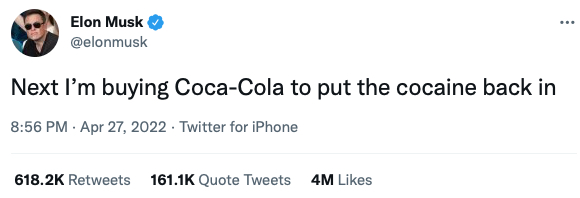
Elon Musk (apparently) buys "the de-facto public square"

 
Of course, my first response on Twitter was:


Yeah, but not seein' "the End of Western Civilization As We Know it" here.

I must have been out sick the day in grad school ConLaw when they covered "de-facto Public Square" (I cannot locate the words in the Constitution). 
 
Whatever, y'all. Have at it.

BTW: for a serious read on the history of "free speech,"

If Dirck Coornhert, Baruch Spinoza, John Lilburne, Olympe de Gouges, or Frederick Douglass were alive today they would surely declare the twenty-first century an unprecedented Golden Age for free speech. They would marvel at what can be freely discussed openly in real time between people across the globe with no looming Inquisition, Star Chamber, or Committee of Public Safety. No one in the Netherlands bats an eyelid if the doctrines of the Reformed Church are questioned or rejected. Every “free-born Englishman”—regardless of class or religious belief—has a right to criticize the government with no prior censorship or onerous laws against seditious words. In France, women have the same right to “mount the tribune” as men, and political heretics don’t have to fear the guillotine. And in the US, though racism is yet to be defeated, African Americans are no longer “dumb in their chains,” nor can they be silenced by repressive “black codes” or violent mobs acting with impunity.

Given the epic struggles, setbacks, false starts, and enormous sacrifices that led to this happy state of affairs, there is indeed much to celebrate about the current condition of free expression. But the Golden Age of free speech is in decline rather than ascendancy despite the unprecedented ubiquity of speech and information.

In the ninth century CE, Ibn al-Rāwandī could reject prophecy and central doctrines of Islam without serious punishment. But if he were alive today, his life and liberty would be severely threatened in a number of Muslim-majority countries, where blasphemy and apostasy are punishable by death. Even in secular democracies like France and the UK, al-Rāwandī’s radical ideas might well be met with the Jihadist’s Veto.

Gandhi would surely lament that India still uses colonial-era speech crimes to curtail the freedoms of speech and assembly that Gandhi considered the “two lungs that are absolutely necessary for a man to breathe the oxygen of liberty.”

Four decades ago, Western democracies relied on freedom of expression to empower dissidents behind the Iron Curtain, which contributed to the triumph of the Helsinki effect and the end of European communism. Today, the combination of free speech and technology ensuring the free flow of information across borders is increasingly seen as a trojan horse threatening democracy rather than a battering ram knocking down the walls of censorship in closed societies.

At times European democratic leaders have sounded more like a distorted echo of the Soviet apparatchiks who warned against the flood of Western “racism,” “fascism,” and “false propaganda” than the stewards of democracies built upon the central premise of free and open debate for all. Eleanor Roosevelt’s prescient warning that prohibiting incitement to hatred under international human rights law “would encourage governments to punish all criticism under the guise of protecting against religious or national hostility” has been forgotten.

In the US, the robust legal protection afforded by the First Amendment can barely disguise that the underlying assumptions of American “free speech exceptionalism” have lost much of their unifying appeal. As an abstract principle, American faith in free speech remains strong. But the unity collapses along unforgiving tribalist and identarian lines once each side’s sacred taboos are violated by the other side…


Mchangama, Jacob. Free Speech (pp. 383-385). Basic Books. Kindle Edition
Excellent book.
 
Maybe Musk will make Twitter less toxic, net. Maybe not. Will he make it profitable? I guess we'll see (, moreover, he didn't cut a personal check; this whole deal is leveraged out the wazoo with Other People's Money, collateralized with stock from his other ventures so I have to question the extent of his unilateral whimsical authority).
 
I mostly have just used Twitter to pimp my blog (it seems to have worked pretty well), and my days are waning in any event, so I could certainly live without social media broadly. And, were Musk to order Donald Trump et al reinstated to Twitter, that might be the day I delete.

NEWS UPDATE
A sharp fall in Tesla’s share price is raising doubts that CEO Elon Musk will be able to go ahead with his $44 billion purchase of Twitter. Tesla fell by 12.2 percent on Tuesday, slashing $126 billion off the market value of the electric automaker. That drop cut the value of Musk’s Tesla stake by $21 billion, which, as Reuters noted, was exactly the same amount he has committed in equity to the Twitter buyout. One analyst said the possibility of Musk selling shares, and becoming distracted by the bid, was causing “a bear festival on the [Tesla] name.” Others said continued falls in Tesla’s share price could jeopardize his funding arrangements. On a bad day for tech stocks, Twitter shares also fell back to trade around 8 percent below Musk’s offer price of $54.20 a share—reflecting fears that the world’s richest man might walk away from the deal. —Daily Beast
Interesting.

Where does all of this leave Trump's poignant "Truth Social?"
 
UPDATE
 

Right. Richest dude on earth, gaslighting away in juvie fashion. Seriously?
________