Search the KHIT Blog

Showing posts with label Ideology. Show all posts

Sunday, May 5, 2024

"It doesn't matter what’s true," continued.

The Allure of Certainty (Kathryn Schulz)

The trouble began, as it so often does, with taxes. In AD 6, the Roman Empire, ramping up its policy of territorial expansion and control, decided to impose a tariff on the Jews of the province of Judaea, in what is now Israel and the West Bank. By then, the local Jews had been living under a capricious and often cruel Roman rule for seventy years, so the tax issue was hardly their only grievance. Still, it rankled, and the question of what to do about it caused a schism in the community. The majority heeded the counsel of the high priest Joazar and reluctantly agreed to pay up in the interest of keeping the peace. But a handful, led by one Judas of Galilee, rebelled. Disgusted by what he saw as Joazar’s complicity with Roman rule, Judas vowed to establish a new sect of Jews whose members, in the words of the first-century Jewish historian Josephus, “have an inviolable attachment to liberty, and say that God is to be their only Ruler and Lord.”

That sounds like an honorable attitude. And a courageous one: Judas and his followers, a small and marginalized minority, took on one of history’s most formidable imperial states. As such, they seem like good candidates for hero status in the eyes of their fellow Jews, ancient and modern—and some people view them that way. But to Josephus, and to many others before and since, they were little better than villains and murderers. Judas’s sect practiced a scorched-earth policy (including against other Jews, to deprive them of food and shelter and thereby force them to join the sectarian fight), advocated the outright murder not only of Romans but also of Jewish “collaborators” (essentially, anyone with less single-minded politics than their own), and contributed to the destruction of Jerusalem and the ferocity of Roman reprisals through their own extreme violence and unwillingness to negotiate. Josephus records a characteristic raid—the sacking of the Jewish enclave of Ein-Gedi, where the able-bodied men apparently fled, and, “As for such that could not run away, being women and children, they slew of them above seven hundred.” The historian sums up the sect and its legacy this way:

All sorts of misfortunes also sprang from these men, and the nation was infected with this doctrine to an incredible degree; one violent war came upon us after another, and we lost our friends which used to alleviate our pains; there were also very great rob beries and murder of our principal men…. Such a change was made, as added a mighty weight toward bringing all to destruction, which these men occasioned by their thus conspiring together; for Judas and Sadduc [another leader of the rebellion], who excited a fourth philosophic sect among us, and had a great many followers therein, filled our civil government with tumults at present, and laid the foundations of our future miseries.

Who were the members of this “fourth philosophic sect,” in all their unphilosophical brutality? These were the original, capital-Z Zealots. History doesn’t record the fate of Judas, but most of the other Zealots perished in the first Jewish-Roman war, which began in AD 66 and ended four years later, with the destruction of the temple in Jerusalem and the defeat of the Jews. A small band of survivors retreated to a fort at Masada, near the Dead Sea, where they held off a Roman siege for three years. When the Romans finally breached the fort, they discovered that its 960 inhabitants had organized a mass self-slaughter, murdering one another (suicide being forbidden in Hebrew law) rather than letting themselves be captured or killed by the RomansAs the generic use of their name suggests, the legacy of the Zealots was not ideological but methodological. Murdering in the name of faith, religious or otherwise, was hardly unheard of before they came along, but they clarified and epitomized it as a practice. In the two millennia since the last of Judas of Galilee’s Zealots perished, a thousand lowercase zealots have kept that legacy alive—meaning, they have killed in its name. These latter-day zealots have hailed from many different backgrounds and held many different beliefs. At heart, though, and paradoxically, they have all shared a single conviction: that they and they alone are in possession of the truth. (The very word “zealot” comes from a Greek root meaning to be jealous of the truth—to guard it as your own.) What zealots have in common, then, is the absolute conviction that they are right. In fact, of all the symbolic ones and zeros that extremists use to write their ideological binary codes—us/them, same/different, good/evil—the fundamental one is right/wrong. Zealotry demands a complete rejection of the possibility of error.

The conviction that we cannot possibly be wrong: this is certainty. We’ve seen a lot of this conviction already, in the form of people who are sure they can see, or sure of what they do see (mountain chains, pregnant women), or sure of what they believe or predict or recall. Most of the time, this garden-variety certainty seems far removed from zealotry—and in a sense, it is. There’s a very big difference between, say, insisting that you are right about Orion and, say, murdering the Protestants, Muslims, Jews, bigamists, blasphemers, sodomites, and witches who are defiling your country. Not everyone who is filled with passionate certitude is Torquemada…


Schulz, Kathryn. Being Wrong: Adventures in the Margin of Error Chapter 8 (pp. 159-162). HarperCollins. Kindle Edition.
Kathryn published those thoughts in 2010. Still reads much like yesterday (arguably moreso). Being Wrong is one of my favorite books. Do yourselves a favor. Get it. Study it closely.

I bought the book in hardcover when it first came out, then later also bought the Kindle edition, for ease of further study and citation. I've long read her work in The New Yorker. She is a fabulous writer and thinker. This post is intended to continue the riff begun in the prior post. No timely "Zealotry" flying around these days, right? Hmmm... let us not forget today's Christian Nationalist Warriors, either.

"Two Cheers for Uncertainty"


Yeah, that always gets 'em going.

UPDATE ERRATUM

I diverged into downloading and reading Kathryn Schulz's memoir. Hit 'pause' on the world while I finished it.

   
I am rarely at a loss for apt words, but, this is one of those times.
_________
 

Friday, March 24, 2023

"God SAID it; I BELIEVE it; that SETTLES it."

Just finished another excellent read.

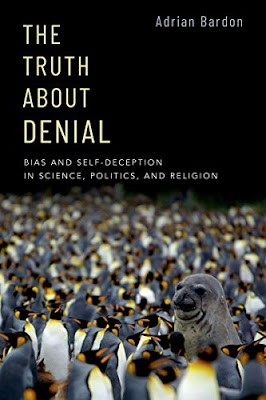
Click cover image
Of late, observers of the U.S. political landscape have been commenting more and more on the alarming ways in which Americans of different political persuasions and cultural, racial, and other identity groups seem not just to disagree on issues but also to be living in different realities. One area where this situation has significant consequences is in the way people can interpret reports of scientific consensus differently, depending on their prejudices and allegiances. Different people, for example, may hear about the science on the human causes of climate change and—sincerely—perceive either certainty, uncertainty, or outright hoax. This phenomenon undercuts public discourse on matters where public policy grounded in solid science has never been more essential.

This phenomenon is on a continuum with the way in which different people can look at those living in poverty, and see them either as victims of unfair circumstances or as people who are complicit in a culture of irresponsibility and dependency. Different people will consider a given refugee population, and see either an alien threat to our way of life or deserving potential members of our society. Different people will see a video of a police shooting; some will see justification and others will see murder.

An environment of polarization, prejudice, bias, and willful self-deception, combined with an often misleading political and media environment, is toxic for political discourse. Polarization on matters of fact is affecting progress on matters of critical public importance, such as action on climate.

Research on denial has exploded over just the last few years. This includes game-changing work from social, political, cognitive, and evolutionary psychology, as well as from sociology, communication studies, political science, history, and philosophy. My goal has been to bring this diverse work together for the reader while, I hope, convincing readers of the urgent importance of gaining a better understanding of unconscious bias and self-deception. Denial concerns all of us—both as victims and as perpetrators—and so this work is intended not just for an academic audience; it is for everyone.

Adrian Bardon. The Truth About Denial. Oxford University Press. Kindle Edition. 

The author nailed it. Great scholarly writing style, leavened with numerous LMAO moments. 

File this one under "Deliberation Science." Also, see "The Big Myth." And, "Trust The Plan." Lots to ponder.
The purpose of this book is to examine the pervasive human tendency to deny uncomfortable truths and to discuss how this tendency affects public discourse—as well as private life—on an exceedingly wide range of important topics. The phenomenon of denial, as we shall see, is dependent on motivated cognition. “Motivated cognition” refers to the “unconscious tendency of individuals to process information in a manner that suits some end or goal extrinsic to the formation of accurate beliefs.” Motivated cognition happens behind the scenes, but is closely tied to the more overt rationalization of belief, which I shall define as the process of retroactively inventing defensive justifications for holding those beliefs formed via motivated cognition. Motivated cognition is about belief formation, whereas rationalization is about maintaining and defending beliefs. Rationalization is thus a kind of second stage for motivated cognition. Unlike motivated cognition, explicit rationalization is a conscious process, though we are often not consciously aware of our motives when we engage in it. (I shall use the familiar phrase motivated reasoning—the popular use of which doesn’t generally distinguish between initial motivated cognition and the second-stage rationalization of that way of thinking—to denote the whole process wherein implicit, motivated cognition is followed by the generation of spurious reasons to maintain those sincerely held beliefs formed via motivated cognition.)

Let’s get a little clearer on exactly what “denial” does and does not include, for purposes of this discussion. It does not refer, for instance, simply to being misinformed. I wish to examine denial strictly in that sense of being “in denial” wherein the denier is exhibiting a kind of emotionally self-protective self-deception. (Denial is often misattributed to ignorance; as I shall discuss further, there is good reason to think that the real issue is motivated reasoning.) Denial, in this context, presumes some exposure to relevant—and unwelcome—facts and constitutes a kind of reaction to them. This sort of self-deception is different from mendacity, wherein one purposefully lies to others about the existence of evidence for something, or deliberately misrepresents the evidence. One might know perfectly well, for example, that one’s oil company is responsible for a toxic spill, and respond by actively and consciously engaging in a cover-up and public denial of responsibility.

Neither am I talking about “spin,” or what philosopher Harry Frankfurt has termed bullshit. The bullshitter’s intent is not to lie but, rather, to influence or to create a certain reality, and is simply indifferent as to whether his or her claims are true or false. The job of the trial attorney, the political operative, or the commercial advertiser is neither to uphold the truth nor to lie; rather, the job is to represent one’s client in the best light possible.

Being in denial is also to be distinguished from wishful thinking. What wishful thinking has in common with denial is that each fulfills an emotional need of some kind. However, with wishful thinking, there is a belief without solid evidence for a conclusion one way or the other…
[Adrian Bardon, pp. 4-5].
CONTENTS
 
Preface
Acknowledgments

1. Bias and Belief
1.1 What Is Denial?
1.2 “Hot Cognition”
1.3 Mechanisms of Motivated Reasoning
1.4 The Origins of Denial
1.5 Pathological Ideology, and Denialism as a Social Phenomenon
2. Science Denial
2.1 Climate Science Denial
2.2 Personality, System, and Status Quo
2.3 The Asymmetry Thesis
2.4 Science and Societal Change
3. Pride, Prejudice, and Political Economy
3.1 Political Economics
3.2 Poverty and the Fundamental Attribution Error
3.3 Classism and Racial Stereotyping
3.4 The Liberty Argument
3.5 Asymmetry Again
4. Religion
4.1 Reasons to Believe
4.2 Is It Even a Belief?
4.3 The Origins of Religiosity
4.4 Tenacity
4.5 The Problem(s) with Religion
4.6 The Retreat into Abstraction
Afterword: Directions for Science Communication
A.1 More Information?
A.2 Message Framing and Delivery
Index
 
You might find some of his conclusions a bit counterintuitive at first blush, but his evidence is fairly compelling. Uhhh... "Evidence?" Define "evidence." 
I have by now studied and reviewed dozens of books on the operational sciences, philosophy of science, science communication, etc. on this blog, and while the word “evidence“ has shown up thousands of times thus far (I always do searches of keywords and phrases), I have yet to encounter a writer providing a definition of the term. I find that sadly telling. We mostly tend to assume that we all have the same general understanding of key words. Adrian, to his credit, at least points out that, on hot-button issues, partisans tend to deploy opposing ideological interpretations of key definitions. These tangential wafts of “No True Scotsman“ fallacy just muck things up. 
Stay tuned.
_____

ON DECK


This was reviewed in my latest Science Magazine—"Achieving Cognitive Liberty"
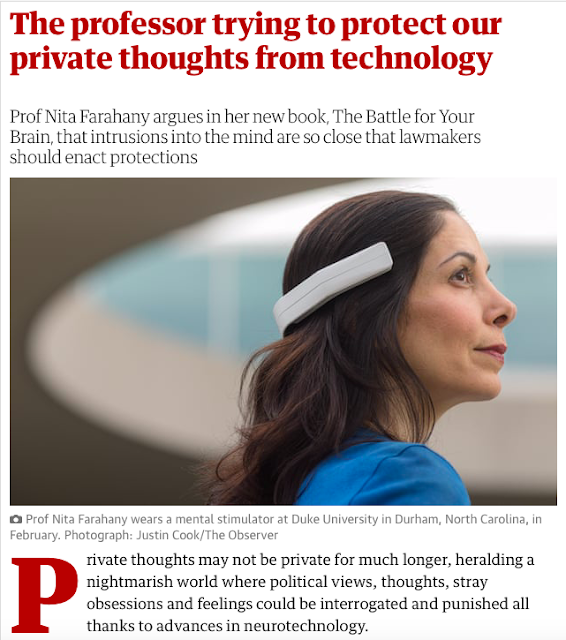
In her latest book, The Battle for Your Brain, neuroethicist and law professor Nita Farahany warns readers that neurotechnology—technology designed to monitor or manipulate the human nervous system—can “either empower or oppress us.” Farahany generously illustrates how such technologies, which range from monitoring tools such as functional magnetic resonance imaging and the electroencephalogram (EEG) to techniques that can alter brain function, such as deep brain stimulation and transcranial magnetic stimulation, are affecting our lives. But The Battle for Your Brain is, above all, a call to expand human rights to include “cognitive liberty,” a right articulated in 2004 by Wrye Sententia as our “autonomy over [our] own brain chemistry”…
 
Farahany ends her analysis by inviting readers to join the debate about the benefits and risks of various transhumanist proposals. These include postmortem brain cryopreservation, the expansion of human senses through brain–computer interfaces, brain-to-brain communication, brain-to-text messaging, and the use of brain implants to inactivate pain and suffering.

In The Battle for Your Brain, Farahany calls for “prudent vigilance and democratic deliberation” regarding the social repercussions of neurotechnology. The book is valuable reading, not only for those interested in neuroscience but also for anyone genuinely concerned about the challenges humanity will face in the near future.

I'm confident that this too will be excellent.


Hmmm… “Electrome,” anyone? See also "Data Driven."
 
UPDATE
Click the article.
UPDATE
Neurotech’s Battles Impact Our Brains’ Future
Mental sovereignty, says author Nita Farahany, is no longer a given
BTW: I finished her book today (Mar 28th). A lot to assimilate. More to come...
________