Search the KHIT Blog

Showing posts with label Deliberation. Show all posts

Wednesday, May 3, 2023

"Deliberation Science?" A Creative Commons cross-post

Respectful persuasion is a relay race, not a solo sprint – 3 keys to putting it in practice

Sure, you can try to force people to agree with you–
but respectful persuasion is something else.
Andrii Yalanskyi/iStock via Getty Images Plus

Colin Marshall, University of Washington

The 2024 presidential election is still a year and a half away, but it can feel much closer: President Joe Biden has made his reelection bid official, presumed candidates are giving out-of-state speeches, pundits are already weighing in on nomination hopefuls, and social media is, as ever, a mess of people trying to persuade strangers to back their favorite. All for good reason: Even a little political persuasion in the next year could change the course of history.
 
I’m a philosopher who studies and teaches the ethics of persuasion. My students are eager to find ways to persuade their friends, family and neighbors about political issues such as climate change and abortion. Moreover, many of them want to persuade with integrity: They want to engage the people they’re talking with respectfully, instead of using the manipulative tricks they regularly see in politics and marketing. But what is respectful persuasion, and what distinguishes it from disrespectful manipulation?
 
There’s no simple formula for respectful persuasion. However, some philosophers see crucial hints in the work of 18th-century philosopher Immanuel Kant, whose theory of respect has guided many ethicists and policymakers for the past two centuries.
 
Drawing on Kant’s work, and that of other philosophers inspired by him, I think we can isolate three key components of respectful persuasion. This isn’t just an academic exercise. My students and I have found that these factors increase the chances of deep, meaningful conversation.

1. Giving reasons

Broadly speaking, reasons are considerations that rationally support some belief or action, including both empirical evidence and abstract arguments. For example, astronauts’ pictures of a round Earth rationally support the belief that the Earth is round. When we sincerely give someone reasons, we show respect for their rationality: their ability to recognize good reasons. 
 
By contrast, a hallmark of manipulation is bypassing rationality, such as repeatedly exposing people to false statements to make them appear true – something that psychologists call the “illusory truth effect.”
 
Manipulation can be effective, but psychologists have found that persuasion using reasons is more durable than nonrational persuasion such as repetition-based tricks. For example, someone who comes to believe in climate change based on the scientific evidence probably will not be as easily swayed later on by repeated exposure to climate skepticism. The rational support that good reasons provide for a belief can make that belief more stable.

2. Being open to learning

Giving reasons is not difficult by itself. The second component of respectful persuasion, however, is much more challenging: being open to receiving the other side’s reasons – a form of intellectual humility. This is especially hard for persuaders, since they have to give up some of the time they would have used to make their case.
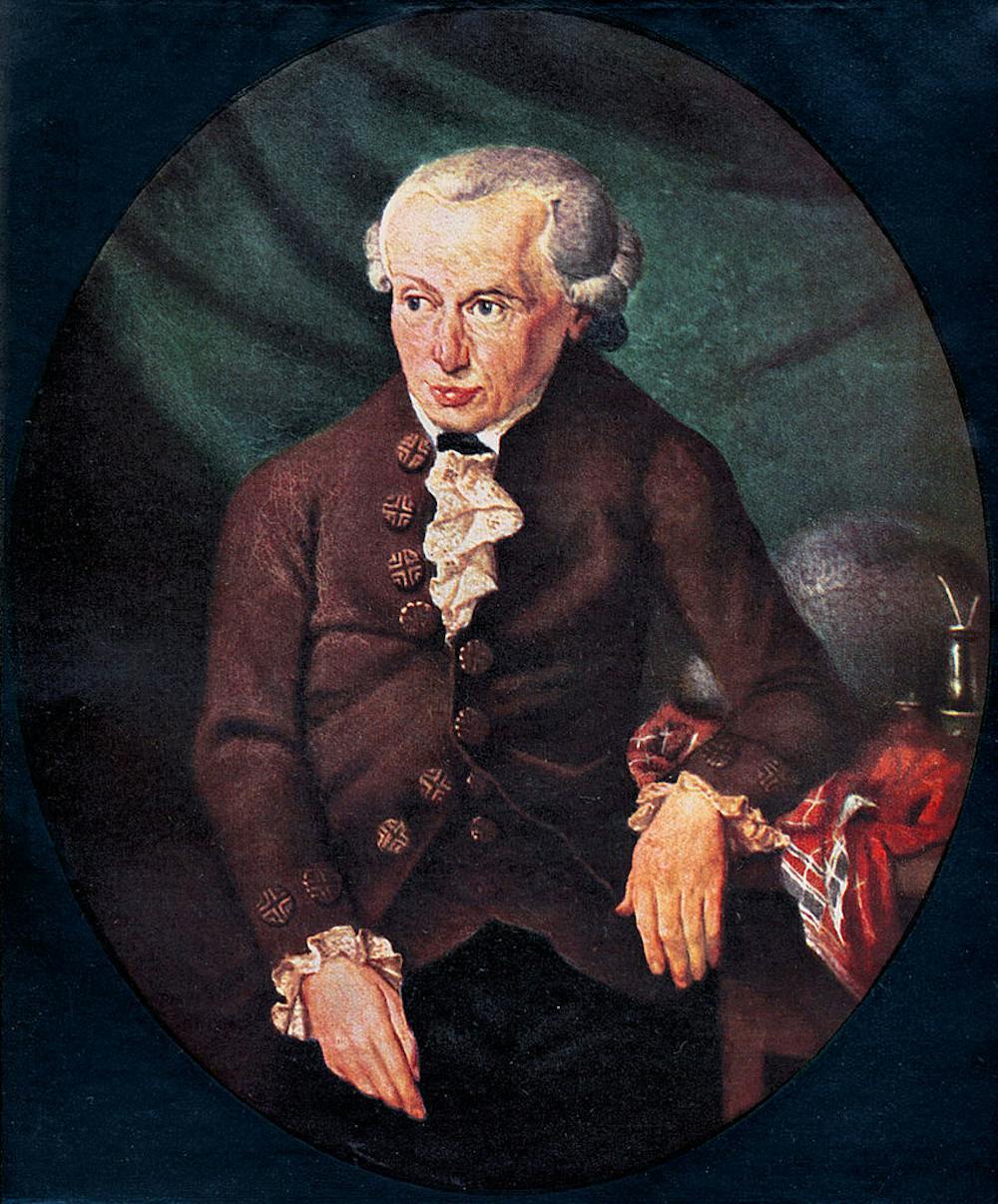
A centuries-old painting of a serious-looking seated man in a powdered wig and brown suit.
Kant’s ideas about respect are still helpful for thinking through sticky situations today.
Culture Club/Hulton Archive via Getty Images
Kant expressed this core idea nicely. Even someone encountering a person whose opinion seems obviously wrong, Kant wrote, has “a duty … to suppose that his judgment must yet contain some truth and to seek this out.” This isn’t merely a suggestion to listen to people one wants to persuade. Instead, respect demands actively seeking out truth in what the other person says. 
 
In fact, some studies suggest that intellectual humility makes people better able to evaluate the strength of arguments. This means that intellectually humble people may be more likely to recognize that a persuader’s arguments are actually better than their own, and have to reconsider their views – which can pose a real risk to someone’s self-esteem.
 
But being open to other people’s reasons also increases the chance of their being open to yours – a form of reciprocity in which you take turns learning from each other. Decades of psychological research have shown that, especially in two-person exchanges, people value reciprocity in communication and see it as a way of treating each other fairly. 
 
In other words, if you show openness to learning from someone else, rather than just lecturing, it may seem fair to them to be open to you too. 
 
That is why faking this kind of respect can be a powerful manipulative tool. A psychologically savvy canvasser, for instance, can manipulate swing voters by pretending to be open to learning about their own opinions. But this carries its own risk, since people who discover they have been manipulated may resent it.

3. Live and let live

Kant’s central principle of respect is that one should “not degrade any other as a mere means” to one’s ends. This requires people to rein in their own self-love out of consideration for others. In popular culture, this might be summed up in the idea of “live and let live”: Other things being equal, we shouldn’t interfere in other people’s lives. 
 
Overlooking this principle can make persuasion disrespectful in a variety of ways, even when the persuader has good intentions. The philosopher George Tsai argues that this happens in cases of unsolicited advice: Imagine, he writes, that while your date goes to the restroom, an eavesdropping stranger tells you that she thinks you could do better. Even if the stranger is right, it’s simply none of her business.

Two men in business attire chat while a woman in a sleeveless white top listens in, looking concerned.
Having an opinion doesn’t mean you need to share it.
DragonImages/iStock via Getty Images Plus
Another example of how interference can make persuasion disrespectful is that changing someone’s mind can harm their dignity and disrupt their connection to their community. For example, say that you persuade a relative who lives in a small ranching community to become vegan. That change might lead to their being ostracized by people they rely on.
 
Because persuasion can affect other people’s lives in many ways, this third component of respect is the most difficult to adhere to. Sometimes, people may be justified in interfering in other people’s lives, such as if lives are at stake or in particularly close relationships – but those are special circumstances.

One conversation at a time

In class, my students attempt to persuade one another four times, using a range of formats: five minutes vs. a whole week; in person vs. over Zoom. At the end, they score one another on effectiveness and respectfulness.
 
My students are smart, informed and passionate, and the class offers them a positive, carefully structured environment. Despite all that, they almost never succeed in persuading one another – at least not when it comes to politics.
 
Something interesting happens, though, when they let respect guide their conversations. Instead of launching into lectures, they start seeing each exchange as an opportunity to learn from each other – perhaps as an opportunity to leave their partner thinking about something in a new way, without fully persuading them.
 
If you approach our conversation as a chance to exchange ideas, without trying to change my mind, you may lay a cornerstone of trust. That, in turn, could make me more receptive to similar viewpoints in the future – even if I’m speaking with other people. Truly respectful political persuasion might best be seen as an extended team effort, not a one-time, one-person task.
___The Conversation
 
Colin Marshall, Associate Professor of Philosophy, University of Washington
 
This article is republished from The Conversation under a Creative Commons license. Read the original article.
__________
 
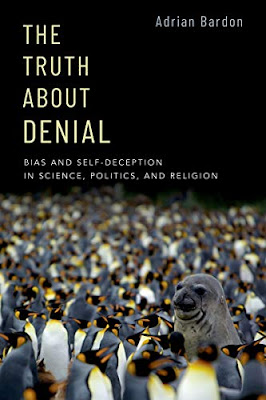
Is there in fact a "Science of Deliberation?" See also "The Truth About Denial." And, how about "Mental Immunity" from disinformation and fabulism? Hmmm... "Collective Illusions?" After all, we all want to be "influential," right?

Friday, March 24, 2023

"God SAID it; I BELIEVE it; that SETTLES it."

Just finished another excellent read.

Click cover image
Of late, observers of the U.S. political landscape have been commenting more and more on the alarming ways in which Americans of different political persuasions and cultural, racial, and other identity groups seem not just to disagree on issues but also to be living in different realities. One area where this situation has significant consequences is in the way people can interpret reports of scientific consensus differently, depending on their prejudices and allegiances. Different people, for example, may hear about the science on the human causes of climate change and—sincerely—perceive either certainty, uncertainty, or outright hoax. This phenomenon undercuts public discourse on matters where public policy grounded in solid science has never been more essential.

This phenomenon is on a continuum with the way in which different people can look at those living in poverty, and see them either as victims of unfair circumstances or as people who are complicit in a culture of irresponsibility and dependency. Different people will consider a given refugee population, and see either an alien threat to our way of life or deserving potential members of our society. Different people will see a video of a police shooting; some will see justification and others will see murder.

An environment of polarization, prejudice, bias, and willful self-deception, combined with an often misleading political and media environment, is toxic for political discourse. Polarization on matters of fact is affecting progress on matters of critical public importance, such as action on climate.

Research on denial has exploded over just the last few years. This includes game-changing work from social, political, cognitive, and evolutionary psychology, as well as from sociology, communication studies, political science, history, and philosophy. My goal has been to bring this diverse work together for the reader while, I hope, convincing readers of the urgent importance of gaining a better understanding of unconscious bias and self-deception. Denial concerns all of us—both as victims and as perpetrators—and so this work is intended not just for an academic audience; it is for everyone.

Adrian Bardon. The Truth About Denial. Oxford University Press. Kindle Edition. 

The author nailed it. Great scholarly writing style, leavened with numerous LMAO moments. 

File this one under "Deliberation Science." Also, see "The Big Myth." And, "Trust The Plan." Lots to ponder.
The purpose of this book is to examine the pervasive human tendency to deny uncomfortable truths and to discuss how this tendency affects public discourse—as well as private life—on an exceedingly wide range of important topics. The phenomenon of denial, as we shall see, is dependent on motivated cognition. “Motivated cognition” refers to the “unconscious tendency of individuals to process information in a manner that suits some end or goal extrinsic to the formation of accurate beliefs.” Motivated cognition happens behind the scenes, but is closely tied to the more overt rationalization of belief, which I shall define as the process of retroactively inventing defensive justifications for holding those beliefs formed via motivated cognition. Motivated cognition is about belief formation, whereas rationalization is about maintaining and defending beliefs. Rationalization is thus a kind of second stage for motivated cognition. Unlike motivated cognition, explicit rationalization is a conscious process, though we are often not consciously aware of our motives when we engage in it. (I shall use the familiar phrase motivated reasoning—the popular use of which doesn’t generally distinguish between initial motivated cognition and the second-stage rationalization of that way of thinking—to denote the whole process wherein implicit, motivated cognition is followed by the generation of spurious reasons to maintain those sincerely held beliefs formed via motivated cognition.)

Let’s get a little clearer on exactly what “denial” does and does not include, for purposes of this discussion. It does not refer, for instance, simply to being misinformed. I wish to examine denial strictly in that sense of being “in denial” wherein the denier is exhibiting a kind of emotionally self-protective self-deception. (Denial is often misattributed to ignorance; as I shall discuss further, there is good reason to think that the real issue is motivated reasoning.) Denial, in this context, presumes some exposure to relevant—and unwelcome—facts and constitutes a kind of reaction to them. This sort of self-deception is different from mendacity, wherein one purposefully lies to others about the existence of evidence for something, or deliberately misrepresents the evidence. One might know perfectly well, for example, that one’s oil company is responsible for a toxic spill, and respond by actively and consciously engaging in a cover-up and public denial of responsibility.

Neither am I talking about “spin,” or what philosopher Harry Frankfurt has termed bullshit. The bullshitter’s intent is not to lie but, rather, to influence or to create a certain reality, and is simply indifferent as to whether his or her claims are true or false. The job of the trial attorney, the political operative, or the commercial advertiser is neither to uphold the truth nor to lie; rather, the job is to represent one’s client in the best light possible.

Being in denial is also to be distinguished from wishful thinking. What wishful thinking has in common with denial is that each fulfills an emotional need of some kind. However, with wishful thinking, there is a belief without solid evidence for a conclusion one way or the other…
[Adrian Bardon, pp. 4-5].
CONTENTS
 
Preface
Acknowledgments

1. Bias and Belief
1.1 What Is Denial?
1.2 “Hot Cognition”
1.3 Mechanisms of Motivated Reasoning
1.4 The Origins of Denial
1.5 Pathological Ideology, and Denialism as a Social Phenomenon
2. Science Denial
2.1 Climate Science Denial
2.2 Personality, System, and Status Quo
2.3 The Asymmetry Thesis
2.4 Science and Societal Change
3. Pride, Prejudice, and Political Economy
3.1 Political Economics
3.2 Poverty and the Fundamental Attribution Error
3.3 Classism and Racial Stereotyping
3.4 The Liberty Argument
3.5 Asymmetry Again
4. Religion
4.1 Reasons to Believe
4.2 Is It Even a Belief?
4.3 The Origins of Religiosity
4.4 Tenacity
4.5 The Problem(s) with Religion
4.6 The Retreat into Abstraction
Afterword: Directions for Science Communication
A.1 More Information?
A.2 Message Framing and Delivery
Index
 
You might find some of his conclusions a bit counterintuitive at first blush, but his evidence is fairly compelling. Uhhh... "Evidence?" Define "evidence." 
I have by now studied and reviewed dozens of books on the operational sciences, philosophy of science, science communication, etc. on this blog, and while the word “evidence“ has shown up thousands of times thus far (I always do searches of keywords and phrases), I have yet to encounter a writer providing a definition of the term. I find that sadly telling. We mostly tend to assume that we all have the same general understanding of key words. Adrian, to his credit, at least points out that, on hot-button issues, partisans tend to deploy opposing ideological interpretations of key definitions. These tangential wafts of “No True Scotsman“ fallacy just muck things up. 
Stay tuned.
_____

ON DECK


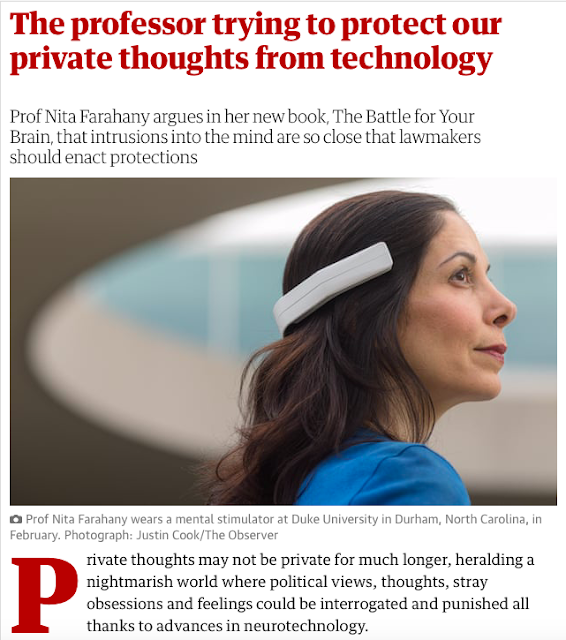
This was reviewed in my latest Science Magazine—"Achieving Cognitive Liberty"
In her latest book, The Battle for Your Brain, neuroethicist and law professor Nita Farahany warns readers that neurotechnology—technology designed to monitor or manipulate the human nervous system—can “either empower or oppress us.” Farahany generously illustrates how such technologies, which range from monitoring tools such as functional magnetic resonance imaging and the electroencephalogram (EEG) to techniques that can alter brain function, such as deep brain stimulation and transcranial magnetic stimulation, are affecting our lives. But The Battle for Your Brain is, above all, a call to expand human rights to include “cognitive liberty,” a right articulated in 2004 by Wrye Sententia as our “autonomy over [our] own brain chemistry”…
 
Farahany ends her analysis by inviting readers to join the debate about the benefits and risks of various transhumanist proposals. These include postmortem brain cryopreservation, the expansion of human senses through brain–computer interfaces, brain-to-brain communication, brain-to-text messaging, and the use of brain implants to inactivate pain and suffering.

In The Battle for Your Brain, Farahany calls for “prudent vigilance and democratic deliberation” regarding the social repercussions of neurotechnology. The book is valuable reading, not only for those interested in neuroscience but also for anyone genuinely concerned about the challenges humanity will face in the near future.

I'm confident that this too will be excellent.


Hmmm…Electrome,” anyone? See also "Data Driven."
 
UPDATE
Click the article.
UPDATE
Neurotech’s Battles Impact Our Brains’ Future
Mental sovereignty, says author Nita Farahany, is no longer a given
BTW: I finished her book today (Mar 28th). A lot to assimilate. More to come...
________
 

Saturday, January 14, 2023

"Deliberation Science" readings update

 
There's so much yet to learn. And, even more yet to "unlearn." Some current readings.

First, a Christmas gift book from my sister.
 
The past several years, we’ve felt as if we’re all stuck in some weird Twilight Zone nightmare where we are constantly, relentlessly gaslit. Up is down, left is right, right is wrong. It feels as if the values of our society have changed almost overnight. We feel disoriented, frustrated, disaffected, and distrustful of each other. We ask ourselves whether we’ve gone crazy, or the world has, or both. No wonder people in the United States are waging a kind of war on trust, building elaborate castles of suspicion that imperil our personal happiness and national prosperity.

All around the world, democracy is now under strain due in part to social problems that cannot be solved through legislation or technology. In a very real sense, collective illusions do the most damage in free societies, precisely because they depend on shared reality, common values, and the willingness to engage with different viewpoints in order to function, let alone flourish. That is why I see collective illusions as an existential threat.

 The bad news is that we are all responsible for what is happening. And yet that is also the good news, because it means we have the power, individually and together, to solve the problem. The best news of all is that, as powerful as collective illusions are, they are also fragile because they are rooted in lies and can be dismantled through individual actions. With the right tools and some wise guidance, we can dismantle them…

…While our social nature is part of our biology, our reaction to our social instincts is within our control. When we’re armed with the right knowledge and skills, we don’t have to choose between being a maverick or being a lemming. This book aims to give you the tools you need to truly understand why and how we conform, how conformity leads directly to collective illusions, and how you can learn to control social influence so that it doesn’t control you…

…we often conform because we’re afraid of being embarrassed. Our stress levels rise at the thought of being mocked or viewed as incompetent, and when that happens, the fear-based part of the brain takes over. Confused and unsure of ourselves, we surrender to the crowd because doing so relieves our stress. Caving to the majority opinion also diffuses our personal responsibility for our decisions, making it easier to bear mistakes. When you find yourself making a decision on your own, it can feel isolating, and the personal responsibility can be intimidating. Indeed, whether our actions are right or wrong, they always feel better if we take them together with others.


Rose, Todd (2022-01-31T22:58:59.000). Collective Illusions. Hachette Books. Kindle Edition.
Persuasive case, eloquently made.
 
 
Think about Robert Cialdini's venerable "Influence: the Psychology of Persuasion" and how his "levers" model fits with Todd's thesis:
Liking;
Reciprocity;
Consistency and Commitment;
Social Proof;
Appeals to Evidence;
Appeals to Authority;
Appeals to Scarcity.
Dr. Cialdini's work is widely known in the advertising / marketing domains, re principles and techniques going to being "influential." Dr. Rose's work reveals an unhappy flip side of that—our vulnerability to malign influence given our social anxieties regarding "fitting in" to socioculturural norms (which includes the political space).

How about some Justin Gregg?


I would also recommend Todd Kashdan's book apropos of this topic:
 
 
Also, more on principles of influence by our esteemed Zoe B. Chance in a prior post.

I recently subscribed to some useful Substack readings. This recent Steven Pinker offering stood out:
Reason To Believe
How and why irrationality takes hold, and what do to about it.


When I tell people that I teach and write about human rationality, they aren’t curious about the canons of reason like logic and probability, nor the classic findings from the psychology lab on how people flout them. They want to know why humanity appears to be losing its mind…

…Can anything be done? Explicit instruction in “critical thinking” is a common suggestion. These curricula try to impart an awareness of fallacies such as arguments from anecdote and authority, and of cognitive biases such as motivated reasoning. They try to inculcate habits of active open-mindedness, namely to seek disconfirmatory as well as confirmatory evidence and to change one’s mind as the evidence changes.

But jaded teachers know that lessons tend to be forgotten as soon as the ink is dry on the exam. It’s hard, but vital, to embed active open-mindedness in our norms of intellectual exchange wherever it takes place. It should be conventional wisdom that humans are fallible and misconceptions ubiquitous in human history, and that the only route to knowledge is to broach and then evaluate hypotheses. Arguing ad hominem or by anecdote should be as mortifying as arguing from horoscopes or animal entrails; repressing honest opinion should be seen as risible as the doctrines of biblical inerrancy or Papal infallibility.

But of course we can no more engineer norms of discourse than we can dictate styles of hairstyling or tattooing. The norms of rationality must be implemented as the ground rules of institutions. It’s such institutions that resolve the paradox of how humanity has mustered feats of great rationality even though every human is vulnerable to fallacies. Though each of us is blind to the flaws in our own thinking, we tend to be better at spotting the flaws in other people’s thinking, and that is a talent that institutions can put to use. An arena in which one person broaches a hypothesis and others can evaluate it makes us more rational collectively than any of us is individually.

Examples of these rationality-promoting institutions include science, with its demands for empirical testing and peer review; democratic governance, with its checks and balances and freedom of speech and the press; journalism, with its demands for editing and fact-checking; and the judiciary, with its adversarial proceedings. Wikipedia, surprisingly reliable despite its decentralization, achieves its accuracy through a community of editors that correct each other's work, all of them committed to principles of objectivity, neutrality, and sourcing. (The same cannot be said for web platforms that are driven by instant sharing and liking.)

If we are to have any hope of advancing rational beliefs against the riptide of myside bias, primitive intuitions, and mythological thinking, we must safeguard the credibility of these institutions. Experts such as public health officials should be prepared to show their work rather than deliver pronouncements ex cathedra. Fallibility should be acknowledged: we all start out ignorant about everything, and whenever changing evidence calls for changing advice, that should be touted as a readiness to learn rather than stifled as a concession of weakness.

Perhaps most important, the gratuitous politicization of our truth-seeking institutions should be halted, since it stokes the cognitively crippling myside bias. Universities, scientific societies, scholarly journals, and public-interest nonprofits have increasingly been branding themselves with woke boilerplate and left-wing shibboleths. The institutions should not be surprised when they are then blown off by the center and right which make up the majority of the population. The results have been disastrous, including resistance to climate action and vaccination.

The defense of freedom of speech and thought must not be allowed to suffer that fate. Its champions should have at their fingertips the historical examples in which free speech has been indispensable to progressive causes such as the abolition of slavery, women’s suffrage, civil rights, opposition to the war in Vietnam, and gay rights. They should go after the censors on the right as vigorously as those on the left, and should not give a pass to conservative intellectuals or firebrands who are no friends to free speech, but are merely enemies of their enemies.

The creed of universal truth-seeking is not the natural human way of believing. Submitting all of one’s beliefs to the trials of reason and evidence is cognitively unnatural. The norms and institutions that support this radical creed are constantly undermined by our backsliding into tribalism and magical thinking, and must constantly be cherished and secured…
Hmmm… “critical thinking?” Yeah. “Necessary but insufficient?” One wonders.

Dr. Pinker cites Professor Keith Stanovich:

Myside bias is displayed by people holding all sorts of belief systems, values, and convictions. It is not limited to those with a particular worldview. Any belief that is held with conviction—any distal belief, to use Robert Abelson’s (1986) term—can be the driving force behind myside thinking. In short, as an information processing tendency, myside cognition is ubiquitous.

Some might argue that something so ubiquitous and universal must be grounded in the evolution of our cognitive systems (either as an adaptation or as a by-product). Others, however, might argue that myside bias could not be grounded in evolution because evolutionary mechanisms would be truth seeking, and myside bias is not. In fact, evolution does not guarantee perfect rationality in the maximizing sense used throughout cognitive science—whether as maximizing true beliefs (epistemic rationality) or as maximizing subjective expected utility (instrumental rationality). Although organisms have evolved to increase their reproductive fitness, increases in fitness do not always entail increases in epistemic or instrumental rationality. Beliefs need not always track the world with maximum accuracy in order for fitness to increase.

Evolution might fail to select out epistemic mechanisms of high accuracy when they are costly in terms of resources, such as memory, energy, or attention. Evolution operates on the same cost-benefit logic that signal detection theory does. Some of our perceptual processes and mechanisms of belief fixation are deeply unintelligent in that they yield many false alarms, but if the lack of intelligence confers other advantages such as extreme speed of processing and the noninterruption of other cognitive activities , the belief fixation errors might be worth their cost (Fodor 1983; Friedrich 1993; Haselton and Buss 2000; Haselton, Nettle, and Murray 2016). Likewise, since myside bias might tend to increase errors of a certain type but reduce errors of another type, there would be nothing strange about such a bias from an evolutionary point of view (Haselton, Nettle, and Murray 2016; Johnson and Fowler 2011; Kurzban and Aktipis 2007; McKay and Dennett 2009; Stanovich 2004). What might be the nature of such a trade-off?

For many years in cognitive science, there has been a growing tendency to see the roots of reasoning in the social world of early humans rather than in their need to understand the natural world (Dunbar 1998, 2016). Indeed, Stephen Levinson (1995) is just one of many theorists who speculate that evolutionary pressures were focused more on negotiating cooperative mutual intersubjectivity than on understanding the natural world. The view that some of our reasoning tendencies are grounded in the evolution of communication dates back at least to the work of Nicholas Humphrey (1976), and there are many variants of this view. For example, Robert Nozick (1993) has argued that in prehistory, when mechanisms for revealing what is true about the world were few, a crude route to reliable knowledge might have been to demand reasons for assertions by conspecifics (see also Dennett 1996, 126–127). Kim Sterelny (2001) developed similar ideas in arguing that social intelligence was the basis of our early ability to simulate (see also Gibbard 1990; Mithen 1996, 2000; Nichols and Stich 2003). All of these views are, despite subtle differences between them, sketching the genetic-cultural coevolutionary history (Richerson and Boyd 2005) of the negotiation of argument with conspecifics.

The most influential synthesis of these views—and the most relevant to myside bias—was achieved by Hugo Mercier and Dan Sperber (2011, 2017),whose subtle, nuanced theory of reasoning is grounded in the logic of the evolution of communication. Mercier and Sperber’s theory posits that reasoning evolved for the social function of persuading others through arguments. If persuasion by argument is the goal, then reasoning will be characterized by myside bias. We humans are programmed to try to convince others with arguments, not to use arguments to ferret out the truth. Like Levinson (1995) and the other theorists mentioned earlier, Mercier and Sperber (2011, 2017) see our reasoning abilities as arising from our need not to solve problems in the natural world but to persuade others in the social world. As Daniel Dennett (2017, 220) puts it: “Our skills were honed for taking sides, persuading others in debate, not necessarily getting things right.”

In several steps, Mercier and Sperber’s (2011, 2017) theory takes us from the evolution of reasoning to our ubiquitous tendency, as humans, to reason with myside bias. We must have a way of exercising what Mercier and Sperber call “epistemic vigilance.” Although we could adopt the inefficient strategy of differentiating trustworthy people from untrustworthy people by simply memorizing the history of our interactions with them, such a strategy would not work with new individuals. Mercier and Sperber (2011, 2017) point out that argumentation helps us to evaluate the truth of communications based simply on content rather than on prior knowledge about particular persons. Likewise, we learn to produce coherent and convincing arguments when we wish to transmit information to others with whom we have not established a trusting relationship. These skills of producing and evaluating arguments allow members of a society to exchange information with other members without the need to establish a prior relationship of trust with them.

If, however, the origins of our reasoning abilities lie in their having as a prime function the persuasion of others through argumentation, then our reasoning abilities in all domains will be strongly colored by persuasive argumentation. If the function of producing an argument is to convince another person, it is unlikely that the arguments produced will be an unbiased selection from both sides of the issue at hand. Such arguments would be unconvincing. Instead, we can be expected to have an overwhelming tendency to produce arguments that support our own opinion (see Mercier 2016).

Mercier and Sperber (2011) argue that this myside bias carries over into situations where we are reasoning on our own about one of our opinions and that, in such situations, we are likely to anticipate a dialogue with others (see Kuhn 2019). The anticipation of a future dialogue will also cause us to think to ourselves in a mysided manner. Mercier and Sperber’s (2016, 2017) theory makes differential predictions about our ability to evaluate the arguments of others. Basically, it predicts that, though we will display a myside bias in evaluating arguments if the issue in question concerns a distal belief, we will display much less of a myside bias when the issue in question is a testable belief.

In short, Mercier and Sperber (2011, 2017) provide a model of how myside bias is inherent in the evolutionary foundations of reasoning. From their evolutionary story of origins, it is not hard to imagine how the gene-culture coevolutionary history (see Richerson and Boyd 2005) of argumentation abilities would reinforce the myside properties of our cognition (a subject of much speculation I can only allude to here). For example, in an early discussion of myside costs and benefits, Joshua Klayman (1995) suggests some of the gene-culture coevolutionary trade-offs that may have been involved. He discusses the cognitive costs of generating ideas outside the mainstream—“Just keeping an open mind can have psychic costs” (Klayman 1995, 411)—and the potential social disapproval of those who waffle. And he discusses the often-immediate benefits of myside confidence triumphing over the more long-term benefits of doubt and uncertainty. Anticipating Mercier and Sperber (2011) in some ways, Klayman (1995, 411) argues that “when other people lack good information about the accuracy of one’s judgments, they may take consistency as a sign of correctness”; he points to the many characteristics of myside argumentation (e.g., consistency, confidence) that can bootstrap social benefits to the individual and group. Dan Kahan’s discussions of his concept of identity protective cognition (Kahan 2013, 2015; see also Kahan, Jenkins-Smith, and Braman 2011; Kahan et al. 2017) likewise suggest other potential mechanisms for myside bias to confer evolutionary benefit by facilitating group cohesion. These possible social benefits must be taken into account when we assess the overall rationality of mysided thinking…

Stanovich, Keith E. (2021-08-30T23:58:59.000). The Bias That Divides Us. MIT Press. Kindle Edition.
That blew me away. I am a long-time fan of Mercier & Sperber's "Why Do Humans Reason?"
 
"Why do humans reason?" Uhhh... to WIN the argument at hand. If objective truth happens along the way, so much the better.
A "Pen is Mightier Than The Sword" riff.
ANOTHER READ


I agreed to accept a comp hardcopy to read, evaluate, and review this book. Just finished it. Review pending. Tangential to the topic of this post, a Very enjoyable read nonetheless. The above quote sums it up succinctly and accurately. While the "pursuit of happiness" is an widely enduring yet often "aspirational" ideal, orienting toward consistently having more deliberate "fun" is easier to accomplish and helps in the achievement of rational, prosocial, stable "happiness."


RELATEDLY
Click

Goes beyond “fun.”

OFF-TOPIC TECH ERRATUM

You know those recent iPhone Max Pro ads, “Hollywood in your pocket?“ I guess we’re fixin’ to see. I just ordered the full Monty—a 14 Max Pro with a terabyte of capacity.

“Baltimore in my pocket.”
__________
 

Saturday, September 24, 2022

"How to Think"

apropos of so-called "deliberation science"
 
OK, this author is all over it.
THE WORK OF METAPHOR

...keywords are always dangerous, always threatening to become parasitic on thinking, but they do some of their most wicked work when they take the form of unacknowledged metaphors. This is one of the great themes of that seminal book by George Lakoff and Mark Johnson, Metaphors We Live By. In an especially important passage, they discuss the consequences of one of the most deeply embedded metaphors in our common discourse, the one that identifies argument as a form of warfare. Their examples:
Your claims are indefensible.
He attacked every weak point in my argument.
His criticisms were right on target.
I demolished his argument.
I’ve never won an argument with him.
If you use that strategy, he’ll wipe you out.
He shot down all of my arguments.

The identification of argument with war is so complete that if you try to suggest some alternative way of thinking about what argument is—It’s an attempt to achieve mutual understanding; It’s a means of clarifying our views—you’re almost certainly going to be denounced as a wishy-washy, namby-pamby sissy-britches.

We fixate so immovably on this notion of argument as war in part because human beings, generally speaking, are insanely competitive about everything; but also because in many arguments there truly is something to be lost, and most often what’s under threat is social affiliation. Losing an argument can be a personal embarrassment, but it can also be an indication that you’ve sided with the wrong people, which means that you need to find a new ingroup or else learn to live with what the Marxists call “false consciousness.” (It was in hopes of avoiding this choice that Phelps-Roper cut off communication with David Abitbol, but, as we saw, she had already crossed a kind of social and intellectual Rubicon.)

So yes: argument can indeed be war, or at least a contest in which it is possible to lose. But there’s another side to this story: what is lost not in an argument but through passive complicity with that militaristic metaphor. Because there are many situations in which we lose something of our humanity by militarizing discussion and debate; and we lose something of our humanity by dehumanizing our interlocutors. When people cease to be people because they are, to us, merely representatives or mouthpieces of positions we want to eradicate, then we, in our zeal to win, have sacrificed empathy: we have declined the opportunity to understand other people’s desires, principles, fears. And that is a great price to pay for supposed “victory” in debate.

If we look more closely at the argument-as-war metaphor, we’ll see that it depends on a habit of mind that is lodged very deep in our consciousness: the habit of dichotomizing…

Jacobs, Alan. How to Think: A Survival Guide for a World at Odds (pp. 96-98). The Crown Publishing Group. Kindle Edition. 
"We shouldn’t expect moral heroism of ourselves. Such an expectation is fruitless and in the long run profoundly damaging. But we can expect to cultivate a more general disposition of skepticism about our own motives and generosity toward the motives of others. And—if the point isn’t already clear—this disposition is the royal road that carries us to the shining portal called Learning to Think." [pg 147]
 
This book is just packed with sobering wisdoms.
4. THE MONEY OF FOOLS
The dangers of too much trust in and reliance on words


The title of this chapter comes courtesy of Thomas Hobbes, the great seventeenth-century political philosopher. Early in his masterpiece, Leviathan, he writes, “Nor is it possible without letters for any man to become either excellently wise, or, unless his memory be hurt by disease or ill constitution of organs, excellently foolish. For words are wise men’s counters—they do but reckon by them; but they are the money of fools. Translating Hobbes’s point into contemporary English: Literacy (“letters”) is an extraordinary invention because of its power to amplify existing traits. By reading, a man already having some wisdom can gain far more; but it is equally true that reading can make a man already inclined toward foolishness far, far more foolish…

…It is easy to become captive to words, to treat them as though they truly and fully convey genuine knowledge—as though they are real cash money, legal tender, accepted everywhere at their face value, rather than mere counters.

Words are immensely seductive, in ways we don’t often recognize. Their power can perhaps most clearly be seen in young children, who become fascinated by new words and look for every possible opportunity to use them. Now, in fact, adults are no different in this respect: we just have learned to do a better job than our younger counterparts of obscuring our fascination, of pretending that a phrase brand new to us has been part of our word hoard forever. Oh, this old thing? But we turn the shiny new phrases over and over in our minds, as a miser fondles the coins in his pockets.

…Whenever we use a particular vocabulary—political, say, or aesthetic, or moral, or religious, or sociological—to describe a person, or a thing, or an event, we call attention to certain aspects of what we’re describing. But we also, as long as we look through the screen of that language, inadvertently hide from ourselves, become blind to, other aspects. Burke doesn’t believe we have a choice about whether or not to employ terministic screens: “We can’t say anything without the use of terms.” But for that very reason we need to work hard to understand how our terms work, especially how they “direct the attention”: What does this language ask me to see? What does it prevent me from seeing? And—perhaps most important of all: Who benefits from my attention being directed this way rather than that?
[How to Think pp. 89-91]
Sobering. I long-ago tested off-the-charts high on "verbal skills / reading comprehension." I can imagine Dr. Jacobs gently admonishing "yeah, just don't dislocate your shoulder patting yourself on the back." The nexus of verbal fluency and effective, beneficent thinking (and communication) is substantially more tenuous than I have long simply assumed. I stand admonished once again.
 
Dr. Jacobs concludes:
The Thinking Person’s Checklist

1. When faced with provocation to respond to what someone has said, give it five minutes. Take a walk, or weed the garden, or chop some vegetables. Get your body involved: your body knows the rhythms to live by, and if your mind falls into your body’s rhythm, you’ll have a better chance of thinking.

2. Value learning over debating. Don’t “talk for victory.”

3. As best you can, online and off, avoid the people who fan flames.

4. Remember that you don’t have to respond to what everyone else is responding to in order to signal your virtue and right-mindedness.

5. If you do have to respond to what everyone else is responding to in order to signal your virtue and right-mindedness, or else lose your status in your community, then you should realize that it’s not a community but rather an Inner Ring.

6. Gravitate as best you can, in every way you can, toward people who seem to value genuine community and can handle disagreement with equanimity.

7. Seek out the best and fairest-minded of people whose views you disagree with. Listen to them for a time without responding. Whatever they say, think it over.

8. Patiently, and as honestly as you can, assess your repugnances.

9. Sometimes the “ick factor” is telling; sometimes it’s a distraction from what matters.

10. Beware of metaphors and myths that do too much heavy cognitive lifting; notice what your “terministic screens” are directing your attention to—and what they’re directing your attention away from; look closely for hidden metaphors and beware the power of myth.

11. Try to describe others’ positions in the language that they use, without indulging in in-other-wordsing.

12. Be brave.
[How to Think p. 148]
Also,

ON DECK
 
Just got an Amazon suggestion. We shall see. Looks interesting.
 
UPDATE
 
Bought the book. Well into it. Very good.
__________
 

Wednesday, September 14, 2022

More new reading

apropos of so called "Deliberation Science"

Dr. Ahn's book has just been released. Kim Wehle's is fairly recent (I've read and cited her before). I'm reading these two side by side. Very illuminating. 
 
I'm deep into Dr. Ahn's book straight away. Chapter 2 (on "confirmation bias") alone was worth the price. She runs this outfit (below) at Yale.
 
 
This is likely to be a long post. Stay tuned. For now, among other prior posts, ponder Dr. Justin Gregg.

Also, older blog stuff, via searching "Critical Thinking."
 
UPDATE: A NEW TITLE SERENDIPITOUSLY INTRUDES.
 
Saw this touted on Twitter. Had to check it out. Only $4.99. Looks topically relevant.
 
Table of Contents

Title Page
Copyright Page
Epigraph
Table of Contents
Foreword
I. Concept of primatology
II. Evolutionary trees
III. Power relations in animal societies
IV. Power relations in the tree of Homo sapiens
V. Comparing human and animal societies
VI. Evolution of human societies
VII. Politics within a society
VIII. Evolutionary foundations of conservatism and liberalism
IX. Evolutionary theory of politics: evidence and applications
X. Predicting politics in human societies
XI. Recap
About the Author
 
...Our nature will always lead us to compete for more resources. That is, to change “from primates to politicians” as part of our survival instinct. That fight is part of our day-to-day and makes us a true political animal. Not in the sense that Aristotle contemplated, but in the sense of a competition for power in which the only ethical principle that seems to be universal is the need for certainty of punishment.

Such certainty of punishment is not the responsibility of governments alone: society is called to demand justice, to pave conditions that allow fair and equitable competition.

Corrupt politicians, clientelists, despots, populists and other subgenres: these are not who betrays us. Society betrays itself, every time it allows the ascent of a leader without the right profile to provide adequate social governance. We betray ourselves as individuals and as a society every time we expect “someone else” to take control of the situation, or every time we turn a blind eye to the rants of the current heads of state…

The “evolutionary theory of politics” developed in this book explains the oscillations in leadership styles throughout history. Cycles of authoritarianism alternated with equity seem to be the natural response of the societies created by our species, in the face of the stress that our own technological advances represent.

Regarding the inevitable question of whether liberals or conservatives do a better job of governing, we could say that both ideologies are necessary, that rotation in power is good, and that the clear ideological definition of political currents enriches democracy. The balance between conservatives and liberals prevents liberals from making changes so fast that things get out of hand and end up in anarchy similar to the French revolution, just as it prevents conservatives from establishing a kind of monarchy that would return us to the obscurantism of the Middle Ages. Social progress depends on both ideologies for changes to take place gradually, at a speed that allows their assimilation by the majority in an atmosphere of social organization, without leading to chaos…

There is no doubt that our brain is complex, as is our biology. Our societies are even more complex since they are the result of the interaction between our biological characteristics and the evolution of the brain of the most intelligent animal on the planet.

But no matter how intelligent, sophisticated and complex we become, our ancestors will always be hanging around backstage in our DNA. Our politicians will always be primates, and primates will always be politicians.

[From Primate to Politicians, pp. 191-194.]
Brings to mind the question "Why do humans 'reason'?".  (Answer: To "win" the argument; the Pen is Mightier Than the Sword. —an evolutionary 'adaptive utility' riff.)
___
 
QUICK DIVERSION

Recall my recent review of Justin Gregg's new book "If Nietzsche Were a Narwhal."
 
Here's a killer review by Rafia Zakaria in The Baffler.

I OWE CHICKENS AN APOLOGY. Not only have I been eating them until very recently, but I have refused to even consider the possibility of a chicken having any kind of inner life. This estimation was not made from a lack of interaction. As children, my twin brother and I purchased baby chicks from a street vendor. We did this unfazed by the fact that quite often, the chickens would die. Once, when we were nine, we had two that lived, a hen and a rooster. No one told us that we should probably get more hens. Not having any other female companions, the rooster exerted his attentions on the one chicken. She would lay an egg or two every day, much to our delight, but soon sickened and died. Then there was only an incel rooster who roamed our compound and terrorized the women. After a few ugly incidents, he was “given away” to one of the women who worked at our house. We were never told what happened to him, and I didn’t care. There is nothing worse than an incel rooster patrolling your house all day long.

Now, so many years later, I’ve found my way to animal behaviorist Justin Gregg’s brilliant new book If Nietzsche Were a Narwhal: What Animal Intelligence Reveals About Human Stupidity. Gregg’s chicken coop is “a huge enclosed area” with high rafters, because as an animal scientist, he knows them to be jungle birds who need perches on which to sleep at night. But it is not only the magisterial heights of Gregg’s discussion of chickens that stayed with me. I was struck also by Gregg’s description of his chickens’ varied personalities, one anxious, another friendly, and so on; he tells us that these chickens do have inner lives and thus a consciousness of themselves as distinct from others. Instead of the feckless creatures I (and most people) assume them to be, chickens have just the sort of intelligence that is necessary for their own survival. They don’t think like humans, Gregg tells us, because they do not need to.

Intelligence, in Gregg’s explanation, does not exist in the way SATs or other IQ tests would have you believe. Those tests quantify a certain kind of ability to process information. People who do not do well on such tests may have other kinds of abilities that simply are not being measured. Intelligence is not one easily definable thing; engineers working on artificial intelligence cannot agree on a definition of it. But what humans have is a tendency to ask why things operate in a certain way. In Gregg’s terminology, humans are “why specialists,” a proclivity that in natural selection terms is no advantage and perhaps even a liability. A narwhal swimming around in the sea, for instance, would never have the kind of mental breakdown that the German philosopher pondering nihilism suffered toward the end of his life. Animal intelligence is practical and does not get caught up in abstract thought. By and large, animals make calculations based on what they can observe; ideas such as “causality,” which lie at the crux of human intelligence, are outside their capacity for thought…
Read all of it. Excellent. Majorly. I was not aware of Rafia Zakaria. I am remiss.

UPDATE

Finished both Dr. Ahn's book and Kim Wehle's book. I was reminded of a number of others in my stash.

 
I think I'll continue this topic in a subsequent post. I'll leave you with this for now.

When we believe something to be true, we tend also to see the very process of arriving at it as clear and objective, and therefore the kind of thing we can achieve on our own; when we hold that a given notion is false, we ascribe belief in it to some unfortunate wrong turning, usually taken because an inquirer was led astray, like Hansel and Gretel being tempted into the oven by a wicked witch. And yet even the briefest reflection would demonstrate to us that nothing of the sort is the case: there is no connection between independence and correctness, or social thinking and wrongness...

Jacobs, Alan. How to Think: A Survival Guide for a World at Odds (p. 38). The Crown Publishing Group. Kindle Edition.
Also (noted in a prior post):
WHEN YOU THINK ABOUT the individual genetic and developmental differences that impact the sensory portions of our nervous systems, it’s remarkable that we can agree on a shared reality at all…

…Each of us operates from a different perception of the world and a different perception of ourselves.

A portion of the individual variation in sensory systems is innate. But those innate effects are elaborated and magnified with time as we accumulate experiences, expectations, and memories, filtered through and in turn modifying those very same sensory systems. In this way, the interacting forces of heredity, experience, plasticity, and development resonate to make us unique.


Linden, David. Unique (pp. 253-254). Basic Books. Kindle Edition.
And,
…If you’ve ever doubted the significance of brain plasticity, rest assured that its tendrils reach from the individual to the society.

Because of livewiring, we are each a vessel of space and time. We drop into a particular spot on the world and vacuum in the details of that spot. We become, in essence, a recording device for our moment in the world.

When you meet an older person and feel shocked by the opinions or worldview she holds, you can try to empathize with her as a recording device for her window of time and her set of experiences. Someday your brain will be that time-ossified snapshot that frustrates the next generation.

Here’s a nugget from my vessel: I remember a song produced in 1985 called “We Are the World.” Dozens of superstar musicians performed it to raise money for impoverished children in Africa. The theme was that each of us shares responsibility for the well-being of everyone. Looking back on the song now, I can’t help but see another interpretation through my lens as a neuroscientist. We generally go through life thinking there’s me and there’s the world. But as we’ve seen in this book, who you are emerges from everything you’ve interacted with: your environment, all of your experiences, your friends, your enemies, your culture, your belief system, your era—all of it. Although we value statements such as “he’s his own man” or “she’s an independent thinker,” there is in fact no way to separate yourself from the rich context in which you’re embedded. There is no you without the external. Your beliefs and dogmas and aspirations are shaped by it, inside and out, like a sculpture from a block of marble. Thanks to livewiring, each of us is the world.


Eagleman, David. Livewired (pp. 244-245). Knopf Doubleday Publishing Group. Kindle Edition.
'eh?
 
How does all this stuff go to so-called "Deliberation Science?"
__________