NOW REPORTING FROM BALTIMORE. A private, non-commercial blog begun in support of the federal Meaningful Use REC initiative, and Health IT and Heathcare improvement more broadly. Moving now toward important broader STEM and societal/ethics topics. Formerly known as "The REC Blog."
NOTE: Comments are moderated, thanks to trolls and bots.
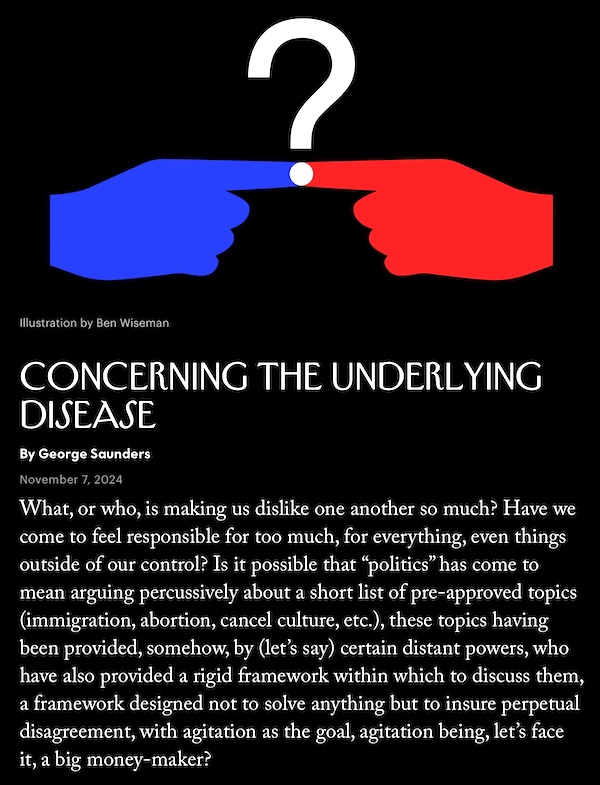
Imagine a baseball stadium. Fill it with twenty thousand Americans. Require Democrats to wear blue and Republicans red. At a podium at second base, have a person make a speech about, say, immigration.
Soon enough, fights break out.
Rewind.
Same twenty thousand people. Let them dress however they like. Instead of the speechmaking guy, put two baseball teams out there. Instantly, it’s a different energy. Among the fans for Team One will be both liberals and conservatives, suddenly united in common cause. Ditto Team Two. There will be disagreements, sure, but because we’ve been taught about acceptable baseball-game discourse, these will tend to be relatively good-natured.
Questions for Discussion:
Regarding the first example: Who put out the order to wear red or blue? Who dragged that podium out there? Who selected the topic? And from what list ___
Thought Experiment No. 5
There’s a parable, recounted in Paulo Coelho’s novel Veronika Decides to Die, among other places, about a kingdom whose well was poisoned by a wizard, such that a person drinking from the well would be driven insane. Everyone in the kingdom drank from the well, except the king and queen, who had a separate well for their use. Alarmed by the madness of the people, the king tried to issue edicts to control their behavior. To the insane populace, these edicts sounded like nonsense. The king’s problem was this: If he refused to drink from the poisoned well, which would make him insane, the people, believing he was insane, would dethrone him.
Questions for Discussion:
Is it possible that, in our culture, we each have our own customized, algorithm-enforced poisoned well? And that certain “wizards” have learned that lies are an especially potent form of poison? And that, therefore, the wells to which those “wizards” have access are more full of lies than others? And that even the wells that are full of truths aren’t great, since the method of delivery tends to enlarge one truth (one way of seeing) at the expense of others, thereby making it difficult to sustain such fragile things as ambiguity, doubt, sympathy, complexity, or genuine curiosity?
Might we then consider ourselves a culture being actively poisoned, a poisoning to which we are enthusiastically consenting?
What might we do about this?
Provide specific examples. ____
"Might we then consider ourselves a culture being actively poisoned, a poisoning to which we are enthusiastically consenting?"
President Trump at the CDC, prattling on in his 2020 re-election
campaign "KAG" cap, and humbling praising himself for his scientific
public health acumen (inherited from his late "great super genius" MIT
physics professor uncle).
Here's Trump rambling at length about how smart he is and how well he understands public health pic.twitter.com/1Co6MaRkzl
Electing Donald J. Trump once could be dismissed as a fluke, an aberration, a terrible mistake—a consequential one, to be sure, yet still fundamentally an error. But America has now twice elected him as its President. It is a disastrous revelation about what the United States really is, as opposed to the country that so many hoped that it could be. His victory was a worst-case scenario—that a convicted felon, a chronic liar who mismanaged a deadly once-in-a-century pandemic, who tried to overturn the last election and unleashed a violent mob on the nation’s Capitol, who calls America “a garbage can for the world,” and who threatens retribution against his political enemies could win—and yet, in the early morning hours of Wednesday, it happened.
Trump’s defeat of Kamala Harris was no upset, nor was it as unimaginable as when he beat Hillary Clinton, in 2016. But it was no less shocking. For much of the country, Trump’s past offenses were simply disqualifying. Just a week ago, Harris gave her closing argument to the nation in advance of the vote. Trump “has spent a decade trying to keep the American people divided and afraid of each other—that’s who he is,” she said. “But, America, I’m here tonight to say: that’s not who we are.” Millions of voters in the states that mattered most, however, chose him anyway. In the end, Trump’s inflammatory rhetoric about invading immigrant hordes, his macho posturing against a female opponent, and his promise to boost an inflation-battered U.S. economy simply resonated more than all the lectures about his many deficiencies as a person and a would-be President… [Susan B. Glasser]
We are former public servants who swore an oath to the Constitution. Many of us risked our lives for it. We are retired generals, admirals, senior non-commissioned officers, ambassadors, and senior civilian national security leaders. We are Republicans, Democrats, and Independents. We are loyal to the ideals of our nation—like freedom, democracy, andthe rule of law—not to any one individual or party.
We do not agree on everything, but we all adhere to two fundamental principles. First, we believe America’s national security requires a serious and capable Commander-in-Chief. Second, we believe American democracy is invaluable. Each generation has a responsibility to defend it. That is why we, the undersigned, proudly endorse Kamala Harris to be the next President of the United States.
This election is a choice between serious leadership and vengeful impulsiveness. It is a choice between democracy and authoritarianism. Vice President Harris defends America’s democratic ideals, while former President Donald Trump endangers them.
We do not make such an assessment lightly. We are trained to make sober, rational decisions. That is how we know Vice President Harris would make an excellent Commander-in-Chief, while Mr. Trump has proven he is not up to the job. As leaders, we know effective leadership requires in-depth knowledge, careful deliberation, understanding of your adversaries, and empathy for those you lead. It requires listening to those with expertise and not firing them when they disagree with you.
Vice President Harris has proven she is an effective leader able to advance American national security interests. Her relentless diplomacy with allies around the globe preserved a united front in support of Ukraine’s fight against Russian aggression. She grasps the reality of American military deterrence, promising to preserve the American military’s status as the most “lethal” force in the world.
The contrast with Mr. Trump is clear: where Vice President Harris is prepared and strategic, he is impulsive and ill-informed. He has heaped praise on adversarial dictators like China’s Xi Jinping, North Korea’s Kim Jung Un, and Russia’s Vladimir Putin, as well as the terrorist leaders of Hezbollah. Conversely, he has publicly and privately excoriated the leaders of our most steadfast allies, including the United Kingdom, Israel, Australia, Canada, and Germany. He abandoned our Kurdish allies while ceding influence in the Middle East to Russia, Iran, and China.
Further, Mr. Trump denigrates our great country and does not believe in the American ideal that our leaders should reflect the will of the people. While Vice President Harris follows the democratic norms we expect of any political leader—including promising to abide by the outcome of the pending election and respecting the rule of law—Mr. Trump is the first president in American history to actively undermine the peaceful transfer of power, the bedrock of American democracy.
Mr. Trump threatens our democratic system; he has said so himself. He has called for the “termination” of parts of the Constitution. He said he wants to be a “dictator,” and his clarification that he would only be a dictator for a day is not reassuring. He has undermined faith in our elections by repeating lies, without evidence, of “millions” of fraudulent votes.
He has shown no remorse for trying to overturn the 2020 election on January 6th, promises to pardon the convicted perpetrators, and has made clear he will not respect the results of the 2024 election should he lose again.
That alone proves Mr. Trump is unfit to be Commander-in-Chief.
We believe, as President Ronald Reagan said, that “America is a shining city on a hill.” Yet in this election, one of President Reagan’s more ominous warnings is equally relevant. “Freedom,” he said, “is never more than one generation away from extinction.”
Our endorsement of Vice President Harris is an endorsement of freedom and an act of patriotism. It is an endorsement of democratic ideals, of competence, and of relentless optimism in America’s future. We hope you will join us in voting for her.
Sincerely,
President of National Security Leaders for America: Rear Admiral Michael E. Smith, USN (Ret)
If you see a"sign in to prove you're not a bot"message, just click "Watch on YouTube."
Cheryl and I have already voted. She will serve as an election judge on November 5th.
If you watched any of Donald Trump’s recent rally in Butler, Pa., you probably noticed Elon Musk beside him — jumping, jiving, arms raised, belly bared — and wondered what in the name of Tesla the chronically overstimulated gazillionaire was doing. Impromptu aerobics? A cheerleading audition? Charades?
If only. Musk, I fear, was previewing a second Trump administration — in which Trump would embrace and embolden a crew of self-impressed eccentrics and ideological outliers who are happy, even eager, to make confounding and fawning spectacles of themselves. Consider Musk their spirit animal. Multiply him by about two dozen and you have the Trump cabinet of tomorrow — or an only slightly exaggerated cartoon of it.
Much of the fallout of a Trump victory is unknowable. But this much is certain: Returned to the White House, Trump would get input from — and award key positions to — a bestiary of nihilists, destructionists and even criminals unlike any collection of advisers that any other president assembled. They’d be unscrupulous in all fashions but one: unswerving loyalty to Trump. He fumed about what he saw as a lack of that among his previous cadre of helpmates. The coming coterie would affirm Trump’s worst impulses, nurture his nuttiest ideas and gleefully carry out his orders... [NY Times]
Tick, tick, tick...
TRUMP JUST PRATTLES ON
Yeah, sure.
Nonetheless w/respect to the aggregate picture,
After two impeachments, several damning judgments in civil suits, federal indictments and a guilty verdict on all 34 counts in a Manhattan criminal case, he seems to have a 50-50 shot at an inauguration in January. Why wouldn’t he junk any nettlesome procedures? What’s to stop him from putting a neutered figurehead in a job that senators monitor and giving more power to far-right flatterers in the shadows?
What’s to stop those flatterers from plundering and degrading the richest and most powerful country on earth? Certainly not Trump. He’d be too busy admiring their initiative and accepting their compliments. —Frank Bruni
Spoiler alert: Trump is not, in fact, a genius. He’s a sophisticated con man who used the tools of rhetoric to pick the pockets of the American body politic. He double-talked his way to power. He buried his opponents with an avalanche of gibberish. He convinced more than 60 million Americans that the barnyard odor of his bombast was actually the pungent aroma of pure truth.
How did that happen? This book shows us by dissecting his demagogic language with a particularly precise scalpel. In doing so, it deserves a place alongside George Orwell’s Politics and the English Language and Harry G. Frankfurt’s On Bullshit. It’s a brilliant dissertation on Trump’s patented brand of balderdash. That makes it one of the most important political books of this perilous summer…
Yeah. Read Dr. Merciece's book when it first came out. She rocks. Very nice WaPo atricle here.
Highly recommended.
Ugh.
Below: From back in June. on ...
UPDATE
Trump is holding a rally at Madison Square Garden. We can be certain he quadruple down oncw more on the rhetorical venom.
If you see a "sign in to prove you're not a bot" message, just click "Watch on YouTube."
…Harris could lose the election, not because she didn’t offer the right policies, or give enough interviews, or inspire enough people. She could lose because just enough people in four or five states flatly don’t care about any of that.
Some voters, to be sure, have bought into the mindless tropes that Democrats are communists or Marxists or some other term they don’t understand. But the truly loyal Trump voters are people who are burning with humiliation. They can’t get over the trauma of losing in 2020, the shame of buying Trump’s lie about rigged elections, and the shock of seeing each of their champions—Tucker Carlson, Rudy Giuliani, Steve Bannon, and others—turn out to be liars and charlatans who have been fired, financially imperiled, or even imprisoned.
Rather than reckoning with the greatest mistake they’ve ever made at the ballot box, they have decided that their only recourse is to put Trump back in the Oval Office. For them, restoring Trump would be both vindication and vengeance. It would prove that 2016 was not a fluke, and horrify people both they and Trump hate.
I am not hopeful that Democrats will rally in large enough numbers to prevent this outcome…
Ugh.
OCT 24TH
Trump rally in Arizona. A continuous stream of over-the-top invective aimed at his countless "Enemies From Within." His escalating exhortations fomenting hatreds are simply depressing.
The science policy implications of the looming 2024 Presidential election (& other stuff).
"Kamala Harris and Donald Trump promise radically different paths for the country. Although neither has said much about science, the winner of next month’s US presidential election will have a substantial impact on the nation’s research enterprise by influencing funding levels, the ability of foreign scientists to work in the country, rules on overseas collaborations, and the training of the next generation of scientists. See pages249and262."
SIX PRIORITY AREAS
Lots of detail within the issue addressing the foregoing six priority topical areas.
__________
RE "OTHER STUFF"
Every time a new issue of Science is released, a priority stop for me is the "Books, et al" section. I just found this. and bought it.
Introduction
The Primal Scene of Academic Writing All academic writers begin their journeys in the classroom. There they write for an audience of one person: the teacher.
Professors read students’ work as evaluators. The evaluator has a specific job: to read their students’ writing from beginning to end and assess it. (The job usually includes writing a response, too, but let’s put that task aside.)
The central quality of the evaluator’s job is thoroughness. She will read your work closely and completely. One of my former teachers, Edward Tayler, described it this way:
With proper allowance for human weakness, you may reasonably hope for an attentive, sympathetic reading of every word you write—a kind of reading you may not reasonably hope for ever again.
This kind of careful reading is a gift. As Simone Weil put it: “Attention is the rarest and purest form of generosity.”
But there’s another concrete and essential reason why student writers may expect this careful attention: the reader is getting paid.
The evaluator’s position as a paid reader is the exact opposite of the general reader’s. General readers pay for the privilege of reading (by buying books or magazines, or subscribing to websites), and they feel no obligation whatever to be thorough. General readers will quit reading if they don’t enjoy what they’re doing, or if they don’t feel they’re getting something worthwhile out of the experience.
Every academic writer begins by writing for a captive audience: someone who is literally being paid to pay attention. Long before they set foot in graduate school or venture beyond it, academic writers spend years getting used to a reader who can’t be distracted or discouraged, because that reader receives cash to read to the end.
The main problem with writing for a captive audience is that it teaches us to take the reader’s attention for granted. Student writers learn to be long-winded because they know—consciously or not—that their reader won’t quit on them. They can begin a mile away from their topic and slowly work their way in. Or they may supply three examples where one will do (usually to fill up pages to reach an assigned word limit—tell me you’ve never done that), all because they trust that the reader will dutifully trudge through.
When student writers sit down to write for a paid audience of one, they enact the primal scene of academic writing. Like other mythical moments of originary consciousness—the fall of Adam and Eve, the Freudian discovery of civilization’s discontents, and so on—this primal scene portends disappointment. It points to its own future failures.
But academic writing’s primal scene begets far worse than prolixity. Its worst symptom is that it promotes a disconnection from, and disregard for, the reader.
If you know that your readers will stay with you no matter what, you don’t have to worry too much about how you treat them. Instead of working to care for the reader, academic writers are taught by their earliest experience that readers are unconditionally invested. They require no consideration because they’re already on the hook. That unfortunate lesson invites all kinds of bad writing, and with it the genesis of this book.
Like all primal scenes, the academic writer’s beginning ripples forward to affect the future. Academic writers don’t leave our primal scene behind. Instead, we re-create and repeat it. (I know I have. I’ve made many of the mistakes that I warn against in this book.) After we pass the stage of writing for an audience of one, we go on to make many of the same bad moves when we write for wider audiences, often with the hope of getting published. Unexamined bad habits become enshrined. Care for the reader remains an afterthought—or no thought at all.
The primal scene thus stays with us ever after. Writing a paper for your undergraduate professor, a dissertation for a committee, and an article for publication are really three versions of the same exercise, separated by time and experience. Like the professor who reads a student’s work, the evaluators of journal and book submissions are paid readers also…
Cassuto, Leonard. Academic Writing as if Readers Matter (Skills for Scholars) (pp. 14-16). Princeton University Press. Kindle on.
Lots to consider in these pages. Much to learn. Just getting started. UPDATE: Likin' it. Seein' some cross-reference potential with this one.
This book differed from my initial anticipation. I've spent a good bit of my white collar career studying the "thinking" processes of engineers, physicians, and lawyers. When I first saw this title I thought "hmmm... that will be interesting."
Well, yeah, but not in the way I'd expected.
Despite all the uncertainties about academic judgment, I aim to combat intellectual cynicism. Post-structuralism has led large numbers of academics to view notions of truth and reality as highly arbitrary. Yet many still care deeply about “excellence” and remain strongly committed to identifying and rewarding it, though they may not define it the same way.
I also aim to provide a deeper understanding, grounded in solid research, of the competing criteria of evaluation at stake in academic debates. Empirically grounded disciplines, such as political science and sociology, have experienced important conflicts regarding the place of formal theory and quantitative research techniques in disciplnary standards of excellence. In political science, strong tensions have accompanied the growing influence of rational choice theory... [Loc 205]
Much attention going to the sociocultural / organizational politics of postsecondary academia thus far. Which, of course, cannot but factor into the way one "thinks."
I can also see some value in pondering in some depth a good lick of Elevina Fedorenko w/ respect to this topic (i.e., ostensible "severability" of language and "thinking").
OFF-TOPIC ERRATUM
Love it. Stayed up to watch all of it. Yikes. An OT nail-biter, Game 5.
sort of (between innumerable crass pre-adolescent, unresponsive barbs—updated to include his Oct 17th NYC Al Smith Dinner “speech”).
Draw your own conclusions.
The equal opportunity insulter.
APROPOS, NEW BOOK JUST RELEASED
Bill Adair, Pulitzer Prize winner, journalism professor, and founder of Politifact, presents an eye-opening and engaging history of political liars and a vision for how to make them stop.
Bill Adair knows a lie when he hears one. Since 2008, the site he founded, PolitiFact, has been the go-to spot for media members and political observers alike to seek the truth in an increasingly deceitful world. Since the site’s launching, politics’ tenuous relationship with the truth has only gotten weaker—and weirder.
In this groundbreaking book, Adair reveals how politicians lie and why. Relying on dozens of candid interviews with politicians, political operatives, and experts in misinformation, Adair reveals the patterns of lying, why Republicans do it more, and the consequences for our democracy. He goes behind the scenes to describe several episodes that reveal the motivations and tactics of the nation’s political liars, show the impact they have on people’s lives, and demonstrate how the problem began before Donald Trump and will continue after he’s gone. Adair examines how Republicans have tried to change the landscape to allow their lying by intimidating the news media, people in academia and government, and tech companies.
An award-winning journalist and pioneer in political fact-checking, Adair is uniquely able to tell this story. With humor and insight, this remarkable book unpacks the sad state of our politics, but also, provides solutions to put an end to American political deceit once and for all. [Amazon blurb]
This book just came to my attention via a Substack post. Of topical relevance to some recent prior posts. (See here as well.)
Donald Trump claims to have "the best words." But, what of his thoughts? (Objection, Your Honor! Assumes facts not in evidence!)
Goes to so-called "Deliberation Science" (and perhaps accompanying tech). Only part of human "thinking" rises to the level of rational "deliberation," seems to me.
…We can measure blood flow changes when people engage in different tasks and ask questions about whether the two systems are distinct or overlapping—for example, whether your language regions overlap with regions that help you solve math problems. These brain-imaging tools are really good for these questions. But before I could ask these questions, I needed a way to robustly and reliably identify language areas in individual brains, so I spent the first bunch of years of my career developing tools to do this.
And once we have a way of finding these language regions, and we know that these are the regions that, when damaged in adulthood, lead to conditions such as aphasia, we can then ask whether these language regions are active when people engage in various thinking tasks. So you can come into the lab, and I can put you in the scanner, find your language regions by asking you to perform a short task that takes a few minutes—and then I can ask you to do some logic puzzles or sudoku or some complex working memory tasks or planning and decision-making. And then I can ask whether the regions that we know process language are working when you’re engaging in these other kinds of tasks. There are now dozens of studies that we’ve done looking at all sorts of nonlinguistic inputs and tasks, including many thinking tasks. We find time and again that the language regions are basically silent when people engage in these thinking activities…
FOREWORD Ever since philosophers speculated about a “cerebroscope,” a mythical device that would display a person’s thoughts on a screen, social scientists have been looking for tools to expose the workings of human nature. During my career as an experimental psychologist, different ones have gone in and out of fashion, and I’ve tried them all—rating scales, reaction times, pupil dilation, functional neuroimaging, even epilepsy patients with implanted electrodes who were happy to while away the hours in a language experiment while waiting to have a seizure.
Yet none of these methods provides an unobstructed view into the mind. The problem is a savage tradeoff. Human thoughts are complex propositions; unlike Woody Allen speed-reading War and Peace, we don’t just think “It was about some Russians.” But propositions in all their tangled multidimensional glory are difficult for a scientist to analyze. Sure, when people pour their hearts out, we apprehend the richness of their stream of consciousness, but monologues are not an ideal dataset for testing hypotheses. On the other hand, if we concentrate on measures that are easily quantifiable, like people’s reaction time to words, or their skin response to pictures, we can do the statistics, but we’ve pureed the complex texture of cognition into a single number. Even the most sophisticated neuroimaging methodologies can tell us how a thought is splayed out in 3-D space, but not what the thought consists of… [Forward, Steve Pinker]
From my Kindle stash. Interesting resource. Below, another of my Kindle reads:
Liar, Liar, Everywhere She is pregnant. Raising a child takes a lot of time and energy, yet she is short of both. Homeless, she has no choice but to find somebody else to take care of her baby—for free. It’s not easy, but she knows how to pull it off. She scouts around and spots a cozy house in a quiet neighborhood. The young wife of the family looks caring and has just given birth to a new baby, so is a perfect choice as a surrogate. She hides herself and waits in the vicinity, keeping watch on the house. Opportunity presents itself when the new mother takes a short trip to get some food. She sneaks in and switches the baby with her own. Then she heartlessly throws the victim’s infant in a dump.
What you have just read is a cold-blooded murder case, one that takes place in nature when a female cuckoo bird sneaks her egg into a warbler’s nest. The cuckoo is cheating, though the scenario doesn’t quite fit Oxford English Dictionary’s definition of the verb “cheat”: to “act dishonestly or unfairly in order to gain an advantage.” Cheating in humans usually involves an element of intention. In the larger biological world, however, establishing intent is neither easy nor necessary. For biologists, as long as organisms act to favor themselves at the expense of others—especially in situations when cooperation is expected—they are cheating.
This book is about the behavior, evolution, and natural history of cheating. Although, in common usage, the word “cheating” is often interchangeable with “lying” and “deceiving,” the three words differ in connotation, nonetheless. Furthermore, lying and deceiving involve two very different biological processes…
Sun, Lixing. The Liars of Nature and the Nature of Liars: Cheating and Deception in the Living World (pp. 1-2). Princeton University Press. Kindle Edition.
I am reminded of professor Harry G. Frankfurter's delightful book "On Bullshit."
The notion of carefully wrought bullshit involves, then, a certain inner strain. Thoughtful attention to detail requires discipline and objectivity. It entails accepting standards and limitations that forbid the indulgence of impulse or whim. It is this selflessness that, in connection with bullshit, strikes us as inapposite. But in fact it is not out of the question at all. The realms of advertising and of public relations, and the nowadays closely related realm of politics, are replete with instances of bullshit so unmitigated that they can serve among the most indisputable and classic paradigms of the concept. And in these realms there are exquisitely sophisticated craftsmen who—with the help of advanced and demanding techniques of market research, of public opinion polling, of psychological testing, and so forth—dedicate themselves tirelessly to getting every word and image they produce exactly right.
Yet there is something more to be said about this. However studiously and conscientiously the bullshitter proceeds, it remains true that he is also trying to get away with something. There is surely in his work, as in the work of the slovenly craftsman, some kind of laxity that resists or eludes the demands of a disinterested and austere discipline. The pertinent mode of laxity cannot be equated, evidently, with simple carelessness or inattention to detail.
Frankfurt, Harry G. (2009-01-10).On Bullshit(pp. 23-24). Princeton University Press. Kindle Edition.
Yeah.
OFF-TOPIC PERSONAL ERRATUM
I am a Tennessee grad. My wife is Alabama 1972. 3rd Saturday October is always fractious here.