Search the KHIT Blog

Showing posts with label Economics. Show all posts

Tuesday, October 15, 2024

Donald Trump on his pending 2nd term economic policies,

sort of (between innumerable crass pre-adolescent, unresponsive barbs—updated to include his Oct 17th NYC Al Smith Dinner “speech”).
   
Draw your own conclusions.
The equal opportunity insulter.
 
APROPOS, NEW BOOK JUST RELEASED 

Bill Adair, Pulitzer Prize winner, journalism professor, and founder of Politifact, presents an eye-opening and engaging history of political liars and a vision for how to make them stop.
 
Bill Adair knows a lie when he hears one. Since 2008, the site he founded, PolitiFact, has been the go-to spot for media members and political observers alike to seek the truth in an increasingly deceitful world. Since the site’s launching, politics’ tenuous relationship with the truth has only gotten weaker—and weirder.

In this groundbreaking book, Adair reveals how politicians lie and why. Relying on dozens of candid interviews with politicians, political operatives, and experts in misinformation, Adair reveals the patterns of lying, why Republicans do it more, and the consequences for our democracy. He goes behind the scenes to describe several episodes that reveal the motivations and tactics of the nation’s political liars, show the impact they have on people’s lives, and demonstrate how the problem began before Donald Trump and will continue after he’s gone. Adair examines how Republicans have tried to change the landscape to allow their lying by intimidating the news media, people in academia and government, and tech companies.

An award-winning journalist and pioneer in political fact-checking, Adair is uniquely able to tell this story. With humor and insight, this remarkable book unpacks the sad state of our politics, but also, provides solutions to put an end to American political deceit once and for all. [Amazon blurb]
This book just came to my attention via a Substack post.  Of topical relevance to some recent prior posts. (See here as well.)


FRIDAY UPDATE
CLICK
Imagine our surprise.
 
MORE BILL ADAIR
 

MR. PREMIER PANTS-ON-FIRE, OCT 17TH, 2024


TANGENTIALLY, AS IT GOES TO LYING
 
Saw this in my SciAm:


Donald Trump claims to have "the best words." But, what of his thoughts? (Objection, Your Honor! Assumes facts not in evidence!)
 
Goes to so-called "Deliberation Science" (and perhaps accompanying tech). Only part of human "thinking" rises to the level of rational "deliberation," seems to me.

I have yet another scientist to check out.
…We can measure blood flow changes when people engage in different tasks and ask questions about whether the two systems are distinct or overlapping—for example, whether your language regions overlap with regions that help you solve math problems. These brain-imaging tools are really good for these questions. But before I could ask these questions, I needed a way to robustly and reliably identify language areas in individual brains, so I spent the first bunch of years of my career developing tools to do this.

And once we have a way of finding these language regions, and we know that these are the regions that, when damaged in adulthood, lead to conditions such as aphasia, we can then ask whether these language regions are active when people engage in various thinking tasks. So you can come into the lab, and I can put you in the scanner, find your language regions by asking you to perform a short task that takes a few minutes—and then I can ask you to do some logic puzzles or sudoku or some complex working memory tasks or planning and decision-making. And then I can ask whether the regions that we know process language are working when you’re engaging in these other kinds of tasks. There are now dozens of studies that we’ve done looking at all sorts of nonlinguistic inputs and tasks, including many thinking tasks. We find time and again that the language regions are basically silent when people engage in these thinking activities…
 
Wonder what Dr. Nita Farahany might have to say on these issues?
 
BACK TO LYING...
FOREWORD
Ever since philosophers speculated about a “cerebroscope,” a mythical device that would display a person’s thoughts on a screen, social scientists have been looking for tools to expose the workings of human nature. During my career as an experimental psychologist, different ones have gone in and out of fashion, and I’ve tried them all—rating scales, reaction times, pupil dilation, functional neuroimaging, even epilepsy patients with implanted electrodes who were happy to while away the hours in a language experiment while waiting to have a seizure.

Yet none of these methods provides an unobstructed view into the mind. The problem is a savage tradeoff. Human thoughts are complex propositions; unlike Woody Allen speed-reading War and Peace, we don’t just think “It was about some Russians.” But propositions in all their tangled multidimensional glory are difficult for a scientist to analyze. Sure, when people pour their hearts out, we apprehend the richness of their stream of consciousness, but monologues are not an ideal dataset for testing hypotheses. On the other hand, if we concentrate on measures that are easily quantifiable, like people’s reaction time to words, or their skin response to pictures, we can do the statistics, but we’ve pureed the complex texture of cognition into a single number. Even the most sophisticated neuroimaging methodologies can tell us how a thought is splayed out in 3-D space, but not what the thought consists of…
[Forward, Steve Pinker]

From my Kindle stash. Interesting resource. Below, another of my Kindle reads:

Liar, Liar, Everywhere

She is pregnant. Raising a child takes a lot of time and energy, yet she is short of both. Homeless, she has no choice but to find somebody else to take care of her baby—for free. It’s not easy, but she knows how to pull it off. She scouts around and spots a cozy house in a quiet neighborhood. The young wife of the family looks caring and has just given birth to a new baby, so is a perfect choice as a surrogate. She hides herself and waits in the vicinity, keeping watch on the house. Opportunity presents itself when the new mother takes a short trip to get some food. She sneaks in and switches the baby with her own. Then she heartlessly throws the victim’s infant in a dump.

What you have just read is a cold-blooded murder case, one that takes place in nature when a female cuckoo bird sneaks her egg into a warbler’s nest. The cuckoo is cheating, though the scenario doesn’t quite fit Oxford English Dictionary’s definition of the verb “cheat”: to “act dishonestly or unfairly in order to gain an advantage.” Cheating in humans usually involves an element of intention. In the larger biological world, however, establishing intent is neither easy nor necessary. For biologists, as long as organisms act to favor themselves at the expense of others—especially in situations when cooperation is expected—they are cheating.

This book is about the behavior, evolution, and natural history of cheating. Although, in common usage, the word “cheating” is often interchangeable with “lying” and “deceiving,” the three words differ in connotation, nonetheless. Furthermore, lying and deceiving involve two very different biological processes…

Sun, Lixing. The Liars of Nature and the Nature of Liars: Cheating and Deception in the Living World (pp. 1-2). Princeton University Press. Kindle Edition.

BRIEF 2015 REMEMBRANCE

I am reminded of professor Harry G. Frankfurter's delightful book "On Bullshit."

The notion of carefully wrought bullshit involves, then, a certain inner strain. Thoughtful attention to detail requires discipline and objectivity. It entails accepting standards and limitations that forbid the indulgence of impulse or whim. It is this selflessness that, in connection with bullshit, strikes us as inapposite. But in fact it is not out of the question at all. The realms of advertising and of public relations, and the nowadays closely related realm of politics, are replete with instances of bullshit so unmitigated that they can serve among the most indisputable and classic paradigms of the concept. And in these realms there are exquisitely sophisticated craftsmen who—with the help of advanced and demanding techniques of market research, of public opinion polling, of psychological testing, and so forth—dedicate themselves tirelessly to getting every word and image they produce exactly right. 

Yet there is something more to be said about this. However studiously and conscientiously the bullshitter proceeds, it remains true that he is also trying to get away with something. There is surely in his work, as in the work of the slovenly craftsman, some kind of laxity that resists or eludes the demands of a disinterested and austere discipline. The pertinent mode of laxity cannot be equated, evidently, with simple carelessness or inattention to detail.


Frankfurt, Harry G. (2009-01-10). On Bullshit (pp. 23-24). Princeton University Press. Kindle Edition.
 Yeah.
 
OFF-TOPIC PERSONAL ERRATUM
 
 
I am a Tennessee grad. My wife is Alabama 1972. 3rd Saturday October is always fractious here.

Stay tuned...
_________
  

Wednesday, March 1, 2023

The history of the Myth America Pageant

 
When I first opened this book after downloading it, Kindle estimated my reading time at "18 hrs 59 minutes." 824 pages of analytic historical whup-ass, elegantly written, consistently coherent.
 
And, the authors, while forthright regarding their points of view, are consistently charitable with respect to myriad contrary doctrinal assertions (while also calling BS where logic, facts, and, evidence warrant doing so).
 
Gonna be a while reviewing this one. Stay tuned. 
 
UPDATE: from a summary by George Hosea:
The Big Myth: How American Business Taught Us to Loathe Government and Love the Free Market, by Naomi Oreskes and Erik M. Conway, explores the historical and cultural roots of the popular belief in the United States that government is the enemy of free enterprise, and that the free market is the solution to all social and economic problems. The authors contend that this notion is not the natural product of a free society but the result of a purposeful effort by commercial interests to change public opinion and legislation in their favor. [It] traces the origins of this effort to the 1930s, when business executives were worried at the advent of the New Deal and the rising influence of labor unions. They worried that government interference in the economy would restrict their earnings and their influence over the workers.

To address this danger, industry leaders made a systematic effort to promote the advantages of the free market and demonize government involvement as an infringement on individual liberty. They supported think tanks, media outlets, and political campaigns that promoted this message and worked to sway public opinion. Throughout time, this effort proved so effective that it has become a deeply ingrained element of American society and politics.

Oreskes and Conway claim that this conviction in the free market and skepticism of government has had severe effects on American society, including increased inequality, a weakening of social safety nets, and a degradation of public goods like infrastructure and education. They argue that it is necessary to review these assumptions and to propose alternative forms of economic organization that promote social welfare and the common good.

To accomplish this, the authors believe that it is vital to confront conventional beliefs about the free market and government, observing that the free market is not a natural, self-regulating system but rather a human creation that needs government intervention to work efficiently. Oreskes and Conway also note that government is not an outside force that limits individual liberty, but is rather a reflection of the collective will of the people, and that its job is to guarantee that the advantages of economic activity are shared equitably.

The authors underline the necessity of understanding the historical environment in which these ideas took root, contending that the contemporary mistrust of government is not an inherent product of human nature but rather the result of particular historical events and political campaigns…

The Big Myth is a thought-provoking and informative exploration of the causes and effects of the overwhelming belief in the free market and skepticism of government in the United States ... Oreskes and Conway trace the roots of contemporary confidence in the free market back to the Gilded Age of the late 19th century, when corporate executives exploited their money and power to influence public opinion and legislation in their favor. effective in part because it was able to co-opt the vocabulary of populism and position economic concerns as identical to the interests of ordinary people…
Good enough to get us underway. I cleaned up a few grammatical items, but his overall take squares with the basic issues presented in the book.
__________
 
For openers, there is no such thing as "The Free Market."
If there were only one man in the world, he would have a lot of problems, but none of them would be legal ones. Add a second inhabitant, and we have the possibility of conflict. Both of us try to pick the same apple from the same branch. I track the deer I wounded only to find that you have killed it, butchered it, and are in the process of cooking and eating it.

The obvious solution is violence. It is not a very good solution; if we employ it, our little world may shrink back down to one person, or perhaps none. A better solution, one that all known human societies have found, is a system of legal rules explicit or implicit, some reasonably peaceful way of determining, when desires conflict, who gets to do what and what happens if he doesn’t.

The legal rules that we are most familiar with are laws created by legislatures and enforced by courts and police. But even in our society much of the law is the creation not of legislatures but of judges, embedded in past precedents that determine how future cases will be decided; much enforcement of law is by private parties such as tort victims and their lawyers rather than by police; and substantial bodies of legal rules take the form not of laws, but of private norms, privately enforced.


Friedman, David D.. Law's Order: What Economics Has to Do with Law and Why It Matters (p. 3). Princeton University Press - A. Kindle Edition.

"Private enterprise," "private markets," yeah, of course. But human transactional affairs get "governed" one way or another. Spare me the conflation. Moreover,

A sweeping historical read.

I am now 77, a first-wave Baby Boomer born in Feb. 1946. My parents were Depression-era kids. My Dad and all four of his brothers served in WWII, as did my mother's adult brothers. Much of the bulk of this book spans that period (Pop was born in 1916). I am quite familiar with the socio-political-economic and cultural trends of the era.

My personal awareness of the broader world began roughly with the Presidential tenure of Dwight Eisenhower (I recall the "I Like Ike" buttons). My parents were hardcore (albeit relatively passive) Goldwater Republicans. Patriotic "conservatives" with a fairly reflexive disdain for anything smacking of "socialism" or “worse.”

In light of our recent "MAGA" looniness, I irascibly posted this on Twitter last year:
 

It's easy to casually conclude this extreme "free market GOOD / government BAD" polarization is of relatively recent vintage, but the heated all-or-nothing rhetoric goes back a long time (even if things are further exacerbated by current-day digital social media). The Big Myth lays the long history out in great detail.

It's a history larded with cynicism, ill will, bad faith, and a cornucopia of logical/rhetorical fallacies: Magical Thinking, False Dichotomies, Appeal to Authority/Tradition, the Slippery Slope, Perfectionism Fallacy, Begging the Question, ad hominem attacks, correlation/causation conflation, and so on. The ever-handy toolkit of the propagandist.
 
The Rogues' Gallery: Von Mises, Hayek, Ayn Rand, Milton Friedman (with his egregious mischaracterizations of Adam Smith), Goldwater, Robert Bork, Ronald Reagan, and a sizable rogues gallery of lesser "free market uber alles" ideologues (along with their partisan "think tanks"), all given a thorough critical evaluation here. The "sacred, indivisible 3-legged stool" of The Free Market, Liberty, and Democracy (the latter in particular grossly mischaracterized), posited by neoliberals as the ONLY sociopolitical edifice holding off the Merciless Totalitarian Hordes, (and, oh yeah, before I forget, we now gotta toss in white Christian Nationalism to the Sacred Indivisible Liturgy)
...A key part of the manufacturers’ propaganda campaign was the myth of the Tripod of Freedom, the claim that America was founded on three basic, interdependent principles: representative democracy, political freedom, and free enterprise. This was a fabricated claim. Free enterprise appears in neither the Declaration of Independence nor the Constitution, and the nineteenth-century American economy was laced with government involvement in the marketplace. But NAM spent millions to convince the American people of the truth of the Tripod of Freedom, and to persuade Americans that the villain in the story of the Great Depression was not “Big Business,” but “Big Government.” [Oreskes & Conway, The Big Myth, p. 16].
Nothing much has materially changed.
 
CUTTING TO THE CHASE
CHAPTER 15
The High Cost of the “Free” Market


…In 2019, in a meeting that now seems clairvoyant, experts at the Center for Health Security at Johns Hopkins University addressed “preparedness for a high-impact respiratory pathogen pandemic.” Among their recommendations: countries should improve their core public health competencies; draw up national action plans, with strategies to make decisions quickly when needed and prepare for supply interruptions; and develop the capacity for “surge manufacturing in crisis.” Obviously, their advice was ignored.

Over the past thirty years, scientists’ counsel on a wide range of issues—from pandemic preparedness to climate change—has been widely discounted and sometimes rejected outright. A major reason is the influence of the thinking that insists on limiting the power and reach of the federal government and relying on markets to solve our problems. Most damagingly, the market-oriented framework of recent decades has resisted any facts—scientific, historical, sociological, or otherwise—that suggest a need for a strong, centralized, or otherwise coordinated governmental response.

In some countries, concentrated central power may be a threat to liberty, but the United States is not one of them, in part because the country was set up with that concern in mind. The conservative preoccupation with constraining government power has left us with a federal government too weak and too divided to handle big problems like Covid-19 and climate change. Even as the pandemic raged, millions of Americans refused to get vaccinated in large part because of distrust of “the government,” and the lion’s share of those Americans were political conservatives.

The steps necessary to avoid the worst effects of an emergent disease—stockpiling supplies, educating people about hand-washing and social distancing, developing accurate tests and implementing them equitably, and sustaining the research infrastructure that can kick in to develop a vaccine—are not readily undertaken by the private sector. There’s not much of a business case for stockpiling a billion face masks. Nor can we rely on the private sector to step up when a new virus emerges, because by then it is too late. The “just in time” supply model that dominates in business is efficient for many purposes, but it does not work in the face of a pandemic.

For any problem that has a scientific, medical, or technological component, the challenge is not simply to mobilize resources when they are needed, but to have them ready in advance. It takes a year or more to build a laboratory; it takes a decade to train a cadre of scientists and engineers. We could no more muster on demand the needed expertise and infrastructure to fight a pandemic than we could suddenly raise a professional military, replete with aircraft carriers and their air wings, within weeks of an attack. Nearly all conservatives acknowledge the need for military preparedness, yet they have been loath to allow that government is needed to address a wide range of problems—and not just scientific ones—that markets can’t or won’t solve on their own…
[The Big Myth, pp. 539-541]
In 2019, in a meeting that now seems clairvoyant, experts at the Center for Health Security at Johns Hopkins University addressed “preparedness for a high-impact respiratory pathogen pandemic.”

Yeah. From my blog in April 2020.

Box 6: What Would the 1918 Influenza Pandemic Look Like Today?
In the worst pandemic in recorded history, the 1918 influenza pandemic, the novel virus infected approximately one-third of the global population over a period of 2 years, ultimately leading to 50 to 100 million deaths world-wide. One might imagine that the death rate would be lower today due to the advent of modern medical equipment and procedures that did not exist in 1918, but the global population is now approximately 4 times greater than in 1918. This growth, however, is disproportionately higher in low- and middle-income countries, often the ones with developing health systems. Many—predominantly in Africa, Southeast Asia, Latin America, and the Middle East—have experienced population growths of 1,000% or more since 1918. Crowded urban areas provide prime conditions for the spread of respiratory diseases, and urbanization is increasing globally, including the emergence of 47 “mega-cities” (populations over 10 million). By comparison, London was the world’s largest city in 1918, at approximately 5 million people. Additionally, global travel has increased by orders of magnitude compared to 1918. Even then, shipping and population movement (including World War I) played an important role in global spread of the disease, but today, humans can fly anywhere in the world in less than 1 incubation period, meaning that global transmission can be expected to be even faster.

In 1918, the global case fatality ratio is estimated to have been 2.5%, but it was considerably greater in low- and middle-income countries, with some estimates exceeding 10%. Today, some high-income countries would be expected to fare much better because of modern health care, but the case fatality in countries with limited access to healthcare could be as bad as or worse than 1918. Simple arithmetic would suggest the possibility of 100 to 400 million deaths if a 1918-like pandemic were to occur today, but unprepared or under-resourced health systems could further exacerbate disease transmission through nosocomial spread and an inability to promptly diagnose and render care, a particular concern for developing health systems. During the 2003 SARS epidemic, 72% and 55% of presumed and confirmed cases in Toronto and Taiwan, respectively, occurred as a result of healthcare transmission. A similar nosocomial outbreak in which healthcare facilities became amplifiers of the epidemic, this time of MERS, happened in South Korea in 2015.
[Page 47 of 83]

Yes, “obviously, their advice was ignored.”

Hat tip to Dr. Naomi Oreskes.
 
:SOCIOECONOMIC DRAMA. FROM A 2012 POST OF MINE
 
I think this tangentially fits the Big Myth topic.
 

There is a long-established, conceptually simple, cogent cognitive psych model of dysfunctional interpersonal behavior known as "Script Theory." It emanated decades ago from Eric Berne's work on "Transactional Analysis." Within this model is the Rescuer-Victim-Persecutor concept:
  • I, the benevolent intervenor, arrogate to myself the right to and imperative of "rescuing" you, the "Victim" from your plight(s);
  • You, the "Victim," irritated by (or just apathetic toward) my putatively altruistic and unsolicited ministrations, react with insufficient gratitude and attitude/behavior change;
  • which then give me the right to demonize and persecute you.
Think about it.

The supportive psych literature is rather voluminous.


I pretty much buy it. Occam's Razor simplicity and all that. Think about the drama you repeatedly witness (or participate in) within your family and social circles. 


Shorter Claude Steiner: to the extent that you live a "scripted" life, you are not free.
 
1971
Of late I can't help but observe that our society in the aggregate is now in the "Persecutor" phase of socioeconomic dynamics, in the wake of our recent disappointments. Ironic, given all this hyperbolic talk about "freedom" of late.

It's probably cyclical. We tend to oscillate between maxima and minima of concerns over "social justice."


Unless you've been off incommunicado in a cave of late, you've seen it.

  • Presidential Candidate Ron Paul gets loud, angry cheers during a GOP primary "debate" wherein he summarily shrugs off the moral implications of allowing the destitute to die at the ER curbside (and, he's a physician, no less).
  • The fatuous writings of the late Ayn Rand (raging against "Moochers" and "Looters") have risen to new popularity.
  • A nationally known AM radio host loudly demeans a woman as a "slut" and a "prostitute"because of her advocacy for contraceptive rights.
  • The long-term jobless are described as "lazy." It is argued, among other things, that they be subjected to drug testing as a condition of eligibility for unemployment compensation. Ron Paul's senator son Rand claims in late 2013 that extended employment insurance is a "disservice" to the jobless.
I could do a very long bullet list.

But, you get the idea. The "failures of liberalism" give us convenient license to blame the the unfortunate, poor, and inept.

The adversity POV:
Ich, Du, Sie

  • I innocently suffered a misfortune.
  • You should have done more to avoid calamity.
  • He is is a parasite, a Moocher.
We tend to attribute our successes to acumen and initiative, while declaiming responsibility for our misfortunes, which are proffered to be the result of bad luck or the machinations of more powerful adversarial others. 
 
'Eh?
 
BTW, you might enjoy my 2008 recounting of my 5 year stint in subprime risk management. See "Tranche Warfare."


ALSO—"CRYPTO," ANYONE?
 
Gresham's Dynamic on steroids.
 
RECAPPING

__________
 

Friday, October 29, 2021

The definition of an "economist?"

"Someone who sees something that works in practice and tries to determine whether it will work in theory."—JD Kleinke
 
 
apropos,


I am reminded of an old Jay Leno Tonight Show joke, wherein he sarcastically mocked mindless TV ad copy platitudes:
"Do you want the highest quality at the lowest price?"
"NO, we wanna pay top dollar for crap!"
I've riffed on the U.S. healthcare system at some length across the years. See also my Hahnemann debacle post.
 
From the above Healthcare Triage video:
 
 
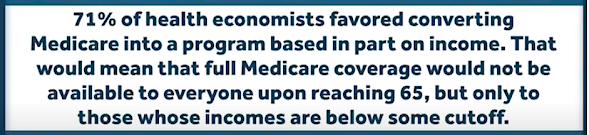
OK, 71% of health care economists have apparently not gotten The Memo. **
(** Wait a minute. The v/o contradicts the slide. Which is it? Favored or opposed?)
I am now 75 and a Medicare bene, as is my 71 yr old wife. We hit the Medicare "high income earners" threshold several years ago, approximately doubling our monthly "Medicare Premium Deduction" (it has since gone back down to "normal"). Cheryl was still working, and we'd taken a couple of sizable IRA disbursements (which count as taxable "earned" income in the year withdrawn). So, some significant "means testing" is already in effect. Not that hard-liners don't still want to convert Medicare into a flat-out penurious welfare program, with "asset" limits as well as income ceilings. Spend-down-to-poverty-for-eligibility.
 
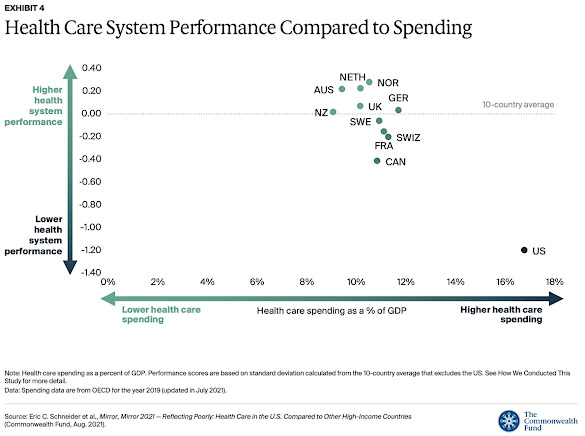
"Netherlands, Norway, Australia, New Zealand, UK, Germany, Sweden, Switzerland, France, Canada?" Higher-performing, lower costs? Buncha Commies.

No, we'll stick with Paying Top Dollar For Crap.
 
I first came to the healthcare space in 1993, as a QIO analyst, just as the corporatization of the sector was getting up to warp speed.
 
 
Interesting. This blog ensued during my 2nd QIO tenure in Health Information Technology. We were gonna materially improve outcomes quality and "bend the cost curve," in large measure via the widespread deployment of digital IT.
 
We mostly just MBA-ified it. 

MORE HEALTHCARE TRIAGE

  
I often reflect on what I wrote in 2009, when "Obamacare" was in the legislative oven.
Some reform advocates have long argued that we can indeed [1] extend health care coverage to all citizens, with [2] significantly increased quality of care, while at the same time [3] significantly reducing the national (and individual) cost. A trifecta "Win-Win-Win." Others find the very notion preposterous on its face. In the summer of 2009, this policy battle is now joined in full fury…

THE U.S. "HEALTH CARE" "SYSTEM"?

I will by no means be the first to note that our medical industry is not really a "system," nor is it predominantly about "health care." It is more aptly described as a patchwork post hoc disease and injury management and remediation enterprise, one that is more or less "systematic" in any true sense only at the clinical level. Beyond that it comprises a confounding perplex of endlessly contending for-profit and not-for-profit entities acting far too often at ruinously expensive cross-purposes…
__________
 

Friday, October 15, 2021

You don't need a weatherman

to know which way the wind is blowin'
 

Mostly Covid-19 related ECON upshot, I would think.
 
One of our tiny grocery countermeasures.
 

Life-long omnivore here (albeit moderately so). We've started buying this "Impossible Burger" at Trader Joe's. Thus far we've used it to make baked stuffed peppers, stroganov, and actual burgers. Totally impressed; I can't tell any difference. A lot cheaper than ground beef as well. Heartily recommended.

COVID-19 ERRATUM

722k US deaths to date

ON DECK

 
Reviewed in my Science Magazine (paywalled). 
In the mid-19th century, the polymath William Whewell coined the term “consilience” to describe the progress of science through time (1). According to Whewell, inductive knowledge should “jump together” with evidence from different disciplines of science supporting more and more general, unified knowledge claims. The historian Kyle Harper explicitly adopts and enlarges this goal—which he attributes to E. O. Wilson—beyond science proper, incorporating insights from history, economics, anthropology, paleogenomics, parasitology, ecology, and phylogenetics, to write an ambitious, engaging, and unified history of humanity’s interaction with infectious disease….
From the Amazon blurb:
"...Panoramic in scope, Plagues upon the Earth traces the role of disease in the transition to farming, the spread of cities, the advance of transportation, and the stupendous increase in human population. Harper offers a new interpretation of humanity’s path to control over infectious disease—one where rising evolutionary threats constantly push back against human progress, and where the devastating effects of modernization contribute to the great divergence between societies. The book reminds us that human health is globally interdependent—and inseparable from the well-being of the planet itself.

Putting the COVID-19 pandemic in perspective, Plagues upon the Earth tells the story of how we got here as a species, and it may help us decide where we want to go."
688 pages. I am never bored.
"The book reminds us that human health is globally interdependent—and inseparable from the well-being of the planet itself."
Anthropocene, anyone?
 
Exigencies.
 
BTW: Under "Threats to Democracy."
_________