

Prior posts of mine on Russia's aggression against Ukraine.
 |
| Yeah, the internets are alive and well with exasperated multimedia snark. |
|
| Yeah, the internets are alive and well with exasperated multimedia snark. |


Hannity: "You said before the interview that in two minutes you would know...What vibe did you get in two minutes?"
Trump: "You know, I always had a great relationship with President Putin. And we would have done great things together in terms of, you know. Their land is incredible. The rare earth, the oil gas — it's incredible. It is the largest piece of land in the world as a nation by far. I think they have 11 timezones if you can believe it, that's big stuff. But we would have done a lot of great things we had the Russia, Russia, Russia hoax which stopped us from doing that. We would have done so great. But we have the greatest — one of the great hoaxes. I mean, there were others like the election itself and as you know, as you covered better than anyone. But it was a rigged election and a horrible thing that took place in 2020. But we would have had a great relationship but we did amazingly well considering — you know, he would look and see what happened, he would think we're crazy with the made up Russia, Russia, Russia hoax. So we had something very important and we had a very good meeting today, but we'll see. I mean it's, you have to get a deal."

Reacting to a report that someone in Donald Trump’s entourage who went with him to Alaska left sensitive State Department documents on a public hotel printer, critics of the president pounced on yet another security breach since he took office.
According to a report from NPR on Saturday, Three guests staying at the Hotel Captain Cook, located 20 minutes away from Joint Base Elmendorf-Richardson where the Russian and American president were meeting, discovered the documents that included names, meeting times, room locations, phone numbers and other details.
That led Jon Michaels, a professor of law at UCLA who lectures about national security, to explain to NPR, "It strikes me as further evidence of the sloppiness and the incompetence of the administration.You just don't leave things in printers. It's that simple." …

…I have spent my life trying to understand Russia and its people. Now, like everyone, I am disgusted by Russian savagery. Fury grows in me each time I see the mutilated corpses and leveled homes—not only because of the sadistic violence, but also because I know that the Russian regime, in trying to destroy the Ukrainian nation, has destroyed a chance, at least for some years to come, for a better world.
And for what?
For the messianic dreams of a small man, a frightened and delusional thug leading a criminal enterprise masquerading as a government, who believes that he is doing God’s will.
You might be surprised at the last sentence, but Vladimir Putin really believes this. He thinks he’s on a mission. I’ll come back to this in a moment, but it’s a reality that too many in the West have either overlooked or chosen to ignore. And as much as I’d like to lay all of this mayhem on Putin’s shoulders alone, we now have to accept that his butchery of innocent people is either tacitly or openly supported by millions of Russians. Yes, there are brave Russians who have risked their lives to protest this war, but there is no way, any longer, to deny that Putin enjoys more support than any decent nation should give to such horror.
And so I grieve not only for Ukraine, but for the knowledge that no matter how this war ends, the era of hope that began in 1989 is over. Ukraine is now the scene of the largest conflict in Europe since World War II. NATO and Russia are openly enemies again. Nuclear war, for a time a forgotten abstraction, is a real danger…


While most people understand that we face a looming climate disaster characterized by severe droughts, melting glaciers, and increasingly common wildfires and superstorms, certain technical details, policy considerations, and related justice and equity issues remain murky. Two timely new books aim to fill these gaps in knowledge.Just starting these. Stay tuned. apropos of my episodic Anthropocene riffs, albeit principally from the ethical points of view.
In Is Science Enough? Forty Critical Questions About Climate Justice, historian Aviva Chomsky breaks down the key concepts, terminology, and often-contentious debates that surround climate change so that audiences ranging from students to activists can easily understand them. As the title implies, Chomsky argues that scientific interventions are not sufficient to combat global warming. Our current economic paradigm, she argues, relies on “extracting and consuming the earth’s resources in ever-increasing quantities, and turning them into waste,” and such a system is incompatible with a healthy planet…
In What Climate Justice Means and Why We Should Care, moral philosopher Elizabeth Cripps argues that we all share a responsibility to combat the effects of a changing climate that is disproportionately affecting those who have done the least to cause it. She presents clear and compelling evidence of the burden borne by disadvantaged populations, maintaining that climate change is, above all, “about privilege.”
Ten countries, Cripps notes, are responsible for 60% of greenhouse gas emissions—a major driver of climate change—and while the impacts of climate change are global and include severe winter storms in Texas, wildfires in Australia, and floods in Europe, the Global South has suffered the most devastating consequences. Between 2008 and 2016, she writes, roughly 22 million people were displaced in the Global South each year. The consequences of such displacements include child marriages, loss of schooling and employment opportunities, food insecurity, and more…

In this country, Ukraine has done what nothing else—no election or insurrection, no pandemic, no environmental catastrophe—could do: shown the difference between right and wrong, heroism and barbarism, truth and lies, with such clarity that most Americans are in agreement…
Yet I worry that we’ll soon forget about Ukraine. It’s far away, and Americans have famously short attention spans.
In the days after Zelensky’s speech to Congress, you could sense American life returning to its natural state. Republican senators accused Judge Ketanji Brown Jackson of being soft on pedophilia, then checked their phones for their mentions. Meta Platforms announced that CEO Mark Zuckerberg will spend more time working remotely from his 1,500-acre Hawaiian estate and other homes. Kylie Jenner told her 325 million Instagram followers that her newborn son will no longer go by the name of Wolf. An online horde of journalists attacked The New York Times for publishing an editorial in defense of free speech. For 72 hours, Will Smith slapping Chris Rock at the Oscars was bigger than the war in Ukraine. The endless self-regard, triviality, and cynicism of American culture in the age of digital polarization seeped back, amid images of Ukrainians filling sandbags on the Odesa beaches or risking Russian shelling to bring shelter dogs to safety.
Even when the cause is just, people inevitably lose interest in far-off calamities that happen to people they don’t know. Against the will, a numb indifference sets in, and life goes relentlessly on…
Can the war change anything in this country? Ukrainians, in their struggle to build a democracy out of an autocratic past, have looked to the American example. What will it take for us to be worthy of them?
The questions aren’t idle. Ukraine’s survival requires the sustained support of its most important ally, the United States. Time will not be on Ukraine’s side. If the war drags on for months, it will grow murkier to Americans watching at a distance; its moral clarity will start to blur. Ukrainians’ justifiable rage at all things Russian will produce images that foreigners will find less easy to love than the picture of a string quintet performing in the ruins of a Kharkiv metro station. We’ll see more reports of Ukrainian atrocities that are not the inventions of the Kremlin, Fox News, or Glenn Greenwald. Some Americans will conclude that distinguishing propaganda from truth isn’t worth the effort, that it’s all the same (which is the goal of Russian propaganda). They’ll start to wonder why they have to pay $5 or $6 a gallon for gas with no relief in sight. Going into the midterms, Republicans will be happy to highlight these troubles and hang them around the neck of the party in power.
So the fate of Ukrainian democracy depends in part on American staying power. And in turn, the health of American democracy depends in part on Ukraine. If Vladimir Putin succeeds in demolishing Ukraine, converting its fragments into the vassal states of a new Russian empire, then strongmen and wannabes around the world will be emboldened. Putin will have won his bet that what matters in global affairs is raw power, that oil and gas are more important to Europe than freedom and justice, that the West is too tired and comfortable to sacrifice for its supposed values—that, as he said last summer, “the liberal idea has become obsolete.”
If, on the other hand, Putin’s regime of militarized kleptocracy—fascism without the inspiration—suffers an unmistakable defeat, it will diminish American authoritarians of all types. Ukraine’s win might start to clear out some of the reflexive cynicism that corrodes our politics. The current position of most Republicans—denouncing Russia and criticizing Biden for not doing more to help Ukraine, yet saying nothing when Trump calls Putin a “genius” or openly asks him for political favors while Russia commits war crimes—will become less tenable. Russian aggression will be harder to explain away than American insurrection, and Putin will be harder to defend than Trump. Republican anti-Trump voices will gain numbers and strength. The party will have to decide whether it wants to enter the 2024 elections still infected with the homegrown strain of an utterly discredited Putinism. That can’t be opposed abroad while it’s being stoked at home.
To win, Ukraine needs the stakes of the war to be clear to Americans. If the conflict comes to be seen as an impenetrable European mess, a war over spheres of influence and natural gas, or proof of the West’s hypocrisy, the American public will stop caring…
…Americans cannot afford to forget about Ukraine. When Zelenskyy says that Ukraine is fighting for us and our values too, we had better believe him. Liberal values don’t revive spontaneously or vicariously. They have to be defended, practiced, empowered, and criticized. The weeks since February 24 recall the period after September 11—the sense of crisis and unity at a historic turning point—but there’s this difference: Two decades ago, at the height of the unipolar era, America was blind with hubris. The sense of unity soon took the form of a fearful triumphalism. The Bush administration’s National Security Strategy of 2002 declared: “The great struggles of the twentieth century between liberty and totalitarianism ended with a decisive victory for the forces of freedom—and a single sustainable model for national success: freedom, democracy, and free enterprise.” America, the paragon of this model, would lead the world—with us or against us—in a new struggle for liberty.
Twenty years later, with the failures of Iraq, Afghanistan, and the War on Terror, with the rise of new powers abroad, with rampant economic inequality and entrenched political hatred at home, the 9/11 fever is gone. We suffer from its opposite: exhaustion, disbelief. Ukrainians are right to worry that we’ll soon lose interest and lapse back into our solipsistic dysfunction…


THERE IS NO LIBERAL WORLD ORDERAs soon as the CBS 60 Minutes interview with President Zelenskyy is posted to YouTube, I will put it up. I have it on TV right now. I couldn't give a flying flip about who won the NCAA hoops final or the Master's Golf Tournament in the face of all this misery.
Unless democracies defend themselves, the forces of autocracy will destroy them.
By Anne Applebaum
There is no natural liberal world order, and there are no rules without someone to enforce them. unless democracies defend themselves together, the forces of autocracy will destroy them. i am using the word forces, in the plural, deliberately. many american politicians would understandably prefer to focus on the long-term competition with china. but as long as russia is ruled by putin, then russia is at war with us too. so are belarus, north korea, venezuela, iran, nicaragua, hungary, and potentially many others. we might not want to compete with them, or even care very much about them. but they care about us. they understand that the language of democracy, anti-corruption, and justice is dangerous to their form of autocratic power—and they know that that language originates in the democratic world, our world.
this fight is not theoretical. it requires armies, strategies, weapons, and long-term plans. it requires much closer allied cooperation, not only in europe but in the pacific, africa, and latin america. NATO can no longer operate as if it might someday be required to defend itself; it needs to start operating as it did during the cold war, on the assumption that an invasion could happen at any time. Germany’s decision to raise defense spending by 100 billion euros is a good start; so is Denmark’s declaration that it too will boost defense spending. but deeper military and intelligence coordination might require new institutions—perhaps a voluntary European legion, connected to the European union, or a Baltic alliance that includes Sweden and Finland—and different thinking about where and how we invest in European and Pacific defense.
if we don’t have any means to deliver our messages to the autocratic world, then no one will hear them. much as we assembled the department of homeland security out of disparate agencies after 9/11, we now need to pull together the disparate parts of the u.s. government that think about communication, not to do propaganda but to reach more people around the world with better information and to stop autocracies from distorting that knowledge. why haven’t we built a russian-language television station to compete with putin’s propaganda? why can’t we produce more programming in Mandarin—or Uyghur? our foreign-language broadcasters—radio free europe/radio liberty, radio free Asia, radio martí in Cuba—need not only money for programming but a major investment in research. we know very little about Russian audiences—what they read, what they might be eager to learn…


THE SEIZURE of a school with hundreds of children came as a shock to Russia but hardly a surprise. Over ten years and two wars, the conflict to control the rugged mountainous territory of Chechnya barely thirty miles to the east of Beslan had evolved from a nationalist struggle for independence into a blood feud in which both sides terrorized civilians with wanton cruelty. Any sense of moral boundaries had long since evaporated. Vladimir Putin renewed the war in the days after his appointment as prime minister in 1999, promising it would be over in two weeks. Yet five years later, it wore on, bitter and unrelenting, deadly and indiscriminate. Putin’s bombers flattened the Chechen capital of Grozny, dropping more ordnance than any European city had endured since World War II, indifferent to the civilians huddling in their basements, and leaving behind a hollowed-out shell of a city where not a single building was still standing fully intact. Soldiers regularly conducted zachistki (or “cleansing operations”), sweeping up virtually any Chechen man between his teens and retirement age, many of whom wound up tortured and killed or simply went missing forever.Baker, Peter; Glasser, Susan (2005-06-06T23:58:59.000). Kremlin Rising: Vladimir Putin's Russia and the End of Revolution. Scribner. Kindle Edition.
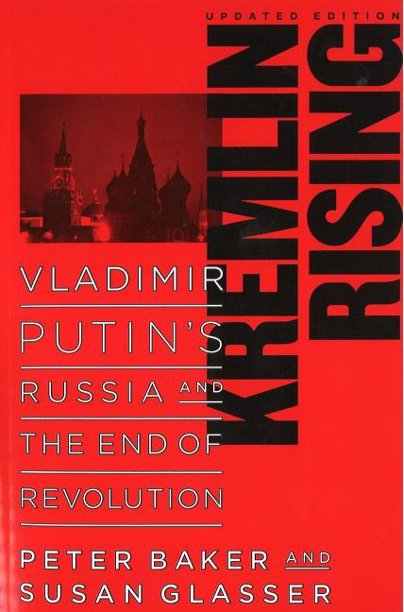
We had arrived in Russia as correspondents for the Washington Post on the eve of Putin’s election as president in 2000 and would stay on through nearly four years of change in a country the world thought it had gotten to know under Yeltsin. We found the place in the throes of a nationalist reawakening, cheered on by a proud, young leader, and yet such a weakened shadow of its former superpower self that it faced an epidemic of young conscripts running away from an army that couldn’t properly feed them. It was a time of economic boom as oil revenues floated Russia out of the bank runs and ruble collapses of Yeltsin’s presidency. And yet it was also a place ruled by ambivalence and anxiety, when fears of the future crowded out memories of the brutalities in the not-so-distant Communist past. This was a newly assertive Russia, rejecting international loans instead of defaulting on them, glorifying its lost empire rather than exulting in the downfall of dictatorship, a Russia where the clichés of the 1990s, of begging babushkas, gangster capitalism, and oligarchic excess, were no longer operative. The grinding, brutal war in the breakaway region of Chechnya—and the spill-over wave of gruesome terror attacks against subway riders and airline passengers, schoolchildren, and theatergoers—became a grim constant linking the two eras.
.…Putin’s Russia, no longer Communist yet not quite capitalist, no longer a tyranny yet not quite free. The heady idealism of the day that Yeltsin had clambered atop a tank in 1991 and brought down the Soviet Union was long since dead and often unmourned. “Democracy” was not now—if it had ever been—a goal supported by much of the population, and the very word had been discredited, an epithet that had come to be associated with upheaval rather than opportunity. Polls consistently found that no more than a third of the population considered themselves democrats a decade into the experiment, while an equally large number believed authoritarianism was the only path for their country.2 Yeltsin had, in other words, succeeded in killing off Communism but not in creating its successor.
Instead, the Russia we found on the eve of the Putin era remained a country in between, where strong-state rhetoric played well even as the state collapsed, where corruption and the government were so intertwined as to be at times indistinguishable, and where the president from the KGB set as his main priority the establishment of what he euphemistically called the “dictatorship of the law.” Like everyone else, we were left to wonder where these slogans would in reality lead, certain only that the Putin presidency would be very different from what had preceded it… [Baker & Glasser, ibid.]


 |
| CNN story |


In the middle of Europe in the middle of the twentieth century, the Nazi and Soviet regimes murdered some fourteen million people. The place where all of the victims died, the bloodlands, extends from central Poland to western Russia, through Ukraine, Belarus, and the Baltic States. During the consolidation of National Socialism and Stalinism (1933–1938), the joint German-Soviet occupation of Poland (1939–1941), and then the German-Soviet war (1941–1945), mass violence of a sort never before seen in history was visited upon this region. The victims were chiefly Jews, Belarusians, Ukrainians, Poles, Russians, and Balts, the peoples native to these lands. The fourteen million were murdered over the course of only twelve years, between 1933 and 1945, while both Hitler and Stalin were in power. Though their homelands became battlefields midway through this period, these people were all victims of murderous policy rather than casualties of war. The Second World War was the most lethal conflict in history, and about half of the soldiers who perished on all of its battlefields all the world over died here, in this same region, in the bloodlands. Yet not a single one of the fourteen million murdered was a soldier on active duty. Most were women, children, and the aged; none were bearing weapons; many had been stripped of their possessions, including their clothes.__________
Snyder, Timothy (2012-10-01T23:58:59.000). Bloodlands . Basic Books. Kindle Edition.


I have seen firsthand just how vulnerable America is to the political afflictions that have befallen Russia. In the second half of this book I offer an account of my own experiences of populist politics in action inside the Trump administration. I share what I learned from this and my observations of how Donald Trump began to follow “the authoritarians’ playbook” scripted by Vladimir Putin and other “strongman” leaders. By November 2019, when I was subpoenaed as a fact witness in the first impeachment trial of President Trump and found myself in the international spotlight, I knew that America had embarked on an authoritarian swing of its own. When the global coronavirus pandemic hit, the U.S. teetered on the verge of a system failure. We needed to address our opportunity crisis and pull ourselves back from the brink.
Hill, Fiona (2021-10-04T23:58:59.000). There Is Nothing For You Here. HarperCollins. Kindle Edition.


THERE IS NO LIBERAL WORLD ORDERRED SQUARE IN LONDONGRAD. THE RUSSIAN OLIGARCHS' UK HAVEN
Unless democracies defend themselves, the forces of autocracy will destroy them.
By Anne Applebaum
There is no natural liberal world order, and there are no rules without someone to enforce them. unless democracies defend themselves together, the forces of autocracy will destroy them. i am using the word forces, in the plural, deliberately. many american politicians would understandably prefer to focus on the long-term competition with china. but as long as russia is ruled by putin, then russia is at war with us too. so are belarus, north korea, venezuela, iran, nicaragua, hungary, and potentially many others. we might not want to compete with them, or even care very much about them. but they care about us. they understand that the language of democracy, anti-corruption, and justice is dangerous to their form of autocratic power—and they know that that language originates in the democratic world, our world.
this fight is not theoretical. it requires armies, strategies, weapons, and long-term plans. it requires much closer allied cooperation, not only in europe but in the pacific, africa, and latin america. nato can no longer operate as if it might someday be required to defend itself; it needs to start operating as it did during the cold war, on the assumption that an invasion could happen at any time. germany’s decision to raise defense spending by 100 billion euros is a good start; so is denmark’s declaration that it too will boost defense spending. but deeper military and intelligence coordination might require new institutions—perhaps a voluntary european legion, connected to the european union, or a baltic alliance that includes sweden and finland—and different thinking about where and how we invest in european and pacific defense.
if we don’t have any means to deliver our messages to the autocratic world, then no one will hear them. much as we assembled the department of homeland security out of disparate agencies after 9/11, we now need to pull together the disparate parts of the u.s. government that think about communication, not to do propaganda but to reach more people around the world with better information and to stop autocracies from distorting that knowledge. why haven’t we built a russian-language television station to compete with putin’s propaganda? why can’t we produce more programming in mandarin—or uyghur? our foreign-language broadcasters—radio free europe/radio liberty, radio free asia, radio martí in cuba—need not only money for programming but a major investment in research. we know very little about russian audiences—what they read, what they might be eager to learn…
Putin's Blunder and Europe's Gamble
A conversation with Russia expert Thane Gustafson on Putin's blunder, the Ukraine war, and the role of energy in the future of Europe and Russia.
By Tom Nichols


How should the West respond? There is only one rule: We cannot be afraid. Russia wants us to be afraid—so afraid that we are crippled by fear, that we cannot make decisions, that we withdraw altogether, leaving the way open for a Russian conquest of Ukraine, and eventually of Poland or even further into Europe. Putin remembers very well an era when Soviet troops controlled the eastern half of Germany. But the threat to those countries will not decrease if Russia carries out massacres in Ukraine. It will grow.
Instead of fear, we should focus on a Ukrainian victory. Once we understand that this is the goal, then we can think about how to achieve it, whether through temporary boycotts of Russian gas, oil, and coal; military exercises elsewhere in the world that will distract Russian troops; humanitarian airlifts on the scale of 1948 Berlin; or more and better weapons.
The specific tactics will be determined by those who best understand diplomacy and military strategy. But the strategy has to be clear. A month ago, nobody believed this war would matter so much, and I’m sure many people wish it did not. But it does. That’s why every move we make must have a single goal: How does it help Ukraine win?


