Search the KHIT Blog

Showing posts sorted by relevance for query Ukraine. Sort by date Show all posts

Sunday, April 10, 2022

Will we soon forget about Ukraine? We must NOT.

George Packer certainly echoes my concerns.

In this country, Ukraine has done what nothing else—no election or insurrection, no pandemic, no environmental catastrophe—could do: shown the difference between right and wrong, heroism and barbarism, truth and lies, with such clarity that most Americans are in agreement…

Yet I worry that we’ll soon forget about Ukraine. It’s far away, and Americans have famously short attention spans.


In the days after Zelensky’s speech to Congress, you could sense American life returning to its natural state. Republican senators accused Judge Ketanji Brown Jackson of being soft on pedophilia, then checked their phones for their mentions. Meta Platforms announced that CEO Mark Zuckerberg will spend more time working remotely from his 1,500-acre Hawaiian estate and other homes. Kylie Jenner told her 325 million Instagram followers that her newborn son will no longer go by the name of Wolf. An online horde of journalists attacked The New York Times for publishing an editorial in defense of free speech. For 72 hours, Will Smith slapping Chris Rock at the Oscars was bigger than the war in Ukraine. The endless self-regard, triviality, and cynicism of American culture in the age of digital polarization seeped back, amid images of Ukrainians filling sandbags on the Odesa beaches or risking Russian shelling to bring shelter dogs to safety.

Even when the cause is just, people inevitably lose interest in far-off calamities that happen to people they don’t know. Against the will, a numb indifference sets in, and life goes relentlessly on…

Can the war change anything in this country? Ukrainians, in their struggle to build a democracy out of an autocratic past, have looked to the American example. What will it take for us to be worthy of them?

The questions aren’t idle. Ukraine’s survival requires the sustained support of its most important ally, the United States. Time will not be on Ukraine’s side. If the war drags on for months, it will grow murkier to Americans watching at a distance; its moral clarity will start to blur. Ukrainians’ justifiable rage at all things Russian will produce images that foreigners will find less easy to love than the picture of a string quintet performing in the ruins of a Kharkiv metro station. We’ll see more reports of Ukrainian atrocities that are not the inventions of the Kremlin, Fox News, or Glenn Greenwald. Some Americans will conclude that distinguishing propaganda from truth isn’t worth the effort, that it’s all the same (which is the goal of Russian propaganda). They’ll start to wonder why they have to pay $5 or $6 a gallon for gas with no relief in sight. Going into the midterms, Republicans will be happy to highlight these troubles and hang them around the neck of the party in power.

So the fate of Ukrainian democracy depends in part on American staying power. And in turn, the health of American democracy depends in part on Ukraine. If Vladimir Putin succeeds in demolishing Ukraine, converting its fragments into the vassal states of a new Russian empire, then strongmen and wannabes around the world will be emboldened. Putin will have won his bet that what matters in global affairs is raw power, that oil and gas are more important to Europe than freedom and justice, that the West is too tired and comfortable to sacrifice for its supposed values—that, as he said last summer, “the liberal idea has become obsolete.”

If, on the other hand, Putin’s regime of militarized kleptocracy—fascism without the inspiration—suffers an unmistakable defeat, it will diminish American authoritarians of all types. Ukraine’s win might start to clear out some of the reflexive cynicism that corrodes our politics. The current position of most Republicans—denouncing Russia and criticizing Biden for not doing more to help Ukraine, yet saying nothing when Trump calls Putin a “genius” or openly asks him for political favors while Russia commits war crimes—will become less tenable. Russian aggression will be harder to explain away than American insurrection, and Putin will be harder to defend than Trump. Republican anti-Trump voices will gain numbers and strength. The party will have to decide whether it wants to enter the 2024 elections still infected with the homegrown strain of an utterly discredited Putinism. That can’t be opposed abroad while it’s being stoked at home.

To win, Ukraine needs the stakes of the war to be clear to Americans. If the conflict comes to be seen as an impenetrable European mess, a war over spheres of influence and natural gas, or proof of the West’s hypocrisy, the American public will stop caring…

…Americans cannot afford to forget about Ukraine. When Zelenskyy says that Ukraine is fighting for us and our values too, we had better believe him. Liberal values don’t revive spontaneously or vicariously. They have to be defended, practiced, empowered, and criticized. The weeks since February 24 recall the period after September 11—the sense of crisis and unity at a historic turning point—but there’s this difference: Two decades ago, at the height of the unipolar era, America was blind with hubris. The sense of unity soon took the form of a fearful triumphalism. The Bush administration’s National Security Strategy of 2002 declared: “The great struggles of the twentieth century between liberty and totalitarianism ended with a decisive victory for the forces of freedom—and a single sustainable model for national success: freedom, democracy, and free enterprise.” America, the paragon of this model, would lead the world—with us or against us—in a new struggle for liberty.

Twenty years later, with the failures of Iraq, Afghanistan, and the War on Terror, with the rise of new powers abroad, with rampant economic inequality and entrenched political hatred at home, the 9/11 fever is gone. We suffer from its opposite: exhaustion, disbelief. Ukrainians are right to worry that we’ll soon lose interest and lapse back into our solipsistic dysfunction…

I have to agree. Read all of it at The Atlantic.


RE-POSTING ANNE APPLEBAUM
THERE IS NO LIBERAL WORLD ORDER
Unless democracies defend themselves, the forces of autocracy will destroy them.

By Anne Applebaum

There is no natural liberal world order, and there are no rules without someone to enforce them. unless democracies defend themselves together, the forces of autocracy will destroy them. i am using the word forces, in the plural, deliberately. many american politicians would understandably prefer to focus on the long-term competition with china. but as long as russia is ruled by putin, then russia is at war with us too. so are belarus, north korea, venezuela, iran, nicaragua, hungary, and potentially many others. we might not want to compete with them, or even care very much about them. but they care about us. they understand that the language of democracy, anti-corruption, and justice is dangerous to their form of autocratic power—and they know that that language originates in the democratic world, our world.

this fight is not theoretical. it requires armies, strategies, weapons, and long-term plans. it requires much closer allied cooperation, not only in europe but in the pacific, africa, and latin america. NATO can no longer operate as if it might someday be required to defend itself; it needs to start operating as it did during the cold war, on the assumption that an invasion could happen at any time. Germany’s decision to raise defense spending by 100 billion euros is a good start; so is Denmark’s declaration that it too will boost defense spending. but deeper military and intelligence coordination might require new institutions—perhaps a voluntary European legion, connected to the European union, or a Baltic alliance that includes Sweden and Finland—and different thinking about where and how we invest in European and Pacific defense.

if we don’t have any means to deliver our messages to the autocratic world, then no one will hear them. much as we assembled the department of homeland security out of disparate agencies after 9/11, we now need to pull together the disparate parts of the u.s. government that think about communication, not to do propaganda but to reach more people around the world with better information and to stop autocracies from distorting that knowledge. why haven’t we built a russian-language television station to compete with putin’s propaganda? why can’t we produce more programming in Mandarin—or Uyghur? our foreign-language broadcasters—radio free europe/radio liberty, radio free Asia, radio martí in Cuba—need not only money for programming but a major investment in research. we know very little about Russian audiences—what they read, what they might be eager to learn… 
As soon as the CBS 60 Minutes interview with President Zelenskyy is posted to YouTube, I will put it up. I have it on TV right now. I couldn't give a flying flip about who won the NCAA hoops final or the Master's Golf Tournament in the face of all this misery.
 
Been stewing over the "Crisis of Democracy" for quite a while now. 

 
Corruption, kleptocracy are significant factors.


UPDATE


More shortly...
__________
 

Thursday, February 23, 2023

One year on:

Russia's 3-day conquest of Ukraine.
 

It was gonna be a cakewalk, with Zelenskyy quickly arrested, exiled, or dead, Putin's tank columns rolling boldly through KyIv in no time, euphoric Ukrainians lining the streets to throw flowers at their liberators.
 
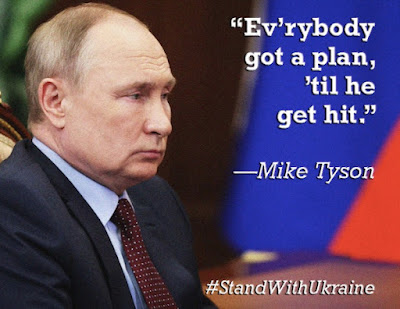
As noted foreign policy analyst Mike Tyson observes:
"Ev'rybody got a plan, 'til he get hit."
NY TIMES UPDATE
A walk in the park.

That was the assurance skeptical members of the Russian military said they were given by superiors as it appeared increasingly clear that President Vladimir V. Putin truly did mean to wage an unprovoked war on neighboring Ukraine.

And it seemed to make sense.

Ukraine was a vastly outgunned nation led by the unlikeliest of presidents, a former comedian elected just a few years before. Russia was a major military power, if not the global force it was in the days of the Soviet Union.

And so when the first planes raced across the border followed by ground troops, it was widely assumed that it would be mere days before the Russian tricolor was hoisted over Kyiv, the capital.

That was a year ago. Now, no one is talking about a walk in the park. They speak of slogs and slaughter. Of a Kremlin “special military operation” that metastasized into the biggest ground war in Europe since World War II. Of Russian casualties of around 200,000 killed or wounded, by some Western estimates."...

Been a very sad year.
How and When the War in Ukraine Will End
Forecasting a conclusion to an unpredictable conflict

By Uri Friedman

Sometimes the best way to understand what’s possible is to ask impossible questions.

One year ago, Russia launched a war that many never expected it to wage and assumed it would quickly win against a cowed Ukraine and its allies. How and when will the conflict end? For a war that has defied expectations, those questions might seem impossible to answer. Yet I recently posed them to several top historians, political scientists, geopolitical forecasters, and former officials—because only in imagining potential futures can we understand the rough bounds of the possible, and our own agency in influencing the outcome we want.

The main takeaways from the responses I received? Prepare for the possibility of a long, shape-shifting conflict, perhaps lasting years, even a decade or more. Watch how the rest of the world regards the Kremlin’s imperial ambitions. Expect any negotiated settlement to be fragile and reliant on third-party intervention. And don’t anticipate a dramatic finish, such as a Russian nuclear detonation in Ukraine or the overthrow of Vladimir Putin in Russia. Notably, in a reversal of perceptions a year ago, some experts could envision a decisive Ukrainian victory against Russia, but none forecast a decisive Russian win against Ukraine…
 
"The war in Ukraine is the final shovel of dirt on the grave of any optimism about the world order that was born with the fall of Soviet Communism. Now we are faced with the long grind of defeating Moscow’s armies and eventually rebuilding a better world."Tom Nichols
__________
 

Saturday, March 19, 2022

Ukraine invasion update

 
Succinct.
 

So much of what we imagine to be new is old; so many of the seemingly novel illnesses that afflict modern society are really just resurgent cancers, diagnosed and described long ago. Autocrats have risen before; they have used mass violence before; they have broken the laws of war before. In 1950, in the preface she wrote to the first edition of The Origins of Totalitarianism, Hannah Arendt, knowing that what had just passed could repeat itself, described the scant half decade that had elapsed since the end of the Second World War as an era of great unease: “Never has our future been more unpredictable, never have we depended so much on political forces that cannot be trusted to follow the rules of common sense and self-interest—forces that look like sheer insanity, if judged by the standards of other centuries.”

The toxic nationalism and open racism of Nazi Germany, only recently defeated; the Soviet Union’s ongoing, cynical attacks on liberal values and what it called “bourgeois democracy”; the division of the world into warring camps; the large influx of refugees; the rise of new forms of broadcast media capable of pumping out disinformation and propaganda on a mass scale; the emergence of an uninterested, apathetic majority, easily placated with simple bromides and outright lies; and above all the phenomenon of totalitarianism, which she described as an “entirely new form of government”—all of these things led Arendt to believe that a darker era was about to begin.

She was wrong, or partly so. Although much of the world would remain, for the rest of the 20th century, in thrall to violent and aggressive dictatorships, in 1950 North America and Western Europe were in fact just at the beginning of an era of growth and prosperity that would carry them to new heights of wealth and power. The French would remember this era as Les Trente Glorieuses; the Italians would speak of the boom economico, the Germans of the Wirtschaftswunder. In this same era, liberal democracy, a political system that had failed spectacularly in 1930s Europe, finally flourished. So did international integration. The Council of Europe, the North Atlantic Treaty Organization, the eventual European Union—all of these institutions not only supported the liberal democracies but knit them together more tightly than ever before. The result was certainly not a utopia—by the 1970s, growth had slowed; unemployment and inflation soared—but it nevertheless seemed, at least to those who lived inside the secure Western bubble, that the forces of what Arendt had called “sheer insanity” had been kept at bay.

Now we live in a different era, one in which growth at those 1950s levels is impossible to imagine. Inequality has grown exponentially, creating huge divides between a tiny billionaire class and everyone else. International integration is failing; declining birth rates, combined with a wave of immigration from the Middle East and North Africa, have created an angry rise of nostalgia and xenophobia. Worse, some of the elements that made the postwar Western world so prosperous—some of the elements that Arendt’s pessimistic analysis missed—are fading away. The American security guarantee that underlies the stability of Europe and North America is more uncertain than it has ever been. America’s own democracy, which served as a role model for so many others, is challenged as it has not been in decades, including by those who no longer accept the results of American elections. At the same time, the world’s autocracies have now accumulated enough wealth and influence to challenge the liberal democracies, ideologically as well as economically. The leaders of China, Russia, Iran, Belarus, and Cuba often work together, supporting one another, drawing on kleptocratic resources—money, property, business influence—at a level Hitler or Stalin could never have imagined. Russia has defied the entire postwar European order by invading Ukraine…
Read the entire article.

apropos of "kleptocratic resources,"


Acutely toxic to Democracy. Existentially exigent.

See also
 
UKRAINE INVASION UPDATE:
ANNIE LOWRY ON INFLATION
...One of the world’s biggest energy exporters is engaged in an unprovoked assault on one of Europe’s largest agricultural exporters. This means higher prices for commodities, which means higher prices for manufacturers, which means higher prices for retailers, which means higher prices for families in a brief matter of time. Much higher, perhaps: One barometer of the price of raw materials jumped 16 percent in the first week of March, the sharpest increase in half a century…

At the same time, the invasion has cut Europe off from its bread basket: Ukrainian wheat, corn, and sunflower oil are no longer leaving its Black Sea ports. As a result, wheat futures listed on the Chicago Board of Trade jumped the maximum allowed each of the first five days of March; they are now up about 40 percent from before the invasion. Even if Russia were to withdraw from Ukraine shortly, those price increases would probably persist. The war is disrupting the harvest cycle and damaging Ukraine’s shipping infrastructure, and the West is likely to maintain sanctions on Russia for years…
"For years?" Let's just hope we have "years."

UPDATE: STEVE COLL
It has become common to describe Russia’s invasion as a watershed in history comparable to 9/11 or to the fall of the Berlin Wall. “The war in Ukraine marks a turning point for our continent and our generation,” President Emmanuel Macron, of France, said earlier this month. Perhaps, but some of this speculation about Europe’s destiny and the future of Great Power competition may be premature. Certainly, the war has already produced a humanitarian disaster of shocking and destabilizing dimensions. Three million Ukrainians have fled their country. The 1.8 million of them who have gone to Poland constitute a population roughly the size of Warsaw’s. If the fighting drags on and Ukraine implodes, the country will export many more destitute people, and, as happened in the former Yugoslavia during the nineteen-nineties, it may also draw in opportunists, including mercenaries and extremists.

Meanwhile, Russia’s economy, according to the International Monetary Fund, could shrink by thirty-five per cent this year under the weight of Western sanctions. Putin’s oligarchs and enablers can endure the loss of super-yachts and private jets, but a sudden economic contraction on that scale would crush ordinary Russians and inevitably cost lives. (“Our economy will need deep structural changes,” Putin acknowledged last week, adding, “They won’t be easy.”) Russia’s isolation from large swaths of global banking and trade, and its loss of access to advanced U.S. technologies, could last a long time, too: democracies often find it easier to impose sanctions than to remove them, even when the original cause of a conflict subsides. (Ask Cuba.) “When the history of this era is written, Putin’s war on Ukraine will have left Russia weaker and the rest of the world stronger,” Biden said in his recent State of the Union address.

Still, some introspection may be in order. In his address, the President also declared that, “in the battle between democracy and autocracies, democracies are rising to the moment.” But Europe is troubled by illiberal populism, including in Poland. And Donald Trump—who, just two days before Russia rolled into Ukraine, called Putin’s preparatory moves “genius”—retains a firm hold on the Republican Party, and appears to be all in for a reëlection campaign in 2024. As long as Trump’s return to the White House is a possibility, Biden’s declarations will require some asterisks...
UPDATE FROM CNN
Ukrainian President Volodymyr Zelensky said Sunday he is ready to negotiate with Russian President Vladimir Putin, but warned that if any negotiation attempts fail, it could mean the fight between the two countries would lead to "a third World War."

“I’m ready for negotiations with him. I was ready for the last two years. And I think that without negotiations, we cannot end this war,” Zelensky told CNN’s Fareed Zakaria in an exclusive interview Sunday morning.

“If there’s just 1% chance for us to stop this war, I think that we need to take this chance. We need to do that. I can tell you about the result of this negotiations — in any case, we are losing people on a daily basis, innocent people on the ground," he said.

He continued, “Russian forces have come to exterminate us, to kill us. And we can demonstrate that the dignity of our people and our army that we are able to deal a powerful blow, we are able to strike back. But, unfortunately, our dignity is not going to preserve the lives. So, I think we have to use any format, any chance in order to have a possibility of negotiating, possibility of talking to Putin. But if these attempts fail, that would mean that this is a third World War.”
I think the probability of Putin agreeing to meet with President Zelenskyy is about zero. Vladimir is interested in one thing: Ukrainian capitulation. If it requires burning the entire nation down and killing everyone, so be it.

 
CODA
 
You might want to read up on Aleksandr Dugin. Putin's Jim Jones. Seriously bad news, this guy. The Putin Whisperer. And, then there's this swell guy.
__________
 

Thursday, March 10, 2022

Thinking back to Chernobyl

April 1986, Ukraine, near Belarus


As the horrific Russian invasion of Ukraine slogs on, I think back 36 years. A quick post of mine from 11 years ago:
In the spring of 1986 I was managing a Radiological Environmental Monitoring Program database and reporting system (REMP) I’d developed for the environmental radiation lab in Oak Ridge where I worked. One of our clients was Perry Nuclear of Ohio (they intended to build a nuke plant there). The REMP stuff comprised an ongoing environmental baseline study via which to establish natural radionuclide levels across the breadth of matrices within a 5 mile radius of the proposed plant site — soils, vegetation, water, milk from local cows, all manner of biota, and the air.

The air filter analyses always came back “below LLD” (Lower Limit of Determination, i.e., in this case “LT 0.04 pCi/cu.m." (less than 4-100ths of a trillionth of a Curie). I had a macro code snippet that simply populated that field with that update ongoing.
One week after Chernobyl we had elevated positive lab readings across all air filter locations. I-131. Given its 8.05 day half-life, it descended back down to below LLD after about 5 weeks.
Nonetheless, it was a bit creepy.

Other, heavier radionuclides like Cs-137 were blown all over the arctic regions. Scientists are probably STILL studying biota uptake and rad migration on a lot of this stuff.
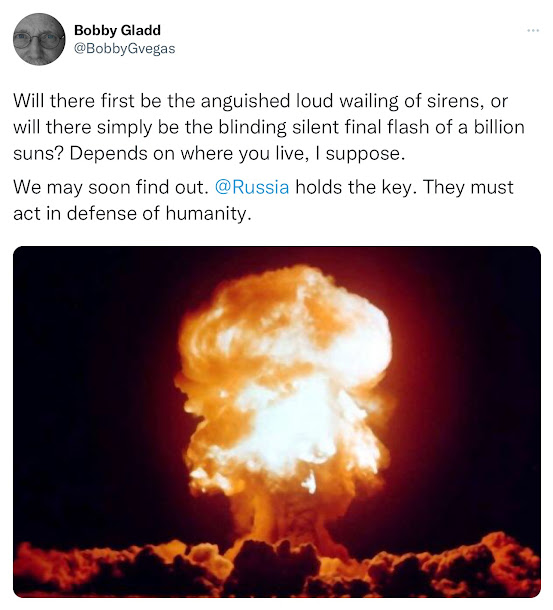
Putin may well soon cause another nuclear disaster during his chaotic invasion of Ukraine, either by escalating to using nuke weapons, or by hitting a Ukraine nuclear power plant (he's already damaged one).

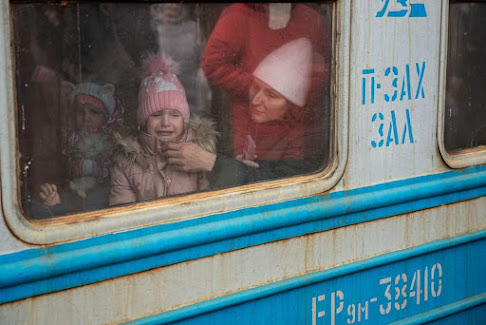
Ukrainians fleeing Kharkiv. Covid-19 petri dish?
UPDATE:
__________
 

Sunday, June 25, 2023

Whither Russia?

Good luck finding accurate information on this past weekend's developments.
  
 
If don't don't have Google Maps, install / launch it, zoom out to the entire globe, spin it around to view the breadth of the Eurasian continent (above).
 
RUSSIA
 

Russia spans 11 time zones, comprising 6.6 million square miles of terrain within its borders, nearly twice that of the United States (@ 3.5 million sq mi). Also, Russia, at 143 million population, is roughly 44% our our 331 million people. It has the most sparse national average population density per sq mi. Nearly 13,000 miles of land border, 24,000 miles of coastline.
 
The Russian GDP is smaller than that of Italy.

And, it is an autocratic / oligarchic / "mafia" state that is Number One in the arsenals of nuclear weapons. It has now spent the weekend parrying an internal armed rebellion in the wake of prolonged difficulties pertaining to its invasion of Ukraine.

Were the Putin government fall to a mutinous civil war / coup, it's anybody's guess at this point who might rise to secure the political and national defense reins.Who would control those nukes? How would they defend their huge landmass national territory and its abundant natural resources?

This stuff is not funny.
 

Wagner Group Mercenaries commander Prigozhin may not be smiling for smartphone selfies for long in the wake of his quickly stillborn turnaround attack on Putin and his Kremlin regime. Late word is that he's exiling to Belarus. Interesting week upcoming.

 
...Democratic politicians spend a lot of time thinking about how to engage people and persuade them to vote. But a certain kind of autocrat, of whom Putin is the outstanding example, seeks to convince people of the opposite: not to participate, not to care, and not to follow politics at all. The propaganda used in Putin’s Russia has been designed in part for this purpose. The constant provision of absurd, conflicting explanations and ridiculous lies—the famous “firehose of falsehoods”— encourages many people to believe that there is no truth at all. The result is widespread cynicism. If you don’t know what’s true, after all, then there isn’t anything you can do about it. Protest is pointless. Engagement is useless.

But the side effect of apathy was on display yesterday as well. For if no one cares about anything, that means they don’t care about their supreme leader, his ideology, or his war. Russians haven’t flocked to sign up to fight in Ukraine. They haven’t rallied around the troops in Ukraine or held emotive ceremonies marking either their successes or their deaths. Of course they haven’t organized to oppose the war, but they haven’t organized to support it either.

Because they are afraid, or because they don’t know of any alternative, or because they think it’s what they are supposed to say, they tell pollsters that they support Putin. And yet, nobody tried to stop the Wagner Group in Rostov-on-Don, and hardly anybody blocked the Wagner convoy on its way to Moscow. The security services melted away, made no move and no comment...
SPECULATIVE UPDATE
You come at the king, you best not miss,” said Omar, the legendary outlaw in the equally legendary series The Wire. Maybe Yevgeny Prigozhin didn’t watch The Wire. Maybe he should have.

Like the gangsters Omar made a habit of robbing, Vladimir Putin runs an empire built on fear. The certainty of violent retaliation plays, in systems like Russia, the functional role that law plays in the West. It’s the glue that holds the whole thing together, the basic principle at its core. In autocracy you do what you do because you fear the man above you, who does what he does because he fears the man above him, and on and on in an unbroken chain to Vladimir Putin’s office.

This form of personalism is the one element of continuity in Russia’s history, dating back to the days of the tsars. In a country that never quite got the knack for the rule of law, the top spot in the chain of terror passed seamlessly from tsar to general secretary to president without ever being quite reformed. Laws exist, to be sure, in a system like this, but their role is ornamental at best, instrumental at worst. As one Latin American caudillo put it to describe very much the same system of government: “to my friends: everything! to my enemies: the law!”

This is how things in Russia work—or, well, “work.” Things remain together, just, but only so long as everyone fears Putin most. And that’s why last weekend’s bizarre mini-crisis in Russia has destabilized the Putin system as consequentially as it has.

For one fleeting moment, just one mad-cap afternoon, Vladimir Putin was not the man Russians feared most. On Friday, following months of tensions among the Russian military leadership, Prigozhin, the leader of the Wagner mercenary group fighting in Ukraine, announced an audacious march on Moscow. The next day his forces filed through the southern city of Rostov-on-Don and allegedly made it within 120 miles of the capital.

The aura of menace built so carefully over so long crumbled in plain view of the entire world as rumors swirled of a panicked Putin hopping on a plane leaving Moscow. In a system built on fear, that right there is the very definition of a constitutional crisis. 

But Prigozhin went for the king, and he missed. Worse, he never took a shot at all. In a matter of hours, the Wagner Group had withdrawn amid reports of a deal being brokered allowing Prigozhin to flee to Belarus.

Where does that leave Russia? Well, in the primate dominance dance that passes for elite politics in Russia, it leaves the entire power structure destabilized. In a state that relies on the leader’s menace for its stability, rebuilding stability means rebuilding that sense of menace…

 _________ 

Friday, February 28, 2025

One of these leaders has spent more than 3 years surviving unrelenting military assaults by Putin's Russia.

The other is loudmouth bully & draft dodger Donald Trump.
 
Of the many bizarre and uncomfortable moments during today’s Oval Office meeting between Donald Trump, J. D. Vance, and Volodymyr Zelensky—during which Trump finally shattered the American alliance with Ukraine—one was particularly revealing: What, a reporter asked, would happen if the cease-fire Trump is trying to negotiate were to be violated by Russia? “What if anything? What if a bomb drops on your head right now?” Trump spat back, as if Russia violating a neighbor’s sovereignty were the wildest and most unlikely possibility, rather than a frequently recurring event… - Jonathan Chait
I could scarcely be more appalled today.
It Was an Ambush
Today marked one of the grimmest days in the history of American diplomacy.
By Tom Nichols

Leave aside, if only for a moment, the utter boorishness with which President Donald Trump and Vice President J. D. Vance treated Ukrainian President Volodymyr Zelensky at the White House today. Also leave aside the spectacle of American leaders publicly pummeling a friend as if he were an enemy. All of the ghastliness inflicted on Zelensky today should not obscure the geopolitical reality of what just happened: The president of the United States ambushed a loyal ally, presumably so that he can soon make a deal with the dictator of Russia to sell out a European nation fighting for its very existence.

Trump’s advisers have already declared the meeting a win for “putting America first,” and his apologists will likely spin and rationalize this shameful moment as just a heated conversation—the kind of thing that in Washington-speak used to be called a “frank and candid exchange.” But this meeting reeked of a planned attack, with Trump unloading Russian talking points on Zelensky (such as blaming Ukraine for risking global war), all of it designed to humiliate the Ukrainian leader on national television and give Trump the pretext to do what he has indicated repeatedly he wants to do: side with Russian President Vladimir Putin and bring the war to an end on Russia’s terms. Trump is now reportedly considering the immediate end of all military aid to Ukraine because of Zelensky’s supposed intransigence during the meeting…

Tuesday, March 15, 2022

Ukraine: the 44 million trolleys problem

Kyiv, Ukraine, before Putin's invasion.
 
Yeah, it's perhaps a bit of a clickbait headline. The analogy is somewhat strained. Humor me.
 
Recall that annoying "moral reasoning thought experiment" from undergrad PHIL101?
 
A trolley is running loose down the tracks without its driver, headed toward a cluster of unaware citizens who might be killed. You have access to track switching controls that could divert it to a siding, where it would subsequently certainly kill one innocent person prior to coming to rest. What should you do?
 
OK, rearrange the particulars. Do we "sacrifice" 44 million Ukrainians (on the siding) in materially passive deference to our larger concern that Vladimir Putin might unleash nuclear obliteration on the wider world, as he has repeatedly threatened?
 
20 days of Russian savagery have ensued as of today. Ukraine is being reduced to rubble, its non-combatant citizens terrorized. Several million Ukrainians have now fled their country. The misery is mind-boggling.
 
What would you do?
 
 
UPDATE
 
__________
 

Tuesday, June 17, 2025

Ambassador Mike Huckabee to Donald Trump:

"It is my honor to serve you!"
Mr President, God spared you in Butler, PA to be the most consequential President in a century-maybe ever.

The decisions on your shoulders I would not want to be made by anyone else. You have many voices speaking to you Sir, but there is only ONE voice that matters. HIS voice. I am your appointed servant in this land and am available for you but I do not try to get in your presence often because I trust your instincts. No President in my lifetime has been in a position like yours. Not since Truman in 1945. I don't reach out to persuade you. Only to encourage you. I believe you will hear from heaven and that voice is far more important than mine or ANYONE else's. You sent me to Israel to be your eyes, ears and voice and to make sure our flag flies above our embassy. My job is to be the last one to leave.

I will not abandon this post. Our flag will NOT come down! You did not seek this moment. This moment sought YOU! It is my honor to serve you!

Mike Huckabee
The foregoing is the full text of a Truth Social post of Mike's (which Trump re-posted). Note he did not say "an honor to serve the American people."
 
THINGS ARE MOVING QUICKLY
 
Congress didn't get The Article I
Declaration of War Memo, one presumes.
 
UPDATE
Trump’s Gilded Gut Instinct

Wall Street analysts recently began joking that the best way to predict the behavior of President Trump — and make money in the process — was by practicing the “TACO trade,” which stands for “Trump always chickens out.” You can always bet on Trump rolling back a reckless tariff.

This mocking of Trump’s inconsistency, which drives him nuts — “Don’t ever say what you said,” he told a reporter who asked him about it — not only is accurate but also deserves to be more widely applied.

One day he is pushing Ukraine away; the next day he is shaking Ukraine down for its minerals; the next day Ukraine is back in the fold. One day Vladimir Putin is Trump’s friend; the next day he’s “crazy.” One day Canada will be the 51st state; the next day it is the target of tariffs. One day he brags that he hires only “the best” people; the next day more than 100 experts at the National Security Council are pushed out just weeks after many were hired. One day the president hosts a gala at his Virginia golf club for the biggest buyers of his memecoin, who spent a combined $148 million for the chance to hear him give a talk standing behind the presidential seal, and the White House spokeswoman suggests it’s not corruption because the president was “attending it in his personal time.”

Trump is governing by unchecked gut impulses, with little or no homework or coordination among agencies. He respects no real lines of authority, has his golfing buddy (Steve Witkoff) act as secretary of state and his secretary of state (Marco Rubio) act as his ambassador to Panama. He compels anyone who wants to stop him to take him to court, while blurring all lines between his legal duties and personal enrichment.

What is this telling us? We are not being governed anymore by a traditional American administration. We are being governed by the Trump Organization Inc…

[ Thomas Friedman ]
ARTICLE EXCERPT FROM FOREIGN AFFAIRS
...To avoid a total surrender, Khamenei could also keep the fight going. That might include going for a nuclear breakout. Assuming Iran still possesses its stockpile of highly enriched uranium and retains the know-how, the regime could still try to test a nuclear device, hoping that becoming a nuclear state will restore a measure of its lost deterrence. Tehran could also continue to wage war, aiming to either exhaust Israel’s will to fight or increase support for the regime among the Iranian people. The regime may even hope that Israel expands its strikes, or aim to draw in the United States, believing that if more Iranian civilians are killed, Iranian society will become more sympathetic toward the country’s only defenders: the regime. That “rally around the flag” effect is, at this point, the regime’s last remaining hope to get Iranians on its side.

But increased aggression is a very dicey bet and could leave the regime isolated and broke. The longer the war continues, the greater the destruction the country will face, which would reduce the regime’s capacity to simply operate. If there is no rally around the flag effect, or if it eventually passes, the Islamic Republic’s citizens could ultimately turn on the regime. And if the government secures a nuclear weapon in order to safeguard its hold on power, Iran could end up looking quite a lot like North Korea—a scenario no Iranian would want.

Whatever happens, the Iranian regime has doubtless lost its decades-long conflict with Israel. It will either have to give up its foundational political ideology and seek integration with the rest of the region through diplomatic and economic engagement, or it will need to double down on its beliefs, drawing further into itself. Ali Khamenei and the IRGC have lost; the regional status quo they established is finished.

 More to come...

Tuesday, March 22, 2022

oderint dum metuant

 "Let them hate, so long as they fear."
 
Words fail to capture the savagery of Vladimir Putin.
 
How should the West respond? There is only one rule: We cannot be afraid. Russia wants us to be afraid—so afraid that we are crippled by fear, that we cannot make decisions, that we withdraw altogether, leaving the way open for a Russian conquest of Ukraine, and eventually of Poland or even further into Europe. Putin remembers very well an era when Soviet troops controlled the eastern half of Germany. But the threat to those countries will not decrease if Russia carries out massacres in Ukraine. It will grow.

Instead of fear, we should focus on a Ukrainian victory. Once we understand that this is the goal, then we can think about how to achieve it, whether through temporary boycotts of Russian gas, oil, and coal; military exercises elsewhere in the world that will distract Russian troops; humanitarian airlifts on the scale of 1948 Berlin; or more and better weapons.

The specific tactics will be determined by those who best understand diplomacy and military strategy. But the strategy has to be clear. A month ago, nobody believed this war would matter so much, and I’m sure many people wish it did not. But it does. That’s why every move we make must have a single goal: How does it help Ukraine win?
NOW ON NETFLIX, ZELENSKYY’S “SERVANT OF THE PEOPLE”


Painfully brilliant. Everyone should see it.
__________
 

Sunday, March 6, 2022

I can't be the only one wondering about this...

Russians, are you listening?

apropos,
The hostilities in Ukraine—more than any other in recent memory—are threatening to become a direct conflict between nuclear states. The reason that this is such a test is that Americans have grown used to thinking of our power through the lens of endless proxies, wars that never really impinge on us directly.

Another way to put all of this is that we are trapped in a cycle of multiple unrealities, all of which make us sluggish now that our own security is much more at risk. On the one hand, we have grown accustomed to using abstract ideals of rights and international order to distance ourselves from the fragility of life. On the other—and in part as a response to the excesses of the first—realists (despite their name) tend to sidestep just how much the dynamics of life and politics do, in fact, depend on values: what we care about, why we care about it, and how much we are willing to sacrifice in response… —Samuel Kimbriel
Eliot A. Cohen:
Russia is in many ways a functioning fascist state, in the grip of a nationalist ideology and an all-powerful leader. For that reason, then, and barring a new Russian revolution, the Western objective must be to leave Russia profoundly weakened and militarily crippled, incapable of renewing such an onslaught, isolated and internally divided until the point that an aging autocrat falls from power. Targeting Putin alone is not enough.

… the West has the opportunity, and faces the necessity, of changing the story of democratic decline and weakness to one of strength and self-confidence. Europe’s remarkable response to the invasion is a long step in this direction, as is the American leadership that has rallied so many to oppose Russia and stand with Ukraine. China is watching the invasion of Ukraine; so, too, are Iran and lesser authoritarian regimes, waiting to see whether such opportunities are available to them, or too perilous to attempt. The Western powers must induce them to take the latter view by the visible successes that they achieve. There are internal audiences as well, particularly in the United States. After a decade of deeply self-critical contemplation of America’s internal divisions, this is the moment to restore confidence in the ideals and beliefs that have made the United States at once powerful and free...


We must fix this mess.
__________