AbstractInteresting paper (open source Creative Commons). Read all of it. We will continue to shoot at a moving vaxx target.
The spike protein receptor-binding domain (RBD) of SARS-CoV-2 is th.e molecular target for many vaccines and antibody-based prophylactics aimed at bringing COVID-19 under control. Such a narrow molecular focus raises the specter of viral immune evasion as a potential failure mode for these biomedical interventions. With the emergence of new strains of SARS-CoV-2 with altered transmissibility and immune evasion potential, a critical question is this: how easily can the virus escape neutralizing antibodies (nAbs) targeting the spike RBD? To answer this question, we combined an analysis of the RBD structure-function with an evolutionary modeling framework. Our structure-function analysis revealed that epitopes for RBD-targeting nAbs overlap one another substantially and can be evaded by escape mutants with ACE2 affinities comparable to the wild type, that are observed in sequence surveillance data and infect cells in vitro. This suggests that the fitness cost of nAb-evading mutations is low. We then used evolutionary modeling to predict the frequency of immune escape before and after the widespread presence of nAbs due to vaccines, passive immunization or natural immunity. Our modeling suggests that SARS-CoV-2 mutants with one or two mildly deleterious mutations are expected to exist in high numbers due to neutral genetic variation, and consequently resistance to vaccines or other prophylactics that rely on one or two antibodies for protection can develop quickly -and repeatedly- under positive selection. Predicted resistance timelines are comparable to those of the decay kinetics of nAbs raised against vaccinal or natural antigens, raising a second potential mechanism for loss of immunity in the population. Strategies for viral elimination should therefore be diversified across molecular targets and therapeutic modalities.
Discussion
...The evolvability of SARS-CoV-2 in response to selection pressure will determine the ultimate tractability of our efforts at disease control. Our work suggests that the capacity of SARS-CoV-2 to evade the immune system may be greater than originally anticipated and raises the specter of a process of ongoing and continuous evolution in response to antibody-based prophylaxis, occurring on a timescale that may not be convenient or tractable for the design of novel biomedical interventions. Thus, our findings speak to the need for both public health and biomedical intervention strategies targeting SARS-CoV-2 to be designed to account for the risk of rapid evolutionary response to biomedical interventions.
NOW REPORTING FROM BALTIMORE. A private, non-commercial blog begun in support of the federal Meaningful Use REC initiative, and Health IT and Heathcare improvement more broadly. Moving now toward important broader STEM and societal/ethics topics. Formerly known as "The REC Blog." NOTE: Comments are moderated, thanks to trolls and bots.
Search the KHIT Blog
Sunday, July 11, 2021
Chasing the SARS-Cov-2 variants
Thursday, July 8, 2021
#CriticalRaceWeary
According to their poignant Lead Counsel John Coale, "Big Tech" are now explicitly "government actors," and there's nothing SCOTUS hates more than "prior restraint"—he cites, in unfortunate analogy, The Pentagon Papers case (uh, well, the DOJ plaintiffs lost that one, recall). Tilt.
Also noteworthy in that regard: irrespective of the "restraints" eventually imposed on Mr. Trump, none were "prior." They were all post-hoc reactive to his innumerable ToS violations, many of which went to implicit and explicit incitements to violence. Moreover, he was head of the government at the time of his sanctioning. How come he didn't simply order the social media "government actors" to abide his public "communications?"
Monday, July 5, 2021
Maryland "VaxCash." Hey, whatever works.
Maryland (my state of residence since April 2019) is not the only state doing this. We're now doling out a random $40k per day to documentably vaxxed residents. I have no idea what the cost/benefit estimates are for this effort. But, I seriously doubt our Republican governor would have approved a financially profligate feel-good initiative.
Within weeks of the onset of the virus, a barrage of confusing, misleading, and inaccurate information spread faster than the virus itself. Misinformation was coming from all corners: politicians, newscasts, social media, dark web conspiracy theorists, and even the presidential briefing room. Never has it been so imperative that individuals have the skills to understand scientific inquiry and know how to evaluate what they read and hear. Nor has it ever been more critical that policy makers listen to scientists and make use of scientific data to guide decisions to protect their communities, states, and countries. The first vaccine received emergency approval in mid-December 2020, others have followed, and the rate of vaccinations grows. Yet worries persist about whether enough citizens will choose to be vaccinated, a deeply concerning problem when such decisions affect others’ lives, not just one’s own.See also my "Science Communication" posts.
Sinatra, Gale; Hofer, Barbara. Science Denial (p. x). Oxford University Press. Kindle Edition.
Six months after the attack on the Capitol triggered by that lie, commentators, political scientists, and families around the dinner table still struggle to come to grips with perverse reality. It is natural to want to understand how we got here. The fate of our democracy turns on not just what our electorate believes but why they believe it. Why are a third of us such gullible rubes?Yeah. "Read a book," indeed. I try to do 2-3 a week.
We are as a society—and by “we” I mean virtually all of us on the planet —brought up to believe howling absurdities, ridiculous impossibilities, and insupportable malarkey from our very first moments on Earth. We have massive lie-delivery systems that are the core institutions of our society. And we have created cultural barriers to even questioning those fabrications which are most deserving of skeptical scrutiny. For example, we regularly label as sacred those ideas that are least able to stand up to scrutiny. (Heck, we have folks in our society who can’t even handle the idea that the history we teach our kids might actually be based on what happened, you know, back in the past.)
Our parents lie to us. Our churches, synagogues, and mosques like to us. Our schools lie to us. Hollywood lies to us. Madison Avenue lies to us. The media lies to us. Our leaders lie to us. Our friends lie to us. (They do. Going to the gym couldn’t hurt.)
What is more the lies they offer are not always big lies (e.g. Buying a particular brand of beer will not make you more attractive) while some are just gross oversimplifications (e.g. The Founding Fathers did a lot of good... but they were not the figures carved out of marble we were sold for years). Some have a seed of truth within them but are gross distortions (e.g. Columbus did not discover America). And some of the time we invite the lies because they open the door to enjoyment (e.g. Keto? All the bacon I can eat? I’m in).
But one of the key reasons we buy into so many small lies is that we have been force fed so many big ones. I mean really big ones. I mean ones that make the current Big Lie look like one of those low-calorie snacks that is actually a high-calorie treat shrunk to a smaller size and repackaged.
The original big lies are so big that if you are like most people some of them are ingrained in your identity, they are who you are. They come from religions and heritage. They are cooked into the primal soup of our minds. Many of them have been around for longer than many of the “facts” we have and as such are so covered in the dust of history and tradition that they appear to be as substantial as what is true. Indeed, some have a timeworn patina that makes them seem almost more important than that which is verifiable or even knowable.
Social science research gives a variety of reasons for why we are inclined to believe “alternative facts.” (Studies show a person is “quick to share a political article on social media if it supports their beliefs, but is more likely to fact check a story if it doesn’t.” We tend to vote for what we want to be true or what our friends believe. According to Peter Ditto, a social psychologist at the University of California, “our wishes, hopes, fears and motivations often tip the scales to make us more likely to accept something as true if it supports what we want to believe.” That said, another reason is often cited for our willingness to buy into the bullshit we are being fed. According to a 2019 University of Regina study, “People who believe false headlines tended to be the people (who) didn’t think carefully, regardless of whether those headlines aligned with their ideology.” So, one way or another, we fall for fake news because it’s easier for us, socially or intellectually.
Many of these lies were created out of necessity. Life is finite. (OK, I’m sorry. It is. Take a deep breath if you need to and then continue reading.) If we don’t come up with a good story about what happens after it ends or why we are here we will all go mad. So we make up preposterous stories about magic people in the sky and then immediately say that we cannot question those stories, that “faith” in them is more important than knowledge of what is real. Why? Because they will not stand up to scrutiny.
When challenged, the defenders of these original big lies say the truth is unknowable. Good try. Hard to argue with that. We don’t know there is not an omniscient rule-maker beyond the clouds or a heaven filled with virgins to give pleasure to the faithful so how can you question it? But of course, selling what is unknowable as a truth is one of the most important categories of lies we encounter in life. Indeed, it is the foundation of much of (speculation-based and often hooey-ridden) human philosophy. And it works.
There are other big lies, of course. Some are related to the religious lies—like the divine right of kings or the lie that the clergy somehow are more in touch with truth than, say, scientists who actually devote their lives to studying the truth. Some come from political leaders. For example, the lie that to die in war is glorious is one that has done irreparable damage for eons. It has been disproven for thousands of years and yet remains so essential to getting young men and women to give up their lives to serve the ambitions of the rich and powerful that it endures. You know many of the other lies that have lived for centuries—about the superiority of races or genders or nationalities, about patriotism, about comforting ideas like that everything is for the best or things work out in the end. It’s not. They don’t. Read a book.
Sunday, July 4, 2021
An Independence Day reflection
CARLOS AND RANGER ARE NOT JULY 4TH FANSIn Congress, July 4, 1776
The unanimous Declaration of the thirteen united States of America, When in the Course of human events, it becomes necessary for one people to dissolve the political bands which have connected them with another, and to assume among the powers of the earth, the separate and equal station to which the Laws of Nature and of Nature's God entitle them, a decent respect to the opinions of mankind requires that they should declare the causes which impel them to the separation.
We hold these truths to be self-evident, that all men are created equal, that they are endowed by their Creator with certain unalienable Rights, that among these are Life, Liberty and the pursuit of Happiness.--That to secure these rights, Governments are instituted among Men, deriving their just powers from the consent of the governed, --That whenever any Form of Government becomes destructive of these ends, it is the Right of the People to alter or to abolish it, and to institute new Government, laying its foundation on such principles and organizing its powers in such form, as to them shall seem most likely to effect their Safety and Happiness. Prudence, indeed, will dictate that Governments long established should not be changed for light and transient causes; and accordingly all experience hath shewn, that mankind are more disposed to suffer, while evils are sufferable, than to right themselves by abolishing the forms to which they are accustomed. But when a long train of abuses and usurpations, pursuing invariably the same Object evinces a design to reduce them under absolute Despotism, it is their right, it is their duty, to throw off such Government, and to provide new Guards for their future security.--Such has been the patient sufferance of these Colonies; and such is now the necessity which constrains them to alter their former Systems of Government. The history of the present King of Great Britain is a history of repeated injuries and usurpations, all having in direct object the establishment of an absolute Tyranny over these States. To prove this, let Facts be submitted to a candid world.
He has refused his Assent to Laws, the most wholesome and necessary for the public good.
He has forbidden his Governors to pass Laws of immediate and pressing importance, unless suspended in their operation till his Assent should be obtained; and when so suspended, he has utterly neglected to attend to them.
He has refused to pass other Laws for the accommodation of large districts of people, unless those people would relinquish the right of Representation in the Legislature, a right inestimable to them and formidable to tyrants only.
He has called together legislative bodies at places unusual, uncomfortable, and distant from the depository of their public Records, for the sole purpose of fatiguing them into compliance with his measures.
He has dissolved Representative Houses repeatedly, for opposing with manly firmness his invasions on the rights of the people.
He has refused for a long time, after such dissolutions, to cause others to be elected; whereby the Legislative powers, incapable of Annihilation, have returned to the People at large for their exercise; the State remaining in the mean time exposed to all the dangers of invasion from without, and convulsions within.
He has endeavoured to prevent the population of these States; for that purpose obstructing the Laws for Naturalization of Foreigners; refusing to pass others to encourage their migrations hither, and raising the conditions of new Appropriations of Lands.
He has obstructed the Administration of Justice, by refusing his Assent to Laws for establishing Judiciary powers.
He has made Judges dependent on his Will alone, for the tenure of their offices, and the amount and payment of their salaries.
He has erected a multitude of New Offices, and sent hither swarms of Officers to harrass our people, and eat out their substance.
He has kept among us, in times of peace, Standing Armies without the Consent of our legislatures.
He has affected to render the Military independent of and superior to the Civil power.
He has combined with others to subject us to a jurisdiction foreign to our constitution, and unacknowledged by our laws; giving his Assent to their Acts of pretended Legislation:
For Quartering large bodies of armed troops among us:
For protecting them, by a mock Trial, from punishment for any Murders which they should commit on the Inhabitants of these States:
For cutting off our Trade with all parts of the world:
For imposing Taxes on us without our Consent:
For depriving us in many cases, of the benefits of Trial by Jury:
For transporting us beyond Seas to be tried for pretended offences
For abolishing the free System of English Laws in a neighbouring Province, establishing therein an Arbitrary government, and enlarging its Boundaries so as to render it at once an example and fit instrument for introducing the same absolute rule into these Colonies:
For taking away our Charters, abolishing our most valuable Laws, and altering fundamentally the Forms of our Governments:
For suspending our own Legislatures, and declaring themselves invested with power to legislate for us in all cases whatsoever.
He has abdicated Government here, by declaring us out of his Protection and waging War against us.
He has plundered our seas, ravaged our Coasts, burnt our towns, and destroyed the lives of our people.
He is at this time transporting large Armies of foreign Mercenaries to compleat the works of death, desolation and tyranny, already begun with circumstances of Cruelty & perfidy scarcely paralleled in the most barbarous ages, and totally unworthy the Head of a civilized nation.
He has constrained our fellow Citizens taken Captive on the high Seas to bear Arms against their Country, to become the executioners of their friends and Brethren, or to fall themselves by their Hands.
He has excited domestic insurrections amongst us, and has endeavoured to bring on the inhabitants of our frontiers, the merciless Indian Savages, whose known rule of warfare, is an undistinguished destruction of all ages, sexes and conditions.
In every stage of these Oppressions We have Petitioned for Redress in the most humble terms: Our repeated Petitions have been answered only by repeated injury. A Prince whose character is thus marked by every act which may define a Tyrant, is unfit to be the ruler of a free people.
Nor have We been wanting in attentions to our Brittish brethren. We have warned them from time to time of attempts by their legislature to extend an unwarrantable jurisdiction over us. We have reminded them of the circumstances of our emigration and settlement here. We have appealed to their native justice and magnanimity, and we have conjured them by the ties of our common kindred to disavow these usurpations, which, would inevitably interrupt our connections and correspondence. They too have been deaf to the voice of justice and of consanguinity. We must, therefore, acquiesce in the necessity, which denounces our Separation, and hold them, as we hold the rest of mankind, Enemies in War, in Peace Friends.
We, therefore, the Representatives of the united States of America, in General Congress, Assembled, appealing to the Supreme Judge of the world for the rectitude of our intentions, do, in the Name, and by Authority of the good People of these Colonies, solemnly publish and declare, That these United Colonies are, and of Right ought to be Free and Independent States; that they are Absolved from all Allegiance to the British Crown, and that all political connection between them and the State of Great Britain, is and ought to be totally dissolved; and that as Free and Independent States, they have full Power to levy War, conclude Peace, contract Alliances, establish Commerce, and to do all other Acts and Things which Independent States may of right do. And for the support of this Declaration, with a firm reliance on the protection of divine Providence, we mutually pledge to each other our Lives, our Fortunes and our sacred Honor.
Monday, June 28, 2021
Stewardship of global collective behavior, infotech considerations
Good paper. Quite worthy. 10 page pdf (PNAS Creative Commons download), 17 contributing authors, 166 endnote citations.
Summary
Human collective dynamics are critical to the wellbeing of people and ecosystems in the present and will set the stage for how we face global challenges with impacts that will last centuries (14, 15, 64). There is no reason to suppose natural selection will have endowed us with dynamics that are intrinsically conducive to human wellbeing or sustainability. The same is true of communication technology, which has largely been developed to solve the needs of individuals or single organizations. Such technology, combined with human population growth, has created a global social network that is larger, denser, and able to transmit higher fidelity information at greater speed. With the rise of the digital age, this social network is increasingly coupled to algorithms that create unprecedented feedback effects.
Insight from across academic disciplines demonstrates that past and present changes to our social networks will have functional consequences across scales of organization. Given that the impacts of communication technology will transcend disciplinary lines, the scientific response must do so as well. Unsafe adoption of technology has the potential to both threaten wellbeing in the present and have lasting consequences for sustainability. Mitigating risk to ourselves and posterity requires a consolidated, crisis-focused study of human collective behavior.
Such an approach can benefit from lessons learned in other fields, including climate change and conservation biology, which are likewise required to provide actionable insight without the benefit of a complete understanding of the underlying dynamics. Integrating theoretical, descriptive, and empirical approaches will be necessary to bridge the gap between individual and large-scale behavior. There is reason to be hopeful that well-designed systems can promote healthy collective action at scale, as has been demonstrated in numerous contexts including the development of open-sourced software, curating Wikipedia, and the production of crowd-sourced maps (165, 166). These examples not only provide proof that online collaboration can be productive, but also highlight means of measuring and defining success. Research in political communications has shown that while online movements and coordination are often prone to failure, when they succeed, the results can be dramatic (137). Quantifying benefits of online interaction, and limitations to harnessing these benefits, is a necessary step toward revealing the conditions that promote or undermine the value of communication technology.
A consolidated study of human collective behavior will be limited to providing mechanistic insight into the consequences of changes to our social system and potential solutions. The ethical issues raised by stewardship of social systems, like those associated with ecological systems, will require input from philosophy, public policy, and disciplines across the humanities (147). There is no viable hands-off approach. Inaction on the part of scientists and regulators will hand the reins of our collective behavior over to a small number of individuals at for-profit companies. Despite the scientific and ethical challenges, the risks of inaction both in the present and for future generations necessitate stewardship of collective behavior.
A must-read. Click the cover.
Sunday, June 27, 2021
"There's never just ONE cockroach"
George Floyd murderer Derek Chauvin will likely be out of prison before the Surfside-related condo building collapse litigation is over. A lot of beachfront SE Florida high-rise real estate may end up effectively uninsurable.
Saturday, June 26, 2021
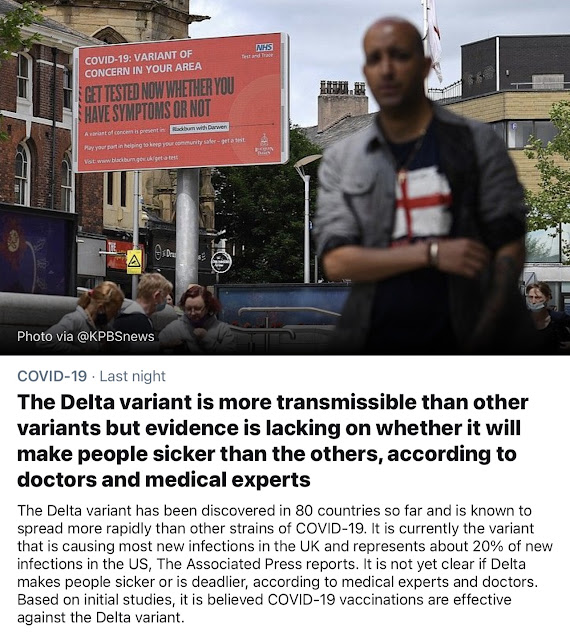
Delta Dawn?
Sunday, June 20, 2021
Jonathan Bush,
Over the past two decades, the government has tried and failed to create a unified medical record system in the United States. The idea sounds easy enough: if a patient ends up in an emergency room on vacation in Florida, the doctor should be able to access their medical history in New York. In the aughts, state and local governments started to build towards this, but efforts largely lost momentum without the funding needed to build and maintain the infrastructure to warehouse such huge troves of data.
Jonathan Bush, the punchy and oft irreverent cofounder of Athenahealth, is betting the ever-growing army of new digital health startups has finally created the market conditions to make such a system work—and he plans to build it. His new venture, the Watertown, Massachusetts-based Zus, launched Thursday with $34 million in funding led by Andreessen Horowitz. Bush thinks he has the key to unlock the door that’s stymied the likes of Google, Microsoft and Intel.
While technically Bush only started self-funding Zus around six months ago, in many ways it’s the same vision he’s been working towards since cofounding Athenahealth in 1999...
“Creating the industry’s first shared development platform backed by a shared data record, Zus aims to bring about a better health data reality by empowering a wave of new, digital-first healthcare builders who will create digital health technologies and services that are cheaper, more customizable and more personalized. This new digital health vanguard is NOT composed of data hoarders who seek to monetize access to proprietary information, but rather those who believe in the network effect of data sharing. The new community of innovators assume as fundamental that the greatest potential comes from using modern technology not just to help with care, but to revolutionize it. This vision drives Zus to proactively connect the largest array of traditional medical providers to novel health data sources so that health data becomes frictionless to use.” —Yahoo FinanceI've thus far combed through the Zus website. To their credit, no mention of "blockchain." Though, my "interoperababble" misgivings linger.
"So, Zus is a B2B intending to serve the #healthIT startup space, and sustained via their #VentureCapital money. Ja?"
Saturday, June 19, 2021
Juneteenth
This stuff is personal for me. Above, my wonderful great-grandson Kai turned 1 yesterday. His Daddy Keenan is my late daughter Danielle's son.
Friday, June 18, 2021
Can we get a 3-strikes law
Sunday, June 13, 2021
Sad WaPo headline
“Painfully good. The book could have been called, ‘Outrageous.’ The story Andy Slavitt tells is not just about Trump’s monumental failures but also about the deeper ones that started long before, with our health system, our politics, and more.” --Atul Gawande, author of Being MortalJune 15th release.
The definitive, behind-the-scenes look at the U.S. Coronavirus crisis from one of the most recognizable and influential voices in healthcare
From former Biden Senior Advisor Andy Slavitt, Preventable is the definitive inside account of the United States' failed response to the Coronavirus pandemic. Slavitt chronicles what he saw and how much could have been prevented -- an unflinching investigation of the cultural, political, and economic drivers that led to unnecessary loss of life.
With unparalleled access to the key players throughout the government on both sides of the aisle, the principal public figures, as well as the people working on the frontline involved in fighting the virus, Slavitt brings you into the room as fateful decisions are made and focuses on the people at the center of the political system, health care system, patients, and caregivers. The story that emerges is one of a country in which -- despite the heroics of many -- bad leadership, political and cultural fractures, and an unwillingness to sustain sacrifice light a fuse that is difficult to extinguish.
Written in the tradition of The Big Short, Preventable continues Andy Slavitt’s important work of addressing the uncomfortable realities that brought America to this place. And, he puts forth the solutions that will prevent us from being here again, ensuring a better, stronger country for everyone. [Amazon blurb]
Andy Slavitt has Cred.
“Depopulation” by COVID-19 vaccines?
COVID-19 and antivaccine conspiracy theorists like Joe Mercola, Michael Yeadon, and Peter McCullough are spreading the conspiracy theory that COVID-19 vaccines are intended as a tool for “global depopulation.” This is nothing more than an old antivaccine conspiracy theory repurposed for the pandemic. As ridiculous as it might seem, it is nonetheless very appealing to antivaxxers...
Thursday, June 10, 2021
Solving public problems
AUTHOR’S NOTE
On January 6, 2021, a systematic, relentless campaign of grievance and falsehood, led by former President Donald Trump and stoked by members of the Republican Party in Congress and right-wing media, culminated in a violent attack on the Capitol. The incompetently planned but nonetheless deadly coup attempt counted among its leaders White supremacists, neo-Nazis, and devotees of the paranoid conspiracy theory QAnon. Yet support among Americans for the insurrection went way beyond the far-right fringe. According to YouGov about 45 percent of Republicans said they backed the attack on the Capitol, while 74 million Americans voted for Trump in 2020, despite his undisguised contempt for democratic institutions and decision-making both during the campaign and over the four years of his presidency. Watching these events, one could be forgiven for thinking that American democracy was reaching its final hours. I have written this book in the firm belief that this is not so…
Noveck, Beth Simone. Solving Public Problems. Yale University Press. Kindle Edition (location 35).
THE GOVLAB’S MISSION IS TO IMPROVE PEOPLE’S LIVES BY CHANGING THE WAY WE GOVERN.
Our goal is to strengthen the ability of institutions – including but not limited to governments – and people to work more openly, collaboratively, effectively and legitimately to make better decisions and solve public problems.
We believe that increased availability and use of data, new ways to leverage the capacity, intelligence, and expertise of people in the problem-solving process, combined with new advances in technology and science can transform governance.
We approach each challenge and opportunity in an interdisciplinary, collaborative way, irrespective of the problem, sector, geography and level of government.
WE LEARN BY DOING
We embrace failure: failing fast and often, learning from our mistakes and sharing experiences.
We collaborate with and connect experts and practitioners, across sectors and disciplines, levels of governance and geographies.
We rely on reproducible experiments and metrics to better understand what works (and what doesn’t) and to translate theory and hypotheses into actionable insights.
We put users at the center, to ensure we stay focused on improving people’s lives.
Solving Public ProblemsSo far, so good. Stay tuned. Coheres with a lot of my recent reads.
Reviewed by Ming Ivory
Governance professor Beth Simone Noveck, who formerly served as the first White House deputy chief technology officer, believes that “public entrepreneurship” can counter the failures that have dominated public policy design in the United States since the 1960s. Her new book, Solving Public Problems, revisits the four stages of policy design—identifying problems, identifying solutions, designing for implementation, and evaluation and evolution—while identifying 20 crucial decisions that prioritize “human-centered public policies.”
Experts often expend much effort on program design, but once these programs are created, there is usually little fine-tuning of the implementation and hardly any emphasis on measuring whether the desired outcomes are achieved. The US federal civil service, for example, first celebrated as a defense of the “public interest” for its structural insulation from shortsighted patronage and political corruption, has recently come to be viewed by some as a nonelected “deep state” that frustrates legitimate partisan power and private-sector freedom. Noveck fearlessly defends the existence of “public interests,” arguing that their complexity and ethical significance are distinct from academic theory, electoral politics, and private-sector capitalism…
Nations, like individuals, tell stories in order to understand what they are, where they come from, and what they want to be. National narratives, like personal ones, are prone to sentimentality, grievance, pride, shame, self-blindness. There is never just one—they compete and constantly change. The most durable narratives are not the ones that stand up best to fact-checking. They’re the ones that address our deepest needs and desires. Americans know by now that democracy depends on a baseline of shared reality—when facts become fungible, we’re lost. But just as no one can live a happy and productive life in nonstop self-criticism, nations require more than facts—they need stories that convey a moral identity. The long gaze in the mirror has to end in self-respect or it will swallow us up.
Tracing the evolution of these narratives can tell you something about a nation’s possibilities for change. Through much of the 20th century, the two political parties had clear identities and told distinct stories. The Republicans spoke for those who wanted to get ahead, and the Democrats spoke for those who wanted a fair shake. Republicans emphasized individual enterprise, and Democrats emphasized social solidarity, eventually including Black people and abandoning the party’s commitment to Jim Crow. But, unlike today, the two parties were arguing over the same recognizable country. This arrangement held until the late ’60s—still within living memory.
The two parties reflected a society that was less free than today, less tolerant, and far less diverse, with fewer choices, but with more economic equality, more shared prosperity, and more political cooperation. Liberal Republicans and conservative Democrats played important roles in their respective parties. Americans then were more uniform than we are in what they ate (tuna noodle casserole) and what they watched (Bullitt). Even their bodies looked more alike. They were more restrained than we are, more repressed—though restraint and repression were coming undone by 1968.
Since then, the two parties have just about traded places. By the turn of the millennium, the Democrats were becoming the home of affluent professionals, while the Republicans were starting to sound like populist insurgents. We have to understand this exchange in order to grasp how we got to where we are.
The 1970s ended postwar, bipartisan, middle-class America, and with it the two relatively stable narratives of getting ahead and the fair shake. In their place, four rival narratives have emerged, four accounts of America’s moral identity. They have roots in history, but they are shaped by new ways of thinking and living. They reflect schisms on both sides of the divide that has made us two countries, extending and deepening the lines of fracture. Over the past four decades, the four narratives have taken turns exercising influence. They overlap, morph into one another, attract and repel one another. None can be understood apart from the others, because all four emerge from the same whole…
(I will eventually have to quibble just a tad with Beth's drive-by characterization of the term.)
Recall discussing "High Conflict?" Dealing with our growing overpopulation of "conflict entrepreneurs?"
Three days a week we run the Paddington Road Graycare Center for our fabulous grandson Calvin. He goes to commercial daycare two days a week for the peer socialization. The other day he was mowin' some Cheerios for snacks when I shot this.
Monday, June 7, 2021
"Are we there yet?"
Thursday, June 3, 2021
Nothing personal, just bidness. Pillaging Hahnemann
Hospitals in the U.S. are estimated to be closing at a rate of about thirty a year. Most closures happen for financial reasons, in places where there are relatively few privately insured patients. Increasingly, hospitals are regarded as businesses like any other: at least a fifth of hospitals are now run for profit, and, globally, private-equity investment in health care has tripled since 2015; last year, some sixty-six billion dollars was spent on acquisitions. The industry’s movement into health care has been linked to price hikes, an increase in unnecessary procedures, and the destabilization of health-care networks.This is a great read, about 40 minutes worth. It should piss you off. It did me.
The bad actors of private equity are sometimes accused of destroying American health care. But they are more symptoms than disease…
Philadelphia is one of the poorest big cities in the United States, with about a quarter of its 1.6 million residents living below the poverty line. Since 1977, when Philadelphia General closed, it has also been the largest American city without a public hospital. Hahnemann, with nearly five hundred beds, occupied a city block on the edge of North Philadelphia, an area that includes several impoverished neighborhoods. A majority of the more than fifty thousand patients that the hospital treated each year had publicly funded medical insurance or none at all; two-thirds were Black or Hispanic.
Because Hahnemann treated so many poor patients, it had significant financial difficulties. But patient outcomes rivalled those of practically any hospital in the country, and the people who worked there were driven by a sense of mission. “The doctors at Hahnemann were there because they wanted to be there,” Logio said. “Hahnemann took care of the people that no one else wanted to take care of...”
In Philadelphia, as elsewhere across the country, people of color have borne the brunt of the coronavirus pandemic. In March, 2020, city officials entered negotiations with Freedman to reopen Hahnemann to house covid patients during an anticipated surge. But Freedman asked for more than four hundred thousand dollars a month to lease the facility—a rate that he said was “very reasonable.” The talks quickly broke down. Responsibility for the care of coronavirus patients fell heavily on the remaining hospitals in the area, including Temple, which converted a seven-story pavilion to a coronavirus clinic, and erected a tent outside the E.R. There have been some hundred and fifty thousand confirmed infections in the city, and more than thirty-six hundred deaths...
A PRIVATE EQUITY BARON SITTING ON AN EMPTY PHILADELPHIA HOSPITAL IS IN LINE FOR HUGE TAX GIFT IN THE COVID-19 STIMULUSIs this a great country, or what?
Joel Freedman, who shuttered Philadelphia’s Hahnemann University Hospital in September, could benefit from a provision that favors real estate investors.
...HAHNEMANN, WHICH HAD served the city’s poorest and most critically ill residents since 1848, was acquired in 2018 by a subsidiary of American Academic Health System LLC, of which Freedman is the founder and chief executive officer. That subsidiary, Philadelphia Academic Health Systems, filed for bankruptcy in June. Freedman said Hahnemann had been losing millions of dollars a month, but the hospital’s real estate was not included in the bankruptcy filing. Rather, it was redistributed to another of Freedman’s companies, Broad Street Health Care Properties.
Under the federal stimulus, which passed unanimously in the Senate and by a voice vote in the House, corporations and businesses will still see the bulk of dollars allocated, while workers get modest increases in unemployment benefits and a one-time check of up to $1,200 per individual. At least one provision benefitting real estate investors, which increases the amount of nonbusiness income and capital gains they can protect from taxation, could result in tax breaks up to $170 billion over 10 years.
“That group comprises the top 1 percent of taxpayers, according to Internal Revenue Service data,” the New York Times reported. “The result is that people can enjoy big tax breaks stemming from only-on-paper losses, even if they enjoy big cash profits in the real world…”
“We are all well-trained neural networks, but our brains come with a history track, as do ANNs. New information is not stored independent of other safely stored information content. Instead, any new bit of information is processed in the context of the entire history of the network. The same experience means something different for every individual. And the better the information is aligned with previous experiences, the easier it is for the network to “believe” the new arrival. This simple thought has some interesting consequences for the concept of cognitive bias: in a network built on algorithmic growth, bias is a feature, not a bug of the system, whether we like it or not.”