Search the KHIT Blog

Wednesday, April 6, 2022

From Beslan to Bucha:

We can't claim to not have been warned.
THE SEIZURE of a school with hundreds of children came as a shock to Russia but hardly a surprise. Over ten years and two wars, the conflict to control the rugged mountainous territory of Chechnya barely thirty miles to the east of Beslan had evolved from a nationalist struggle for independence into a blood feud in which both sides terrorized civilians with wanton cruelty. Any sense of moral boundaries had long since evaporated. Vladimir Putin renewed the war in the days after his appointment as prime minister in 1999, promising it would be over in two weeks. Yet five years later, it wore on, bitter and unrelenting, deadly and indiscriminate. Putin’s bombers flattened the Chechen capital of Grozny, dropping more ordnance than any European city had endured since World War II, indifferent to the civilians huddling in their basements, and leaving behind a hollowed-out shell of a city where not a single building was still standing fully intact. Soldiers regularly conducted zachistki (or “cleansing operations”), sweeping up virtually any Chechen man between his teens and retirement age, many of whom wound up tortured and killed or simply went missing forever.

Baker, Peter; Glasser, Susan (2005-06-06T23:58:59.000). Kremlin Rising: Vladimir Putin's Russia and the End of Revolution. Scribner. Kindle Edition.
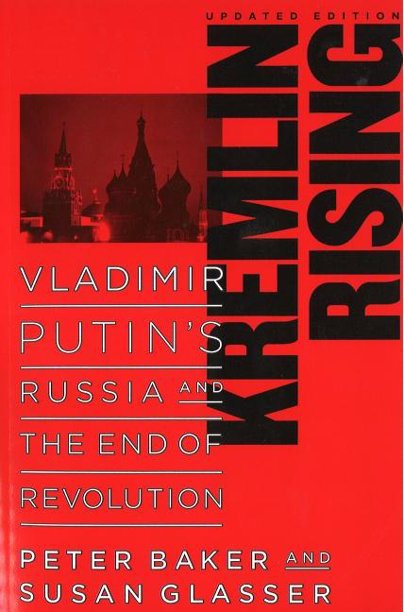
We had arrived in Russia as correspondents for the Washington Post on the eve of Putin’s election as president in 2000 and would stay on through nearly four years of change in a country the world thought it had gotten to know under Yeltsin. We found the place in the throes of a nationalist reawakening, cheered on by a proud, young leader, and yet such a weakened shadow of its former superpower self that it faced an epidemic of young conscripts running away from an army that couldn’t properly feed them. It was a time of economic boom as oil revenues floated Russia out of the bank runs and ruble collapses of Yeltsin’s presidency. And yet it was also a place ruled by ambivalence and anxiety, when fears of the future crowded out memories of the brutalities in the not-so-distant Communist past. This was a newly assertive Russia, rejecting international loans instead of defaulting on them, glorifying its lost empire rather than exulting in the downfall of dictatorship, a Russia where the clichés of the 1990s, of begging babushkas, gangster capitalism, and oligarchic excess, were no longer operative. The grinding, brutal war in the breakaway region of Chechnya—and the spill-over wave of gruesome terror attacks against subway riders and airline passengers, schoolchildren, and theatergoers—became a grim constant linking the two eras.

.…Putin’s Russia, no longer Communist yet not quite capitalist, no longer a tyranny yet not quite free. The heady idealism of the day that Yeltsin had clambered atop a tank in 1991 and brought down the Soviet Union was long since dead and often unmourned. “Democracy” was not now—if it had ever been—a goal supported by much of the population, and the very word had been discredited, an epithet that had come to be associated with upheaval rather than opportunity. Polls consistently found that no more than a third of the population considered themselves democrats a decade into the experiment, while an equally large number believed authoritarianism was the only path for their country.2 Yeltsin had, in other words, succeeded in killing off Communism but not in creating its successor.

Instead, the Russia we found on the eve of the Putin era remained a country in between, where strong-state rhetoric played well even as the state collapsed, where corruption and the government were so intertwined as to be at times indistinguishable, and where the president from the KGB set as his main priority the establishment of what he euphemistically called the “dictatorship of the law.” Like everyone else, we were left to wonder where these slogans would in reality lead, certain only that the Putin presidency would be very different from what had preceded it…
[Baker & Glasser, ibid.]
As I post today, the nihilistically brutal Putin assault on Ukraine is six weeks old, with no clear indication of how it might end (nukes? chem/bio WMD?), or what the ensuing global political and socioeconomic ramifications will be. Of late I've been scrambling to mitigate my own relative historical post-Soviet cluelessness. apropos of this topic, among other sources, I recommend the works of Anne Applebaum, Fiona Hill, Tom Nichols, Masha Gessen, Timothy Snyder, Peter Baker & Susan Glasser, Joshua Yaffa, and Karen Dawisha, just to cite a few. In addition, the various new works going more broadly to the increasingly extensive enervating consequences of corrupt global kleptocracies (both overtly state-directed and transnationally oligarchic) have inextricable, significant revelance. See, e.g., Brooke Harrington, Katharina Pistor, Casey Michel, Tom Burgis, and Sarah Chayes.

 
So much for my emerging "exigent priorities" riff. "Armed State Conflict" has certainly jumped to the fore of late.

To be sure, a lot of these issues remain more or less inter-correlated and will not simply fade away. The only thing changing might be the relative prioritizations and intensities of the inter-correlations. If Vladimir Putin is successful in goading the rest of the world into nuclear conflict, much of these other topics may no longer matter materially–either permanently or for a long time.

It all certainly messes with my sleep.
 
UPDATE
CNN story
Buckle up, folks.
 
APRIL 8TH
 
UPDATE:
BROADER HISTORICAL BACKGROUND 
 
 
My sister bought me this for Christmas. Finally started it. Brilliant. A towering scholarly work of history. A tough read. I'm about an hour and a half in. The "Bloodlands" of the 1933-1945 era were comprised mostly of Ukraine, Belarus, and Poland. 14 million non-combatants were killed there by both Hitler's Nazis and Stalin's Soviets. Today's Russian barbarity is no mystery. 
In the middle of Europe in the middle of the twentieth century, the Nazi and Soviet regimes murdered some fourteen million people. The place where all of the victims died, the bloodlands, extends from central Poland to western Russia, through Ukraine, Belarus, and the Baltic States. During the consolidation of National Socialism and Stalinism (1933–1938), the joint German-Soviet occupation of Poland (1939–1941), and then the German-Soviet war (1941–1945), mass violence of a sort never before seen in history was visited upon this region. The victims were chiefly Jews, Belarusians, Ukrainians, Poles, Russians, and Balts, the peoples native to these lands. The fourteen million were murdered over the course of only twelve years, between 1933 and 1945, while both Hitler and Stalin were in power. Though their homelands became battlefields midway through this period, these people were all victims of murderous policy rather than casualties of war. The Second World War was the most lethal conflict in history, and about half of the soldiers who perished on all of its battlefields all the world over died here, in this same region, in the bloodlands. Yet not a single one of the fourteen million murdered was a soldier on active duty. Most were women, children, and the aged; none were bearing weapons; many had been stripped of their possessions, including their clothes.

Snyder, Timothy (2012-10-01T23:58:59.000). Bloodlands . Basic Books. Kindle Edition.
__________
 

Sunday, April 3, 2022

On the former Deputy Mayor of St. Petersburg:

The Putin Whisperers are a disconcerting crew.

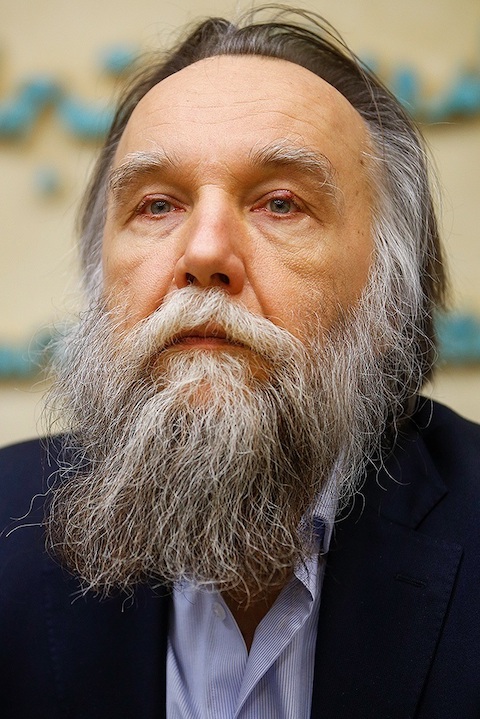
The late Ivan Ilyin, Patriarch Kirill of Moscow, Alexsandr Dugin. Bad news, all.
 
 
Putin's worldview is violently messianic, irrational.
 
Some of my current background reading relating to Putin.
 
I have seen firsthand just how vulnerable America is to the political afflictions that have befallen Russia. In the second half of this book I offer an account of my own experiences of populist politics in action inside the Trump administration. I share what I learned from this and my observations of how Donald Trump began to follow “the authoritarians’ playbook” scripted by Vladimir Putin and other “strongman” leaders. By November 2019, when I was subpoenaed as a fact witness in the first impeachment trial of President Trump and found myself in the international spotlight, I knew that America had embarked on an authoritarian swing of its own. When the global coronavirus pandemic hit, the U.S. teetered on the verge of a system failure. We needed to address our opportunity crisis and pull ourselves back from the brink.

Hill, Fiona (2021-10-04T23:58:59.000). There Is Nothing For You Here. HarperCollins. Kindle Edition.

 
ANNE APPLEBAUM
THERE IS NO LIBERAL WORLD ORDER
Unless democracies defend themselves, the forces of autocracy will destroy them.

By Anne Applebaum

There is no natural liberal world order, and there are no rules without someone to enforce them. unless democracies defend themselves together, the forces of autocracy will destroy them. i am using the word forces, in the plural, deliberately. many american politicians would understandably prefer to focus on the long-term competition with china. but as long as russia is ruled by putin, then russia is at war with us too. so are belarus, north korea, venezuela, iran, nicaragua, hungary, and potentially many others. we might not want to compete with them, or even care very much about them. but they care about us. they understand that the language of democracy, anti-corruption, and justice is dangerous to their form of autocratic power—and they know that that language originates in the democratic world, our world.

this fight is not theoretical. it requires armies, strategies, weapons, and long-term plans. it requires much closer allied cooperation, not only in europe but in the pacific, africa, and latin america. nato can no longer operate as if it might someday be required to defend itself; it needs to start operating as it did during the cold war, on the assumption that an invasion could happen at any time. germany’s decision to raise defense spending by 100 billion euros is a good start; so is denmark’s declaration that it too will boost defense spending. but deeper military and intelligence coordination might require new institutions—perhaps a voluntary european legion, connected to the european union, or a baltic alliance that includes sweden and finland—and different thinking about where and how we invest in european and pacific defense.

if we don’t have any means to deliver our messages to the autocratic world, then no one will hear them. much as we assembled the department of homeland security out of disparate agencies after 9/11, we now need to pull together the disparate parts of the u.s. government that think about communication, not to do propaganda but to reach more people around the world with better information and to stop autocracies from distorting that knowledge. why haven’t we built a russian-language television station to compete with putin’s propaganda? why can’t we produce more programming in mandarin—or uyghur? our foreign-language broadcasters—radio free europe/radio liberty, radio free asia, radio martí in cuba—need not only money for programming but a major investment in research. we know very little about russian audiences—what they read, what they might be eager to learn…
RED SQUARE IN LONDONGRAD. THE RUSSIAN OLIGARCHS' UK HAVEN
 

UPDATE
Putin's Blunder and Europe's Gamble
A conversation with Russia expert Thane Gustafson on Putin's blunder, the Ukraine war, and the role of energy in the future of Europe and Russia.

By Tom Nichols
__________


Wednesday, March 30, 2022

Five weeks of savagery in Ukraine

 
I have to say, like many, I too thought the Russians would quickly capture Kyiv and remove President Zelenskyy (and perhaps kill him).
 
Notwithstanding the heroic, adroit Ukrainian pushback, the utter physical destruction across the country is depressing, and the misery visited upon the non-combatant civilian population is beyond heart-rending.

 
I am now 10 episodes into "Servant of the People" on Netflix. Highly recommended. Very informative, notwithstanding being a "sitcom."

 
UPDATE
 
This is rather jarring. PBS Frontline:
 
Through in-depth conversations with multiple heads of U.S. intelligence agencies, diplomats, Russian politicians, historians and journalists, this special report chronicles events that shaped the Russian leader, the grievances that drive him, and how a growing conflict with the West exploded into war in Europe. From acclaimed filmmaker Michael Kirk and his team, the documentary traces how Putin went from low-ranking KGB agent to longtime Russian president. It delves into his crackdown on dissent — and the media — inside Russia. It reveals how he has tested the West’s appetite for confrontation over and over again, including in Ukraine in 2014, as he’s tried to expand Russia’s global footprint. And it raises difficult questions about the path forward. Watch the documentary for an urgent examination of what led to this historic moment and how it could still unfold.
Also, a must-read essay by Anne Applebaum. "There IS no Liberal World Order."
Take democracy seriously. Teach it, debate it, improve it, defend it. Maybe there is no natural liberal world order, but there are liberal societies, open and free countries that offer a better chance for people to live useful lives than closed dictatorships do. They are hardly perfect; our own has deep flaws, profound divisions, terrible historical scars. But that’s all the more reason to defend and protect them. Few of them have existed across human history; many have existed for a time and then failed. They can be destroyed from the outside, but from the inside, too, by divisions and demagogues...

____________

THE SLAP I WANT TO SEE

 
MEANWHILE, BACK IN THE LAND OF THE FREE AND HOME OF THE BRAVE
 
You can't make this shit up.
__________
 

Thursday, March 24, 2022

Enough Putin for now. Back to some science stuff

“When you give everyone a voice and give people power, the system usually ends up in a really good place,” Mark Zuckerberg, founder and CEO of Facebook, said in 2010. Twelve years later, the world is not in such a great place. Facebook, Twitter, and other platforms may have given everyone a voice, but they’ve also unleashed a storm of negative effects—spreading disinformation, inciting hate, and endangering democracy…

It’s not a new phenomenon—“We feel your pain,” climate researcher Michael Mann says to the new victims—but the pandemic and today’s hyperpolarized climate have made things worse. And although an individual troll may be easy to block, the tsunami of abuse triggered by organized campaigns can take a serious toll.

For some researchers, the spread of mis- and disinformation has become a study subject in itself. Evolutionary biologist Carl Bergstrom believes our brains are maladapted for the daily diet of factoids and titillation that social media algorithms serve us, the same way our bodies can’t cope with an abundance of sugars and fat. As reporter Kai Kupferschmidt explains in his story, Bergstrom is convinced that “bullshit” spread online is one the biggest threats facing humanity in the 21st century—and that studying it is as important as climate science…
Don't get me started on Zuckerberg.

When Carl Bergstrom worked on plans to prepare the United States for a hypothetical pandemic, in the early 2000s, he and his colleagues were worried vaccines might not get to those who needed them most. “We thought the problem would be to keep people from putting up barricades and stopping the truck and taking all the vaccines off it, giving them to each other,” he recalls.

When COVID-19 arrived, things played out quite differently. One-quarter of U.S. adults remain unvaccinated against a virus that has killed more than 1 million Americans. “Our ability to convince people that this was a vaccine that was going to save a lot of lives and that everyone needed to take was much, much worse than most of us imagined,” Bergstrom says.

He is convinced this catastrophic failure can be traced to social media networks and their power to spread false information—in this case about vaccines—far and fast. “Bullshit” is Bergstrom’s umbrella term for the falsehoods that propagate online—both misinformation, which is spread inadvertently, and disinformation, designed to spread falsehoods deliberately...
In January 2020, some 2 months before the World Health Organization declared the coronavirus pandemic a global emergency, a tweet appeared on virologist Benhur Lee’s smartphone. It linked to a website, virological.org, where scientists had just posted the genetic sequence of SARS-CoV-2. Lee, at the Icahn School of Medicine at Mount Sinai, quickly shared the tweet with his followers, along with the words “Here we go” and an animation of planes taking off. Within days, the pharmaceutical firm Moderna and the U.S. National Institutes of Health had announced plans to develop what just 10 months later proved to be an effective vaccine, based on the sequence that codes for the virus’ spike protein.

In an earlier age, it might have taken days or longer for such useful DNA data to reach interested scientists via a Table of Contents alert from a journal. But the rise of Twitter and other social media platforms enabled users like Lee to spread the word about the SARS-CoV-2 sequence within hours, sparking global conversations and accelerating efforts to develop vaccines and treatments.

It was an early sign of how the pandemic prompted many scientists—and the public—to turn to social media to share and learn about hot new findings. COVID-19 “changed the game” because the threat “immediately connects with the public, [so] there’s a much bigger natural audience” for information about pandemic science than for most areas of research, says Michael Thelwall, a data scientist at the University of Wolverhampton, City Campus, who studies social media. In particular, Twitter has become a go-to resource for anyone trying to make sense of the torrent of pandemic studies—and for those intent on quickly pushing back against misinformation…

But the pandemic has also helped demonstrate the limitations of social media. It can be difficult, for example, for scientists to be heard over the cacophony of messages on Twitter—some 500 million each day. And although some scientists have used the platform to elevate their online presence, that has rarely translated into concrete professional rewards. Eventually the sizable Twitter followings some have built during the pandemic may fade. And in the meantime, some have suffered from their digital fame, attracting harsh personal attacks and threats of violence. Despite such challenges, many researchers believe that—like it or not—the pandemic has forever altered how certain scientists communicate with each other and the public…

When Marion Koopmans, a virologist at Erasmus University Medical Center, visited a museum in Amsterdam with her family last year, she was spotted by the wrong crowd: people who hate Koopmans because of her work on COVID-19. “They started really yelling, banging,” she says. “Security locked the doors.”

Since early in the pandemic, Koopmans has found herself targeted by people who believe the pandemic is a hoax, the virus was created intentionally to cause harm, or vaccines are dangerous. She has received death threats, been accused of belonging to an elite network of pedophiles—a belief held by devotees of the QAnon conspiracy theory—and told she should be tried for crimes against humanity.

Now, Koopmans no longer makes public appearances without first alerting the police. As a frequent guest on Dutch TV, “I cannot go out on the street anonymously,” she says. Her family is not comfortable walking outside with her, and they worry about her ever traveling to the United States, where much of the vitriol originates…
A packed issue. Lots to consider. Goes materially to "#SciComm" topics.

JUST LEARNED A NEW ACRONYM

"MRgFUS"

What? Cheryl hipped me to an ad in Baltimore Magazine touting "Magnetic Resonance Guided Focused Ultrasound" tx now approved by FDA and being offered by the University of Maryland Medical Center (and elsewhere).

A non-invasive ultrasound treatment for Parkinson's disease that was tested in a pivotal trial led by University of Maryland School of Medicine (UMSOM) researchers is now more broadly available at the University of Maryland Medical Center (UMMC). Recent FDA approval of a device used in the procedure effectively opens up access to focused ultrasound beyond clinical trial participation. 

The device, called Exablate Neuro and manufactured by Insightec, was approved in late 2021 by the U.S. Food and Drug Administration to treat advanced Parkinson's disease on one side of the brain. UMMC is one of only several sites in the Mid-Atlantic region with the capabilities and expertise to perform focused ultrasound for Parkinson's disease and other movement disorders. The procedure requires a multi-disciplinary team, including a neurosurgeon, movement disorder neurologist, and neuroradiologist...

CPT Code 0398T (People gotta get paid.)
 
Of serious interest to me, given that Sinemet still


I also recently ran across news of human clinical trials in Denmark involving genetically modified stem cells engineered to be used as dopamine-generating neurotransmitter replacement brain cells. Apparently going on in multiple countries of late.

I'm ready for something. My Parkinson's is getting increasingly annoying.

But, ahhh... everyone should have my problems.
__________
 

Tuesday, March 22, 2022

oderint dum metuant

 "Let them hate, so long as they fear."
 
Words fail to capture the savagery of Vladimir Putin.
 
How should the West respond? There is only one rule: We cannot be afraid. Russia wants us to be afraid—so afraid that we are crippled by fear, that we cannot make decisions, that we withdraw altogether, leaving the way open for a Russian conquest of Ukraine, and eventually of Poland or even further into Europe. Putin remembers very well an era when Soviet troops controlled the eastern half of Germany. But the threat to those countries will not decrease if Russia carries out massacres in Ukraine. It will grow.

Instead of fear, we should focus on a Ukrainian victory. Once we understand that this is the goal, then we can think about how to achieve it, whether through temporary boycotts of Russian gas, oil, and coal; military exercises elsewhere in the world that will distract Russian troops; humanitarian airlifts on the scale of 1948 Berlin; or more and better weapons.

The specific tactics will be determined by those who best understand diplomacy and military strategy. But the strategy has to be clear. A month ago, nobody believed this war would matter so much, and I’m sure many people wish it did not. But it does. That’s why every move we make must have a single goal: How does it help Ukraine win?
NOW ON NETFLIX, ZELENSKYY’S “SERVANT OF THE PEOPLE”


Painfully brilliant. Everyone should see it.
__________
 

Saturday, March 19, 2022

Ukraine invasion update

 
Succinct.
 

So much of what we imagine to be new is old; so many of the seemingly novel illnesses that afflict modern society are really just resurgent cancers, diagnosed and described long ago. Autocrats have risen before; they have used mass violence before; they have broken the laws of war before. In 1950, in the preface she wrote to the first edition of The Origins of Totalitarianism, Hannah Arendt, knowing that what had just passed could repeat itself, described the scant half decade that had elapsed since the end of the Second World War as an era of great unease: “Never has our future been more unpredictable, never have we depended so much on political forces that cannot be trusted to follow the rules of common sense and self-interest—forces that look like sheer insanity, if judged by the standards of other centuries.”

The toxic nationalism and open racism of Nazi Germany, only recently defeated; the Soviet Union’s ongoing, cynical attacks on liberal values and what it called “bourgeois democracy”; the division of the world into warring camps; the large influx of refugees; the rise of new forms of broadcast media capable of pumping out disinformation and propaganda on a mass scale; the emergence of an uninterested, apathetic majority, easily placated with simple bromides and outright lies; and above all the phenomenon of totalitarianism, which she described as an “entirely new form of government”—all of these things led Arendt to believe that a darker era was about to begin.

She was wrong, or partly so. Although much of the world would remain, for the rest of the 20th century, in thrall to violent and aggressive dictatorships, in 1950 North America and Western Europe were in fact just at the beginning of an era of growth and prosperity that would carry them to new heights of wealth and power. The French would remember this era as Les Trente Glorieuses; the Italians would speak of the boom economico, the Germans of the Wirtschaftswunder. In this same era, liberal democracy, a political system that had failed spectacularly in 1930s Europe, finally flourished. So did international integration. The Council of Europe, the North Atlantic Treaty Organization, the eventual European Union—all of these institutions not only supported the liberal democracies but knit them together more tightly than ever before. The result was certainly not a utopia—by the 1970s, growth had slowed; unemployment and inflation soared—but it nevertheless seemed, at least to those who lived inside the secure Western bubble, that the forces of what Arendt had called “sheer insanity” had been kept at bay.

Now we live in a different era, one in which growth at those 1950s levels is impossible to imagine. Inequality has grown exponentially, creating huge divides between a tiny billionaire class and everyone else. International integration is failing; declining birth rates, combined with a wave of immigration from the Middle East and North Africa, have created an angry rise of nostalgia and xenophobia. Worse, some of the elements that made the postwar Western world so prosperous—some of the elements that Arendt’s pessimistic analysis missed—are fading away. The American security guarantee that underlies the stability of Europe and North America is more uncertain than it has ever been. America’s own democracy, which served as a role model for so many others, is challenged as it has not been in decades, including by those who no longer accept the results of American elections. At the same time, the world’s autocracies have now accumulated enough wealth and influence to challenge the liberal democracies, ideologically as well as economically. The leaders of China, Russia, Iran, Belarus, and Cuba often work together, supporting one another, drawing on kleptocratic resources—money, property, business influence—at a level Hitler or Stalin could never have imagined. Russia has defied the entire postwar European order by invading Ukraine…
Read the entire article.

apropos of "kleptocratic resources,"


Acutely toxic to Democracy. Existentially exigent.

See also
 
UKRAINE INVASION UPDATE:
ANNIE LOWRY ON INFLATION
...One of the world’s biggest energy exporters is engaged in an unprovoked assault on one of Europe’s largest agricultural exporters. This means higher prices for commodities, which means higher prices for manufacturers, which means higher prices for retailers, which means higher prices for families in a brief matter of time. Much higher, perhaps: One barometer of the price of raw materials jumped 16 percent in the first week of March, the sharpest increase in half a century…

At the same time, the invasion has cut Europe off from its bread basket: Ukrainian wheat, corn, and sunflower oil are no longer leaving its Black Sea ports. As a result, wheat futures listed on the Chicago Board of Trade jumped the maximum allowed each of the first five days of March; they are now up about 40 percent from before the invasion. Even if Russia were to withdraw from Ukraine shortly, those price increases would probably persist. The war is disrupting the harvest cycle and damaging Ukraine’s shipping infrastructure, and the West is likely to maintain sanctions on Russia for years…
"For years?" Let's just hope we have "years."

UPDATE: STEVE COLL
It has become common to describe Russia’s invasion as a watershed in history comparable to 9/11 or to the fall of the Berlin Wall. “The war in Ukraine marks a turning point for our continent and our generation,” President Emmanuel Macron, of France, said earlier this month. Perhaps, but some of this speculation about Europe’s destiny and the future of Great Power competition may be premature. Certainly, the war has already produced a humanitarian disaster of shocking and destabilizing dimensions. Three million Ukrainians have fled their country. The 1.8 million of them who have gone to Poland constitute a population roughly the size of Warsaw’s. If the fighting drags on and Ukraine implodes, the country will export many more destitute people, and, as happened in the former Yugoslavia during the nineteen-nineties, it may also draw in opportunists, including mercenaries and extremists.

Meanwhile, Russia’s economy, according to the International Monetary Fund, could shrink by thirty-five per cent this year under the weight of Western sanctions. Putin’s oligarchs and enablers can endure the loss of super-yachts and private jets, but a sudden economic contraction on that scale would crush ordinary Russians and inevitably cost lives. (“Our economy will need deep structural changes,” Putin acknowledged last week, adding, “They won’t be easy.”) Russia’s isolation from large swaths of global banking and trade, and its loss of access to advanced U.S. technologies, could last a long time, too: democracies often find it easier to impose sanctions than to remove them, even when the original cause of a conflict subsides. (Ask Cuba.) “When the history of this era is written, Putin’s war on Ukraine will have left Russia weaker and the rest of the world stronger,” Biden said in his recent State of the Union address.

Still, some introspection may be in order. In his address, the President also declared that, “in the battle between democracy and autocracies, democracies are rising to the moment.” But Europe is troubled by illiberal populism, including in Poland. And Donald Trump—who, just two days before Russia rolled into Ukraine, called Putin’s preparatory moves “genius”—retains a firm hold on the Republican Party, and appears to be all in for a reëlection campaign in 2024. As long as Trump’s return to the White House is a possibility, Biden’s declarations will require some asterisks...
UPDATE FROM CNN
Ukrainian President Volodymyr Zelensky said Sunday he is ready to negotiate with Russian President Vladimir Putin, but warned that if any negotiation attempts fail, it could mean the fight between the two countries would lead to "a third World War."

“I’m ready for negotiations with him. I was ready for the last two years. And I think that without negotiations, we cannot end this war,” Zelensky told CNN’s Fareed Zakaria in an exclusive interview Sunday morning.

“If there’s just 1% chance for us to stop this war, I think that we need to take this chance. We need to do that. I can tell you about the result of this negotiations — in any case, we are losing people on a daily basis, innocent people on the ground," he said.

He continued, “Russian forces have come to exterminate us, to kill us. And we can demonstrate that the dignity of our people and our army that we are able to deal a powerful blow, we are able to strike back. But, unfortunately, our dignity is not going to preserve the lives. So, I think we have to use any format, any chance in order to have a possibility of negotiating, possibility of talking to Putin. But if these attempts fail, that would mean that this is a third World War.”
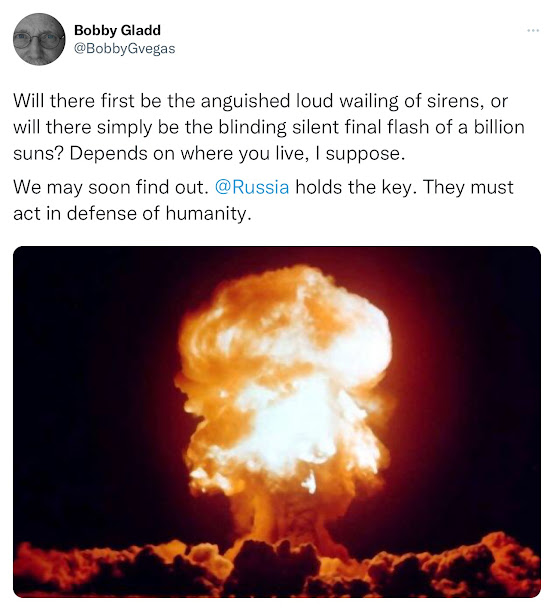
I think the probability of Putin agreeing to meet with President Zelenskyy is about zero. Vladimir is interested in one thing: Ukrainian capitulation. If it requires burning the entire nation down and killing everyone, so be it.
 
CODA
 
You might want to read up on Aleksandr Dugin. Putin's Jim Jones. Seriously bad news, this guy. The Putin Whisperer. And, then there's this swell guy.
__________
 

Tuesday, March 15, 2022

Ukraine: the 44 million trolleys problem

Kyiv, Ukraine, before Putin's invasion.
 
Yeah, it's perhaps a bit of a clickbait headline. The analogy is somewhat strained. Humor me.
 
Recall that annoying "moral reasoning thought experiment" from undergrad PHIL101?
 
A trolley is running loose down the tracks without its driver, headed toward a cluster of unaware citizens who might be killed. You have access to track switching controls that could divert it to a siding, where it would subsequently certainly kill one innocent person prior to coming to rest. What should you do?
 
OK, rearrange the particulars. Do we "sacrifice" 44 million Ukrainians (on the siding) in materially passive deference to our larger concern that Vladimir Putin might unleash nuclear obliteration on the wider world, as he has repeatedly threatened?
 
20 days of Russian savagery have ensued as of today. Ukraine is being reduced to rubble, its non-combatant citizens terrorized. Several million Ukrainians have now fled their country. The misery is mind-boggling.
 
What would you do?
 
 
UPDATE
 
__________
 

Saturday, March 12, 2022

Fiona Hill on Vladimir Putin

Few people know Putin's Russia better than Fiona Hill
UPDATE
 
 
Very illuminating.
__________
 

Thursday, March 10, 2022

Thinking back to Chernobyl

April 1986, Ukraine, near Belarus


As the horrific Russian invasion of Ukraine slogs on, I think back 36 years. A quick post of mine from 11 years ago:
In the spring of 1986 I was managing a Radiological Environmental Monitoring Program database and reporting system (REMP) I’d developed for the environmental radiation lab in Oak Ridge where I worked. One of our clients was Perry Nuclear of Ohio (they intended to build a nuke plant there). The REMP stuff comprised an ongoing environmental baseline study via which to establish natural radionuclide levels across the breadth of matrices within a 5 mile radius of the proposed plant site — soils, vegetation, water, milk from local cows, all manner of biota, and the air.

The air filter analyses always came back “below LLD” (Lower Limit of Determination, i.e., in this case “LT 0.04 pCi/cu.m." (less than 4-100ths of a trillionth of a Curie). I had a macro code snippet that simply populated that field with that update ongoing.
One week after Chernobyl we had elevated positive lab readings across all air filter locations. I-131. Given its 8.05 day half-life, it descended back down to below LLD after about 5 weeks.
Nonetheless, it was a bit creepy.

Other, heavier radionuclides like Cs-137 were blown all over the arctic regions. Scientists are probably STILL studying biota uptake and rad migration on a lot of this stuff.
Putin may well soon cause another nuclear disaster during his chaotic invasion of Ukraine, either by escalating to using nuke weapons, or by hitting a Ukraine nuclear power plant (he's already damaged one).

Ukrainians fleeing Kharkiv. Covid-19 petri dish?
UPDATE:
__________
 

Sunday, March 6, 2022

I can't be the only one wondering about this...

Russians, are you listening?

apropos,
The hostilities in Ukraine—more than any other in recent memory—are threatening to become a direct conflict between nuclear states. The reason that this is such a test is that Americans have grown used to thinking of our power through the lens of endless proxies, wars that never really impinge on us directly.

Another way to put all of this is that we are trapped in a cycle of multiple unrealities, all of which make us sluggish now that our own security is much more at risk. On the one hand, we have grown accustomed to using abstract ideals of rights and international order to distance ourselves from the fragility of life. On the other—and in part as a response to the excesses of the first—realists (despite their name) tend to sidestep just how much the dynamics of life and politics do, in fact, depend on values: what we care about, why we care about it, and how much we are willing to sacrifice in response… —Samuel Kimbriel
Eliot A. Cohen:
Russia is in many ways a functioning fascist state, in the grip of a nationalist ideology and an all-powerful leader. For that reason, then, and barring a new Russian revolution, the Western objective must be to leave Russia profoundly weakened and militarily crippled, incapable of renewing such an onslaught, isolated and internally divided until the point that an aging autocrat falls from power. Targeting Putin alone is not enough.

… the West has the opportunity, and faces the necessity, of changing the story of democratic decline and weakness to one of strength and self-confidence. Europe’s remarkable response to the invasion is a long step in this direction, as is the American leadership that has rallied so many to oppose Russia and stand with Ukraine. China is watching the invasion of Ukraine; so, too, are Iran and lesser authoritarian regimes, waiting to see whether such opportunities are available to them, or too perilous to attempt. The Western powers must induce them to take the latter view by the visible successes that they achieve. There are internal audiences as well, particularly in the United States. After a decade of deeply self-critical contemplation of America’s internal divisions, this is the moment to restore confidence in the ideals and beliefs that have made the United States at once powerful and free...


We must fix this mess.
__________
 

Tuesday, March 1, 2022

"Cometh the hour, cometh the man"

 
Heroic Ukrainian President Volodmyr Zelenskyy will not flee, and will probably soon die in Kviv defending his nation from the obscene war criminal Vladimir Putin.
 
 
This is a horrific tragedy. People of Russia, rise up and remove madman Putin and his Mafia.
History has accelerated; the impossible has become possible. Shifts that no one imagined two weeks ago are unfolding with incredible speed.


As it turns out, nations are not pieces in a game of Risk. They do not, as some academics have long imagined, have eternal interests or permanent geopolitical orientations, fixed motivations or predictable goals. Nor do human beings always react the way they are supposed to react. Last week, nobody who was analyzing the coming war in Ukraine imagined that the personal bravery of the Ukrainian president and his emotive calls for sovereignty and democracy could alter the calculations of foreign ministers, bank directors, business executives, and thousands of ordinary people. Few imagined that the Russian president’s sinister television appearances and brutal orders could alter, in just a few days, international perceptions of Russia.


And yet all of that has happened. Volodymyr Zelensky’s courage has moved people, even the hard-bitten CEOs of oil companies, even dull diplomats accustomed to rote pronouncements. Vladimir Putin’s paranoid ranting, meanwhile, has frightened even people who were lauding his “savvy” just a few days ago. He is not, in fact, someone you can do business with, as so many in Berlin, Paris, London, and Washington falsely believed; he is a cold-blooded dictator happy to murder hundreds of thousands of neighbors and impoverish his nation, if that’s what it takes to remain in power. However the war ends—and many scenarios are still imaginable—we already live in a world with fewer illusions… — Anne Applebaum, the Atlantic

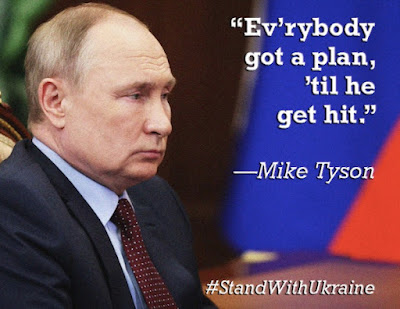
#StandWithUkraine
 
__________