Search the KHIT Blog

Sunday, July 9, 2023

"Ethics" prior post follow-up.

"Every year I ask my Stanford students to send me their top seven principles (e.g., below, 2019). Some choose personal traits, like honesty and curiosity; others select priorities, such as education and family. I generally recommend that individuals and organizations consider somewhere in the range of five to eight principles." (Dr. Susan Liautaud, The Power of Ethics, p. 26 et seq.)
  1. Honesty
  2. Integrity
  3. Kindness
  4. Compassion
  5. Loyalty
  6. Empathy
  7. Authenticity
Much discussion ensues regarding the practical importance of honesty, as least as expressed by the academic elites of places such as Stanford.

per "elites"—Oops...

NY Times.

When behavioral-science researchers are accused of misbehavior, the allegations have a funny way of being a little on the nose. The former Harvard psychologist Marc Hauser, author of Moral Minds: The Nature of Right and Wrong, was found to have fabricated data and manipulated results. The University of Michigan psychologist Lawrence Sanna, who studied judgment and decision making, resigned after facing similar allegations. Diederik Stapel, a Dutch social psychologist whose work touched on such topics as selfishness and morality, fabricated data at least 50 times, making him “perhaps the biggest con man in academic science.” And last month, Francesca Gino, a Harvard Business School professor who studies dishonesty—and who wrote a book titled Rebel Talent: Why It Pays to Break the Rules at Work and in Life—was accused of falsifying data in at least four papers, three of which are on their way to being retracted. Her accusers now suggest that Gino, who has been placed on administrative leave from Harvard, may have faked data in dozens of her other published papers.

…The obvious irony of Gino’s situation makes for a punchy headline—“Dishonesty Researcher Accused of Dishonesty”—but it also speaks to a vexing paradox of human behavior, one that Gino has herself returned to again and again in her academic work. “Researchers across disciplines have become increasingly interested,” she wrote in a 2014 paper, “in understanding why even people who care about morality predictably cross ethical boundaries.” Let’s assume, for the sake of argument, that she is such a person—someone who cares about doing right but, at some point, for some reason, started doing wrong…
Hmmm...

SOME COOL STUFF FROM TX McCOMBS SCHOOL OF BUSINESS: CONCEPTS UNWRAPPED


36 short videos well worth your time and attention. Excellent job, folks.
All is Not Relative
Appropriation & Attribution
Being Your Best Self, Part 1: Moral Awareness
Being Your Best Self, Part 2: Moral Decision Making
Being Your Best Self, Part 3: Moral Intent
Being Your Best Self, Part 4: Moral Action
Bounded Ethicality
Causing Harm
Cognitive Dissonance
Conflict of Interest
Conformity Bias
Ethical Fading
Ethical Leadership, Part 1: Perilous at the Top
Ethical Leadership, Part 2: Best Practices
Framing
Fundamental Attribution Error
Fundamental Moral Unit
Implicit Bias
Incentive Gaming
Incrementalism
Intro to Behavioral Ethics
Legal Rights & Ethical Responsibilities
Loss Aversion
Moral Agent & Subject of Moral Worth
Moral Emotions
Moral Equilibrium
Moral Imagination
Moral Muteness
Moral Myopia
Obedience to Authority
Overconfidence Bias
Representation
Role Morality
Self-serving Bias
Systematic Moral Analysis
Tangible & Abstract
NOTE: Their complete glossary comprises 58 video items.
TUES UPDATE: I've just finished reviewing all 58..
A COUPLE OF RELEVANT READS
 
 
JUSTIN GREGG'S BOOK
Humans have been designed by evolution to be liars. Liars that are, strangely enough, susceptible to lies. This is a problem unique to our species. We are not an exceptional species because we can deceive; as we’ve seen, other species—from insects to cuttlefish—produce communicative signals that contain false information. And a few of them even intend to deceive others. But our species has weaved the intention to deceive—to lie by manipulating the beliefs of others—into the very fabric of our brand of social cognition. At best, we can educate our children to be sensitive to the proliferation of false information, and to want to reduce the harm it causes. But we cannot remove the human capacity to both produce and believe lies any more than we can remove our capacity for walking upright. It is who we are.

Gregg, Justin. If Nietzsche Were a Narwhal (p. 76).
More to come...
__________
 

Wednesday, July 5, 2023

Define "Ethics"


Should you be asked to define "ethics," a lot of synonyms and contextually-related terms and phrases may pop to mind (assuming you even care to venture a response).
 
I've given the topic a ton of ongoing thought since getting my Master's in Ethics & Policy Studies (EPS) in 1998 at the age of 52. EPS was an interdisciplinary curriculum comprising Western Philosophies, Jurisprudence (incl. ConLaw), ECON, PolySci, and—in my case,—Public Health (specifically, Drug Abuse Policy).
 
Just finished a couple of delightful, intriguing books by Dr. Susan Liautaud.
 

I will certainly give these well-written-and-argued books 5-star reviews on Amazon, notwithstanding a few picks.

e.g., I'm a bit of a pedant with respect to the provision of material and adequately precise definitions in complex technical arguments, e.g.,
Dr. Liautaud finally gets around to a sort of a definition of "ethics" near the end of her first book:
You and I began this narrative journey by defining ethical decision-making on the edge. Every year, I send my students off with a forward-looking definition of ethics that spotlights the messiness, imperfection, truth, and recovery. It is this:
Above all, ethics are about creating the story we want for our lives and all the lives we are privileged to touch, by applying principled decision-making, no matter how close we are to the edge. Ethics require an unflinching commitment to truth and humanity. Ethics are recording the story that we will be proud for others to uncover as our view of a life well lived—however the facts may unravel, however we may succeed or fail, whatever luck we may or may not experience, while learning from, but leaving unedited, the inevitable human moments when we don’t live up to this definition.
The Power of Ethics: How to Make Good Choices in a Complicated World (p. 218). Simon & Schuster. Kindle Edition. 
apropos, from a 2018 post of mine:

I've alluded to this a couple of times:


I reached out to these folks, and gently pointed out that their "Ethical Framework" pdf download document had no definition of "ethics." The email reply I got blew me off -- "we all know what we mean, we're not gonna get bogged down in abstract academic jargon."

Right. In Silicon Valley-speak, just "Don't Be Evil" while you "Fail Fast and Break Stuff" in your Agile Scrums.

Dudes, I'm not talkin' obtuse ivory tower "Dialectical Hermeneutics,"or hypothetical "gotcha" moral dilemma "Trolley Problems," etc, just a common-sense primer of sufficient detail. e.g., from a book I got onto via Science Based Medicine: 


Ethical Frameworks and Principles 
Ethical considerations of any problem or issue can be divided into two major categories: (a) nonconsequentialist and (b) consequentialist approaches. 1 Nonconsequentialism considers that the action (or even just the motivation behind an action) is the crucial ethical factor. In other words, the action itself is more important than the actual outcome (consequence) of the action. By contrast, consequentialism holds that outcomes (as opposed to actions) should be the crucial determinants of ethical decisions…

Principlism 
The inherent subjectivity of ethics presents a problem: even when reflexive and uncritical responses (such as the ‘gut reactions’ of tabloid readers) are excluded, along with religious outlooks, medical ethicists still do not all agree on which ethical principles are best. 

It was in response to this reality that an approach to ethical analysis known as principlism was developed. Principlism attempts to factor in both nonconsequentialist and consequentialist approaches. The standard version is based on four core principles:

(1) Respect for autonomy (a nonconsequentialist principle—but one that utilitarianism also supports). 
(2) Nonmaleficence (‘first, do no harm’—a nonconsequentialist principle). 
(3) Beneficence (increase overall utility—a consequentialist principle; it is essentially utilitarianism). 
(4) Justice (fairly distribute benefits, risks and costs—a nonconsequentialist principle). 
Principlists apply this approach to an ethical case by examining how each of the four principles (in turn) applies to the issues raised by the case. It is quite common for medical ethics committees to use this method to reach decisions. Principlism can be very useful as a structured ‘checklist’ method to address ethical problems and therefore finds favour amongst laypeople or non-ethically trained professionals, who predominate on ethics committees…

Ernst, Edzard. More Harm than Good?: The Moral Maze of Complementary and Alternative Medicine (Kindle Locations 83-208). Springer International Publishing. Kindle Edition.
That entire chapter is excellent. One need not, however, even go to that much trouble. Any quick Google search will get you tons of relevant, succinct definitional information on the topic of Ethics.

Below, a good, accessible, inexpensive resource:


I still have all of my many grad school texts, but I keep this in my Kindle as a handy refresher.

It was emphasized to us in grad school early on that "Ethics" was not about some lookup cookbook of "right/wrong," but rather a frequently arduous process of rational moral deliberation comprising evidence (including accrued wisdoms), logic, and -- yes -- "values" fused in honest attempts to derive just decisions and policies.
 
Another relevant 2018 topical post—"Information Ethics."
 
And, is there such a thing as a "Science of Deliberation?" 

Way more to come.  For now, an hour with the author, in her own words.
 
 
UPDATE
 
I watched the entire hour of the above. Pretty good discussion of the issues and methods as Susan sets them forth in her books. This is probably not practical, but I'd have liked to have viewed a substantial bit less Zoom chat "talking heads" in favor of some deftly placed graphics overlays—even if mostly bullet list Powerpoint-type deck cards. I think it'd be helpful for those who've yet to read her books (which I unreservedly recommend your doing).

A RELATED SUSAN LIAUTAUD INITIATIVE


OK, I remain a tad clueless as to what is meant by "innovative ethics."
 
But, continue to drill down for contextual clues.
Our Ethos

HUMANITY

: We respect humanity. Effective ethics tethers us to our humanity as technology and science blur the boundaries between human and machine and global risks spiral to inhuman scale.
INNOVATION
: We are a laboratory and platform for ethics innovation. Effective ethics happens along with, or prior to, the science and technology. It is a partner in progress not an impediment to innovation or a clean-up act for its unwanted consequences.
CREATIVITY: 
We seek ethical wisdom everywhere from the arts to astronomy. Effective ethics is creative and solution-oriented: a forward-looking catalyst for positive change and “first evers” not a backward-looking limitation.
TRUTH
: We seek and support truth. Effective ethics rigorously and relentlessly insists on verifiable truth and questions bias, subjectivity, and context.
COMMITMENT
: We are “all in.” Effective ethics requires commitment not compromise--even in the most challenging situations.
REALITY: 
We do real world ethics. Effective ethics has concrete impact on real people in real situations. It is not an abstract or theoretical matter.
TRANSPARENCY: 
We share all our learning (whether revealing success or failure). Effective ethics requires transparency and exchange of ideas. It is a public good for shared benefit not a private possession.
CHALLENGE: 
We humbly tackle today’s most challenging ethics topics. Effective ethics requires collaboration and cross-pollination. We invite you to join us… and to challenge us.
"Innovation," "incubation..." Man, that is SO Silicon Valley. "We're Making the World a Better Place."
 
UPDATE: LOOKING BACK SOME 17 MONTHS
 
SOME TOPICAL ERRATA BEARING ON "CRITICAL THINKING"

apropos of "The Power of Ethics."

Some things that bedevil our thinking, particularly as it goes to persuasion and influence:

There is no first-person singular present-tense active voice usage of the word "wrong." No one ever says "I AM wrong."
 
[props to Kathryn Schulz]  Our aggregate default is that we're right about everything. To the extent that we continue to survive, that's an understandable assumption—as it pertains to minor, inconsequential issues, anyway, and it inexorably tilts us toward "confirmation bias."
 
Our education system mostly tells us there's one "right answer" to every question—lurking amid a boatload of "wrong ones."
 
And, those who quickly alight on the "right answer" get reinforced and nurtured as they move through the system.
 
Being wrong is not a synonym for being "stupid" or ignorant. 

Neither is "ignorant" a synonym for "stupid." But it's mostly epithetically spun that way

Humans "reason" to WIN the argument.

 Should truth happen along the way, so much the better. (See "Why Do Humans Reason?" by Sperber & Mercier) Evolutionary adaptive utility, "The Pen is Mightier Than The Sword."

He/She with the best story WINS!

Trial Lawyering 101. Prior to writing and movable type, stories were the whole ballgame. Hence, our evolved affinity.

Once you decide that X is right or wrong / good or bad, you cannot unring that bell.

A staple look-before-you-leap admonishment of mine back when I was teaching "Critical Thinking."

If, when it's all said and done, your logic is impeccable, and your facts and evidence are bulletproof, yet you remain unpersuasive, what have you really accomplished?''

Another classroom staple of mine. That one was "exceeding my brief" as it were, but my Sups never noticed or cared. Anyway, my overall teach-to-the-text priority focus as a piddly Adjunct necessarily had to be "OK, here's how this stuff works. Take it or leave it."
 
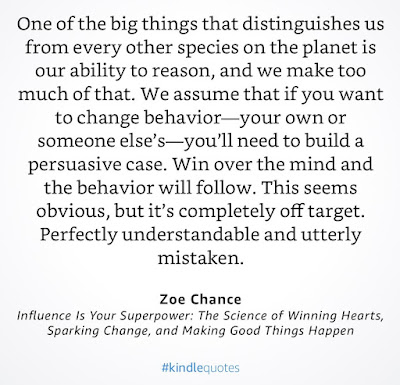
BACK TO ZOE
 

Once you finish her book you will have a firm grip on just why.
WHEN YOU THINK ABOUT the individual genetic and developmental differences that impact the sensory portions of our nervous systems, it’s remarkable that we can agree on a shared reality at all.  Linden, David. Unique(p. 253). Basic Books. Kindle Edition
A lot to think about and discuss here. "Truth?" Yeah.

SUSAN'S SECOND BOOK
The Six Forces Driving Ethics

Throughout this book, you will have seen references to six forces that I believe influence the ethics of every choice we make…

Banish the binary: Ethics are not a “yes or no” or “do it or don’t do it” choice. Some ethics failures are indeed straight-up unacceptable: racism, sexual misconduct, and disregarding science-based evidence about Covid-19. But most questions we face require navigating a gray zone…

Scattered power: Today, power is no longer concentrated only in the hands of a few; it’s more scattered than ever. Think of the power you have with your cell phone—to contribute to a political campaign or tutor a child across the country… or incite violence. The challenge today is to reconnect power to ethical responsibility… and to recognize that we each have a role…

Contagion: Ethics are contagious—for good or for ill. But we often focus so much on the unwanted behavior (fraud, social media data privacy, not wearing masks) that we ignore the factors that drove the spreading of the behavior—leaving them to fester and spur further trouble…

Pillars of ethics: Transparency and (un)informed consent are two long-standing pillars of ethical decision making. They depend on understanding what’s at stake in our decisions (short- and longer-term) but are crumbling in today’s complex, technological world…

Blurred boundaries: Blurred boundaries are everywhere today: human and machine, human and animal, and increasingly work and home. We are in uncharted, sometimes uncomfortable, territory as we think about the role of robots in society (receptionists, caring for the elderly, nannies, driverless cars), looking to animals for medical treatment (growing organs in pigs for human transplant), and beyond. We must keep humanity front and center and assure that humans take responsibility for the blur… and for reclarifying boundaries.

Compromised truth: Ethics hinge on truth. There is no such thing as post-truth or alternatively factual ethics. Today, truth is under threat in unprecedented ways from denial of science and other factual information to distrust of experts to algorithmic distortion of our news feeds and social media bubbles shielding us from diverse views. This compromised truth removes our choices from reality…


Liautaud, Susan. The Little Book of Big Ethical Questions (pp. 277-280). Simon & Schuster. Kindle Edition.
 
OK, LET'S BACK UP TO THE OUTSET OF SUSAN'S FIRST BOOK

Core considerations for contemplating pending ethically-sound decisions.
Question #1:
What are my guiding principles?

Who are you, as an individual or an organization? What do you stand for?

Our principles define our identity and tell the world what to expect from us, as well as how we expect others to behave. Principles apply to ethics choices in all aspects of our lives…
The Power of Ethics (p. 24).

Question #2:
Do I have the information I need to make this decision?

And what important information lies in the gap between the information you should know and the information you can know?

Entrepreneurs increasingly launch new products before we can fully assess the ways they might be used or misused, or before the creators fully comprehend the power and capability of the technologies behind them. We, as consumers, employees, and parents then use these new technologies before fully understanding their opportunities and risks. In between the two, regulators fail to keep pace. The complexity of technology has increased the complexity and unpredictability of information we must consider in order to make thoughtful ethical decisions before we launch, use, or regulate innovations.
(p. 27)

Question #3:
Who or what stakeholders matter to my decision?

Who or what could influence, or be affected by, your decision?

I define a stakeholder as any person, organization, object, or factor that could influence, or be affected by, a decision or situation. We often think stakeholders are only human beings, but stakeholders can also be inanimate objects if they have an impact on (or are impacted by) our choices. Even the digital assistant in your kitchen is a stakeholder if it gives you information (“It’s 35 degrees Fahrenheit outside”) that influences your decisions (I should put on a coat). Stakeholders can be a company, a policy, an algorithm, a chat bot, a test score, fake news, an edited gene, a government organization, and more. They can make positive or negative contributions to your decisions, and you can affect them positively or negatively.
(p. 30)

Question #4:
What are the potential consequences of my decision in the short, medium, and long term?

Have you considered the immediate and future impact of your decision at the time of the decision?

The framework requires us to a look at the short-, medium-, and long-term consequences of our decisions at the time they are being made. We should then do regular framework check-ins, so we can monitor consequences over time and keep up with evolving developments…
(p. 32)
Dr. Liautaud's four-facet overarching framework combined with the Six Forces criteria provide a rather comprehensive (yet broadly accessible) decision model for ethically sound small-d "democratic" decisionmaking. 
 
The stakes have never been higher.

 
After re-reading the foregoing assertion several times, I've warmed to it (at first blush I'd found it perhaps a tad hyperbolic in places). Humanity is up to its aggregate eyeballs in existential alligators. No one's coming to our rescue.
 
Recall my list:

We have much pressing moral work to do.
 
More to come...
__________
 

Saturday, July 1, 2023

July 1st, 1998

Sissy, R.I.P.
 

Miss that kid. Always feels like last week, despite now being 25 years.
__________
 

Thursday, June 29, 2023

Another Code Red day in Baltimore

 
Cheryl and I on the I-83 about 6:15 pm, northbound toward Towson from the kids' house near Camden Yards. The air today was simply wretched. Code Red Baltimore.
 
 
IN CASE YOU LACK ENOUGH OF EXIGENT CONCERN
 
…Hyatt’s invention [celluloid], often described as the world’s first commercially produced plastic, was followed a few decades later by Bakelite. Bakelite was followed by polyvinyl chloride, which was, in turn, followed by polyethylene, low-density polyethylene, polyester, polypropylene, Styrofoam, Plexiglas, Mylar, Teflon, polyethylene terephthalate (familiarly known as pet)—the list goes on and on. And on. Annual global production of plastic currently runs to more than eight hundred billion pounds. What was a problem of scarcity is now a problem of superabundance.

In the form of empty water bottles, used shopping bags, and tattered snack packages, plastic waste turns up pretty much everywhere today. It has been found at the bottom of the Mariana Trench, thirty-six thousand feet below sea level. It litters the beaches of Svalbard and the shores of the Cocos (Keeling) Islands, in the Indian Ocean, most of which are uninhabited. The Great Pacific Garbage Patch, a collection of floating debris that stretches across six hundred thousand square miles between California and Hawaii, is thought to contain some 1.8 trillion plastic shards. Among the many creatures being done in by all this junk are corals, tortoises, and elephants—in particular, the elephants of Sri Lanka. In recent years, twenty of them have died after ingesting plastic at a landfill near the village of Pallakkadu.

How worried should we be about what’s become known as “the plastic pollution crisis”? And what can be done about it? These questions lie at the heart of several recent books that take up what one author calls “the plastic trap.”

“Without plastic we’d have no modern medicine or gadgets or wire insulation to keep our homes from burning down,” that author, Matt Simon, writes in “A Poison Like No Other: How Microplastics Corrupted Our Planet and Our Bodies.” “But with plastic we’ve contaminated every corner of Earth.”

Simon, a science journalist at Wired, is especially concerned about plastic’s tendency to devolve into microplastics. (Microplastics are usually defined as bits smaller than five millimetres across.) This process is taking place all the time, in many different ways. Plastic bags drift into the ocean, where, after being tossed around by the waves and bombarded with UV radiation, they fall apart. Tires today contain a wide variety of plastics; as they roll along, they abrade, sending clouds of particles spinning into the air. Clothes made with plastics, which now comprise most items for sale, are constantly shedding fibres, much the way dogs shed hairs. A study published a few years ago in the journal Nature Food found that preparing infant formula in a plastic bottle is a good way to degrade the bottle, so what babies end up drinking is a sort of plastic soup. In fact, it is now clear that children are feeding on microplastics even before they can eat. In 2021, researchers from Italy announced that they had found microplastics in human placentas. A few months later, researchers from Germany and Austria announced that they’d found microplastics in meconium—the technical term for an infant’s first poop…

…Plastics are made from by-products of oil and gas refining; many of the chemicals involved, such as benzene and vinyl chloride, are carcinogens. In addition to their main ingredients, plastics may contain any number of additives. Many of these—for example, polyfluoroalkyl substances, or PFASs, which confer water resistance—are also suspected carcinogens. Many of the others have never been adequately tested.

As plastics fall apart, the chemicals that went into their manufacture can leak out. These can then combine to form new compounds, which may prove less dangerous than the originals—or more so. A couple of years ago, a team of American scientists subjected disposable shopping bags to several days of simulated sunlight, in order to mimic the conditions that they’d encounter flying or floating loose. The researchers found that a single bag from CVS leached more than thirteen thousand compounds; a bag from Walmart leached more than fifteen thousand. “It is becoming increasingly clear that plastics are not inert in the environment,” the team wrote. Steve Allen, a researcher at Canada’s Ocean Frontier Institute who specializes in microplastics, tells Simon, “If you’ve got an IQ above room temperature, you have to understand that this is not a good material to have in the environment.”…

…Precisely because plastic is now ubiquitous, it’s difficult to imagine how to replace all of it, or even much of it. Even in cases where substitutes are available, it’s not always clear that they’re preferable. Franklin-Wallis cites a 2018 study by the Danish Environmental Protection Agency which analyzed how different kinds of shopping bags compare in terms of life-cycle impacts. The study found that, to have a lower environmental impact than a plastic bag, a paper bag would have to be used forty-three times and a cotton tote would have to be used an astonishing seventy-one hundred times. “How many of those bags will last that long?” Franklin-Wallis asks. Walker-Franklin and Jambeck also note that exchanging plastic for other materials may involve “tradeoffs,” including “energy and water use and carbon emissions.” When Schaub’s supermarket stopped handing out plastic shopping bags, it may have reduced one problem only to exacerbate others—deforestation, say, or pesticide use.

“In the grand scheme of human existence, it wasn’t that long ago that we got along just fine without plastic,” Simon points out. This is true. It also wasn’t all that long ago that we got along just fine without Coca-Cola or packaged guacamole or six-ounce bottles of water or takeout everything. To make a significant dent in plastic waste—and certainly to “end plastic pollution”—will probably require not just substitution but elimination. If much of contemporary life is wrapped up in plastic, and the result of this is that we are poisoning our kids, ourselves, and our ecosystems, then contemporary life may need to be rethought. The question is what matters to us, and whether we’re willing to ask ourselves that question.
Excerpted from her long-read article.
__________
 

Tuesday, June 27, 2023

"Bad, sick people"

TRUMP: These are bad sick people, but …

STAFFER: That was your coup, you know, against you.

TRUMP: Well, it started right at the …

STAFFER: Like when Milley is talking about, “oh, you were going to try to do a coup.” No, they were trying to do that before you even were sworn in.

[0:16] UNIDENTIFIED SPEAKER: That’s right.

STAFFER: Trying to overthrow your election.
TRUMP: Well, with Milley-uh, let me see that, I’ll show you an example. He said that I wanted to attack Iran.

[PAPERS SHUFFLING]

[0:27] 
TRUMP: Isn’t it amazing? I have a big pile of papers, this thing just came up. Look. 
[PAPERS SHUFFLING] 
This was him. They presented me this – this is off the record – but they presented me this. This was him. This was the Defense Department and him.

[0:44] WRITER: Wow.

TRUMP: We looked at some. This was him. This wasn’t done by me, this was him. All sorts of stuff – pages long, look.

STAFFER: Mm.
TRUMP: Wait a minute, let’s see here. 
[PAPERS SHUFFLING]

[0:55] UNIDENTIFIED SPEAKER: Oh my gosh.

STAFFER: [Laughter] Yeah.

TRUMP: I just found, isn’t that amazing? This totally wins my case, you know.

STAFFER: Mm-hm.

TRUMP: Except it is like, highly confidential.
 [1:06] 
STAFFER: Yeah. [Laughter]

TRUMP: Secret. This is secret information. Look, look at this. You attack, and …
STAFFER: Hillary would print that out all the time, you know.

TRUMP: She’d send it …

STAFFER: Her private emails.
 [1:15] 
TRUMP: No, she’d send it to Anthony Weiner.

MULTIPLE: (Laughter) Yeah.

TRUMP: The pervert.

STAFFER: Please print.
TRUMP: By the way. Isn’t that incredible?

STAFFER: Yeah. 
[1:23] 
TRUMP: I was just thinking, because we were talking about it. And you know, he said, “he wanted to attack Iran, and what …”

TRUMP: These are the papers.

STAFFER: You did.

TRUMP: This was done by the military and given to me. Uh, I think we can probably, right?

[1:39] STAFFER: I don’t know, we’ll, we’ll have to see. Yeah, we’ll have to try to – 
TRUMP: Declassify it.

STAFFER: – figure out a – yeah.

TRUMP: See as president I could have declassified it.

STAFFER: Yeah. [Laughter]
 [1:46] 
TRUMP: Now I can’t, you know, but this is still a secret.

STAFFER: Yeah. [Laughter] Now we have a problem.
TRUMP: Isn’t that interesting?

STAFFER: Yeah

TRUMP: It’s so cool, I mean, it’s so, look, her and I, and you probably almost didn’t believe me, but now you believe me.

[1:56] WRITER: No, I believed you.

TRUMP: It’s incredible, right?

WRITER: No, they never met a war they didn’t want.
TRUMP: Hey, bring some, uh, bring some Cokes in please. [2:02]
Ok, then...
 
UPDATES
 
Ok, Trump brazenly claims that the audio exonerates him, that there was no secret Iran attack "document," he was just waving around newspaper clippings, magazine articles, and golf course building plans, while "engaging in bravado" with those present (meaning he was lying, to try to impress them).
 
Why am I utterly not surprised? 
Donald Trump, once again, wants us not to believe our own lying ears. The template for this defense was set on October 7, 2016, when the Washington Post published a tape of Trump laughing crudely as he described to the “Access Hollywood” host Billy Bush his ability to do what he wanted with women (“grab ’em by the pussy”), because “when you’re a star, they let you do it.” The gaslighting that followed the leaking of that tape was a master class in Trump’s ability to obfuscate, bluster, and brazen his way out of the trouble that his big mouth had got him into—even if it meant denying that he meant what everyone had heard him say.

We are about to find out now whether Trump’s deny-it-even-if-you-said-it approach has any chance of succeeding in a federal courtroom, where he stands accused of thirty-seven criminal counts of taking classified documents from the White House and obstructing efforts by the government to reclaim them. Trump’s own words, captured on tape on July 21, 2021, about one such document—an alleged Pentagon war plan for Iran—figured prominently in the indictment, given that Trump was recorded at his golf club in Bedminster, New Jersey, claiming that he possessed it and admitting that he knew showing it off was wrong. On Monday, CNN broadcast the audio. Talk about a gotcha tape…
[Susan B. Glasser]
__________