Search the KHIT Blog

Showing posts sorted by relevance for query anthropocene. Sort by date Show all posts

Wednesday, October 2, 2019

"Covering Climate Now" - the "Anthropocene," is that actually a THING?


OK, that's funny. Good Photoshop job, whoever rendered that. I lived in Las Vegas for 21 years, 1992-2013. The iconic Vegas welcome sign next to McCarren was about 10 minutes from my house on Creek Water just south of the airport.


So, again, is the "Anthropocene" a 'thing,' worthy of naming in geological science? I recently read a contrarian mainstream media article calling it "a joke."

Well, before you decide (mostly as to the semantic nit-pickiness of that), read this excellent book.

‘We are in the Anthropocene!’ exclaimed Nobel-prize winning atmospheric chemist Paul Crutzen in frustration at a conference in 2000. Why were his colleagues still calling our time the Holocene? Humans had so clearly reshaped Earth since the last ice age ended, the beginning of the Holocene Epoch. From this moment on, the proposal to rename Earth’s current interval of geological time after us, the Anthropos, has been gaining extraordinary traction—and critics—both inside and outside the academy... [pg 1]

Overwhelming evidence now confirms that humans are changing Earth in unprecedented ways. Global climate change, acidifying oceans, shifting global cycles of carbon, nitrogen, and other elements, forests and other natural habitats transformed into farms and cities, widespread pollution, radioactive fallout, plastic accumulation, the course of rivers altered, mass extinction of species, human transport and introduction of species around the world. These are just some of the many different human-induced global environmental changes that will most likely leave a lasting record in rock: the basis for marking new intervals of geologic time... [pp 2-3]

Who is responsible for the Anthropocene? Homo sapiens? The first farmers? Wealthy consumers of the industrial age? And is the Anthropocene necessarily a catastrophe—an environmental disaster and the end of humanity—or could there be a ‘good Anthropocene’ in which both humans and nature might thrive together into the deep future?... [pp 3-4]

In 1999, Hans Joachim Schellnhuber asked the pivotal question of the Anthropocene. ‘Why should Prometheus not hasten to Gaia’s assistance?’ If humans are indeed transforming Earth, what is to be done? Or more humbly—what can be done? Can humans help to bend Earth’s trajectory towards better outcomes for both humanity and non-human nature? 


The science is clear. Human well-being is generally improving at the same time that our societies are rapidly producing a hotter, more polluted, less biodiverse, and less predictable planet. The entire Earth system is being forced into a state with no analogue in its history, introducing the very real possibility of environmental changes so rapid and so powerful that even the most resourceful societies on Earth might not survive them. To continue along such a trajectory is to gamble with the very future of both human societies and the rest of life on Earth. What’s at stake, outside the domains of geology and stratigraphy, is a new account of our place in nature, our relationship with the rest of the planet.
This narrative raises some hard questions, like, what exactly are we doing with our planet? Is this a story of senseless destruction or a story of awakening and redemption? It is clear we have only just begun to understand the many dimensions, variations, and alternatives that could play out in the future of the Anthropocene... [pp 144-145]
Given the overwhelming scale, rate, and diversity of harmful global environmental changes produced by human societies, it is hard not to view the Anthropocene as an unmitigated disaster. It might well be viewed as an interval in which humanity, or at least, its wealthiest industrial societies, are driving themselves and the rest of the planet senselessly to ruin. The prospect of a ‘bad’ Anthropocene defined by toxic environments, declining human health and well-being, war, failed agriculture, submerged cities, catastrophic climate change, mass extinction, and societal collapse, might be unavoidable. Prometheus might be entirely the wrong metaphor. Icarus’ foolish hubris to fly in the face of overwhelming odds might prove more accurate. And yet, despite it all, some humans now do in fact fly. It’s actually safer than walking down the street... [pg 155]
Between (and beyond) these excerpts you will find a fascinating historical recounting, and compelling, nuanced support for calling our time "the Anthropocene" (BTW, who is Erle C. Ellis?).
Among many other points, I found his riff on the underappreciated "nitrogen" problem particularly interesting. CO2 and Methane are not the whole story.
I don't much give a flip what we call it; I conclude that we must deal with it for the good of our species. So, yes, it's a "thing" worthy of its name.

TAKING SHOTS AT GRETA THUNBERG

This arrived in my inbox from Medium.com.
“[T]he real problem with the climate change activist sensation Greta Thunberg is not that she is 16 years old. Rather, it is that she is a clueless fanatic who is considered brave and enlightened for promoting a cause that almost everyone agrees with without any study or reflection. And it is the duty of anyone who does not want clueless fanaticism to determine policies affecting billions to call it out as such.”
It'll take you all of five seconds to find press comments by Greta Thunberg where she says "don't take my word for it; ask the scientists."

UPDATE


ERRATUM: October 2nd today, 98F here in Baltimore (at BWI).

UPDATE: RAINING ON THE "GREEN NEW DEAL" PROPOSAL

From Naked Capitalism: "Understanding why the Green New Deal won't really work." Elevator speech? "Post-carbon non-nuke renewables won't scale, not even close."

I'd like to hear Naomi Klein's reaction. Her new book comprises a detailed argument for "Green New Deal" legislation and policies.
EPILOGUE: THE CAPSULE CASE FOR A GREEN NEW DEAL CRITICS OF THE GREEN NEW

Deal have plenty of serious arguments for why all this is doomed. Political paralysis in Washington is real. Even in a world where climate change–denying Republicans were swept out of power, there would still be plenty of centrist Democrats convinced that their constituents had no appetite for radical change. The plans are expensive, and getting the budgets approved would be a herculean effort. 

A better course of action, we hear, would be to advance climate policies that appeal to many on the right, like a shift from coal to nuclear power, or a small tax on carbon that returns the revenues as a “dividend” to every citizen. 

The main trouble with these incremental approaches is that they simply won’t get the job done. In order to win support from Republicans soaked in fossil fuel money, the price on carbon would be too low to make much of an impact. Nuclear power is expensive and slow to roll out compared with renewables—and that is not to mention the risks associated with uranium mining and waste storage. 

The truth is, we cannot lower emissions as steeply and as rapidly as required to swerve off our perilous trajectory without a sweeping industrial and infrastructure overhaul. The good news is that the Green New Deal isn’t nearly as impractical or unrealistic as its many critics claim. I have made the case for why that is throughout this book, but what follows are nine more reasons the Green New Deal has a fighting chance—a chance that will increase every time we go out and make the case...

Klein, Naomi. On Fire: The (Burning) Case for a Green New Deal (pp. 280-281). Simon & Schuster. Kindle Edition.


Buy her book and read it carefully. I'll get to my concerns. Stay tuned.
_____________

More to come... #CoveringClimateNow

Saturday, September 28, 2019

"Covering Climate Now" - Here Comes The Sun


Barriers to a timely global transition to a just and sustainable #PostCarbonEra are entirely political (which includes the "economic" sphere), not technological. None of which is to imply a solar nirvana, so incumbent vested-interest (or simply ignorant) Climate Change Deniers can spare us the Perfectionism Fallacy.

I hope that this "Covering Climate Now" effort will have the requisite Legs. Frase's "Quadrant IV" draws nigh, whether we care to admit it or not.
Photovoltaic tech, wind turbines, passive floating ocean wave energy buoys are all "solar." Hydro power dams are essentially solar (yet I don't see us needing more of them long-term, given their other ecological liabilities). Why not develop photovoltaic capacity at scale to, say, desalinate sea water (and yeah, it too has toxic brine problems needing mitigation), and/or directly crack water into hydrogen and oxygen (in lieu of conventional catalytic converter tech that still leaves us with CO/CO2 residuals)?
Let us pause briefly from all of this heaviness...


Back on topic:


UPDATE: QIUCK BOOK ON THE TOPIC

The Amazon blurb:
The proposal that the impact of humanity on the planet has left a distinct footprint, even on the scale of geological time, has recently gained much ground. Global climate change, shifting global cycles of the weather, widespread pollution, radioactive fallout, plastic accumulation, species invasions, the mass extinction of species - these are just some of the many indicators that we will leave a lasting record in rock, the scientific basis for recognizing new time intervals in Earth's history. The Anthropocene, as the proposed new epoch has been named, is regularly in the news.

Even with such robust evidence, the proposal to formally recognize our current time as the Anthropocene remains controversial both inside and outside the scholarly world, kindling intense debates. The reason is clear. The Anthropocene represents far more than just another interval of geologic time. Instead, the Anthropocene has emerged as a powerful new narrative, a concept through which age-old questions about the meaning of nature and even the nature of humanity are being revisited and radically revised.

This Very Short Introduction explains the science behind the Anthropocene and the many proposals about when to mark its beginning: the nuclear tests of the 1950s? The beginnings of agriculture? The origins of humans as a species? Erle Ellis considers the many ways that the Anthropocene's "evolving paradigm" is reshaping the sciences, stimulating the humanities, and foregrounding the politics of life on a planet transformed by humans. The Anthropocene remains a work in progress. Is this the story of an unprecedented planetary disaster? Or of newfound wisdom and redemption? Ellis offers an insightful discussion of our role in shaping the planet, and how this will influence our future on many fronts.
_____________

More to come... #CoveringClimateNow

Tuesday, May 18, 2021

New book releases

 
I've been eagerly awaiting the Kahneman et al book for months. John Green's book dropped into my lap via a CBS Morning news segment with the author this morning. They were both released this morning.
 
Reading away. Both are killer reads thus far. Stay tuned. 

UPDATE

The John Green book jumped the queue. Marvelous writing. But only ever-so-tangentially and infrequently about the "Anthropocene."
I can’t remember when I first came across the word Anthropocene, but it must have been around 2002. The Anthropocene is a proposed term for the current geologic age, in which humans have profoundly reshaped the planet and its biodiversity. Nothing is more human than aggrandizing humans, but we are a hugely powerful force on Earth in the twenty-first century... This book started out as a podcast, where I tried to chart some of the contradictions of human life as I experience it—how we can be so compassionate and so cruel, so persistent and so quick to despair. Above all, I wanted to understand the contradiction of human power: We are at once far too powerful and not nearly powerful enough. We are powerful enough to radically reshape Earth’s climate and biodiversity, but not powerful enough to choose how we reshape them. We are so powerful that we have escaped our planet’s atmosphere. But we are not powerful enough to save those we love from suffering. I also wanted to write about some of the places where my small life runs into the large forces of the Anthropocene. In early 2020, after two years of writing the podcast, an exceptionally large force appeared in the form of a novel coronavirus. I began then to write about the only thing I could write about. Amid the crisis—and writing to you from April of 2021, I am still amid it—I find much to fear and lament. But I also see humans working together to share and distribute what we collectively learn, and I see people working together to care for the sick and vulnerable. Even separated, we are bound up in each other. As Sarah told me, there are no observers; only participants. Green, John. The Anthropocene Reviewed (pp. 4-7). Penguin Publishing Group. Kindle Edition. “I smell the wound and it smells like me,” Terry Tempest Williams writes in Erosion. I live in a wounded world, and I know I am the wound: Earth destroying Earth with Earth. What does it mean to live in a world where you have the power to end species by the thousands, but you can also be brought to your knees, or to your end, by a single strand of RNA? I have tried here to map some of the places where my little life brushes up against the big forces shaping contemporary human experience, but the only conclusion I can draw is a simple one: We are so small, and so frail, so gloriously and terrifyingly temporary. When I think of how I have enjoyed the Anthropocene so far, I think of Robert Frost, who wrote, “Like a piece of ice on a hot stove, the poem must ride on its own melting.” So it is with poems, and so it is with us. Like ice on a hot stove, we must ride on a melting Earth, all the while knowing who is melting it. A species that has only ever found its way to more must now find its way to less... (p. 273)
Bit of a clickbait book title? Quite worthy nonetheless. Elegant writing, candid, thoughtful revelations.

"NOISE?"

Just finished it. Fabulous. It will deserve its own post.

ON DECK
apropos of the "anthropocene."
_________

Sunday, July 18, 2021

The Anthropocene and the FSMLs: "Science" editorial

Sitting at the interface of human societies and the natural environment are sentinels tracking environmental change. Across the globe, field stations and marine laboratories (FSMLs) amass crucial information about climate, biodiversity, environmental health, and emerging diseases, anchoring multidecadal data sets needed to solve environmental challenges of the Anthropocene. These observatories are now in danger of being shut down—part of the collateral damage of the COVID-19 pandemic…

As Earth's population swells to 8 billion, understanding and predicting human impacts on the planet become ever more urgent. Both long-term and real-time data are needed to quantify the repercussions of deforestation, agricultural intensification, desertification, climate change, ocean acidification, and other stresses if we are to mitigate their effects, plan adaptive responses, and develop national and international policies. Nature's struggles are humanity's struggles: As biodiversity is lost and ecosystems erode, so will the quality of our air, waters, and soils. This degradation will also affect the essential ecosystem services that nature consistently provides. Crop pollination services alone are estimated as a $500 billion annual benefit for society. And emerging pathogens will continue to be a threat across all borders. Environmental data to guide sound, science-based solutions, and broader public understanding and engagement, are necessary to overcome these mounting environmental challenges.

FSMLs are essential for educating and training the next generation of scientists. Immersive in situ experiences are foundational to those seeking careers in biology and ecology, geology and soil science, oceanography, hydrology and limnology, meteorology, conservation, and resource management. Evidence shows that field courses close demographic gaps in science participation and persistence and improve diversity across disciplines. Virtual materials and live-stream research-based field experiences simply cannot supplant place-based learning, curiosity-driven exploration, the life-changing value of discovery, and the realization that Earth is still a little-known planet. Furthermore, FSMLs play a broader role in education. Field course alumni become educators and school administrators, or pursue careers in medicine, law, social services, and business, among other professions. Scientists and nonscientists alike take away a deeper understanding and appreciation for nature and a propensity to embrace an ethic of planetary stewardship…   

The pandemic has cut revenue streams to FSMLs for a second year. At a time when environmental issues demand even greater attention, the world cannot risk undermining their contributions to scientific literacy, environmental research, and student training—all of which are essential to protect Earth's bountiful natural heritage and life-sustaining ecosystems. Universities, governments, and other organizations must find ways to save these global sentinels—all life depends on them...
Science Magazine
 
apropos of my prior post.

UPDATE


Unreal. Far too real.
_________
 

Monday, July 12, 2021

Baked Alaska:

Our bright, glowing future?
 
 
Anthropocene global warming, my friends. Widespread persistent, worsening U.S. droughts. They are not "hoaxes."
 
I lived in Seattle 1968—1975. In the summers, high temperatures ever-so-rarely got to 80F. Two weeks ago they hit 107F. Las Vegas, where we lived 1992—2013, recently hit 117F. The entire western U.S. and Canada have been broiling. Wildfires are raging out of control.


So much for keeping it below 350 ppm.

...We are imposing a rate of change on the planet that has almost never happened before in geologic history, while largely preventing life on Earth from adjusting to that change.

Taking in the whole sweep of Earth’s history, now we see how unnatural, nightmarish, and profound our current experiment on the planet really is. A small population of our particular species of primate has, in only a few decades, unlocked a massive reservoir of old carbon slumbering in the Earth, gathering since the dawn of life, and set off on a global immolation of Earth’s history to power the modern world. As a result, up to half of the tropical coral reefs on Earth have died, 10 trillion tons of ice have melted, the ocean has grown 30 percent more acidic, and global temperatures have spiked. If we keep going down this path for a geologic nanosecond longer, who knows what will happen? The next few fleeting moments are ours, but they will echo for hundreds of thousands, even millions, of years. This is one of the most important times to be alive in the history of life.
An excellent, bracing long-read. Has an embedded audio v/o transcript (56 min). Very nice. You will likely need a drink after reading it.

LATEST BOOKS

 
Just finished the Sinatra-Hofer book. Sally Weintrobe's prior to that. Both highly recommended. Below, see also this book I'd cited a couple of years ago.

 
All of which go to informing the important discipline of "Science Communication."
NOTE: I routinely keyword/phrase search the books I study and cite here for core terms. Fundamental to science is "evidence." I have by now gotten a cumulative couple thousand hits for the word across these volumes. But, not yet a single definition. We all assume we mean the same thing, but then come to loggerheads over what it denotes during contentious issue debates (in science and beyond). I have spent a lot of time studying legal reasoning. I don't take much for granted. Pedantic, yeah, I know.
ANTI-VAXX UPDATE
 

"Free speech" and all that. 
 

EXIGENCIES

These come readily to mind. A good bit of multi-correlational overlap.
Global warming
Pandemic(s)
Economic disruption
Academic turmoil
Social/racial justice upheaval
Threats to democracy
Pollution
Firearms violence
Migration crises
Cybercrime
Oh, and lest we overlook:
Britney Spears' conservatorship dispute
Ahem... Seriously, no shortage of major issues in need of sustained serious, rational, deliberative attention.
_________
 

Monday, July 18, 2022

Anthropocene: Rapid job growth sector

Zero employment rate here going forward for the outdoorsy type.
"We have a choice. Collective action or collective suicide. This has to be the decade of decisive climate action. It is in our hands.” —United Nations Secretary-General António Guterres, July 2022
Below, recent out-of-control inflagration in Spain.


The competing/interlocking exigencies are piling up, are they not? Synergistically so, to an increasing degree—adverse negative feedback loops gathering momentum. Just consider most recently, "Armed State Conflict"—Russia's attack on Ukraine. Adverse side effects have rippled through many areas of concern worldwide, and are likely to only worsen as the conflict drags on.
 
 
Prior anthropocene-related posts here. 
__________
 

Saturday, January 25, 2020

The evolution of knowledge

Rethinking Science for the Anthropocene

https://www.amazon.com/dp/B07W168D9P/ref=dp-kindle-redirect?_encoding=UTF8&btkr=1

On deck. I'm about 2/3rds through it as I post this. Read a review in my Science Magazine. Hefty, powerful book.
There cannot be any doubt: since the nineteenth century, science has dramatically changed the human condition in terms of energy provision and food production, through the introduction of new materials and new forms of transportation and communication, and with new pharmaceuticals and advances in medical care. Now the very survival of our culture in the Anthropocene may depend on the production of the appropriate scientific and technological knowledge. [pg 16]
Click the book cover image for the Amazon link. Goes to my climate change posts.

OFF-TOPIC MOMENT


Speechless. Nine people gone in an instant.
_____________

More to come...

Monday, April 22, 2019

An #EarthDay reflection from Baltimore

Still waiting on our (late now on this end) moving truck, sleeping on an air mattress, hotspotting, sitting in fold-up camping chairs, and eating with plastic utensils. A laudatory Yelp review is increasingly unlikely.

I tweeted:


It's now up.


Read all of it carefully. Fine writing, astute, sobering reflections. Eventually none of us will escape the wrath of the unleashed Anthropocene, intractable dilettante denialisms notwithstanding.

See also Ron's excellent 2015 piece "The Sea Also Rises."

Relatedly, I'm well into Bill McKibbin's new book.

Thirty years ago Bill McKibben offered one of the earliest warnings about climate change. Now he broadens the warning: the entire human game, he suggests, has begun to play itself out.
Bill McKibben’s groundbreaking book The End of Nature -- issued in dozens of languages and long regarded as a classic -- was the first book to alert us to global warming. But the danger is broader than that: even as climate change shrinks the space where our civilization can exist, new technologies like artificial intelligence and robotics threaten to bleach away the variety of human experience. 
Falter tells the story of these converging trends and of the ideological fervor that keeps us from bringing them under control. And then, drawing on McKibben’s experience in building 350.org, the first truly global citizens movement to combat climate change, it offers some possible ways out of the trap. We’re at a bleak moment in human history -- and we’ll either confront that bleakness or watch the civilization our forebears built slip away.

Falter is a powerful and sobering call to arms, to save not only our planet but also our humanity.
Is it too early to start drinking? (He asks, Samuel Adams Summer Ale already in hand.)

WEDNESDAY UPDATE

Still no moving van. Unreal. But, yesterday I at least got WiFi hooked up so we can quit piling up those exorbitant Verizon hotspotting bandwidth overage charges.

Eyeball deep into Bill McKibbin's book. This gentle man and astute analytical writer (my analogy is "the James Taylor of environmental journalism") has had death threats over his findings and views? Shameful.


Remediation time is seriously abating, at an accelerating pace. None of us may survive the worst of what looms, should our rigid aggregate denialism continue. McKibben concludes,
…So, yes, we can wreck the Earth as we’ve known it, killing vast numbers of ourselves and wiping out entire swaths of other life—in fact, as we’ve seen, we’re doing that right now. But we can also not do that. We could instead put a solar panel on the top of every last one of those roofs that I described at the opening of this book, and if we do, then we will have started in a different direction. We can engineer our children, at least a little now and doubtless more in the future—or we can decide not to. We can build our replacements in the form of ever-smarter robots, and we can try to keep ourselves alive as digitally preserved consciousnesses—or we can accept with grace that each of us has a moment and a place.

I do not know that we will make these choices. I rather suspect we won’t—we are faltering now, and the human game has indeed begun to play itself out. That’s what the relentless rise in temperature tells us, and the fact that we increasingly spend our days staring glumly at the rectangle in our palm. But we could make those choices. We have the tools (nonviolence chief among them) to allow us to stand up to the powerful and the reckless, and we have the fundamental idea of human solidarity that we could take as our guide.

We are messy creatures, often selfish, prone to short-sightedness, susceptible to greed. In a Trumpian moment with racism and nationalism resurgent, you could argue that our disappearance would be no great loss. And yet, most of us, most of the time, are pretty wonderful: funny, kind. Another name for human solidarity is love, and when I think about our world in its present form, that is what overwhelms me. The human love that works to feed the hungry and clothe the naked, the love that comes together in defense of sea turtles and sea ice and of all else around us that is good.

The love that lets each of us see we’re not the most important thing on earth, and makes us okay with that. The love that welcomes us, imperfect, into the world and surrounds us when we die.

Even—especially—in its twilight, the human game is graceful and compelling.


McKibben, Bill. Falter (pp. 255-256). Henry Holt and Co.. Kindle Edition.
Taking it back to the top,
Thirty years ago, in 1989, I wrote the first book for a wide audience on climate change—or, as we called it then, the greenhouse effect. As the title indicates, The End of Nature was not a cheerful book, and sadly its gloom has been vindicated. My basic point was that humans had so altered the planet that not an inch was beyond our reach, an idea that scientists underlined a decade later when they began referring to our era as the Anthropocene. 

This volume is bleak as well—in some ways bleaker, because more time has passed and we are deeper in the hole. It offers an account of how the climate crisis has progressed and of the new technological developments in fields such as artificial intelligence that also seem to me to threaten a human future. Put simply, between ecological destruction and technological hubris, the human experiment is now in question. The stakes feel very high, and the odds very long, and the trends very ominous. So, I have no doubt that there are other books that would offer readers a merrier literary experience. [ibid, pg. 1]
 The span between these excerpts is depressingly compelling. See also

Another scary read.
____________

More to come...

Monday, July 26, 2021

Anthropocene limits to growth, an update

 Interesting new paper.
Abstract
In the 1972 bestseller Limits to Growth (LtG), the authors concluded that, if global society kept pursuing economic growth, it would experience a decline in food production, industrial output, and ultimately population, within this century. The LtG authors used a system dynamics model to study interactions between global variables, varying model assumptions to generate different scenarios. Previous empirical data comparisons since then by Turner showed closest alignment with a scenario that ended in collapse. This research constitutes a data update to LtG, by examining to what extent empirical data aligned with four LtG scenarios spanning a range of technological, resource, and societal assumptions. The research benefited from improved data availability since the previous updates and included a scenario and two variables that had not been part of previous comparisons. The two scenarios aligning most closely with observed data indicate a halt in welfare, food, and industrial production over the next decade or so, which puts into question the suitability of continuous economic growth as humanity’s goal in the twenty-first century. Both scenarios also indicate subsequent declines in these variables, but only one—where declines are caused by pollution—depicts a collapse. The scenario that aligned most closely in earlier comparisons was not amongst the two closest aligning scenarios in this research. The scenario with the smallest declines aligned least with empirical data; however, absolute differences were often not yet large. The four scenarios diverge significantly more after 2020, suggesting that the window to align with this last scenario is closing. 
Full paper here (pdf). Well worth your time. In 1972 I was 26, and I was dimly aware of the original study—notably that it was controversial. New, more comprehensive data tend to support the unhappy findings.
 
 
BAU = "Business as Usual." Unsustainable. Few, if any, will survive the upshot. Anthropocene adversities are picking up steam.
 
Useful to recall some thoughts offered by Naked Capitalism's Yves Smith (Jan 2, 2020)
Maybe it’s a function of who I follow on Twitter, but I didn’t see much in the way of “ring in the new year” chipperness. Seeing Australia go up in flames might have something to do with that, but even those who seemed awfully domestically focused also seemed subdued. I also noticed comparatively few “Year in review” or “Best of 2019/the past ten years” but that could just as well be due to the gutting of news rooms. Nevertheless, I thought I might be so bold as to offer a theory.

It’s not hard to see plenty of reasons why all save a select few (which includes the deluded and End of Days fans) have reason to be downbeat. Climate change. Mass species dieoff. Poisoning of the planet, particularly with plastics (that overlaps with dieoff but also creates day to day health and diet worries). Student debt. Short job tenures combined with mainly McJobs on offer. Often unaffordable and crapified health care. Having kids who ought to be able to go to college but need to be talked out of it since the debt load would be punitive. Fear over one’s likely inability to retire with the real risk of not being able to work. And that’s before getting to personal tragedies, like suffering a foreclosure or bankruptcy, or death, disability or drug addiction in the family. Shocks like that are even harder to take when so many things seem precarious.

To add to that long list, there’s more anxiety. Bizarrely fearful parenting even though the overwhelming majority of kids are safer than their free-range parents were at a similar age….and the riskiest thing kids do today on a regular basis is ride in a car. Anger and frustration over seemingly more and more Kafka-eque bureaucracies wreaking havoc. Surprisingly widespread diet fesithism. Anger about Trump. I’m sure readers could add to these lists.

None of these are news, but what seems to deepen the general gloom is a lack of confidence that anything will get better, a sense both of sorely limited personal power and lack of trust in those nominally in charge to do the right thing. And that is mademore intense by concerns about pending collapse. When the very richest people in the world are acting like preppers, there’s reason to be worried.

I am personally upset at being part of the problem. I now live in a freestanding house, which means energy inefficient. I use a car to get about. Public transportation here is pretty much non-existent, and please don’t advise walking or biking. Both are physically impossible.

I also despair at my inability to do anything other than take pathetically trivial steps to reduce how much plastic I wind up using. Even with being a Yankee and using things until they are about to or do fall apart, I do wind up buying some things. Even socks are in plastic! And forget about buying food in the US. Eggs? Yogurt? Berries? You’d be surprised at how few egg vendors use cardboard cartons. It’s even gotten hard to to buy loose lettuce down here (although oddly loose kale is a different story). Admittedly not everything is this way….but way too much is.

So why are we so stuck on a bad trajectory? Simple explanations are always simplistic, but I hazard that humans have seldom been good at working out how to manage competing levels of responsibility, and the tensions and contradictions get greater as societies become more complex…
'eh?
_________
 

Friday, February 21, 2020

"Deliberation Science," meet "Deception Science"

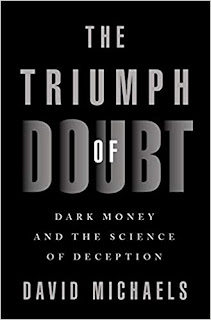
"A government insider exposes the industry playbook for undermining evidence-based policy."

Reviewed in my latest Science Magazine. Had to get it.
https://www.amazon.com/Triumph-Doubt-Money-Science-Deception-ebook/dp/B082VD4GHK/ref=pd_ybh_a_11?_encoding=UTF8&psc=1&refRID=RAVDG70XVF23NBR4S99E
At the dawn of a new decade and in a pivotal election year, we face unprecedented challenges that threaten the environment, public health, and security. Meanwhile, dark money is being funneled through powerful lobbyists, plaguing the process of enacting informed, evidence-based policies. David Michaels's new book, The Triumph of Doubt, is a tour de force that examines how frequently, and easily, science has been manipulated to discredit expertise and accountability on issues ranging from obesity and concussions to opioids and climate change.

Michaels is the quintessential voice on the influence of special interests in policy-making and government inaction. An epidemiologist and professor of environmental and occupational health at George Washington University, he spent 7 years leading the U.S. Occupational Safety and Health Administration (OSHA) under President Obama and previously served as President Clinton's assistant secretary of energy for environment, safety, and health.

His book offers account after account of unethical bad actors working against the public good on issues ranging from asbestos to climate change. Powerful firms and individuals seeking personal gain repeat the tactics of a well-worn playbook of denial and misdirection proven effective by Big Tobacco more than 50 years ago. Michaels pulls no punches, naming the corporations and people responsible for fraud, deception, and even what he terms “climate terrorism.” He reveals the dirty ways that industries have succeeded at shaping their own narratives regarding safety and health by producing articles and diversions designed to deny and distort science while confusing the public…

Every chapter is deeply disturbing yet feels familiar because the tactics—and at times even the actors—are the same. The book will, and should, infuriate readers and serve as a call to action to demand more government oversight and regulation on health and safety issues that affect every citizen regardless of party affiliation.

Michaels begins the final chapter by acknowledging that capitalism has the capacity to produce extreme wealth and economic development at a cost to our health and the environment. The book closes with a sense of unease and urgency, offering practical steps to strengthen U.S. regulatory oversight, provide more funding transparency, and increase corporate accountability.

Only when we begin to recognize the abuse of power that is rampant in decisions that affect the health and safety of our families and communities will we understand our necessary role in demanding scientific integrity in policy-making…
You even get reviewed in Science Magazine, you tend to have presumptive cred; they don't waste space on weak stuff. I'm almost done reading it. Stay tuned. It's excellent.

"Deliberation Science?" Is that a thing?

See also "Define science."

David Michaels concludes:
Regulation Defends Capitalism
The catalog of horrors that has necessitated the growth of America’s public health regulatory system is long. It includes everything from the conditions in Chicago’s slaughterhouses (exposed by novelist Upton Sinclair in The Jungle) to cigarettes and asbestos to climate breakdown and the widespread PFAS contamination of drinking water. In each case, corporations making a product caused damage and externalized the costs. Litigation is typically valuable in redressing the public’s grievance, but it is not sufficient for changing the root issues, in part because litigation always occurs after the fact. By the time the lawsuit is filed, too many people have been sickened, or maimed, or killed—to say nothing of how the environment has been desecrated. 

Our regulatory system is the response to these market failures. The objectives of the new laws and the agencies empowered to enforce them is not only to stop the damage and prevent future harm; it is to maintain and strengthen the free market system. Although many advocates of free market economics refuse to acknowledge this dynamic, law and regulation are the underpinnings of our economic system. They define market structure and property rights while attempting to ensure that property rights don’t intrude on personal liberties. Without the regulatory apparatus of the state, our modern economy could not exist. The state fosters a safe space for market growth.

We all value freedom, in particular the freedom to live the lives we choose. But this is not possible unless we are secure from being harmed by others, and in our modern world we individuals cannot bargain with the factory owner or the manufacturer of contaminated food. We generally have little or no knowledge of the effects of a given exposure, or sometimes that such exposures are even occurring. It is our elected representatives and officials who must enact and enforce laws that protect us from individual and collective harm—from violence and from robbery, but also from dangers posed by tainted food, polluted air and water, unsafe drugs, and dangerous workplace exposures.

Science underpins all of these public health and environmental protections. The basic principle of the regulatory system holds that decisions must be made on the basis of the best evidence available at the time. Product defense science doesn’t just game our free-market system; it prevents our government from accomplishing one of the reasons for its very existence. It is often unrecognized because it is so ingrained in our understanding that a primary government function is to facilitate some individuals (including the owners of corporations) to benefit by producing or performing something that does not impinge on the freedom and well-being of other individuals. This is the basis of the criminal justice system, as well as our system of public health and environmental protections. We want stronger regulation not because we don’t care about freedom, but because we cannot be free without the state’s protection from harm. We need to know that our air is safe to breathe, that our food is safe to eat, and that we can return home from work at the end of our shifts no less healthy than when we walked out the door in the morning. That is both the imperative and, alas, the challenge.

Michaels, David. The Triumph of Doubt (pp. 270-272). Oxford University Press. Kindle Edition.
I will have a lot more to say shortly once I finish.

UPDATE

Finished.  Table of Contents:
  1. Introduction
  2. The Science of Deception
  3. The Forever Chemicals
  4. The NFL’s Head Doctors
  5. A Spirited Denial
  6. The Deal with Diesel
  7. On Opioids
  8. Deadly Dust
  9. Working the Refs
10. Volkswagen’s Other Bug
11. The Climate Denial Machine
12. Sickeningly Sweet
13. The Party Line
14. Science for Sale
15. Future in Doubt

Disclosures and Acknowledgments
Notes
Index
An important read. Although my wife and I have worked in highly regulated domains since the 1980s--FAA, EPA, DOE, NRC, OSHA, HHS, OCC, FDIC--and are fairly up to speed on regulatory processes and issues, I learned some great new stuff on the tactics and strategies of the "product defense" lobby industries.

Dr. Michaels is definitely cutting against the current de-regulatory neoliberal grain, which prioritizes the privatization of corporate profits concomitant with the socialization of risks and losses (dramatically accelerated under the Trump administration). I am reminded of a couple of recent reads.

to wit:
In a seminal study, Naomi Oreskes and Erik Conway have reconstructed the attempts of a handful of scientists, aligning themselves with corporate and political interests, to obscure scientific findings and limit their impact on democratic decision-making processes by spreading doubt in the public sphere.48 An essential ploy was to distract people’s attention from the core facts to marginal issues, for example, by discussing the role of volcanos rather than the effects of anthropogenic air pollution. This strategy (involving massive lobbying activities as well as corporate-funded research) was first successfully practiced in the 1950s with regard to the health risks of tobacco and was then reiterated and refined for other issues such as acid rain, the ozone hole, and climate change. It cynically exploits the open-ended nature of scientific discourse to create the impression that it is always too early to make such drastic decisions as prohibiting smoking in certain environments, stopping the use of CFCs, or limiting the emission of greenhouse gases. 

But why can this strategy work at all? It profits, first of all, from the highly differentiated division of labor in modern societies. Science is a complex societal subsystem, seemingly of little direct concern to most of the rest of society. One of its visible interfaces with society is an oversimplified image of knowledge shaped by past experiences, as well as by ideologies. In the United States, in particular, it has been influenced by the experience of the Cold War and neoliberal convictions: society-at-large relies on science when it comes to military challenges, to conquering new frontiers, and to securing commercial superiority. Science, essentially, is an asset in competitive situations, where it is expected to produce technical solutions. 

From the perspective of this image of knowledge, the warnings of critical scientists of the unintended side-effects of industrial, technological, or scientific developments appear to be a transgression of their natural sphere of activity; they mingle with politics and create problems, rather than delivering tangible solutions, optimally, in the form of technology. Against this background, it becomes easy for their opponents to cast doubt on their results, and even on their personal integrity, and to call for further, “more serious” research before any actions are taken that do not belong to the sphere of technology but to the sphere of societal regulations. Counteracting the strategic spread of misinformation therefore requires critical engagement with problematic images of science as well as with the economy of knowledge through which scientific knowledge (and misinformation) are shared within society, as has recently also been argued in a contribution to the journal Nature Climate Change:
As science continues to be purposefully undermined at large scales, researchers and practitioners cannot afford to underestimate the economic influence, institutional complexity, strategic sophistication, financial motivation and societal impact of the networks behind these campaigns. The spread of misinformation must be understood as one important strategy within a larger movement towards post-truth politics and the rise of “fake news.” Any coordinated response to this epistemic shift away from facts must both counter the content of misinformation as it is produced and disseminated, and (perhaps more importantly) must also confront the institutional and political architectures that make the spread of misinformation possible in the first place.
As it turns out, only a small fraction of the funds invested into research and development worldwide are dedicated to the augmentation of public knowledge. And even publicly funded research may suffer from constraints and path dependencies imposed by political or economic interests, or by the academic system itself—encouraging, for instance, a concentration of research on mainstream topics, with the danger that precisely the knowledge required to deal with the challenges of the Anthropocene may fail to be generated or publicly shared. What currently prevails is an “oligopolization of knowledge: when few know much, and many know little.” This oligopolization of knowledge is, of course, conditioned by the oligopolization of power—and vice versa. The risk is that the innovations necessary to meet the challenges of the Anthropocene are stymied, in particular when they present themselves in forms that may require locally adapted solutions rather than universal prescriptions. 

One example of the lack of research on key topics is the way in which the global challenges of disease are being addressed. Diseases are not only part of biological evolution; they are also part of cultural evolution, and they are becoming a challenge of epistemic evolution as well. They have emerged, for instance, from contact between humans and animals in domestication processes. One such example is smallpox, which was transferred from rodents to humans some millennia ago in the age of the Neolithic Revolution. Today global traffic, global nutrition chains, and global inequality of living conditions have set a new stage for the emergence and spread of bacterial and viral diseases. Diseases may constitute challenges that affect societies and economies on a global scale, even if they do so in extremely different ways in different parts of the world. While human health is probably better now than at any other time in history, this progress may have come at the price of degrading the environment and thus at the cost of future generations; and it may now be threatened by the consequences of our interventions in the Earth system. Knowledge produced in the traditional mode (as a by-product of cultural evolution through basic research and market-driven innovations) may turn out to be inadequate to cope with these challenges.

Renn, Jürgen. The Evolution of Knowledge (pp. 392-393). Princeton University Press. Kindle Edition.
Human affairs inexorably get "regulated" one way or another. Apologies to my "Libertarian" friends.

A note on law and "regulation." Trump fatuously never tires of touting his talking-point insistence that "for every new regulation issued, at least two existing ones must be eliminated."

The bulk of federal regulations are "statutory" in nature, authorized "as the Secretary shall determine" in passed and signed legislation. Think of laws as "policies" and regulations as "procedures." The policies (laws) set forth the "what" and the "why." The procedures (regulations) specify the "who/how/where/when" actions via which to administer the laws. Federal regulations cannot legally exceed the scopes of the parent laws. When they do, they are quickly challenged and struck down or modified.

Are there ineptly promulgated laws and regulations? Of course. The remedy is to make them more rational, focused, and effective, not simply do away with them. Again, human affairs get regulated one way or another.
If there were only one man in the world, he would have a lot of problems, but none of them would be legal ones. Add a second inhabitant, and we have the possibility of conflict. Both of us try to pick the same apple from the same branch. I track the deer I wounded only to find that you have killed it, butchered it, and are in the process of cooking and eating it. 

The obvious solution is violence. It is not a very good solution; if we employ it, our little world may shrink back down to one person, or perhaps none. A better solution, one that all known human societies have found, is a system of legal rules explicit or implicit, some reasonably peaceful way of determining, when desires conflict, who gets to do what and what happens if he doesn’t.

Friedman, David D.. Law's Order: What Economics Has to Do with Law and Why It Matters (p. 3). Princeton University Press - A. Kindle Edition.
UPDATE: THE LATEST ON BEING "DATA DRIVEN"

On deck. apropos of this post.
https://www.amazon.com/Power-Experiments-Decision-Making-Data-Driven-ebook/dp/B084P2SD7Y/ref=tmm_kin_swatch_0?_encoding=UTF8&qid=&sr=
Per The New Yorker.

The Amazon blurb:
How organizations—including Google, StubHub, Airbnb, and Facebook—learn from experiments in a data-driven world.

Have you logged into Facebook recently? Searched for something on Google? Chosen a movie on Netflix? If so, you've probably been an unwitting participant in a variety of experiments—also known as randomized controlled trials—designed to test the impact of different online experiences. Once an esoteric tool for academic research, the randomized controlled trial has gone mainstream. No tech company worth its salt (or its share price) would dare make major changes to its platform without first running experiments to understand how they would influence user behavior. In this book, Michael Luca and Max Bazerman explain the importance of experiments for decision making in a data-driven world.

Luca and Bazerman describe the central role experiments play in the tech sector, drawing lessons and best practices from the experiences of such companies as StubHub, Alibaba, and Uber. Successful experiments can save companies money—eBay, for example, discovered how to cut $50 million from its yearly advertising budget—or bring to light something previously ignored, as when Airbnb was forced to confront rampant discrimination by its hosts. Moving beyond tech, Luca and Bazerman consider experimenting for the social good—different ways that govenments are using experiments to influence or “nudge” behavior ranging from voter apathy to school absenteeism. Experiments, they argue, are part of any leader's toolkit. With this book, readers can become part of “the experimental revolution.”
_____________

More to come...