Search the KHIT Blog

Showing posts sorted by relevance for query dobbs. Sort by date Show all posts

Friday, June 24, 2022

"The Constitution does not confer a right to abortion;"

"Roe and Casey are overturned;"
 
Women have now effectively been written out of the 14th Amendment.
"The authority to regulate abortion is returned to the people and their elected [state] representatives."
Former Vice President Mike Pence wasted no time in coming out in support of federal legislation outlawing abortion nationwide.


Justice Alito asserts that, because the word "privacy" does not appear in the Constitution, it "confers" no such right. Well...
 
 
This goes to an old beef of mine going back decades.

I ran an ASCII text copy of the complete U.S. Constitution through a text analysis program.
Exported the results to an Excel sheet, where I tabulated the summary findings.

Pick an English language word at random. Raw base probability is about 99.5% that it won't be in the U.S. Constitution. So spare me that fatuous notion that because a given word doesn't appear in the Constitution, there can be no associated right. If the 4-word phrase "secure in her person" has any meaning at all, it comprises a lexically clear synonym for presumptive "privacy." (In that regard, the logical semantic meanings of phrases is what matters, not individual words. Need we seriously have to point that out? Apparently so.)
And, no, "presumptive" is not a synonym for "absolute." C’mon, people. Moreover, kindly spare me the old Borkian "privacy to to what, senator?" canard. The Constitution is not a checkbox tally sheet of fine-grained behavioral specifics.
A dark day, this one.

Curiously, no mention of Loving vs Virginia.
 
UPDATE: FINE TOPICAL ARTICLE
‘A revolutionary ruling – and not just for abortion’: A Supreme Court scholar explains the impact of Dobbs

The Supreme Court’s decision to reverse 50 years of constitutional protection for the right to get an abortion is more than 200 pages long. Morgan Marietta, a political scientist at the University of Massachusetts, Lowell, and editor of the annual SCOTUS series at Palgrave Macmillan, studies the ideas and ideology of the court. We asked him to illuminate the thinking that lies behind the momentous decision.

What does this ruling mean?


This is a revolutionary ruling. Not just for abortion, but for the ongoing debates over the nature of rights under the Constitution.

The ruling signals a massive change in how we read the Constitution, from a living reading to an original reading. The court has firmly rejected the theory of the living Constitution, which argues that the meaning of the document’s language changes as the beliefs and values of Americans change.

The living view, which prevailed at the Supreme Court during the second half of the 20th century, means that additional rights can emerge over time, including abortion, privacy and same-sex marriage. The living Constitution is updated through the judgment of the justices of the Supreme Court, who determine when public values have changed, and hence new rights have emerged.

Originalism, which is the approach taken by the justices who overruled Roe, rejects the living Constitution. In the originalist view, the Constitution is static until officially altered by amendment. It does not evolve on its own without public approval. The role of the justices is to determine the original public meaning of the text, but to leave other decisions to democratic representation through elections.

Regarding abortion, the conclusion of Dobbs is clear: “The Constitution does not prohibit the citizens of each State from regulating or prohibiting abortion. Roe and Casey arrogated that authority. We now overrule those decisions and return that authority to the people and their elected representatives.”

“Arrogated” is an unusual word; it means to take without justification, implying that it is done in an arrogant way. That is the core argument of Dobbs: Roe was the court being arrogant, taking power the justices didn’t have, which rightly belongs with “the people,” a Revolutionary-era term in a revolutionary ruling…
Worth yout time. Read all of it. There has been an absolute blizzard of excellent analytical commentary writing online since the Alito Opinion was published on Friday. I've been reading away since the decision was announced.

MORE DR. MORGAN
The explicit rights clearly described and enumerated in the Bill of Rights — freedom of religion, freedom of speech, freedom to bear arms and others — are rising in influence, specifically because they have been approved and ratified by the people.
I have to again (Quixotically?) call emphatic Bullshit on spurious assertions that the 4th Amendment, in contrast to the examples alluded to above, does not "enumerate" a presumptive, broad right to privacy. Other fundamental individual prerogatives set forth in the Bill of Rights are equally brief and lacking in detailed specifics. And, then there's the 9th Amendment.  to wit, citing my 1998 grad Thesis: 
While the word “privacy” admittedly appears nowhere in the text of the Bill of Rights, neither do the terms “obscenity,” “sodomy,” “pregnancy,” “sacred marital bedroom,” or “drug abuse.” Those who espouse a view of the Constitution as a document of broad moral principles find such lack of specificity compelling in their argument against simplistically limited textual “strict construction.” Indeed, the 9th Amendment—“The enumeration in the Constitution of certain rights shall not be construed to deny or disparage others retained by the people”—is universally cited by “broad construction” advocates to counter the observation that the specific term “privacy” is absent from the Constitutional language. To the “Constitution-of-Principle” advocate, the very brevity and generality of the Constitutional text is dispositive evidence that, far from being a document essentially no different than a commercial insurance contract, the “large-C” Constitution provides the general vision of justice and procedural guidelines for those who must administer ongoing the “small-c” constitution comprised of the very breadth of our social fabric.
SO, WHAT'S NEXT?
 
Democrats vow to enact a federal law guaranteeing abortion/reproductive autonomy rights nationally. Republican aggressively vow the opposite—federally outlawing abortion nationwide (so much for deference to the states). Given the current (and likely lengthy) makeup of the Supreme Court, Democrats have the more difficult task, i.e., legislation worded in a way that can survive an immediate SCOTUS challenge. Beyond that, hard-right activists will openly push for outlawing contraception, same-sex marriage (& perhaps interracial wedlock), and all things LGBTQIA. Gonna be a mess.

Like we don't already have enough to tend to.

DOBBS UPDATE
 
Dr. Michelle Goodwin in the NY Times:
No, Justice Alito, Reproductive Justice Is in the Constitution 
 
...Black women’s sexual subordination and forced pregnancies were foundational to slavery. If cotton was euphemistically king, Black women’s wealth-maximizing forced reproduction was queen.

Ending the forced sexual and reproductive servitude of Black girls and women was a critical part of the passage of the 13th and 14th Amendments. The overturning of Roe v. Wade reveals the Supreme Court’s neglectful reading of the amendments that abolished slavery and guaranteed all people equal protection under the law. It means the erasure of Black women from the Constitution.

Mandated, forced or compulsory pregnancy contravenes enumerated rights in the Constitution, namely the 13th Amendment’s prohibition against involuntary servitude and protection of bodily autonomy, as well as the 14th Amendment’s defense of privacy and freedom...

The 14th Amendment opens with the sentence, “All persons born or naturalized in the United States … are citizens of the United States and of the State wherein they reside” and as such would be protected by the laws of the United States. Such language applied to infants born to Black women, changing the provisions of law that had long denied Black children citizenship and the protection of laws. Lawmakers were understandably concerned about overturning states laws that had denied children the dignity of personhood.

Justice Samuel Alito’s claim, that there is no enumeration and original meaning in the Constitution related to involuntary sexual subordination and reproduction, misreads and misunderstands American slavery, the social conditions of that enterprise and legal history. It misinterprets how slavery was abolished, ignores the deliberation and debates within Congress, and craftily renders Black women and their bondage invisible.

It is no hyperbole to say that the Supreme Court’s decision in the Dobbs case is in league with some of the darkest rulings — Plessy v. Ferguson, which opened the floodgates to “separate but equal” laws that ushered in Jim Crow, and Buck v. Bell, which sanctioned states’ eugenics laws permitting forced sterilization of poor women
___
"Enumeration"—the act or process of making or stating a list of things one after another; the list itself.
 
4th Amendment—"The right of the people to be secure in their persons, houses, papers, and effects..."
 
"Secure"—free from danger; affording safety; free from risk of loss. 

SECURITY, PRIVACY, AND LIBERTY
The Dobbs ruling’s insistence that the Court should not impede states from making policies in which they weigh the interest in life for themselves, through their democratic processes, is tragicomic, even gruesome, coming the very day after the Court did just that in striking down a New York State gun-licensing law, based on the Court’s expansion of an individual right to bear arms under the Second Amendment.

In Planned Parenthood v. Casey, the plurality that reaffirmed Roe v. Wade wrote that “liberty finds no refuge in a jurisprudence of doubt”—meaning that, if the public is in doubt about whether constitutional rights are in danger of disappearing, that is not liberty. Dobbs leaves no doubt that the federal constitutional right to abortion is gone. And it ushers in an era of grave doubt about the status of liberty in the United States
.—Jeannie Suk Gersen, Harvard Law School
"An era of grave doubt about the status of liberty in the United States."

Particularly—for now—the Constitutional liberty of women.
 
__________
 

Sunday, May 21, 2023

"A Professor with a Twitter account."

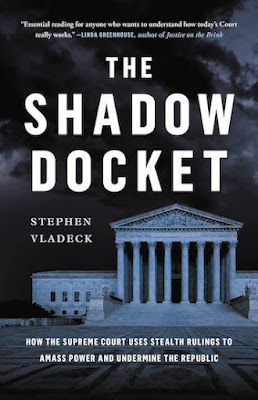
And now, a compelling new book release.

 
I've been eagerly awaiting this book release for weeks. It did not disappoint one whit. Clear jargon-free prose, great recounting of SCOTUS history (and the broader US judiciary) going back all the way to the Founding, as well as astute and acute analyses of emergent Article III "shadow docket" trends.
 
Totally a 5-Star read. 
“This book began as nothing more than a series of tweets. I’ve always been both professionally and personally interested in some of the more arcane areas of the Supreme Court’s practice, but it wasn’t until the fall of 2017—after the June 2017 travel ban ruling and a series of subsequent Supreme Court orders over that summer—that I started to see the germ of a more focused study of the Court’s evolving behavior through unsigned orders.” [pg 307]
A professor with a Twitter account.

...Judge Kacsmaryk, who has come to national attention in recent weeks as he considers in a separate case whether to issue a nationwide injunction banning the most common form of medication abortion in a lawsuit that could’ve been brought anywhere in the country, but was brought in Amarillo—entirely so that it would be heard by Kacsmaryk (whose anti-abortion views are well known). If all Judge Kacsmaryk did in his Tuesday ruling was deny the DOJ’s motion to change venue in the ESG case, it wouldn’t be much of a story. But in the course of rejecting the DOJ’s arguments, Kacsmaryk decided to come after me—even though I’m not involved in that case in any way.

First, he dismissed the (incontrovertible) evidence of Texas’ behavior as “an amicus brief filed by a professor with a Twitter account.” Leaving aside that the amicus brief to which he’s referring, once again, was filed in a different court in a different case, this clumsy attempt at a burn (lots of professors—and lawyers—have Twitter accounts) never comes close to addressing the substance of my trifling little tweets. If I had posted my data to a more academic site, would it somehow be more compelling?

But in a footnote, he took an even subtler and more personal shot, suggesting that “mercifully,” the late Texas Law Professor Charles Alan Wright “did not live long enough to endure the ‘tweet and repeat’ indignity of the Twittersphere.” Just to make the dig clear, I currently hold the Charles Alan Wright Chair in Federal Courts at the University of Texas School of Law. It’s hard to say what exactly Kacsmaryk intended to convey by name-checking the man whose chair I have the honor of holding; no doubt it was meant as another fire-emoji-level burn of me personally. But it’s a remarkably childish and churlish shot for a sitting federal judge to take at a non-party for the sin of amassing accurate data in support of a position he doesn’t like.

Indeed, there’s a lot to say about this passage. Were Professor Wright here, he might note how much of a stickler he was for both judicial decorum and for the importance of preserving the courts’ institutional reputation (he was also an early adopter of new technology; his Twitter account would’ve been lit). Since he’s not, I’ll note what it says about a judge that he’d go out of his way to try to denigrate someone with no direct involvement in a case before him for no other reason than scoring points (on Twitter, one presumes) and auditioning for a promotion in the next Republican administration. You wouldn’t think “I’m owning libs, so I’d make a great appellate judge” would be a persuasive argument, but here we are.

Then there’s the extent to which, again, it’s not actually responsive to any of the data I’ve gathered or the arguments I’ve made against the practice Kacsmaryk is endorsing. There’s the pettiness (to say nothing of the inaccuracy) of the “your chair’s namesake would disapprove” nonsense. But most of all, there’s the sense that this kind of behavior is beneath the dignity of a life-tenured federal judge with the power (at least for the moment) to issue rulings with nationwide implications…

As I noted in a prior post,
 
A woman's reproductive decisions are rightfully no one else's business. And, the improper ideological extrajudicial motives of this fundamentalist "Christian" judge, Matthew Kacsmaryk, could not be more clear.

Back to Steve Vladeck.
PREFACE
History books will teach that the Supreme Court eliminated the constitutional right to abortion on June 24, 2022. That’s when five justices officially overruled Roe v. Wade in a Mississippi case known as Dobbs v. Jackson Women’s Health Organization. Lost in the shadows will be another decision that the Court handed down almost ten months earlier, two minutes before midnight on September 1, 2021. That night, the same five justices who would later form the majority in Dobbs refused to block Texas’s ban on abortions after the sixth week of pregnancy—a point at which many do not yet know they’re even pregnant. Even though the Texas law, known as “SB8,” or the Texas Heartbeat Act, was clearly (and deliberately) inconsistent with Roe, five justices allowed it to go into effect. Justice Samuel Alito’s June 2022 opinion for the majority in Dobbs, which was publicly joined by Justices Clarence Thomas, Neil Gorsuch, Brett Kavanaugh, and Amy Coney Barrett, laid out, in 108 pages, a series of arguments about why the US Constitution should not be understood to protect a right to abortion, and why the Court’s prior decisions recognizing such a right should be overruled. The unsignedi September 2021 order in a dispute known as Whole Woman’s Health v. Jackson, in contrast, which no justice publicly endorsed, spanned just 401 words.

Unlike Dobbs, the cryptic order in Whole Woman’s Health did not expressly overrule the 1973 ruling in Roe that had first recognized abortion as a constitutional right. Instead, the single paragraph penned by the majority offered a technical reason for the Court’s refusal to block Texas’s abortion ban, noting that there were unresolved questions about whether the plaintiffs in that case had sued the right defendants. But for those on the ground in Texas, that was a distinction without a difference. By the morning of September 2, abortion providers across the nation’s second-largest state had largely shut their doors. From then on, most Texans needing abortions who had the means to travel out of state for the procedure did so. For those who couldn’t leave, Roe was a dead letter, effectively if not formally, from the Red River to the Rio Grande.

The Court’s refusal to stop Texas’s law from going into effect was a harbinger of things to come. After all, the same five justices—Thomas, Alito, Gorsuch, Kavanaugh, and Barrett—had used similar unsigned orders to block numerous state COVID restrictions over the previous year. Those decisions had established new—and more expansive—constitutional protections for religious worship compared to precedents. What’s more, many of the orders blocking COVID restrictions had come in cases where it was even less clear than in the Texas dispute that the justices could reach the merits of the constitutional question; indeed, the earlier rulings ran roughshod over some of the very procedural obstacles the majority cited in the Texas case. If the Court was nevertheless justified in intervening in those cases to protect a new understanding of constitutional rights, what did it say about the future of abortion that it wouldn’t intervene to protect an old one?

The paltriness of its legal reasoning notwithstanding, the unsigned order in the Texas case had a monumental impact in the real world. In that respect, it was no outlier. In recent years, the justices have issued a raft of similar orders, many containing even less analysis than the September 2021 ruling in the Texas case, that have produced massive substantive effects. From abortion to asylum; from elections to evictions to executions; from COVID vaccinations to the Clean Water Act; and from redistricting to religious liberty, the Court’s new conservative majority has used obscure procedural orders to shift American jurisprudence definitively to the right…
[pp 8-10
]
I was riveted by this book, glued to the couch for hour after hour.with my iPad. The text is now awash in Kindle highlighter, bookmarks, and notations. This is an important read.
 
A professor with a Twitter account.
  

Dude has cred. Kacsmaryk?
 
 
I am certainly no lawyer, much less a ConLaw one. But neither am I some clueless yet opinionated Barstool Barrister always at the shoot-at-the-lip ready to pop off on all things jurisprudential. I spent considerable time in grad school plumbing the opaque depths of various core facets of constitutional law relevant to my thesis topic. Across the ensuing 25 years, my study has routinely continued (hence the topic of this post). The more I learn, the less I sometimes feel I know in the aggregate.
 
Nonetheless, I ankle-bite episodically, and try to add more signal than noise.

MONDAY UPDATE: NPR
 
"The title sounds more like a thriller than a legal treatise. The Shadow Docket: How the Supreme Court uses stealth rulings to amass power and undermine the republic" — and the author, University of Texas law professor Stephen Vladeck, admits the term "shadow docket" is evocative.

Vladeck's book, written so it can be understood by the interested non-lawyer, focuses on a part of the court's work that until six or seven years was mainly viewed as pretty boring…


 "Are you CRYING?..."
MORE UPDATES
 
A great way to spend an hour. These people are certainly fast on their cognitive "feet."
 

OK, THIS STUFF IS HARDLY ACADEMIC
8 women join suit over Texas' abortion bans, claim their lives were put in danger

…Two plaintiffs, Kiersten Hogan and Elizabeth Weller, had their water break prematurely, but were both told to wait until they were sick enough to receive abortion care, according to a draft of the suit.

Hogan was allegedly told that if she tried to leave the hospital to seek care elsewhere she could be arrested for trying to kill her baby, according to a draft of the suit. She was kept in the hospital until she went into labor four days later in the hospital bathroom and delivered her son stillborn.

Weller had to wait until she developed an infection before a hospital approved her abortion despite her losing almost all her amniotic fluid, which a pregnancy is not viable without, according to a draft of the suit.

Kylie Beaton and Samantha Casiano said they were both forced to carry nonviable pregnancies to term…
That is obscene.
 
OFF-TOPIC ERRATUM
 
While many of us in the U.S. angrily vent ad nauseum over Our Constitutional Right To Not Be Inconvenienced, on Day 452 of Putin's 3-day Conquest of Ukraine...

A twenty-two-year-old Ukrainian sniper, code-named Student, stuffed candy wrappers into his ears before firing a rifle at the Russians’ tree line. He’d been discharged from the hospital two weeks earlier, after being shot in the thigh.
__________
 

Wednesday, May 4, 2022

2022 Mother's Day greetings from Justice Alito

Mother's Day will now be mandatory. "It is so ordered."
JUSTICE ALITO delivered the (Dobbs v Jackson, leaked first draft] opinion of the Court.

Abortion presents a profound moral issue on which Americans hold sharply conflicting views. Some believe fervently that a human person comes into being at conception and that abortion ends an innocent life. Others feel just as strongly that any regulation of abortion invades a woman's right to control her own body and prevents women from achieving full equality. Still others in a third group think that abortion should be allowed under some but not all circumstances, and those within this group hold a variety of views about the particular restrictions that should be imposed.

For the first 185 years after the adoption of the Constitution, each State was permitted to address this issue in accordance with the views of its citizens. Then, in 1973, this Court decided Roe v. Wade, 410 U. S. 113. Even though the Constitution makes no mention of abortion, the Court held that it confers a broad right to obtain one. It did not claim that American law or the common law had ever recognized such a right, and its survey of history ranged from the constitutionally irrelevant (e.g. its discussion of abortion in antiquity) to the plainly incorrect (c.g, its assertion that abortion was probably never a crime under the common law). After cataloguing a wealth of other information having no bearing on the meaning of the Constitution, the opinion concluded with a numbered set of rules much like those that ‘might be found in a statute enacted by a legislature.’

Under this scheme, each trimester of pregnancy was regulated differently, but the most critical line was drawn at roughly the end of the second trimester, which, at the time, corresponded to the point at which a fetus was thought to achieve “viability,” ic., the ability to survive outside the womb. Although the Court acknowledged that States had a legitimate interest in protecting “potential life,” it found that this interest could not justify any restriction on pre-viability abortions. The Court did not explain the basis for this line, and even abortion supporters have found it hard to defend Roe's reasoning. One prominent constitutional scholar wrote that he “would vote for a statute very much like the one the Court ended up drafting ”if he were “a legislator,” but his assessment of Roe was memorable and brutal: Roe was “not constitutional law” at all and gave almost no sense of an obligation to try to be.” …

Roe was egregiously wrong from the start. Its reasoning was exceptionally weak, and the decision has had damaging consequences. And far from bringing about a national settlement of the abortion issue, Roe and Casey have enflamed debate and deepened division.

It is time to heed the Constitution and return the issue of abortion to the people's elected representatives. “The permissibility of abortion, and the limitations upon it, are to be resolved like most important questions in our democracy: by citizens trying to persuade one another and then voting.”…

…As we have explained, ‘procuring an abortion is not a fundamental constitutional right because such a right has no basis in the Constitution's text or in our nation's history…

VI
‘We end this opinion where we began. Abortion presents a profound moral question. The Constitution does not prohibit the citizens of each State from regulating or prohibiting abortion. Roe and Casey arrogated that authority. We now overrule those decisions and return that authority to the people and their elected representatives.

‘The judgment of the Fifth Circuit is reversed, and the case is remanded for further proceedings consistent with this opinion.

it is so ordered.
_______
 
98 pages of arrogant, disingenuous, cherry-picking, confirmation bias "argument." (Though, really, the latter third comprises simply a summary compilation of the various state suits seeking to overturn Roe and Casey.)

 
The vapid "Originalist / Textualist" assertion.
OK, there are 171,476 "active" words in the English language (per Oxford Dictionary). There are 7,591 words comprising the U.S. Constitution—Preamble through the 27th Amendment. Within those there are 1,153 discrete words, 555 of which appear only once. Pick any English word at random. The base probability of it not being in the Constitution is 99.7%.

apropos of this issue, a curious small sample of other words not to be found therein: explicit, implicit, male(s), woman, women, child, children, female(s), reproduction, reproductive, ovum, conception, contraception, pregnant, pregnancy, gestation(al), fetus, unborn, birth, childbirth, infant, baby, mother, personhood...

You (should) get the idea.

Phrases not found: Separation of powers, separation of church and state, co-equal branches, checks and balances, Unitary Executive...

Seriously, need we continue?
Justice Alito wants it both ways. Imagine my surprise. Who wouldn't? So, pro-choice advocates "must show that the right is somehow implicit in the constitutional text?" What part of the 14th Amendment "Equal Protection clause" clear, explicit language escapes you, sir? Yeah, I know, back during the time of the 14th Amendment debate, women were not regarded as "persons," right? They were politically "not part of our nation's history."
It was in fact argued in 1868 during Senate debate that that had been Framer James Madison's view.
Being at one demonstrably "pro-life and pro-choice," I've been posting on this issue for 14 years. As a male, I have misgivings about even proffering my opinion (but, my opinion is hardly grounded in philosophical abstractions).
 
No.

Cutting to the chase, a woman's reproductive decisions are no one else's business, male or female, individual or institutional. These decisions are not the legitimate turf of socio-politcal plebiscites, nor judicial interventions.
“How dare they? How dare they tell a woman what she can do and cannot do with her own body?” —Vice President Kamala Harris
And, I know full well we may lose that argument, politically. The adverse upshot will extend far and wide.
 
________

UPDATE
 
Yeah, he festooned his draft with enough window dressing to keep Ginni Thomas measuring the White House drapes for years
 
OK, what's the "logic" here? The "if/then/therefore/else" stuff?
 
And, yeah, I know Dobbs is not a "law." It's at this point a "legislative fetus."

We might also note the prior "case-law" references:
Heller, 509 U.S, at 319, 320
FCC v. Beach Communications, Inc., 508 U.S. 307, 313
New Orleans, 421 U.S, at 303
Williamson v. Lee Optical of Okla., Inc. 348 U.S. 483, 491
Gonzales, 550 U.S, at 157-158
Roe, 410 U.S. at 150
Glucksberg, 521 U.S., at 728-731
Of course, properly, we'd have to assess their materiality individually, in full. What "evidence" do they add? "You get what you inspect, not what you expect."
 
This type of exasperating pedantry comes from the tedious grad school "Argument Analysis and Evaluation" method. You first thoroughly and clearly establish what is being argued. Only subsequent to that deconstructive effort can you undertake to "evaluate" it.
The foregoing is from one paragraph. There are well in excess of 100 (not counting footnotes) in Alito-Dobbs.
Note that the foregoing assertive passage makes no mention whatsoever about the woman's right to physical and moral autonomy, which is apparently assumed to be subordinate, notwithstanding the charming cover-your-ass sop proffered in 3.2. (And, 3.6 simply leaves me scratching my head.)

Alito asserts [pg 9] that Roe “held that the abortion right, which is not mentioned in the Constitution, is part of a right to privacy, which is also not mentioned.”
 
Yeah, that insipid albeit hardy perennial "textualist" beg-off.
 
I am not a lawyer, and certainly make no claim to constitutional expertise broadly, but I will put my 4th Amendment chops up against his any day. e.g., two chapters from the online draft of my 283 pg 1998 graduate thesis: Chapter 4, and Chapter 5.
...While the word “privacy” admittedly appears nowhere in the text of the Bill of Rights, neither do the terms “obscenity,” “sodomy,” “pregnancy,” “sacred marital bedroom,” or “drug abuse.” Those who espouse a view of the Constitution as a document of broad moral principles find such lack of specificity compelling in their argument against simplistically limited textual “strict construction.” Indeed, the 9th Amendment—“The enumeration in the Constitution of certain rights shall not be construed to deny or disparage others retained by the people”—is universally cited by “broad construction” advocates to counter the observation that the specific term “privacy” is absent from the Constitutional language. To the “Constitution-of-Principle” advocate, the very brevity and generality of the Constitutional text is dispositive evidence that, far from being a document essentially no different than a commercial insurance contract, the “large-C” Constitution provides the general vision of justice and procedural guidelines for those who must administer ongoing the “small-c” constitution comprised of the very breadth of our social fabric..
C'mon, people.

"I think it [the Alito Dobbs draft opinion] is intellectual and historically bankrupt. The founding document did not list all of the rights we have. It doesn't say anything about our right to marry, our rights to decide how to bring up our children, our freedom to think what we will. It protects liberty in very broad terms. It protects equality.”


"This idea by Justice Alito -- he is backed by the right-wing of the court and by many right-wing activists, this idea that the Constitution protects only those rights that are listed and those rights that are rooted in a misogynist history that really did not take account of women at all. It is simply a prescription for turning the clock back, not just to the 1950s, but to the 1850s. It is a regressive approach, it is not consistent with our trajectory of constitutional rights, which have expanded and expanded."


   — Harvard Law Professor Emeritus Lawrence Tribe, on MSNBC

LAWYER & WRITER JILL FILOPOVIC
Demand more of men. Some men are out front of this issue; most of them are not. Where are the men in your life? Are they speaking out about how abortion rights have made their lives better, directly or indirectly? Are they only willing to support pro-choice politicians? Are they also protesting, making phone calls, talking about this with their friends, and donating their money? Are they as invested in this fight as you are? And if not — how much do they really value you, or women more generally? What role do you want them to play in your life? If you’re a man reading this, consider how abortion rights have affected you. If you got someone pregnant who had an abortion (and maybe that happened but you don’t know about it), how did that choice allow you to live the life you have now? If a loved one has had an abortion — and I promise you, someone you love has had an abortion — how did that allow her to live the life she has now? How have all of the ways in which abortion rights made women freer and safer improved your life and the lives of those you love?
Am I doing enough? Probably not.
 
JUST IN
Click here.
Just came to my attention via PBS Newshour. Kathryn Kolbert, Julie F. Kay. Bought it.
______
 
BTW, tangentially, broadly apropos,

 
SNL IS ON IT
 
 
CODA
Liberty No More
If Roe v. Wade is overturned, the very definition of what it means to be American will change for women and girls in the United States.
By Adrienne LaFrance

How strange it is, the condition of having a body, of being a body. Consider the sponge of the marrow that makes your blood, the skeleton frame that holds in your organs, the tendons that attach your muscles to bone, the heart that pumps blood through your veins, the electrical signals that travel along the optic nerve from your retinas, the neural networks that light up the galaxies of your brain like constellations.

A person’s interiority—your sense of youness—is typically understood to be situated in the mind, yet the mind and the body are inextricable. What, then, must it mean to be in possession of a body in America? This is, we are told, a land of tremendous abundance, of self-reliance, of liberty, and of invention. The promise America makes to its people, the covenant that we Americans can feel in our bones and in our blood and in our beating hearts, is the guarantee that we are free.

Liberty is given to us by God, by nature, by our own humanity—not by government. I am American and so I am free to speak, free to publish, free to worship, free to assemble, free to keep and bear arms. It is to me self-evident that I am free to pursue the life I choose, without interference from the state. Freedom of mind does not come without freedom of body.

If Roe v. Wade is overturned, as now appears likely, the very definition of what it means to be American will change for women and girls in the United States. If the state makes a claim to your body—a claim therefore to your self—you can no longer be American, not truly. To allow the state to control the body of a citizen is to deny her full personhood. To allow the state to control the body of a citizen is to undermine the very notion of what America is, the core promise it makes.

Abortion presents, as Justice Samuel Alito writes in his draft opinion in the Dobbs case, “a profound moral issue.” None of us can claim to understand with certainty the mysteries of human life. As medicine and science have advanced, the moral questions about abortion that we must contemplate have only grown more complicated. But none of that changes the fact that government control of women’s bodies—interference from the state that obliterates women’s freedom and in some cases ends their lives—represents a monumental blow to human rights…
Read all of it. Pay it forward. Below, one last report.
Republicans Are Wasting No Time Pushing Dystopian Post-Roe Laws
It’s gonna get so bad
Having all but won the SCOTUS abortion war—the GOP’s twisted, totalitarian worldview is being laid bare for the entire world to see.
Max Burns, Daily Beast


It’s only been a week since the explosive leak of a draft Supreme Court decision presaging the end of 50 years of legal abortion in America. But the GOP is wasting no time building its bleak, authoritarian successor state.


Having seemingly won their signal victory on abortion, Republicans do not have time for messy things like participatory democracy, only the raw exercise of power.


 What Republicans are planning goes far beyond ending legal abortion as defined in the landmark case Roe v. Wade—and past what even many self-identified Republican voters want.
 
In court challenges and proposed legislation from Idaho to Florida to Congress, the GOP has expanded its war on reproductive freedom to include their worst theocratic fever dreams.

Criminalization of miscarriages. Bans on condoms, IUDs, and other forms of birth control. Stripping pre-existing abortion protections from state constitutions.


These laws and bills represent not only the biggest backwards step in reproductive freedom in American history, they finally showcase the GOP’s twisted, totalitarian worldview for the entire world to see...
OH, AND ONE MORE THING
 

My veneration of both parenthood and Motherhood is unassailable.
__________
 

Monday, June 24, 2024

Samuel Alito's Dobbs Love Child turns two

   
Moreover, let's be perfectly clear about the intentions of the Alito camp allies.
 
 
The 900+ page Project 2025 "Action Plan Playbook" (pdf) negatively cites the word "abortion" 198 times (repeatedly conflating it with other hated "liberal" policies), and is utterly clear regarding its reactionary "Christian conservative" goal of establishing constitutionally-protected, vigilantly-enforced "Personhood at Conception."
 
JOHN OLIVER ON PROJECT 2025
 

134 days to the November 5th 2024 U.S. elections.
 
RELENTLESS WHITE CHRISTIAN NATIONALIST THEOCRATS
 

I have no problem with any of these reactionary people and groups advocating for their fatuous causes (look up the two doozy books depicted above). Where they cross over from advocacy to (more and more overt) coercion is where my red line resides.

 
Below, just ran across these two beauts on TwitterX:
 

JUNE 25 UPDATE

"Trump 2024 examines the presidency of Donald Trump through the eyes of 25 Evangelical Leaders. These leaders include:

Dennis Prager, Franklin Graham, Mike Huckabee, Tony Perkins, Irvin Baxter, Jerry Boykin, Damon Friedman, Brigitte Gabriel, Jack Graham, Harry Jackson, Jack Hibbs, Dr. Robert Jeffress, Alveda King, Mike Lindell, Bob McEwen, Eric Metaxas, Star Parker, Tony Perkins, Sammy Rodriguez, Dave Robbins, Don Stewart, Stephen Strange, Randall Terry, Paula White, Jeff Wickwire."
Quite the crew.
 
BRIAN KLAAS
Five Reasons Trump 2.0 Would Be Worse
There's a widespread misconception that a second Trump term would be just like the first. That's a catastrophic misreading of American politics—and the unprecedented risks if he wins. 

Brian rocks.

 
More to come...
_________
   

Sunday, July 10, 2022

A world of hurt


136 days of obscene Russian war (crimes) against Ukraine as of July 10th, with no end in sight. And, 121 days until the U.S. mid-term elections, portending the possible beginning-of-the-end of our Democracy (fully culminating in 2024 should the GOP retake the White House, assuming they gain control of Congress this November).
 
In that regard, the U.S. Supreme Court "conservative / textualist" supermajority has now struck down womens' federal reproductive rights via the Dobbs decision (nullifying Roe), made it easier to obtain handguns by overturning New York's permit regulations on "concealed carry," invalidated EPA Clean Air Act environmental regulatory authority, and further eroded the separation of Church and State via their Maine religious schools and Bremerton WA "kneeling Christian football coach" rulings. SCOTUS has also agreed to next hear cases intended to accord state legislatures unreviewable plenary authority to summarily appoint "Presidential Electors," irrespective of previously certified state popular vote tallies.
 
Inflation is now (unsurprisingly) rampant, globally. People in the underdeveloped world face massive looming starvation. War, droughts, adverse climate change comprise enervating force multipliers...
 
Had I not direct multigenerational offspring, perhaps I'd have fewer [bleeps] to give.
 
“We just have a few more tragedies to report before we can get to the fun stuff.”
 
RECOMMENDED READING
 
"Autistic isolation," LOL. Mic drop.

Don't take my word for it. Do Your Own Research. 
 
TOPICAL ERRATA
Confirmation bias is normal human behavior. What’s not normal is the emergence of a populist madness on the American right that counts on the intimidation of the sensible many by the delusional few. This development threatens to turn a great republic into little more than a collection of unthinking and dangerous reflexes, its citizens like a school of fish aimlessly darting back and forth as they are lured by bait or chased by predators…

…That means it’s up to us to assert those norms and values in everything we do in our daily life. It means that citizens of good will must hold their ground, calmly and without reacting to the many bad-faith provocations thrown at them. It means linking arms with people with whom we disagree about almost everything, so long as we agree on the Constitution and our rights as citizens…
—Tom Nichols, @TheAtlantic
 ON JUSTICE CLARENCE THOMAS
...In his second year on the Court, Thomas said that he was “proudly and unapologetically irrelevant and anachronistic.” Almost thirty years later, he has become what conservatives of every era seek to be: anachronistic and relevant.

Under Thomas’s aegis, the Court now assumes a society of extraordinary violence and minimal liberty, with no hope of the state being able to provide security to its citizens. In his Bruen concurrence, Alito extends Thomas’s history of Reconstruction to all modern America: “Many people face a serious risk of lethal violence when they venture outside their homes.” Like the Black citizens of Reconstruction, he argues, few of us should expect the police to protect us. “The police cannot disarm every person who acquires a gun for use in criminal activity,” Alito writes, “nor can they provide bodyguard protection for [New York] State’s nearly 20 million residents.”

Once upon a time, Alito’s claims of systemic danger and state incapacity would have been dismissed as the rantings of a mountain survivalist. But, after decades of mass shootings, his assertion that the cops can’t protect you reads as a corollary to the left’s warning that the cops won’t protect you. What makes both beliefs plausible is the failed state that America has become, with no small amount of help from Thomas, the right-wing Court, and elected officials from both parties.

Today’s felt absence of physical security is the culmination of a decades-long war against social welfare. In the face of a state that won’t do anything about climate change, economic inequality, personal debt, voting rights, and women’s rights, it’s no wonder that an increasing portion of the population, across all races, genders, and beliefs, have determined that the best way to protect themselves, and their families, is by getting a gun. A society with no rights, no freedoms, except for those you claim yourself—this was always Thomas’s vision of the world. Now, for many Americans, it is the only one available. —Corey Robin, the @NewYorker
MORE ON THE CURRENT SCOTUS SUPERMAJORITY
Watching Justice Samuel Alito go spelunking in his Dobbs opinion through centuries of so-called history and tradition in search of legal justifications to overturn the right to abortion decided almost 50 years ago in Roe v. Wade was like watching a boy play in a pile of dirt. Where do I dig next, he seemed to be muttering to himself as he shoveled manure from a slave-era law in Virginia onto an 18th-century pile of garbage he quoted from some doofus who believed women were inferior beings. Clarence Thomas was right there behind him in his decision that New York can't prevent people from carrying concealed weapons, plowing through statutes from jolly old England and the American frontier to show that Dodge City didn't really mean it when they told cowboys they had to check their six-guns with the sheriff if they came into town.

And then along came Chief Justice Roberts as clean-up man, swinging the club of something known as the "major questions doctrine" to deny the Environmental Protection Agency its statutory authority to — duh — protect the environment unless Congress spells out exactly how they should do it. According to Roberts, it is Congress, not the EPA, that has to write a rule telling corporations they can't empty industrial waste directly into creeks, rivers or the ocean because it's a "major question" if it costs corporations a lot of money, so let's make it as hard as possible for the government to take a chunk out of our golf buddies' bottom lines…

All of this in service to their favorite doctrine of all — rights granted by the Constitution must be "deeply rooted in the nation's history and tradition" or they aren't really rights at all. Legal scholars have been predicting that the court will use its new jewel of a doctrine to overturn Obergefell v. Hodges, not to mention other recent decisions recognizing rights under the privacy provision of the equal protection clause of the 14th Amendment … because we have no "history and tradition" of same-sex marriage or gay sex or rubbers or the pill, or anything else they simply don't like...
—Lucian K. Truscott IV, @Salon
__________