Search the KHIT Blog

Showing posts with label DNA. Show all posts

Friday, June 3, 2022

New concerns regarding your DNA, a Creative Commons cross-post

Genetic paparazzi are right around the corner, and courts aren’t ready to confront the legal quagmire of DNA theft
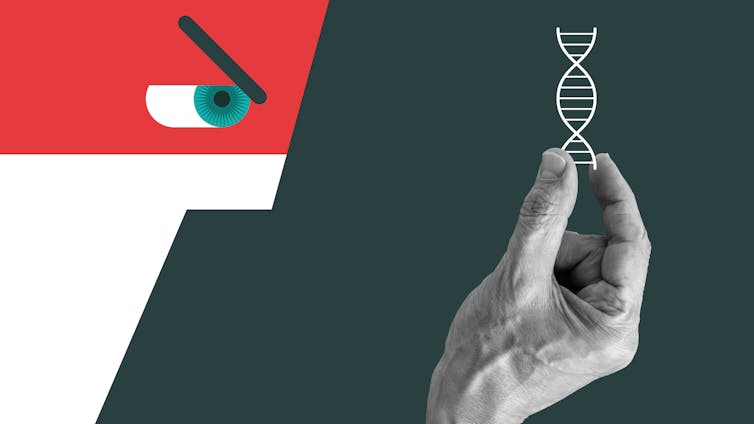
DNA is a trove of personal information that can be hard to keep track of and protect. Boris Zhitkov/Moment via Getty Images
Liza Vertinsky, University of Maryland and Yaniv Heled, Georgia State University

Every so often stories of genetic theft, or extreme precautions taken to avoid it, make headline news. So it was with a picture of French President Emmanuel Macron and Russian President Vladimir Putin sitting at opposite ends of a very long table after Macron declined to take a Russian PCR COVID-19 test. Many speculated that Macron refused due to security concerns that the Russians would take and use his DNA for nefarious purposes. German Chancellor Olaf Scholz similarly refused to take a Russian PCR COVID-19 test.

While these concerns may seem relatively new, pop star celebrity Madonna has been raising alarm bells about the potential for nonconsensual, surreptitious collection and testing of DNA for over a decade. She has hired cleaning crews to sterilize her dressing rooms after concerts and requires her own new toilet seats at each stop of her tours.

At first, Madonna was ridiculed for having DNA paranoia. But as more advanced, faster and cheaper genetic technologies have reached the consumer realm, these concerns seem not only reasonable, but justified.

Putin and Macron sitting at opposite ends of a long table
For some, keeping one’s distance might be a preferable alternative to getting one’s DNA stolen. AP Photo/Pool Sputnik Kremlin

We are law professors who study how emerging technologies like genetic sequencing are regulated. We believe that growing public interest in genetics has increased the likelihood that genetic paparazzi with DNA collection kits may soon become as ubiquitous as ones with cameras.

While courts have for the most part managed to evade dealing with the complexities of surreptitious DNA collection and testing of public figures, they won’t be able to avoid dealing with it for much longer. And when they do, they are going to run squarely into the limitations of existing legal frameworks when it comes to genetics.

Genetic information troves

You leave your DNA behind you everywhere you go. The strands of hair, fingernails, dead skin and saliva you shed as you move through your day are all collectible trails of DNA.

Genetic analysis can reveal not only personal information, such as existing health conditions or risk for developing certain diseases, but also core aspects of a person’s identity, such as their ancestry and the potential traits of their future children. In addition, as genetic technologies continue to evolve, fears about using surreptitiously collected genetic material for reproductive purposes via in vitro gametogenesis become more than just paranoia.

In vitro gametogenesis (IVG), while still in development, could allow prospective parents to create egg or sperm from other parts of the body, like skin.

Ultimately, taking an individaul’s genetic material and information without their consent is an intrusion into a legal domain that is still considered deeply personal. Despite this, there are few laws protecting the interests of individuals regarding their genetic material and information.

Existing legal frameworks

When disputes involving genetic theft from public figures inevitably reach the courtroom, judges will need to confront fundamental questions about how genetics relates to personhood and identity, property, health and disease, intellectual property and reproductive rights. Such questions have already been raised in cases involving the use of genetics in law enforcement, the patentability of DNA and ownership of discarded genetic materials.

In each of these cases, courts focused on only one dimension of genetics, such as privacy rights or the value of genetic information for biomedical research. But this limited approach disregards other aspects, such as the privacy of family members with shared genetics, or property and identity interests someone may have in genetic material discarded as part of a medical procedure.

In the case of genetic paparazzi, courts will presumably try to fit complex questions about genetics into the legal framework of privacy rights because this is how they have approached other intrusions into the lives of public figures in the past.

Modern U.S. privacy law is a complex web of state and federal regulations governing how information can be acquired, accessed, stored and used. The right to privacy is limited by First Amendment protections on the freedom of speech and press, as well as Fourth Amendment prohibitions on unreasonable searches and seizure. Public figures face further restrictions on their privacy rights because they are objects of legitimate public interest. On the other hand, they also have publicity rights that control the commercial value of their unique personally identifying traits.

People whose genetic material has been taken without their consent may also raise a claim of conversion that their property has been interfered with and lost. Courts in Florida are currently considering a conversion claim in a private dispute where the former CEO of Marvel Entertainment and his wife accused a millionaire businessman of stealing their DNA to prove that they were slandering him through a hate-mail campaign. This approach replaces the narrow legal framework of privacy with an even narrower framework of property, reducing genetics to an object that someone possesses.

What the future may hold

Under existing laws and the current state of genetic technology, most people don’t need to worry about surreptitious collection and use of genetic material in the way that public figures might. But genetic paparazzi cases will likely play an important role in determining what rights everyone else will or will not have.
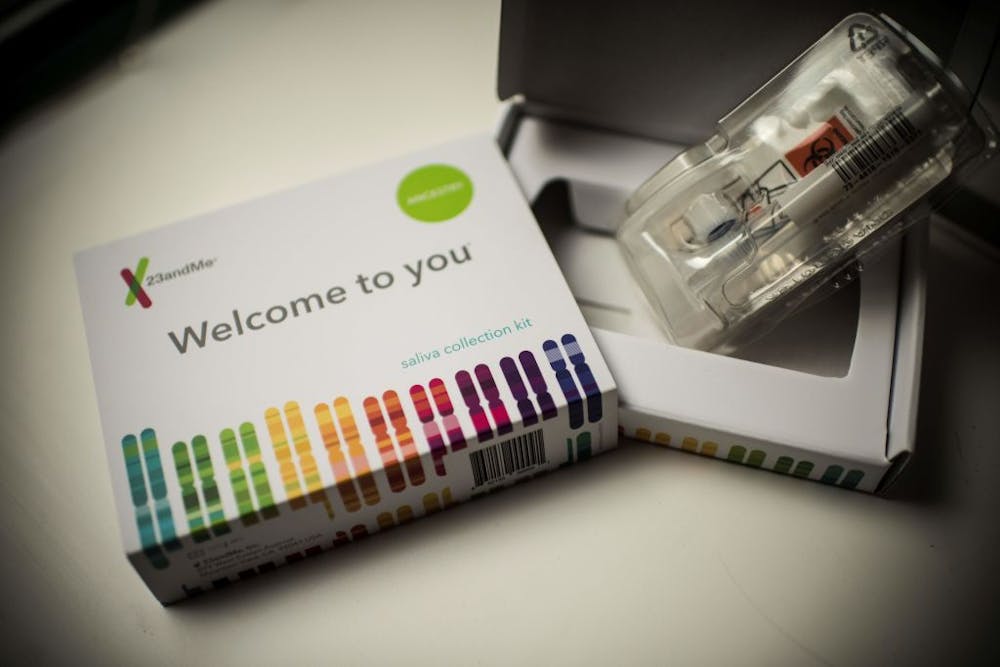
Open 23andMe genetic testing kit
As DNA testing technology advances, questions about genetic privacy and ownership will only become more complex. Eric Baradat/AFP via Getty Images

The U.S. Supreme Court is very unlikely to recognize new rights, or even affirm previously recognized rights, that are not explicitly mentioned in the Constitution. Therefore, at least at the federal level, individual protections for genetic material and information are not likely to adapt to changing times.

This means that cases involving genetics are likely to fall within the purview of state legislatures and courts. But none of the states have adequately grappled with the complexities of genetic legal claims. Even in states with laws specifically designed to protect genetic privacy, regulations cover only a narrow range of genetic interests. Some laws, for example, may prohibit disclosure of genetic information, but not collection.

For better or for worse, how the courts rule in genetic paparazzi cases will shape how society thinks about genetic privacy and about individual rights regarding genetics more broadly. 
~~~~~~

Liza Vertinsky, Professor of Law, University of Maryland and Yaniv Heled, Associate Professor of Law, Georgia State University

This article is republished from The Conversation under a Creative Commons license. Read the original article.
_________________________
 
I'd intended to post some stuff about day 100 of Putin's invasion of Ukraine today, but the foregoing got my attention. Thought it would be worth your time.
 
File this one under "Malign Technologies."
 
OTHER STUFF
 
The pile-on of late of all the seriously bad news worldwide has slowed me down, but I keep plodding on. Several more books now in play:
 
 
The latter title goes to my abiding interest in so-called "Deliberation Science."
My son recently got called to Baltimore jury service. Now that the trial has concluded, we can talk about it. One of his fellow jurors was this ProPublica journalist. Great article. Stay tuned; there will be stuff to explore and recount from Nick's perspective.
"Inside The Juror." Not available in Kindle edition, so I've been slogging away with the pen and yellow highlighter. Stay tuned.
 
 
__________
 

Wednesday, November 3, 2021

"Malign Technologies?"

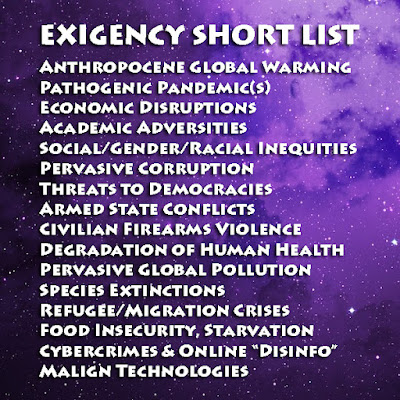
Added one to my exigencies list.

Yeah, and, again, lots of recursive cause/effect overlap in the foregoing, some of it probably transient. But, a lot of it likely increasing in adverse intensity.
Mulling over adding Fentanyl (etc) to the list (lethally dangerous addictive intoxicants). Might it warrant its own category line item? Or would it suffice to just be implicitly subsumed under Degradation of Human Heaith?
"Malign technologies?" See, for one recent example, my prior post on "synthetic media / deep fakes." I see a decided skew on the "malignancy vs. beneficence" relative potential balance beam. What of "Artificial Intelligence" more broadly? Applications of genomics?

Yeah, blah, blah, blah, "technology is morally neutral." Right.

BTW: I got'cher Malign Disinfo Technology right here. "Threats to Democracy?"
___

Whenever my Science Magazine arrives, I typically head straight for the book reviews.

 
Found this yesterday.
 

Since humankind’s first migration out of Africa, we have trimmed, trained, and reshuffled the tree of life at breakneck speed. In the past 10,000 years, we learned to manipulate the basic building blocks of life through breeding. In the past century, we increased the speed and magnitude of our impact through mass global transportation, industrialized agriculture, and urbanization. In the past decade, we have seen major advances in biotechnology that now allow us to directly rewrite the genetic code of almost any organism to create never-before-seen biological variation.

Our unmatched ability to destroy, reshape, and rebui
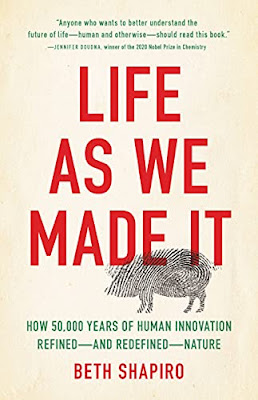
ld life to suit our purposes has allowed our species to become an evolutionary force rivaled only by the five major mass extinctions of Earth’s past. Evolutionary biologist Beth Shapiro explores this legacy in her new book, Life as We Made It.

In eight chapters, Shapiro takes readers on a succinct and compelling journey through historical events, inventions, and decisions that have forever changed the course of life on Earth…

Shapiro’s latest literary work makes plain that human intervention will likely be necessary to confront the problems we currently face and that biotechnology has an important role to play across a range of issues, from saving species teetering on the brink of extinction to curing disease to feeding a growing human population…

In what is perhaps the greatest accomplishment of Life as We Made It, Shapiro clearly articulates key questions whose answers will define how we think about and use the power we now yield. In a world that has been remixed and remade by humans several times over, what is “natural”? When and how should we intervene in evolution? Who should make this call?…

In a world where we can engineer life in much the same way we engineer skyscrapers, we are bounded more by imagination than by ability. But while buildings will eventually deteriorate in the sands of time, life will keep on ticking. In Life as We Made It, Shapiro offers readers a history lesson from which to pull both caution and inspiration. In doing so, she sets the table for a needed conversation about our lasting imprint on the tree of life. It is up to us to take a seat.

It's customary in Science book reviews to give 'em the venerable "Praise-Criticism-Praise Sandwich" workover.

Not one disparaging word about this book. Hmmm... "Purchase instantly with 1-Click."


And Off We Go...
THE LAST DECADE HAS SEEN DEVELOPMENT OF POWERFUL BIOTECHNOLOGIES that are at the same time astonishing, encouraging, and pretty scary. Cloning, genome editing, synthetic biology, gene drives—these are words and phrases that promise a different kind of future, but is it a welcome future? On the one hand, technological advance is a good thing. Biotechnology stops us from getting sick, cures diseases that we already have, and makes our food taste better and stay fresh longer. On the other hand, biotechnology creates things that feel weirdly unnatural, like corn with embedded bacterial genes and chickens that lay eggs out of which ducklings hatch.1 In fact, it is increasingly difficult to find anything that hasn’t been sullied by people in some way. And while scientists race to protect the natural things and spaces that remain, crises like offshore oil spills, rising extinction rates, and emerging infectious diseases demand solutions beyond what our existing technologies can achieve. Should we dig in, embrace the power of modern science, and look ahead to a future where bacteria clean up our messes and where hairy elephants roam Siberian fields while sterilized mosquitoes buzz overhead? Or should we resist this future and stop messing with things before it is too late?

For many, a future filled with human-modified plants and animals is bleak. Engineered microbes, mammothified elephants, and mosquitoes that can’t transmit disease would probably benefit people in some way, but creating them just isn’t right, and a world that includes them is somehow false. To those who feel this way, there is a tendency to blame science. Thanks to scientists and their twenty-first-century technologies, our world is on the precipice of a metamorphosis beyond which lies a new nature, one created entirely by and for people, and one that is anything but natural. This nervous narrative assumes, however, that humans have only just begun to meddle with nature—that the border between natural and unnatural is obvious and unblurred. History, however, and archaeology and paleontology and even genomics, tells a different story. In studying the past, we learn that people have been shaping the evolution of the living things around us throughout our history. Within the last 50,000 years, our ancestors hunted, polluted, and outcompeted hundreds of species to extinction. They turned wolves into Boston terriers, teosinte into popcorn, and wild cabbage into kale, broccoli, cauliflower, brussels sprouts, and collard greens (to name a few). As our ancestors learned to hunt, to domesticate, and to travel, their actions and movements created opportunities for species to adapt and evolve. Some species survived their encounters with humans, but many did not, and all were transformed in some way. Living things today are as we made them, shaped in part by the randomness of evolution and in part by less random human intent…


Shapiro, Beth. Life as We Made It (pp. 9-11). Basic Books. Kindle Edition.
Stay tuned. Interesting person. Very impressive.

 
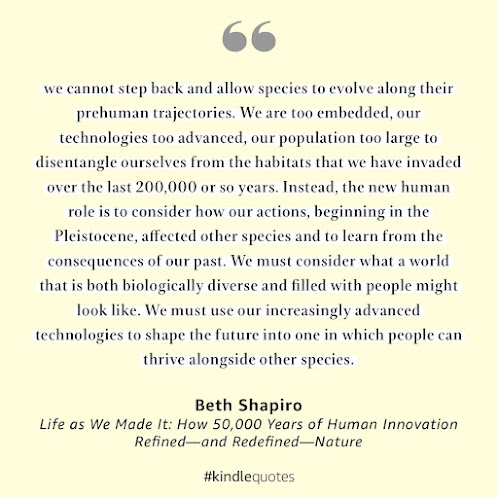
Over the last 50,000 years, we transformed the plants and animals with which we share our planet into lineages that are exquisitely adapted to today’s world, where the dominant evolutionary force is us.

We are, however, a different kind of evolutionary force. Evolution is a random walk through experimental space. Evolution does not evaluate risk before making decisions about which breeding experiments to perform, but we do. Evolution doesn’t care what the next generation looks like or even if the next generation survives, but we do. Evolution is not guiding horses or wheat or cattle or bison to any particular fate, but we are. And this is where the contradiction in our opposition to our biotechnologies is laid bare. We resist biotechnologies precisely because they give us the control over evolution that humans have continuously worked to achieve. Evolution will not get us to a future that we predetermine. Our biotechnologies, however, can.

The decisions that we make over the next decades will determine our own fate and the fate of other species, perhaps far into the future. We can choose to take advantage of our technologies as they develop, to use synthetic biology to make even more with less, to protect wild species and wild spaces, and to do so in a sustainable way. Or we can reject our new biotechnologies and follow this same path anyway, just more slowly and with less success.

Biotechnologies can be frightening, in particular when they are new. We still have lots of work to do to make our technologies safe, to learn how to assess risk, to collaborate at a global scale. But biotechnologies also give us reason to be hopeful. The world is changing, and people and animals and ecosystems are suffering. Biotechnologies give us the power to help. We can change the evolutionary trajectories of species destined to become extinct. We can clean up our trash and make our farms more efficient. We can cure diseases that afflict us and other species. We can create and sustain a world in which wild species thrive in natural spaces and where people are healthy and happy and decidedly in charge. [Beth Shapiro, pp. 313-314]
__________