Search the KHIT Blog

Showing posts with label extinction. Show all posts

Tuesday, December 17, 2024

Klaas is once again in session: Taleb's turkey.

The Zero Numerator problem.
  
I: Don’t Draw a Black Ball from the Urn of Invention

“It is an unnerving thought,” Bill Bryson once wrote, “that we may be living the universe's supreme achievement and its worst nightmare simultaneously.” Our sensations of awe and beauty, our intense ability to love, our self-aware consciousness may each be unparalleled—a rare instance of the universe perceiving itself.1

But as humans, we also possess an awesome capability known to no other species on the planet: we can make ourselves extinct. No matter how much octopuses scheme or chimpanzees twirl rudimentary tools, they cannot destroy themselves. We are in our own club, trapped in a cage of existential risk—designed by our cleverness, as seemingly inescapable as the march of progress, and with the unfortunate potential to kill us all…

…[F]or those who favor complacency, it’s important to note: just because something has been alright for a long time, doesn’t mean it will continue to be alright forever. Taleb uses the parable of the turkey on a farm, a plump bird who sees the farmer as a lovely man who comes to bring him food, without fail, every day. The farmer is his friend, his provider, his carer—until one day, right before Thanksgiving, ruin comes unexpectedly. We would be wise not to be that turkey.

V: We Don’t Have to Destroy Ourselves

If Bostrom is correct that a black ball is lurking in the urn, then he points to two possible solutions to mitigate our cataclysmic end. The first is a non-starter: create such extensive policing surveillance that “any halfwit” can’t destroy humanity because every halfwit is constantly being monitored to ensure they don’t take advantage of an “easy nukes” scenario.

The more realistic scenario is difficult, but not impossible: true global governance of existential risks. This requires unprecedented cooperation to avoid unprecedented consequences. So far, our track record is not great…

…[As] Filippa Lentzos of King’s College London explained to me previously, there still is no international organization with enforcement power that regulates or inspects all of the most potentially dangerous labs in the world—those known as biosafety level 4, or BSL-4 labs. It’s such an obvious area of potential risk—and we continue to allow a laissez-faire attitude, leaving these decisions mostly to national governments. The same is broadly true of artificial intelligence, where the technology is rapidly outpacing regulation.

But we don’t have to accept reckless courting of existential risk. If we fear a black ball is being withdrawn from the urn, we have the power to stop it. It’s a choice…

The point is not to suggest that existential risks are overblown—they’re clearly not. Whether it’s extreme climate change, nuclear apocalypse, devastation from artificial intelligence, mirror life or other biothreats, we are living in an unprecedented era of a new power—the power to destroy ourselves.

But humans can be astonishingly wise when it counts most; if we demand that our leaders take these threats more seriously; and if our politicians have the courage to create new, powerful international agencies that have the teeth to manage and mitigate the lurking black balls that could end our species, then I’d be far more willing to bet on humanity’s longevity.

Despite our cornucopia of flaws, we are worth saving; a species defined not just by our maddening defects, but by our unique curiosity, wonder, awe, love, beauty, ingenuity, and kindness. And yet, nobody can save us but ourselves…
Yeah, Klaas is once again back in session. The foregoing is excerpted from his Substack newsletter series. Do yourself a favor. Read his books and subscribe to his Stack. See also this post.

This stuff coheres nicely with two books in progress at the moment.
 
 
From The Demon in the Machine
FROM THE IDEA FACTORY
Introduction
WICKED PROBLEMS

This book is about the origins of modern communications as seen through the adventures of several men who spent their careers working at Bell Telephone Laboratories. Even more, though, this book is about innovation—about how it happens, why it happens, and who makes it happen. It is likewise about why innovation matters, not just to scientists, engineers, and corporate executives but to all of us. That the story is about Bell Labs, and even more specifically about life at the Labs between the late 1930s and the mid-1970s, isn’t a coincidence. In the decades before the country’s best minds began migrating west to California’s Silicon Valley, many of them came east to New Jersey, where they worked in capacious brick-and-glass buildings located on grassy campuses where deer would graze at twilight. At the peak of its reputation in the late 1960s, Bell Labs employed about fifteen thousand people, including some twelve hundred PhDs. Its ranks included the world’s most brilliant (and eccentric) men and women. In a time before Google, the Labs sufficed as the country’s intellectual utopia. It was where the future, which is what we now happen to call the present, was conceived and designed.

For a long stretch of the twentieth century, Bell Labs was the most innovative scientific organization in the world. It was arguably among the world’s most important commercial organizations as well, with countless entrepreneurs building their businesses upon the Labs’ foundational inventions, which were often shared for a modest fee. Strictly speaking, this wasn’t Bell Labs’ intended function. Rather, its role was to support the research and development efforts of the country’s then-monopolistic telephone company, American Telephone & Telegraph (AT&T), which was seeking to create and maintain a system—the word “network” wasn’t yet common—that could connect any person on the globe to any other at any time. AT&T’s dream of “universal” connectivity was set down in the early 1900s. Yet it took more than three-quarters of a century for this idea to mature, thanks largely to the work done at Bell Labs, into a fantastically complex skein of copper cables and microwave links and glass fibers that tied together not only all of the planet’s voices but its images and data, too. In those evolutionary years, the world’s business, as well as its technological progress, began to depend on information and the conduits through which it moved. Indeed, the phrase used to describe the era that the Bell scientists helped create, the age of information, suggested we had left the material world behind. A new commodity—weightless, invisible, fleet as light itself—defined the times.

A new age makes large demands. At Bell Labs, it required the efforts of tens of thousands of scientists and engineers over many decades—millions of “man-hours,” in the parlance of AT&T, which made a habit of calculating its employees’ toil to a degree that made its workers proud while also keeping the U.S. government (which closely monitored the company’s business practices and long-distance phone monopoly) at bay. For reasons that are conceptual as well as practical, this book does not focus on those tens of thousands of Bell Laboratories workers. Instead, it looks primarily at the lives of a select and representative few: Mervin Kelly, Jim Fisk, William Shockley, Claude Shannon, John Pierce, and William Baker. Some of these names are notorious—Shockley, for instance, who won the Nobel Prize in Physics in 1956 and in his later years steadfastly pursued a scientific link between race and intelligence. Others, such as Shannon, are familiar to those within a certain area of interest (in Shannon’s case, mathematics and artificial intelligence) while remaining largely unknown to the general public. Pierce, a nearly forgotten figure, was the father of satellite communications and an instigator of more ideas than can be properly accounted for here. Kelly, Fisk, and Baker were presidents of the Labs, and served as stewards during the institution’s golden age. All these men knew one another, and some were extremely close. With the exception of Mervin Kelly, the eldest of the group, they were sometimes considered members of a band of Bell Labs revolutionaries known as the Young Turks. What bound them was a shared belief in the nearly sacred mission of Bell Laboratories and the importance of technological innovation.

The men preferred to think they worked not in a laboratory but in what Kelly once called “an institute of creative technology.” This description aimed to inform the world that the line between the art and science of what Bell scientists did wasn’t always distinct. Moreover, while many of Kelly’s colleagues might have been eccentrics, few were dreamers in the less flattering sense of the word. They were paid for their imaginative abilities. But they were also paid for working within a culture, and within an institution, where the very point of new ideas was to make them into new things…


Gertner, Jon. The Idea Factory: Bell Labs and the Great Age of American Innovation (pp. 1-3). Penguin Publishing Group. Kindle Edition. 
NOTEWORTHY
  
 
Hmmm... "Wicked Problems?" Recent book I've read. 
 
UPDATE: CLAUDE SHANNON OF BELL LABS


I don't know that my Dad ever knew him. Pop worked in semiconductor R&D, one of myriad lower level lab technicians. 
 
More shortly...
_________
  

Tuesday, April 23, 2024

The increasingly immodest children of a modest star

What would governance look like if our planetary condition was central rather than ancillary to our political self-conceptions? What issues would become paramount, and how might this change our views? How would we act if we took seriously humanity’s profound integration into Earth’s planetary systems, demonstrated by the COVID pandemic, from the microbiological scale of the virus to the macrosystemic scale of the planet’s atmosphere? What would change as a result of human beings being revealed, not as masters of the planet, but as part of it? 


Human beings are essentially and ineluctably embedded within planetary-scale phenomena: we affect and are affected by our Earthly home. Western science, which is the bedrock of modern technology, politics, and worldviews, however, emerged in large measure in denial of this embeddedness. Springing from a secularized distillation of Christian belief (“And God said, Let us make man in our image,” according to King James’ Genesis, “and let them have dominion . . . over all the earth”), this scientific tradition rested on the precept that humans were inherently different from all of God’s other creatures. Unlike the beasts, the “fowl of the air,” and “every thing that creepeth upon the earth,” humankind was endowed with reason and a capacity, if not moral duty, for technical mastery over the natural world—a unique inheritance that set us humans apart from nature. Yet the scientific method that developed over time from those precepts—a method of inquiry rooted in the scrutiny of evidence and radical skepticism—has, by the early twenty-first century, revealed that there is no separation between human beings and the natural world. In a triumph of the scientific method, the tools of science overturned science’s most basic assumptions. This insight has been percolating for about a century, catching the attention of the occasional forward-thinking scientist, but it is now increasingly clear that the idea of humans distinguished from nature is intellectually unsustainable. It is, moreover, ecologically ruinous. The idea of “humanity apart” is, and for a long time has been, encouraging grave harm to the ecosystems in which humans dwell and the biosphere of which humans are a part. 


These discoveries have changed the face of science and, in turn, have triggered a rupture in philosophy. But these insights about the state of the world and our place in it have yet to trickle out of the scientific labs, specialist journals, and rarified seminar rooms and into the mainstream consciousness. They certainly have not yet affected how societies act. With this book, we hope to change that. Given what we now know—and are likely to still learn—about Earth and the place of humans on it, the question that animates this book is: What should we do about it? 


Our answer is that we must transform our modes and systems of governance, which is to say the institutionalized social rules that tell us how we are supposed to live in common…


Blake, Jonathan S.; Gilman, Nils (2024-04-22T23:58:59.000). Children of a Modest Star. Stanford University Press. Kindle Edition. 

Another new book. apropos of core exigent / existential concerns...
 
"Human beings are essentially and ineluctably embedded within planetary-scale phenomena: we affect and are affected by our Earthly home. Western science, which is the bedrock of modern technology, politics, and worldviews, however, emerged in large measure in denial of this embeddedness. Springing from a secularized distillation of Christian belief (“And God said, Let us make man in our image,” according to King James’ Genesis, “and let them have dominion . . . over all the earth”), this scientific tradition rested on the precept that humans were inherently different from all of God’s other creatures. Unlike the beasts, the “fowl of the air,” and “every thing that creepeth upon the earth,” humankind was endowed with reason and a capacity, if not moral duty, for technical mastery over the natural world—a unique inheritance that set us humans apart from nature..."
A lot to reflect upon, in light of the topics of recent posts here. 
 
 Not to mention new findings.
 
Click
Does "sentience" bring with it "legal rights?" Irrespective of species?

Stay tuned...
_________
   

Saturday, August 20, 2022

Dr. Justin Gregg: Some new unsparing thinking on human "intelligence."

“Human, all too human”: It’s a thought that occurred to me a few times while reading Justin Gregg’s “If Nietzsche Were a Narwhal,” and not just because the phrase also happens to be the title of a work by Nietzsche himself. Gregg’s clever and provocative book is full of irreverent notions and funny anecdotes — the creative upside to being a human animal. But our ability to abstract from our immediate experience means we can take that creativity too far.

“If Nietzsche had been born a narwhal,” Gregg writes, “the world might never have had to endure the horrors of the Second World War or the Holocaust.” Say what? This seems to be a sterling example of what Gregg calls our species-specific penchant for “unexpected ludicrousness.”

Such rhetorical contortions are probably the consequence of what he derides as our obsession with causal inference. Nonhuman animals get by just fine on “learned associations.” They link actions with results, without having to understand why something is happening. Humans, though, are “why specialists.” We need to look for causal connections — leading to some incredible achievements but also to some bizarre practices...

From a NY Times review. I bought the book forthwith, and the world subsequently went on "pause" 'til I finished it. I found it riveting. Do yourselves a favor and read it ASAP.
 

OK, then: "fixed, canonical, and binding." Uh, "paradigms," anyone?

Humans are unlike other animals when it comes to our capacity for deception. Because we are why specialists, we have minds overflowing with ideas—dead facts—about how the world works, which gives us an infinite number of subjects about which we could lie. We are also in possession of a communication medium—language—that allows us to transform these dead facts into words that slither into the minds of other people with ease. What’s more, we have the capacity to understand that other people have minds in the first place; minds that hold beliefs about how the world is (i.e., what’s true), and thus minds that can be fooled into believing false information. As Levine points out, we’re also particularly bad at spotting false information. This sets up a scenario where, as we will see in this section, being a lying bullshit artist in a world filled with gullible victims can be a path to success...

Gregg, Justin. If Nietzsche Were a Narwhal (pp. 69-70). Little, Brown and Company. Kindle Edition.
"A path to success?" Well, yeah, in the short run. "He who dies with the most toys wins."

And dies nonetheless.

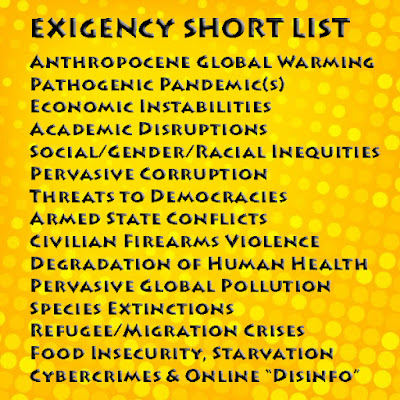
Recall my Exigencies rant? 
 
The world is experiencing multiple crises all at once. Russia's war in Ukraine is the first such large-scale conventional conflict in Europe since the end of World War II. China's power and reach are increasing, not just in the Pacific but around the world. The United States is reorienting its military, diplomatic and economic resources in response to China's rising superpower status. Some type of clash seems inevitable.

The COVID pandemic has receded somewhat in the U.S., although hundreds of people continue to die every day. The pandemic continues to cause death and misery around the world, with an estimated death toll of 6.5 million and an incalculable amount of personal, societal and economic suffering.

Extreme wealth and income inequality grows largely unabated. Many of the world's richest people have exploited this period of crisis and challenge to expand their power rather than to improve the human condition. Global democracy is in retreat around the world as fascist, authoritarian and other illiberal forces, operating under the banner of "populism," continue to expand their power and influence.

Here in the U.S., Donald Trump's political cult and a Republican Party dominated by fascists are attempting to end multiracial democracy. This is a revolutionary struggle whose goal is to create a new American society, that in practical terms will be an apartheid Christian fascist plutocracy ruled without challenge or accountability by a small number of rich white men. As seen on Jan. 6, 2021, and throughout the Age of Trump, right-wing political violence, including acts of terrorism, is now integral to the neofascist campaign against democracy.

The existential danger of global climate disaster looms over all the world's crises and challenges. Humanity has faced many great challenges before. But the world is now hyperconnected through digital media and other technologies with such speed and immediacy that our ability to properly process and understand these challenges has been greatly impaired…
Chauncey Devega
Are we gonna be able to "reason" our ways outa these looming existential catastrophes? e.g., via "Delberation Science?" My dubiety iteratively waxes and wanes.
"Human intelligence is not the miracle of evolution we like to think it it."
Lots more to unpack here. Justin Gregg, thank you, sir. Helluva a fine read.
The future of human intelligence

The human mind is exceptional. We have a capacity that all other species lack: the ability to intentionally produce more pleasure for other minds. As why specialists with episodic foresight and theory of mind, we understand that our actions can generate pleasure and misery in the minds of other creatures, be it human or animal. We understand that child soldiers and battery cage hens are miserable. We know these things, and we have the ability to change them. We have the cognitive and technological capacity to create a world that maximizes pleasure for all humans, as well as nonhuman animals. We could flood the world in pleasure qualia, if we wanted to. And this would elevate the value of human intelligence to something beyond that of other species, who cannot conceive of a pleasure-maxed world. If there is one way in which human minds are superior to those of animals in terms of worth, it is our capacity for understanding that pleasure is important and wanting to spread it as far and wide as possible. Paradoxically though, we don’t.

One of the reasons I love Star Trek is because it envisions a kind of techno-dork utopia like this, where humans live somewhat harmoniously with one another and have eliminated much of the day-to-day suffering that we currently experience. Is Star Trek’s pleasure-maximization world a fantasy?

There are two schools of thought on the future of the human species when it comes to creating a pleasure-maxed utopia. In one corner, you have Steven Pinker, the Harvard psychologist and linguist who has written extensively about why there is hope for our species when it comes to bettering ourselves. Pinker points out that humans have been doing a bang-up job of improving our lot in life thanks to the kind of Enlightenment thinking (i.e., “reason applied to human betterment”) that has doubled our average life span in just two hundred years, and reduced global poverty to its current levels (an all-time low). When asked to speculate on the future of our species, Pinker is somewhat optimistic, arguing that “problems are inevitable, but problems are solvable, and solutions create new problems that can be solved in their turn. It’s not a promise of an inevitable utopia, but it’s got a Star Trek ring to it that smacks more of optimism than extinction.

In the other corner you have the philosopher John Gray, who has written many books on humanity’s place in the natural world. Gray acknowledges the lovely boost that comes with Enlightenment style–thinking that has given us modern technology and medicine and everything else, but does not seem to have much hope that these advantages will be enough to free humans of the endless cycle of self-destructive prognostic myopia. In his book Straw Dogs he writes:
The growth of knowledge is real and—barring a world-wide catastrophe—it is now irreversible. Improvements in government and society are no less real, but they are temporary. Not only can they be lost, they are sure to be. History is not progress or decline, but recurring gain and loss. The advance of knowledge deludes us into thinking we are different from other animals, but our history shows that we are not.
Yes, it’s possible we will break this cycle of inevitable loss and live in a technologically beautiful future like in Star Trek, with adamantine cities floating in the sky above lush, untouched rain forests blanketing a rejuvenated Earth. Where biodiversity has been restored, and humans get their food from sustainably grown farming that doesn’t require as much land or water usage, and where we have eliminated the animal misery created by current farming practices… [Justin Gregg, pp. 204-206].
'eh?
___

apropos of the overall topic (human "vs" lower animal cognition), I've been studying Ed Yong's new book for a while. Also excellent. Not sure there's gonna be much overlap with Justin's principal thrust, though. Worthy in it's own right nonetheless.
 
to wit,
Through centuries of effort, people have learned much about the sensory worlds of other species. But in a fraction of the time, we have upended those worlds. We now live in the Anthropocene—a geological epoch defined and dominated by the deeds of our species. We have changed the climate and acidified the oceans by releasing titanic amounts of greenhouse gases. We have shuffled wildlife across continents, replacing indigenous species with invasive ones. We have instigated what some scientists have called an era of “biological annihilation,” comparable to the five great mass extinction events of prehistory. And amid this already dispiriting ledger of ecological sins, there is one that should be especially easy to appreciate and yet is often ignored—sensory pollution. Instead of stepping into the Umwelten of other animals, we have forced them to live in ours by barraging them with stimuli of our own making. We have filled the night with light, the silence with noise, and the soil and water with unfamiliar molecules. We have distracted animals from what they actually need to sense, drowned out the cues they depend upon, and lured them, like moths to a flame, into sensory traps.

Many flying insects are fatally attracted to streetlights, mistaking them for celestial lights and hovering below them until they succumb to exhaustion. Some bats exploit their confusion, feasting on the disoriented swarms. Other, slow-moving species, like the little brown bats that Barber tagged, stay clear of the light, perhaps because it makes them easier prey for owls. Lights reshape the animal communities around them, drawing some in and pushing others away, with consequences that are hard to predict. Could the light-averse bats do badly because their habitable zones have shrunk and their insect prey have been pulled away? Might the light-attracted bats temporarily benefit but eventually suffer as the local insect populations crash?


Yong, Ed. An Immense World (pp. 336-337). Random House Publishing Group. Kindle Edition.
UPDATE: APROPOS OF US HUMAN "WHY" SPECIALISTS

THE THREE LEVELS OF CAUSATION
So far I may have given the impression that the ability to organize our knowledge of the world into causes and effects was monolithic and acquired all at once. In fact, my research on machine learning has taught me that a causal learner must master at least three distinct levels of cognitive ability: seeing, doing, and imagining.

The first, seeing or observing, entails detection of regularities in our environment and is shared by many animals as well as early humans before the Cognitive Revolution. The second, doing, entails predicting the effect(s) of deliberate alterations of the environment and choosing among these alterations to produce a desired outcome. Only a small handful of species have demonstrated elements of this skill. Use of tools, provided it is intentional and not just accidental or copied from ancestors, could be taken as a sign of reaching this second level. Yet even tool users do not necessarily possess a “theory” of their tool that tells them why it works and what to do when it doesn’t. For that, you need to have achieved a level of understanding that permits imagining. It was primarily this third level that prepared us for further revolutions in agriculture and science and led to a sudden and drastic change in our species’ impact on the planet.

I cannot prove this, but I can prove mathematically that the three levels differ fundamentally, each unleashing capabilities that the ones below it do not. The framework I use to show this goes back to Alan Turing, the pioneer of research in artificial intelligence (AI), who proposed to classify a cognitive system in terms of the queries it can answer. This approach is exceptionally fruitful when we are talking about causality because it bypasses long and unproductive discussions of what exactly causality is and focuses instead on the concrete and answerable question “What can a causal reasoner do?” Or more precisely, what can an organism possessing a causal model compute that one lacking such a model cannot?


Pearl, Judea; Mackenzie, Dana. The Book of Why: The New Science of Cause and Effect (p. 27). Basic Books. Kindle Edition.
More to come...
__________
 

Wednesday, November 3, 2021

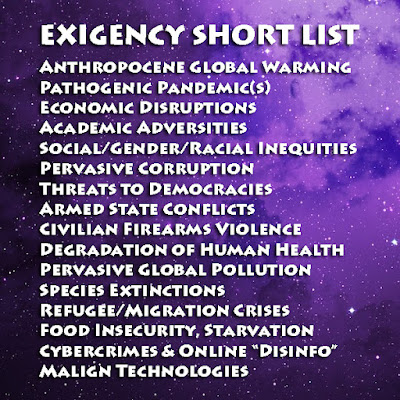
"Malign Technologies?"

Added one to my exigencies list.

Yeah, and, again, lots of recursive cause/effect overlap in the foregoing, some of it probably transient. But, a lot of it likely increasing in adverse intensity.
Mulling over adding Fentanyl (etc) to the list (lethally dangerous addictive intoxicants). Might it warrant its own category line item? Or would it suffice to just be implicitly subsumed under Degradation of Human Heaith?
"Malign technologies?" See, for one recent example, my prior post on "synthetic media / deep fakes." I see a decided skew on the "malignancy vs. beneficence" relative potential balance beam. What of "Artificial Intelligence" more broadly? Applications of genomics?

Yeah, blah, blah, blah, "technology is morally neutral." Right.

BTW: I got'cher Malign Disinfo Technology right here. "Threats to Democracy?"
___

Whenever my Science Magazine arrives, I typically head straight for the book reviews.

 
Found this yesterday.
 

Since humankind’s first migration out of Africa, we have trimmed, trained, and reshuffled the tree of life at breakneck speed. In the past 10,000 years, we learned to manipulate the basic building blocks of life through breeding. In the past century, we increased the speed and magnitude of our impact through mass global transportation, industrialized agriculture, and urbanization. In the past decade, we have seen major advances in biotechnology that now allow us to directly rewrite the genetic code of almost any organism to create never-before-seen biological variation.

Our unmatched ability to destroy, reshape, and rebui
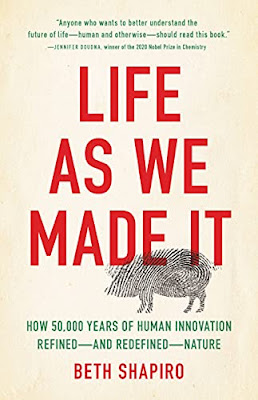
ld life to suit our purposes has allowed our species to become an evolutionary force rivaled only by the five major mass extinctions of Earth’s past. Evolutionary biologist Beth Shapiro explores this legacy in her new book, Life as We Made It.

In eight chapters, Shapiro takes readers on a succinct and compelling journey through historical events, inventions, and decisions that have forever changed the course of life on Earth…

Shapiro’s latest literary work makes plain that human intervention will likely be necessary to confront the problems we currently face and that biotechnology has an important role to play across a range of issues, from saving species teetering on the brink of extinction to curing disease to feeding a growing human population…

In what is perhaps the greatest accomplishment of Life as We Made It, Shapiro clearly articulates key questions whose answers will define how we think about and use the power we now yield. In a world that has been remixed and remade by humans several times over, what is “natural”? When and how should we intervene in evolution? Who should make this call?…

In a world where we can engineer life in much the same way we engineer skyscrapers, we are bounded more by imagination than by ability. But while buildings will eventually deteriorate in the sands of time, life will keep on ticking. In Life as We Made It, Shapiro offers readers a history lesson from which to pull both caution and inspiration. In doing so, she sets the table for a needed conversation about our lasting imprint on the tree of life. It is up to us to take a seat.

It's customary in Science book reviews to give 'em the venerable "Praise-Criticism-Praise Sandwich" workover.

Not one disparaging word about this book. Hmmm... "Purchase instantly with 1-Click."


And Off We Go...
THE LAST DECADE HAS SEEN DEVELOPMENT OF POWERFUL BIOTECHNOLOGIES that are at the same time astonishing, encouraging, and pretty scary. Cloning, genome editing, synthetic biology, gene drives—these are words and phrases that promise a different kind of future, but is it a welcome future? On the one hand, technological advance is a good thing. Biotechnology stops us from getting sick, cures diseases that we already have, and makes our food taste better and stay fresh longer. On the other hand, biotechnology creates things that feel weirdly unnatural, like corn with embedded bacterial genes and chickens that lay eggs out of which ducklings hatch.1 In fact, it is increasingly difficult to find anything that hasn’t been sullied by people in some way. And while scientists race to protect the natural things and spaces that remain, crises like offshore oil spills, rising extinction rates, and emerging infectious diseases demand solutions beyond what our existing technologies can achieve. Should we dig in, embrace the power of modern science, and look ahead to a future where bacteria clean up our messes and where hairy elephants roam Siberian fields while sterilized mosquitoes buzz overhead? Or should we resist this future and stop messing with things before it is too late?

For many, a future filled with human-modified plants and animals is bleak. Engineered microbes, mammothified elephants, and mosquitoes that can’t transmit disease would probably benefit people in some way, but creating them just isn’t right, and a world that includes them is somehow false. To those who feel this way, there is a tendency to blame science. Thanks to scientists and their twenty-first-century technologies, our world is on the precipice of a metamorphosis beyond which lies a new nature, one created entirely by and for people, and one that is anything but natural. This nervous narrative assumes, however, that humans have only just begun to meddle with nature—that the border between natural and unnatural is obvious and unblurred. History, however, and archaeology and paleontology and even genomics, tells a different story. In studying the past, we learn that people have been shaping the evolution of the living things around us throughout our history. Within the last 50,000 years, our ancestors hunted, polluted, and outcompeted hundreds of species to extinction. They turned wolves into Boston terriers, teosinte into popcorn, and wild cabbage into kale, broccoli, cauliflower, brussels sprouts, and collard greens (to name a few). As our ancestors learned to hunt, to domesticate, and to travel, their actions and movements created opportunities for species to adapt and evolve. Some species survived their encounters with humans, but many did not, and all were transformed in some way. Living things today are as we made them, shaped in part by the randomness of evolution and in part by less random human intent…


Shapiro, Beth. Life as We Made It (pp. 9-11). Basic Books. Kindle Edition.
Stay tuned. Interesting person. Very impressive.

 
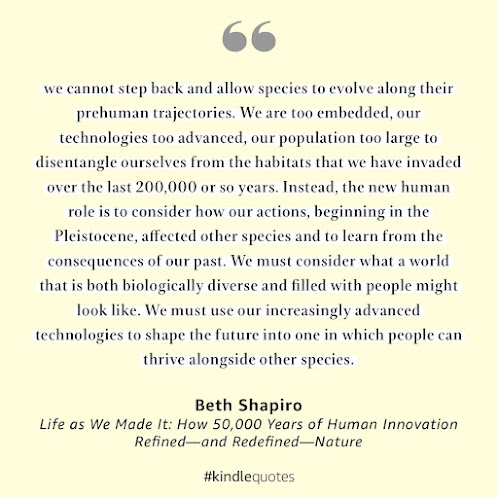
Over the last 50,000 years, we transformed the plants and animals with which we share our planet into lineages that are exquisitely adapted to today’s world, where the dominant evolutionary force is us.

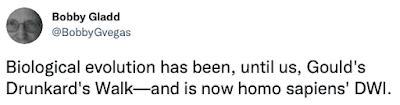
We are, however, a different kind of evolutionary force. Evolution is a random walk through experimental space. Evolution does not evaluate risk before making decisions about which breeding experiments to perform, but we do. Evolution doesn’t care what the next generation looks like or even if the next generation survives, but we do. Evolution is not guiding horses or wheat or cattle or bison to any particular fate, but we are. And this is where the contradiction in our opposition to our biotechnologies is laid bare. We resist biotechnologies precisely because they give us the control over evolution that humans have continuously worked to achieve. Evolution will not get us to a future that we predetermine. Our biotechnologies, however, can.

The decisions that we make over the next decades will determine our own fate and the fate of other species, perhaps far into the future. We can choose to take advantage of our technologies as they develop, to use synthetic biology to make even more with less, to protect wild species and wild spaces, and to do so in a sustainable way. Or we can reject our new biotechnologies and follow this same path anyway, just more slowly and with less success.

Biotechnologies can be frightening, in particular when they are new. We still have lots of work to do to make our technologies safe, to learn how to assess risk, to collaborate at a global scale. But biotechnologies also give us reason to be hopeful. The world is changing, and people and animals and ecosystems are suffering. Biotechnologies give us the power to help. We can change the evolutionary trajectories of species destined to become extinct. We can clean up our trash and make our farms more efficient. We can cure diseases that afflict us and other species. We can create and sustain a world in which wild species thrive in natural spaces and where people are healthy and happy and decidedly in charge. [Beth Shapiro, pp. 313-314]
__________