NOW REPORTING FROM BALTIMORE. A private, non-commercial blog begun in support of the federal Meaningful Use REC initiative, and Health IT and Heathcare improvement more broadly. Moving now toward important broader STEM and societal/ethics topics. Formerly known as "The REC Blog."
NOTE: Comments are moderated, thanks to trolls and bots.
Eyeball deep in David Z. Morris at the moment, in the wake of Messrs McKenzie & Silverman. Badasses, all of them. Individually and topically in concert.
Sam Bankman Fried ("SBF")? Yeah. Lordy. Been there, done that.
DAVID BEGINS:
I spent almost every weekday in October of 2023 in a courtroom in Lower Manhattan, listening to experts, lawyers, and first-hand witnesses recount the collapse of the FTX cryptocurrency exchange and prove Sam Bankman-Fried’s responsibility for it to a jury.
But while this book recounts Bankman-Fried’s crimes in detail, it is ultimately focused on his ideas. Bankman-Fried, for a time known affectionately as “SBF,” was deeply tied to concepts and movements with names like Effective Altruism, determinism, utilitarianism, extinction risk, Rationalism, and longtermism.
These buzzwords have been developed into increasingly formal systems by professional philosophers and ethicists at elite universities, and further amplified through a network of institutions well-funded by technology billionaires. But they stand for much deeper, much older structures of thought: a historical teleology that I here call “techno-utopianism.”
The superficial optimism of Effective Altruism was fundamental to the public fascination with Bankman-Fried that helped fuel his lightning-fast ascent. But its deeper biases — to which he was perhaps uniquely vulnerable — also helped Bankman-Fried rationalize his crimes, and its superficial logics created the blind spots that led to his downfall.
This book is not a work of journalism, but of forensic philosophy. It asks how techno-utopian ideas, so loudly declaring their intent to do good, instead led to one of the largest financial frauds in American history — and whether their broader sway in twenty-first-century politics and society may lead to similar results, on a much larger scale.
Morris, David. Stealing The Future: Sam Bankman-Fried, Elite Fraud, and the Cult of Techno-Utopia (pp. 8-9). (Function). Kindle Edition.
UPDATE
Sam Bankman-Fried's mother has recently submitted a 64-page appeal brief on her son's behalf:
I am a law professor at Stanford, where I have taught for close to forty years. Before that, I was a practicing lawyer in New York and clerked on the Second Circuit Court of Appeals. I am also Sam Bankman-Fried’s mother. Because of my professional life, I have witnessed the events of the past three years through two very different sets of eyes. Someday I may write about what it has been like to live through this experience as a parent. Today I write as a lawyer, about the government’s legal case against Sam and the other FTX defendants. I would have much preferred to leave this task to others. But the spectacle that has surrounded the FTX case since day one has not been conducive to serious, independent thought or attention to facts. It has also imposed a very high cost on anyone who publicly expressed doubts about whether justice has been done in this case. I hope this will change in time, and others will come forward to supplement or amend what I have written here. Most of what I say below is documented in the trial transcript and public records posted on the official court docket. I have provided cites for those who would like to follow up on their own…
Many observers see a fairly obvious Trump pardon effort ploy here. The further along I get in David's book, the more I tend to agree.
____
More broadly with respect to FinSec / crypto fraud, we must not forget our Sorkin. Andrew interviewed SBF remotely via Zoom for his "Dealbook" program in the wake of the FTX crash. David's analytic recounting of that conversation is riveting.
That (surprisingly?) took just a mere few hours (~5). Next? Remanded to remain in MCC pending sentencing (in March 2024)? Hey, I know! We'll let your jive ass out on bail to go do some on-the-ground Effective Altruism interim humanitarian work in Gaza. The Bayesian Priors are maxed-out up front (in myriad 30-ft deep bomb craters), the Expected Value dwarfs any of the speculative virtue-signaling bullshit you, your brother, your Dad, and Mother spewed ad nauseum).
CODA
Enough of this guy. Save one final worthy citation.
Over the course of the trial, the jurors were largely spared an extended discussion of the doctrines of effective altruism, although Ellison did mention at one point that Bankman-Fried’s pure utilitarianism left him unbothered by the ethical strictures—don’t lie, don’t steal—with which ordinary people are saddled. For what it’s worth, most effective altruists express a belief in utilitarianism “with side constraints”—that is, their aspirations to do the greatest good for the greatest number tend to be leavened with the normie morality of at least the major Commandments, if not all ten. Effective altruism was, however, present in style if not in substance. Even the most winning E.A.s—a group that includes Nishad Singh, someone I personally liked very much when I interviewed him eighteen months ago—are the most pedantic people alive. They believe they speak the mathematically precise language of the knowable universe. When Singh took the stand and banged on about things like auto-deleveraging events and liquidity backstop providers, the judge, his patience with E.A. specificity wearing thin, cut him off: “You stick to answering the questions that are asked, O.K.?”
[Amazon blurb] A powerful, pocket-sized citizen’s guide on how to fight back against the disinformation campaigns that are imperiling American democracy, from the bestselling author of Post-Truth and How to Talk to a Science Denier.
The effort to destroy facts and make America ungovernable didn’t come out of nowhere. It is the culmination of seventy years of strategic denialism. In On Disinformation, Lee McIntyre shows how the war on facts began, and how ordinary citizens can fight back against the scourge of disinformation that is now threatening the very fabric of our society. Drawing on his twenty years of experience as a scholar of science denial, McIntyre explains how autocrats wield disinformation to manipulatea populace and deny obvious realities, why the best way to combat disinformation is to disrupt its spread, and most importantly, how we can win the war on truth.
McIntyre takes readers through the history of strategic denialism to show how we arrived at this precarious political moment and identifies the creators, amplifiers, and believers of disinformation. Along the way, he also demonstrates how today’s “reality denial” follows the same flawed blueprint of the “five steps of science denial” used by climate deniers and anti-vaxxers; shows how Trump has emulated disinformation tactics created by Russian and Soviet intelligence dating back to the 1920s; provides interviews with leading experts on information warfare, counterterrorism, and political extremism; and spells out the need for algorithmic transparency from Facebook, Twitter, and YouTube. On Disinformation lays out ten everyday practical steps that we can take as ordinary citizens—from resisting polarization to pressuring our Congresspeople to regulate social media—as well as the important steps our government (if we elect the right leaders) must take.
Compact, easy-to-read (and then pass on to a friend), and never more urgent, On Disinformation does nothing less than empower us with the tools and knowledge needed to save our republic from autocracy before it is too late.
Very interesting, very well-written. Squares with a ton of my prior study. Goes to my Deliberation Science Jones.
UPDATE
Finished the McIntyre book. Loved it.
______
As of August 12th, there are 451 days left until the 2024 U.S. national election. Will our Democracy remain thereafter? Can we continue to successfully juggle all of these major existential balls?
Some days my dubiety enervates me. But, stay calm and carry one, I guess.
EXIGENCY UPDATE
Ugh.
[AUG 12th UPDATE] A catastrophe. Death toll will likely soon surmount three figures. Lahaina (on Maui) has been reduced to ash.
Highly recommend her book.
A thermometer doesn’t give you a different answer depending on how you vote. Even in the U.S., climate change used to be a respectably bipartisan issue well within most of our lifetimes. In 1998, a Gallup poll found that 47 percent of Republicans and 46 percent of Democrats agreed that the effects of global warming had already begun. In 2003, Senators John McCain, an Arizona Republican, and Joseph Lieberman, then a Connecticut Democrat, introduced the Climate Stewardship Acts. As recently as 2008, former speaker of the House Newt Gingrich, a Republican, and current House speaker Nancy Pelosi, a Democrat, cozied up on a love seat in front of the U.S. Capitol to film a commercial about climate change. “We do agree, our country must take action to address climate change,” Gingrich said, while Pelosi added, “We need cleaner forms of energy, and we need them fast.”
Hayhoe, Katharine. Saving Us: A Climate Scientist's Case for Hope and Healing in a Divided World (p. 5). Atria/One Signal Publishers. Kindle Edition.
CNN's John King came away stunned after an Iowa supporter of former President Donald Trump argued that Western support for Ukraine in defending itself against Russia is part of an elaborate plot to cover up President Joe Biden's corruption.
While talking with Iowa Trump fans, King asked them if any of them supported aiding Ukraine against Russian aggression -- and none of them raised their hands.
One of the Trump supporters then outlined how he believed the entire war was an effort to cover up crimes committed by the Biden family.
"You don't have to that smart to connect the dots, right?" he said. "And so is the war to cover up sins committed to cover your tracks? There is too much money that has been thrown over there!"
King appeared skeptical of this and asked the man if he really believed every NATO country would spend massive amounts of money and send over huge troves of military equipment to Ukraine just to help keep Hunter Biden out of prison.
"It all depends on [Ukrainian President Volodymyr] Zelensky, how much dirt he has on Biden, to keep the money coming," the man said…
SPEAKING OF "YOUR FAVORITE PRESIDENT"
Seriously?
Asked and Answered. The Show Must Go On.
apropos of the foregoing topic: Amanda Ripley's "High Conflict."
OK, ENOUGH OF THIS DEPRESSING STUFF.
BRIEF OFF-TOPIC ERRATUM
One of my Swedish friends (a fellow Santa Fe fan), hipped me to Henrik Hansson, also from Sweden. Lives in Japan. This is perhaps the most wrenchingly beautiful and painful song I've ever heard. Astonishing vocal.
Elizabeth Holmes ordered to pay massive restitution over fraud.
[Mercury News] Theranos founder Elizabeth Holmes and her co-accused [and now also convicted] and former lover Sunny Balwani were ordered late Tuesday to pay more than $450 million in restitution for defrauding investors.
Holmes, the founder and former CEO of the now-defunct Palo Alto, California, blood testing startup, has said in court filings that she “continues to work on ideas for patents” but “has essentially no assets of meaningful value” and “has incurred substantial debt from which she is unlikely to recover.”
In his restitution order, Judge Edward Davila, who presided over the trials and convictions of Holmes and Balwani, held the two “jointly and severally liable” for the nearly half-billion-dollar repayment to individuals and entities, because they were both found guilty of conspiring with each other to defraud investors. That means Holmes and Balwani — the former Theranos president who has denied Holmes’ claims he sexually abused and coerced her — are each on the hook for the full amount, but if one pays, they can seek a contribution from the other...
I first learned the concept of "joint and severable liability" in 1986 during my tenure as a programmer and QC analyst in a forensic-level environmental radioanalytical lab in Oak Ridge. Much of our work resulted in evidence used in radiation contamination and/or exposure liability litigation and regulatory actions. Basically if you were found to have 1% "liability" but you had 99% of the attachable liquid assets, well, guess what?
Elizabeth Holmes is going to federal prison (11 yrs). Neither she nor SunnyBalwani (now in the Joint for 13 yrs) is ever likely to pay diddley in restitution.
To, Robert Gladd Address: 8210 Creek Water Lane Las Vegas NV 89123 Email: **********@comcast.net
This is last chance for you, to hold this Case File you must submit a minimum payment of $300.00
You can email us on below address for any query or payment mode; ge.debtcollectionagency@gmail.com
This Legal Proceeding will be issued on your Docket Number DL-20731642 with one of Cash Advance Inc. Company to let you know that after making calls on your phone number, we were unable to reach out to you. So, the account's department of Cash Advance has decided to mark this case as a Flat Refusal and press Legal Charges against you.
CASE NO: FGTM-98524L2 Amount Outstanding: $1200.00
Do revert if you want to get rid of these legal consequences and make payment arrangements today or else, we will be proceeding legally against you and this notification will also be sent to your current employer. The opportunity to take care of this voluntarily is quickly coming to an end. I regret to advise that unless payment is received before the end of this week this invoice will be passed over to our legal authority. This could seriously affect your credit rating, so I urge you to contact us immediately to make payment or arrange an alternative before this date.
We will be forced to go ahead legally against you and once it proceeds to the Court House, the creditor has entire rights to tell your employer and your references about this issue and the lawsuit will be the next step which will be amounting to $6700.00 and will be totally levied upon excluding your attorney charges. If you take care of this matter out of court, then we will release the clearance certificate from the court and make sure that no one will contact you in the future.
Please let us know of your intention by today itself so we can hold the case or else we will send the paperwork to your local county sheriff department, and you will be served by court summons at your doorstep.
You can reply us on below address for more information;
ge.debtcollectionagency@gmail.com
_____________
One scarcely knows where to begin. Perhaps we could start with a Google search for "CASE NO: FGTM-98524L2." 'eh?
I get this kind of crap all the time. Y'all probably do as well, right? These (cringingly English-as-a-2nd/3rd/4th language) phishers are relentless. Moronically so.
I sold that Las Vegas house in Sept. 2013, and moved back to California. I'd retired in May 2013. Didn't have Comcast email until after we'd relocated to the Bay Area.
In your next novel, “Red Team Blues,” you focus on Martin Hench, a sixty-seven-year-old forensic accountant, who is tasked with recovering a set of stolen signing keys that, with some technical finagling, can permit one to rewrite a blockchain’s distributed ledger, swiping assets from one side to the other, as it were. Do you think blockchain tech is less secure than enthusiasts portray it to be?
I think so. One of the things about pseudonymity is that it has a cumulative information-leakage problem. So, if you’re pseudonymous, and you make one transaction and then never do anything else, that transaction will likely be very hard to trace back to you, right? If you make one blockchain transaction, it’s unlikely to be identifiable as you. If you make two, suddenly you’re getting into a lot more possible re-identification material. And then, if you have a long life on the blockchain, where you do lots of things over years and years, and something happens that unmasks something a long time ago—say, someone is arrested and they disclose records of which people were associated with which wallets—now a bunch of your transactions are in the public domain, even if you weren’t doing anything illegal.
Did you have fun writing about crypto?
A little bit. Crypto is weird, because, much more so than other technologies, if you don’t like crypto, crypto people really want to convince you that you’re wrong. There are other technological choices that I’ve been involved with. Like, for example, I think that the iOS model of curated computing, where a company not only has its own app store but stops you from choosing a rival app store—I think that’s bullshit. And there are a lot of people who really like Apple, and yet very few of them insist that I come on their podcast to explain why I think they’re wrong. And I had to declare a moratorium on going on blockchain podcasts to explain why I thought people were wrong. There is, among blockchain enthusiasts, a kind of unwillingness to believe that, if someone disagrees with you, it’s because they understand you and, despite understanding you, still disagree.
Ethereum is a project based around decentralized applications, which run on a scattered network of computers and don’t have a single owner who controls them. That would seem to be in line with what you want for the Internet, in the sense of more interoperability and more security. Or am I wrong?
I think distributed apps are a great idea. I am skeptical of smart contracts, which are the building block of distributed apps. Smart contracts are hard to get right. And this is not a thing that you can fix. There’s this foundational idea in computer science called the halting problem, which says that, above a pretty minimal threshold, it’s impossible to know all the different ways that a program can behave. One of the ways that computer scientists try to address this risk is by keeping Undo buttons around in our code. We try not to make irreversible operations. We try to write a backup of the data before we save it again, so that, when you save it, if the program crashes, you have a backup of the last save state. We try to maintain an audit log and to unwind processes that go off the rails.
The code in your anti-lock braking system, though—once it fails, your brakes don’t work, and that’s it. You can’t unring that bell. Or the code that controls whether or not the coolant will be released into the nuclear reactor—if it fails to go off, and the reactor melts down, you can’t fix it. Those are still instances where we want automation, and we try to minimize how automated they are, and we try to surround them by other systems—we try to build, like, soft walls around them, because we understand that this should be the exception, and it should be treated as very dangerous, because computer programs are very unpredictable.
In blockchain land, including in smart-contract land, we throw all of that away. We take applications that in no way benefit from being irreversible and we make them irreversible. So, rather than having a bank that decides whether or not a transaction goes forward, you have this automated Proof of Work or Proof of Stake process, all these different computers, running in tandem, all checking each other’s work, and there’s no way to unwind it.
The title “Red Team Blues” plays on an idea from cybersecurity and war gaming, that red attacks and blue defends. The red-versus-blue concept comes up at different points in the narrative. Was it a structural cornerstone for the book from the beginning?
In some ways, it’s just me working out my own anxieties. I am firmly convinced of the attacker’s advantage—that the attacker needs to find one exploitable defect, and the defender needs to make no mistakes. And this means that, over the long term, attackers tend to have the advantage, and defenders need to become attackers in order to win. But, at the same time, it makes me despair for some of the things that I treasure. Like content moderation, for example.
I worry that, because of the attacker’s advantage, the people who want to break the rules are always going to be able to find ways around them, and that we’re never going to be able to make a set of rules that is comprehensive enough to forestall bad conduct. We see this all the time, right? Facebook comes up with a rule that says you can’t use racial slurs, and then racists figure out euphemisms for racial slurs. They figure out how to walk right up to the line of what’s a racial slur without being a racial slur, according to the rule book. And they can probe the defenses. They can try a bunch of different euphemisms in their alt accounts; they can see which ones get banned or blocked, and then they can pick one that they think is moderator-proof.
Meanwhile, if you’re just some normie who’s having racist invective thrown at you, you’re not doing these systematic probes—you’re just trying to live your life. And they’re sitting there trying to goad you into going over the line. And as soon as you go over the line they know chapter and verse. They know exactly what rule you’ve broken, and they complain to the mods and get you kicked off. And so you end up with committed professional trolls having the run of social media and their targets being the ones who get the brunt of bad moderation calls. Because dealing with moderation, like dealing with any system of civil justice, is a skilled, context-heavy profession. Basically, you have to be a lawyer. And, if you’re just a dude who’s trying to talk to your friends on social media, you always lose. So this book is me trying to work out what it means to be on the red team—or, rather, to be forced onto the blue team when you want to be on the red team, and how you can turn the tables…
Good stuff.
SUMMARY RECAP
UPDATE
Reported by Yahoo Finance:
The judge who presided over the criminal fraud trials of Theranos founder Elizabeth Holmes and her co-defendant and one-time boyfriend, Theranos COO and president Ramesh “Sunny” Balwani, sentenced Balwani on Wednesday to nearly 13 years in prison plus three years of probation...
I'm OK with that. Given the length, it's not gonna be Club Fed. Looks like he'll serve not quite 11 years, net (federal system). I don't wish him any harm. You properly go to prison as punishment, not for punishment.
OK, BACK TO THE BEAST
Scary to realize that someone so inept and so full of shit could gain access to billions of dollars of others' actual money—which he then made disappear, either through negligence or nefarious intent.
Younger brother Gabe's $3.3 million DC "charity" digs.
sbf
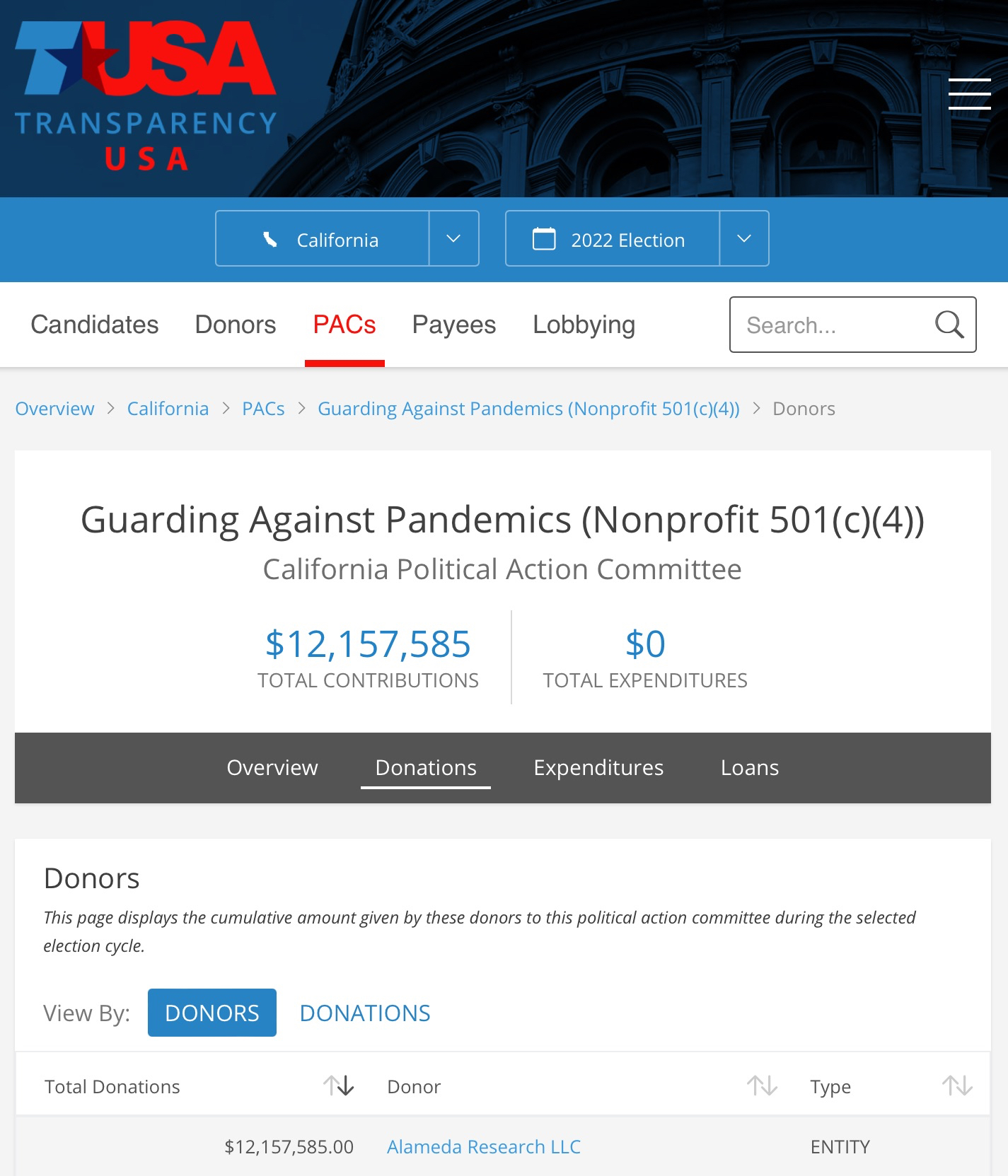
Gabe Bankman-Fried—younger brother of the disgraced FTX founder, Sam Bankman-Fried—purchased a $3.289 million Capitol Hill townhouse in April. The deal was made through Gabe's nonprofit, Guarding Against Pandemics. The organization, aimed at preventing another pandemic, was partly funded by SBF. The move to the US capital was meant to send the message that the FTX founder "and his network were in DC to stay," according to a report from Puck.
Just one week before FTX's collapse, Guarding Against Pandemics hosted back-to-back cocktail parties for high-ranking Democrats and Republicans, the New York Post reported.
The four-story townhouse comes with four bedrooms, four-and-a-half bathrooms, two private terraces, and an elevator, according to a listing for the property from real estate company Bright MLS…
Yeah. Of course.
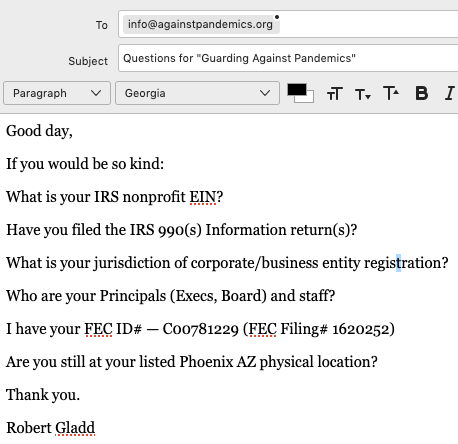
OK, nothing on their website regarding Board of Directors or staff. A Guidestar.org search turns up nothing at all (you look there for things such as the annual IRS Form 990 non-profit information returns that set forth revenue, expenses, salaries of Principals, compensation of outside entities, etc). I rather doubt we'll readily find any legit incorporating documentation here. Across my life, I've founded and administered three for-profit corporations (two Sub-S and a C-Corp), as well as a 501(c)(3) non-profit charity, and 501(c)(6) "professional organization" non-profit (all on my own without lawyers). I know what to look for and where it should be found.
This is a "PAC" (Political Action Committee), not a 501(c)(3) public service "charity." Imagine our surprise.
It'd be nice if actual professional investigative reporters (and regulatory authorities) would peek into this. Ya think?
UPDATE: Search of the Arizona Secretary of State's business & charities database comes up empty. Unsurprisingly. Be interesting to know the jurisdiction of registration.
MORE
No corporate SoS listing in California either. A search of the IRS site fails to find their 501(c)(4) EIN and related information.
So, Gabe's PAC got a $12,157,585 "donation" from his brother's "Alameda Research." Nothing fishy there...
I've written a ton about this Theranos debacle. Given her pending appeals, it could very likely yet be years before she presents for incarceration (assuming her appeals fail).
Convicted on multiple significant fraud counts. Her attorneys have filed for a new trial. I guess we'll see. Color me dubious. The verdict did not hinge on the circumstantial evidence testimony of one now supposedly regretful witness.
UPDATE
The trial judge has reportedly denied her retrial request—"tentatively." Sentencing remains scheduled for October 17th. Further reporting has it that the Holmes lawyers have submitted a second retrial motion, on differing grounds.
Back when I was covering the Health IT startup space, the Health 2.0 peeps in particular were frustrated that they could never book Elizabeth Holmes for a conference keynote or panel.
Would have been interesting. As is her current trial for fraud.