


WHAT DOES IT REALLY MEAN TO LEARN?
A leading computer scientist says it’s “educability,” not intelligence, that matters most.
Joshua Rothman, Aug 27, 2024, The New Yorker
... Arguably, it’s one of the tragedies of humanities education that so much of it occurs between the ages of eighteen and twenty-two. We don’t teach people to drive at twelve, when they’re carless; why should we make them read novels about life’s regrets when they have none? Yet there’s a theory behind the assignment of “Middlemarch” to sophomores: it’s that knowledge acquired too early gets stored away. Patterns of thinking established now will be retraced later; ideas encountered first in art will prime us for the rest of life. This sounds chancy and vague, until you reflect on the fact that knowledge almost never arrives at the moment of its application. You take a class in law school today only to argue a complicated case years later; you learn C.P.R. years before saving a drowning man; you read online about how to deter a charging bear, because you never know. In the mid-twentieth century, Toyota pioneered a methodology called just-in-time manufacturing, according to which car parts were constructed and delivered as close as possible to the hour of assembly. This was maximally efficient because it reduced waste and the cost of storage. But the human mind doesn’t work that way. Knowledge must often molder in our mental warehouses for decades until we figure out what to do with it.
.
Leslie Valiant, an eminent computer scientist who teaches at Harvard, sees this as a strength. He calls our ability to learn over the long term “educability,” and in his new book, “The Importance of Being Educable,” he argues that it’s key to our success. When we think about what makes our minds special, we tend to focus on intelligence. But if we want to grasp reality in all its complexity, Valiant writes, then “cleverness is not enough.” We need to build capacious and flexible theories about the world—theories that will serve us in new, unanticipated, and strange circumstances—and we do that by gathering diverse kinds of knowledge, often in a slow, additive, serendipitous way, and knitting them together. Through this process, we acquire systems of beliefs that are broader and richer than the ones we can create through direct personal experience. This is how, after our first divorce, we find that we can draw on wisdom borrowed from English literature...

 |
| Necessarily assumes revealable truths? |
…Recognizing that we process different belief systems in our brains in similar ways does not mean that they are to be treated as equivalent. There is no contradiction in an individual differentiating among belief systems as being worthy or not of their support.
Science as a Belief System
Fluency with belief systems gave humans the opportunity to develop the advanced technological civilization that we have. While the power of science is for all to see, the reasons it has been so productive in the past are not so self-evident. Even less obvious is what we need to do to keep the benefits of science flowing in the future.
Science is a belief system. A critical component of it is the idea that there are important patterns in the world that are not readily visible but are worth the effort to discover. That there is a moderate number of chemical elements and all materials on Earth are composed of these is not self-evident and had to be demonstrated through ingenuity and labor. Similarly, the bacterial and viral causes of disease are not obvious to the eye. The individuals who made these discoveries believed that useful but well-hidden patterns existed and could be found.
Science as a belief system, even when pursued by imperfect self-interested individuals, has strong self-correcting tendencies. An announcement of any significant result will prompt other scientists to seek to verify it by repeating the experiment or analysis. Also, there is usually wide agreement on the interpretation of an experimental result or an analysis with respect to a relevant question. These two facts in tandem keep the scientific enterprise on track, despite all the mistakes that may occur along the way. They also keep the incidence of fraud to a low level and the influence of any one such fraudulent act usually to a short duration…
…The reasons science works so well are more to do with the world to which it applies than the particular way humans approach it. Science might be compared to a gold mine where each field of science is a vein. Near each vein of well-established science, so much more new science can be unearthed. Venturing beyond these known productive veins gives less predictable results but can lead to new even more productive veins.
No human activity or judgment occurs in isolation. They all occur in the context of some belief system. For any judgment or activity, one ought to declare the context in which it can be justified. For example, the perspective of this volume is the science belief system from a computational perspective…
The Scientific Revolution
While the gift of educability may yet bring humanity to its destruction, it has also led to great triumphs. Educability is a capacity that has taken a long time to have its impact. The possibility of accumulating knowledge discovered by others and creating new knowledge from it may have existed for hundreds of thousands of years. Eventually this gift spectacularly caught fire as the Scientific Revolution, which unfolded in the sixteenth and seventeenth centuries. Its principal protagonists lived in different corners of Europe, employed variously by universities, rulers, and religious entities, or living on personal wealth. They had Latin as a common language. They published their work in printed books, a technology invented not much earlier. They read one another’s work. Clubs and meeting places arose to bring together local groups of scientific researchers in Italy, Spain, England, Germany, and France. By the late seventeenth century, these had evolved into academies, including the Royal Society in London, the Académie des Sciences in Paris, and the Leopoldina in Germany.
Why this unique event, the Scientific Revolution, took place exactly when and where it did, some three hundred thousand years after the emergence of our species, is open to debate. The precipitating event was not a genetic mutation in fifteenth-century Europe…
…Humanity is finally exploiting the gift of educability in a systematic way and on an industrial scale. At the same time, it is enjoying all the benefits the new scientific knowledge provides.
It is quite possible that further improvements can be made in the scientific research process itself.4 A scientist needs access to previous knowledge, convenient ways of isolating those pieces that are relevant to the research question at hand, and new ideas. The sharing of information on the web and the use of search engines have already had important effects. Scientists can now more rapidly follow what is happening in their field, which will have orders of magnitude more participants than Kepler or Newton had to follow. Digital technology may well be launching a phase of scientific progress that is even more intense than before. This is not just because of all the opportunities computers offer for simulating scientific theories and detecting patterns in data, but more simply because digital technology offers another revolution in the dissemination of knowledge.
Equality
That “all men are created equal” was “sacred and undeniable” to Thomas Jefferson in his draft of the United States Declaration of Independence. With later editing, it became “self-evident” in the final document. While historians still debate Jefferson’s own intent, the continuing impact of his phrase prompts the question of how to interpret the words now. Can one justify Jefferson’s final wording as a statement of fact? Several religions support the concept of equality, and hence Jefferson’s choice of “sacred” would be more understandable. At no point in history, however, has equality been self-evident from looking around. Different social classes in the same region and the same classes in different regions have had different enough lives to make such a proposition counterfactual on the surface.
I suggest that the educability hypothesis fills a gap here in providing an angle from which to view our equality. Educability implies that humans, whatever our genetic differences at birth, have a unique capability to transcend these differences through the knowledge, skills, and culture we acquire after birth. We are born equal because any differences we have are subject to enormous subsequent changes through individual life experience, education, and effort. This capacity for change, growth, and improvement is the great equalizer. It is possible for billions of people to continuously diverge in skills, beliefs, and knowledge, all becoming self-evidently different from each other. This characteristic of our humanity, which accounts for our civilization, also makes us equal.
Perhaps the most serious challenge to the notion of human equality that came from modern science was the eugenics movement. The term comes from the Greek word for “well-born.” The adherents believed that inequality at birth was fundamental. The movement flourished from the 1880s to the 1930s in Europe and North America, driven by the eugenicists’ fear that if people with so-called “superior” genes reproduced at a lower rate than those with “inferior” genes, then humanity’s genetic stock would decline. The eugenicists proposed to take measures to discourage reproduction of what they considered the “inferior” genes. The criteria they considered as valid to discriminate between superior and inferior included measures such as IQ scores as well as membership of national and racial groups.
The reason for eugenics eventually falling into disrepute was neither the ethical issue it obviously raised nor scientific questioning, but rather the wide-ranging use of its tenets by the Nazi regime in Germany. Subsequently, in 1948 the United Nations General Assembly adopted the Genocide Convention, which included in its definition of genocide the imposition of any measures intended to prevent births within a “national, ethnical, racial or religious” group.
The history of eugenics deserves study as an example where the self-correcting tendency of science was not in evidence for a long time. Several of the creators and primary movers of eugenics were among the most prominent scientists of their time. Some of them laid the foundations of modern statistics. Users of statistics will recognize their names and the statistical techniques they contributed: Francis Galton (regression to the mean, standard deviation), Karl Pearson (chi-squared test, principal component analysis), and Ronald Fisher (tests of significance, maximum likelihood testing).
It is now widely thought that these statisticians were mistaken in their belief in the primacy of human inequality at birth. How could such a group have been so wrong? Their published papers were chock-full of data, and they were applying their scientific expertise—statistics—for analyzing the data. Their statistical methodologies continue to be the basis for understanding data in the empirical sciences to this day. My suggestion is that the data available to them did not provide much information about the power of educability. They had little systematic data on individuals of different classes, cultures, ethnicities, and gender being subject to the same educational opportunities over an extended period. Human educability is a surprising and amazing phenomenon that these statisticians—and their contemporaries—failed to detect. Some would explain the eugenics movement by saying simply that the participants were biased by the beliefs of their times. The power of beliefs is, of course, a central theme of this book—but beliefs come from somewhere, and one should try to understand their origin.
For many measurable traits of plants and animals, scientists have sought to distinguish the effects of nature and nurture by assigning percentages to each of these sources using statistical analysis. Such analysis by itself provides no understanding of the mechanisms by which nature and nurture influence the trait. For cognitive traits, such analysis is particularly problematic if we accept that education plays a role in the development of the trait. Educability allows the influence of the environment to be quite enormous. The essence of educability is the unique and extreme power of this influence.
The answer to the eugenicists’ fear is that the capacity to change through experience and education is at the very center of the architecture of the human mind. Fortunately for humanity, the main social development of the last century has been the worldwide expansion of education. We are still in the middle of this expansion. Improvements in education and in the numbers receiving it have overwhelming potential. Pursuing this potential is the most rewarding focus for anyone aiming to improve a society.
Worldviews
Belief systems that are broad enough to suggest positions on diverse issues have been called worldviews. Religions are examples. Political and economic systems are others. Throughout human history there have always been widely held and wildly different belief systems about race, class, and gender, about who is the enemy, and about who is fully human.
Worldviews continue their struggle for acceptance every day. In each epoch various worldviews have been particularly influential. It is customary to be smug about one’s own worldview and dismissive of those of others, especially those of earlier times. Educability offers, among other things, an onlooker’s vantage point on this struggle.
Currently, a worldview with much influence is science. I think this is good. Nations that include most of the human population are teaching science to their young and putting resources into exploiting it for the benefit of their citizens. The proven success of this enterprise is one thing that we can be sure about and would do well to further. A scientific consensus on the nature of the Civilization Enabler may be impactful. Some convergence on what defines us may promote commonality among the ruling worldviews.
We therefore have opportunities.
What about the threats? What guarantees do we have that the ruling worldviews will not follow trajectories that most would currently regard as undesirable, such as returning to widespread human sacrifice? The answer seems to be none. Humans are just too facile with absorbing and applying arbitrary belief systems, and we seem to have much weaker countervailing abilities to evaluate the consequences or validity of our beliefs. This volume shows that one can discuss aspects of belief system acquisition and processing with some precision. Much remains to be discovered. What makes an individual commit to a belief system? What makes an individual maintain their commitment or give it up when it is challenged?
There is little evidence that our civilization is securely on an upward slope. Wars and oppressive political regimes persist and continue to attract supporters. I see no guarantee that belief systems that are worse, or much worse, than those that currently dominate around the world will not displace them. The only actionable defense I see is to seek a better understanding of how we process beliefs. Understanding our critical capacity could help guard against its worst dangers.
Educability is an information processing capability that humans have. It has enabled us to stand on each other’s shoulders and build the edifice of beliefs that is our current civilization. Our power to generate and adopt new beliefs has few limits. The beliefs we adopt govern how we act and have consequences without end. One would hope that if educability is recognized to be the defining human capability, then the search for a deeper understanding of it would become a unifying quest. Surely, we can direct our power of being educable at ourselves, to better understand the nature of this power and set a steadier course…
Valiant, Leslie. The Importance of Being Educable: A New Theory of Human Uniqueness (pp. 217-225). Princeton University Press. Kindle Edition.

One of the most troubling issues around generative AI is simple: It’s being made in secret. To produce humanlike answers to questions, systems such as ChatGPT process huge quantities of written material. But few people outside of companies such as Meta and OpenAI know the full [sic] extent of the texts these programs have been trained on.
Some training text comes from Wikipedia and other online writing, but high-quality generative AI requires higher-quality input than is usually found on the internet—that is, it requires the kind found in books. In a lawsuit filed in California last month, the writers Sarah Silverman, Richard Kadrey, and Christopher Golden allege that Meta violated copyright laws by using their books to train LLaMA, a large language model similar to OpenAI’s GPT-4—an algorithm that can generate text by mimicking the word patterns it finds in sample texts. But neither the lawsuit itself nor the commentary surrounding it has offered a look under the hood: We have not previously known for certain whether LLaMA was trained on Silverman’s, Kadrey’s, or Golden’s books, or any others, for that matter.
Pirated books are being used as inputs for computer programs that are changing how we read, learn, and communicate. The future promised by AI is written with stolen words.
Upwards of 170,000 books, the majority published in the past 20 years, are in LLaMA’s training data. In addition to work by Silverman, Kadrey, and Golden, nonfiction by Michael Pollan, Rebecca Solnit, and Jon Krakauer is being used, as are thrillers by James Patterson and Stephen King and other fiction by George Saunders, Zadie Smith, and Junot Díaz. These books are part of a dataset called “Books3,” and its use has not been limited to LLaMA. Books3 was also used to train Bloomberg’s BloombergGPT, EleutherAI’s GPT-J—a popular open-source model—and likely other generative-AI programs now embedded in websites across the internet. A Meta spokesperson declined to comment on the company’s use of Books3…

 |
| Screenshot from my Kindle |


Yeah, it's not funny.
OK, backing up a tad in paraphrase: "To produce humanlike answers to questions, people like BobbyG process huge quantities of written material. But few people ... know the extent of the texts he has been trained on."


“Human, all too human”: It’s a thought that occurred to me a few times while reading Justin Gregg’s “If Nietzsche Were a Narwhal,” and not just because the phrase also happens to be the title of a work by Nietzsche himself. Gregg’s clever and provocative book is full of irreverent notions and funny anecdotes — the creative upside to being a human animal. But our ability to abstract from our immediate experience means we can take that creativity too far.
“If Nietzsche had been born a narwhal,” Gregg writes, “the world might never have had to endure the horrors of the Second World War or the Holocaust.” Say what? This seems to be a sterling example of what Gregg calls our species-specific penchant for “unexpected ludicrousness.”
Such rhetorical contortions are probably the consequence of what he derides as our obsession with causal inference. Nonhuman animals get by just fine on “learned associations.” They link actions with results, without having to understand why something is happening. Humans, though, are “why specialists.” We need to look for causal connections — leading to some incredible achievements but also to some bizarre practices...


OK, then: "fixed, canonical, and binding." Uh, "paradigms," anyone?
Humans are unlike other animals when it comes to our capacity for deception. Because we are why specialists, we have minds overflowing with ideas—dead facts—about how the world works, which gives us an infinite number of subjects about which we could lie. We are also in possession of a communication medium—language—that allows us to transform these dead facts into words that slither into the minds of other people with ease. What’s more, we have the capacity to understand that other people have minds in the first place; minds that hold beliefs about how the world is (i.e., what’s true), and thus minds that can be fooled into believing false information. As Levine points out, we’re also particularly bad at spotting false information. This sets up a scenario where, as we will see in this section, being a lying bullshit artist in a world filled with gullible victims can be a path to success...
Gregg, Justin. If Nietzsche Were a Narwhal (pp. 69-70). Little, Brown and Company. Kindle Edition.
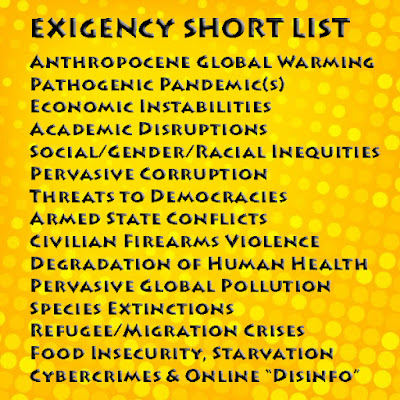
The world is experiencing multiple crises all at once. Russia's war in Ukraine is the first such large-scale conventional conflict in Europe since the end of World War II. China's power and reach are increasing, not just in the Pacific but around the world. The United States is reorienting its military, diplomatic and economic resources in response to China's rising superpower status. Some type of clash seems inevitable.Are we gonna be able to "reason" our ways outa these looming existential catastrophes? e.g., via "Delberation Science?" My dubiety iteratively waxes and wanes.
The COVID pandemic has receded somewhat in the U.S., although hundreds of people continue to die every day. The pandemic continues to cause death and misery around the world, with an estimated death toll of 6.5 million and an incalculable amount of personal, societal and economic suffering.
Extreme wealth and income inequality grows largely unabated. Many of the world's richest people have exploited this period of crisis and challenge to expand their power rather than to improve the human condition. Global democracy is in retreat around the world as fascist, authoritarian and other illiberal forces, operating under the banner of "populism," continue to expand their power and influence.
Here in the U.S., Donald Trump's political cult and a Republican Party dominated by fascists are attempting to end multiracial democracy. This is a revolutionary struggle whose goal is to create a new American society, that in practical terms will be an apartheid Christian fascist plutocracy ruled without challenge or accountability by a small number of rich white men. As seen on Jan. 6, 2021, and throughout the Age of Trump, right-wing political violence, including acts of terrorism, is now integral to the neofascist campaign against democracy.
The existential danger of global climate disaster looms over all the world's crises and challenges. Humanity has faced many great challenges before. But the world is now hyperconnected through digital media and other technologies with such speed and immediacy that our ability to properly process and understand these challenges has been greatly impaired…—Chauncey Devega
"Human intelligence is not the miracle of evolution we like to think it it."
The future of human intelligence
The human mind is exceptional. We have a capacity that all other species lack: the ability to intentionally produce more pleasure for other minds. As why specialists with episodic foresight and theory of mind, we understand that our actions can generate pleasure and misery in the minds of other creatures, be it human or animal. We understand that child soldiers and battery cage hens are miserable. We know these things, and we have the ability to change them. We have the cognitive and technological capacity to create a world that maximizes pleasure for all humans, as well as nonhuman animals. We could flood the world in pleasure qualia, if we wanted to. And this would elevate the value of human intelligence to something beyond that of other species, who cannot conceive of a pleasure-maxed world. If there is one way in which human minds are superior to those of animals in terms of worth, it is our capacity for understanding that pleasure is important and wanting to spread it as far and wide as possible. Paradoxically though, we don’t.
One of the reasons I love Star Trek is because it envisions a kind of techno-dork utopia like this, where humans live somewhat harmoniously with one another and have eliminated much of the day-to-day suffering that we currently experience. Is Star Trek’s pleasure-maximization world a fantasy?
There are two schools of thought on the future of the human species when it comes to creating a pleasure-maxed utopia. In one corner, you have Steven Pinker, the Harvard psychologist and linguist who has written extensively about why there is hope for our species when it comes to bettering ourselves. Pinker points out that humans have been doing a bang-up job of improving our lot in life thanks to the kind of Enlightenment thinking (i.e., “reason applied to human betterment”) that has doubled our average life span in just two hundred years, and reduced global poverty to its current levels (an all-time low). When asked to speculate on the future of our species, Pinker is somewhat optimistic, arguing that “problems are inevitable, but problems are solvable, and solutions create new problems that can be solved in their turn. It’s not a promise of an inevitable utopia, but it’s got a Star Trek ring to it that smacks more of optimism than extinction.
In the other corner you have the philosopher John Gray, who has written many books on humanity’s place in the natural world. Gray acknowledges the lovely boost that comes with Enlightenment style–thinking that has given us modern technology and medicine and everything else, but does not seem to have much hope that these advantages will be enough to free humans of the endless cycle of self-destructive prognostic myopia. In his book Straw Dogs he writes:The growth of knowledge is real and—barring a world-wide catastrophe—it is now irreversible. Improvements in government and society are no less real, but they are temporary. Not only can they be lost, they are sure to be. History is not progress or decline, but recurring gain and loss. The advance of knowledge deludes us into thinking we are different from other animals, but our history shows that we are not.Yes, it’s possible we will break this cycle of inevitable loss and live in a technologically beautiful future like in Star Trek, with adamantine cities floating in the sky above lush, untouched rain forests blanketing a rejuvenated Earth. Where biodiversity has been restored, and humans get their food from sustainably grown farming that doesn’t require as much land or water usage, and where we have eliminated the animal misery created by current farming practices… [Justin Gregg, pp. 204-206].

Through centuries of effort, people have learned much about the sensory worlds of other species. But in a fraction of the time, we have upended those worlds. We now live in the Anthropocene—a geological epoch defined and dominated by the deeds of our species. We have changed the climate and acidified the oceans by releasing titanic amounts of greenhouse gases. We have shuffled wildlife across continents, replacing indigenous species with invasive ones. We have instigated what some scientists have called an era of “biological annihilation,” comparable to the five great mass extinction events of prehistory. And amid this already dispiriting ledger of ecological sins, there is one that should be especially easy to appreciate and yet is often ignored—sensory pollution. Instead of stepping into the Umwelten of other animals, we have forced them to live in ours by barraging them with stimuli of our own making. We have filled the night with light, the silence with noise, and the soil and water with unfamiliar molecules. We have distracted animals from what they actually need to sense, drowned out the cues they depend upon, and lured them, like moths to a flame, into sensory traps.
Many flying insects are fatally attracted to streetlights, mistaking them for celestial lights and hovering below them until they succumb to exhaustion. Some bats exploit their confusion, feasting on the disoriented swarms. Other, slow-moving species, like the little brown bats that Barber tagged, stay clear of the light, perhaps because it makes them easier prey for owls. Lights reshape the animal communities around them, drawing some in and pushing others away, with consequences that are hard to predict. Could the light-averse bats do badly because their habitable zones have shrunk and their insect prey have been pulled away? Might the light-attracted bats temporarily benefit but eventually suffer as the local insect populations crash?
Yong, Ed. An Immense World (pp. 336-337). Random House Publishing Group. Kindle Edition.

THE THREE LEVELS OF CAUSATIONMore to come...
So far I may have given the impression that the ability to organize our knowledge of the world into causes and effects was monolithic and acquired all at once. In fact, my research on machine learning has taught me that a causal learner must master at least three distinct levels of cognitive ability: seeing, doing, and imagining.
The first, seeing or observing, entails detection of regularities in our environment and is shared by many animals as well as early humans before the Cognitive Revolution. The second, doing, entails predicting the effect(s) of deliberate alterations of the environment and choosing among these alterations to produce a desired outcome. Only a small handful of species have demonstrated elements of this skill. Use of tools, provided it is intentional and not just accidental or copied from ancestors, could be taken as a sign of reaching this second level. Yet even tool users do not necessarily possess a “theory” of their tool that tells them why it works and what to do when it doesn’t. For that, you need to have achieved a level of understanding that permits imagining. It was primarily this third level that prepared us for further revolutions in agriculture and science and led to a sudden and drastic change in our species’ impact on the planet.
I cannot prove this, but I can prove mathematically that the three levels differ fundamentally, each unleashing capabilities that the ones below it do not. The framework I use to show this goes back to Alan Turing, the pioneer of research in artificial intelligence (AI), who proposed to classify a cognitive system in terms of the queries it can answer. This approach is exceptionally fruitful when we are talking about causality because it bypasses long and unproductive discussions of what exactly causality is and focuses instead on the concrete and answerable question “What can a causal reasoner do?” Or more precisely, what can an organism possessing a causal model compute that one lacking such a model cannot?
Pearl, Judea; Mackenzie, Dana. The Book of Why: The New Science of Cause and Effect (p. 27). Basic Books. Kindle Edition.

Imagine an elephant in a room. This elephant is not the proverbial weighty issue but an actual weighty mammal. Imagine the room is spacious enough to accommodate it; make it a school gym. Now imagine a mouse has scurried in, too. A robin hops alongside it. An owl perches on an overhead beam. A bat hangs upside down from the ceiling. A rattlesnake slithers along the floor. A spider has spun a web in a corner. A mosquito buzzes through the air. A bumblebee sits upon a potted sunflower. Finally, in the midst of this increasingly crowded hypothetical space, add a human. Let’s call her Rebecca. She’s sighted, curious, and (thankfully) fond of animals. Don’t worry about how she got herself into this mess. Never mind what all these animals are doing in a gym. Consider, instead, how Rebecca and the rest of this imaginary menagerie might perceive one another…This book was released today. Just getting started. It's been 40 years since I had undergrad psych "Sensation and Perception" at UTK. Will be an interesting read, this book. I hope it helps improve my own thinking on "Deliberation Science" issues.
These seven creatures share the same physical space but experience it in wildly and wondrously different ways. The same is true for the billions of other animal species on the planet and the countless individuals within those species.[*1] Earth teems with sights and textures, sounds and vibrations, smells and tastes, electric and magnetic fields. But every animal can only tap into a small fraction of reality’s fullness. Each is enclosed within its own unique sensory bubble, perceiving but a tiny sliver of an immense world.
These seven creatures share the same physical space but experience it in wildly and wondrously different ways. The same is true for the billions of other animal species on the planet and the countless individuals within those species.[*1] Earth teems with sights and textures, sounds and vibrations, smells and tastes, electric and magnetic fields. But every animal can only tap into a small fraction of reality’s fullness. Each is enclosed within its own unique sensory bubble, perceiving but a tiny sliver of an immense world.
There is a wonderful word for this sensory bubble—Umwelt. It was defined and popularized by the Baltic-German zoologist Jakob von Uexküll in 1909. Umwelt comes from the German word for “environment,” but Uexküll didn’t use it simply to refer to an animal’s surroundings. Instead, an Umwelt is specifically the part of those surroundings that an animal can sense and experience—its perceptual world. Like the occupants of our imaginary room, a multitude of creatures could be standing in the same physical space and have completely different Umwelten…
…Uexküll compared an animal’s body to a house. “Each house has a number of windows,” he wrote, “which open onto a garden: a light window, a sound window, an olfactory window, a taste window, and a great number of tactile windows. Depending on the manner in which these windows are built, the garden changes as it is seen from the house. By no means does it appear as a section of a larger world. Rather, it is the only world that belongs to the house—its Umwelt. The garden that appears to our eye is fundamentally different from that which presents itself to the inhabitants of the house.”
…Unlike many of his contemporaries, Uexküll saw animals not as mere machines but as sentient entities, whose inner worlds not only existed but were worth contemplating. Uexküll didn’t exalt the inner worlds of humans over those of other species. Rather, he treated the Umwelt concept as a unifying and leveling force. The human’s house might be bigger than the tick’s, with more windows overlooking a wider garden, but we are still stuck inside one, looking out. Our Umwelt is still limited; it just doesn’t feel that way. To us, it feels all-encompassing. It is all that we know, and so we easily mistake it for all there is to know. This is an illusion, and one that every animal shares…
A few terms will act as guideposts on our journey. To sense the world, animals detect stimuli—quantities like light, sound, or chemicals—and convert them into electrical signals, which travel along neurons toward the brain. The cells that are responsible for detecting stimuli are called receptors: Photoreceptors detect light, chemoreceptors detect molecules, and mechanoreceptors detect pressure or movement. These receptor cells are often concentrated in sense organs, like eyes, noses, and ears. And sense organs, together with the neurons that transmit their signals and the parts of the brain that process those signals, are collectively called sensory systems. The visual system, for example, includes the eyes, the photoreceptors inside them, the optic nerve, and the visual cortex of the brain. Together, these structures give most of us the sense of sight.
The preceding paragraph could have been pulled from a high school textbook. But take a moment to consider the miracle of what it describes. Light is just electromagnetic radiation. Sound is just waves of pressure. Smells are just small molecules. It’s not obvious that we should be able to detect any of those things, let alone convert them into electrical signals or derive from those signals the spectacle of a sunrise, or the sound of a voice, or the scent of baking bread. The senses transform the coursing chaos of the world into perceptions and experiences—things we can react to and act upon. They allow biology to tame physics. They turn stimuli into information. They pull relevance from randomness, and weave meaning from miscellany. They connect animals to their surroundings. And they connect animals to each other via expressions, displays, gestures, calls, and currents.
The senses constrain an animal’s life, restricting what it can detect and do. But they also define a species’ future, and the evolutionary possibilities ahead of it. For example, around 400 million years ago, some fish began leaving the water and adapting to life on land. In open air, these pioneers—our ancestors—could see over much longer distances than they could in water. The neuroscientist Malcolm MacIver thinks that this change spurred the evolution of advanced mental abilities, like planning and strategic thinking. Instead of simply reacting to whatever was directly in front of them, they could be proactive. By seeing farther, they could think ahead. As their Umwelten expanded, so did their minds…
Yong, Ed. An Immense World (pp. 3-8). Random House Publishing Group. Kindle Edition.

Nineteen leading literary writers from around the globe offer timely, haunting first-person reflections on how climate change has altered their lives—including essays by Lydia Millet, Alexandra Kleeman, Kim Stanley Robinson, Omar El Akkad, Lidia Yuknavitch, Melissa Febos, and more.Goes to the "Anthropocene." From the introduction:
In this riveting anthology, leading literary writers reflect on how climate change has altered their lives, revealing the personal and haunting consequences of this global threat.
In the opening essay, National Book Award finalist Lydia Millet mourns the end of the Saguaro cacti in her Arizona backyard due to drought. Later, Omar El Akkad contemplates how the rise of temperatures in the Middle East is destroying his home and the wellspring of his art. Gabrielle Bellot reflects on how a bizarre lionfish invasion devastated the coral reef near her home in the Caribbean—a precursor to even stranger events to come. Traveling through Nebraska, Terese Svoboda witnesses cougars running across highways and showing up in kindergartens.
As the stories unfold—from Antarctica to Australia, New Hampshire to New York—an intimate portrait of a climate-changed world emerges, captured by writers whose lives jostle against incongruous memories of familiar places that have been transformed in startling ways.
When we think of environmental crises our minds might go first to extreme weather events, like Superstorm Sandy, whose size and scale were amplified by climate change. At approximately 8:00 p.m. on October 29, 2012, Sandy struck Atlantic City, New Jersey. That night, a full moon hung in the turbulent sky, pulling the ocean tides a full 20 percent higher than normal and increasing Sandy’s storm surge. Seawater rose along the Eastern Seaboard toward New York City and then poured into Manhattan, flooding subways and sidewalks. More than six hundred thousand people lost power throughout the five boroughs; many would be without electricity for more than a week. The years since Sandy have seen an escalating series of even larger events. In 2020, there were so many tropical storms that the World Meteorological Organization nearly ran out of names for them.__________
But the connections between humans and the natural world go beyond extreme weather events. As the Earth warms, other devastating phenomena continue to thrash the planet: invasive species migrate to cooler climates, choking off local wildlife and creating potentially threatening moments of contact between animals and humans. Wildfire “seasons” are now year-round. Low-lying nations threatened by sea-level rise, like the Marshall Islands, are being forced to consider a terrifying, almost inconceivable choice: relocate the entire population or elevate the land. For the Marshallese, the latter would involve raising 1,200 islands scattered across 750,000 square miles of ocean. Early in 2020—and partway through compiling this anthology—the COVID-19 pandemic encircled the world, altering our lives in ways that are by now familiar. The catastrophic novel coronavirus was borne out of humanity’s complex and unsustainable relationship with wildlife. The way things are headed, this pandemic likely won’t be the last.
To use a metaphor that has grown uncanny, these visible effects of global warming are just the tip of the iceberg. In the public conversation about climate change, macro change tends to take center stage, and for good reason: it impacts the lives of millions and serves as an increasingly urgent reminder of the need for decisive action. But less told among the literature of climate change are the stories of individuals—how they’re coping (or not) with the changes occurring in their own lives. That’s the scale that The World as We Knew It seeks to highlight—not by turning away from global events, but by emphasizing the links between the individual, the collective, and the environmental. Sometimes the connections between the personal and the planetary can be hard to see, but once we start looking, we notice that they’re everywhere…
The World As We Knew It (pp. xii-xiv). Catapult. Kindle Edition

