Search the KHIT Blog

Showing posts with label Reason. Show all posts

Tuesday, February 27, 2024

More readings on deck


Lots going on this week. Barb McQuade's book was just released this morning. With various court actions in process and pending against Our Favorite President, these are timely.
 
Different topic. Coming March 5th:
 
 
In addition to new and ongoing book readings, I've spent a lot of time listening to the latest live audio Orals at the U.S. Supreme Court. Fascinating (well, most of it).
 
Stay tuned... 
 
FEB 29TH UPDATE 
 
Finished the Tristan Snell book. 
For decades, Trump had appeared invincible. But once we had proven that he wasn’t, more cases have followed in our wake. And while the earlier cases merely imposed some fines and repayments on Trump, these newest cases may dismantle his businesses and send him to prison.

Perhaps above all, what has changed in the legal battles against Trump is that he finally ran out of prosecutors and litigants he could buy off or intimidate. Campaign contributions and charity donations have suddenly become useless for Trump. Bullying and threats are not working. Our team at the New York AG’s office was not scared of Trump. Tish James and Fani Willis and Jack Smith are not scared, and they are not backing down. The same has been true of E. Jean Carroll, Michael Cohen, and their attorneys.

The courage and the relentless dedication that it requires to bring a case against a powerful figure, against all odds, against all opposition—that is the most indispensable element in holding such figures accountable and finally bringing them to justice. And we cannot and must not rely solely on elected officials and special counsel to have that courage for us. That courage requires all of us. It requires us all to have the collective determination to enforce the laws fairly, objectively, and persistently, no matter who is on the receiving end, no matter what the outcome is and whether we agree with it personally. It requires us all to fight, to vote, to advocate, to raise our voices, to insist upon people and policies to make accountability a reality rather than just an empty abstraction. Justice is not something that just happens: it’s a choice we make, not merely by our words or pleasant thoughts, but by our actions, with every ounce of zealousness we can muster.


Snell, Tristan. Taking Down Trump (pp. 177-178). Melville House. Kindle Edition. 
Very enjoyable and enlightening read. Now, I need to finish Attack From Within ASAP. Things are moving quickly this week.
 
BARB MCQUADE


__________
 

Wednesday, May 3, 2023

"Deliberation Science?" A Creative Commons cross-post

Respectful persuasion is a relay race, not a solo sprint – 3 keys to putting it in practice

Sure, you can try to force people to agree with you–
but respectful persuasion is something else.
Andrii Yalanskyi/iStock via Getty Images Plus

Colin Marshall, University of Washington

The 2024 presidential election is still a year and a half away, but it can feel much closer: President Joe Biden has made his reelection bid official, presumed candidates are giving out-of-state speeches, pundits are already weighing in on nomination hopefuls, and social media is, as ever, a mess of people trying to persuade strangers to back their favorite. All for good reason: Even a little political persuasion in the next year could change the course of history.
 
I’m a philosopher who studies and teaches the ethics of persuasion. My students are eager to find ways to persuade their friends, family and neighbors about political issues such as climate change and abortion. Moreover, many of them want to persuade with integrity: They want to engage the people they’re talking with respectfully, instead of using the manipulative tricks they regularly see in politics and marketing. But what is respectful persuasion, and what distinguishes it from disrespectful manipulation?
 
There’s no simple formula for respectful persuasion. However, some philosophers see crucial hints in the work of 18th-century philosopher Immanuel Kant, whose theory of respect has guided many ethicists and policymakers for the past two centuries.
 
Drawing on Kant’s work, and that of other philosophers inspired by him, I think we can isolate three key components of respectful persuasion. This isn’t just an academic exercise. My students and I have found that these factors increase the chances of deep, meaningful conversation.

1. Giving reasons

Broadly speaking, reasons are considerations that rationally support some belief or action, including both empirical evidence and abstract arguments. For example, astronauts’ pictures of a round Earth rationally support the belief that the Earth is round. When we sincerely give someone reasons, we show respect for their rationality: their ability to recognize good reasons. 
 
By contrast, a hallmark of manipulation is bypassing rationality, such as repeatedly exposing people to false statements to make them appear true – something that psychologists call the “illusory truth effect.”
 
Manipulation can be effective, but psychologists have found that persuasion using reasons is more durable than nonrational persuasion such as repetition-based tricks. For example, someone who comes to believe in climate change based on the scientific evidence probably will not be as easily swayed later on by repeated exposure to climate skepticism. The rational support that good reasons provide for a belief can make that belief more stable.

2. Being open to learning

Giving reasons is not difficult by itself. The second component of respectful persuasion, however, is much more challenging: being open to receiving the other side’s reasons – a form of intellectual humility. This is especially hard for persuaders, since they have to give up some of the time they would have used to make their case.
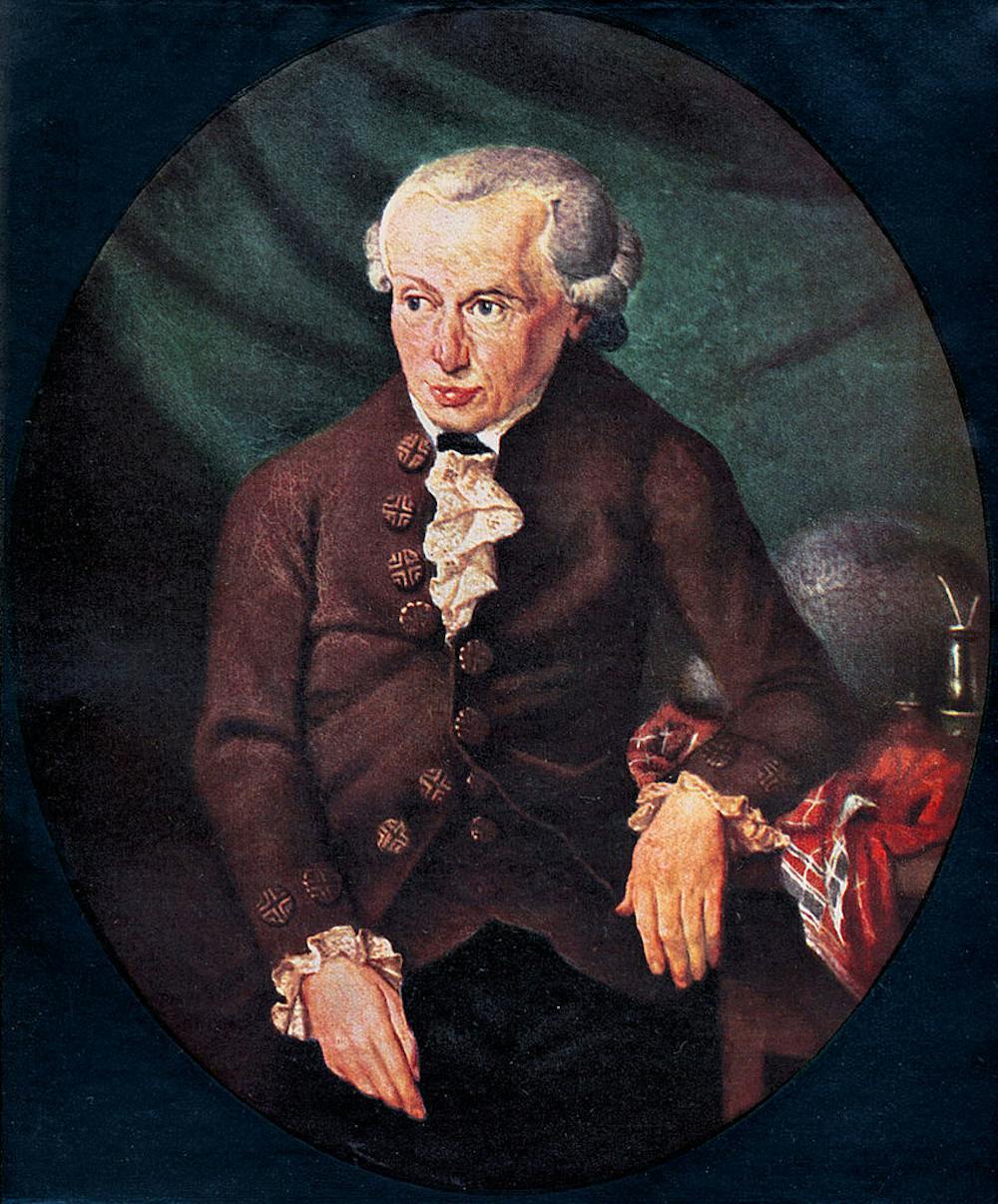
A centuries-old painting of a serious-looking seated man in a powdered wig and brown suit.
Kant’s ideas about respect are still helpful for thinking through sticky situations today.
Culture Club/Hulton Archive via Getty Images
Kant expressed this core idea nicely. Even someone encountering a person whose opinion seems obviously wrong, Kant wrote, has “a duty … to suppose that his judgment must yet contain some truth and to seek this out.” This isn’t merely a suggestion to listen to people one wants to persuade. Instead, respect demands actively seeking out truth in what the other person says. 
 
In fact, some studies suggest that intellectual humility makes people better able to evaluate the strength of arguments. This means that intellectually humble people may be more likely to recognize that a persuader’s arguments are actually better than their own, and have to reconsider their views – which can pose a real risk to someone’s self-esteem.
 
But being open to other people’s reasons also increases the chance of their being open to yours – a form of reciprocity in which you take turns learning from each other. Decades of psychological research have shown that, especially in two-person exchanges, people value reciprocity in communication and see it as a way of treating each other fairly. 
 
In other words, if you show openness to learning from someone else, rather than just lecturing, it may seem fair to them to be open to you too. 
 
That is why faking this kind of respect can be a powerful manipulative tool. A psychologically savvy canvasser, for instance, can manipulate swing voters by pretending to be open to learning about their own opinions. But this carries its own risk, since people who discover they have been manipulated may resent it.

3. Live and let live

Kant’s central principle of respect is that one should “not degrade any other as a mere means” to one’s ends. This requires people to rein in their own self-love out of consideration for others. In popular culture, this might be summed up in the idea of “live and let live”: Other things being equal, we shouldn’t interfere in other people’s lives. 
 
Overlooking this principle can make persuasion disrespectful in a variety of ways, even when the persuader has good intentions. The philosopher George Tsai argues that this happens in cases of unsolicited advice: Imagine, he writes, that while your date goes to the restroom, an eavesdropping stranger tells you that she thinks you could do better. Even if the stranger is right, it’s simply none of her business.
Two men in business attire chat while a woman in a sleeveless white top listens in, looking concerned.
Having an opinion doesn’t mean you need to share it.
DragonImages/iStock via Getty Images Plus
Another example of how interference can make persuasion disrespectful is that changing someone’s mind can harm their dignity and disrupt their connection to their community. For example, say that you persuade a relative who lives in a small ranching community to become vegan. That change might lead to their being ostracized by people they rely on.
 
Because persuasion can affect other people’s lives in many ways, this third component of respect is the most difficult to adhere to. Sometimes, people may be justified in interfering in other people’s lives, such as if lives are at stake or in particularly close relationships – but those are special circumstances.

One conversation at a time

In class, my students attempt to persuade one another four times, using a range of formats: five minutes vs. a whole week; in person vs. over Zoom. At the end, they score one another on effectiveness and respectfulness.
 
My students are smart, informed and passionate, and the class offers them a positive, carefully structured environment. Despite all that, they almost never succeed in persuading one another – at least not when it comes to politics.
 
Something interesting happens, though, when they let respect guide their conversations. Instead of launching into lectures, they start seeing each exchange as an opportunity to learn from each other – perhaps as an opportunity to leave their partner thinking about something in a new way, without fully persuading them.
 
If you approach our conversation as a chance to exchange ideas, without trying to change my mind, you may lay a cornerstone of trust. That, in turn, could make me more receptive to similar viewpoints in the future – even if I’m speaking with other people. Truly respectful political persuasion might best be seen as an extended team effort, not a one-time, one-person task.
___The Conversation
 
Colin Marshall, Associate Professor of Philosophy, University of Washington
 
This article is republished from The Conversation under a Creative Commons license. Read the original article.
__________
 
Is there in fact a "Science of Deliberation?" See also "The Truth About Denial." And, how about "Mental Immunity" from disinformation and fabulism? Hmmm... "Collective Illusions?" After all, we all want to be "influential," right?

Saturday, April 15, 2023

"Mental Immunity?"

Hmmm... cue the Cognitive Antivaxxers in 3, 2, 1?
Is the marketing metaphor broadly apt, or potentially problematic? (Let a thousand Marxist Woke Lib Re-Education Camps proliferate.) Are there identifiable material neural cognitive "pathogens" equivalent to bacteria, viruses, fungi, protozoa, worms, and prions? Will we find them in "the Electrome amid "the battle for your brain?"

More stuff to study.

Looking fairly promising early on.
 
 
Oh, so, it's merely an "analogy? OK.
 
Andy Norman gets big props for this:
 
 
That was imparted to me in grad school a quarter century ago. This is the first time since then I've encountered someone else succinctly making the same point. Major brownie points, Sir. Very cool. 
apropos: "What image does the word philosopher conjure? Maybe Socrates, bearded and barefoot, counseling Plato on the agora; Rousseau on one of his solitary walks around the outskirts of Paris; Sartre sucking pensively on his pipe at the Café de Flore. What it may not call to mind is a woman.."
'eh?
 
BTW: I would also commend backing up a bit to Adrian Bardon's deft "The Truth About Denial."

 
All of this stuff goes to my ongoing Jones regarding so-called "Deliberation Science."
 
A SMH headline this morning.
 
 
Okeee dokeee, then.
 
Moving along. Dr. Norman:

 
I taught undergrad "Critical Thinking" and then graduate "Argument Analysis" as an Adjunct for a number of years (evening school part-time faculty; day gig risk analyst in a bank at the time). I loved it (notwithstanding the crap compensation), but, I never really dug the conventional phrase "critical thinking." Whole 'nuther digression, that...
 
But, first, Dr. Norman:
The Twentieth Century’s Critical Thinking Crusade

A third initiative centers on the concept of critical thinking. A hundred years ago, the philosopher John Dewey introduced the phrase to name a quasi-scientific frame of mind. His insight was sound: responsible thinkers test ideas and try not to rely on the ones that don’t survive scrutiny. As we now like to put it: we can teach people how to “think critically,” and thereby reduce their susceptibility to bad ideas.

This approach, too, has fallen short of expectations. Despite being the focal point of higher education for one hundred years, our species remains distressingly prone to irrational thinking. There’s some evidence that higher education imparts a limited immunity to some forms of ideological contagion, but on all accounts, the effect is weaker than hoped. One study found that “many colleges fail to improve critical thinking skills.” Another found that, while a large majority of professors claim to impart critical thinking skills, relatively few can say what they mean by critical thinking or explain how their teaching imparts it. In 2016, 43 percent of American college graduates voted for the disastrously unqualified and unprincipled Donald Trump. This massive failure of America’s critical thinking factory should be a wake-up call for us all.

I no longer find the concept of critical thinking particularly useful. It’s mostly a vague, feel-good term that means “the way we educated people like to think.” It’s really a conceptual black box, one that hides important differences. It’s not a solution, but a placeholder for one. Yes, the term critical hints at the need to reduce our susceptibility to bad ideas, but the concept of critical thinking does little more than gesture clumsily at the traits that make that possible.

Immunity to bad ideas depends on far more than the critical thinking skills we like to talk about in higher education. Indeed, our focus on skills has led us to overlook the better part of the mind’s defenses. (It’s more important to shape the deep sensibilities that marshal these skills for one or another purpose, and mold the resulting habits of mind.) Meanwhile, we need to acknowledge this truth: the critical thinking paradigm has not served us particularly well.

Reason, science, and critical thinking: these concepts give shape to some of our best efforts to prevent outbreaks of bad ideas. Each effort is well intentioned and worthy of admiration. None, though, can claim true success. Now we can see why: each approach has limitations rooted in its defining concept. The conceptual toolbox we’ve inherited isn’t channeling our efforts in the right way. As a result, we’re not doing enough—or enough of the right things—to promote responsible cognition. In this sense, philosophy’s reason project—and its science and critical thinking–based variants—are failing us.


Norman, Andy. Mental Immunity (pp. 28-29). HarperCollins. Kindle Edition. 
Resonates with me. My initial faculty experience was also that too many of my students assumed that the "Critical" part meant that they'd get to endlessly criticize each other, and vent off their pet peeves via classroom verbal free-for-alls. Moreover, I'd look out over my classes and think "man, most of you people need to re-take high school English." And that was no mere irascible elitist conceit; the university publicly admitted during my tenure (1999-2004) that more than half of incoming freshman had to be remanded to remedial English.

FROM A PRIOR POST: BOBBYG'S RANDOM MUSINGS ON COGNITION
Some things that bedevil our thinking, particularly as it goes to persuasion and influence:

There is no first-person singular present-tense active voice usage of the word "wrong." No one ever says "I AM wrong."
 
[props to Kathryn Schulz]  Our aggregate default is that we're right about everything. To the extent that we continue to survive, that's an understandable assumption—as it pertains to minor, inconsequential issues, anyway, and it inexorably tilts us toward "confirmation bias."
 
Our education system mostly tells us there's one "right answer" to every question—lurking amid a boatload of "wrong ones."
 
And, those who quickly alight on the "right answer" get reinforced and nurtured as they move through the system.
 
Being wrong is not a synonym for being "stupid" or ignorant. 

Neither is "ignorant" a synonym for "stupid." But it's mostly epithetically spun that way

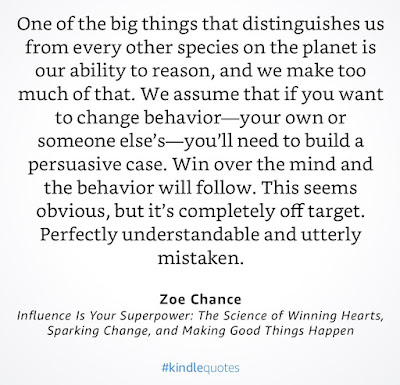
Humans "reason" to WIN the argument.

 Should truth happen along the way, so much the better. (See "Why Do Humans Reason?" by Sperber & Mercier) Evolutionary adaptive utility, "The Pen is Mightier Than The Sword."

He/She with the best story WINS!

Trial Lawyering 101. Prior to writing and movable type, stories were the whole ballgame. Hence, our evolved affinity.

Once you decide that X is right or wrong / good or bad, you cannot unring that bell.

A staple look-before-you-leap admonishment of mine back when I was teaching "Critical Thinking."

If, when it's all said and done, your logic is impeccable, and your facts and evidence are bulletproof, yet you remain unpersuasive, what have you really accomplished?''

Another classroom staple of mine. That one was "exceeding my brief" as it were, but my Sups never noticed or cared. Anyway, my overall teach-to-the-text priority focus as a piddly Adjunct necessarily had to be "OK, here's how this stuff works. Take it or leave it."
BACK TO ZOE
 

Once you finish her book you will have a firm grip on just why. I love it when I learn stuff.
WHEN YOU THINK ABOUT the individual genetic and developmental differences that impact the sensory portions of our nervous systems, it’s remarkable that we can agree on a shared reality at all.  Linden, David. Unique (p. 253). Basic Books. Kindle Edition
 Stay tuned. More to come...
__________


Tuesday, October 11, 2022

Science, philosophy, and "other ways of knowing"

as we consider "deliberation science."

Interesting.

apropos,
JUST AS CONTEMPORARY agnosticism has tended to lose its confidence and lapse into scepticism, so Buddhism has tended to lose its critical edge and lapse into religiosity. What each has lost, however, the other may be able to help restore. In encountering contemporary culture, the dharma may recover its agnostic imperative, while secular agnosticism may recover its soul.

An agnostic Buddhist would not regard the dharma as a source of “answers” to questions of where we came from, where we are going, what happens after death. He would seek such knowledge in the appropriate domains: astrophysics, evolutionary biology, neuroscience, etc. An agnostic Buddhist is not a “believer” with claims to revealed information about supernatural or paranormal phenomena, and in this sense is not “religious.”

An agnostic Buddhist looks to the dharma for metaphors of existential confrontation rather than metaphors of existential consolation. The dharma is not a belief by which you will be miraculously saved. It is a method to be investigated and tried out. It starts by facing up to the primacy of anguish, then proceeds to apply a set of practices to understand the human dilemma and work toward a resolution. The extent to which dharma practice has been institutionalized as a religion can be gauged by the number of consolatory elements that have crept in: for example, assurances of a better afterlife if you perform virtuous deeds or recite mantras or chant the name of a Buddha.

An agnostic Buddhist eschews atheism as much as theism, and is as reluctant to regard the universe as devoid of meaning as endowed with meaning. For to deny either God or meaning is simply the antithesis of affirming them. Yet such an agnostic stance is not based on disinterest. It is founded on a passionate recognition that I do not know. It confronts the enormity of having been born instead of reaching for the consolation of a belief. It strips away, layer by layer, the views that conceal the mystery of being here—either by affirming it as something or denying it as nothing.

Such deep agnosticism is an attitude toward life refined through ongoing mindful awareness. It may lead to the realization that ultimately there is neither something nor nothing at the core of ourselves that we can put a finger on. Or it may be focused in an intense perplexity that vibrates through the body and leaves the mind that seeks certainty nowhere to rest.

IN A FAMOUS parable the Buddha imagines a group of blind men who are invited to identify an elephant. One takes the tail and says it’s a rope; another clasps a leg and says it’s a pillar; another feels the side and says it’s a wall; another holds the trunk and says it’s a tube. Depending on which part of Buddhism you grasp, you might identify it as a system of ethics, a philosophy, a contemplative psychotherapy, a religion. While containing all of these, it can no more be reduced to any one of them than an elephant can be reduced to its tail.

That which contains the range of elements that constitute Buddhism is called a “culture.” The term was first explicitly defined in 1871 by the anthropologist Sir Edward Burnett Tylor as “that complex whole which includes knowledge, belief, art, morals, law, custom, and any other capabilities and habits acquired by man as a member of society.” Since this particular culture originates in the awakening of Siddhartha Gautama and aims to cultivate a way of life conducive to such awakening, Buddhism could be described as “the culture of awakening.”

While Buddhism has tended to become reductively identified with its religious forms, today it is in further danger of being reductively identified with its forms of meditation. If these trends continue, it is liable to become increasingly marginalized and lose its potential to be realized as a culture: an internally consistent set of values and practices that creatively animates all aspects of human life. The challenge now is to imagine and create a culture of awakening that both supports individual dharma practice and addresses the dilemmas of an agnostic and pluralist world.

Batchelor, Stephen. Buddhism without Beliefs (pp. 18-20). Penguin Publishing Group. Kindle Edition.
OK, I count myself fairly hardass on "scientific explanations," in light of my education and subsequent technical career (environmental radiation analytics, industrial diagnostics, health care analytics, & financial risk management). Nonetheless, from my 1998 essay on my late elder daughter's cancer struggle:
'Arrogant, narrow-minded, greedy, and indifferent?'

Is science the enemy? To the extremist "alternative healing" advocate, the answer is a resounding 'yes'! A disturbing refrain common to much of the radical "alternative" camp is that medical science is "just another belief system," one beholden to the economic and political powers of establishment institutions that dole out the research grants and control careers, one that actively suppresses simpler healing truths in the pursuit of profit, one committed to the belittlement and ostracism of any discerning practitioner willing to venture "outside the box" of orthodox medical and scientific paradigms.

One e-mail correspondent, a participant in the internet newsgroup alt.support.cancer, vented splenetic at length recently regarding U.S. authorities' alleged hounding, arrest, and imprisonment of alternative healers. He railed that law enforcement, at the behest of the AMA/FDA Conspiracy (a.k.a. the "corrupt AMA/FDA/NCI/ACS cartel"), had made the practice of alternative medicine illegal in the U.S. Moreover, he considered the fact that medical science can only claim "cures" for approximately 10% of the roughly 10,000 classified human diseases an a priori indictment of the mainstream profession.

I know: this is akin to the U.N. Black Helicopters/One-World-Government Conspiracy stuff of the not-too-tightly-wrapped. Still, I couldn't resist-- pointing out in (no doubt futile) reply that no one came with guns drawn and cuffs at the ready the night at Brotman Rehab when "Healing Angelite Crystals" practitioners-- devotees of India's Sai Baba-- came from Topanga Canyon to hover for hours in ceremony over Sissy (to the curious and wary befuddlement of the night shift nurses); neither did Security nor the medical staff at Brotman confiscate the goopy-looking herbal tonic we brought in, an elixir prescribed for Sissy by a Chinese herbal pharmacist doing business quite openly in Chinatown near downtown L.A.; nor would SWAT teams pounce on the backyard in the Valley where we took part in evening-long Lakota Souix "healing sweat lodge" ceremonies conducted by the venerable Wallace Black Elk; and finally, Wyndie, one of Sissy's highly skilled and effective physical therapists at Brotman did not have her certification revoked for counseling my daughter on the Hindu principles of the Chakras and efficacy of aromatherapy.

Moreover, I had to respond, the fact that we can only cure 10% of known diseases implies nothing regarding the quality of mainstream medical research and practice, unless the alternatives industry can provide hard, "case-mix adjusted," scientifically valid data showing their methods to effect consistently and significantly better outcomes-- which they cannot (a dearth of peer-reviewed studies being a central characteristic of "alternative" practice). Additionally, I asked, can anyone even cite historical curative percentages from 30, 50, or perhaps 100 years ago? Indeed, even such statistics would prove problematic-- "shooting at a moving target," as it were-- in that more subtle and clinically unresponsive maladies continue to be discovered and classified while the easier to treat are dealt with more readily. And, classificatory observation is easy compared to the work and resources required to effect cures; we should expect that identification will outpace remedy. Finally, 50 years ago death certificates listing demise from "natural causes" would today likely have identifiable diseases recorded as the cause of death.

Purveyors of medical quackery should fear the hot breath and hard heel of competent authority, but I see no evidence of suppression of alternative therapy methods that are not certifiably fraudulent. All manner of "unproven" substances are sold quite openly at retail, both in the health food stores and in the national chain outlets; all that need accompany the product is the legal boilerplate disclaimer acknowledging an absence of FDA blessing, along with the inoculating phrase 'dietary supplement.’…

For the bulk of the alternative healing industry, the real frustration has nothing whatever to do with clinical and political repression, and everything to do with lack of access to the pockets of third-party payers. While such may be a very real economic problem for health care consumers and the vendors of alternative products and services, it has little to do with clinical "narrow-minded arrogance." Peer-reviewed studies of the unpatentable epigallocatechin alone have, after all, somehow found funding hundreds of times thus far. ["One in Three."]
I read "Buddhism Without Beliefs" repeatedly while sitting at Sissy's bedside daily during her final months.

It helped keep me sane.
 
I keep the original hardcopy close at hand, and also have it in my Kindle stash.

FROM A 2008 BLOG POST OF MINE
 
In the mid-late 1990s, while caring for my terminally ill daughter in Hollywood, I recall reading that there were more MRI machines deployed in the Los Angeles area than in the entire nation of Canada, the inference being that the American economics of hugely expensive sense-extending diagnostic imaging technologies such as MRI units, CAT scanners, cardiac dynamic stress test machines, etc tended toward the economically problematic. Every medical institution feels compelled to have them to be credible, competitive Players in the market, but everyone also needs to keep them all profitably humming, with viable billable payers at the end of the back office line. And, every additional install exacerbates the billable utilization problem. Damned if you do, damned if you don't.

Well consider a brief true story from several decades ago, written by surgeon and writer Dr. Richard Selzer:

On the bulletin board in the front hall of the hospital where I work, there appeared an announcement. “Yeshi Dhonden,” it read, “will make rounds at six o’clock on the morning of June 10.” The particulars were then given, followed by a notation: “Yeshi Dhonden is personal physician to the Dalai Lama.” I am not so leathery a skeptic that I would knowingly ignore an emissary from the gods. Not only might such sangfroid be inimical to one’s earthly well-being, it could take care of eternity as well. Thus, on the morning of June 10, I joined a clutch of whitecoats waiting in the small conference room adjacent to the ward selected for the rounds. The air in the room is heavy with ill concealed dubiety and suspicion of bamboozlement. At precisely 6 o’clock, he materializes, a short, golden, barrely man dressed in a sleeveless robe of saffron and maroon. His scalp is shaven, and the only visible hair is a scanty black line each hooded eye.
He bows in greeting while his young interpreter makes the introduction. Yeshi Dhonden, we are told will examine a patient selected by a member of the staff. The diagnosis is as unknown to Yeshi Dhonden as it is to us. The examination of the patient will take place in our presence, after which we will reconvene in the conference room where Yeshi Dhonden will discuss the case. We are further informed that for the past two hours Yeshi Dhonden has purified himself by bathing, fasting, and prayer. I, having breakfasted well, performed only the most desultory of ablutions, and given no thought at all to my soul, glanced furtively at my fellows. Suddenly, we seem a soiled, uncouth lot.
The patient had been awakened early and told that she was to be examined by a foreign doctor, and had been asked to produce a fresh specimen of urine, so when we enter her room, the woman shows no surprise. She has long ago taken on that mixture of compliance and resignation that is that the facies of chronic illness. This was to be but another in an endless series of tests and examinations. Yeshi Dhonden steps to the bedside while the rest stand apart, watching. For a long time he gazes at the woman, favoring no part of her body with his eyes, but seeming to fix his glance at a place just above her supine form. I, too, study her. No physical sign nor obvious symptom gives a clue to the nature of her disease.
At last he takes her hand, raising it in both of his own. Now he bends over the bed in a kind of crouching stance, his head drawn down into the collar of his robe. His eyes are closed as he feels for her pulse. In a moment he has found the spot, and for the next half hour he remains of us, suspended above the patient like some exotic golden bird with folded wings, holding the pulse of the woman beneath his fingers, cradling her hand in his. All the power of the man seems to have been drawn down into this one purpose. It is tell patient of the pulse raced to the state of ritual. From the foot of the bed, where I stand, it is as though he and the patient had entered a special place of isolation, of apartness, about which a vacancy hovers, and across which no violation is possible. After a moment the woman rests back upon her pillow. From time to time she raises her head to look at the strange figure above her, then sinks back once more. I cannot see their hands joined in a correspondence that is exclusive, intimate, his fingertips receiving the voice of her sick body through the rhythm and throb she offers at her wrist. All at once I am envious -- not of him, not of Yeshi Dhonden for his gift of beauty in holiness, but of her. I want to be held like that, touched so, received. And I know that I, who have palpated 100,000 pulses, have not felt a single one.
At last Yeshi Dhonden straightens, gently places the woman’s hand upon the bed, and steps back. The interpreter produces a small wooden bowl into sticks. Yeshi Dhonden pours a portion of the urine specimen into the bowl, and proceeds to whip the liquid with the two sticks. This he does for several minutes until a foam is raised. Then, bowing above the bowl, he inhales the older three times. He sets down the bowl, and turns to leave. All this while, he has not uttered a single word. As he nears the door, the woman raises her head and calls out to him in a voice at once urgent and serene. “Thank you, doctor,” she says, and touches with her other hand the place he had held on her wrists, as though to recapture something that had visited their. Yeshi Dhonden turns back for a moment to gaze at her, then steps into the corridor. Rounds are at an end.
We are seated once more in the conference room. Yeshi Dhonden speaks now for the first time, in soft Tibetan sounds that I’ve never heard before. He has barely begun when the young interpreter begins to translate, the two voices continuing in tandem – a bilingual fugue, the one chasing the other. It is like the chanting of monks. He speaks of winds coursing through the body of the woman, currents that break against barriers, eddying. These vortices are in her blood, he says. The last spendings of an imperfect heart. Between the chambers of her heart, long, long before she was born, a wind had come and blown open a deep gate that must never be opened. Through it charged the full waters of her river, as the mountain stream cascades in the springtime, battering, knocking loose the land, and flooding her breath. Thus he speaks, and is silent.
“May we now have the diagnosis?” A professor asks.
The host of these rounds, the man who knows, answers. “Congenital heart disease,” he says. “Interventricular septal defect, with resultant heart failure.”
A gateway in the heart, I think. That must not be opened. Through it charge the full waters that flood her breath. So! Here then is the doctor listening to the sounds of the body to which the rest of us are deaf. He is more than doctor. He is Priest.
I know, I know, the doctor to the gods is pure knowledge you’re healing. The doctor to man stumbles, most often wound; his patient must die, as must he.
Now and then it happens, as I make my own rounds, but I hear the sounds of his voice, like an ancient Buddhist prayer, its meaning long since forgotten, only the music remaining. Then the jubilation possesses me, and I feel myself touched by something divine.
[1976: Richard Selzer, MD, Mortal Lessons: Notes on the art of surgery]
__

For me, such an inferentially instructive tale goes beyond mere abstract epistemological interest -- achingly so. Several years prior to being diagnosed with fatal liver cancer, my daughter also had encounters with non-western medical diagnostic assessments, one of which might well have saved her life (and this father's now permanently broken heart) had she not blown it off. As I wrote in my "1 in 3" essay, ruminating on this aspect of "alternative medicine":
It was, after all, a Santa Monica Chinese practitioner of acupuncture and herbal medicine, one Dr. Yi Pan, who first called Sissy's attention to a problem with her liver several years prior to her HCC diagnosis. She'd been referred to him by a girlfriend for attention to a menstrual problem. Dr. Pan had a diagnostic acumen requiring no x-rays, CT scans, or blood tests. Yet, the internet medical fraud site www.quackwatch.com dismisses traditional Chinese medicine as "ineffective," as do many other critics of alternative practices.
Tragically, Sissy summarily discounted his prescient admonition. I can only speculate wistfully on the implications of our having known three years earlier.
__
Indeed. Indeed.
___
 
BTW, "Philosophy," as it was defined for me in grad school, properly denotes "Love" (philo) of "Knowledge / Wisdom" (sophia). Not inscrutable, obtuse academic jargon. 
__________
 

Wednesday, September 14, 2022

More new reading

apropos of so called "Deliberation Science"

Dr. Ahn's book has just been released. Kim Wehle's is fairly recent (I've read and cited her before). I'm reading these two side by side. Very illuminating. 
 
I'm deep into Dr. Ahn's book straight away. Chapter 2 (on "confirmation bias") alone was worth the price. She runs this outfit (below) at Yale.
 
 
This is likely to be a long post. Stay tuned. For now, among other prior posts, ponder Dr. Justin Gregg.

Also, older blog stuff, via searching "Critical Thinking."
 
UPDATE: A NEW TITLE SERENDIPITOUSLY INTRUDES.
 
Saw this touted on Twitter. Had to check it out. Only $4.99. Looks topically relevant.
 
Table of Contents

Title Page
Copyright Page
Epigraph
Table of Contents
Foreword
I. Concept of primatology
II. Evolutionary trees
III. Power relations in animal societies
IV. Power relations in the tree of Homo sapiens
V. Comparing human and animal societies
VI. Evolution of human societies
VII. Politics within a society
VIII. Evolutionary foundations of conservatism and liberalism
IX. Evolutionary theory of politics: evidence and applications
X. Predicting politics in human societies
XI. Recap
About the Author
 
...Our nature will always lead us to compete for more resources. That is, to change “from primates to politicians” as part of our survival instinct. That fight is part of our day-to-day and makes us a true political animal. Not in the sense that Aristotle contemplated, but in the sense of a competition for power in which the only ethical principle that seems to be universal is the need for certainty of punishment.

Such certainty of punishment is not the responsibility of governments alone: society is called to demand justice, to pave conditions that allow fair and equitable competition.

Corrupt politicians, clientelists, despots, populists and other subgenres: these are not who betrays us. Society betrays itself, every time it allows the ascent of a leader without the right profile to provide adequate social governance. We betray ourselves as individuals and as a society every time we expect “someone else” to take control of the situation, or every time we turn a blind eye to the rants of the current heads of state…

The “evolutionary theory of politics” developed in this book explains the oscillations in leadership styles throughout history. Cycles of authoritarianism alternated with equity seem to be the natural response of the societies created by our species, in the face of the stress that our own technological advances represent.

Regarding the inevitable question of whether liberals or conservatives do a better job of governing, we could say that both ideologies are necessary, that rotation in power is good, and that the clear ideological definition of political currents enriches democracy. The balance between conservatives and liberals prevents liberals from making changes so fast that things get out of hand and end up in anarchy similar to the French revolution, just as it prevents conservatives from establishing a kind of monarchy that would return us to the obscurantism of the Middle Ages. Social progress depends on both ideologies for changes to take place gradually, at a speed that allows their assimilation by the majority in an atmosphere of social organization, without leading to chaos…

There is no doubt that our brain is complex, as is our biology. Our societies are even more complex since they are the result of the interaction between our biological characteristics and the evolution of the brain of the most intelligent animal on the planet.

But no matter how intelligent, sophisticated and complex we become, our ancestors will always be hanging around backstage in our DNA. Our politicians will always be primates, and primates will always be politicians.

[From Primate to Politicians, pp. 191-194.]
Brings to mind the question "Why do humans 'reason'?".  (Answer: To "win" the argument; the Pen is Mightier Than the Sword. —an evolutionary 'adaptive utility' riff.)
___
 
QUICK DIVERSION

Recall my recent review of Justin Gregg's new book "If Nietzsche Were a Narwhal."
 
Here's a killer review by Rafia Zakaria in The Baffler.

I OWE CHICKENS AN APOLOGY. Not only have I been eating them until very recently, but I have refused to even consider the possibility of a chicken having any kind of inner life. This estimation was not made from a lack of interaction. As children, my twin brother and I purchased baby chicks from a street vendor. We did this unfazed by the fact that quite often, the chickens would die. Once, when we were nine, we had two that lived, a hen and a rooster. No one told us that we should probably get more hens. Not having any other female companions, the rooster exerted his attentions on the one chicken. She would lay an egg or two every day, much to our delight, but soon sickened and died. Then there was only an incel rooster who roamed our compound and terrorized the women. After a few ugly incidents, he was “given away” to one of the women who worked at our house. We were never told what happened to him, and I didn’t care. There is nothing worse than an incel rooster patrolling your house all day long.

Now, so many years later, I’ve found my way to animal behaviorist Justin Gregg’s brilliant new book If Nietzsche Were a Narwhal: What Animal Intelligence Reveals About Human Stupidity. Gregg’s chicken coop is “a huge enclosed area” with high rafters, because as an animal scientist, he knows them to be jungle birds who need perches on which to sleep at night. But it is not only the magisterial heights of Gregg’s discussion of chickens that stayed with me. I was struck also by Gregg’s description of his chickens’ varied personalities, one anxious, another friendly, and so on; he tells us that these chickens do have inner lives and thus a consciousness of themselves as distinct from others. Instead of the feckless creatures I (and most people) assume them to be, chickens have just the sort of intelligence that is necessary for their own survival. They don’t think like humans, Gregg tells us, because they do not need to.

Intelligence, in Gregg’s explanation, does not exist in the way SATs or other IQ tests would have you believe. Those tests quantify a certain kind of ability to process information. People who do not do well on such tests may have other kinds of abilities that simply are not being measured. Intelligence is not one easily definable thing; engineers working on artificial intelligence cannot agree on a definition of it. But what humans have is a tendency to ask why things operate in a certain way. In Gregg’s terminology, humans are “why specialists,” a proclivity that in natural selection terms is no advantage and perhaps even a liability. A narwhal swimming around in the sea, for instance, would never have the kind of mental breakdown that the German philosopher pondering nihilism suffered toward the end of his life. Animal intelligence is practical and does not get caught up in abstract thought. By and large, animals make calculations based on what they can observe; ideas such as “causality,” which lie at the crux of human intelligence, are outside their capacity for thought…
Read all of it. Excellent. Majorly. I was not aware of Rafia Zakaria. I am remiss.

UPDATE

Finished both Dr. Ahn's book and Kim Wehle's book. I was reminded of a number of others in my stash.

 
I think I'll continue this topic in a subsequent post. I'll leave you with this for now.

When we believe something to be true, we tend also to see the very process of arriving at it as clear and objective, and therefore the kind of thing we can achieve on our own; when we hold that a given notion is false, we ascribe belief in it to some unfortunate wrong turning, usually taken because an inquirer was led astray, like Hansel and Gretel being tempted into the oven by a wicked witch. And yet even the briefest reflection would demonstrate to us that nothing of the sort is the case: there is no connection between independence and correctness, or social thinking and wrongness...

Jacobs, Alan. How to Think: A Survival Guide for a World at Odds (p. 38). The Crown Publishing Group. Kindle Edition.
Also (noted in a prior post):
WHEN YOU THINK ABOUT the individual genetic and developmental differences that impact the sensory portions of our nervous systems, it’s remarkable that we can agree on a shared reality at all…

…Each of us operates from a different perception of the world and a different perception of ourselves.

A portion of the individual variation in sensory systems is innate. But those innate effects are elaborated and magnified with time as we accumulate experiences, expectations, and memories, filtered through and in turn modifying those very same sensory systems. In this way, the interacting forces of heredity, experience, plasticity, and development resonate to make us unique.


Linden, David. Unique (pp. 253-254). Basic Books. Kindle Edition.
And,
…If you’ve ever doubted the significance of brain plasticity, rest assured that its tendrils reach from the individual to the society.

Because of livewiring, we are each a vessel of space and time. We drop into a particular spot on the world and vacuum in the details of that spot. We become, in essence, a recording device for our moment in the world.

When you meet an older person and feel shocked by the opinions or worldview she holds, you can try to empathize with her as a recording device for her window of time and her set of experiences. Someday your brain will be that time-ossified snapshot that frustrates the next generation.

Here’s a nugget from my vessel: I remember a song produced in 1985 called “We Are the World.” Dozens of superstar musicians performed it to raise money for impoverished children in Africa. The theme was that each of us shares responsibility for the well-being of everyone. Looking back on the song now, I can’t help but see another interpretation through my lens as a neuroscientist. We generally go through life thinking there’s me and there’s the world. But as we’ve seen in this book, who you are emerges from everything you’ve interacted with: your environment, all of your experiences, your friends, your enemies, your culture, your belief system, your era—all of it. Although we value statements such as “he’s his own man” or “she’s an independent thinker,” there is in fact no way to separate yourself from the rich context in which you’re embedded. There is no you without the external. Your beliefs and dogmas and aspirations are shaped by it, inside and out, like a sculpture from a block of marble. Thanks to livewiring, each of us is the world.


Eagleman, David. Livewired (pp. 244-245). Knopf Doubleday Publishing Group. Kindle Edition.
'eh?
 
How does all this stuff go to so-called "Deliberation Science?"
__________