NOW REPORTING FROM BALTIMORE. A private, non-commercial blog begun in support of the federal Meaningful Use REC initiative, and Health IT and Heathcare improvement more broadly. Moving now toward important broader STEM and societal/ethics topics. Formerly known as "The REC Blog."
NOTE: Comments are moderated, thanks to trolls and bots.
HOW TO PERSUADE OTHERS has been on our minds for millennia. Texts such as the Instruction of Ptahhotep, written around 2300 B.C.E. in ancient Egypt, give advice on how to win an argument. And from the beginning, people were wary of the power of new technologies—including writing itself—to persuade. In the fourth century B.C.E., the Greek philosopher Plato analyzed rhetoric and persuasion in his work Phaedrus and warned that the written word allowed people to convince others of their ideas without presenting them an opportunity to challenge them. Many technologies since then—from radio to TV to computers—have brought up similar concerns...
EVEN AS THE EVIDENCE accumulated that AI chatbots could change minds, Hackenburg felt there was a gap. “I still didn’t have a real sense of how persuasive these models are compared to the people who actually persuade in the real world,” he says.
So Hackenburg pitted the chatbots not just against laypeople, but also against a paid group of 56 elite debaters, including world champions. As a further incentive, the debaters received a bonus tied to how persuasive they were.
The humans took different approaches. For instance, one of the highest performing debaters used proverbs from his home country of Nigeria to persuade people, Hackenburg says. “These were humans from all over the world giving it their best shot and trying approaches and techniques that were very specific to their culture and context.” But it wasn’t enough. Although they were better than laypeople, the champion debaters were significantly less persuasive than AI.
Hackenburg even gave his humans some AI help. He built a coaching tool for the elite debaters that showed them their past conversations with study participants, how much they had swayed each one, and what the AIs would have said at various points in those conversations. Using the tool for 8 hours improved the humans’ performance a bit, but AI still came out on top. “In the end it wasn’t particularly close,” Hackenburg says. His team even found that participants were more likely to give money to Save the Children, an international charity, after talking to a persuasive AI bot than after talking to professional canvassers who had worked for the group for years.
But what gives chatbots the edge? Some early research had suggested it was the AI’s ability to personalize arguments using details about its human partner provided by the experimenter. However, other studies have found that giving a chatbot extra personal information does little to improve its persuasiveness. That doesn’t mean microtargeting is not at play; instead, an LLM may glean enough from its counterpart in a chat that additional demographic information makes no difference.
Like Willer in his foundational study, other researchers have shown that AI’s powers rely on appeals to facts and evidence. In a 2025 preprint, a follow-up to their Science paper, Costello and his colleagues found that the only time the chatbot was unsuccessful in convincing people out of conspiracy theories was when it was forbidden from using evidence or rational arguments. “It tries to say, ‘Oh, well, you shouldn’t believe this. This is really damaging, and it could hurt people,’” Pennycook says. “People are like, ‘You haven’t given me any reasons to change my mind.’ And so they don’t change their mind.”
The study confirms people will listen to good arguments, Pennycook says. “Facts and evidence really matter.” But this doesn’t mean the facts used by chatbots necessarily have to be accurate. In a Science paper published last year, Hackenburg found that models trained to become more persuasive also ended up being less truthful. It’s possible the models learn that “facts” seem to be the thing that most persuades people, Hackenburg says, and end up filling their conversations with dubious or simply false ones. “They start scraping the bottom of the barrel of the facts that they have and know and so the quality of facts just sort of degrades,” he says. Even in Hackenburg’s recent preprint, Claude spouted numerous inaccuracies and falsehoods when persuading the U.K.-based participant to support tougher penalties for disruptive protests...
My friend Gary Marcus put out a nice blog post earlier this week titled “Leopold’s Folly,” which uses the late-July implosion of Leopold Aschenbrenner’s tragicomically-namedSituational Awarenesshedge fund — $45 billion of assets compressed to roughly $10 billion in a matter of days, the whole public book sold to Citadel under margin pressure — as a symbol for the financial structure of the entire AI economy.
Gary’s essay is vivid and, on its central financial observation, more right than his critics will want to admit. All the circular financing in the modern AI and hardware world does have a Ponzi-esque smell to it, at least on the surface — and it’s clear there are some eventualities where this whiff leads to a Ponzi-crash-style reality...
I got to teach collegiate "critical thinking" for 5 fun years while living in Las Vegas (evening school adjunct faculty; my day gig was that of a credit risk analyst in a bank). I never really liked the curricular title. I'm likewise guarded about cavalierly using the word "idiot."
Too many of my students came in thinking "oh, cool, we're just gonna argue about stuff endlessly and get our gripes off our chests..." Also, "idiot" is not a dtrect synonym for "stupid," notwithstanding common invective usage. Greek "idios," aware of only one's self. Yeah, one could argue that such egocentric fixations are "stupid:" I suppose, but, dunno, brosdly.
Stay tuned...
UPDATE
Will have to get back to this. Cleto Escobedo III just died.
[Amazon blurb] A powerful, pocket-sized citizen’s guide on how to fight back against the disinformation campaigns that are imperiling American democracy, from the bestselling author of Post-Truth and How to Talk to a Science Denier.
The effort to destroy facts and make America ungovernable didn’t come out of nowhere. It is the culmination of seventy years of strategic denialism. In On Disinformation, Lee McIntyre shows how the war on facts began, and how ordinary citizens can fight back against the scourge of disinformation that is now threatening the very fabric of our society. Drawing on his twenty years of experience as a scholar of science denial, McIntyre explains how autocrats wield disinformation to manipulatea populace and deny obvious realities, why the best way to combat disinformation is to disrupt its spread, and most importantly, how we can win the war on truth.
McIntyre takes readers through the history of strategic denialism to show how we arrived at this precarious political moment and identifies the creators, amplifiers, and believers of disinformation. Along the way, he also demonstrates how today’s “reality denial” follows the same flawed blueprint of the “five steps of science denial” used by climate deniers and anti-vaxxers; shows how Trump has emulated disinformation tactics created by Russian and Soviet intelligence dating back to the 1920s; provides interviews with leading experts on information warfare, counterterrorism, and political extremism; and spells out the need for algorithmic transparency from Facebook, Twitter, and YouTube. On Disinformation lays out ten everyday practical steps that we can take as ordinary citizens—from resisting polarization to pressuring our Congresspeople to regulate social media—as well as the important steps our government (if we elect the right leaders) must take.
Compact, easy-to-read (and then pass on to a friend), and never more urgent, On Disinformation does nothing less than empower us with the tools and knowledge needed to save our republic from autocracy before it is too late.
Very interesting, very well-written. Squares with a ton of my prior study. Goes to my Deliberation Science Jones.
UPDATE
Finished the McIntyre book. Loved it.
______
As of August 12th, there are 451 days left until the 2024 U.S. national election. Will our Democracy remain thereafter? Can we continue to successfully juggle all of these major existential balls?
Some days my dubiety enervates me. But, stay calm and carry one, I guess.
EXIGENCY UPDATE
Ugh.
[AUG 12th UPDATE] A catastrophe. Death toll will likely soon surmount three figures. Lahaina (on Maui) has been reduced to ash.
Highly recommend her book.
A thermometer doesn’t give you a different answer depending on how you vote. Even in the U.S., climate change used to be a respectably bipartisan issue well within most of our lifetimes. In 1998, a Gallup poll found that 47 percent of Republicans and 46 percent of Democrats agreed that the effects of global warming had already begun. In 2003, Senators John McCain, an Arizona Republican, and Joseph Lieberman, then a Connecticut Democrat, introduced the Climate Stewardship Acts. As recently as 2008, former speaker of the House Newt Gingrich, a Republican, and current House speaker Nancy Pelosi, a Democrat, cozied up on a love seat in front of the U.S. Capitol to film a commercial about climate change. “We do agree, our country must take action to address climate change,” Gingrich said, while Pelosi added, “We need cleaner forms of energy, and we need them fast.”
Hayhoe, Katharine. Saving Us: A Climate Scientist's Case for Hope and Healing in a Divided World (p. 5). Atria/One Signal Publishers. Kindle Edition.
CNN's John King came away stunned after an Iowa supporter of former President Donald Trump argued that Western support for Ukraine in defending itself against Russia is part of an elaborate plot to cover up President Joe Biden's corruption.
While talking with Iowa Trump fans, King asked them if any of them supported aiding Ukraine against Russian aggression -- and none of them raised their hands.
One of the Trump supporters then outlined how he believed the entire war was an effort to cover up crimes committed by the Biden family.
"You don't have to that smart to connect the dots, right?" he said. "And so is the war to cover up sins committed to cover your tracks? There is too much money that has been thrown over there!"
King appeared skeptical of this and asked the man if he really believed every NATO country would spend massive amounts of money and send over huge troves of military equipment to Ukraine just to help keep Hunter Biden out of prison.
"It all depends on [Ukrainian President Volodymyr] Zelensky, how much dirt he has on Biden, to keep the money coming," the man said…
SPEAKING OF "YOUR FAVORITE PRESIDENT"
Seriously?
Asked and Answered. The Show Must Go On.
apropos of the foregoing topic: Amanda Ripley's "High Conflict."
OK, ENOUGH OF THIS DEPRESSING STUFF.
BRIEF OFF-TOPIC ERRATUM
One of my Swedish friends (a fellow Santa Fe fan), hipped me to Henrik Hansson, also from Sweden. Lives in Japan. This is perhaps the most wrenchingly beautiful and painful song I've ever heard. Astonishing vocal.
The 2024 presidential election is still a year and a half away, but it can feel much closer: President Joe Biden has made his reelection bid official, presumed candidates are giving out-of-state speeches, pundits are already weighing in on nomination hopefuls, and social media is, as ever, a mess of people trying to persuade strangers to back their favorite. All for good reason: Even a little political persuasion in the next year could change the course of history.
I’m a philosopher who studies and teaches the ethics of persuasion. My students are eager to find ways to persuade their friends, family and neighbors about political issues such as climate change and abortion. Moreover, many of them want to persuade with integrity: They want to engage the people they’re talking with respectfully, instead of using the manipulative tricks they regularly see in politics and marketing. But what is respectful persuasion, and what distinguishes it from disrespectful manipulation?
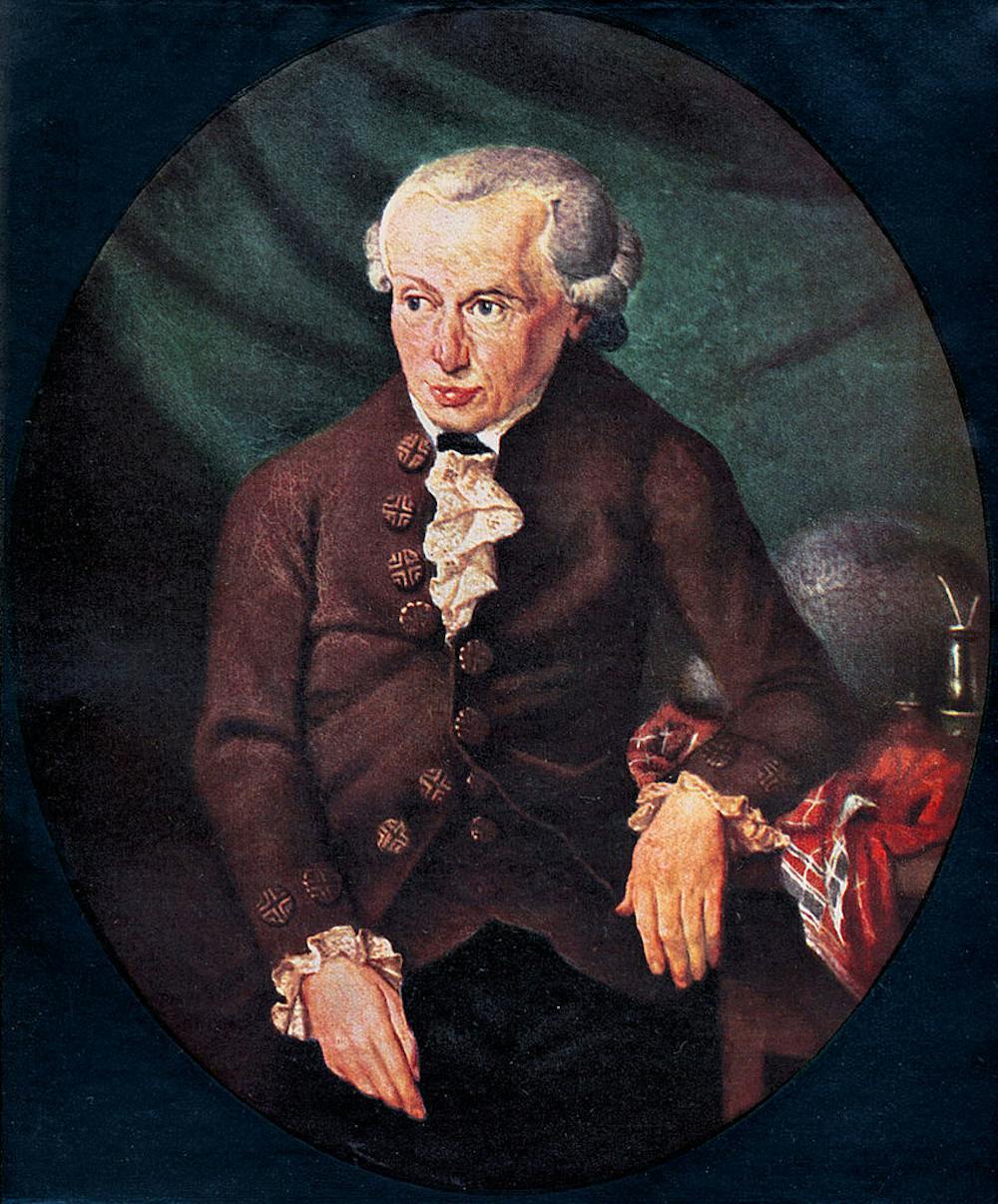
There’s no simple formula for respectful persuasion. However, some philosophers see crucial hints in the work of 18th-century philosopher Immanuel Kant, whose theory of respect has guided many ethicists and policymakers for the past two centuries.
Drawing on Kant’s work, and that of other philosophers inspired by him, I think we can isolate three key components of respectful persuasion. This isn’t just an academic exercise. My students and I have found that these factors increase the chances of deep, meaningful conversation.
1. Giving reasons
Broadly speaking, reasons are considerations that rationally support some belief or action, including both empirical evidence and abstract arguments. For example, astronauts’ pictures of a round Earth rationally support the belief that the Earth is round. When we sincerely give someone reasons, we show respect for their rationality: their ability to recognize good reasons.
By contrast, a hallmark of manipulation is bypassing rationality, such as repeatedly exposing people to false statements to make them appear true – something that psychologists call the “illusory truth effect.”
Manipulation can be effective, but psychologists have found that persuasion using reasons is more durable than nonrational persuasion such as repetition-based tricks. For example, someone who comes to believe in climate change based on the scientific evidence probably will not be as easily swayed later on by repeated exposure to climate skepticism. The rational support that good reasons provide for a belief can make that belief more stable.
2. Being open to learning
Giving reasons is not difficult by itself. The second component of respectful persuasion, however, is much more challenging: being open to receiving the other side’s reasons – a form of intellectual humility. This is especially hard for persuaders, since they have to give up some of the time they would have used to make their case.
Kant expressed this core idea nicely. Even someone encountering a person whose opinion seems obviously wrong, Kant wrote, has “a duty … to suppose that his judgment must yet contain some truth and to seek this out.” This isn’t merely a suggestion to listen to people one wants to persuade. Instead, respect demands actively seeking out truth in what the other person says.
In fact, some studies suggest that intellectual humility makes people better able to evaluate the strength of arguments. This means that intellectually humble people may be more likely to recognize that a persuader’s arguments are actually better than their own, and have to reconsider their views – which can pose a real risk to someone’s self-esteem.
But being open to other people’s reasons also increases the chance of their being open to yours – a form of reciprocity in which you take turns learning from each other. Decades of psychological research have shown that, especially in two-person exchanges, people value reciprocity in communication and see it as a way of treating each other fairly.
In other words, if you show openness to learning from someone else, rather than just lecturing, it may seem fair to them to be open to you too.
That is why faking this kind of respect can be a powerful manipulative tool. A psychologically savvy canvasser, for instance, can manipulate swing voters by pretending to be open to learning about their own opinions. But this carries its own risk, since people who discover they have been manipulated may resent it.
3. Live and let live
Kant’s central principle of respect is that one should “not degrade any other as a mere means” to one’s ends. This requires people to rein in their own self-love out of consideration for others. In popular culture, this might be summed up in the idea of “live and let live”: Other things being equal, we shouldn’t interfere in other people’s lives.
Overlooking this principle can make persuasion disrespectful in a variety of ways, even when the persuader has good intentions. The philosopher George Tsai argues that this happens in cases of unsolicited advice: Imagine, he writes, that while your date goes to the restroom, an eavesdropping stranger tells you that she thinks you could do better. Even if the stranger is right, it’s simply none of her business.
Another example of how interference can make persuasion disrespectful is that changing someone’s mind can harm their dignity and disrupt their connection to their community. For example, say that you persuade a relative who lives in a small ranching community to become vegan. That change might lead to their being ostracized by people they rely on.
Because persuasion can affect other people’s lives in many ways, this third component of respect is the most difficult to adhere to. Sometimes, people may be justified in interfering in other people’s lives, such as if lives are at stake or in particularly close relationships – but those are special circumstances.
One conversation at a time
In class, my students attempt to persuade one another four times, using a range of formats: five minutes vs. a whole week; in person vs. over Zoom. At the end, they score one another on effectiveness and respectfulness.
My students are smart, informed and passionate, and the class offers them a positive, carefully structured environment. Despite all that, they almost never succeed in persuading one another – at least not when it comes to politics.
Something interesting happens, though, when they let respect guide their conversations. Instead of launching into lectures, they start seeing each exchange as an opportunity to learn from each other – perhaps as an opportunity to leave their partner thinking about something in a new way, without fully persuading them.
If you approach our conversation as a chance to exchange ideas, without trying to change my mind, you may lay a cornerstone of trust. That, in turn, could make me more receptive to similar viewpoints in the future – even if I’m speaking with other people. Truly respectful political persuasion might best be seen as an extended team effort, not a one-time, one-person task.
Well, the target market for this book is everyone.
Once upon a time, on an auspicious day in history, you were born—influential. In fact, influence was your only means of survival. You had no sharp teeth or claws to protect you. You couldn’t run away or camouflage yourself. You didn’t seem that smart yet, but you had an innate ability to express your desires, connect with other human beings, and persuade them to take care of you. Which they did, day and (sleepless) night, for years.
When you learned to speak, you expressed yourself more precisely, using your words to become even more influential. You told people what you wanted and what you absolutely did not want. NO! You learned quickly that life could be negotiable and began asking for later bedtimes, more television, your favorite treats. You were like a tiny carpet merchant in a Moroccan bazaar. Wielding influence was as automatic as breathing. You were growing physically stronger too, but your greatest strength was the power to persuade people to take action on your great ideas.
Interpersonal influence is our human advantage, passed down in our DNA. It is what allowed our species to band together, work together, and span the globe. It will remain our advantage in an increasingly digital world, for as long as people are in charge…
Chance, Zoe. Influence Is Your Superpower (pp. 3-4). Random House Publishing Group. Kindle Edition.
This was a fun and illuminating read. It jumped my never-diminishing priority books queue and kept me riveted. Given my persistent (and chronically dubiety-afflicted) Jones for "Deliberation Science," it gave me a lot to think about. We have much important stuff to attend to.
Welcome to Zoe's World of Gators, Judges, Sharks, and even a Kindly Brontosaurus.
The Gator is Dr. Chance's metaphor for Daniel Kahneman's "System 1" ancient lizard brain: quick, efficient, heuristic cut-to-the chase thinking model, adaptive in a world of relatively simple opportunities and threats ("The 4 F's of evolution: Feeding, Fighting, Fleeing, and Reproduction").
The Judge is neocortical "System 2"—"deliberative," logical, methodical (simplistically regarded as "reasoned"). "Just The Facts."
I been diggin' me some Kahneman & Tversky for decades. "Behavioral ECON" has a lot going for it.
Dr. Chance hardly needs my interpretations. She's got this stuff down cold:
Cool, 'eh?
Lots to unpack here. First off, you owe it to yourself to buy and study her book. Read the Amazon reviews (confirmation bias and all, LOL). I pretty much agree with all of the reviewers' assessments.
Some things that bedevil our thinking, particularly as it goes to persuasion and influence:
There is no first-person singular present-tense active voice usage of the word "wrong." No one ever says "I AM wrong."
[props to Kathryn Schulz] Our aggregate default is that we're right about everything. To the extent that we continue to survive, that's an understandable assumption—as it pertains to minor, inconsequential issues, anyway, and it inexorably tilts us toward "confirmation bias."
Our education system mostly tells us there's one "right answer" to every question—lurking amid a boatload of "wrong ones."
And, those who quickly alight on the "right answer" get reinforced and nurtured as they move through the system.
Being wrong is not a synonym for being "stupid" or ignorant.
Neither is "ignorant" a synonym for "stupid." But it's mostly epithetically spun that way
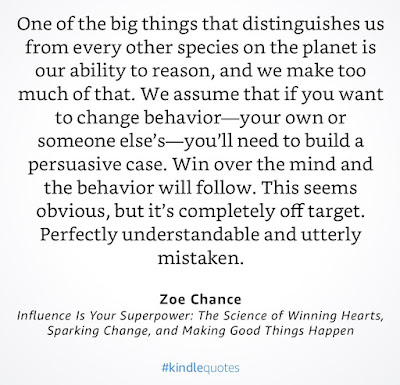
Humans "reason" to WIN the argument.
Should truth happen along the way, so much the better. (See "Why Do Humans Reason?" by Sperber & Mercier) Evolutionary adaptive utility, "The Pen is Mightier Than The Sword."
He/She with the best story WINS!
Trial Lawyering 101. Prior to writing and movable type, stories were the whole ballgame. Hence, our evolved affinity.
Once you decide that X is right or wrong / good or bad, you cannot unring that bell.
A staple look-before-you-leap admonishment of mine back when I was teaching "Critical Thinking."
If, when it's all said and done, your logic is impeccable, and your facts and evidence are bulletproof, yet you remain unpersuasive, what have you really accomplished?''
Another classroom staple of mine. That one was "exceeding my brief" as it were, but my Sups never noticed or cared. Anyway, my overall teach-to-the-text priority focus as a piddly Adjunct necessarily had to be "OK, here's how this stuff works. Take it or leave it."
BACK TO ZOE
Once you finish her book you will have a firm grip on just why. I love it when I learn stuff.
WHEN YOU THINK ABOUT the individual genetic and developmental differences that impact the sensory portions of our nervous systems, it’s remarkable that we can agree on a shared reality at all. Linden, David. Unique (p. 253). Basic Books. Kindle Edition
Stay tuned. More to come, but gonna post this much now and go prep for my grandson Calvin, who is coming to stay the night...
MONDAY UPDATE
Back to Zoe.
to wit,
Page 144
Yeah. Recall a riff of mine:
Loud Boy comes to mind. LOL Recall Amanda Ripley's "conflict entrepreneurs?" Poster Boy Joe.
BTW
Yeah, the word "influence" can conjure up some negativity. e.g., add the word "peddling." 'eh? Dr. Chance would just say "don't let the Bad Guys have all the fun."
Thinking about some of my recent readings that jibe with Dr. Chance's work.
Hardly exhaustive. e.g., James Alcock's "Belief" also jumps to mind. How about "Moral Tribes?"
You get the idea.
Yeah, it's difficult, daunting, often overwhelming. But, as my wise old friend "Uncle Al" liked to say (the eminent South Knoxville auto body & paint artisan, older brother to my drummer), "if all we had to do was sign up for the checks we'd all be millionaires."
You, Me, We
As our paths cross, entwine, diverge, and reconnect, we form a greater whole, a sprawling, living web of influence. You are already part of this collective power. The root of the word “influence” is the Latin influere, “to flow in.” As a river. A current. Your influence flows from other people, and to other people, and from them to others, and on and on. Sometimes you’re aware of those who lifted you up or helped inspire your great ideas, sometimes not. Sometimes you’re aware of your own ripple effects, sometimes not. Small nudges here and there, sacrifices by brave and committed individuals, kind acts by not-so-committed individuals, accidents and acts of fate: They all connect us.
Awakening to this web is like embarking on a choose-your-own-adventure book. You can step up to be the hero, play a supporting role as the sidekick, stand your ground as the ally, or sit this one out. You can also change your mind along the way. Not every great idea will be right for you. But when you do choose to step forward, now you can do it bigger and better…
Not all battles are yours to fight. But my hope is that when you choose your own, the tools and ideas in this book will help you recruit allies who will improve your chances of succeeding and making the process more enjoyable. Margaret Mead was talking about influence when she famously said, “Never doubt that a small group of thoughtful, committed citizens can change the world; indeed, it’s the only thing that ever has.”
Together, and with big enough dreams, we can make magic happen. We can reverse the path of climate change. We can eradicate the caste systems that have kept generations of people poor, sick, and humiliated. We can collaborate on technical solutions to cure our worst diseases. We can join together to face the darkness and move beyond our fears.
You don’t have to change the whole world. Or save it. But each one of us can make a difference for someone. You can help in your community. You can lobby your leaders to get policies passed that will make life easier for the people at work, at your school, or in your town. You can organize the members of your church, mosque, or temple to protect and serve people who need it. You can mediate a conflict within your family. You can be a role model. A mentor. A teacher… [Zoe, pp. 226-228]
Or an old washed-up guitar player writing a blog, trying to figure stuff out.
A compelling read, at the right time Reviewed in the United States on February 6, 2022 Verified Purchase
I forget now precisely how I came upon this book, but I’m glad I did. I have long been a student of how subject matter experts think — predominantly with respect to the cognitive processes of physicians and lawyers — and have an abiding interest in processes of “deliberation.” Specifically, these days regarding our public discourse polarization, with its increasingly fractious tribal “talking past each other” trend, in the face of serious social problems in need of resolution or effective mitigation.
I started undergraduate school in my 30s, originally as an advertising major, so I am fairly up to speed on “persuasion” tactics in marketing. I then went on to grad school In a program called “Ethics and Policy Studies.” All “deliberation” all the time, on complex, thorny issues. Followed that up with a fun stint teaching “critical thinking” at my U. I would ask my students “what if your logic and evidence are bulletproof, your reasoning crystal clear, yet you change no minds? What have you really accomplished?” I never really gave that enough attention.
Were I teaching that course today, Dr. Chance’s book would be a required text.
One thing has become painfully clear across the ensuing decades: logical reasoning is not enough, by any means. Dr. Chance’s work and this book provide an accessible and thorough addition to both the scholarly literature and practical “News You Can Use.” Well worth your time.
A particularly endearing aspect of this book to me is Zoe‘s candid recounting of often difficult episodes from her own life and career. Her humanity pours through in addition to her obvious expertise. Very nice.
I will have more to say on this topic soon. Suffice it to say for now that I've focused inordinate "choirboy" attention on those rational, deliberate "Judges," while according the cognitive Gators short shrift. Zoe Chance has nudged me in a more fruitful direction. We have work to do.