Search the KHIT Blog

Tuesday, June 7, 2022

Jury service: a Creative Commons cross-post courtesy of ProPublica

My son Matt recently served on this jury. Didn't know any details 'til it'd concluded.
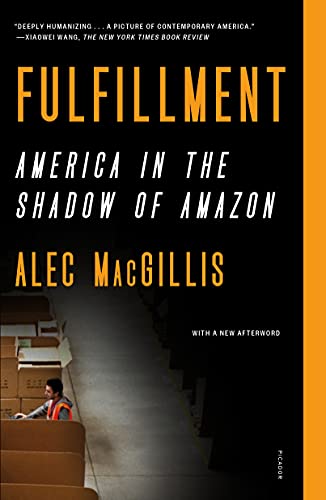
Author Alec MacGillis is one fine journalist.
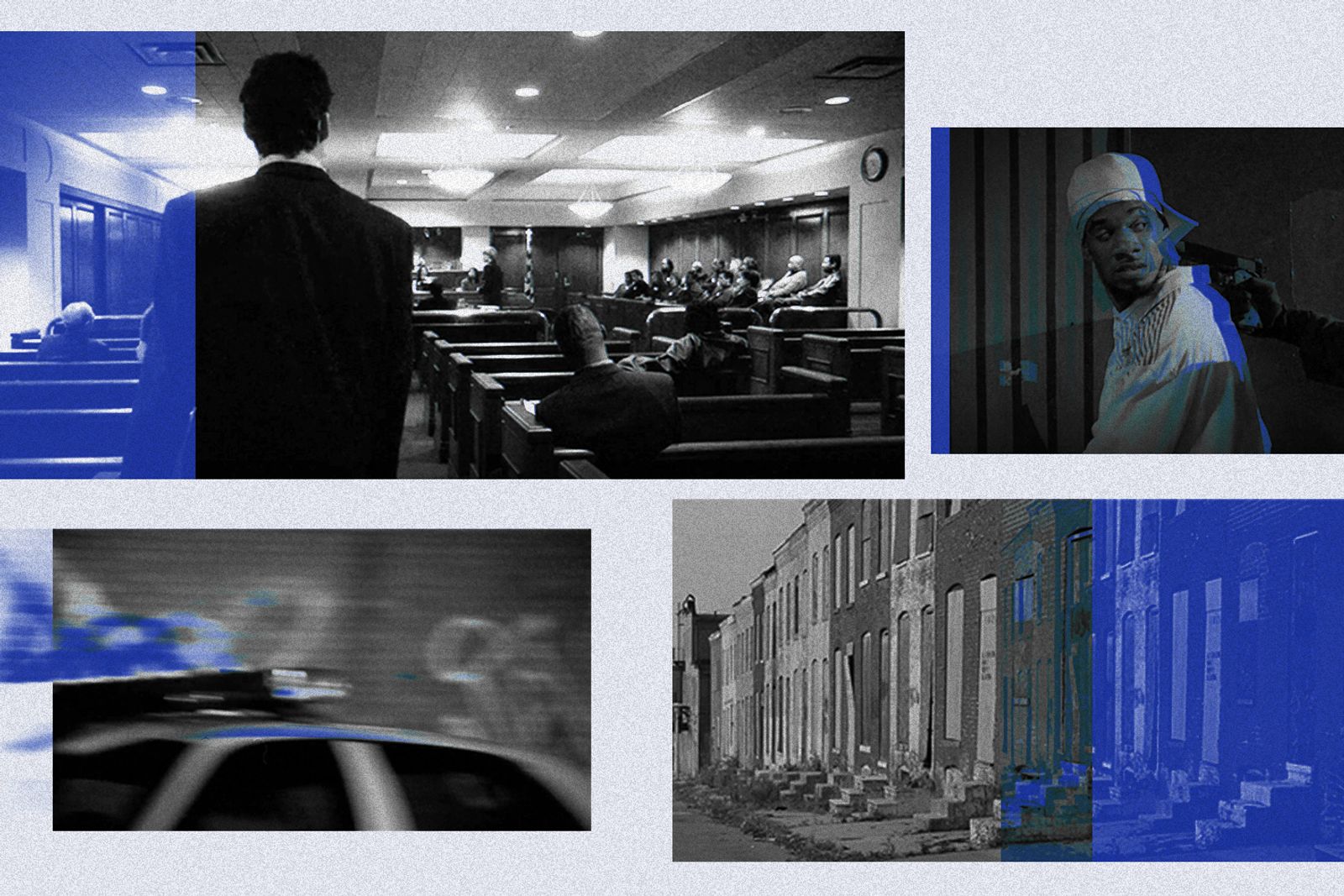


Trial Diary: A Journalist Sits on a Baltimore Jury

Could 12 strangers agree on justice in Baltimore, a city riddled with killings and distrust of the police, in a shooting case where the victim was an actor on the legendary drama “The Wire”?


ProPublica is a Pulitzer Prize-winning investigative newsroom. Sign up for The Big Story newsletter to receive stories like this one in your inbox.

By the end of our first afternoon of deliberations in the jury room up the narrow stairs from the courtroom, the water cooler was running low, the lock on the bathroom door kept sticking and the wheezing HVAC system was making it even harder to make out the audio in a crucial jailhouse phone recording. We were also nowhere close to a consensus on whether or not Domonic White was guilty of attempted murder and lesser charges in the 2021 shooting of Chris Clanton in the presence of Clanton’s 5-year-old son.

It was hardly unusual for a jury to struggle to come to an agreement. What made this case unusual was the context provided by the victim’s identity. Clanton was an actor on “The Wire” and is now appearing on “We Own This City,” the new HBO miniseries produced by the creators of “The Wire” and based on Baltimore journalist Justin Fenton’s nonfiction book about an eye-popping police corruption scandal exposed five years ago.

At the heart of the new series, which began airing one week before the trial, was the profound damage that police corruption had done to community trust in law enforcement. “Now, even if you find the witnesses and have a case,” says one cop in the second episode, “now when you need to get 12 people together to make a jury, 12 people to believe that you aren’t lying on the witness stand about who shot Tater or who robbed the Rite Aid, they look at you and remember when some other cop lied on them about their son or brother. The lawyers will tell you that you lost the city juries on that stuff.”

We were now those 12 people, charged with assessing testimony by members of that same Police Department to decide who had shot an actor from the television show that was dramatizing this corruption.

It was more than I had bargained for when I had reported for jury duty at the Circuit Court for Baltimore City two days earlier. I had never been selected for a panel, likely in part because I am a journalist, which is often enough to prompt a lawyer’s request for dismissal. This time, I had been chosen, and I had not minded. I was overdue to serve that basic civic duty, and it happened that I’m in the midst of reporting on the nationwide resurgence in gun violence. It could only help to get perspective from within the jury box, a corner of the criminal justice system that we hear far less about than other aspects of the system.

But now, at the end of the first day of deliberations, I had a more pressing concern. By the luck of the draw, I had been seated first on the jury and had thus been appointed foreman. I had no idea what exactly that role entailed, beyond reading out an eventual verdict, but a hung jury sure sounded like failing at the job, however it was defined. And after more than three hours of inconclusive deliberations, that seemed like where we were headed.

Clanton, 36, had come to testify on the second day of the trial. He entered with the bearing of a man distinctly displeased to be there. He made his way across the high-ceilinged courtroom in torn gray jeans and a beige jacket over a lavender hoodie, with a thick beard, passing in front of his alleged assailant, who sat placidly in rimless glasses, cleanshaven in a tie and white shirt.

Even before Clanton identified himself and disclosed his TV roles, the mere fact of his presence was notable. In Baltimore and many other cities around the country, it is not at all uncommon for shooting survivors to refuse to identify their attackers to the authorities. It’s the most extreme manifestation of the no-snitching ethic — don’t tell the cops who the shooter was even if you’re the one who was shot — and it’s a big reason why the closure rate for nonfatal shootings is even lower than it is for homicides. But here was Clanton, come to testify against a man he had once considered a close friend.

We jurors had already heard from one of the two officers who responded to the shooting just before 7 p.m. on April 29, 2021. Kaivon Stewart and his partner had just shared a pizza at a 7-Eleven on Belair Road, in a mostly Black working-class section of northeast Baltimore, when they heard a gunshot close by. Stewart, who was at the wheel, headed southwest down Belair and, on a small side street called Eierman Avenue, the officers saw a man with a gun standing over another man lying on the ground, as if poised to shoot. They were not close enough to identify the shooter, beyond the fact that he was a Black man dressed all in black.

They pulled into Eierman and jumped out of the cruiser. The shooter ran off into an alley to the right, heading northeast. Stewart ministered to Clanton, who had been shot in the left ear. He was bleeding heavily but was conscious.

Parked on the street close to where the victim was found, Stewart said, was a blue 2007 Pontiac G6 with the engine still running. Inside the car was a cellphone with a lock screen photo of a couple that, police would later determine, was the woman to whom the car was registered and her fiance, White, who is 39. Not among the items recovered: a gun or any shell casings.

Then came Clanton’s testimony. Glowering, he related what had happened on the evening in question. He had been visiting his mother’s house nearby with his five-year-old son. He had walked down Belair with his son to get him a drink at the 7-Eleven. On the way, someone Clanton knew had called out from a porch on Eierman to let him know that he soon wanted another haircut from Clanton, who does occasional barbering on the side.

Clanton and his son had walked up to the porch, where a small group of men was gathering, among them White. White, whom Clanton called Nick, had been a good friend of Clanton’s when they were young men, Clanton testified, but they had barely seen each other in the decade since a friend of theirs had been killed. Clanton said he was “genuinely happy” to see White after so long but felt an immediate “tension” from him.

Not understanding why he was getting “the cold shoulder,” Clanton said, according to my notes, he followed White down from the porch toward the running car. “I figured if I could get him by himself, he would open up.”

“Whassup?” he said he kept asking White. “I ain’t seen you in a minute.”

“You know what’s up,” White responded, according to Clanton.

They came down to the side of the Pontiac, Clanton testified, with his son trailing, behind the car’s trunk. Clanton pressed again for an explanation of what was bothering White. Then, Clanton said, White pulled a handgun out of his waistband.

“I turned real fast because I thought, if this guy is going to kill me, my mother got to see something,” Clanton said, referring mordantly to his desire to preserve his face for an open-casket funeral.

Lying on the ground after being shot, with White standing over him, Clanton said he heard the siren of the arriving cruiser. “I ain’t never been so happy to see police in my life,” he said. Everyone had scattered. All Clanton was thinking about, he said, was his son, who had been pulled to safety by a neighbor.

A day or two later, after he was released from the hospital, detectives came to his home and he identified White as the shooter. Clanton described the medical fallout: Doctors had made his ear whole again, but he still had bullet fragments in his head that they decided were too risky to remove, and he suffered occasional seizures.

It was time for the cross-examination from White’s attorney, Roland Brown, a veteran defense lawyer with a bearish build and assured manner. After a few perfunctory niceties toward the shooting victim, he needled Clanton, asking whether he had been drunk or high when the shooting occurred, asking if he was really sure it was White whom he had followed off the porch.

Clanton bridled. “I know exactly who shot me,” he said. “I have to deal with this every day. We were all best friends. I didn’t know he was feeling some kind of way toward me.”

As a kid growing up in Baltimore, Clanton’s eighth-grade social-studies teacher was Ed Burns, the homicide detective-turned-teacher who was a co-creator of “The Wire,” alongside David Simon. On “The Wire,” Clanton played Savino Bratton, who appeared in Season One as an enforcer for drug kingpin Avon Barksdale and then in Season Five working for successor kingpin Marlo Stanfield. In that season, Savino joined others in the Stanfield crew in hunting for legendary stick-up man Omar Little, before being fatally shot by Little.

On “We Own This City,” Clanton has switched sides. He’s now playing a police officer, Brian Hairston, who is not shy about challenging untoward behavior by fellow officers. In the first episode, he is with Danny Hersl, a notoriously rough officer, when Hersl gratuitously beats up a suspect. “Look, I’m canceling that jail wagon and calling for a fucking ambulance,” Hairston tells Hersl angrily.

“What the fuck?” Hersl says. “Throw a Band-Aid on him in Central Booking. He’s all right.”

“You banged him, Hersl,” Hairston says. “Fuck if I’m going to have him dumped in a jail van bleeding and have Marilyn Mosby indict my ass.”

Mosby is the Baltimore state’s attorney who, in May 2015, brought charges against six of the officers involved in the arrest and transport of Freddie Gray. (Gray died, his spinal cord nearly severed, seven days after being moved, shackled and unbuckled, in a police van.) None of those charges resulted in conviction, but they loom over the events portrayed in “We Own This City.” They are cited repeatedly as the excuse used by many cops in deciding to hang back on the job, even as violence surged to unprecedented levels following the riots after Gray’s death.

That general apathy, in turn, is cited as the reason why the officers of the unit at the heart of the corruption scandal, the Gun Trace Task Force, were given such a long leash. “Simply put, Hersl and guys like him get out of their cars and they make arrests,” a judge says in the first episode. “And that’s more than you can say about too many police in this city who are collecting a paycheck.” Or as Sgt. Wayne Jenkins, the head of the corrupt unit when it reached its apex of depravity — stealing hundreds of thousands of dollars, planting drugs and guns on suspects, filing wildly fraudulent overtime claims — puts it in the fourth episode: “As long as we produce, as long as we put those numbers up, they don’t fucking give a shit about what we do. We can do whatever the fuck we want.”

That aura of haplessness around the Police Department has lingered since the scandal was exposed, as the city’s homicide rate has remained elevated at the levels it spiked to after the protests over Gray’s death. So it was hardly surprising that Brown, White’s defense lawyer, tried to capitalize on that perception of the police in trying to bring us jurors over to his side. He wasn’t trying to get us to disbelieve the police because they were untrustworthy; rather he was trying to get us to dismiss the evidence because it was the result of inadequate effort.

He grilled the lead detective on the case, Anthony Forbes, over his failure to find witnesses to the shooting. Why had he not tried harder to canvass that block of Eierman? Was it because he was too “starstruck” by Clanton and thus willing to go simply on his word?

Brown also took that tack to try to dismiss a seemingly damning piece of evidence that came up during the prosecutor’s questioning of the detective, a phone call on a recorded jailhouse line one day after the shooting from an incarcerated 20-year-old man named Darian White to the man that the detective said was his father, Domonic White. Why, Brown asked, had he not gone to the Division of Vital Records to confirm that Darian was the son of Domonic? Brown did not offer evidence to suggest that the two Whites were not related. The intent was simply to raise doubt and to underscore that Forbes and his fellow officers were lazy clock-punchers.

We got to hear the phone call the next day. It was scratchy, but I could make out a father telling his incarcerated son that “shit got ugly yesterday,” which is why he was going to have to “turn myself in” or let the police come get him. He also expressed affection and concern for his son and told him that “I was getting ready to go a different route” the day before but that his son had been “on my mind.” “That’s the only reason I didn’t do it,” the father said.

It was the defense’s turn to call its only witness, Mark Pratt. (Domonic White himself would not testify in his own defense.) Pratt was a longtime friend of White’s and a cousin of his fiancee. Pratt was hanging out with White at a small shopping plaza before the shooting, as security camera footage showed, and then drove behind him to Eierman to buy marijuana for an NFL draft-watching gathering.

He offered a completely different account than had Clanton. There was no tension between Clanton and White, he testified. Instead, what happened was this: As the group on Eierman was getting ready to split up, two young men in black face masks appeared from the alley to the left, coming from the southwest, and approached Clanton. One of them shot him, and when the police came, the pair ran back the way they had come, down the alley to the southwest.

The prosecutor, Veronica Colson, challenged Pratt over why he had not mentioned these two young men when asked by the police at the scene if he had seen anything, and why he had also not come forward about them after he heard that his good friend had been charged in the shooting a month later. She did not challenge a factual contradiction between his account and that of Stewart, the responding officer: that the man with the gun had run up the alley to the right, to the northeast, in the opposite direction of what Pratt was now offering.

The details of the gunman’s alley escape became more relevant in Colson’s closing argument, when she played for the first time some additional security-camera footage showing White emerging (with no gun visible), about 30 seconds after the shooting, from the other end of the alley — consistent with the police account — and strolling off across Belair Road.

In his closing argument, Brown began by reminding us that Clanton was an actor, seeking to raise doubts about the veracity of his testimony. And he zeroed in again on the corner-cutting in the police investigation. “Were you impressed by the shooting detective?” he said.

There is a moment in jury selection in Baltimore where the judge asks the assembled citizens if any of them has been a victim of gun violence or has an immediate family member who has been a victim of it, or has a family member who has been charged with gun violence. Invariably, more than a third of the people stand up.

I’ve been stunned by this moment every time I’ve seen it, even though I shouldn’t have been, because the response is in line with what you would expect from the numbers. Since the start of 2013, when I returned to Baltimore for my second stint living in the city, there have been 2,916 people murdered there, and more than twice as many have been wounded in nonfatal shootings. This is in a city whose population has fallen from 621,000 to 585,000 over that time. The toll is even more concentrated if considered through the lens of neighborhoods and race. The Black share of Baltimore’s population is 63%; the Black share of the city’s homicide victims is typically over 90%.

So overwhelming is the response to that question that answering yes is not disqualifying for service. Instead, Judge Charles Blomquist called each person who answered in the affirmative up to the bench to talk with him and the lawyers about how the experience might inform their perspective as jurors. The same went for another screening question, about whether our views of the police would keep us from being impartial in weighing their testimony.

The jury selected for White’s trial was not racially proportionate to the city, as is often the case in a city where so many Black citizens are disqualified from service for past criminal history. Eight of the 12 of us were white, alongside three Black women and one Puerto Rican woman. This stood in contrast to the major players in the trial: the defendant, victim, both lawyers and three police officers called to the stand were all Black.

It did not take long after we ascended to start our deliberations, though, to discover that there was a whole different level of diversity when it came to a task like this. Baltimore is an overwhelmingly progressive Democratic city, a place that voted 87% for Joe Biden in 2020. But perspectives range widely when it comes to the local issue that most consumes public attention — public safety — and that range does not break down neatly along racial or class lines.

Soon after we got started, five jurors made clear that they had serious doubts about the prosecution’s case. They didn’t find Clanton credible. Several noted that he was, after all, an actor, while several others said that he wasn’t being candid about whatever beef had fueled White’s anger, or that they simply didn’t like how he had come across. “He was arrogant and braggadocious,” said one of three young white women on the jury. “I didn’t buy his act.”

Above all, though, they wanted more evidence, and for this these jurors blamed the police. Why had the police been unable to recover a gun? Why had the detective not tried harder to find other witnesses? Heck, why had the police not tried harder to catch the shooter in the first place? “If I’m going to be involved in sending someone to jail for a long time, I’m going to need hard evidence,” said the one Black woman who was inclined to acquit.

The skeptical jurors were not suggesting they did not trust what the police were saying. Rather, they were adopting the critique offered by the defense: They were criticizing the police for not having done their job better. It was a striking dynamic, given that this may have been one of the rare cases where the presence of cops likely saved a man’s life. But it fit with the dynamic described on “We Own This City” — a department succumbing to indifference and thus lackluster at doing its job, whether for reasons of self-pity or self-protection.

This was the local context for the jurors’ reluctance to convict White. But it nonetheless startled several members of the jury who were convinced of his guilt, a group that included the two other Black women on the panel. Members of this group kept coming back to the main pieces of evidence: the victim’s testimony, which was seemingly corroborated by the responding officer’s account of the gunman’s flight into the alley; the camera footage of White emerging from that alley; and the recorded jailhouse phone call. Wasn’t that enough?

By day’s end, it wasn’t, and we headed home.

Never had I been more depressed in my work as a reporter than when covering the Gun Trace Task Force trial, in 2018, for an article that examined the broader unraveling of order in Baltimore. The cause of the despair was the impunity that the trial had laid bare, that the officers had for years been able to operate in a world where nothing mattered, in a moral void.

I was thinking again about impunity at home after our inconclusive deliberations. A man had been shot in the ear in the presence of his 5-year-old son, one of 728 nonfatal shootings in the city in 2021. Baltimore police generally solve only a fifth to a quarter of nonfatal shootings, and the state prosecutes only a subset of that subset. In this case, though, the person who had very nearly been killed in the shooting had decided to give a name to the police. This was not an easy thing to do in this city, and even more difficult was then having to come to court with the former longtime friend whom he had identified as his attacker sitting just a few feet away, and tell the story again, to an appraising jury and aggressive defense lawyer.

The next morning, back in the jury room, I tried, haltingly, to articulate my thoughts about Clanton’s decision to testify and the weight it seemed to deserve, given the difficulty in taking that step and the other evidence that corroborated his account.

But the jury was still stuck in the same divide it had been in the previous day. With seemingly little to gain from more discussion, we watched more of the camera footage from along Belair Road, which served the purpose of raising additional questions about the account provided by Mark Pratt, which did not match up with it in several respects.

Still, several jurors were reluctant to accept Clanton’s version. The Black woman inclined to acquit offered personal background to explain why she was not willing to take Clanton’s account at face value: When she had tried to break up with a boyfriend, he had cut himself badly and told the police that his girlfriend did it to him; she had been charged in the incident, she said, and exonerated only after she taped a call from him admitting to the ruse.

A young white man inclined to acquit pushed back at a couple of the jurors favoring conviction who thought it was suspicious that White had not returned for his phone and his fiancee’s car after the shooting. If you’re a Black man in Baltimore with a history of encounters with the police, he said, you may decide to stay away even if you were not involved. And the Puerto Rican woman on the jury kept coming back to the failure of the police to provide additional evidence to buttress Clanton. “The police need to step it up,” she said. “The police had a job to do.”

The insistent demand for more evidence, particularly more witness testimony, provoked one of the two Black women who were inclined toward conviction. Speaking up for the first time, she related her own story: Nearly three decades ago, she had been shot in the back on the street by two stray bullets fired by a 14-year-old boy. She had barely survived, and the effects of her injuries lingered to this day. But no one on the crowded street had been willing to identify the shooter, she said. The whole experience left her with a visceral grasp of why no one else from Eierman had come forward to back up Clanton. “No one would come testify for me,” she said.

By noon, I sent a note to the judge asking what to do if we couldn’t reach a decision. He summoned us to the courtroom and told us to keep going. After lunch, we did. Even more talked-out by this point, we decided to play the recording of the jailhouse call one more time.

With each replaying, we were able to make out more of the scratchy exchange. We heard the father on the call accepting that he would have to face some consequences for what had happened the day before. “What comes out of that, it is what it is,” he said. “I know I’m going to have to sit for a little bit.” We heard him elaborating on why he had not gone a “different route” during the incident, out of a desire not to spend many more years separated from his son. “I’m going to keep it a thousand with you,” he said.

Somehow, hearing the call yet again, and being able to make out more of it, had an effect on several of the jurors who had been inclined to acquit. The conversation drifted to the various charges and the distinctions between them: In addition to attempted murder, White was also charged with first-degree assault, reckless endangerment and various firearm-related offences. It became clear that several of the jurors inclined to acquit White for attempted murder were more willing to entertain his guilt for first-degree assault. As they saw it, there were still enough questions about what transpired between the two men that they couldn’t conclude that White had actually been trying to kill Clanton. But they could accept that he had done him great harm.

One by one, the five jurors who had started out with major doubts about the prosecution’s case came around to conviction for first-degree assault and the lesser charges. At about 4 p.m., we let the judge know we had reached a verdict. As we waited to be called down, there was sudden levity in the room, an unspoken sense that after veering close to a rupture, we had managed to come together.

We filed downstairs, to a courtroom that was fuller than it had been at any point in the trial, though there was no sign of Clanton himself. I gave the verdict on each of the charges. White and his lawyer, Brown, reacted with restrained displeasure. We dispersed with barely a word; the camaraderie was left upstairs. But out on the street, I saw the juror who said she had been framed by her boyfriend, sitting on a bench awaiting a westbound bus. I got her attention, and we exchanged a nod and smile.

And that was it. It was early May in Baltimore, the most beautiful time of year in the city. There had by that point been 116 homicides so far in 2022, up 15% from the year before. The following week, a man with an assault rifle would fire 60 rounds on a block in East Baltimore while killing another man and injuring three others. A couple days after that, a pregnant woman would be killed along with the father-to-be; their baby, delivered from the dying woman, was left in critical condition. A day after that, a high school junior would be fatally shot at an after-prom party.

And two weeks after that, a man accused of fatally shooting the widely admired co-founder of the city’s violence-interrupter program, Safe Streets, would be acquitted of murder, despite having been found with the gun used in the killing and despite cellphone data putting him in the area. “Not enough evidence,” said one juror afterward.

It was a refrain I had heard on the White jury, too. But our jury had something that the latest jury did not: a victim alive and willing to testify.
___
"A young white man inclined to acquit pushed back at a couple of the jurors favoring conviction who thought it was suspicious that White had not returned for his phone and his fiancee’s car after the shooting. If you’re a Black man in Baltimore with a history of encounters with the police, he said, you may decide to stay away even if you were not involved."
 That was my son.
______________________________

ALEC MACGILLIS
 
I'm about halfway through this, his latest. An incredible job. This fellow can write!
The personal stories are wrenching. His data-rich socio-political / Econ evaluations are spot-on.
 
The timing is interesting. I'm currently deep into this book (below).

Goes to so-called "Deliberation Science."

I will never get to do jury service. Retired forensically trained statistical analyst who did a stint teaching collegiate "Critical Thinking?" Forget it. The last time I did voire dire I was the first jury pool candidate excused by prosecutors ("peremptory challenge").
__________
 

Friday, June 3, 2022

New concerns regarding your DNA, a Creative Commons cross-post

Genetic paparazzi are right around the corner, and courts aren’t ready to confront the legal quagmire of DNA theft

DNA is a trove of personal information that can be hard to keep track of and protect. Boris Zhitkov/Moment via Getty Images
Liza Vertinsky, University of Maryland and Yaniv Heled, Georgia State University

Every so often stories of genetic theft, or extreme precautions taken to avoid it, make headline news. So it was with a picture of French President Emmanuel Macron and Russian President Vladimir Putin sitting at opposite ends of a very long table after Macron declined to take a Russian PCR COVID-19 test. Many speculated that Macron refused due to security concerns that the Russians would take and use his DNA for nefarious purposes. German Chancellor Olaf Scholz similarly refused to take a Russian PCR COVID-19 test.

While these concerns may seem relatively new, pop star celebrity Madonna has been raising alarm bells about the potential for nonconsensual, surreptitious collection and testing of DNA for over a decade. She has hired cleaning crews to sterilize her dressing rooms after concerts and requires her own new toilet seats at each stop of her tours.

At first, Madonna was ridiculed for having DNA paranoia. But as more advanced, faster and cheaper genetic technologies have reached the consumer realm, these concerns seem not only reasonable, but justified.

Putin and Macron sitting at opposite ends of a long table
For some, keeping one’s distance might be a preferable alternative to getting one’s DNA stolen. AP Photo/Pool Sputnik Kremlin

We are law professors who study how emerging technologies like genetic sequencing are regulated. We believe that growing public interest in genetics has increased the likelihood that genetic paparazzi with DNA collection kits may soon become as ubiquitous as ones with cameras.

While courts have for the most part managed to evade dealing with the complexities of surreptitious DNA collection and testing of public figures, they won’t be able to avoid dealing with it for much longer. And when they do, they are going to run squarely into the limitations of existing legal frameworks when it comes to genetics.

Genetic information troves

You leave your DNA behind you everywhere you go. The strands of hair, fingernails, dead skin and saliva you shed as you move through your day are all collectible trails of DNA.

Genetic analysis can reveal not only personal information, such as existing health conditions or risk for developing certain diseases, but also core aspects of a person’s identity, such as their ancestry and the potential traits of their future children. In addition, as genetic technologies continue to evolve, fears about using surreptitiously collected genetic material for reproductive purposes via in vitro gametogenesis become more than just paranoia.

In vitro gametogenesis (IVG), while still in development, could allow prospective parents to create egg or sperm from other parts of the body, like skin.

Ultimately, taking an individaul’s genetic material and information without their consent is an intrusion into a legal domain that is still considered deeply personal. Despite this, there are few laws protecting the interests of individuals regarding their genetic material and information.

Existing legal frameworks

When disputes involving genetic theft from public figures inevitably reach the courtroom, judges will need to confront fundamental questions about how genetics relates to personhood and identity, property, health and disease, intellectual property and reproductive rights. Such questions have already been raised in cases involving the use of genetics in law enforcement, the patentability of DNA and ownership of discarded genetic materials.

In each of these cases, courts focused on only one dimension of genetics, such as privacy rights or the value of genetic information for biomedical research. But this limited approach disregards other aspects, such as the privacy of family members with shared genetics, or property and identity interests someone may have in genetic material discarded as part of a medical procedure.

In the case of genetic paparazzi, courts will presumably try to fit complex questions about genetics into the legal framework of privacy rights because this is how they have approached other intrusions into the lives of public figures in the past.

Modern U.S. privacy law is a complex web of state and federal regulations governing how information can be acquired, accessed, stored and used. The right to privacy is limited by First Amendment protections on the freedom of speech and press, as well as Fourth Amendment prohibitions on unreasonable searches and seizure. Public figures face further restrictions on their privacy rights because they are objects of legitimate public interest. On the other hand, they also have publicity rights that control the commercial value of their unique personally identifying traits.

People whose genetic material has been taken without their consent may also raise a claim of conversion that their property has been interfered with and lost. Courts in Florida are currently considering a conversion claim in a private dispute where the former CEO of Marvel Entertainment and his wife accused a millionaire businessman of stealing their DNA to prove that they were slandering him through a hate-mail campaign. This approach replaces the narrow legal framework of privacy with an even narrower framework of property, reducing genetics to an object that someone possesses.

What the future may hold

Under existing laws and the current state of genetic technology, most people don’t need to worry about surreptitious collection and use of genetic material in the way that public figures might. But genetic paparazzi cases will likely play an important role in determining what rights everyone else will or will not have.

Open 23andMe genetic testing kit
As DNA testing technology advances, questions about genetic privacy and ownership will only become more complex. Eric Baradat/AFP via Getty Images

The U.S. Supreme Court is very unlikely to recognize new rights, or even affirm previously recognized rights, that are not explicitly mentioned in the Constitution. Therefore, at least at the federal level, individual protections for genetic material and information are not likely to adapt to changing times.

This means that cases involving genetics are likely to fall within the purview of state legislatures and courts. But none of the states have adequately grappled with the complexities of genetic legal claims. Even in states with laws specifically designed to protect genetic privacy, regulations cover only a narrow range of genetic interests. Some laws, for example, may prohibit disclosure of genetic information, but not collection.

For better or for worse, how the courts rule in genetic paparazzi cases will shape how society thinks about genetic privacy and about individual rights regarding genetics more broadly. 
~~~~~~

Liza Vertinsky, Professor of Law, University of Maryland and Yaniv Heled, Associate Professor of Law, Georgia State University

This article is republished from The Conversation under a Creative Commons license. Read the original article.
_________________________
 
I'd intended to post some stuff about day 100 of Putin's invasion of Ukraine today, but the foregoing got my attention. Thought it would be worth your time.
 
File this one under "Malign Technologies."
 
OTHER STUFF
 
The pile-on of late of all the seriously bad news worldwide has slowed me down, but I keep plodding on. Several more books now in play:
 
 
The latter title goes to my abiding interest in so-called "Deliberation Science."
My son recently got called to Baltimore jury service. Now that the trial has concluded, we can talk about it. One of his fellow jurors was this ProPublica journalist. Great article. Stay tuned; there will be stuff to explore and recount from Nick's perspective.
"Inside The Juror." Not available in Kindle edition, so I've been slogging away with the pen and yellow highlighter. Stay tuned.
 
 
__________
 

Thursday, June 2, 2022

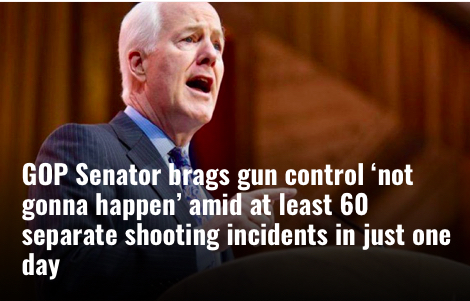
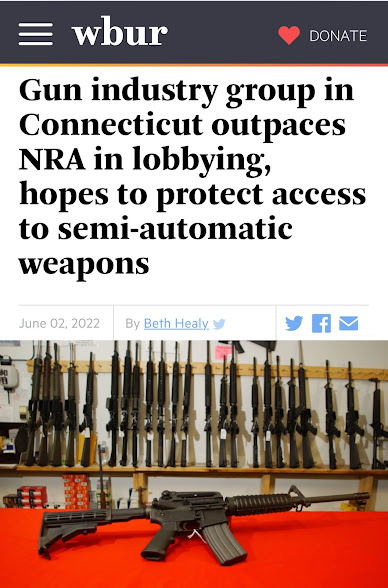
Will civilian gun violence simply continue unabated?

Sadly, it would not surprise me.

Interesting comment at the Naked Capitalism Blog this morning by one of the commentariat regulars:
 
 
Curiously: it disappeared. Ya think? Being from one of the long-resident commenters, this comment escaped moderation. Had it been a comment by a newbie or lurker, it'd never have gotten posted. I'm as horrified and outraged as anyone (and I advocate banning assault weapons in the civilian sector), but advocating that we escalate to vigilante violence—"targeted assassination"—just brings us down to the gun nuts' levels, and would likely only materially worsen things.
 
Saw this (below) on Twitter this morning.

 
I'm not a Beto contributor, but this is worth posting.
 
__________
 

Thursday, May 26, 2022

Uvalde

"The murders in Uvalde barely begin to describe the scale of American violence, but they do provide insight into its character. School shootings are only a subcategory of mass shootings, which are themselves only a subcategory of gun crime. America sharply surpasses other comparably developed countries in each of those classes of violent crime. A country in which those indicators aren’t necessarily signs of terminal decline is conceivable. But these aren’t the growing pains of a society making difficult advances toward an orderly peace. These are the morbid symptoms of a society coming undone, and they arise largely from policy choices made by interested parties with material motives."—Elizabeth Breunig
 
UPDATE 
 
You gotta be kidding. Uvalde TX is a town of some 13,000. They spend 40% of their annual municipal budget on their police department, including stuff like this? Local taxpayers certainly did not get their money's worth this time.
 
 
REPOST:
LET'S CUT THE CRAP, SHALL WE?
 

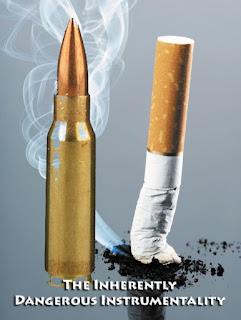
The civil law tort principle of "inherently dangerous instrumentality" is what finally brought Big Tobacco to regulatory and compensatory damages heel. Habitually used as intended, tobacco products disproportionately sicken or kill those who partake of them. They are inherently dangerous, and, as such—while still not outlawed—they are heavily regulated in reflection of the threat they pose (however inadequately).

A firearm, absent its fitted calibre projectile, is just an expensive piece of pipe. The intended function of the bullet, however, is to damage or destroy that which it impacts—be it a beer bottle or can, a paper target, or an animal or human. There is no other purpose (while the addictive "purpose" of smoking tobacco products, from the customer's perspective, is the ensuing psycho/physiological "relaxation" it accords).
And yes, firearms can be “used safely" (while providing end-user "pleasure"). That is not in dispute. But neither can there be any rational dispute about the purpose of bullets. People who buy them intend to use them to hit things. And the necessary vehicles for doing so are the firearms. Locked and loaded, you get inherently dangerous instrumentalities.
It's not a perfect analogy, and, tobacco products are not protected by the constitution. But it's damn close enough functionally to justify rational firearms restriction (I am not arguing prohibition here). The relative risk associated with the smoking of a single cigarette pales in comparison with that posed by the firing of a single bullet.

Let's get real. (But, yes, I realize there's the obstructive PLCAA problem in the way)
____
Ten years ago, in the aftermath of the horror in Newtown, Connecticut—where a twenty-year-old with a semi-automatic rifle entered Sandy Hook Elementary School and fatally shot twenty children and six adults—Wayne LaPierre, the C.E.O. of the National Rifle Association, said, “The only thing that stops a bad guy with a gun is a good guy with a gun.” The idea of vigilant protectors subduing armed antagonists spoke to a vision of a society in which firearms are as commonplace as cell phones, and where more guns mean more safety. If the idea seemed absurd then, the passage of time has only made it empirically so. —Jelani Cobb
__________
 

Tuesday, May 24, 2022

3 months of war,

with no clear end in sight.
 
Like so many people, I assumed and feared that Ukraine would be overrun by Putin's military in a matter of days, with President Zelenskyy quickly exiled, captured, or killed. Boy, were we all wrong. "Cometh the hour, cometh the man" indeed.
 
Month four of war now commences. The multiplicative adverse effects increasingly reverberate around the world.
"From a purely geopolitical point of view, this war matters enormously. Should Vladimir Putin pull victory from his initial catastrophes, we can expect a riven Europe, which would disable the uneasy alliance that won the Cold War and gave the world more than half a century of prosperity after World War II. A Russian victory would encourage China to eye the possibility of conquering Taiwan and imposing its hegemony in East Asia. And it would lead countries around the world to arm themselves with nuclear weapons, because they would know that, in the final analysis, they are alone. And lonely, fearful countries with nuclear weapons may very well use them."—Eliot A. Cohen
per CNN:
Russia’s invasion of Ukraine may have marked the start of “a third world war,” and Russian President Vladimir Putin must be defeated “as soon as possible” if the world wants to preserve civilization.

That was the stark message that Hungarian-born billionaire and philanthropist George Soros delivered on Tuesday to attendees at the 2022 World Economic Forum in Davos, Switzerland.

“Even when the fighting stops, as it eventually must, the situation will never revert” to where it was before, warned the 91-year-old Soros.

“Other issues that concern all of humanity – fighting pandemics and climate change, avoiding nuclear war, maintaining global institutions – have had to take a back seat to that struggle. That’s why I say civilization may not survive.”
Meanwhile, in my country, our maudlin, n-dimensionally fractious domestic political shitshow lurches on incoherently—likewise with no clear resolution(s) in sight.
 

Arizona GOP "Stop-The-Steal" gubernatorial candidate Kari Lake shows off the portrait she says will hang over her desk once she's elected.
 
Is it too early to start drinking yet? 
 
EXIGENT PRIORITIES?
 

Not making much progress sorting through this stuff of late. The Parkinson's ain't helpin' matters.
 
ERRATUM: FILE UNDER "MALIGN TECHNOLOGIES"
 
 
I have never understood this infatuation. to wit:


Highly recommend the videos of "CoffeeZilla."
 
BREAKING
Speechless.

UPDATE: The death toll has now risen to 21.
_____
 
LET US PREY
…Mitch McConnell, the Senate Minority Leader—who once said, following a school shooting in his home state of Kentucky, “I don’t think at the federal level there’s much that we can do other than appropriate funds” for school safety officers and counselling—tweeted that he was “horrified and heartbroken” by the tragedy at Robb Elementary School. Ted Cruz, the junior senator for Texas—who once ran a campaign ad that boasted, “After Sandy Hook, Ted Cruz stopped Obama’s push for new gun-control laws”—tweeted that he and his wife were “fervently lifting up in prayer the children and families in the horrific shooting.” Governor Greg Abbott—who last year signed seven pieces of gun-rights legislation into law, including one that permitted Texans to carry handguns without a license and another exempting the state from future federal gun restrictions—said that he and his wife “mourn this horrific loss and we urge all Texans to come together to show our unwavering support to all who are suffering.”

Politicians like these are routinely criticized for their hypocrisy and empty gestures—their “thoughts and prayers.” But, if only for the sake of rhetorical hygiene, we should go a step further. Republicans, as we know, get what they want. It is their best feature. They have vacuumed up the state legislatures, gerrymandered much of the country, stacked the Supreme Court and the federal judgeships, turned back the clock on L.G.B.T.Q. rights, paralyzed entire school districts with engineered panics over critical race theory and “grooming,” ended (or so it seems) reproductive rights as a constitutionally guaranteed freedom, and blocked all attempts at gun-control legislation. If the leaders of this political movement, which in Texas managed to ban most abortions and criminalize health care for trans kids in the space of a school year, took real offense to murdered children, they would never simply accept their deaths as the unfortunate cost of honoring the Founding Fathers’ right to take up muskets against hypothetical government tyranny. They would act. If America were not afraid to know itself, we could more readily accept that gun-rights advocates are enthralled with violent sorrow. This is the America they envisaged. It is what they worked so hard for. Their thoughts and prayers have been answered.
—Jessica Winter
__________
 

Wednesday, May 18, 2022

U.S. Covid-19 deaths surpass 1 million


According to Johns Hopkins data, the U.S. Covid-19 death toll exceeded one million on May 17th, 2022. Sad milestone.
 
Hope you all are well.
__________
 

Monday, May 16, 2022

White Replacement Theory

18 yr old NY racist mass murderer Payton Gendron
Replete with Tucker Carlson hairstyle. Somehow fitting.
 
 
OK, pay attention. Here's the way it works. "Liberals" will flood the nation with non-white illegals in order to "replace" white citizens at the polls. Got it? Never mind that non-citizens can't (and don't) vote.
 
We good now?
 
I am once again just aghast.
__________
 

Saturday, May 14, 2022

Commander Alito, Patriarch of New Gilead

Margaret Atwood on What ‘The Handmaid’s Tale’ Means in the Age of Trump

In the spring of 1984 I began to write a novel that was not initially called “The Handmaid’s Tale.” I wrote in longhand, mostly on yellow legal notepads, then transcribed my almost illegible scrawlings using a huge German-keyboard manual typewriter I’d rented.

The keyboard was German because I was living in West Berlin, which was still encircled by the Berlin Wall: The Soviet empire was still strongly in place, and was not to crumble for another five years. Every Sunday the East German Air Force made sonic booms to remind us of how close they were. During my visits to several countries behind the Iron Curtain — Czechoslovakia, East Germany — I experienced the wariness, the feeling of being spied on, the silences, the changes of subject, the oblique ways in which people might convey information, and these had an influence on what I was writing. So did the repurposed buildings. “This used to belong to . . . but then they disappeared.” I heard such stories many times.

Having been born in 1939 and come to consciousness during World War II, I knew that established orders could vanish overnight. Change could also be as fast as lightning. “It can’t happen here” could not be depended on: Anything could happen anywhere, given the circumstances.

By 1984, I’d been avoiding my novel for a year or two. It seemed to me a risky venture. I’d read extensively in science fiction, speculative fiction, utopias and dystopias ever since my high school years in the 1950s, but I’d never written such a book. Was I up to it? The form was strewn with pitfalls, among them a tendency to sermonize, a veering into allegory and a lack of plausibility. If I was to create an imaginary garden I wanted the toads in it to be real. One of my rules was that I would not put any events into the book that had not already happened in what James Joyce called the “nightmare” of history, nor any technology not already available. No imaginary gizmos, no imaginary laws, no imaginary atrocities. God is in the details, they say. So is the Devil.

Back in 1984, the main premise seemed — even to me — fairly outrageous. Would I be able to persuade readers that the United States had suffered a coup that had transformed an erstwhile liberal democracy into a literal-minded theocratic dictatorship? In the book, the Constitution and Congress are no longer: The Republic of Gilead is built on a foundation of the 17th-century Puritan roots that have always lain beneath the modern-day America we thought we knew.

The immediate location of the book is Cambridge, Mass., home of Harvard University, now a leading liberal educational institution but once a Puritan theological seminary. The Secret Service of Gilead is located in the Widener Library, where I had spent many hours in the stacks, researching my New England ancestors as well as the Salem witchcraft trials. Would some people be affronted by the use of the Harvard wall as a display area for the bodies of the executed? (They were.)

In the novel the population is shrinking due to a toxic environment, and the ability to have viable babies is at a premium. (In today’s real world, studies are now showing a sharp fertility decline in Chinese men.) Under totalitarianisms — or indeed in any sharply hierarchical society — the ruling class monopolizes valuable things, so the elite of the regime arrange to have fertile females assigned to them as Handmaids. The biblical precedent is the story of Jacob and his two wives, Rachel and Leah, and their two handmaids. One man, four women, 12 sons — but the handmaids could not claim the sons. They belonged to the respective wives.

And so the tale unfolds.

When I first began “The Handmaid’s Tale” it was called “Offred,” the name of its central character. This name is composed of a man’s first name, “Fred,” and a prefix denoting “belonging to,” so it is like “de” in French or “von” in German, or like the suffix “son” in English last names like Williamson. Within this name is concealed another possibility: “offered,” denoting a religious offering or a victim offered for sacrifice.
Why do we never learn the real name of the central character, I have often been asked. Because, I reply, so many people throughout history have had their names changed, or have simply disappeared from view.

Some have deduced that Offred’s real name is June, since, of all the names whispered among the Handmaids in the gymnasium/dormitory, “June” is the only one that never appears again. That was not my original thought but it fits, so readers are welcome to it if they wish.

At some time during the writing, the novel’s name changed to “The Handmaid’s Tale,” partly in honor of Chaucer’s “Canterbury Tales,” but partly also in reference to fairy tales and folk tales: The story told by the central character partakes — for later or remote listeners — of the unbelievable, the fantastic, as do the stories told by those who have survived earth-shattering events.

Over the years, “The Handmaid’s Tale” has taken many forms. It has been translated into 40 or more languages. It was made into a film in 1990. It has been an opera, and it has also been a ballet. It is being turned into a graphic novel. And in April 2017 it will become an MGM/Hulu television series.

In this series I have a small cameo. The scene is the one in which the newly conscripted Handmaids are being brainwashed in a sort of Red Guard re-education facility known as the Red Center. They must learn to renounce their previous identities, to know their place and their duties, to understand that they have no real rights but will be protected up to a point if they conform, and to think so poorly of themselves that they will accept their assigned fate and not rebel or run away.

The Handmaids sit in a circle, with the Taser-equipped Aunts forcing them to join in what is now called (but was not, in 1984) the “slut-shaming” of one of their number, Jeanine, who is being made to recount how she was gang-raped as a teenager. Her fault, she led them on — that is the chant of the other Handmaids.

Although it was “only a television show” and these were actresses who would be giggling at coffee break, and I myself was “just pretending,” I found this scene horribly upsetting. It was way too much like way too much history. Yes, women will gang up on other women. Yes, they will accuse others to keep themselves off the hook: We see that very publicly in the age of social media, which enables group swarmings. Yes, they will gladly take positions of power over other women, even — and, possibly, especially — in systems in which women as a whole have scant power: All power is relative, and in tough times any amount is seen as better than none. Some of the controlling Aunts are true believers, and think they are doing the Handmaids a favor: At least they haven’t been sent to clean up toxic waste, and at least in this brave new world they won’t get raped, not as such, not by strangers. Some of the Aunts are sadists. Some are opportunists. And they are adept at taking some of the stated aims of 1984 feminism — like the anti-porn campaign and greater safety from sexual assault — and turning them to their own advantage. As I say: real life.

Which brings me to three questions I am often asked.

First, is “The Handmaid’s Tale” a “feminist” novel? If you mean an ideological tract in which all women are angels and/or so victimized they are incapable of moral choice, no. If you mean a novel in which women are human beings — with all the variety of character and behavior that implies — and are also interesting and important, and what happens to them is crucial to the theme, structure and plot of the book, then yes. In that sense, many books are “feminist.”

Why interesting and important? Because women are interesting and important in real life. They are not an afterthought of nature, they are not secondary players in human destiny, and every society has always known that. Without women capable of giving birth, human populations would die out. That is why the mass rape and murder of women, girls and children has long been a feature of genocidal wars, and of other campaigns meant to subdue and exploit a population. Kill their babies and replace their babies with yours, as cats do; make women have babies they can’t afford to raise, or babies you will then remove from them for your own purposes, steal babies — it’s been a widespread, age-old motif. The control of women and babies has been a feature of every repressive regime on the planet. Napoleon and his “cannon fodder,” slavery and its ever-renewed human merchandise — they both fit in here. Of those promoting enforced childbirth, it should be asked: Cui bono? Who profits by it? Sometimes this sector, sometimes that. Never no one.

The second question that comes up frequently: Is “The Handmaid’s Tale” antireligion? Again, it depends what you may mean by that. True, a group of authoritarian men seize control and attempt to restore an extreme version of the patriarchy, in which women (like 19th-century American slaves) are forbidden to read. Further, they can’t control money or have jobs outside the home, unlike some women in the Bible. The regime uses biblical symbols, as any authoritarian regime taking over America doubtless would: They wouldn’t be Communists or Muslims.

The modesty costumes worn by the women of Gilead are derived from Western religious iconography — the Wives wear the blue of purity, from the Virgin Mary; the Handmaids wear red, from the blood of parturition, but also from Mary Magdalene. Also, red is easier to see if you happen to be fleeing. The wives of men lower in the social scale are called Econowives, and wear stripes. I must confess that the face-hiding bonnets came not only from mid-Victorian costume and from nuns, but from the Old Dutch Cleanser package of the 1940s, which showed a woman with her face hidden, and which frightened me as a child. Many totalitarianisms have used clothing, both forbidden and enforced, to identify and control people — think of yellow stars and Roman purple — and many have ruled behind a religious front. It makes the creation of heretics that much easier.

In the book, the dominant “religion” is moving to seize doctrinal control, and religious denominations familiar to us are being annihilated. Just as the Bolsheviks destroyed the Mensheviks in order to eliminate political competition and Red Guard factions fought to the death against one another, the Catholics and the Baptists are being targeted and eliminated. The Quakers have gone underground, and are running an escape route to Canada, as — I suspect — they would. Offred herself has a private version of the Lord’s Prayer and refuses to believe that this regime has been mandated by a just and merciful God. In the real world today, some religious groups are leading movements for the protection of vulnerable groups, including women.

So the book is not “antireligion.” It is against the use of religion as a front for tyranny; which is a different thing altogether.

Is “The Handmaid’s Tale” a prediction? That is the third question I’m asked — increasingly, as forces within American society seize power and enact decrees that embody what they were saying they wanted to do, even back in 1984, when I was writing the novel. No, it isn’t a prediction, because predicting the future isn’t really possible: There are too many variables and unforeseen possibilities. Let’s say it’s an antiprediction: If this future can be described in detail, maybe it won’t happen. But such wishful thinking cannot be depended on either.

So many different strands fed into “The Handmaid’s Tale” — group executions, sumptuary laws, book burnings, the Lebensborn program of the SS and the child-stealing of the Argentine generals, the history of slavery, the history of American polygamy . . . the list is long.

But there’s a literary form I haven’t mentioned yet: the literature of witness. Offred records her story as best she can; then she hides it, trusting that it may be discovered later, by someone who is free to understand it and share it. This is an act of hope: Every recorded story implies a future reader. Robinson Crusoe keeps a journal. So did Samuel Pepys, in which he chronicled the Great Fire of London. So did many who lived during the Black Death, although their accounts often stop abruptly. So did Roméo Dallaire, who chronicled both the Rwandan genocide and the world’s indifference to it. So did Anne Frank, hidden in her secret annex.

There are two reading audiences for Offred’s account: the one at the end of the book, at an academic conference in the future, who are free to read but who are not always as empathetic as one might wish; and the individual reader of the book at any given time. That is the “real” reader, the Dear Reader for whom every writer writes. And many Dear Readers will become writers in their turn. That is how we writers all started: by reading. We heard the voice of a book speaking to us.

In the wake of the recent American election, fears and anxieties proliferate. Basic civil liberties are seen as endangered, along with many of the rights for women won over the past decades, and indeed the past centuries. In this divisive climate, in which hate for many groups seems on the rise and scorn for democratic institutions is being expressed by extremists of all stripes, it is a certainty that someone, somewhere — many, I would guess — are writing down what is happening as they themselves are experiencing it. Or they will remember, and record later, if they can.

Will their messages be suppressed and hidden? Will they be found, centuries later, in an old house, behind a wall?

Let us hope it doesn’t come to that. I trust it will not.
______
I have not read this book (nor seen the Hulu series it spawned), but I've now gotten and started the text. The foregoing preface was in the book's 2017 updated paperback edition. She'd published it as a NY Times essay in March 2017.
 
See also her Atlantic article excerpted in the prior post.
 
Samuel Alito’s “Amelia Bedelia” Reading of the Constitution
What the Supreme Court Justice’s leaked draft opinion on abortion reveals about originalism.
By Fabio Bertoni

Twenty years ago, when my kids were little, and we went on long drives, my wife and I would play an audiotape of the Amelia Bedelia stories, by Peggy Parish, to keep them occupied. Amelia Bedelia is a housekeeper who goes to work for a rich couple. They give her instructions—dust the furniture, draw the drapes, put out the lights—that Amelia, being extremely literal-minded, interprets exactly the wrong way. She pours dust on the furniture; draws a picture of the drapes; puts all the lights outside. The couple comes home to the chaos, and resolves to fire poor Amelia—until they taste a pie that she has made. It is so delicious that they can’t bear to let her go.

Our kids loved the wordplay and, of course, the foolish adults. They got the joke. After several hundred listenings, however, it dawned on me: Amelia Bedelia, as others have noted, knows precisely what she is doing. She’s an anarchist, an agent of chaos, and is intentionally punishing the rich couple for some conduct deep in the untold backstory of the series. No reasonable person can use words that literally, with no awareness of how words can have multiple meanings. Even children know that the phrase “catch the school bus” doesn’t refer to grabbing a large yellow vehicle flying through the air. Amelia Bedelia, a functioning adult who manages to get to work each day, surely also understands the figurative use of language, and is simply pretending not to in order to achieve her own nefarious ends.

As a then-recent graduate of law school, I soon had another realization: this narrow focus on a certain understanding of words, to the exclusion of all others, is a close cousin to originalism, a distinctly conservative strain of thinking in constitutional law that was championed and popularized by the late Supreme Court Justice Antonin Scalia. Originalists argue that their thinking is uniquely rigorous and coherent. They believe that it is possible, even imperative, to identify the proper meaning and interpretation of the Constitution by adhering strictly to the text and to the intentions of the men who wrote it. Originalists scoff at the notion of a “living Constitution,” a document whose meaning has changed and expanded with time and evolving circumstances.

Only softheaded liberals, they say, believe that due process encompasses foggy notions and words unmentioned in the Constitution—words such as “privacy.” If something isn’t specifically articulated in the Constitution, any attempt to find it there is entirely speculative—or, as Justice Scalia put it, “pure applesauce.”

By the nineteen-eighties, originalism had become the dominant legal ideology of the right. It allowed conservative legal scholars and judges to claim a higher ground of objectivity and neutrality: they were simply applying what the Framers intended when they wrote the document. Conversely, it enabled them to label federal judges who sought to expand rights or powers of the Constitution as “activist judges”—effectively, as unelected legislators who would bend the language of the Constitution, in order to reshape society to fit a vision of liberal utopia.

But the recently leaked draft opinion in Dobbs v. Jackson Women’s Health Organization, written by Supreme Court Justice Samuel Alito, and an earlier federal decision by Judge Kathryn Kimball Mizelle, in Florida, outlawing the federal mask mandate on airplanes, reveal the dishonesty inherent in the originalism idea. In fact, it appears that, much the way that many Republicans are dropping any pretense of civil decorum or anti-bigotry in order to appeal to radical elements of the base, many conservative judges are leaning into the bare-knuckled, results-oriented jurisprudence to take them in the direction that they want to go: backward.

Justice Alito, in his draft opinion, argues that, because he can find no reference to abortion in the Constitution, and because there was no widely established right to abortion in 1868, at the time of ratification of the Fourteenth Amendment (which contains the due-process clause that Roe v. Wade holds includes the right to privacy), there is no basis for finding that the Constitution protects any such right. That’s not what “due process” means, Alito maintains, because it’s not reflected in the historical record he selectively cites. Like Amelia Bedelia, he latches onto a specific, fixed meaning within the Constitution, and refuses to consider any broader possible meaning. And while, strictly speaking, Amelia Bedelia may be more of a textualist (relying solely on the words themselves) than an originalist (seeking to understand what the words meant at the time that they were used), the utter disregard for destructive outcomes is the same…
 Fabio Bertoni is General Counsel at The New Yorker. This piece is also worth your time in its entirety.
__________