Search the KHIT Blog

Thursday, June 8, 2023

INDICTED

Just saw this breaking news moments ago (8:20 pm EDT, June 8th). Gonna be a total shitshow storm this weekend if true.

Update: it’s true. He has to appear at 3 pm Tuesday in federal court in Miami.
 
Dear Republicans
A thought about our former president, our laws, and our future

TIMOTHY SNYDER  JUN 9, 2023

Dear Republicans,

I wake up this morning to read a number of Republican elected representatives assigning themselves the role of judge and jury in the Trump espionage case.  Why do I write "judge and jury"?  Because to declare the man not guilty is to take the place of the judicial branch.

It's one thing when an average citizen does this.  We can all have our opinions.  But it's quite another when a senator or a representative makes such a claim.  The basis of our Constitution is the separation of powers.  When elected representatives take the place of judges and juries, they violate that spirit.  They tell citizens that the laws they make are in fact meaningless.

I read also of Republicans who suddenly talk about unequal treatment of Americans in our judicial system.  Yes, that is a problem, one recognized by the millions of people who don't have the money to fund your campaigns or your lobbyists, or to fund teams of lawyers like Trump's.  It's a problem for all of the typical Americans who see that people like Trump get off over and over again.  Trump says that he is a wealthy man.  To say that a wealthy man is above the law is making the real problem worse.

I read Republican politicians claim that a former president cannot be tried.  If that were true, then every wealthy criminal would run for office, seeking their lifelong get-out-of-jail card.  If that were true, then presidents in office and out of office would be incentivized to commit crimes.  If that were true, Americans would quickly lose all confidence in the office of the presidency.

The job of the executive is to enforce the law. Putting the executive above the law makes nonsense of the Constitution. Does trying a former president make us a banana republic?  No, not doing so makes us a banana republic, or really something worse.  The moment we say that one person is above the law, we no longer have the rule of law.  The moment we no longer have the rule of law, we cease to exist as any kind of republic…
___
Menacing Tough Guy.

UPDATE

The Special Prosecutor federal indictment in the Trump classified documents Mar-a-Lago case, has been unsealed and released to the public (PDF). It is 49 pages long, and I would encourage everyone to read it carefully.

ADDENDUM
 
Excellent indictment annotations added by the NY Times:
[Top] Although law enforcement officials conducted most of the investigation using a grand jury in Washington, the special counsel chose to bring the case in Florida. That avoided a potential legal fight over venue, but it carried the risk that the case would be assigned to Judge Aileen M. Cannon, who was appointed by former President Donald J. Trump and who has issued a series of rulings unusually favorable to him. Judge Cannon will indeed take the case, according to people familiar with the matter.

[3] The indictment lays out the potential danger of the classified information in the documents Mr. Trump kept at his Mar-a-Lago estate.

[6a] As has been recently reported, the special counsel, Jack Smith, has apparently obtained an audio recording of Mr. Trump acknowledging that he knew a document in his possession was still classified. That stands at odds with Mr. Trump’s public claims that he had declassified all the materials he took from the Oval Office. (No credible evidence has emerged to support that claim, which his lawyers had declined to repeat in court, where there are professional consequences for lying.)

[6b] This section of the indictment outlines another incident in which Mr. Trump is accused of having shown a classified document to someone while acknowledging that it was still secret. It does not refer to a recording, raising the possibility that the unidentified representative of his political action committee provided this account to investigators.

[7a-e] The indictment lays out five specific actions by Mr. Trump that it says were illegal obstruction.

[9] Mr. Trump’s aide Walt Nauta was also indicted and is described in this filing as a co-conspirator in the crimes.

[11] The indictment emphasizes how many people were wandering in and out of Mr. Trump’s estate in Florida, implying that improperly storing classified documents there risked their disclosure.

[22] The indictment uses Mr. Trump’s words from the 2016 campaign, attacking his rival, Hillary Clinton, over her use of a private email server while she was secretary of state, to show he understood the importance of protecting classified information.

25] The indictment includes a photograph showing that some of the boxes Mr. Trump had taken from the White House were stored for a time in a ballroom in Mar-a-Lago where guests had access.

[31] The indictment includes a photograph by Mr. Nauta that shows boxes spilling classified documents onto the floor of a storage room.

[34] The existence of this recording came to public light this month. Mr. Trump claimed the document was written by Gen. Mark A. Milley, the chairman of the Joint Chiefs of Staff.

[34, cont] In this recording, Mr. Trump acknowledged that he had a document that was still classified and was showing it to three other people who did not have security clearances and were not authorized to see it.

[36] The indictment again uses Mr. Trump’s own words to condemn him.

[38] Throughout the investigation, reporting suggested that investigators were examining the movement of boxes in and out of the storage room at Mar-a-Lago after Mr. Trump knew the government wanted the documents back.

[47] The indictment accuses Mr. Nauta of lying to the F.B.I. about moving the boxes.

[53] The details of this description of Mr. Nauta moving a box from the storage room, after a subpoena in May requested the return of the documents, most likely come from Mar-a-Lago security camera footage. Investigators also subpoenaed that footage.

[55] Trump Attorney 1 remains unnamed in the document, but the designation appears to refer to Evan Corcoran, who played a key role in handling Mr. Trump’s responses to the government over its repeated requests for the return of the documents. Mr. Corcoran made a lengthy and detailed voice memo about his conversations with Mr. Trump. Mr. Smith fought a legal battle to obtain that material, and a federal judge ruled that the so-called crime-fraud exception to attorney-client privilege applied.

[55, cont] The indictment inserts this anecdote, apparently about personal emails on Mrs. Clinton’s private server that her lawyer had destroyed, without comment. The insinuation may be that Mr. Trump was implying, without directly asking, his lawyer to destroy classified documents he found problematic.

[58b] The special counsel appears to be connecting phone records and surveillance footage to show a link between Mr. Trump’s and Mr. Nauta’s actions.

[62] The indictment suggests that Mr. Trump and Mr. Nauta hid boxes of documents from Mr. Corcoran, who would soon tell the Justice Department that there were no other files responsive to the subpoena — which was not true.

[66] Here is another instance presented as Mr. Trump asking, without directly asking, for Mr. Corcoran to destroy classified documents rather than turn them over to the government.

[70] The lawyer who signed a statement stating that a diligent search had been conducted and that all known classified information had been returned to the government was Christina Bobb, who was serving as the formal custodian of records for Mr. Trump’s office. The indictment makes clear she did not know the statements in the attestation were false.

[74] The narrative ends with the F.B.I. search that turned up 103 classified documents.

[76] Trump has been charged with violating a provision of the Espionage Act, a 1917 law that makes it a crime to hold onto secret government documents without authorization. This provision was enacted before the advent of the modern classification system, and it does not require prosecutors to prove that the secret documents had been deemed classified. Trump has claimed that he declassified everything that he took from the White House, although no credible evidence has emerged to support that claim. The penalty is up to 10 years per offense.

[77] Only Mr. Trump – not Mr. Nauta – is charged with violations of the Espionage Act.

[77, cont] The indictment lists 31 documents, each of which is the subject of a separate count of Espionage Act violation.

[78] Mr. Trump has been charged with violating a law that makes it a crime to corruptly impede an official proceeding. The penalty is up to 20 years per offense.

[86] Mr. Trump has been charged with violating a law that makes it a crime to conceal records to obstruct an official effort. The penalty is up to 20 years per offense.

[90] Mr. Trump and Mr. Nauta have each been charged with one count of violating a law that makes it a crime to issue false statements to federal investigators. Although Trump said little directly to law enforcement officials — instead communicating through his lawyers — people can be held liable for a crime if they induce other people to commit the action. The penalty is up to five years per offense.

[91] Trump Attorney 3 appears to refer to Ms. Bobb. Mr. Trump is charged as the principal for the false statements made to the government in Ms. Bobb’s certification because he is accused of having induced them.
res ipsa loquitur
 
SPECIAL COUNSEL'S JUNE 9 LIVE TV PRESS STATEMENT
Good afternoon.

Today, an indictment was unsealed charging Donald J. Trump with felony violations of our national security laws as well as participating in a conspiracy to obstruct justice.

This indictment was voted by a grand jury of citizens in the Southern District of Florida, and I invite everyone to read it in full to understand the scope and the gravity of the crimes charged.

The men and women of the United States intelligence community and our armed forces dedicate their lives to protecting our nation and its people. Our laws that protect national defense information are critical to the safety and security of the United States and they must be enforced. Violations of those laws put our country at risk.

Adherence to the rule of law is a bedrock principle of the Department of Justice. And our nation’s commitment to the rule of law sets an example for the world. We have one set of laws in this country, and they apply to everyone. Applying those laws. Collecting facts.

That’s what determines the outcome of an investigation. Nothing more. Nothing less.

The prosecutors in my office are among the most talented and experienced in the Department of Justice. They have investigated this case hewing to the highest ethical standards. And they will continue to do so as this case proceeds.

It’s very important for me to note that the defendants in this case must be presumed innocent until proven guilty beyond a reasonable doubt in a court of law. To that end, my office will seek a speedy trial in this matter. Consistent with the public interest and the rights of the accused. We very much look forward to presenting our case to a jury of citizens in the Southern District of Florida.

In conclusion. I would like to thank the dedicated public servants of the Federal Bureau of Investigation, with whom my office is conducting this investigation and who worked tirelessly every day upholding the rule of law in our country. I’m deeply proud to stand shoulder to shoulder with them.

Thank you very much
.—Jack Smith, USDOJ
 
UPDATE
 
"Challenge to democracy?"
 
My ongoing riffs on "Deliberation Science," anyone?
__________
 

Tuesday, June 6, 2023

"Science Friction"


 Ran into this by way of a tweet this morning. Interesting. Trailer below.


Interesting male-to-female ratio there. Nonetheless, the broad point is taken.
Those TV documentaries you see, and the science experts they feature? Did you know that producers often edit them out of context, and twist their words, to make it seem like they promoted some pop sensationalism instead of the real facts? Science Friction exposes these faux documentaries by name, and gives the scientists a chance to clear the record.
Yeah. The disinfo problem is endemic, goes way beyond science.
 BTW. define "science."
 
Website here. You can rent or buy it via several streaming platforms. I'm gonna buy it through my Amazon Prime account, $4.99. Seems reasonable.
 
Below, the tweet-linked video that led me down this path.
 

apropos, see my post on The Big Myth.
 
UPDATE
 
I bought "Science Friction" via Amazon Prime. In the middle of it at the moment. Very good. A lot of the complaints about mis/disinfo have been around for decades, but this is a very nice compilation thus far, and includes much recent stuff (e.g., antivax dustups). Also, again, in this regard I would recommend Harry Frankfurter's book On Bullshit.
 
 UPDATE2
 
Finished "Science Friction." Yeah, very good. Mostly about purveyors of deliberate "disinformation," mostly in connection with disingenuously edited and packaged A/V productions.

OK, "Science Friction." Hmmm... How about an inverse linear "Coefficient of Fiction" metric? Sort of a Pearson-R knockoff (or, more crudely, an ordinal [ranking] measure mimicking the Spearman-Rho stat).
 
A CoFi™

X-axis horizontal: the higher the "coefficient of fiction," the lower the (Y-axis vertical)—well—"Index of Credibility." 'eh?

Whatever. Yeah, I'm a long-time Stats Geek.
 
STUFF ON DECK
 
In the wake of "The Shadow Docket."
THE U.S. SUPREME COURT PLAYS A singular role. In no other major country do judges—independent, esteemed, serving for life—wield so much power. Nowhere else do people wait breathlessly each June for new rulings from nine unelected individuals. It is an anomaly in our democratic system. Its members have no innate authority. The Court has this power because we choose to believe in its status as above and beyond politics.

Over three days in June 2022, the Supreme Court changed America.

It overturned Roe v. Wade, repealing the protection for abortion rights in place for American women for a half century, and putting at risk all other privacy rights. It radically loosened curbs on guns, amid an epidemic of mass shootings. And it hobbled the ability of government agencies to protect public health and safety and stop climate change when the topic is a “major question.” The Court crammed decades of social change into three days…

Waldman, Michael. The Supermajority: How the Supreme Court Divided America (p. 1). Simon & Schuster. Kindle Edition.
__________
 

Monday, June 5, 2023

Quick drought update.

Lake Mead water level.
   

 Ahhh... the infamous "Bathtub Ring." Looking back from the top of Hoover Dam. I've been there and shot pics there many times during my 21 years living in Las Vegas. The vertical distance from the top of the bathtub ring to the water surface level is now more than 150 feet.
 
I continue to update an Excel sheet monthly, tracking the water level decline since January 2000.
 
Interestingly, in the wake of this past winter's repeated severe western watershed blizzards, the Lake Mead water level has risen a bit more than 8 feet across the past two months. Hardly makes a dent in the average annual decline.
 
Here in Baltimore, while we are not yet formally in drought conditions, our area rainfall is now more than 7 inches below average. And, our sky of late has been an ugly gray-yellow haze, owing to the Canadian wildfires currently ravaging the breadth of that nation from Nova Scotia and Quebec to Manitoba and Alberta Provinces.
 
No rain predicted here in BMore before next week.
 
Stay tuned...
__________
 

Friday, June 2, 2023

"The Battle For Your Brain," and your Vote. A Creative Commons cross-post

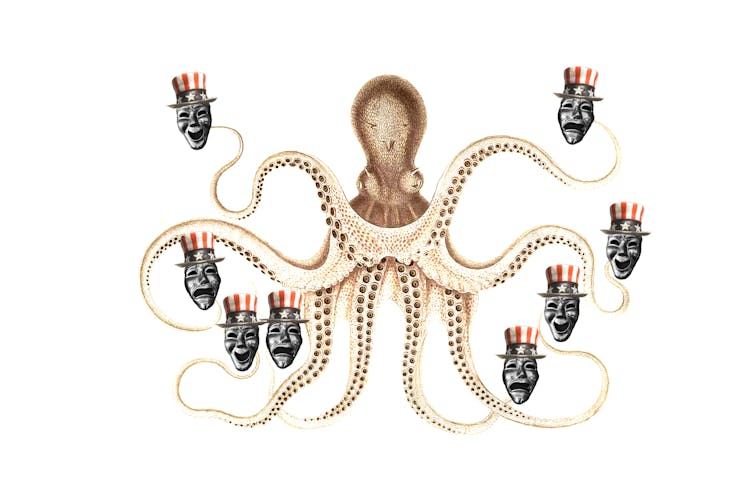
How AI could take over elections–and undermine democracy

An AI-driven political campaign could be all things to all people.
Eric Smalley, TCUS; Biodiversity Heritage Library/Flickr; Taymaz Valley/Flickr, CC BY-ND

Could organizations use artificial intelligence language models such as ChatGPT to induce voters to behave in specific ways?

Sen. Josh Hawley asked OpenAI CEO Sam Altman this question in a May 16, 2023, U.S. Senate hearing on artificial intelligence. Altman replied that he was indeed concerned that some people might use language models to manipulate, persuade and engage in one-on-one interactions with voters.

Altman did not elaborate, but he might have had something like this scenario in mind. Imagine that soon, political technologists develop a machine called Clogger – a political campaign in a black box. Clogger relentlessly pursues just one objective: to maximize the chances that its candidate – the campaign that buys the services of Clogger Inc. – prevails in an election.

While platforms like Facebook, Twitter and YouTube use forms of AI to get users to spend more time on their sites, Clogger’s AI would have a different objective: to change people’s voting behavior.

How Clogger would work

As a political scientist and a legal scholar who study the intersection of technology and democracy, we believe that something like Clogger could use automation to dramatically increase the scale and potentially the effectiveness of behavior manipulation and microtargeting techniques that political campaigns have used since the early 2000s. Just as advertisers use your browsing and social media history to individually target commercial and political ads now, Clogger would pay attention to you – and hundreds of millions of other voters – individually.

It would offer three advances over the current state-of-the-art algorithmic behavior manipulation. First, its language model would generate messages — texts, social media and email, perhaps including images and videos — tailored to you personally. Whereas advertisers strategically place a relatively small number of ads, language models such as ChatGPT can generate countless unique messages for you personally – and millions for others – over the course of a campaign.

Second, Clogger would use a technique called reinforcement learning to generate a succession of messages that become increasingly more likely to change your vote. Reinforcement learning is a machine-learning, trial-and-error approach in which the computer takes actions and gets feedback about which work better in order to learn how to accomplish an objective. Machines that can play Go, Chess and many video games better than any human have used reinforcement learning.

How reinforcement learning works.

Third, over the course of a campaign, Clogger’s messages could evolve in order to take into account your responses to the machine’s prior dispatches and what it has learned about changing others’ minds. Clogger would be able to carry on dynamic “conversations” with you – and millions of other people – over time. Clogger’s messages would be similar to ads that follow you across different websites and social media.

The nature of AI

Three more features – or bugs – are worth noting.

First, the messages that Clogger sends may or may not be political in content. The machine’s only goal is to maximize vote share, and it would likely devise strategies for achieving this goal that no human campaigner would have thought of.

One possibility is sending likely opponent voters information about nonpolitical passions that they have in sports or entertainment to bury the political messaging they receive. Another possibility is sending off-putting messages – for example incontinence advertisements – timed to coincide with opponents’ messaging. And another is manipulating voters’ social media friend groups to give the sense that their social circles support its candidate.

Second, Clogger has no regard for truth. Indeed, it has no way of knowing what is true or false. Language model “hallucinations” are not a problem for this machine because its objective is to change your vote, not to provide accurate information.

Third, because it is a black box type of artificial intelligence, people would have no way to know what strategies it uses.

The field of explainable AI aims to open the black box of many machine-learning models so people can understand how they work.

Clogocracy

If the Republican presidential campaign were to deploy Clogger in 2024, the Democratic campaign would likely be compelled to respond in kind, perhaps with a similar machine. Call it Dogger. If the campaign managers thought that these machines were effective, the presidential contest might well come down to Clogger vs. Dogger, and the winner would be the client of the more effective machine.

Political scientists and pundits would have much to say about why one or the other AI prevailed, but likely no one would really know. The president will have been elected not because his or her policy proposals or political ideas persuaded more Americans, but because he or she had the more effective AI. The content that won the day would have come from an AI focused solely on victory, with no political ideas of its own, rather than from candidates or parties.

In this very important sense, a machine would have won the election rather than a person. The election would no longer be democratic, even though all of the ordinary activities of democracy – the speeches, the ads, the messages, the voting and the counting of votes – will have occurred.

The AI-elected president could then go one of two ways. He or she could use the mantle of election to pursue Republican or Democratic party policies. But because the party ideas may have had little to do with why people voted the way that they did – Clogger and Dogger don’t care about policy views – the president’s actions would not necessarily reflect the will of the voters. Voters would have been manipulated by the AI rather than freely choosing their political leaders and policies.

Another path is for the president to pursue the messages, behaviors and policies that the machine predicts will maximize the chances of reelection. On this path, the president would have no particular platform or agenda beyond maintaining power. The president’s actions, guided by Clogger, would be those most likely to manipulate voters rather than serve their genuine interests or even the president’s own ideology.

Avoiding Clogocracy

It would be possible to avoid AI election manipulation if candidates, campaigns and consultants all forswore the use of such political AI. We believe that is unlikely. If politically effective black boxes were developed, the temptation to use them would be almost irresistible. Indeed, political consultants might well see using these tools as required by their professional responsibility to help their candidates win. And once one candidate uses such an effective tool, the opponents could hardly be expected to resist by disarming unilaterally.

Enhanced privacy protection would help. Clogger would depend on access to vast amounts of personal data in order to target individuals, craft messages tailored to persuade or manipulate them, and track and retarget them over the course of a campaign. Every bit of that information that companies or policymakers deny the machine would make it less effective.

Strong data privacy laws could help steer AI away from being manipulative.

Another solution lies with elections commissions. They could try to ban or severely regulate these machines. There’s a fierce debate about whether such “replicant” speech, even if it’s political in nature, can be regulated. The U.S.’s extreme free speech tradition leads many leading academics to say it cannot.

But there is no reason to automatically extend the First Amendment’s protection to the product of these machines. The nation might well choose to give machines rights, but that should be a decision grounded in the challenges of today, not the misplaced assumption that James Madison’s views in 1789 were intended to apply to AI.

European Union regulators are moving in this direction. Policymakers revised the European Parliament’s draft of its Artificial Intelligence Act to designate “AI systems to influence voters in campaigns” as “high risk” and subject to regulatory scrutiny.

One constitutionally safer, if smaller, step, already adopted in part by European internet regulators and in California, is to prohibit bots from passing themselves off as people. For example, regulation might require that campaign messages come with disclaimers when the content they contain is generated by machines rather than humans.

This would be like the advertising disclaimer requirements – “Paid for by the Sam Jones for Congress Committee” – but modified to reflect its AI origin: “This AI-generated ad was paid for by the Sam Jones for Congress Committee.” A stronger version could require: “This AI-generated message is being sent to you by the Sam Jones for Congress Committee because Clogger has predicted that doing so will increase your chances of voting for Sam Jones by 0.0002%.” At the very least, we believe voters deserve to know when it is a bot speaking to them, and they should know why, as well.

The possibility of a system like Clogger shows that the path toward human collective disempowerment may not require some superhuman artificial general intelligence. It might just require overeager campaigners and consultants who have powerful new tools that can effectively push millions of people’s many buttons.

Learn what you need to know about artificial intelligence by signing up for our newsletter series of four emails delivered over the course of a week. You can read all our stories on generative AI at TheConversation.com.The Conversation

Archon Fung, Professor of Citizenship and Self-Government, Harvard Kennedy School and Lawrence Lessig, Professor of Law and Leadership, Harvard University

This article is republished from The Conversation under a Creative Commons license. Read the original article.
_____________________________
 
Hmmm... looking back nearly a decade (11/16/2013 on this blog):
 

NYeC 2013 Digital Health Conference Day Two

Day two, final day, actually. Wish they could do a 3-day conference. I think there's certainly enough material.

In the Grand Ballroom, A/V actually managed to fire up some overhead fresnel floods, though the above-stage banks of pars remained dark. Lighting was marginally better. Marginally.


NYeC Executive Director David Whitlinger kicks things off, introducing the day's Keynote Speaker, Obama 2012 Re-election Campaign ("OFA") Director Jim Messina.


The air was thick with anticipation: would he address the obvious question surely on all minds -- what about the HealthCare.gov rollout fiasco? We know you're hear to regale us regarding the brilliant Obama 2012 tech smackdown of the hapless Romney-Ryan presidential bid, but how can essentially the same people screw up the PPACA launch so miserably?

He dispensed with it jokingly right up front. He had nothing to do with HealthCare.gov. He would go on to later point out the major problem that is federal procurement. There was no was to simply hand off PPACA HIX to the OFA techies.

Yeah. We know that. But, still, federal procurement is a venerable beast, a long-known quantity. To get blindsided by its HealthCare.gov upshot remains rather inexcusable.

But, not his gig. Not his purpose here.

He did, in fact dazzle us with power of adroitly captured, analyzed, and managed data, and OFA's adept, central use of social media.

Romney-Ryan never knew what hit them. In fact, reports have it that they'd not even prepared concession speeches, so hubristically certain were they of victory on Election Eve. Pride indeed Goeth Before a Fall.


Above, the money shot graph. While Gallup and the other mainstream political media polls showed wildly variable swings in relative Ups/Downs, internal OFA analytics had the President consistently way up. Messina said he told the President, as election day drew nigh, that he was sure that Mr. Obama would be re-elected in an Electoral College blowout, that their finely-tuned Big Data analytics could not be wrong. They could drill right down to the front-door level, precinct by precinct, and capture every available vote. They could ID every Facebook friend and Twitter follower of every Undecided and leverage them for "personal validation" (i.e., you are most amenable to persuasion by your circle of friends).

OFA nailed it. It is a compelling tale. Once NYeC posts the video of Mr. Messina's keynote, I exhort everyone to view it.

What he didn't say, but what had to have been a factor, was a slick Rope-A-Dope element. To mix my metaphors, Romney was playing checkers against a pool shark. The pool parlor hustler always seems to be lucky and just one ball better than you, as he patiently cleans out your wallet (this once happened to me, long ago). OFA was content to work this principle against the poignant Mr. Romney. Fine, let Mrs. Romney measure the White House drapes. Stroke those conceits, actually. Send her the catalogs, gratis… 
____
 
Well, a decade later our data-analytic capabilities are exponentially greater, but the political goals remain the same—win at all costs.
____
 
A bit over 4 years ago I called attention to this:
 

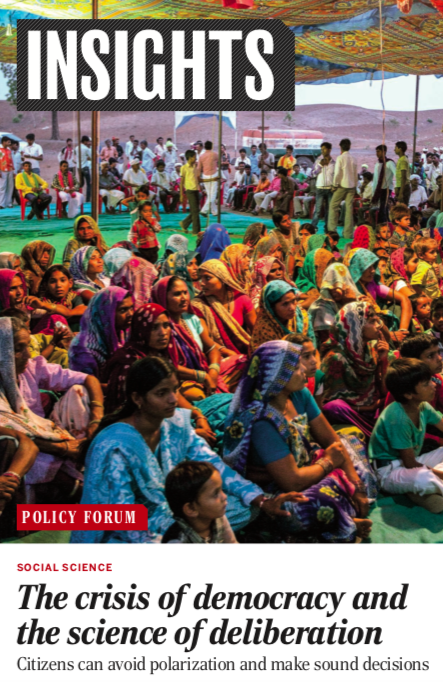
A "Science of Deliberation"?

As regular readers know, I am firmly on the side of science--specifically the "scientific method(s)," warts and all. But, what about "political discourse," which seems more than ever overpopulated with noisy, demagogic fact-averse partisans and ad hominem rhetorical bomb-tossers? After all, the phrase "political science" is unhappily viewed by many as a contradiction in terms.

Interesting piece in Science Magazine (paywalled):

 
Are we making material progress? Sometimes, I have to wonder.

More to come...
__________
 

Tuesday, May 30, 2023

"The Battle for your Brain," continued

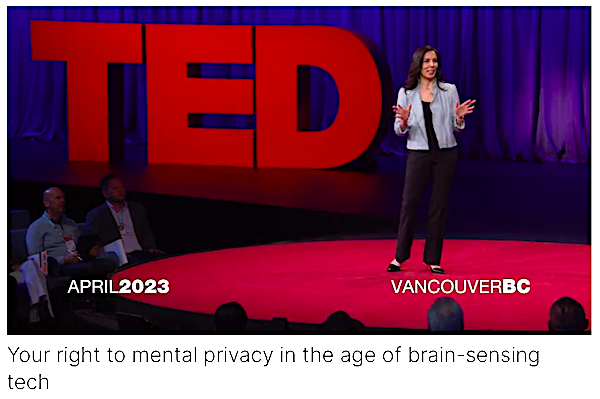
Dr. Nita Farahany
  
Neurotechnology, or devices that let you track your own brain activity, could help you deeply understand your health. But without privacy protections, your innermost thoughts, emotions and desires could be at risk of exploitation, says neurotech and AI ethicist Nita Farahany. She details some of the field's promising potential uses—like tracking and treating diseases from depression to epilepsy—and shares concerns about who collects our brain data and how they plan to use it, ultimately calling for the legal recognition of "cognitive liberty" as we connect our brains and minds to technology.


I've cited her before.

Below: How will this stuff fit in?

The Center for AI Safety (CAIS — pronounced 'case') is a San Francisco-based research and field-building nonprofit. We believe that artificial intelligence (AI) has the potential to profoundly benefit the world, provided that we can develop and use it safely. However, in contrast to the dramatic progress in AI, many basic problems in AI safety have yet to be solved. Our mission is to reduce societal-scale risks associated with AI by conducting safety research, building the field of AI safety researchers, and advocating for safety standards.
Is “artificial intelligence” basically “neurotechnology?” One with silicon microcircuits, standing in for biophysical neurons? Are brains simply “computers?” 
 
Encourage you to in particular study the "8 Examples of AI Risk" pages.

OK, WHAT ABOUT OUR BRAINS?

Leaves me with more questions than answers at this point. I've watched both episodes twice now, and downloaded the transcripts for close study at leisure. Humbled by the cast of participants. Stay tuned...
Your Brain: Perception Deception

PBS Airdate: May 17, 2023

ANIL SETH, PH.D. (University of Sussex): The brain is one of the most complex objects that we know of, in the universe.
NARAYANAN “BOBBY” KASTHURI, M.D., PH.D. (University of Chicago, Argonne National Laboratory): There are 10 times more connections in your brain than there are stars in the Milky Way galaxy. So, we literally walk around with about 10,000 galaxies worth of neuronal connections in one of our brains.
HEATHER BERLIN, PH.D., M.P.H. (Icahn School of Medicine at Mount Sinai): That vast web of connections creates you, but how?
NANCY KANWISHER, PH.D. (Massachusetts Institute of Technology McGovern Institute for Brain Research): Figuring out how the brain implements the mind is a massive challenge.
ANIL SETH: It seems as though the world just pours itself into the mind, through the transparent windows of the eyes and the ears and all our other senses.
HEATHER BERLIN: But is what we see, hear and feel real?
STEPHEN MACKNIK, PH.D (SUNY Downstate Health Sciences University): You might think that the reality outside is actually what you’re perceiving. And the answer is no, it really isn’t…


Your Brain: Who's in Control?

PBS Airdate: May 24, 2023

SUSANA MARTINEZ-CONDE, PH.D. (SUNY Downstate Health Sciences University): The brain is the biggest mystery in science today.
THALIA WHEATLEY, PH.D. (Dartmouth College): It’s responsible for all the facets of our personality, everything we think and everything we feel. It makes you you.
URI MAOZ, PH.D. (Chapman University): A very large fraction of what’s happening in my brain, I am not aware of at all.
HEATHER BERLIN, PH.D., M.D. (Icahn School of Medicine at Mount Sinai): But what exactly is going on in your unconscious brain? What part of your brain is really in charge?
CHARLES LIMB, M.D. (University of California, San Francisco): All day long, we’re doing unscripted things that we didn’t know we would be doing. Life is not scripted…
"LIFE IS NOT SCRIPTED"
 
Stewart Rhodes didn't get The Memo.
__________
 

Monday, May 29, 2023

Memorial Day

 There's nothing "Happy" about it.
  
 
I shot that at the D-Day Cemetery at Omaha Beach, Normandy, France, in 2004. Sobering experience.
 
My Dad and Uncle Warren survived WWII. They were two of the five Gladd brothers who all served, as did my Mother's adult brothers. Pop left a leg behind on Sicily.
 
Below, a quick montage I did, using some music scored by my friend composer Nathan Tanouye.
 
__________
 

Saturday, May 27, 2023

The Dyskinesiac's Diary

Is this my future?
 
  
Groan...

Funny New Yorker cartoon. Yeah, 4 1/2 years after being diagnosed with Parkinson’s, I am exhibiting symptoms of dyskinesia. Relatively minor in my case thus far, but, annoying nonetheless. Messes with my guitar playing.
__________
 

Friday, May 26, 2023

#ElmerStewartMandela

 Who also thinks he's the U.S. Solzhenitsyn.
 
Mr. Multiple Personalities, Legend-in-His-Own-Minds, playtriot Elmer Stewart Rhodes. Guilty of Seditious Conspiracy. Sentenced to 18 years.

Producer, Director, Star, and Victim in his own Epic Theatrical Release.
__________
 

Wednesday, May 24, 2023

Interesting update in the wake of the Shadow Docket post.

AAAS Editorial: Don't let the Court disrupt science.
It is widely expected that by this summer, the United States Supreme Court will overturn long-standing precedents allowing the consideration of race as one factor among many in university admissions. The current legal regime goes back to the Court’s decision (Regents of University of California v. Bakke) in 1978 that banned racial quotas while allowing consideration of race for the purpose of creating a diverse educational environment. Although the law has evolved since then, almost all universities have relied on the Bakke framework to support their strategies to educate a diverse citizenry. If the Court upends those practices, the implications for the scientific enterprise will be far-reaching. It is essential that the process of science continue to become more diverse, equitable, and inclusive. Studies show that the best science is done when teams are diverse. Moreover, the very questions scientists address can change substantially when those scientists come from a variety of racial, ethnic, and other backgrounds.

The upcoming decisions are likely to be disruptive in ways that go far beyond admission practices. Many observers expect the Court to issue a broad ruling that affects student benefits more generally. For example, the Court could prohibit the consideration of race in conferral of scholarships or participation in mentoring, enrichment, or bridge programs—all approaches known to be successful in broadening participation in science. And even if the ruling is a narrow one, the prospect of subsequent lawsuits and confusion about new restrictions likely will have a chilling effect on existing efforts to advance diversity in science. Race-neutral considerations such as socioeconomic status, although important, are insufficient to redress racial inequities. The impact of racism goes well beyond economics.

In response to this new legal environment, it will be critical to continue, within the law, to uphold commitments to diversity in science. The Diversity and the Law project of AAAS (the American Association for the Advancement of Science, the publisher of Science) has developed useful legal guidance, which will be updated in the wake of the rulings. But the scientific community must acknowledge that the programs under pressure from the Court are precisely those designed to help individual students access higher education and succeed in an unwelcoming, sometimes hostile, scientific culture...
 
The upcoming ruling should be a clarion call to improve the scientific environment itself. The need for systemic cultural change was emphasized earlier this year by the US National Academies report, “Advancing Antiracism, Diversity, Equity, and Inclusion in STEMM Organizations: Beyond Broadening Participation.” Its message is that unless the practice of science becomes more equitable and inclusive, efforts to bring more underrepresented scientists into the field are doomed to founder...
 
Reforming the culture of science to be more equitable and inclusive is a key priority of the Alfred P. Sloan Foundation and many of our peers. We are making deep investments in graduate education and the professoriate, seeking institutional partners who are already committed to this transformation. The overwhelming response we have seen shows that many scientists are eager for an environment that is more diverse, equitable, and inclusive...

—Adam Falk & Lorelle Espinosa

Lordy. Far-right Florida governor and GOP 2024 POTUS candidate Ron Desantis, recall, recently signed legislation outlawing DEI ("Diversity, Equity, & Inclusion") initiatives in state universities and colleges. Per The NY Times:
Gov. Ron DeSantis signed legislation on Monday that largely banned Florida’s public universities and colleges from spending money on diversity, equity and inclusion initiatives and imposed other measures that could reshape higher education at state schools...
Breaking Reports also have it that the Governor is issuing an Executive Order banning ACTUAL meteorological rainbows from his Sunshine State.

SERIOUSLY?

No, DEI efforts are not "Treasonous Soros-Funded Woke Marxist Plots to Turn All of Our Children Into Gender Dysphoric LGBTQ+ Radicals," irrespective of what the delusional likes of Marjorie Taylor Greene claim.

 FROM PRAVDA USA, a.k.a. FORBES

Diversity, equity and inclusion have become critical components of business success. While these concepts are often viewed through the lens of social justice and morality, there is also a compelling business case for promoting diversity and creating a culture of inclusion in the workplace. From attracting top talent to fostering a more collaborative and creative workplace, the benefits of DEI are clear…
Wealthy entrepreneur GOP Primary ankle-biter candidate Vivek Ramaswamy didn't get the Memo. I will not dignify him with a link. Suffice it to observe that everything he doesn't like is a "Cult"—inclusive of DEI. Mr. Meritocracy Uber Alles.
 
THE SCIENCE EDITOR'S BLOG
Scientific research is a social process that occurs over time with many minds contributing. But the public has been taught that scientific insight occurs when old white guys with facial hair get hit on the head with an apple or go running out of bathtubs shouting “Eureka!” That’s not how it works, and it never has been. Rather, scientists work in teams, and those teams share findings with other scientists who often disagree, and then make more refinements. Then those findings are placed in the scientific record for even more scientists to examine and produce further adjustments. Eventually, theories become knowledge. All along the way, these scientists are conspicuously and magnificently human—with all the assets and flaws that humans possess. And that means that who those individuals are, and the backgrounds they bring to their work, have a profound influence on the quality of the end result.

 It has somehow become a controversial idea to acknowledge that scientists are actual people. For some, the notion that scientists are subject to human error and frailty weakens science in the public eye. But scientists shouldn’t be afraid to acknowledge their humanity. Individual scientists are always going to make a mistake eventually, and the objective truth that they claim to be espousing is always going to be revised. When this happens, the public understandably loses trust. The solution to this problem is doing the hard work of explaining how scientific consensus is reached—and that this process corrects for the human errors in the long run.

A raging debate has set in over whether the backgrounds and identities of scientists change the outcomes of research. One view is that objective truth is absolute and therefore not subject to human influences. “The science speaks for itself” is usually the mantra in this camp. But the history and philosophy of science argue strongly to the contrary…
Sorry, DEI Deniers. The Defense Rests, Your Honor.
 
OFF-TOPIC ERRATUM
Rest in Peace.
__________